Once I was a clever boy learning the arts of Oxford... is a quotation from the verses written by Bishop Richard Fleming (c.1385-1431) for his tomb in Lincoln Cathedral. Fleming, the founder of Lincoln College in Oxford, is the subject of my research for a D. Phil., and, like me, a son of the West Riding. I have remarked in the past that I have a deeply meaningful on-going relationship with a dead fifteenth century bishop... it was Fleming who, in effect, enabled me to come to Oxford and to learn its arts, and for that I am immensely grateful.


Showing posts with label Richard Fleming. Show all posts

Friday, 6 January 2017

Surge illuminare


" Surge illuminare"  - Rise your light has come [Isaiah 60 v.1] - is a text traditionally used at the feast of the Epiphany and provided the text for the first sermon preached by Richard Fleming as a member of the English delegation before the Council of Constance on this day seven centuries ago in 1417.

council of constance


Meeting of scholars, bishops, cardinals and Pope John XXIII (antipope) in the cathedral of Constance i.e. before John's deposition in May 1415.


Image:indianapublicmedia.org/Fb78 (wikipedia)

Chronicle of the Council of Constance [1414-1418] by Ulrich Riechental, Fol. 007r, c.1470s

A procession of clergy and religious at the Council of Constance
From the Chronicle of Ulrich von Reichental ( MS of c.1470)

Image: Pinterest


At that stage in the Council celebrating the liturgy and listening to sermons whilst they manoevered behind the scenes appears to have been th emain occupation of the Council Fathers. For Fleming this was his first, but by no means his last as a preacher in the cathedral. 

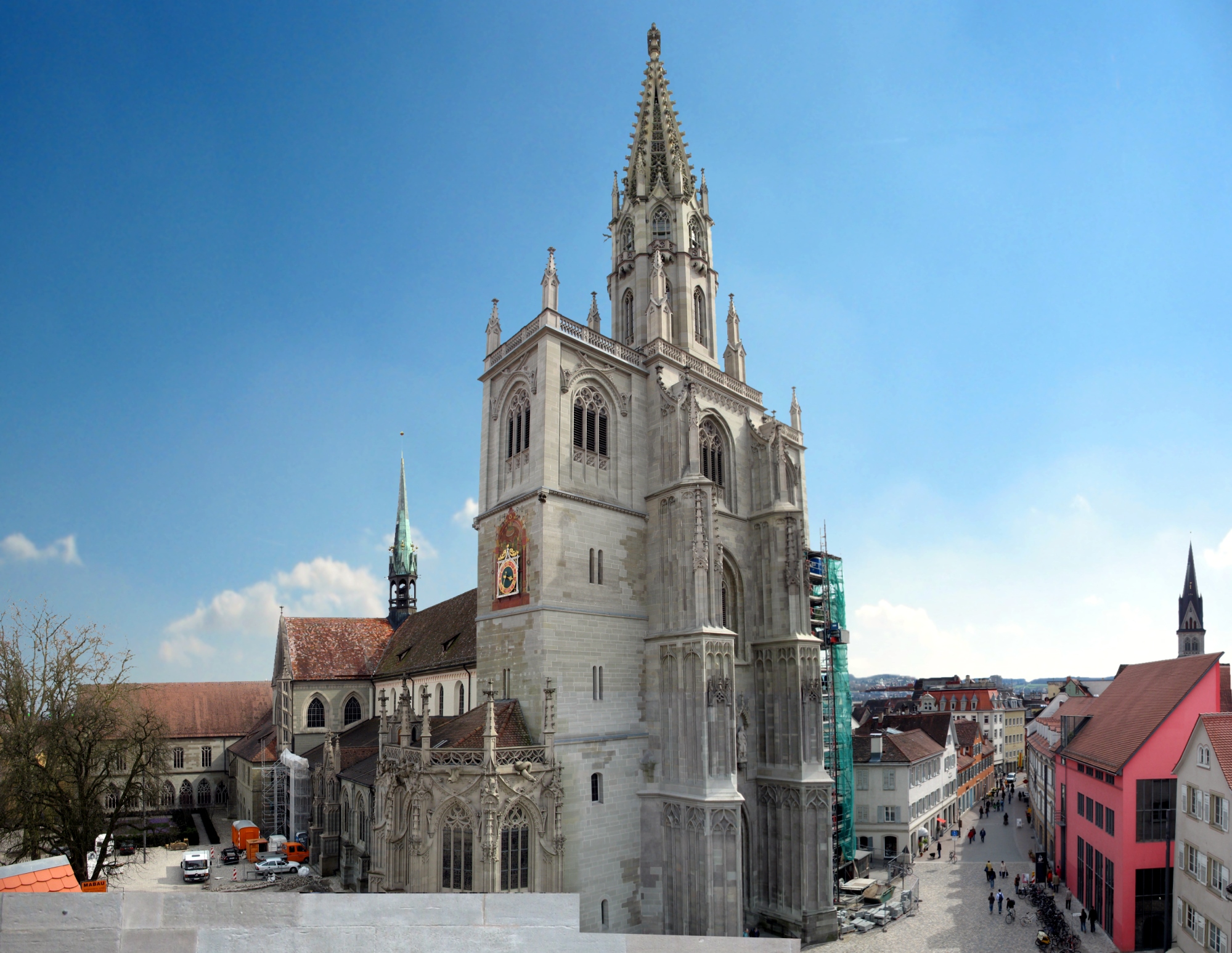
There is an account of the building in which the Council met and of its subsequent development and history at Konstanz Minster

The romanesque nave with its pillars of the basilica was built between 1052 and 1089, is the core  of the cathedral. Over the centuries the cathedral was altered and enhanced. In 1435, the side aisles of the nave were vaulted, followed by the main nave in 1680. In the baroque era, the middle choir was plastered and gilded. In 1856 the western Gothic tower pyramid was built.


 The interior of the cathedral today

Image:stanford.edu 


The west front of Constance Cathedral before the restoration of 1856

Image: Godzdogz 

 https://upload.wikimedia.org/wikipedia/commons/e/ef/MPano_07.jpg

The cathedral today

Image: Wikipedia

Wednesday, 19 February 2014

Archbishop Thomas Arundel


Today is the 600th anniversary of the death of Archbishop Thomas Arundel of Canterbury.


  Thomas Arundel (1353–1414) illuminated initial

Archbishop Thomas Arundel
The Archbishop is surrounded by monks of the cathedral priory at Canterbury or members of his archiepiscopal household.
Image: oxforddnb.com


Born in 1352 he studied at Oxford, and lived in Oriel, where he and his father, the Earl of Arundel, built the college chapel as an expression of their thanks. Leaving Oxford he was appointed in 1373 as Bishop of Ely at 21 - his youthfulness led the Pope to comment about him being the youngest episcopal appointment he was aware of - then, in 1388, Archbishop of York. He served as Lord Chancellor and was a significant political figure in the 1390s, until his translation to Canterbury in 1396, exile the following year and return with Henry of Lancaster in 1399, serving again as Chancellor twice under King Henry IV.

An aristocrat to his fingertips he was also able and conscientious as an administrator, and was to prove a resolute defender of the Catholic Church against Lollardy. His death was as a conseqence of a stroke which might have been triggered by his exertions in the preceding weeks in suppressing the Lollard Rising of 1414.

In late 1408 he had caustic things to say about the subject of my research, Richard Fleming and his associates in Oxford whom the Archbishop saw as supporting Lollardy even if only by resisting his authority to visit the University to root out the problem at its source.

The Oxford DNB life of Arundel by Jonathan Hughes can be read here. The 1885 DNB life by James Gairdner can be read at Thomas Arundel, Archbishop of Canterbury and there is another online biographical account, with links to other sites, at Thomas Arundel.

His formal constitutions against the Lollards issued in1408 can be read in translation at Archbishop Thomas Arundel's Constitutions against the Lollards.


The nave of Canterbury Cathedral, completed under Archbishop Arundel about 1405.
His tomb was in the third bay from the east on the north side, just in front of the present pulpit, until it was destroyed by Cranmer in 1540.

Image:paradoxplace.com


The tomb of King Henry IV and Queen Joanna in Canterbury Cathedral.
Archbishop Arundel helped place the King in power and crowned him in 1399, and served him as Chancellor and advisor for much of his reign.

Image:paradoxplace.com

Wednesday, 25 January 2012

Obit of Bishop Richard Fleming


Today is the obit of Bishop Richard Fleming - he died on January 25th 1431 at about two hours after noon aged about 45 and had apparently suffered an apoplectic stroke - and as he is the subject of my research, and indeed who gave the title to this blog, someone to whom I feel a close attachment.

Here are two pictures of his tomb in the Angel choir of Lincoln cathedral:


http://www.knowledgerush.com/wiki_image/c/c7/Flemtomb.JPG

The tomb and its canopy

Image: knowledgerush.com

http://www.lincolnshireguide.net/images/cc-lincoln-cathedral-tomb-of-bishop-fleming-dave-hitchborne.jpg

The tomb chest enclosing the cadaver effigy

Image: lincolnshireguide.net

As I wrote last year on this anniversary day one thing I believe I have established in my research is that the tomb as it now appears is not quite how it was designed, and that it has been altered in well-intentioned but inaccurate restoration as well as losing the top finials of the canopy.

Please join with me in praying for the repose of the soul of Bishop Fleming and perhaps also spare a thought for me that I can successfully complete my research into his life.

Wednesday, 9 February 2011

Cardinal coincidence

Yesterday afternoon, having nothing better to do whilst acting as a volunteer porter at the Oxford Oratory I started reading Walter Brandmüller's Light and Shadows: Church History and Faith, Fact and Legend (Ignatius Press, 2009) . This is a collection of essays and addresses by the former President of the Pontifical Committee for Historical Sciences, who was created a Cardinal in the most recent Consistory.

large image

All of the ones I have so far read are elegant essays touching on such central issues as the papal primacy, and the ability of the Church to renew itself, often against seemingly massive odds. I particularly enjoyed an essay about the date of Our Lord's birth, which argued that a traditional dating is the most likely, and sweeping away the not-infrequently expressed 'historical' doubts. The work of an Eminent historian indeed, and which I would recommend to anyone interested in the interaction of historical scholarship and the life of the Church.

I met the author some years ago when he visited Oxford and delivered a seminar at All Souls. As he specialises in the Conciliar epoch of the early fifteenth century my supervisor introduced us, and the then Mgr Brandmüller expressed interest in my work on Richard Fleming, who attended the Councils of Constance in 1416-18 and Pavia-Siena in 1424.

Later on yesterday I looked at the New Liturgical Movement and found this link to pictures of a Mass celebrated by Cardinal Brandmüller in the Extraordinary Form on Sunday 6 February, for the Franciscans of the Immaculate at Campocavallo di Osimo. The Deacon was Fr Uwe Michael Lang C.O., author of Turning to the Lord, whom I know from his time in Oxford, and from hearing him lecture both here and in London. Here is one of the photographs from the post:


Tuesday, 25 January 2011

The death of Bishop Richard Fleming


According to his episcopal register Richard Fleming, Bishop of Lincoln, died at about two hours after noon on January 25th 1431 in his castle at Sleaford in Lincolnshire. He was about 45, and had suffered a stroke.

As he is the subject of my thesis research I always commemorate Bishop Fleming on his anniversary.

Virtually nothing now remains of Sleaford castle other than earthworks and one piece of stonework on the site, which lies on the south western edge of the town.


All that now remains of Sleaford castle is one small, toppled portion of a wall in the north-east corner of the inner bailey.

Photo: Eric Dewhurst


There are articles about the castle and its history here, and here, and here.

I have taken this reconstruction drawing from amongst the illustrations on the last of these sites:


Following his death the bishop's body was buried in his cathedral in Lincoln, where his cadaver or transi tomb can still be seen.

photo

The tomb of Bishop Richard Fleming in the Angel Choir of Lincoln Cathedral

Photo by Gordon Plumb on Flickr


I believe that I have shown in my research that not only has the appearance of the tomb been changed in more recent centuries but also that as a result its place in the history of English, and European funerary monuments has been misunderstood.


Wednesday, 17 November 2010

St Hugh of Lincoln


Today is the feast of St Hugh of Lincoln, Carthusian saint and Bishop of Lincoln 1186-1200. There is a biography here.


Saint Hugh of Lincoln with his swan,
Altarpiece from the Carthusian monastery of Saint-Honoré, Thuison, near Abbeville, France, ca 1490-1500
Art Institute of Chicago


St Hugh's holds one of his attributes, the Christ Child rising from the chalice, alluding to a vision he had. There are other recorded examples of such visions at his time, suggesting a concern for the reality of the Real Presence and Transubstantiation.

His other, better known attribute is the swan. This was a fierce swan which lived at the episcopal manor at Stow in Lindsey but which was a docile pet to the saint, followed him around and watched over him when he was asleep.

St Hugh's stole is preserved at the Carthusian house at Parkminster in Sussex. It was on display at Lincoln in 1986 as part of the octocentenary celebrations. His body is thought to still lie somewhere within the cathedral at Lincoln, where a curious bronze superstructure has been added in recent years to the remains of the base of the shrine of St Hugh's Head in the Angel Choir.

St Hugh was the principal saint of Lincoln cathedral and seen as role model for his successors. This can be seen in their referenc eto him bu adding his arms to their monuments in the cathedral. In the case of Bishop Fleming - "my bishop" - the fact that Fleming developed close links with the Carthusian order whilst Bishop of Lincoln, and that John Stone, the Carthusian of Sheen when he wrote his Metrificatio around Fleming's own tomb verses went so far as to ascribe Fleming's failure to be translated to the see of York in 1424-5 as being due to the intervention of St Hugh.

Monday, 25 October 2010

Agincourt


I think I cannot, as a historian of the period, let the anniversary of the battle of Agincourt pass without some comment

Portrait of Henry V

King Henry V
from a contemporary portrait


Signature of HENRY V, King of England
Images from Wikipedia

Although in the long term - though what that term ever means is open for discussion - one can say it achieved little by comparison with Hastings or Bouvines, Blenheim or perhaps Waterloo, in its owm time it had a seemingly seismic impact. The English appear to have been dazed by what they had achieved, just as the Frebch gradually realized just how significant was their defeat. Internationally it transformed the english position in Europe, notably at the Council of Constance, whither went Richard Fleming about a year later.

King Henry V's victories in 1415, from 1417 -20, the Treaty of Troyes of 1420 and the victory of his brother John Duke of Bedford at Verneuil in 1424 changed the international political outlook for a generation. Moreover, and despite what historians of the sixteenth century might try to tell you, not until 1704, 280 year later, at Blenheim, did English arms win a major land victory on the continent.

Indeed not since Najera in 1367 had there been a significant land victory, so the celebrations which greeted King Henry in London in November 1415 are not surprising. Moreover it appear that from the time that the news reached London of Agincourt the battle entered the national conciousness. Almost two centuries later Shapkespeare created the defining image and words, but he was dealing with what was already part of the national identity.

Wednesday, 6 October 2010

Carthusian thoughts

Today being the feast of St Bruno is an opportunity to reflect upon the Carthusian order and its history. I was very struck when I read John Cassian by the way in which his description of early Egyptian monasticism is like the Carthusian model. This point is one that I had not seen brought out properly in more general books on medieval monasticism, and shows the influence of Cassian in the eleventh century - indeed is a reminder of his importance as a writer on monastic life for over a millenium.

More particularly my thoughts turn to that great flowering of Carthusian life in late medieval England and Europe. On several occasions I have visited the remains of Mount Grace Priory - or to give it its proper title that of the Assumption of Our Lady and St Nicholas of Mount Grace of Ingelby - and it is a moving and fascinating place to experience. Recent scholarship has shown how important it was in disseminating devotional texts in the fifteenth and early sixteenth centuries.


Mount Grace Priory

There is a good introduction to the priory here. After the dissolution the little chapel on the hill above the ruins remained as a recusant centre and has now been restored as a place of pilgrimage.

Mount Grace is the best preserved of the houses, but Beauvale in Nottinghamshire is an interesting ruin. The remains are now part of a farm and there are plans announced in 2009, to open it to the public. When I visited it in 1999 we had to view it from the road, but even from several hundred yards it is striking. There is an account of the priory here,and a series of articles from 1908 with other illustrations here, which is also well worth looking at. Both St John Houghton and St Robert Lawrence, two of the Carthusian martyrs of 1535, had served as Priors of Beauvale.

My particular interest in visiting the site, over and beyond my usual historical curiosity, was the fact that Bishop Fleming made at least two viists to stay at the Priory in the 1420s. He seems to have acted as an unofficial protector of the Carthusian order in England - perhaps inspired by the fact of being the latest sucessor of the Carthusian Saint Hugh (d.1200) at Lincoln. In 1428 Fleming is recorded as having consecrated the new bell of the London Charterhouse, where some parts of the monastic buildings survive in the current complex.


The ruins of Beauvale Priory in 2007

Wednesday, 8 September 2010

Our Lady of Lincoln

Today being the feast of the Nativity of Our Lady seems an appropriate day on which to post a view of one of the greatest churches built to her honour, the cathedral at Lincoln. Although I do not subscribe to the urge to list or decide which is the best amongst cathedrals or other works of art, I do consider Lincoln to be in many respects ina class of its own amongst English cathedrals, or indeed European ones.
This image is from the Churchmouse site about the cathedral, and is one of my favourite images of one of my favourite buildings.

Lincoln Cathedral (before 1808), Watercolour by Augustus Charles Pugin (1762-1832). Whitworth Art Gallery, University of Manchester.


Lincoln Cathedral

Watercolour by Augustus Charles Pugin (1762-1832)
Whitworth Art Gallery, University of Manchester.


The painting, by the father of the great architect, shows the cathedral before the removal of the spires on the western towers in 1807.

It appears likely that the towers and their spires were being completed about the time of the episcopate of Bishop Richard Fleming, which adds to the interest of the picture for me. However its real attraction is less academic - I simply think it is a beautiful painting of a beautiful building - itself one of the truly great works of medieval man. I regret, of course, that I cannot myself see the cathedral complete with its spires, but thanks to A.C.Pugin I can more easily envisage it. As a painting it captures an ethereal quality about the cathedral which I find particularly attractive. It is very much a case of dreaming spires and the last enchantments of the middle ages.

Monday, 23 August 2010

Episcopal consecration by the Pope


Whilst preparing my post last Saturday on Pope Pius X I found this photograph in the Wikipedia biography of the Pope.


Pope Pius X consecrates Giacomo Paolo Giovanni Battista della Chiesa, the future Pope Benedict XV, as a Bishop in the Vatican in 1907.

Quite apart from its intrinsic interest this photograph took my eye as Richard Fleming was also consecrated as a bishop by the then Pope, Martin V, in 1420 when the curia was in Florence. The consecration probably took place somewhere in the Dominican house of Sta Maria Novella. Such consecrations did not always take place in a church or chapel - I have seen at least one reference to a room in the Vatican palace being fitted up as a temporary chapel for such a consecration in the early sixteenth century. Following the consecration Fleming can be seen to have received various papal grants on behalf of his family and friends.

In the verses he wrote for his tomb he specifically referred to having been consecrated by the Pope himself and the wonderful piety the Holy Father had displayed.

Although the setting and vestments would have been somewhat different - fashions do, after all, change - photographs such as this are a reminder of the continuity of liturgical tradition and practice, and help one to envisage Fleming's consecration.

Wednesday, 11 August 2010

St Bede's reception

Last night I was at St Bede's Hall here in Oxford for a reception to welcome back to Oxford, at least temporarily, and to his new position at St Bede's as chairman of the Board of Directors, Fr Tom Weinandy O.F.M.

The event was an occasion for old and new friends and associates of St Bede's to meet, or to renew acquaintance. Fr Tom spoke about the vision for the Hall and welcomed overseas contacts from the North American College in Rome and from Belmont College in the USA.

I also spoke to Fr Mark Elvins, the Guardian, about the Centre for Franciscan Studies the Oxford Greyfriars are seeking to develop, including some excellent lectures this last academic year.

I was delighted to meet again Prof. James Carley from Toronto, whose work on the Arthurian legend, and particularly in relation to Glastonbury, I have used in connection with my research on Richard Fleming. Prof. Carley is in Oxford as a visiting scholar for the coming year.

There was a positive spirit to the occasion which should auger well for the students planning on coming to study at St Bede's in the future.

Friday, 6 August 2010

Cardinal Beaufort


In connection with the feast of St Oswald yesterday one of the contributors to the Medieval religion discussion group, the Rev. Gordon Plumb, who takes fine photographs of stained glass, submitted some images from the St Cuthbert window in York Minster. The window, dating from the 1440s, lights the non-projecting south-east choir transept, and with its pair on the north, illustrating the story of St William of York, was designed to illuminate the original site of the high altar of the Minster - it is now situated a bay to the east in what was once the shrine chapel of St William. There is an article about the window here.

Amongst the details Gordon Plumb illustrates is a figure of Cardinal Henry Beaufort, born 1374/5, one of the illegitimate children of John of Gaunt, Duke of Lancaster and Katherine Swynford, who was legitimised following their marriage in 1396, made Bishop of Lincoln in 1398 and translated to Winchester in 1405. He was offered a Cardinal's hat by Pope Martin V in 1417-18, but forced to decline it by King Henry V. It was not until a decade later that he was able to accept the honour, and he can be seen with it in the picture. He died in 1447.

He appears to have been a patron of Richard Fleming, who both became Bishop of Lincoln, like Beaufort, and was a contender to succeed him at Winchester in 1419, when Henry V offered his uncle the choice of retaining Winchester or the red hat - and, in effect, exile. That, due to the course of the war in France, did not come to pass.

The panels at the base of the window are difficult to see when in the Minster because of the height of the wall and the angle and I had not seen a photograph of this panel before, and due to my interest in the subject thought I would share it.


photo

York Minster, sVII, 1b-2b, Cardinal Beaufort of Winchester


Thursday, 15 July 2010

St Bonaventure in Yorkshire?

Today is the feast of St Bonaventure, or to give him his actual name rather than a nickname, John (Giovanni) of Fidanza. Quite apart from his insights as a Doctor of the Church, which are eloquent, the Seraphic Doctor interests me for two more particular reasons.

The first is that an understanding of his mystical theology is, I believe, a great help in understanding the theology of "my" Bishop, Richard Fleming. I am not saying that Bonaventure's work influenced Fleming directly, rather that they arrived at similar views. Fleming's literary remains are not comparable to the collected works of a figure like Bonaventure, but they are in the same essential tradition.

The second point of interest is that both were Papally provided to the see of York, but never secured it. In the case of Fleming politics, both secular and ecclesiastical, played the crucial part on frustrating the plan - but that is another, and very long, as well as very interesting, story.

The fact that John of Fidanza does not figure on the list of Archbishops of York is one that I have never seen fully explored - is it one of those topics I might look at if I ever have time? We'll see. I must look it up in the appropriate authors. The following are a few thoughts off the top of my head.

Essentially John/Bonaventure is said to have declined it through humility, but then he went on to become Cardinal Bishop of Albano.

The death in 1265 of Archbishop Godfrey Ludham left the see vacant. the Chapter elected the Dean to succeed him, but as so often in such cases the Dean's election was quashed by the Pope, Clement IV, and Bonaventure provided in November of that year. It was not until October 1266 that Bonaventure renounced the appointment, which went to Walter Gifford, Bishop of Bath and Wells.

Given the situation in England - 1265 had seen the battle of Evesham and the defeat and death of Simon de Montfort, and in 1266 the siege of Kenilworth was being concluded with the Dictum, it looks as if filling the see of York either got entangled in politics or simply was neglected as far as the government was concerned. Was the appointment of the Seraphic Doctor an example of Clement IV seeking to extend Papal powers in a political vacuum, and also of providing (in both senses) for the appointment of a distinguished theologian? Given that non-native appointees in bishoprics had been an issue in the recent problems between King Henry III and many of his magnates, this was venturing on delicate ground.

Whatever the English context I wonder if Bonaventure would have really wanted to transfer himself to England and the responsibilities of being Archbishop of York. That is, of course, assuming that he might have been resident rather than an absentee. As it was York missed out on having another saint-archbishop, and Bonaventure missed out on the delights or otherwise of dealing with the chapters of York and the three pro-cathedrals of Beverley, Ripon and Southwell, the administration of a huge diocese and a province with, in whoever was Bishop of Durham, a very independent minded principal suffragan, let alone administering the palatine lordship of Hexhamshire. What would the seraphic Doctor and the people of his diocese made of each other? One of those curious might-have-beens of history.

Thursday, 17 June 2010

Charles Waterton


The Lion And The Cardinal, always a wonderful source of visual images, had this rather splendid piece on Charles Waterton on June 9th, and I have ventured to copy and comment on it, as I have several reasons to be interested in this remarkable and endearing nineteenth century naturalist and pioneer concervationist.

First of all he was from Wakefield, my home area. Secondly I might have been born in what had been his home, Walton Hall on the outskirts of the city and which was used in the years before my birth as a maternity hospital as it was I was born in another hospital on the site of the battle of Wakefield - which may, conceivably, explain in some way my late-medieval interests.

Thirdly Waterton was descended from Robert Waterton (d.1425) and his second wife, Cicely, the sister of Bishop Richard Fleming, so he ties in with my thesis, however remotely - though I doubt if he will make it to more than a footnote.

Fourthly Waterton was a Catholic of recusant stock; his son, Edmund, wrote the earliest, or one of the earliest studies of English medieval devotion to Our Lady - a piece valuable in itself and a part of that process whereby historians have helped recover the Catholic life of pre-Reformation England.

Fifthly he played, I suspect, a small part in my conversion. Sometime after I came to Oxford I came across a copy of the modern biography of Waterton, and remember sitting in Oriel MCR reading about Waterton's funeral in 1865, and being struck by the way the Mass was conceived by Waterton and his family as a Thing of itself, something that stands in its own right as the act of propitiation and salvation. Though not a new idea to me as an Anglo-Catholic, I do recall the impact the way the concept was presented had on my mind, and I suspect confirmed and encouraged all those right instincts which eventually brought me to be in the same Communion as Charles Waterton.


Chelonian Research Institute:
The Victorian period was also a time of profound and cultivated eccentricity. For example, the English explorer Charles Waterton (1782-1865), a passionate aristocratic Catholic in a Protestant-dominated society, who sported a short crewcut in a society of Victorian hirsute extravagance, had his home in Yorkshire made into a museum with such exhibits as The English Reformation Zoologically Demonstrated, in which preserved reptiles were contorted into caricatures of famous Protestants. Waterton's idiosyncrasies were so profound and far-reaching as to border on actual insanity. But his was a fine madness - a creative and extraordinarily frolicsome spirit combined with genuine originality, true religious faith, a decidedly experimental approach to problem-solving, and a great capacity for affection, sympathy and passionate love. Perhaps it all had something to do with his ancestry - his documented ancestors included seven saints (Vladimir the Great; Anne of Russia; the Holy Martyrs Boris and Gleb; King Stephen of Hungary; Queen Margaret of Scotland; and Mathilde of Germany, not counting Sir Thomas More, executed in 1535, who was not canonized until 1935; nor Count Humbert III of Savoy, King Ferdinand III of Castile and Louis IX of France, whose relationships with Waterton hinge upon an alleged 15th-century marriage), and four historical individuals portrayed in the plays of Shakespeare.

Certainly, it seems that only England could have produced a Waterton. The Squire, as he was always called, set up a nature reserve, mainly for waterfowl, on his estate near Wakefield, and experimented extensively with jumping foxes to determine how high the walls should be to exclude these predators (the answer was nine feet). Having fallen off a ladder while climbing a tree when he was in his seventies, he concluded with his own peculiar logic that ladders were dangerous and he should thenceforth climb trees without them. And when his doctor told him to place his injured foot under running water, Waterton, on tour in America at the time, travelled to Niagara and stuck the limb in question under the famous falls, on the theory that, if one pill is good, two will be better.

And most touching of all was his marriage. Waterton was in the habit of travelling to Demerara (now part of Guyana) every few years, and it was on one of these trips that he attended the Baptism of a beautiful baby, the daughter of an Arawak princess (and fathered by an English colleague of his by the name of Charles Edmonstone). He fell in love with the infant, checked on her growth and progress in the course of periodic subsequent trips to Demerara, and finally, when she was seventeen, he took her to England and married her. The bride, despite her extreme youth, proved to be a dignified and respected lady of the manor, but tragically she died in childbirth just one year later. Waterton was so devastated that he actually slept on the floor every night for the rest of his life, with just a thin blanket and a wooden block for a pillow. His rationale was a serious one of self-penance; he felt responsible for her death from puerpural sepsis, attributing it to bacteria from dead specimens that he handled and kept in the house, and he earnestly wanted to earn the privilege of being re-united with her in Heaven. But his public statement about his new sleeping habits was, as ever, a joke. He explained that, at least when travelling, you never knew who had been the last user of a bed that was offered. While it could conceivably have been some lovely form divine like his late wife, it is just as likely to have been some horrid alderman... a rough-skinned, pimpled victim to turtle soup and Curacao (the liqueur, not the island).

Waterton's playful side inevitably intruded into his role as Museum Director, and he was responsible for producing not only the famous gallery of distorted Protestant reptiles, but also for a weird specimen, laboriously fashioned from the backside of a hirsute howler monkey into a somewhat humanoid countenance, that he dubbed The Nondescript. But more seriously, he developed a methodology for dry preservation and mounting of vertebrates that involved complete removal of the skeleton, muscles and viscera, stiffening and preservation of the integument with corrosive sublimate, and artistic replication and coloring of features likely to prove unstable if not so treated. The specimens are still in the Wakefield Museum, marvelously intact, and bearing mute testimony to the excellence of the Walton Technique.
Sally Shelton:
He abhorred scientific nomenclature, John James Audubon (whom he called a charlatan), Protestants, Hanoverians, Hanoverian Protestants, rats (the presence of which in England he blamed on the Hanoverian Protestants), and, late in life, Charles Darwin; he loved the natural world, birds, taxidermy, and practical jokes.
More information about Waterton from the Catholic Encyclopaedia is here, and about his books and biographies of him here, and here.


Taxidermic caricature of Martin Luther


The Nondescript


John Bull and the National Debt


Thursday, 20 May 2010

St Bernardine


Today is the feast of St Bernardine (or Bernardino) of Siena (1380-1444), the Franciscan preacher who promoted devotion to the Holy Name of Jesus. There is more about him here and here.

I became more aware of him as a result of my reading about the world in which Bishop Fleming moved - indeed it is not impossible that their paths crossed when Fleming as in Italy in 1418-20 and 1423-24.

In some ways his preaching and call to conversion made him not unlke St Philip Neri - indeed both represent a tradition to be found in medieval and early modern Italy that had fewer representitives in England - and then they were usually heretic, Lollard preachers or their successors.

His promotion of the Name of Jesus either inspired or was part of a devotion which certainly spread to England by the late fifteenth century. Thus Archbishop Thomas Scott or Rotherham founded the Jesus College in the church of his native town of Rotherham at that time.

Here in Oxford one of the devotional images Bernardine used as visual aids and which he used to distribute - an IHS in a sunburst of rays - survives in the Oratory collection of relics, whilst at the Christ Church Gallery one of my favourite paintings is one by Sano di Pietro of Our Lady and the Christ Child surrounded with saints, including Bernardine and Catherine of Siena. Although at first sight it would appear that this must date from after Bernardine's canonisation in 1450, as he is shown with a halo, upon close examination it can be seen that the halo is slightly smaller than those on the other saints, and is painted over the rays indicating a beatus, which originally indicated Bernardine's status. The painting can therefore be dated to the years 1444 to 1450. Such up-dating of images can be seen in other fifteenth century Italian paintings. In any case to my mind this is a particularly appealing piece.

Monday, 26 April 2010

Hymn to St George


http://www.ucc.ie/milmart/grgwstart4l.jpg

This is the text of the hymn we sang at the end of Benediction at the Oratory on St George's Day:

Arm! arm! for the struggle approaches,
Prepare for the combat of life:
Saint George! be our watchword in battle,
Saint George! be our strength in the strife.

Great Saint, from the throne of thy splendour,
Look down on thy chosen isle,
Soon,soon may they share in thy glory,
Who faithfully strive her awhile.

The land of the love is a desert,
It s temples and altars are bare,
The finger of death is upon it,
The footprints of Satan are there.

Arise in the might of they power,
And scatter the foes of the Lord;
As the idols of Rome in their temple
Were crushed at the sound of thy word.

Oh, bring back the faith that we cherish,
For which thou hast nobly withstood
The tortures and rack of the tyrant,
That faith which thou seal'dst with thy blood.

Now this may not be the greatest example of the hymnographer's art, but it did occur to me that it certainly did not lack topicality in present political and cultural circumstances.

Bishop Fleming tugged my sleeve to use this illustration of Donatellp's statue of St George as it dates from 1416-17, and so was brand new when Richard Fleming was in Florence in 1418-20.

Wednesday, 14 April 2010

St Guthlac


Sunday, had it not been Sunday, would have been the feast day of St Guthlac of Croyland. The abbey, deep in the Fens of Lincolnshire, is one of those sites which holds a particular affection for me. I have visited the remains over many years, having relatives in the area, and the interest has been re-inforced by the fact that Richard Fleming was a friend of the Benedictine community there, both as a canon, and then as Bishop, of Lincoln in the early fifteenth century.


The west front of Croyland Abbey


The following notes on St Guthlac are based initially on those submitted to the Medieval Religion discussion list by John Dillon from Wisconsin University, together with several links to images he has provided, to which I have added observations of my own.

St Guthlac (d. 715). Guthlac was a young Mercian warrior, probably from the royal house or one of the great families of the kingdom who underwent a religious conversion, spent two years at the monastery at Repton in today's Derbyshire, and then became a hermit in the Fens before establishing himself at Croyland, now spelled as Crowland, in Lincolnshire. This we must assume was his equivalent of going into the desert or to a remote island. The abbey website suggests the name Croyland means marsh, and the region produced a number of other major Benedictine house that emerged from secluded monastic foundations in the remote, undrained and often impassible Fens - Ely, Peterborough, Ramsey and Thorney.

Here he underwent violent assaults from what monastic writers considered diabolic opponents. Modern historians have suggested that these may have been attacks of marsh-borne malaria, but a lecture I once attended drew attention to the similarities between description of his attackers and to the symptoms of starvation - he may have been the victim of starving peasants, or at least that was how Guthlac or his biographer, Felix, envisaged them. Whatever their cause he overcame these assaults to lead a life of piety in a hermitage on the site of the west end of the present abbey church.

His sister St. Pega (who is said to have given her name to the nearby settlement of Peakirk) opened his grave a year after his death, found his body to be incorrupt, and placed it in a memorial chapel.

The latter was soon honoured by Æthelbald, king of the Mercians, who before he was king is said to have spent time with Guthlac at Croyland and who clearly had a special devotion to him. Æthelbald was to be the ruler who established Mercian hegemony in the eighth century. Croyland Abbey grew up around his shrine. In the eighth century Guthlac's Vita was written by Felix of Croyland (BHL 3723). This is available in a translation by Bertram Colgrave. The abbey church was rebuilt on a number of occasions, and the remains today are a mixture of twelfth to fifteenth century work

The early thirteenth-century Guthlac Roll in the British Library (Harley Roll, Y.6) - thought to be a set of designs for stained glass commemorates Guthlac pictorially. Here is a view of its depiction of Guthlac, aided by St. Bartholomew, the other patron of the abbey, preparing to defend himself against demons intent on carrying him off to Hell:
A detail from one of this manuscript's roundels, showing Pega and Guthlac, and reproductions of two further roundels are here:
An expandable view of the opening of Felix' Vita of Guthlac. (London, BL, Cotton MS Nero C VII, f.29v) is here:
An expandable view of the thirteenth-century Croyland Gradual's decorated initial and music for Guthlac's feast is here:

I would add to these links the Catholic Encyclopaedia account of the abbey, Croyland abbey's own website, and some images courtesy of Wikimedia which show architectural and sculptural details of the remains, including carvings depicting St Guthlac.

The nave of the monastic church was retained at the dissolution, but the damage wrought in the Civil War and the collapse of the main nave roof later in the seventeenth century means that only the north nave aisle now serves as the parish church.

The ruins of Croyland are striking, in part romantic and numinous, dominating the local landscape, and in another way shocking and raw. They still convey a sense of shock at the destruction of what was once a beautiful and noble church in a way that many other Ancient Monuments do not. By a strange twist of the mind - a legacy of early nineteenth century Romanticism perhaps - they can seem right as ruins, as if they were built that way. That is, of course, ridiculous, but it lurks in the mind of far too many people. Croyland is a corrective to that. Perhaps the combative spirit of St Guthlac taking on the demons is speaking to the pilgrim.