Once I was a clever boy learning the arts of Oxford... is a quotation from the verses written by Bishop Richard Fleming (c.1385-1431) for his tomb in Lincoln Cathedral. Fleming, the founder of Lincoln College in Oxford, is the subject of my research for a D. Phil., and, like me, a son of the West Riding. I have remarked in the past that I have a deeply meaningful on-going relationship with a dead fifteenth century bishop... it was Fleming who, in effect, enabled me to come to Oxford and to learn its arts, and for that I am immensely grateful.


Showing posts with label St Bonaventure. Show all posts

Saturday, 3 May 2025

Marian Pilgrimage - Our Lady of the Red Ark in York Minster


Today the Pilgrimage travels north to York Minster and, as I demonstrated in my post last year, its multiplicity of images of the Virgin Mary. That post, with its various links, can be seen at Marian Pilgrimage - Our Lady of the Red Ark in York Minster

York has had three Cardinal Archbishops, but none are buried in the Minster. John Kempe was translated to Canterbury and is buried there, Christopher Bainbridge died - apparently murdered, in Rome and is buried in the chapel of the English College there, and his successor Thomas Wolsey is buried at the site of Leicester Abbey where he died.

In the thirteenth century the future Cardinal and Saint, Bonaventure, was appointed by the Pope to the see of York in 1265, but he resigned it the following year without ever taking possession of it. 

May Our Lady of the Red Ark in York Minster pray for the Papal Conclave and the election of a wise and holy Pope


Friday, 15 July 2016

St Bonaventure


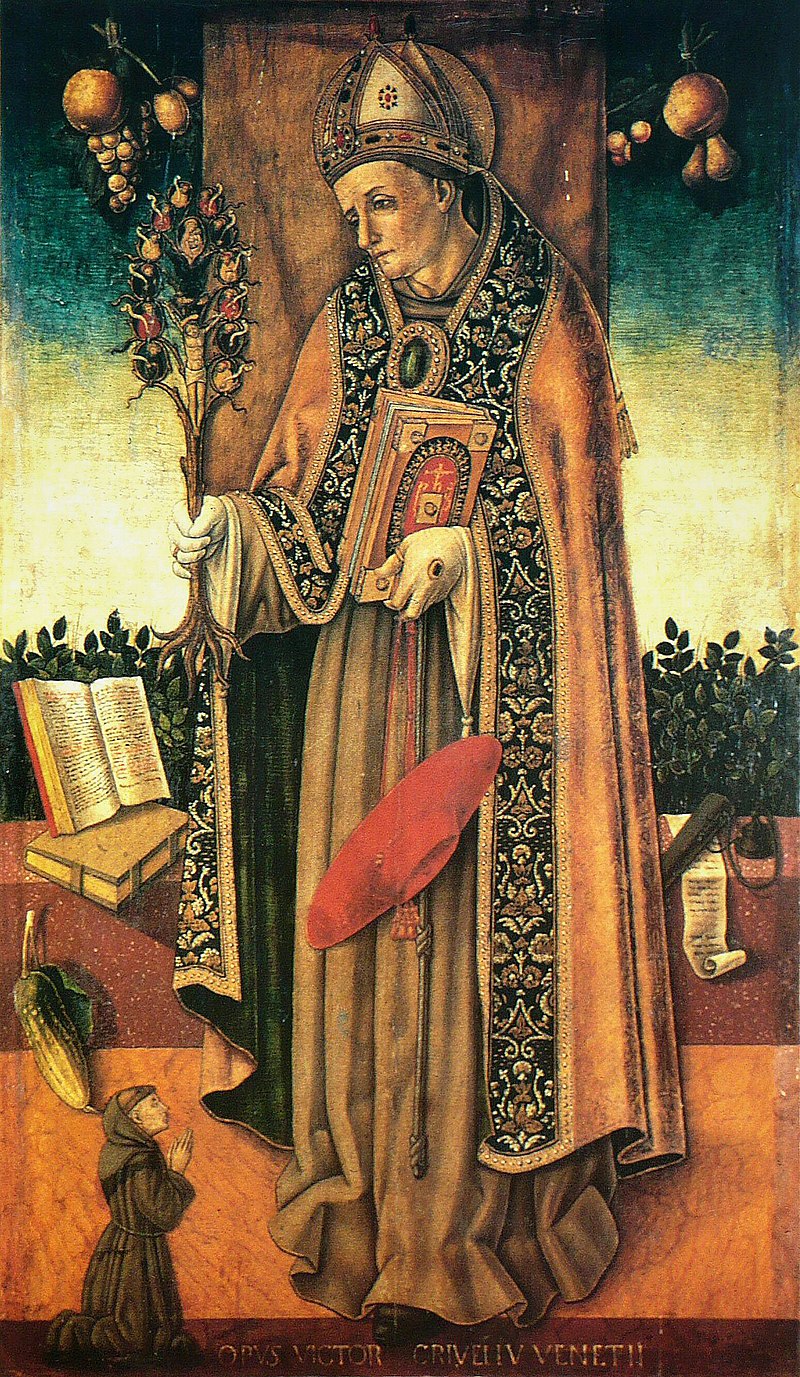
Gordon Plumb drew the attention of readers of the Medieval Religion discussion group to an mage of St Bonaventure which is in the Fitzwilliam Museum in Cambridge.

Detail of Virgin and Child Enthroned with Franciscan and other saints by Vittore Crivelli (1465-1501/2), painted circa 1489, and which can be seen at
https://www.flickr.com/photos/22274117@N08/28318890455

Here is another image of the saint  - who was nominated to the see of York but declined it - and also  by Vittore Crivelli, which will copy and download:

Vittore Crivelli - Saint Bonaventure.jpg

Image:Wikimedia

Tuesday, 15 July 2014

St Bonaventure


Today is the feast of St Bonaventure, who died whilst attending the Second Ecumenical Council of Lyons in 1274. Born in 1218 he became a Franciscan, head of the Order, composer of the Second, definitive, Vita of St Francis, and for hisd last year of life was Cardinal Bishop of Albano. There is an illustrated online life of him and introduction to his works here.

St. Bonaventure of Bagnoregio
St Bonaventure

Image:franciscan-archive.org

My interest in him comes includes the fact that he was offered the Archbishopric of York in 1265, but declined it. What might have happened had he accepted and settled in England?

In connection with my work on Bishop Fleming whose personal theology may reflect Bonaventuran themes I learned something more about the Seraphic Doctor, and I need to do more thereupon, as well as for my own devotional interest.

A few years ago I attended an interesting lecture about the issues surrounding St Bonaventure at the Oxford Centre for Franciscan Studies. The speaker's argument was that although some Franciscans tend to see St Bonaventure and his second Vita as taming the spirituality of St Francis and confining it within ecclesiastical respectability, he however made a good case for the view that Bonaventure should be seen as maintaining the Franciscan vision. In his persuasive argument St Bonaventure expressed in scholastic theology the ecstatic ideals and insights of St Francis. To him Bonaventure provided a means whereby Francis'message could become part of the mainstream.


St Bonaventure

Image:trendspig.com


Thursday, 15 July 2010

St Bonaventure in Yorkshire?

Today is the feast of St Bonaventure, or to give him his actual name rather than a nickname, John (Giovanni) of Fidanza. Quite apart from his insights as a Doctor of the Church, which are eloquent, the Seraphic Doctor interests me for two more particular reasons.

The first is that an understanding of his mystical theology is, I believe, a great help in understanding the theology of "my" Bishop, Richard Fleming. I am not saying that Bonaventure's work influenced Fleming directly, rather that they arrived at similar views. Fleming's literary remains are not comparable to the collected works of a figure like Bonaventure, but they are in the same essential tradition.

The second point of interest is that both were Papally provided to the see of York, but never secured it. In the case of Fleming politics, both secular and ecclesiastical, played the crucial part on frustrating the plan - but that is another, and very long, as well as very interesting, story.

The fact that John of Fidanza does not figure on the list of Archbishops of York is one that I have never seen fully explored - is it one of those topics I might look at if I ever have time? We'll see. I must look it up in the appropriate authors. The following are a few thoughts off the top of my head.

Essentially John/Bonaventure is said to have declined it through humility, but then he went on to become Cardinal Bishop of Albano.

The death in 1265 of Archbishop Godfrey Ludham left the see vacant. the Chapter elected the Dean to succeed him, but as so often in such cases the Dean's election was quashed by the Pope, Clement IV, and Bonaventure provided in November of that year. It was not until October 1266 that Bonaventure renounced the appointment, which went to Walter Gifford, Bishop of Bath and Wells.

Given the situation in England - 1265 had seen the battle of Evesham and the defeat and death of Simon de Montfort, and in 1266 the siege of Kenilworth was being concluded with the Dictum, it looks as if filling the see of York either got entangled in politics or simply was neglected as far as the government was concerned. Was the appointment of the Seraphic Doctor an example of Clement IV seeking to extend Papal powers in a political vacuum, and also of providing (in both senses) for the appointment of a distinguished theologian? Given that non-native appointees in bishoprics had been an issue in the recent problems between King Henry III and many of his magnates, this was venturing on delicate ground.

Whatever the English context I wonder if Bonaventure would have really wanted to transfer himself to England and the responsibilities of being Archbishop of York. That is, of course, assuming that he might have been resident rather than an absentee. As it was York missed out on having another saint-archbishop, and Bonaventure missed out on the delights or otherwise of dealing with the chapters of York and the three pro-cathedrals of Beverley, Ripon and Southwell, the administration of a huge diocese and a province with, in whoever was Bishop of Durham, a very independent minded principal suffragan, let alone administering the palatine lordship of Hexhamshire. What would the seraphic Doctor and the people of his diocese made of each other? One of those curious might-have-beens of history.