Once I was a clever boy learning the arts of Oxford... is a quotation from the verses written by Bishop Richard Fleming (c.1385-1431) for his tomb in Lincoln Cathedral. Fleming, the founder of Lincoln College in Oxford, is the subject of my research for a D. Phil., and, like me, a son of the West Riding. I have remarked in the past that I have a deeply meaningful on-going relationship with a dead fifteenth century bishop... it was Fleming who, in effect, enabled me to come to Oxford and to learn its arts, and for that I am immensely grateful.


Showing posts with label St Francis of Assisi. Show all posts

Tuesday, 17 September 2024

St Francis receives the Stigmata 1224


The other day I posted about the eighth centenary of the establishment of the Franciscan Order in England. At the same time in Umbria St Francis became the first recorded follower of Christ to receive the Stigmata. That was on this day in 1224. Such a configuration to the Passion emphasised the apparently unique status of St Francis, and the sense of a New Age having dawned with his movement.. Later bearers of the Stigmata were sometimes shown to be fraudulent, but others were deemed to be genuine recipients. Probably the most celebrated recognised Stigmatist of recent years was the Capuchin St Pio of Pietrelcina,  

The New Liturgical Movement has an illustrated article about the history of its liturgical commemoration at The Stigmata of St Francis

May St Francis pray for us all


Tuesday, 17 November 2015

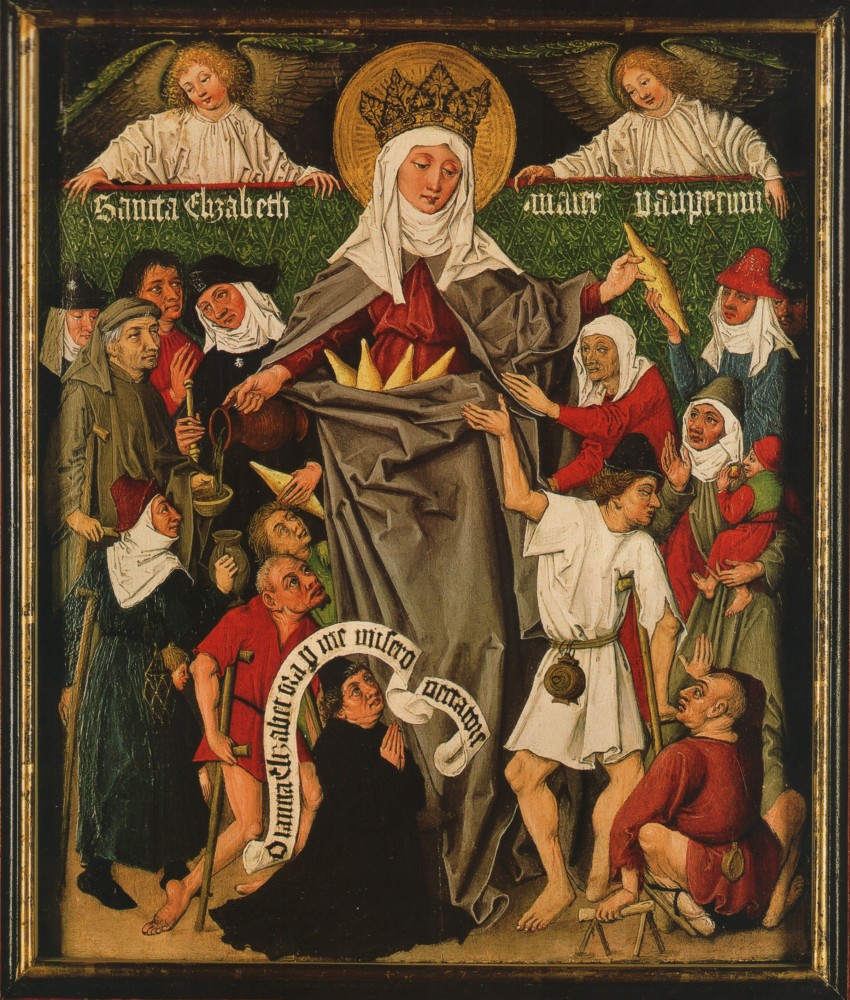
St Elizabeth of Hungary


John Dillon posted about St Elizabeth of Hungary, whose feast falls today in the General calendar, on the Medieval Religion discussion group as follows:

A daughter of King Andrew II of Hungary, Elizabeth was married in 1221 to Ludwig IV, landgrave of Thüringen (whence she is also known as Elizabeth of Thüringen). They had three children of whom the third, a daughter, was born after her crusading father's death at Otranto in 1227 and died in infancy. Only twenty when she was widowed, Elizabeth left the Thuringian court soon afterward -- there was a nasty struggle over her dowry -- and took up residence in Marburg (in today's Hessen), where she lived ascetically, devoted herself to works of charity, and died in 1231 at the age of twenty-four. Miracles were reported at her tomb and a cult arose. Two canonization trials ensued, followed by a canonization in 1235. Having dedicated to St. Francis of Assisi a hospital she had built in Marburg, she was subsequently promoted by Franciscans as a model of lay spirituality and charity. But she was educated at a Dominican convent in Hungary and the Dominicans claim her as well.

Elizabeth has a very extensive hagiographic dossier, including rather different miracle collections emanating from the Order of Friars Minor and from the Order of Preachers. In one legend, the young Elizabeth was forbidden by her father to distribute food to the poor. She of course did so anyway and was stopped for inspection, whereupon the food was changed miraculously to flowers (or was miraculously covered by them).

Some period-pertinent images of St. Elizabeth of Hungary / of Thüringen:

a) as portrayed at the base of her tomb (c. 1235-1250) in the originally thirteenth- and earlier fourteenth-century St. Elisabethkirche in Marburg an der Lahn, begun in the year of her canonization:

 http://www.kornbluthphoto.com/images/ElizShrine2.jpg
http://www.kornbluthphoto.com/images/ElizShrine2.jpg [photo courtesy of Genevra Kornbluth]
The tomb as a whole:

 http://www.elisabethkirche.de/fileadmin/_processed_/csm_04_EC_Mausoleum_01_e7d7fb54ad.jpg


http://www.kornbluthphoto.com/images/ElizShrine1.jpg [photo courtesy of Genevra Kornbluth]

b) as portrayed on her copper-gilt shrine (between 1235 and 1250) in the same church:
1) standing, on one of the shrine's short ends:

 http://www.elisabethkirche.org/typo3temp/pics/aeb08e1fc2.jpg


 http://www.elisabethkirche.org/typo3temp/pics/1ad12d9afb.jpg


2) Scenes of Elizabeth as portrayed on the roof of the shrine:

 http://www.rmv.de/linkableblob/de/38882-26173/original/MR_Elisabethkirche_Schrein.jpg

 http://www.kirchenzeitung.de/sites/bz5.bistumspresse-zentralredaktion.de/files/imagecache/node-gallery-display-full/images/fotostrecken/Elisabeth_5.jpg


 https://www.uni-marburg.de/aktuelles/news/2007/0515w/image_preview


 http://www.heilige-elisabeth-damp.de/bilder/00561_01.jpg


c) Elizabeth as portrayed in an earlier thirteenth-century statue, thought to be from very shortly after her canonization in 1235, in the Kirche (ex-cathedral) St. Peter und Paul in Naumburg:
http://tinyurl.com/2c92wjh

 https://rezitante.files.wordpress.com/2009/08/alten-naumburg-181.jpg?w=450&h=600

d) as depicted (scenes) in several panels of the earlier thirteenth-century glass window (before 1250) devoted to her in the choir of the St. Elisabethkirche in Marburg an der Lahn:
1) http://tinyurl.com/pn23wco
larger view:

 https://s-media-cache-ak0.pinimg.com/736x/6d/e8/32/6de83286d593fb41391968a23b499669.jpg

2) http://tinyurl.com/p4a2k7l

3) http://tinyurl.com/okvgktd
The window as a whole (click on the panels for smallish individual views):
http://alt.elisabethkirche.de/rundgang/ixu_fur_l6.htm

e) as depicted (at right; at left, St. Francis of Assisi) in a late thirteenth-century copy of French origin of the Legenda aurea (San Marino, CA, Huntington Library, ms. HM 3027, fol. 157r):
http://digitalassets.lib.berkeley.edu/ds/huntington/images//000914A.jpg

f) as depicted (tending the sick) in the late thirteenth-century Livre d'images de Madame Marie (c. 1285-1290; Paris, BnF, ms. Nouvelle acquisition française 16251, fol. 82v):
http://tinyurl.com/268a74o

g) as depicted (at left; with Sts. Margaret of Hungary and Henry of Hungary) by Simone Martini in his early fourteenth-century frescoes of Franciscan saints (c. 1318) in the south transept of the lower church of the basilica di San Francesco at Assisi:

 http://www.wga.hu/art/s/simone/3assisi/transept/5saints2.jpg


h) as depicted (at right; at left, St. Clare of Assisi) by Simone Martini in an earlier fourteenth-century fresco (c. 1318-1320) at the entrance to the cappella di San Martino in the lower church of the basilica di San Francesco at Assisi:

 http://www.wga.hu/art/s/simone/3assisi/1saints/saints40.jpg

Detail view (Elizabeth):

 http://www.wga.hu/art/s/simone/3assisi/1saints/saints41.jpg


i) as depicted (giving a cloak to a beggar) in a panel of the earlier fourteenth-century Altenberg Altarpiece (c. 1330) in the Städelsches Kunstinstitut, Frankfurt m Main:
https://www.flickr.com/photos/hen-magonza/5888827150/

j) as depicted (at right; miracle of the flowers) in an earlier fourteenth-century fresco (c. 1337) formerly in the chiesa di Sant'Elisabetta d'Ungheria in Perugia and now in the Galleria Nazionale dell'Umbria in that city:

 http://www.heiligenlexikon.de/Fotos/Nikolaus_von_Tolentino3.jpg


k) as depicted (experiencing a vision) in an earlier fourteenth-century copy of the Legenda aurea in its French-language version by Jean de Vignay (c. 1326-1350; Paris, BnF, ms. Français 185, fol. 223r):
http://tinyurl.com/27kq28s

l) as depicted (experiencing a vision) as depicted in an earlier fourteenth-century copy, from the workshop of Richard and Jeanne de Montbaston, of the Legenda aurea in its French-language version by Jean de Vignay (1348; Paris, BnF, ms. Français 241, fol. 305r):


m) as depicted on the upper portion of a wing of a later fourteenth-century altarpiece (c. 1370-1373) from Schloss Tirol in the Tiroler Landesmuseum Ferdinandeum, Innsbruck:

http://tarvos.imareal.oeaw.ac.at/server/images/7003466.JPG

The altarpiece as a whole:

 http://sammellust.ferdinandeum.at/wo_files/images/objekte/1826b.jpg


n) as depicted (holding flowers) in a late fourteenth- or very early fifteenth-century panel painting attributed to Gherardo Starnina (formerly known as the Maestro del Bambino Vispo) sold at auction at Sotheby's in 1962:

 https://upload.wikimedia.org/wikipedia/it/6/6b/Gherardo_Starnina_-_Sant%27Elisabetta_d%27Ungheria.jpg

Expandable grayscale views of the painting as photographed prior to that sale are here:
http://tinyurl.com/3x2fuzp
Where is the painting now?

o) as depicted (experiencing a vision) in the earlier fifteenth-century Châteauroux breviary (ca. 1414; Châteauroux, Bibliothèque municipale, ms. 2, fol. 415v):

 http://www.enluminures.culture.fr/Wave/savimage/enlumine/irht2/IRHT_054274-p.jpg


p) as depicted (washing a leper) in an early fifteenth-century copy of the Elsässische Legenda aurea (1419; Heidelberg, Universitätsbibliothek, Cod. Pal. germ. 144, fol. 242v):
http://digi.ub.uni-heidelberg.de/diglit/cpg144/0500
http://heidicon.ub.uni-heidelberg.de/heidicon/58/59/8795.html

q) as depicted (experiencing a vision) in an earlier-to-mid-fifteenth century Franciscan breviary of Milanese origin (Paris, BnF, ms. Latin 760, fol. 573r):
http://tinyurl.com/2a7psrq

r) as depicted (scenes) on the earlier fifteenth-century choir screen (c. 1420-1430) of the Heiligen-Geist-Hospital in Lübeck:


The panels in situ:

 https://upload.wikimedia.org/wikipedia/commons/d/d6/L%C3%BCbeck_Heiligen-Geist-Hospital_070311.jpg


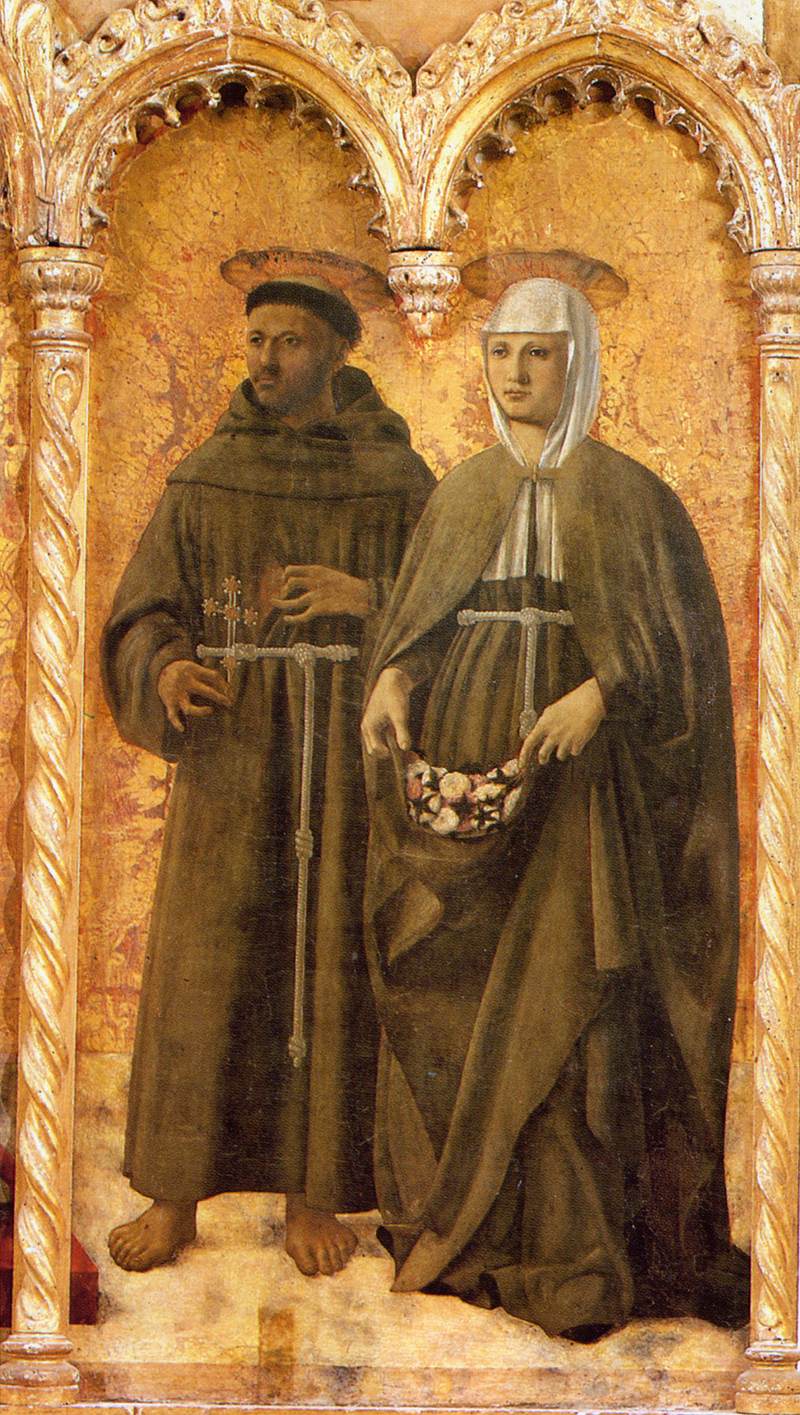
s) as depicted (at right, holding flowers; at left, St. Francis of Assisi) by Piero della Francesca in his later fifteenth-century Polyptych of Sant'Antonio (c. 1460-1470) in the Galleria Nazionale dell'Umbria in Perugia:

 http://www.wga.hu/art/p/piero/1/3anton04.jpg


t) as portrayed in a later fifteenth-century polychromed wooden statue (c. 1470; the crown is later) in the nave (near the choir screen) in the St. Elisabethkirche in Marburg an der Lahn:

https://blogger.googleusercontent.com/img/b/R29vZ2xl/AVvXsEj58nXMpcKwgjMYeh_-aDvuxVdwqr2TodBRR_xynni5CuFdgtS7nalG_Cn5TCmAsEZKYuNHBAQ6D3g-JpcN_VPU5afhH8k5Zmfr1TNJgYO9ygJmPZ3_IkSJY16AJB7PR74wzvd8mGFilHyA/s1600/196.JPG


 https://upload.wikimedia.org/wikipedia/commons/c/ca/Elisabeth_von_Th%C3%BCringen.JPG


In the statue she is holding the Elisabethkirche.

u) as depicted (witha jug and a loaf, succoring the poor) by the Master of the Drapery Studies in the central panel of the later fifteenth-century St. Elizabeth Triptych (c. 1480) in the Staatliche Kunsthalle, Karlsruhe:

 https://www.heiligenlexikon.de/Fotos/Elisabeth_von_Thueringen8.jpg


The altarpiece as a whole:


v) as depicted (succoring the poor) in a later fifteenth-century copy of Vincent of Beauvais' Speculum historiale in its French-language version by Jean de Vignay (c. 1480-1490; Paris, BnF, ms. Français 245, fol. 175r):


w) as depicted (at top in left margin; holding a jug and a loaf) in a hand-coloured woodcut in the Beloit College copy of Hartmann Schedel's late fifteenth-century Weltchronik (Nuremberg Chronicle; 1493) at fol. CCXIr:
http://www.beloit.edu/nuremberg/book/6th_age/right_page/114%20%28Folio%20CCXIr%29.pdf

x) as portrayed (holding a loaf and a spouted jug) by the Master of the Imberger Altar in a late fifteenth-century polychromed statuette in the altarpiece of the BVM and Saints (1495) in the Kapelle St. Jakobus at Reichenbach, a locality of Oberstdorf (Lkr. Oberallgäu) in Bavaria:
1) at right here:

 http://tarvos.imareal.oeaw.ac.at/server/images/7017228.JPG

2) at left here (at right, St. Sebastian):

 http://tarvos.imareal.oeaw.ac.at/server/images/7017229.JPG


y) as portrayed (second from left, holding flowers and looking remarkably aged for someone who died at age twenty-four; at left, St. Francis of Assisi) by Andrea della Robbia in about 1500 in his great terracotta relief of the Madonna and Child with Saints in the chiesa di Sant'Agata in Radicofani (SI) in Tuscany:
http://tinyurl.com/26h953j

z) as portrayed (also elderly; holding loaves and a jug) in a late fifteenth- or earlier sixteenth-century statue in the Stiftskirche in Stuttgart:

 http://www.veranstaltungen.elk-wue.de/fileadmin/mediapool/elkwue/bilder/gedenktage/Elisabeth_von_Thueringen_EvKiStu_Schmeck.jpg


aa) as portrayed (holding a loaf and a jug) in a late fifteenth- or early sixteenth-century panel painting on an altarpiece wing in the Stiftsgalerie in Herzogenburg (Land Niederösterreich):

 http://tarvos.imareal.oeaw.ac.at/server/images/7001310.JPG


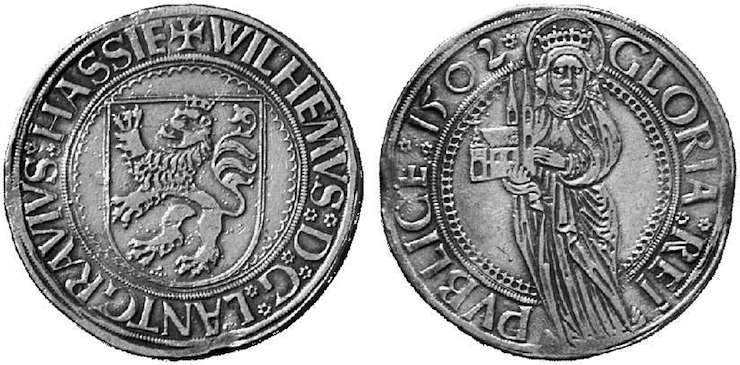
bb) as portrayed on an early sixteenth-century Guldengroschen (1502) struck in Kassel by Wilhelm II, Landgraf of Hessen:
http://www.coingallery.de/Heilige/E/Elisabeth_3.jpg

cc) as portrayed in an earlier sixteenth-century polychromed wooden statue (1511) by Ludwig Juppe on the celebrants' sedile in the east choir of the St. Elisabethkirche in Marburg an der Lahn:

 http://www.elisabethkirche.de/fileadmin/_processed_/csm_2011-04-14_EKTa_0080_e70fcbaf66.jpg

Detail view:

 http://www.rmv.de/linkableblob/de/38872-25816/original/MR_Elisabethkirche_Juppe_Elisabeth.jpg

In the statue she is again depicted holding the Elisabethkirche

dd) as portrayed in an earlier sixteenth-century statue (c. 1520) of Bavarian origin, ascribed to the workshop of Hans Leinberger, in the Musée de l'Oeuvre Notre-Dame, Strasbourg:

 https://upload.wikimedia.org/wikipedia/commons/8/80/Sainte_Elisabeth_de_Hongrie-Mus%C3%A9e_de_l%27Oeuvre_Notre-Dame.jpg


ee) as portrayed in relief in a copy of an earlier sixteenth-century sculpture by Ludwig Juppe on Marburg's City Hall (1527; the original is in the Museum für Kulturgeschichte in the Marburger Schloss):

 http://www.kirchenzeitung.de/sites/bz5.bistumspresse-zentralredaktion.de/files/imagecache/node-gallery-display-full/images/fotostrecken/Elisabeth_6.jpg


Tuesday, 20 October 2015

Early polyphony


George Ferzoco has posted the following note on the Medieval Religion discussion group about an item on the Cambridge University website:

He wrotes "It does the heart good to see that such major discoveries continue to be made.

It’s from the early 900s (not 1900s, but 900s), and it’s a chant dedicated to St Boniface."

As the post explains the source appears to be in a monastery in NW Germany.

The article can be viewed at:
http://www.cam.ac.uk/research/news/earliest-known-piece-of-polyphonic-music-discovered

Scroll down the contents page to the link, which includes a video of a performance of the music.

Laura Jacobus added these images of polyphony:
Colleagues might also enjoy these images of polyphonic singers (as far as I know, the first times polyphony has been depicted) - both are at Assisi

http://uploads7.wikiart.org/images/giotto/st-francis-of-assisi-preparing-the-christmas-crib-at-grecchio-1300.jpg

St Francis preparing the Christmas Crib at Grecchio


upload.wikimedia.org/wikipedia/commons/d/d0/Simone_Martini__St._Martin_is_Knighted_(scene_3)_-_WGA21370.jpg
(showing secular minstrels in corner )

 https://upload.wikimedia.org/wikipedia/commons/8/83/Simone_Martini_-_Burial_of_St_Martin_(scene_10)_-_WGA21391.jpg

Simone Martini St. Martin Chapel- monastic singers are also shown in the Funeral of St Martin, though not obviously polyphonic


Bonnie Blackburn explained the visual imagery as follows:

We can't be sure that they are singing polyphony (i.e. different melodies at the same time) rather than chant. When we see angels with choirbooks, then we know it is polyphonic, because chant was traditionally learnt by heart by the clergy, and we have no records of notation, let alone polyphony, before the early 9th century (this is why Giovanni Varelli's discovery is so spectacular). By the fourteenth century polyphony came to be valued as something special, and angels singing polyphonically became fashionable for artists (see the painting of Mary Queen of Heaven by the Master of the St Lucy legend in the National Gallery in Washington, where we can read the music, a known Marian motet by Walter Frye, Ave regina caelorum).


Monday, 21 September 2015

St Matthew


Today is the feast of St Matthew Apostle and Evangelist. This is going to be a long post, but I have several good friends called Matthew so I am posting this with them in mind.

As with others of this type it is based on posts by contributors to the Medieval Religion discussion group. As is my wont I have opened and copied and pasted many of the images. Flickr does not allow me to do that, nor do some picture gallery collections - so it is worth clicking on the links. Those I have reproduced can often be seen in larger format by clicking on the appropriate link to the lower right in each case. This is a particularly rich and varied selection of depictions of St Matthew and in various different mediums, and illustrates the vitality of art and artists over almost a thousand years.


Gordon Plumb opened the batting with these images in glass of St Matthew:

Bourges, Cathédrale St Étienne, Bay 208, central figure:
https://www.flickr.com/photos/22274117@N08/15892900515

Oxford, Merton College Chapel, sVIII:
https://www.flickr.com/photos/22274117@N08/6404996633
and detail of Matthew:
https://www.flickr.com/photos/22274117@N08/6405001663

Stanford-on-Avon, St Nicholas, Northamptonshire, nIII, A1, c.1324-30:
https://www.flickr.com/photos/22274117@N08/3248334106

Greystoke, Cumbria, east window, 2d, St Matthew in prison from the 15thC. window by York glaziers telling the story of St Andrew including his journey to Wronden to rescue St Matthew from prison there:
https://www.flickr.com/photos/22274117@N08/3016449814

Lincoln Cathedral, sXXIX.1, figure on left, St Matthew, c.1230:
https://www.flickr.com/photos/22274117@N08/5458678395

Norbury, St Mary and St Barlok, Derbyshire east window, 2d-5d:
https://www.flickr.com/photos/22274117@N08/17202988512
and detail:
https://www.flickr.com/photos/22274117@N08/16584465633

Oxford, Trinity College, Old Library, fourth east window, 2b:
https://www.flickr.com/photos/22274117@N08/16584465633

Elsing, St Mary, Norfolk, sII, 1b-3b:
https://www.flickr.com/photos/22274117@N08/6119382253
and detail:
https://www.flickr.com/photos/22274117@N08/6119927618

Gresford, All Saints, Lady Chapel, east window A4:
https://www.flickr.com/photos/22274117@N08/15243242579

York Minster, Great East window, 9a, evangelist symbol of St Matthew:
https://www.flickr.com/photos/22274117@N08/8495136577

Attleborough, Assumption of the Blessed Virgin Mary, Norfolk, wI:
three evangelist symbols of St Matthew:
D2: https://www.flickr.com/photos/22274117@N08/3203829307
D3: https://www.flickr.com/photos/22274117@N08/3204679596
F4: https://www.flickr.com/photos/22274117@N08/32046839165

Orchardleigh, St Mary, Somerset, sII, 3a:
https://www.flickr.com/photos/22274117@N08/32046839164

Melbury Bubb, St Mary, Dorset, wI, B6 left-hand figure:
https://www.flickr.com/photos/22274117@N08/3480767394

Lincoln Cathedral, sII, 4a, the call of Matthew:
https://www.flickr.com/photos/22274117@N08/2258354521

Cartmel Priuory, Cumbria, east window, A4,angel symbol of St Matthew:
https://www.flickr.com/photos/22274117@N08/2893301352

Cartmel Priory, east window, A10:
https://www.flickr.com/photos/22274117@N08/2893315534

Bourges, Cathédrale St Étienne, Bay 37, 2nd from left:
https://www.flickr.com/photos/22274117@N08/4257389964

Chartres, St Père, Bay 219, lower right:
https://www.flickr.com/photos/22274117@N08/2842773067


Genevra Kornbluth added these images from her extensive photo library: http://www.kornbluthphoto.com/SaintMatthew.html

John Dillon then posted the following:

Further period-pertinent images of St. Matthew the Evangelist (NB: for convenience, I'm calling Matthew's tetramorphic image "his angel" throughout: for instances of its portrayal as an actual angel interacting with Matthew see items f, pp, ss, yy, and eee).

a) as depicted (second from top at right; above him, St. Andrew; below him, St. Paul) among the roundels of apostles framing the Theotokos and Christ Child in a sixth-century tapestry icon from Egypt in the Cleveland Museum of Art, Cleveland (OH):


Detail view:
http://tinyurl.com/ph59gr6

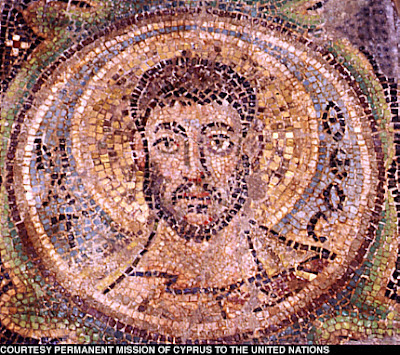
b) as depicted in a late sixth-century mosaic formerly in the apse of the church of the Panagia Kanakaria at Lythrankomi in Turkish-occupied northern Cyprus and now in the Byzantine Museum in that part of Nicosia under the jurisdiction of the Republic of Cyprus:

 https://blogger.googleusercontent.com/img/b/R29vZ2xl/AVvXsEhflWJS9yvtZOAOQYjJQcX8B1450AxKjRfcs1x2bYu2tRMRWXaNKXuqe-W3GKLllWYrbAGxZSq6CXgIE4qY_pTDOkd7F9KYXOCDM_xtxbuP3wLpBfFjV2oSpzdpkDfEWljUKO793_TFoFs/s1600/S.Matteo.jpg


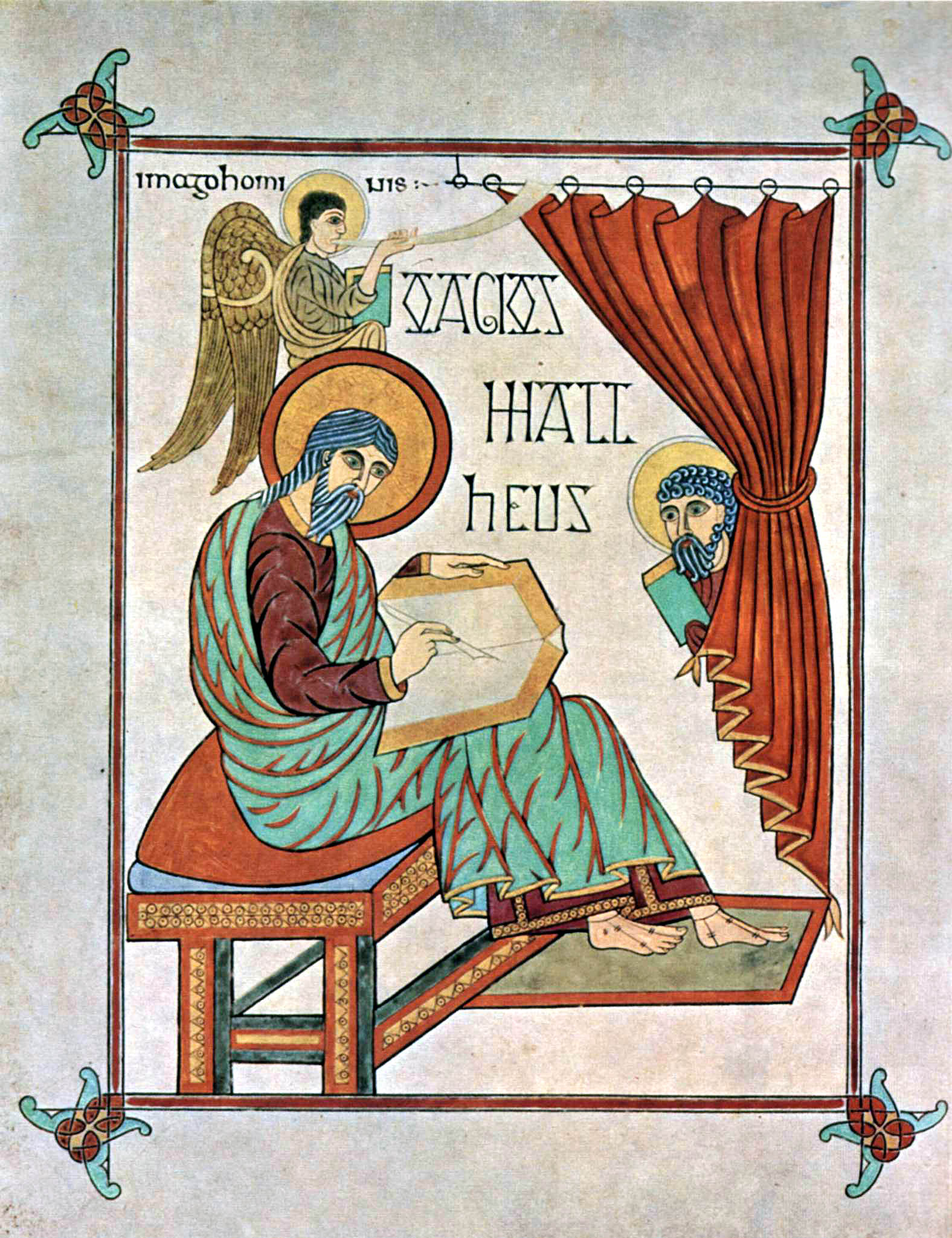
c) as depicted (with his angel) in a full-page illumination in the earlier eighth-century Lindisfarne Gospels (ca. 715-720; London, BL, MS Cotton Nero D. IV, fol. 25v):

 https://upload.wikimedia.org/wikipedia/commons/7/79/Meister_des_Book_of_Lindisfarne_001.jpg


d) as depicted (lower register; upper register, his angel) in the mid-eighth-century Gundohinus Gospels (Autun, Bibliothèque municipale, ms. 3, fol. 186v):

 http://www.enluminures.culture.fr/Wave/savimage/enlumine/irht7/IRHT_106900-p.jpg


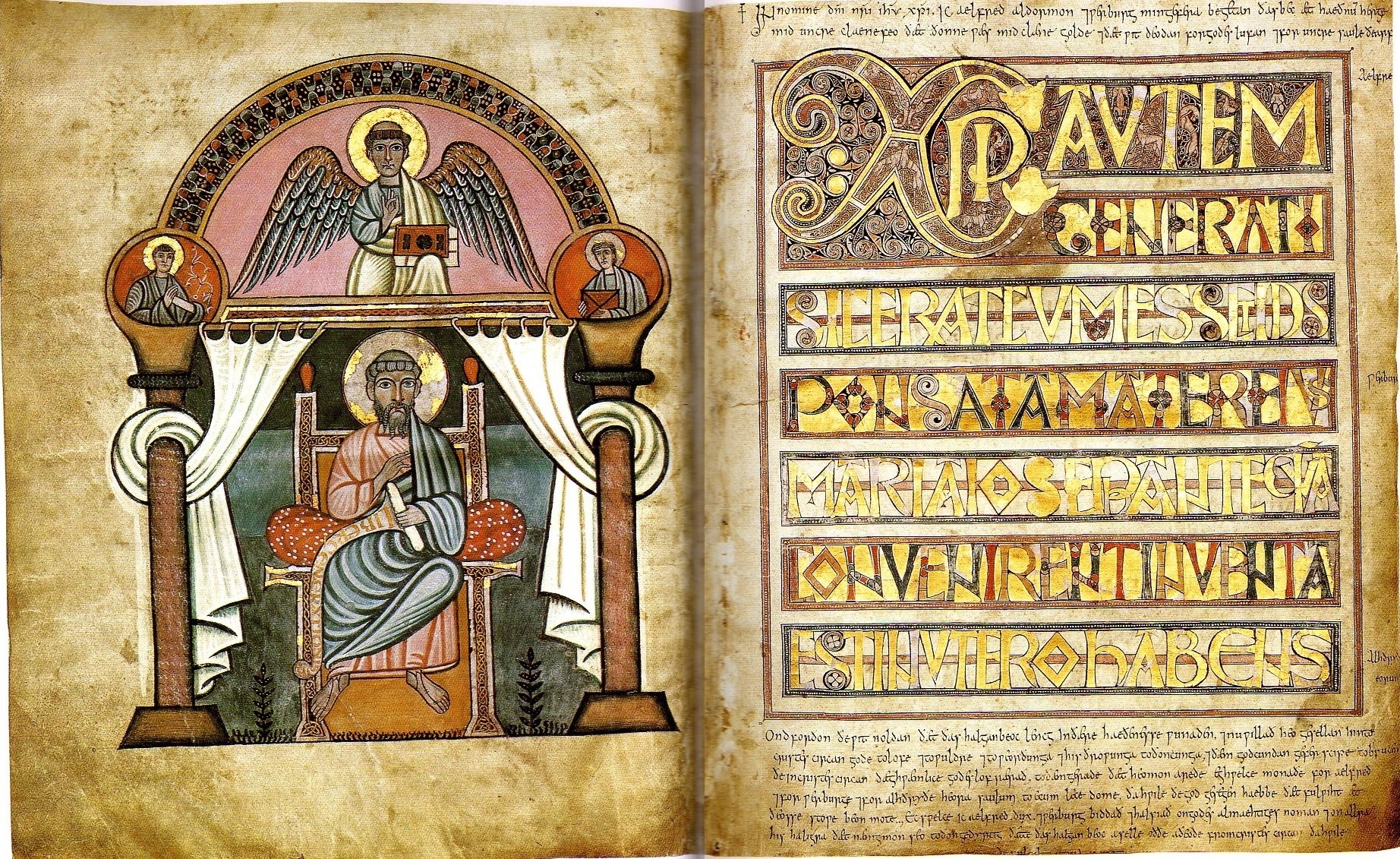
e) as depicted (lower register; upper register, his angel) in the mid-eighth-century Stockholm Codex Aureus (a.k.a. Codex Aureus of Canterbury; Stockholm, Kungliga Biblioteket, MS A. 135, fol. 9v):

 https://upload.wikimedia.org/wikipedia/commons/6/69/CodexAureusCanterburyFolios9v10r.jpg


f) as depicted (with his angel) in a full-page illumination in the late eighth-century Godescalc Gospels (between 781 and 783; Paris, BnF, ms. Nouvelle acquisition latine 1203, fol. 1):


g) as depicted in a full-page illumination in the late eighth-or early ninth-century Coronation Gospels from Aachen (ca. 795-810; Vienna; Kunsthistorisches Museum, Weltliche Schatzkammer, Inv. Nr. XIII 18, fol. 15r):
http://tinyurl.com/pz8jqnz

 https://krizpots.files.wordpress.com/2013/09/st_matthew_coronation_gospels1355085830641.jpg


h) as depicted in a full-page illumination in the earlier ninth-century Ebbo Gospels (ca. 816-841; Épernay, Bibliothèque municipale, ms. 1, fol. 18v):
https://krizpots.files.wordpress.com/2013/09/ebbo.jpg

i) as depicted in a full-page illumination in a late ninth- or early tenth-century Gospels from Landévennec (Oxford, Bodleian Library, MS Auct. D. 2. 16, fol.28v):

 http://image.ox.ac.uk/images/bodleian/ms.auct.d.2.16/28v.jpg


j) as depicted in a full-page illumination in a later tenth- or earlier eleventh-century Gospel lectionary from Constantinople (c. 976-1025; St. Catherine [So. Sinai], Holy Monastery of the God-trodden Mount Sinai, cod. 204, fol. 8r):
http://www.icon-art.info/hires.php?lng=en&type=1&id=2464

k) as depicted in a full-page illumination in a later tenth- or earlier eleventh-century Gospels from Constantinople (c. 976-1025; Paris, BnF, ms. Coislin 20, fol. 10v):
http://tinyurl.com/p9g8utk

l) as depicted in the earlier eleventh-century mosaics (restored between 1953 and 1962) in the narthex of the church of the Theotokos in the monastery of Hosios Loukas near Distomo in Phokis:

 https://upload.wikimedia.org/wikipedia/commons/b/b9/Hosios_Loukas_%28narthex%29_-_East_wall%2C_1st_arch_%28S.Matthew%29_02.jpg


m) as depicted in a full-page illumination in an earlier eleventh-century Gospels from Constantinople (Paris, BnF, ms. Grec 64, fol. 9v):
http://tinyurl.com/25h3ats

n) as depicted in the mid-eleventh-century mosaics in the katholikon of the Nea Moni on Chios:
http://www.eikonografos.com/album/albums/uploads/nea_moni/10.jpg
Detail view:
http://tinyurl.com/nsl72z6

o) as portrayed in high relief on a later eleventh-century ivory plaque of the Four Evangelists of Rhenish origin in the Victoria and Albert Museum, London:

http://media.vam.ac.uk/media/thira/collection_images/2009CA/2009CA7150_jpg_l.jpg

The plaque as a whole:
http://collections.vam.ac.uk/item/O129592/plaque-unknown/

p) as depicted in a twelfth-century copy of the Gospel of Matthew with gloss (Châlons-en-Champagne, Bibliothèques de Châlons, Bibliothèque Pompidou, ms. 78 [86], fol. 1r):

 http://www.culture.gouv.fr/Wave/savimage/enlumine/irht7/IRHT_108122-p.jpg


q) as depicted in a full-page illumination an earlier twelfth-century Gospels from Agen or from the abbey of Moissac (Paris, BnF, ms. Latin 254, fol. 10r):

 Novum Testamentum.


r) as depicted (with his angel) in an earlier twelfth-century legendary from the abbey of Cîteaux (between 1101-1133; Dijon, Bibliothèque municipale, ms. 641, fol. 57r):

 http://www.enluminures.culture.fr/Wave/savimage/enlumine/irht6/IRHT_094812-p.jpg


s) as depicted by the Kokkinobaphos Master in a full-page illumination formerly part of an earlier twelfth-century Gospels from Constantinople (c. 1126-1150; Mt. Athos, Monastery of Great Lavra MS A44) and now in the Walters Art Gallery and Museum, Baltimore (fol. W.530.Er):
http://tinyurl.com/qyang7m

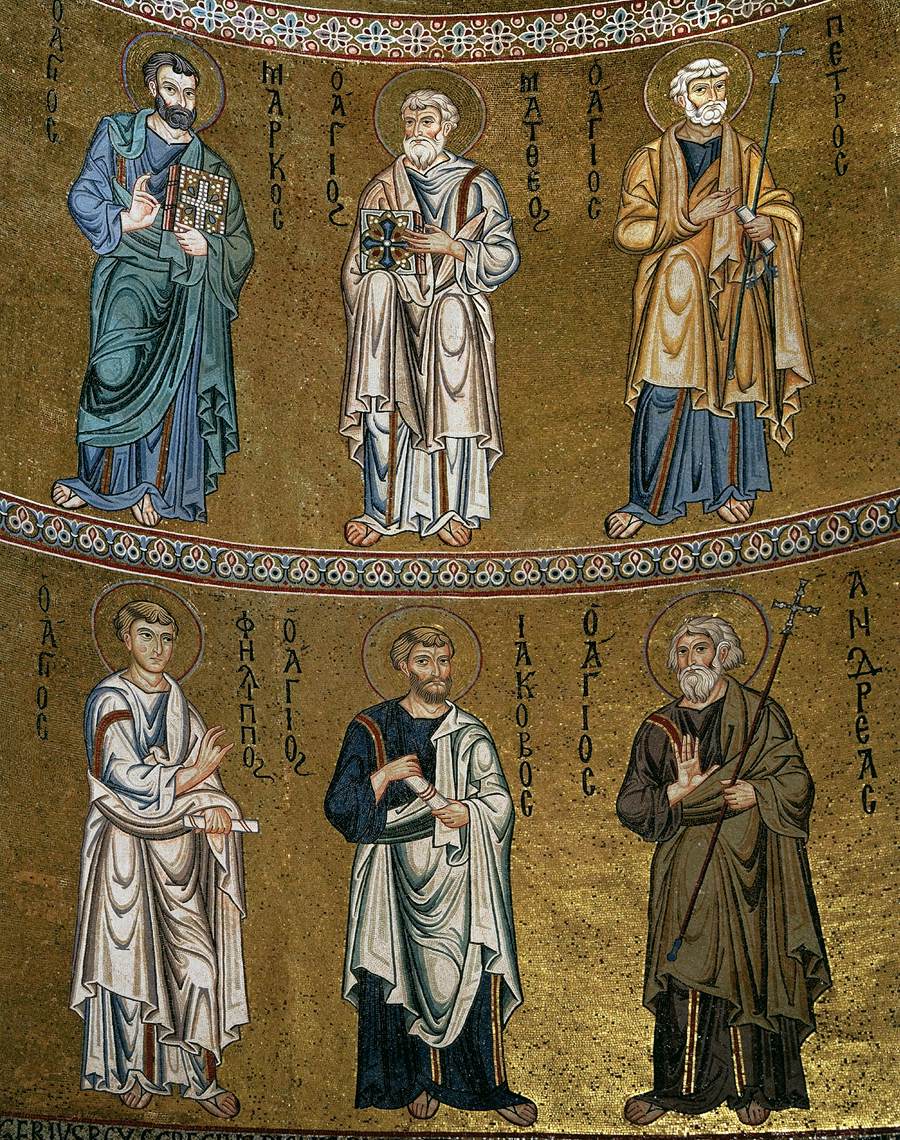
t) as depicted (at left; at right, St. John the Theologian) in the mid-twelfth-century apse mosaic in the left aisle of Trieste's basilica cattedrale di San Giusto martire:

 https://c2.staticflickr.com/4/3889/15164998215_ce7b0fd9d3_b.jpg


u) as depicted (upper register at center) in the mid-twelfth-century apse mosaics (completed in 1148) of the basilica cattedrale della Trasfigurazione in Cefalù:

 http://www.wga.hu/art/zgothic/mosaics/3cefalu/4cefalu.jpg


v) as portrayed (at right; at left, St. Thomas) on a later twelfth-century gilt and enameled copper plaque of Mosan origin (c. 1160) in the Cleveland Museum of Art, Cleveland (OH):


w) as portrayed in relief (at far right in this view, drinking from a cup) by Anselmo da Campione in his Last Supper panel on the later twelfth-century parapet (_pontile_; c. 1170-1180) in the cattedrale di San Geminiano in Modena:

 http://rubens.anu.edu.au/raid1/italy_december_2005_1/modena/duomo/interior/pontile/DSC00019.JPG


x) as depicted in the later twelfth-century Last Judgment fresco (betw. 1176 and 1200) in the church of St. George in Staraya Ladoga:
http://www.icon-art.info/hires.php?lng=en&type=11&id=1447

y) as portrayed in relief (at left; at centre, St. Thomas; at right, St. Peter) on the late twelfth-century enameled copper reliquary châsse (of Limousin origin) of Sts. Calminus and Namadia in the église abbatiale St.-Pierre et St.-Caprais in Mozac (Puy-de-Dôme):

 https://upload.wikimedia.org/wikipedia/commons/3/3d/Ch%C3%A2sse_Calmin_Mozac_les_ap%C3%B4tres_1.JPG


z) as portrayed (top row and the first two views in the following row; scenes of his legendary apostolate in Ethiopia) on a late twelfth-century capital found at Nazareth in 1908 and now mounted on a wall of the modern Church of the Annunciation there:
http://picasaweb.google.com/JuliannaLees/NazarethCapitals#

aa) as portrayed (at center; at right, St. John the Evangelist) in a late twelfth-century jamb statue on the Galluspforte (the north portal; ca. 1180-1190) of the Basler Münster:

 http://www.wga.hu/art/zgothic/1romanes/po-12c3/6s2_1167.jpg


bb) as portrayed in high relief on an earlier thirteenth-century enameled plaque (c. 1220-1230) from the main altar of the then priory church of St. Michael at Grandmont (Haute-Vienne) and now in the Musée du Louvre, Paris:

 http://cartelfr.louvre.fr/pub/fr/image/63519_95-001705.jpg


cc) as portrayed in a statue on the earlier thirteenth-century Angel Pillar (c. 1230) in the cathédrale Notre-Dame in Strasbourg:

https://blogger.googleusercontent.com/img/b/R29vZ2xl/AVvXsEg7lXTyAshvLukWgpkWtVG58eXHBkC51_xiWwsJNXTG0xnTSAenhR7lREfPQa0IyOaz5B85wUxydYFZhdEI7OUvoRUJ4SKL4pGd_HP11yaTBBt4LF93LSQ3CqwzbXlnUyX_Yv0cr7H7S8Ad/s1600/F4+Strasbourg+Cathedral.JPG


dd) as depicted in a later thirteenth-century fresco (between 1260 and 1263) in the nave of the church of the Holy Apostles in the Patriarchate of Peć at Peć in, depending on one's view of the matter, either the Republic of Kosovo or Serbia's province of Kosovo and Metohija:
http://tinyurl.com/2clkpom
Detail view:
http://tinyurl.com/2e687k5

ee) as portrayed (second from left) in a silver gilt statuette on the later thirteenth-century copper gilt châsse of St. Remaclus (completed betw. 1263 and 1268) in the église Saint-Sébastien in Stavelot:
http://tinyurl.com/o2u8rsz
Detail view (zoomable image):
http://balat.kikirpa.be/photo.php?path=KM3923&objnr=10074187&lang=en-GB&nr=1

ff) as depicted by Cimabue in a later thirteenth-century fresco (ca. 1277-1280) in the upper church of the basilica di San Francesco, Assisi (in a vault field that collapsed as a result of the earthquake of 1997; restoration completed, 2007):

 http://easyweb.easynet.co.uk/giorgio.vasari/cimabue/stmatt.jpg

Detail view:
http://www.wga.hu/art/c/cimabue/assisi/vault4.jpg

gg) as portrayed in a later thirteenth-century statue (ca. 1280) on a pillar in the inner choir of Köln's Hohe Domkirche Sankt Petrus und Maria:

 http://www.wga.hu/art/zgothic/gothic/4/03g_1350.jpg


hh) as depicted (at far left) by Duccio di Buoninsegna in his early fourteenth-century Maestà altarpiece (between 1308-1311) in the Museo del Opera del Duomo in Siena:
http://klp.pl/admin-malarstwo/images/d_duccio_duccio/d_duccio_duccio21.jpg

ii) as depicted in an earlier fourteenth-century fresco (c. 1310-1320), often attributed to Giotto di Bondone, in the lower church of the basilica di San Francesco, Assisi:

 http://www.christusrex.org/www1/francis/ABI-matteo-l.jpg


jj) as depicted by the workshop of Simone Martini in an early fourteenth-century panel painting (ca. 1317-1320) in the National Gallery of Art, Washington, DC:
http://www.nga.gov/content/ngaweb/Collection/art-object-page.41633.html

kk) as depicted (centre panel, at left in upper register) by Ugolino di Nerio in an earlier fourteenth-century panel painting (ca. 1325-1330), from his dismembered Santa Croce altarpiece, in the Gemäldegalerie, Berlin:

 http://www.wga.hu/art/u/ugolino/nerio/croce.jpg


ll) as depicted (martyrdom) in an earlier fourteenth-century French-language legendary of Parisian origin, with illuminations attributed to the Fauvel Master (ca. 1327; Paris, BnF, ms. Français 183, fol. 49r):
http://tinyurl.com/2fumpvy

mm) as depicted (at left) by Bernardo Daddi in an earlier fourteenth-century triptych of the BVM with saints (1328) in the Galleria degli Uffizi, Florence:

 http://www.wga.hu/art/d/daddi/mad_chil.jpg


nn) as depicted in a November calendar portrait in the earlier fourteenth-century frescoes (betw. 1335 and 1350) of the narthex in the church of the Holy Ascension at the Visoki Dečani monastery near Peć in, depending on one's view of the matter, either the Republic of Kosovo or Serbia's province of Kosovo and Metohija:
http://tinyurl.com/obejyr9

oo) as depicted (top centre; martyrdom ) in a mid-fourteenth-century copy (ca. 1355) of Ulrich of Lilienfeld's Concordantiae caritatis (Lilienfeld, Stiftsbibliothek, Cod. 151, fol. 214v):

 http://tarvos.imareal.oeaw.ac.at/server/images/7005000.JPG


pp) as depicted (with his angel) in a later fourteenth-century panel painting (betw. 1357 and 1367) by Theodoric of Prague and workshop in the Holy Cross Chapel, Karlštejn Castle (near Prague):

 https://upload.wikimedia.org/wikipedia/commons/6/68/Meister_Theoderich_von_Prag_006.jpg


qq) as depicted in the later fourteenth-century frescoes (1360s and 1370s; restored in 1968-1970) in the church of St. Demetrius in Marko's Monastery at Markova Sušica:

 https://upload.wikimedia.org/wikipedia/commons/0/09/Paintings_in_St._Demetrius_Church_%28Markova_Su%C5%A1ica%29_0290.JPG


rr) as depicted by Andrea Orcagna (M. as evangelist and as missionary in Ethiopia) in a later fourteenth-century triptych (ca. 1367; completed by Jacopo di Cione) in the Galleria degli Uffizi, Florence:

 http://www.wga.hu/art/o/orcagna/matthew.jpg


ss) as depicted (at far right, with his angel) by Spinello Aretino in a late fourteenth-century triptych of the BVM and saints (1391) in the Galleria dell'Accademia, Florence:

 https://upload.wikimedia.org/wikipedia/commons/9/90/Spinello_aretino%2C_trittico_della_madonna_in_trono_e_santi.jpg


tt) as portrayed in high relief (third from left) on the late fourteenth- or early fifteenth-century tomb of St. Wendelin in his basilica in Sankt Wendel:

 https://upload.wikimedia.org/wikipedia/commons/3/31/St.Wendel_Dom_13.JPG


uu) as depicted (bottom register, at far right) by Lorenzo Monaco in a panel painting, from his dismembered early fifteenth-century San Benedetto altarpiece (1307-1309), in the National Gallery, London (image greatly expandable):
http://tinyurl.com/obhzaxp

vv) as portrayed by Bernardo Ciuffagni in an early fifteenth-century statue (between 1410 and 1415) for the facade of the cathedral of Florence (statue now in the Museo dell'Opera del Duomo):

 https://upload.wikimedia.org/wikipedia/commons/1/1f/St_Matthew_Ciuffagni_OPA_Florence.jpg


ww) as depicted (driving off two dragons in Ethiopia) in the early fifteenth-century Châteauroux Breviary (ca. 1414; Châteauroux, Bibliothèque municipale, ms. 2, fol. 337v):

http://www.enluminures.culture.fr/Wave/savimage/enlumine/irht2/IRHT_054188-p.jpg


xx) as depicted in a full-page illumination in the earlier fifteenth-century Radoslav Gospel from Serbia (1428-1429; Saint Petersburg, National Library of Russia, ms. РНБ. F.I.591, fol. 1r):
http://www.icon-art.info/hires.php?lng=en&type=1&id=4827

yy) as portrayed in relief (with his angel) by Donatello in an earlier fifteenth-century terracotta roundel (betw. 1428 and 1445) in the old sacristy of Florence's basilica di San Lorenzo:
http://www.wga.hu/art/d/donatell/2_mature/sacristy/1sacri09.jpg

zz) as depicted (at left; at right, St. Francis of Assisi) by Giovanni di Paolo in an early fifteenth-century predella panel (ca. 1435) , from a dismembered altarpiece, in the Metropolitan Museum of Art, New York:

 Saints Matthew and Francis


aaa) as depicted in the Suffrages in the earlier fifteenth-century Hours of Catherine of Cleves (ca. 1440; New York, The Pierpont Morgan Library, ms. M.917, p. 231; image greatly expandable):
http://www.themorgan.org/collection/hours-of-catherine-of-cleves/88

bbb) as depicted in a full-page illumination in a mid-fifteenth-century Armenian-language Gospels (1456; Paris, BnF, ms. Arménien 18, fol. 28v):
http://tinyurl.com/23aqaud

ccc) as portrayed in a polychromed and gilt later fifteenth-century wooden statue from Brabant (ca. 1470) in the Metropolitan Museum of Art, New York:

 Saint Matthew


ddd) as depicted (at left; at right, St. Simon the Zealot) by Miguel Ximénez and workshop in a panel of his and Martín Bernad's late fifteenth-century altarpiece of the Holy Cross (completed, 1487) for the parish church of Blesa (Teruel) and now, after dismemberment, mostly in the Museo de Zaragoza:

https://blogger.googleusercontent.com/img/b/R29vZ2xl/AVvXsEg4qRW71HiMcuhbOWZbDxhd0ju1_vcLaPQ7xxeeGaciwzPXr83JJoJjSRpqMqQjsik343UJvgGier2-qt8TiCDsvSOBi-dru0tERcOxBF48iHe1u39nM8t1n61l4M6k4uQwPrqIPIsyvcit/s1600/blesa09.jpg


eee) as depicted (with his angel) in a late fifteenth-century breviary according to the Use of Besançon (before 1498; Besançon, Bibliothèque municipale, ms. 69, p. 772):

http://www.enluminures.culture.fr/Wave/savimage/enlumine/irht5/IRHT_083529-p.jpg


To all those wonderful and varied images I will add this additional one, from the statues in King Henry VII's Chapel at Westminster Abbey:

 http://www.westminster-abbey.org/__data/assets/thumbnail/0009/9594/32908.jpeg

The particular interest of this statue is that St Matthew is shown wearing spectacles - he is supposed to have weakened his eye-sight when he was working as a tax collector   

 Image: westminster-abbey.org