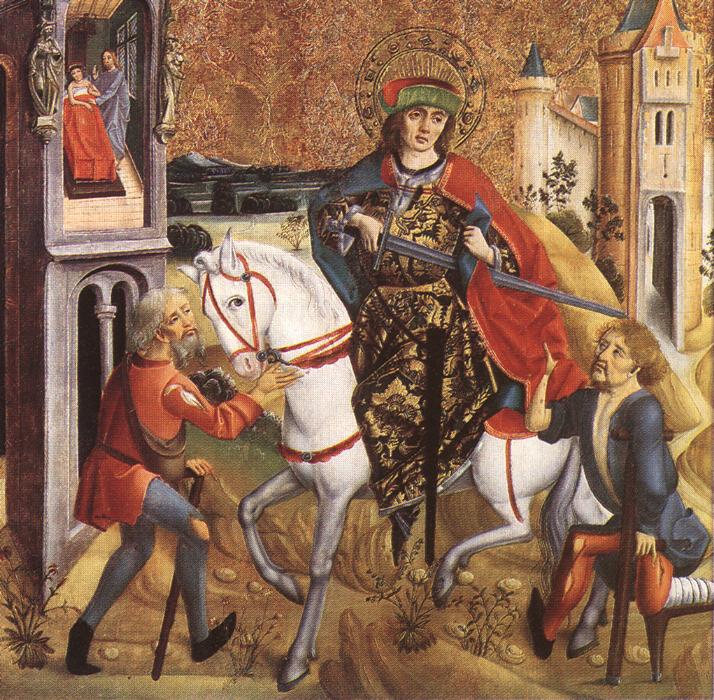
Once I was a clever boy learning the arts of Oxford... is a quotation from the verses written by Bishop Richard Fleming (c.1385-1431) for his tomb in Lincoln Cathedral. Fleming, the founder of Lincoln College in Oxford, is the subject of my research for a D. Phil., and, like me, a son of the West Riding. I have remarked in the past that I have a deeply meaningful on-going relationship with a dead fifteenth century bishop... it was Fleming who, in effect, enabled me to come to Oxford and to learn its arts, and for that I am immensely grateful.


Showing posts with label St Martin. Show all posts

Friday, 13 November 2015

St Brice


Today is the feast of St Brice.

Gordon Plumb posted as follows on the Medieval Religion discussion group about him:

Brice (died 444) was bishop of Tours. He was educated at Martin's monastery at Marmoutiers, though eventually becoming a critic of him. Nevertheless, he succeeded Martin in 397. His long episcopate was marked by ups and downs, with him being accused of adultery on one occasion. Brice went to Rome and was finally vindicated and he returned to Tours after a seven year exile. By 470 his cult was established at Tours, spreading soon to Italy and England. He was almost universally present in English monastic calendars before 1100 and his feast was also in the Sarum calendar.

Wells Cathedral, sII, A2, c.1325:

Wells Cathedral, SIII, 2a-3a, c1340-45:
https://www.flickr.com/photos/22274117@N08/14969512111

John Dillon posted as follows on the same site:

According to Sulpicius Severus (_Dialogi_, 3. 15), Brictius (also Brictio, Briccius, Brixius, etc.; in French and in English usually Brice) was raised by St. Martin of Tours and succeeded him in that see. Attested since the time of bishop St. Perpetuus (d. 491), his cult is closely connected with that of his mentor. St. Gregory of Tours relates a story (Historia Francorum, 2. 1) in which Brictius is said to have maligned Martin both during the latter's lifetime and afterward. As punishment for this, according to Gregory, when Brictius had served as bishop for thirty-three years he was unjustly driven from Tours by its inhabitants who believed, wrongly, that he had impregnated a dedicated virgin who had then carried her child to term. Brictius' accusers were unpersuaded both when he commanded the woman's month-old baby to declare whether he were its father, whereupon the baby said that Brictius was not, and when, to prove his purity, he carried hot coals in his robe to Martin's grave without their causing damage to the garment. His exile lasted for seven years, during which time he betook himself to Rome, confessed to the Pope his sins against Martin's good name, and remained there as a penitent priest. Returning by papal authorization, Brictius entered Tours just after the death of the second of his two successors, resumed his seat, and served happily for another seven years. Thus far Gregory of Tours, whose narrative Jacopo da Varazze follows very closely in his abbreviation in the Legenda aurea (ed. Graesse, cap. 167). Brictius is usually said to have died in about the year 444.


Supplementing Gordon Plumb's post of earlier today, herewith some links to other period-pertinent images of Brictius of Tours (the suffix distinguishes him from his homonyms of Orvieto and Heiligenblut):

a) as depicted (three scenes: accused of fathering the baby; casting hot coals at Martin's grave; commanding the baby to speak) in the late twelfth-century Navarre Picture Bible (1197; Amiens, Bibliothèque Louis Aragon, ms. 108, fols. 243r,244v):
http://www.enluminures.culture.fr/Wave/savimage/enlumine/irht3/IRHT_060531-p.jpg
Detail view (accused of fathering the baby):
http://www.enluminures.culture.fr/Wave/savimage/enlumine/irht3/IRHT_060529-p.jpg
Detail view (commanding the baby to speak):
http://www.enluminures.culture.fr/Wave/savimage/enlumine/irht3/IRHT_060532-p.jpg

b) as depicted (at left; at right, St. Martin of Tours) in an earlier thirteenth-century choir window (w. 217) in the cathédrale Saint-Étienne in Bourges:


c) as depicted (commanding the baby to speak) in an earlier thirteenth-century collection of saint's lives in their French-language translation by Wauchier de Denain (between 1226 and 1250; London, BL, Royal 20 D VI, fol. 127r):
http://www.bl.uk/catalogues/illuminatedmanuscripts/ILLUMIN.ASP?Size=mid&IllID=42726

d) as depicted (commanding the baby to speak) in a late thirteenth-century copy of French origin of the Legenda aurea (San Marino, CA, Huntington Library, ms. HM 3027, fol. 156v):
http://digitalassets.lib.berkeley.edu/ds/huntington/images//000919A.jpg

e) as depicted (commanding the baby to speak) in a late thirteenth-century collection of saint's lives in French (1285; Paris, BnF, ms. Français 412, fol. 127r):
http://gallica.bnf.fr/ark:/12148/btv1b84259980/f263.item.zoom

f) as depicted (commanding the baby to speak) in a late thirteenth- or early fourteenth-century breviary for the Use of the abbey of Montier-la-Celle (Paris, BnF, Nouvelle acquisition latine 3241, fol. 190v):
http://gallica.bnf.fr/ark:/12148/btv1b6000034g/f390.item.zoom

g) as depicted (at left; at right, St. Martin of Tours) in an earlier fourteenth-century copy of the Legenda aurea in its French-language version by Jean de Vignay (ca. 1326-1350; Paris, BnF, ms. Français 185, fol. 173r):
http://tinyurl.com/yezr24z

h) as depicted (at right; at left, St. Martin of Tours) in an earlier fourteenth-century copy, from the workshop of Richard and Jeanne de Montbaston, of the Legenda aurea in its French-language version by Jean de Vignay (1348; Paris, BnF, ms. Français 241, fol. 304r):
http://tinyurl.com/yhnr4sg

i) as depicted in a late fourteenth- or early fifteenth-century copy of the Legenda aurea in its French-language version by Jean de Vignay (Rennes, Bibliothèque de Rennes Métropole, ms. 266, fol. 316r):
http://tinyurl.com/p92rwbf

j) as depicted in an early fifteenth-century copy of the Legenda aurea in its French-language version by Jean de Vignay followed by the Festes nouvelles attributed to Jean Golein (c. 1401-1425; Paris, BnF, ms. Français 242, fol. 256r):
http://gallica.bnf.fr/ark:/12148/btv1b8426005j/f527.item.zoom

k) as depicted (receiving the last rites) in an early fifteenth-century copy of the Elsässische Legenda aurea (1419; Heidelberg, Universitätsbibliothek, Cod. Pal. germ. 144, fol. 194v):
http://digi.ub.uni-heidelberg.de/diglit/cpg144/0404

l) as depicted (bringing hot coals to Martin's grave) by the court workshop of Frederick III in a mid-fifteenth-century copy of the Legenda aurea (1446-1447; Vienna, Österreichische Nationalbibliothek, cod. 326, fol. 243r):
http://tarvos.imareal.oeaw.ac.at/server/images/7006892.JPG

m) as depicted (commanding the baby to speak) in a later fifteenth-century copy from Bruges of the Legenda aurea in its French-language version by Jean de Vignay followed by the Festes nouvelles attributed to Jean Golein (ca. 1460-1470; Mâcon, Médiathèque municipale, ms. 3, fol. 44v):
http://www.enluminures.culture.fr/Wave/savimage/enlumine/irht6/IRHT_095326-p.jpg

n) as depicted (commanding the baby to speak) in a late fifteenth-century breviary for the Use of Langres (after 1481; Chaumont, Mediathèque de Chaumont, ms. 33, fol. 516v):
http://www.enluminures.culture.fr/Wave/savimage/enlumine/irht6/IRHT_097091-p.jpg

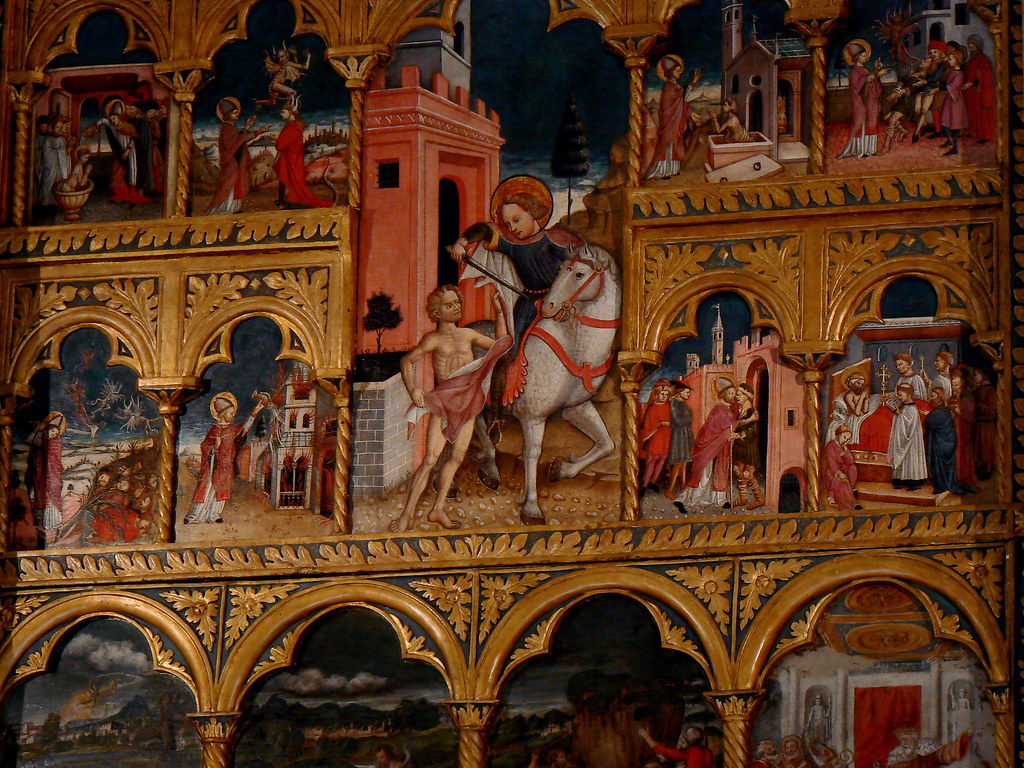
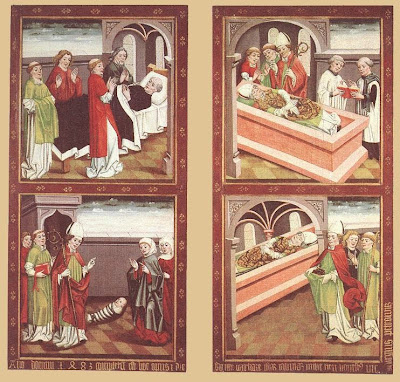
o) as depicted (four scenes) in a late fifteenth-century panel painting (1483) in the Magyar Nemzeti Galéria, Budapest:
 https://blogger.googleusercontent.com/img/b/R29vZ2xl/AVvXsEhPuLx-5iSGmxEISXI-yahOXxUKkc85d-b2LaybWdWLMDzHa2cfLSbyHRnCZE75yBuVhNlVNz_MEs9x0_jnC3Nxo3d23k3aZUmeUpmt91QfmH83RYMi7kffsd9bjiAdJ8UN2rdrY4Ja4zI/s1600/csereny2.jpg

Detail view (bringing hot coals to Martin's grave):


p) as portrayed (at right, flanking St. John the Evangelist; at left, St. Martin of Tours) as portrayed in a late fifteenth-century wooden sculpture (1483) from the high altar of the church of St. Martin, Cserény and now in the Magyar Nemzeti Galéria, Budapest:

 SS. Martin, John the Evangelist and Brice

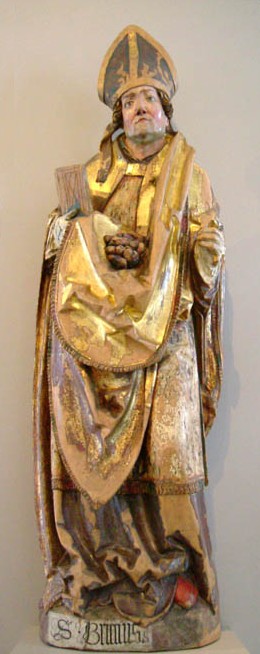
q) as portrayed in an early sixteenth-century polychromed limewood statue (ca. 1510-1520) in the Badisches Landesmuseum Karlsruhe:
 https://www.heiligenlexikon.de/Fotos/Brictius_von_Tours.jpg


Another list member asked about the the St Brice's Day Massacre during the reign of King Aethelred II (https://en.wikipedia.org/wiki/St._Brice%27s_Day_massacre): This raises a question: did his cult fall out of favour around 1100, and if so, was it at least in part due to the massacre, or did Saxon saints in general fall out of favour in the wake of the Norman invasion? [The Clever Boy suspects the latter is the answer]

I have posted about the St Brice's Day massacre, and in particular its place in the history of Oxford in
Massacre in Oxford and also tangentially in Decapitating Vikings in Dorset

Finally on the website New Liturgical Movement Gregory DiPippo posted an article about the saint in  The Feast of St Brice, St Martin’s Bad Disciple 


Wednesday, 11 November 2015

St Martin


Today is the feast of St Martin of Tours, the first non-martyr to have a recognised cult, and a very popular saint in the middle ages - as is indicated by the wide distribution of the images below.

On the Medieval Religion discussion group Gordon Plumb posted the following stained-glass depictions of St Martin:

Beverley Minster, east window, panels of c.1235:
1e, Martin dividing cloak with beggar:
https://www.flickr.com/photos/22274117@N08/3370751437
2a: St Martin among robbers:
https://www.flickr.com/photos/22274117@N08/3370748595
2h: Dream of St Martin:
3h: St Martin chosen as bishop:
https://www.flickr.com/photos/22274117@N08/3370766983
https://www.flickr.com/photos/22274117@N08/3371577724
3b: Miraculous mass of St Martin:
https://www.flickr.com/photos/22274117@N08/3371584594
4h: Death of St Martin:
https://www.flickr.com/photos/22274117@N08/3371590234

Tours Cathedral, bay4, St Martin window, c.1300:
https://www.flickr.com/photos/22274117@N08/14915306224
and detail:
register 4, Martin and the miracle of the pine; Martin baptizes:
https://www.flickr.com/photos/22274117@N08/15536918582

Exeter Cathedral, Choir Clerestory, east window, c.1301-1304:
https://www.flickr.com/photos/22274117@N08/2886163886

York St Martin cum Gregory, sII, 2b-3b, Martin dividing cloak with beggar, c.1340.:
https://www.flickr.com/photos/22274117@N08/4093266976
and detail:
https://www.flickr.com/photos/22274117@N08/4093261040

York St Martin--le-Grand, Coney Street, nII, Life of St Martin, a set on images of the window, c.1440:
https://www.flickr.com/photos/22274117@N08/albums/72157603903400734

Dewsbury Minster, north transept window, 2c, arms of St Martin:
https://www.flickr.com/photos/22274117@N08/4009638434

Shrewsbury, St Mary, south aisle, south-west window, glass from Musterbilzen in Belgium:
https://www.flickr.com/photos/22274117@N08/3180236634

St Nicholas-de-Port, bay 20, St Martin and the beggar, 1514-20 by the workshop of Valentin Bousch:
https://www.flickr.com/photos/22274117@N08/15603129316

John Dillon supplemted Gordon Plumb's posting by adding additional period-pertinent images of St. Martin of Tours:

a) as depicted (at far left) in the heavily restored later sixth-century mosaics (c. 560) in the nave of Ravenna's basilica di Sant' Apollinare Nuovo:

 https://blogger.googleusercontent.com/img/b/R29vZ2xl/AVvXsEiUlfvXORG2JtV4s-b02823lFTyBQre0XH2hc8E6oRAQlfxjxgfM0vRMLUxICpsxXhfQ8WDsCqvCjKXMSpVHhtFSRTIryKFf7Gku-vFIhVt18S5EAImM51sUaZ9VoA7E1ruPDGPRZwSGy5u/s1600/IMG_3936med.jpg

b) as portrayed on one of the very late eleventh-century capitals in the cloister (consecrated, 1100) of the abbaye de Saint-Pierre at Moissac:
http://p2.storage.canalblog.com/28/53/610887/78802475_o.jpg

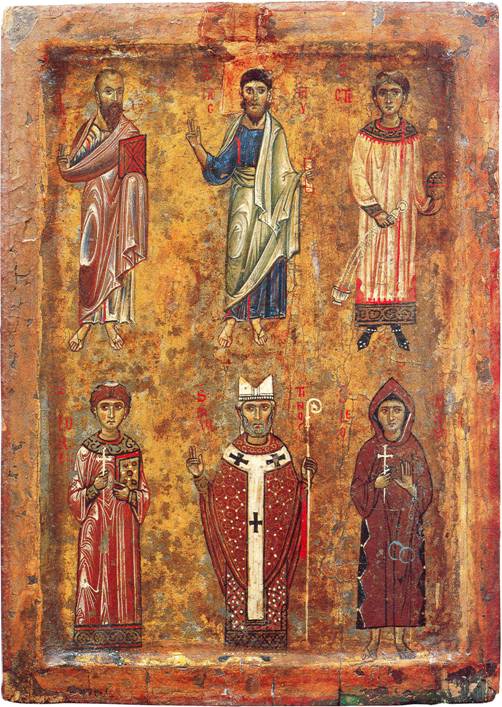
c) as depicted (at centre in lower register, between Sts. Lawrence of Rome and Leonard of Noblac) in a twelfth-century icon of Byzantine origin or inspiration in the Holy Monastery of the God-trodden Mount Sinai in St. Catherine (South Sinai governorate):

 http://www.forum-orthodoxe.com/images/stmartindetours.jpg


d) as depicted in a somewhat restored seemingly earlier twelfth-century mosaic in the diaconicon of the basilica (ex-cattedrale) di Santa Maria Assunta on Torcello:
http://tinyurl.com/26vvdrv
http://tinyurl.com/25a2z44

e) as depicted in an earlier twelfth-century legendary from the abbey of Cîteaux (between 1101 and 1133; Dijon, Bibliothèque municipale, ms. 641, fol. 113r):

http://www.culture.gouv.fr/Wave/savimage/enlumine/irht6/IRHT_094818-p.jpg


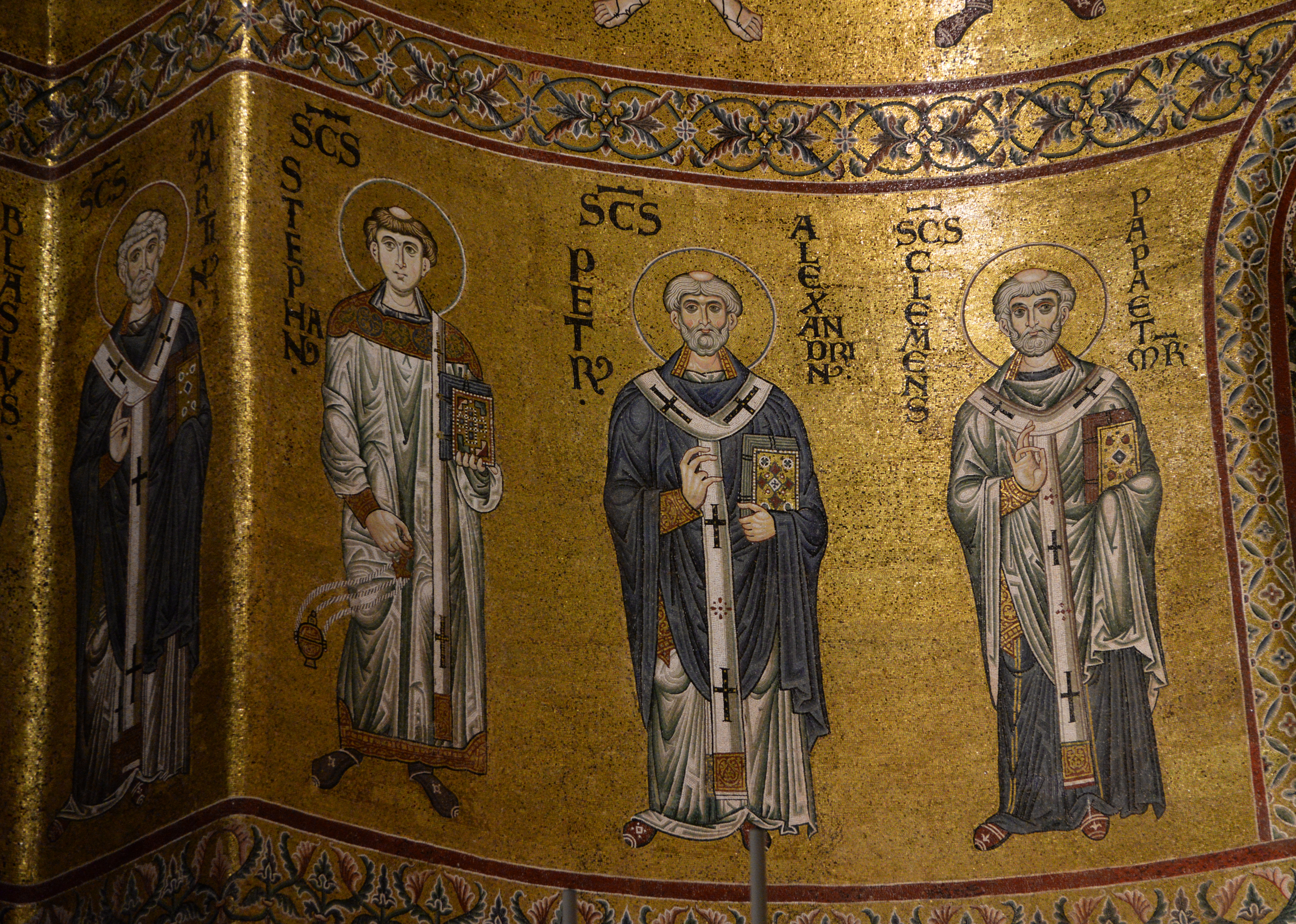
f) as depicted (at far left) in the late twelfth-century mosaics (c. 1182) in the sanctuary of the basilica cattedrale di Santa Maria Nuova in Monreale:


g) as portrayed in high relief in two locations on the right portal of the late twelfth or earlier thirteenth-century south porch of the basilique cathédrale Notre-Dame in Chartres:
1) On the right jambs (at left; at right, St. Jerome):
http://tinyurl.com/ostx422
Detail view:


2) On the tympanum (cutting his cloak):
http://tinyurl.com/ou6mnb5
Detail view:
http://tinyurl.com/nqfmnwc

h) as portrayed (scenes from his Vita) in four earlier thirteenth-century reliefs on the facade of the cattedrale di San Martino in Lucca:
http://tinyurl.com/27df48s
http://tinyurl.com/26rpoeb
http://tinyurl.com/2agms7o
http://tinyurl.com/29zfghw
There are detail views on this page:
http://tinyurl.com/32c6gkz

i) as depicted in the early thirteenth-century Life of St. Martin window (bay 7; c. 1215) in the cathédrale Saint-Étienne in Bourges:
http://www.medievalart.org.uk/bourges/07_pages/Bourges_Bay_07_key.htm
Detail view (cutting his cloak):
http://www.medievalart.org.uk/bourges/07_pages/Bourges_Bay_07_panel_01.htm

j) as depicted in the earlier thirteenth-century Life of St. Martin window (bay 102; c.1215-1225; restored, 1922 and 1995-1996) in the basilique cathédrale Notre-Dame in Chartres:
http://tinyurl.com/na6elhu
Detail view (cutting his cloak):

 https://s-media-cache-ak0.pinimg.com/736x/b2/4b/31/b24b312d70efcdb809034dc8c36a9aaf.jpg


k) as depicted (cutting his cloak) in an earlier thirteenth-century copy (c.1236-1250) of part of the Magnum legendarium Austriacum (Zwettl, Stiftsbibliothek, cod. 14, fol. 149r):
http://tarvos.imareal.oeaw.ac.at/server/images/7002565.JPG

l) as depicted in the earlier thirteenth-century Life of St. Martin window (bay 102b; c. 1240) in the cathédrale Saint-Maurice in Angers:
http://www.medievalart.org.uk/Angers/Bay_102b/Angers_Bay102b_Key.htm

m) as depicted (enthroned) in a mid-thirteenth-century pontifical from Mainz (between 1241 and 1251; Paris, BnF, Ms. Latin 946, fol. Av):


n) as depicted (cutting his cloak) in a late thirteenth-century copy of French origin of the Legenda aurea (San Marino, CA, Huntington Library, ms. HM 3027, fol. 156r):
http://digitalassets.lib.berkeley.edu/ds/huntington/images//000913A.jpg

o) as depicted (cutting his cloak) in the late thirteenth-century Livre d'images de Madame Marie (c. 1285-1290; Paris, BnF, ms. Nouvelle acquisition française 16251, fol. 89r):


p) as depicted (cutting his cloak) in an early fourteenth-century fresco in the cathédrale Saint-Gatien in Tours:
https://www.flickr.com/photos/biron-philippe/7585653434/

q) as depicted (scenes from his Vita) by Simone Martini in a series of early fourteenth-century frescoes (between 1312 and c. 1318) in the cappella di San Martino in the lower church of the basilica di San Francesco in Assisi:

 http://www.wga.hu/art/s/simone/3assisi/00view3.jpg


http://www.wga.hu/art/s/simone/3assisi/00view2.jpg
Detail views with captions:
http://www.wga.hu/frames-e.html?/html/s/simone/3assisi/index.html

r) as depicted (at top right in the major panels) by Giovanni di Bonino, perhaps working from a design by Simone Martini, in one of the three earlier fourteenth-century windows (after 1312) in the cappella di San Martino in the lower church of the basilica di San Francesco in Assisi:
http://www.wga.hu/art/s/simone/3assisi/scenes/99window.jpg
Detail view:

 http://www.akg-images.fr/Docs/AKG/Media/TR3_WATERMARKED/2/6/e/1/AKG286952.jpg


s) as portrayed in an earlier fourteenth-century elephant ivory statuette of German origin (c. 1320; Köln or Mainz) in the Victoria and Albert Museum, London:
http://tinyurl.com/nsnqkgh

 http://sargasso.nl/wp-content/uploads/2014/11/martinus_tours_1320_cologne_vam.jpg


t) as depicted (cutting his cloak) in an earlier fourteenth-century French-language legendary of Parisian origin with illuminations attributed to the Fauvel Master (c. 1327; Paris, BnF, ms. Français 183, fol. 165v):
http://tinyurl.com/nnuec2h

u) as depicted (at left; at right, St. Theodore the Stoudite) in the earlier fourteenth-century frescoes (between 1335 and 1350) in the narthex of the church of the Holy Ascension at the Visoki Dečani monastery near Peć in, depending on one's view of the matter, either the Republic of Kosovo or Serbia's province of Kosovo and Metohija:


v) as portrayed in high relief (consecration as bishop; cutting his cloak) on a mid-fourteenth-century polychromed ivory diptych (c. 1340-1350) of northern French or Flemish origin in the Cleveland Museum of Art:


w) as depicted (at lower right; cutting his cloak) in the mid-fourteenth-century San Martino altarpiece (seemingly later 1340s) from Oristano in the Antiquarium Arborense - Museo archeologico Giuseppe Pau, Oristano:

 http://www.antiquariumarborense.it/it/Museo/Sale/Immagini/retabloSanMartino1.jpg


x) as depicted (cutting his cloak) in a mid-fourteenth-century copy, from the workshop of Richard and Jeanne de Montbaston, of the Legenda aurea in its French-language version by Jean de Vignay (1348; Paris, BnF, ms. Français 241, fol. 300r):
http://tinyurl.com/pua5rvp

y) as depicted (cutting his cloak) in a mid-fourteenth-century vault painting (c. 1350) in Skibby Kirke at Skibby, Lejre Kommune, Sjælland:

 https://upload.wikimedia.org/wikipedia/commons/4/4c/Martin_af_Tours_(Skibby_Kirke).jpg


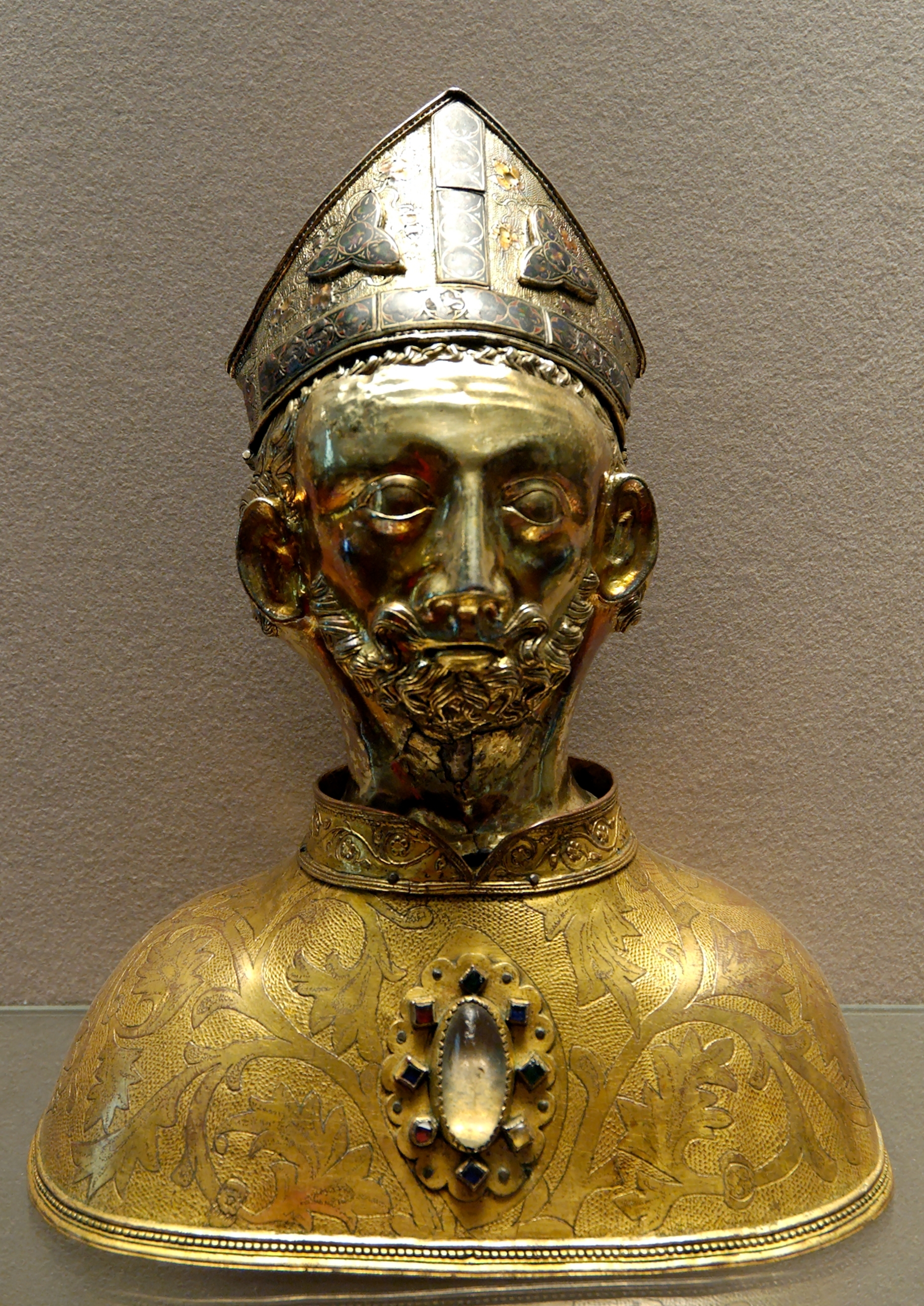
z) as portrayed in a late fourteenth-century reliquary bust (from Avignon?; restored in the twentieth century) in the Musée du Louvre in Paris:

 
 https://upload.wikimedia.org/wikipedia/commons/7/74/Head_reliquary_Martin_Louvre_OA6459.jpg


aa) as depicted (at top in the right margin; demanding a steep price of Clovis for the return of a horse) in the numerous pen-and-ink illustrations in the margins of an early fifteenth-century copy of the Chronicon a mundi creatione ad annum 1220, an abbreviation and continuation of the Pantheon of Godfrey of Viterbo (c. 1400-1415; Paris, BnF, ms. Latin 4935, fol. 8v):
http://gallica.bnf.fr/ark:/12148/btv1b8455934w/f26.image

bb) as depicted (at left; at right, brigands) in an earlier fifteenth-century embroidery of southern Netherlandic origin (c. 1430) in The Cloisters Collection of the Metropolitan Museum of Art, New York:

Saint Martin and the Brigands


cc) as depicted in grisaille (cutting his cloak) by Jean le Tavernier in the mid-fifteenth-century Hours of Philip of Burgundy (c. 1451-1460; Den Haag, KB, ms. 76 F 2, fol. 264v):
http://manuscripts.kb.nl/zoom/BYVANCKB%3Amimi_76f2%3A264v_min

dd) as depicted (upper right; cutting his cloak) by Girolamo di Giovanni of Camerino in a later fifteenth-century triptych (c. 1473) in the chiesa di San Martino Vescovo in Monte San Martino (MC) in the Marche:
http://tinyurl.com/q74m33o

Detail view:

 http://www.liricigreci.it/blog/wp-content/uploads/2013/06/polittico_girolamo_giovanni_monte_san_martino04.jpg


ee) as depicted (cutting his cloak) in a later fifteenth-century vault painting (c. 1474) in Jetsmark Kirke at Pandrup, Jammerbugt Kommune, Nordjylland:
http://tinyurl.com/pu5sh97

ff) as depicted (cutting his cloak and other scenes from his Vita) by the Master of the Galletti Chapel in a later fifteenth-century painted altarpiece (c. 1475-1480) in the crypt of the basilica cattedrale di San Martino in Belluno:
https://c1.staticflickr.com/3/2397/2177982293_8c1e640b3d_b.jpg

gg) as portrayed (with the beggar) in a later fifteenth-century statue (c. 1475-1480) of German origin in the Seattle Art Museum, Seattle (WA):

 http://www.wga.hu/art/m/master/zunk_ge/zunk_ge8/5martin.jpg


hh) as depicted in two late fifteenth-century panel paintings (c. 1490) on either side of a wing from a dismembered altarpiece in the Magyar Nemzeti Galéria, Budapest:
1) Cutting his cloak:

 http://www.wga.hu/art/m/master/zunk_hu/zunk_hu1/06martin.jpg


2) Celebrating Mass in shabby dress:


 http://www.wga.hu/art/m/master/zunk_hu/zunk_hu1/04martin.jpg


ii) as depicted (center panel; cutting his cloak) by Bartolomeo Vivarini in his late fifteenth-century Triptych of St. Martin (1491) in the Accademia Carrara, Bergamo:

 http://passaggioadovest.ilserio.it/immagini/Trittico.JPG


jj) as portrayed (cutting his cloak) in high relief in a late fifteenth- or early sixteenth-century sculpture (c. 1500), from Bjæverskov Kirke in Sjælland, in the Nationalmuseet, Copenhagen:


 https://wuhstry.files.wordpress.com/2015/10/imag0667_burst0021.jpg


kk) as depicted (cutting his cloak) in an embroidered early sixteenth-century cope shield (between 1500 and 1509) in the Museum Catharijneconvent in Utrecht:

 https://upload.wikimedia.org/wikipedia/commons/thumb/2/29/MCC-31218_Koorkapschild_met_St._Maarten_te_paard_en_bedelaar%2C_ingelijst_%281%29.tif/lossy-page1-1024px-MCC-31218_Koorkapschild_met_St._Maarten_te_paard_en_bedelaar%2C_ingelijst_%281%29.tif.jpg?1447199959777


Tuesday, 20 October 2015

Early polyphony


George Ferzoco has posted the following note on the Medieval Religion discussion group about an item on the Cambridge University website:

He wrotes "It does the heart good to see that such major discoveries continue to be made.

It’s from the early 900s (not 1900s, but 900s), and it’s a chant dedicated to St Boniface."

As the post explains the source appears to be in a monastery in NW Germany.

The article can be viewed at:
http://www.cam.ac.uk/research/news/earliest-known-piece-of-polyphonic-music-discovered

Scroll down the contents page to the link, which includes a video of a performance of the music.

Laura Jacobus added these images of polyphony:
Colleagues might also enjoy these images of polyphonic singers (as far as I know, the first times polyphony has been depicted) - both are at Assisi

http://uploads7.wikiart.org/images/giotto/st-francis-of-assisi-preparing-the-christmas-crib-at-grecchio-1300.jpg

St Francis preparing the Christmas Crib at Grecchio


upload.wikimedia.org/wikipedia/commons/d/d0/Simone_Martini__St._Martin_is_Knighted_(scene_3)_-_WGA21370.jpg
(showing secular minstrels in corner )

 https://upload.wikimedia.org/wikipedia/commons/8/83/Simone_Martini_-_Burial_of_St_Martin_(scene_10)_-_WGA21391.jpg

Simone Martini St. Martin Chapel- monastic singers are also shown in the Funeral of St Martin, though not obviously polyphonic


Bonnie Blackburn explained the visual imagery as follows:

We can't be sure that they are singing polyphony (i.e. different melodies at the same time) rather than chant. When we see angels with choirbooks, then we know it is polyphonic, because chant was traditionally learnt by heart by the clergy, and we have no records of notation, let alone polyphony, before the early 9th century (this is why Giovanni Varelli's discovery is so spectacular). By the fourteenth century polyphony came to be valued as something special, and angels singing polyphonically became fashionable for artists (see the painting of Mary Queen of Heaven by the Master of the St Lucy legend in the National Gallery in Washington, where we can read the music, a known Marian motet by Walter Frye, Ave regina caelorum).


Tuesday, 13 January 2015

St Hilary and St Martin


Today is the feast of St Hilary of Poitiers, the fourth century Gaulish champion of orthodoxy in respect of the Divinity of Christ.

He also was the bishop who ordained St Martin of Tours as an acolyte. In this panel from the St Martin window in the church of St Martin in York St Martin is depicted as acolyte at a Mass celebrated by St Hilary. The window dates from circa 1442, and was the gift of the vicar Robert Semer. Originally the west window of the church it was removed in 1940 and so survived the bombing of the church in 1942. In the peculiar, and to my mind, highly dubious scheme of restoration of part of the church - once a fine moid-fifteenth century building - it is now situated in the new north wall.

photo

Image: Gordon Plumb on Flickr

Friday, 11 November 2011

St Martin


Today is the feast of St Martin, the first non-martyr saint. Last year I posted in my article St Martin about some aspects of his cult.

There is an article on his ancient Basilica in Tours, sacked in 1562 and wantonly destroyed in 1793, and on its modern replacement here, which also has illustrations of two fine thirteenth century glass panels illustrating scenes from his story.

http://img.groundspeak.com/waymarking/display/115d7ae7-e774-4cd8-8a55-8e7882bae29f.jpg

La Tour de l'Horloge.
One of the two remaining towers of the medieval basilica - the
street runs through the site of the great church.
The dome of the modern replacement can be seen behind it.

Image: waymarking.com

It is an opportunity to look at some more historic images of the saint, who has been very popular with the faithful, and who, as a consequence, often appears in the art they commissioned. The choice of scenes, as in the glass at St Martin's in York I linked to last year, indicates the awareness of the range of stories about St Martin and of the Life by Sulpicius Severus which recorded them.

St Martin was seen by the Franciscans as a significant anticipator of the life of St Francis, as expounded in a talk earlier this year at the Oxford Centre for Franciscan Studies. Here from the cycle of paintings by Simone Martini from 1313-18 decorating the Chapel of St Martin in the Lower Church ar Assisi is the death of St Martin:


File:Simone Martini 041 bright.jpg

Image: Wikipedia

The details of the vestments repay some study - they may not be those of the late fourth century, though they are perhaps not that different, but they do definitely indicate the splendour of the early fourteenth century.

The other paintings can be vioewd through links on the Chapel of St Martin page.

This painting, being now in Australia, is perhaps less well known in the northern hemisphere than it deserves to be, with two of the most popualr saints of the middle ages as depicted by a mid-fifteenth century artist. It is also interesting for its depiction of contemporary vesture, both clerical and lay:

http://www.friendsofart.net/static/images/art1/unknown-german-master-mid-15th-century-III-st-martin-of-tours-and-st-nicholas-of-bari.jpg

St Martin and St Nicholas
German c.1450
Art Gallery of South Australia, Victoria

Image: friends-of-art

The following image I have included as a depiction of the celebration of Mass in the mid-fifteenth century and the setting and appurtenances of worship:

<span class=

Miraculous Mass of St. Martin of Tours
Franconian School c1440

Samuel H. Kress Collection (1961.045)
Image: www.renaissanceconnection.org


Thursday, 10 November 2011

Mass for Martinmas


For those who may be able to attend I have just been informed that there will be an Extrordinary Form Mass offered for St Martin's Day - Martinmas - at the church of SS Gregory and Augustine in Woodstock Road here in Oxford tomorrow evening at 6 pm.

Thursday, 11 November 2010

St Martin


Today is the feast of St Martin of Tours (316-397). He was the first confessor saint to be afforded liturgical honours and is the patron of numerous churches and cathedral across Europe. The Wikipedia article about him and his cult, with appropriate links, is here. The key text of the life of St Martin by Sulpicius Severus can be read here.

In a biography of St Martin I read some years ago there is the argument that in Britain missionary communities inspired by St Martin's life and example often placed their churches under his patronage. This seems to be borne out by churches such as St Martin in Canterbury - usually thought to pre-date St Augustine's mission of 597 - St Martin in the Fields in London, where recent excavations found late Roman burials underneath the present church, rebuilt in the early eighteenth century in its present form, and the cathedral of St Martin at Whithorn, established by St Ninian. It occurs to me that he is not infrequently found as a patron of histotic churches in cities with Roman origins. I do not know how far the theory has been tested, but it is an attractive one, and one I think plausible. It does, of course, depend on an accurate transmission of the dedication - something which has been questioned in south-west England. In the areas I know well I am not sure, but in most cases dedications seem well established, or changes are recorded.

In my home area there is the fine medieval church of St Martin at Womersley.

<span class=Womersley, The Church of St Martin" src="http://s0.geograph.org.uk/photos/26/06/260618_86ef3667.jpg">
Womersley, The Church of St Martin
© Copyright Gordon Kneale Brooke


<span class=Womersley, Church of St Martin, Interior" src="http://s0.geograph.org.uk/photos/26/06/260643_8c5322f6.jpg">

Womersley, Church of St Martin, the nave and Rood screen

Situated on the magnesian limestone ridge it is built of excellent local stone and has some Anglo-Catholic fine furnishings by G.F.Bodley, who carried out a sympathetic and striking renovation in the 1890s. Unfortunately the stencilled decoration he included has largely disappeared. Nonetheless with some beautiful glass and vestments it was, when I knew it, a prayerful building.

Womersley includes the site of a Roman villa or farmstead, and there have been other Roman finds within the parish, as there has of a pagan Anglo-Saxon burial with grave goods. Given that this part of what is now Yorkshire remained under Christian rule, in the kingdom of Elmet until the beginning of the seventh century, and only a generation or so before St Paulinus' mission in 625 to convert the north - where he found churches which had been deserted by their British clergy - the evidence of late Roman occupation, a pagan Anglo-Saxon presence and a church dedicated to a St Martin whose cult appears to have spread soon after his death in 397, all gathered together in a classically English village setting suggests that Womersley, on well drained land above the marshes to the east and the more wooded clay soils to the west , and not far from Roman roads and routes that have remained in use, may, and I only write may, be an argument for continuity of settlement from the Roman period onwards. It is a complex question, but this looks a tempting example.

Also in my home area, in the city of York is the church of St Martin le Grand in Coney Street. This was a fine mid-fifteenth century church , but tragically was bombed in 1942, and "restored" in the 1960s, which in my opinion, and as we would say up north, made a right mess of it. (Yes, I know the Luftwaffe messed it up to start with but that is no reason not to restore it properly. It is, in my opinion one of G.G. Pace's awful designs, though one website says it is "considered to be one of the best designs by architect George Pace". The whole thing smacks of the diocese of York ridding itself of unwanted and unloved churches).

It is the church where St Margaret Clitherow was baptized and married, so she would have seen the St Martin window.

Mercifully this, the great west window of circa 1442, and the gift of the vicar Robert Semer, had been removed at the beginning of the war and survived, and is still to be seen on site.

photo

The figure of St Martin,
from the window in St Martin le Grand York,
given by the vicar, Robert Semer, circa 1442

Photo by Gordon Plumb


There are details of the window here, in photographs again by Gordon Plumb and also here, which highlights the episodes from St Martin's life as depicted in the window, and shows that Sulpicius Severus' life of the saint remained known.

And finally, simply because I like the paintings of El Greco, here is his depiction of the saint dividing his cloak. Although completely anachronistic in its dress and setting, it does convey the idea of Martin the idealistic young officer impelled to an act of Christian charity.

http://www.salemcatholic.org/wp-content/uploads/2009/11/St-Martin-of-Tours-El-Greco.jpg

El Greco St Martin and the Beggar c.1597-99
National Gallery of Art,
Washington D.C.