Once I was a clever boy learning the arts of Oxford... is a quotation from the verses written by Bishop Richard Fleming (c.1385-1431) for his tomb in Lincoln Cathedral. Fleming, the founder of Lincoln College in Oxford, is the subject of my research for a D. Phil., and, like me, a son of the West Riding. I have remarked in the past that I have a deeply meaningful on-going relationship with a dead fifteenth century bishop... it was Fleming who, in effect, enabled me to come to Oxford and to learn its arts, and for that I am immensely grateful.


Showing posts with label Bourges cathedral. Show all posts

Sunday, 1 January 2017

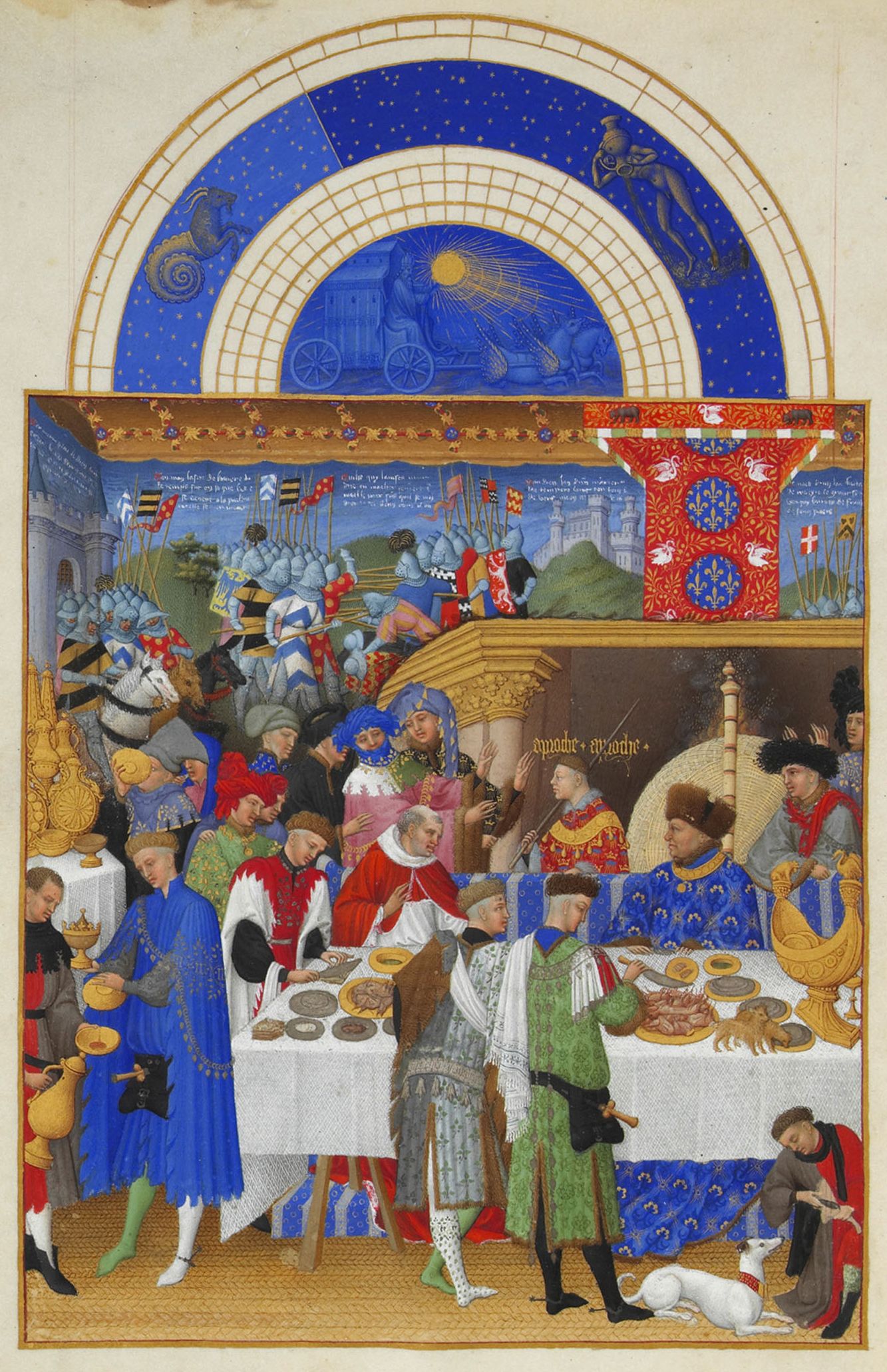
January


Image:Wikipedia

The Duke of Berry (1340-1416), of whom there is an online biography here, is depicted dressed in blue and wearing a livery or chivalric collar and seated to the right, and wearing a handsome fur hat to indicate his status, celebrates the Christmas and Epipany seasons. There appears to be the exchange of gifts - New Year or Epiphany ones - and a cultivated and splendid lifestyle. This is a pattern which would have been replicated or emulated across Europe in royal and aristocratic households.

The importance of the Duke is further indicated by the canopy and cloth of estate with his arms above his head. The tapestries or hangings with their battle scenes which decorate the room are a further sign of wealth. They would have travelled with the household and been hung to decorate whichever residence was in use at the time. What today might appear the rather stark interior of later medieval residences  could have rapidly been transformed by such wallhangings - which also would have provided insulation. A superb contemporary set which depicts the Apocalypse have survived and can be seen at Angers in the castle. In a similar way the trestle table once covered with a fine linen cloth assumes far greater dignity.

The firescreen is also an interesting feature, as is the woven rush matting - rushes on the floor clearly did not mean a strewn hay stack as one might be led to believe, but a fitted covering in such a grand household. Similar floor coverings can be seen today in some National Trust properties such as Hardwick Hall in Derbyshire.

On the left is a sideboard or buffet with a display of gold plate as was expected on such occasions to display princely magnificence, and other splendid plate is in use at the feast, as well as an aquamanile for washing the hands of those dining at the table. The pieces shown are very similar to the relatively few surviving examples from the period in museums and collections such as those of the Oxford and Cambridge colleges. My post The Royal Gold Cup is about another surviving piece, now in the British Museum, of such splendid plate which is specifically linked to the Duke and his nephew King Charles VI.

The whole scene is redolent of courtly life, well mannered, polite, fashionable and stylish - even the greyhound has an air of elegant langour.

The painting is attributed to the artist identified as the 'the courtly painter'. 

The effigy of the Duke in the cathedral of St Etienne in Bourges by Jean de Cambrai shows a great similarity to the figure of him in the illumination:


Tomb of Jean, Duc de Berry

Image:courtauldprints.com


Duc de Berry.jpg

Image:Wikipedia

The Duke was a major player in the French political system both a member of the Royal family, being son of King Charles V, and as a grand seigneur with his appanage of Berry.  That so much of French  politics hinged on the rivalries between Royal Dukes such as Orleans, Burgandy and Berry when King Charles VI was periodically incapacitated by mental illness raised tensions and weakened the ability to respond to the potential threat posed by King Henry V.

Hoever at the beginning of January as the Duke and his court feasted they cannot have imagined the scale of that threat, or of its impact within the coming year.


Wednesday, 20 January 2016

St Sebastian


Being based in Oxford it seems only appropriate when offered by John Dillon via the Medieval Religion discussion group a series of images of St Sebastian to share them with readers on this the feast of the name saint of Lord Sebastian Flyte, the second son of the late Marquess of Marchmain.
Some of the later paintings reflect the choices made in the Italian renaissance by artists and patrons to depict the almost nude male form, as opposed to earlier traditions of representing St Sebastian, and do have, dare I suggest it, something in them of homoerotic sado-masochism - you can't say the Clever Boy fails to cater for all tastes amongst his readers.

Here is John's selection together with his introductory note:


The Roman martyr Sebastian (d. 3d cent.?) is first documented in the Depositio martyrum of the Chronographer of 354, where he is entered under today as a martyr of the Via Appia.  According to St. Ambrose of Milan, Sebastian was a native of that city who was martyred at Rome.  His legendary Passio (BHL 7543; ineptly ascribed to Ambrose) is our earliest source for this saint's frequently depicted attempted execution by arrows, of which so many pierced him that -- still according to the Passio -- he came to resemble a hedgehog.  The same account -- which is set in the the persecution of Diocletian and Maximian and which previously had detailed his support of the twins Mark and Marcellian and many others --  then gives a rapidly healed Sebastian a final colloquy with Diocletian after which the saint is clubbed to death in the Circus and his body is dumped into a nearby sewer.  Instructed by Sebastian in a vision, a Christian matron named Lucina retrieves his body and buries it at a location in the catacombs near the remains of the apostles (Peter and Paul, of course).  When the persecutions have ended Lucina converts her home into a church and gives it to the church of Rome.  Thus far the Passio.  Lucina's church is of course the titulus Lucinae, the predecessor of today's San Lorenzo in Lucina. The burial site specified in the Passio is that of Sebastian's martyrial church on the Via Appia Antica, after several rebuildings over the centuries today's basilica di San Sebastiano ad Catacumbas (or San Sebastiano f. l. M.).


Some period-pertinent images of St. Sebastian of Rome:

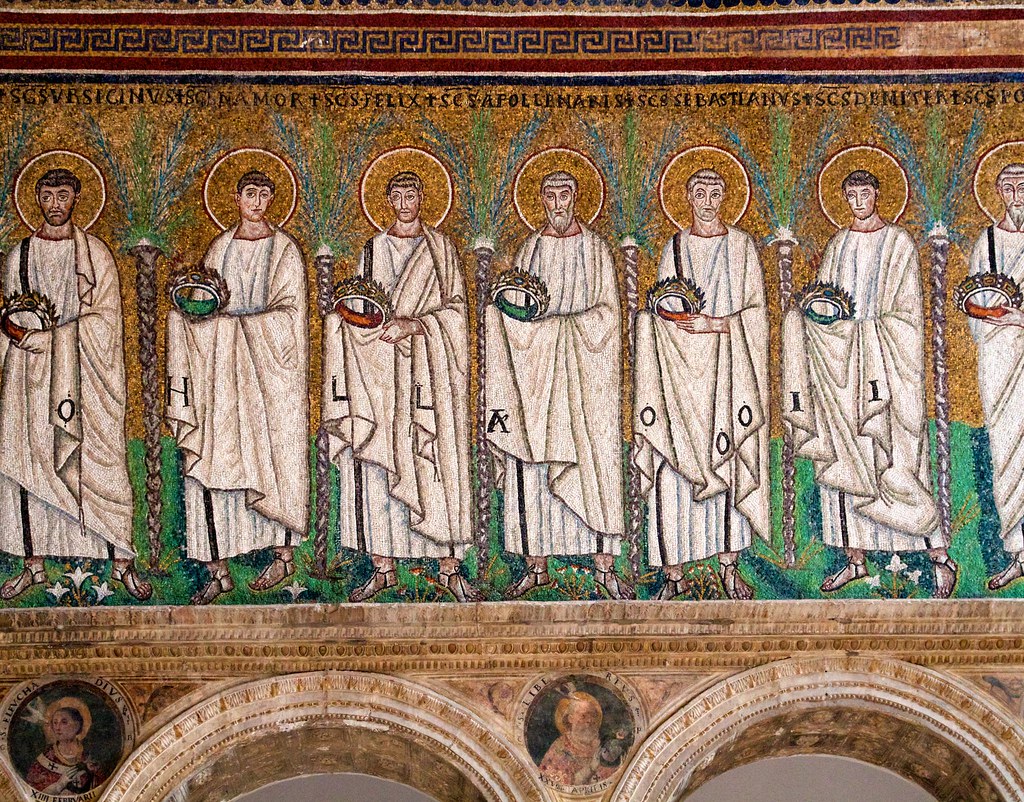
a) as depicted (third from right) in the heavily restored, later sixth-century procession of male martyrs (c. 561) in the nave of Ravenna's basilica di Sant'Apollinare Nuovo:

 
http://tinyurl.com/7lebx8n

b) as depicted in a probably late seventh-century mosaic portrait in Rome's basilica di San Pietro in Vincoli:


http://web.archive.org/web/20080227232948/http://bode.diee.unica.it/~giua/SEBASTIAN/PICS/vincoli.jpg


c) as depicted (upper register, martyrdom; lower register, St. Blasius / Blaise) in a later twelfth-century breviary for the canonesses of Seckau (Graz, UB, cod. 832, fol. 18r):
http://tarvos.imareal.oeaw.ac.at/server/images/7009800.JPG

d) as depicted (martyrdom) in one of four panels of a full-page illumination in the late twelfth-century so-called Bible of Saint Bertin (c. 1190-1200; Den Haag, KB, ms. 76 F 5, fol. 35v, sc. 1B):
http://manuscripts.kb.nl/zoom/BYVANCKB%3Amimi_76f5%3A035v_min_b1

e) as depicted (martyrdom) in an earlier thirteenth-century collection of saint's lives in their French-language translation by Wauchier de Denain (between 1226 and 1250; London, BL, Royal 20 D VI, fol. 48v):
http://www.bl.uk/catalogues/illuminatedmanuscripts/ILLUMIN.ASP?Size=mid&IllID=48231

f) as depicted (at left; St. Mary Magdalene at right) in a mid-thirteenth-century glass window (c. 1250-1260) in the west choir of Naumburg's Dom St. Peter und St. Paul:

 http://www.wga.hu/art/zgothic/stained/13c/12g_1250.jpg


g) as depicted (martyrdom) in a later thirteenth-century Cistercian psalter of upper Rhine origin (c. 1260; Besançon, Bibliothèques municipales, ms. 54, fol. 15r):
http://www.enluminures.culture.fr/Wave/savimage/enlumine/irht5/IRHT_083237-p.jpg

h) as depicted (martyrdom) in the later thirteenth-century frescoes (1278 or 1279) of Rome's chiesa di San Lorenzo in Palatio ad Sancta Sanctorum:
https://www.pemptousia.gr/wp-content/uploads/2014/12/ag.sebastianos22.jpg
A different interpretation (the BVM and St. John disporting themselves at archery?):
http://www.agefotostock.com/age/en/Stock-Images/Rights-Managed/DAE-11285236

i) as depicted (martyrdom) in a late thirteenth-century copy of French origin of the Legenda aurea (San Marino, CA, Huntington Library, ms. HM 3027, fol. 22v):
http://digitalassets.lib.berkeley.edu/ds/huntington/images//000969A.jpg

j) as depicted (at far right, martyrdom; at centre, Sts. Mark and Marcellian) in an earlier fourteenth-century copy of books 9-16 of Vincent of Beauvais' Speculum historiale in its French-language version by Jean de Vignay (c. 1335; Paris, BnF, ms. Arsenal 5080, fol. 218v):
http://gallica.bnf.fr/ark:/12148/btv1b7100627v/f442.item.zoom

k) as depicted (perhaps; the identifying inscription appears to have been re-painted) in the earlier fourteenth-century frescoes (between 1335 and 1350) in the church of the Holy Ascension in the Visoki Dečani monastery near Peć in, depending upon one's view of the matter, either the Republic of Kosovo or Serbia's province of Kosovo and Metohija:
http://tinyurl.com/6uubsp6

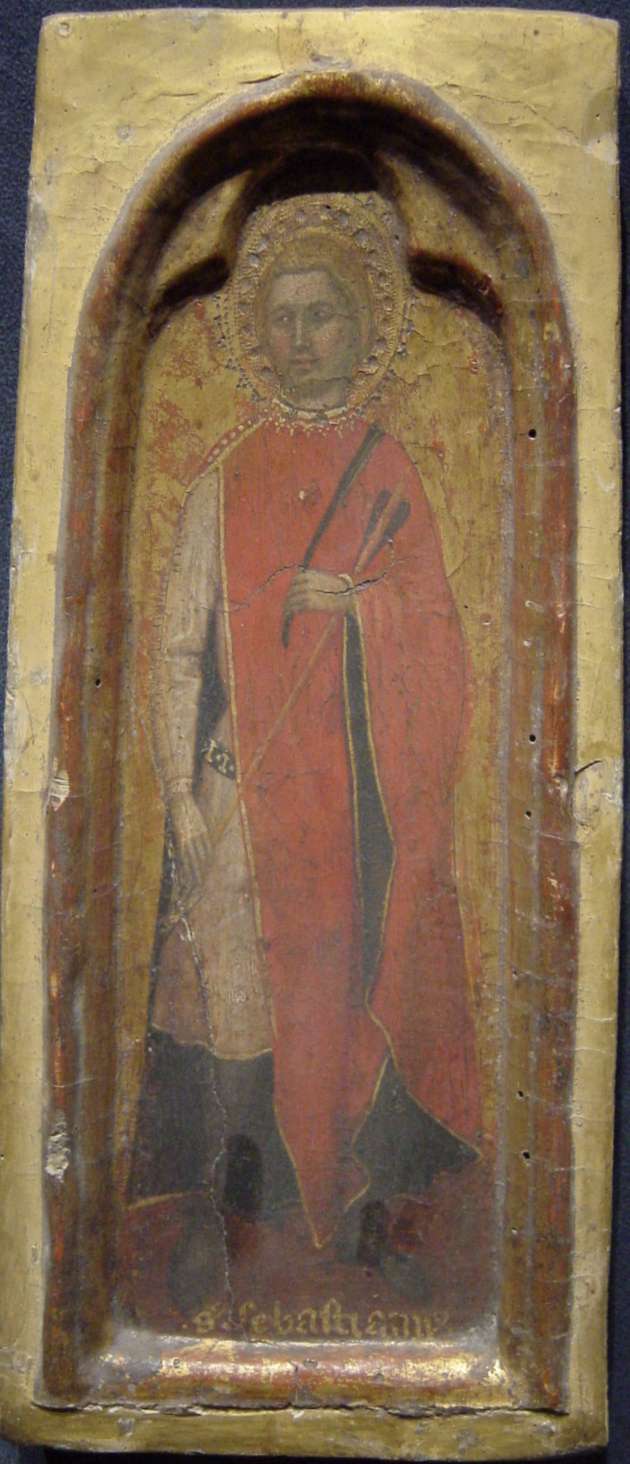
l) as depicted by Nicolò Semitecolo in several later fourteenth-century panel paintings (1367) in the Museo diocesano in Padua:
1) supporting Sts. Mark and Marcellian before the emperors:

 http://www.wga.hu/art/s/semiteco/2christi.jpg

2) martyrdom by arrows:

 https://upload.wikimedia.org/wikipedia/commons/6/63/Niccolo_Semitecolo._Sebastiano_trafitto_dalle_frecce._1367._53x60cm._Padova%2C_Museo_Diocesano.jpg

3) martyrdom by clubbing; his body dumped in a sewer:

https://upload.wikimedia.org/wikipedia/commons/f/f8/B_Nicol%C3%B2_Semitecolo._St_Sebastian_Beaten_with_Sticks._1367%2C_Padova%2C_Museo_Diocesano.jpg

4) entombment:
 https://upload.wikimedia.org/wikipedia/commons/4/4c/Nicol%C3%B2_Semitecolo%2C_Deposizione_del_corpo_di_San_Sebastiano_1367%2865%2C5x70cm%29Padova%2C_Museo_Diocesano.jpg


The Clever Boy would ad dthat these four paintings have some lovely fourteenth century details of interest in themselves - click on the link to see them in alarger format.

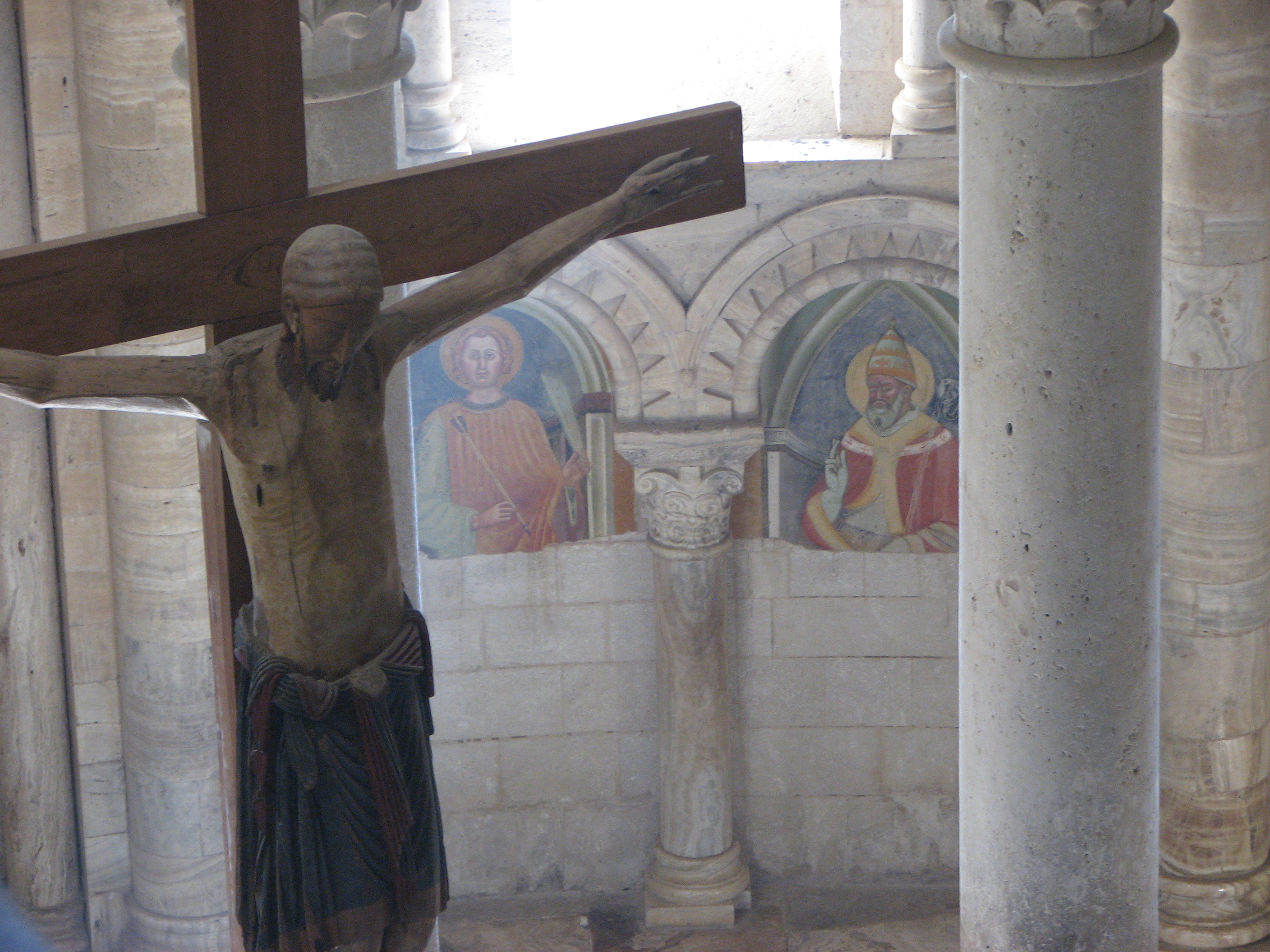
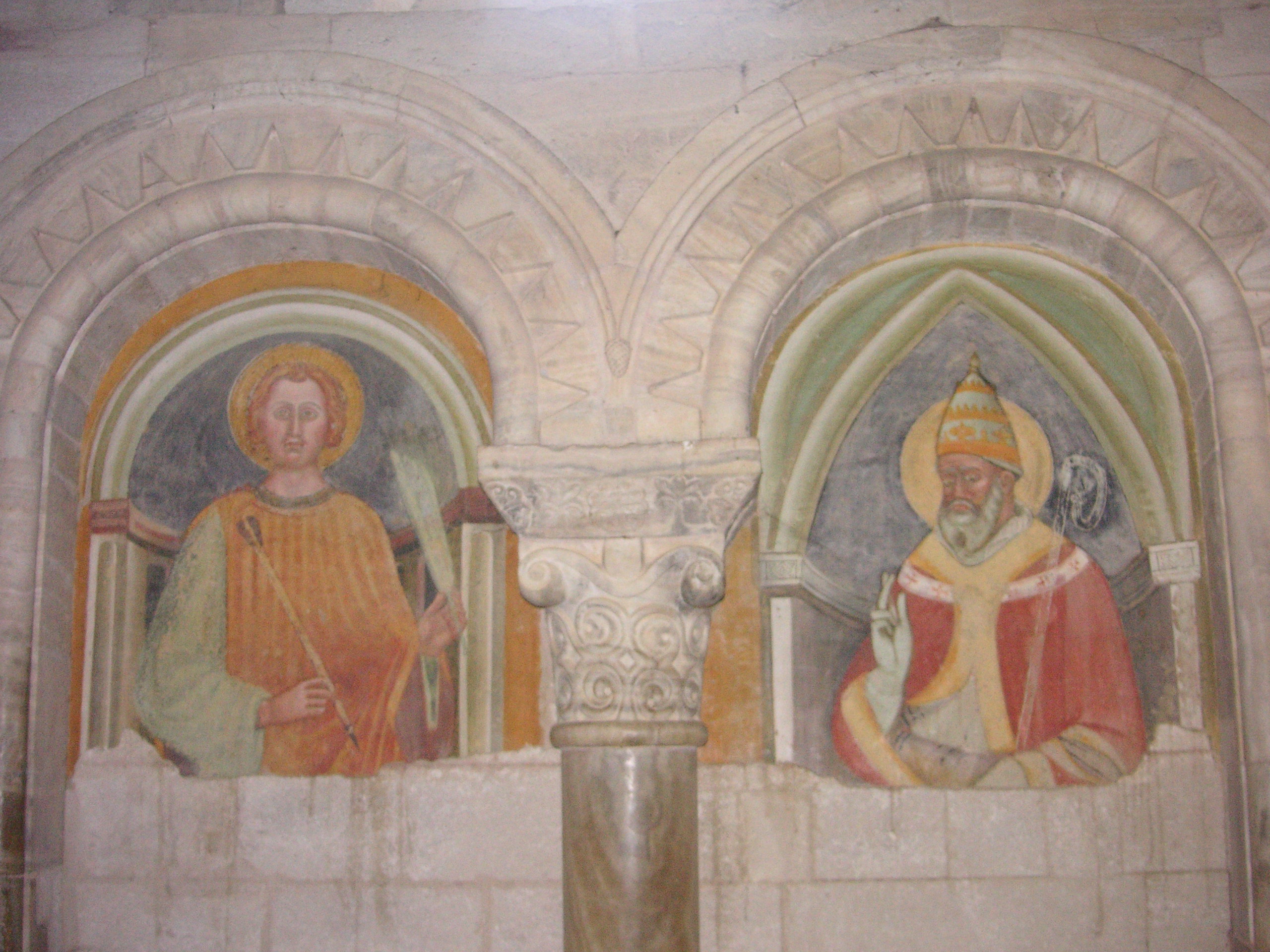
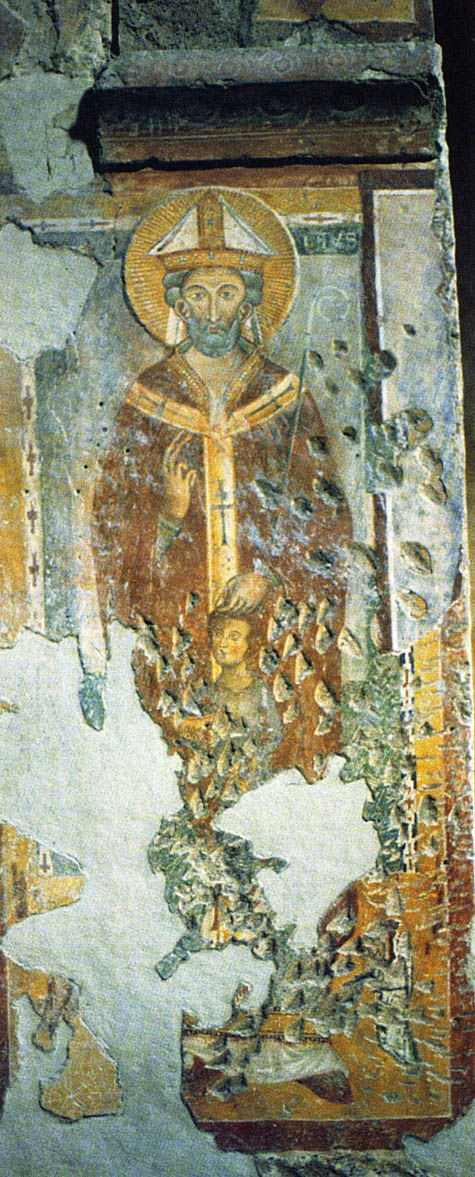
m) as depicted (at left; at right, a sainted pope) in a pair of late fourteenth- or fifteenth-century frescoes in the ambulatory of the abbey church of Sant'Antimo at Montalcino (SI) in Tuscany (the abbey claimed to possess relics of Sebastian given at its foundation in 781 by Pope Hadrian I, who supposedly had received them from Charlemagne):

 https://upload.wikimedia.org/wikipedia/commons/e/e2/Abbazia_di_Sant%27Antimo_-_53_-_Il_crocifisso_e_gli_affreschi_visti_dal_matroneo.jpg

https://upload.wikimedia.org/wikipedia/commons/4/46/Sant%27Antimo_affreschi.JPG


n) as depicted by Taddeo di Bartolo (martyrdom) in a remounted early fifteenth-century fresco (ca. 1400-1410) in Naples' Museo nazionale di Capodimonte:

 https://upload.wikimedia.org/wikipedia/commons/9/98/Taddeo_di_Bartolo_-_Saint_Sebastian.jpg

o) as depicted (martyrdom) in the Suffrages of the earlier to mid-fifteenth-century Hours of Françoise de Dinan (ca. 1435-1450; a.k.a. Hours of Catherine de Rohan and of Françoise de Dinan; Rennes, Bibliothèque de Rennes Métropole, ms. 34bis [pt. 2 of ms. 15942], fol. 87r):
http://www.tablettes-rennaises.fr/app/photopro.sk/rennes/detail?docid=6834#sessionhistory-ready
http://tinyurl.com/jyek5yp

p) as depicted by the Master of the Bodensee (second from left, after St. Anthony of Egypt, and with St George and St Ursula) in an earlier fifteenth-century panel painting in the Staatliche Kunsthalle Karlsruhe:
http://www.ipernity.com/doc/1654608/38630734/

q) as portrayed in a mid-fifteenth-century head reliquary (1450) in the Pfarrkirche St. Sebastian in Ebersberg (Lkr. Ebersberg) in Bavaria:


File:Relic of St. Sebastian 01.JPG

There is anothe rpicture of the reliquary at 
 https://de.wikipedia.org/wiki/Datei:Relic_of_St._Sebastian_02.JPG

r) as depicted by Andrea Mantegna (martyrdom) in a mid-fifteenth-century panel painting (later 1450s) in the Kunsthistorische Museum, Vienna:


https://upload.wikimedia.org/wikipedia/commons/4/4d/Andrea_Mantegna_089.jpg


s) as depicted in a later fifteenth-century fresco in the left apsidal chapel of the crypt of the chiesa di San Ponziano in Spoleto:
https://www.flickr.com/photos/hen-magonza/9124891102/

t) as depicted by Sandro Botticelli (martyrdom) in a later fifteenth-century panel painting (1473) in the Gemäldegalerie, Berlin:

 https://upload.wikimedia.org/wikipedia/commons/4/4c/Sandro_Botticelli_054.jpg


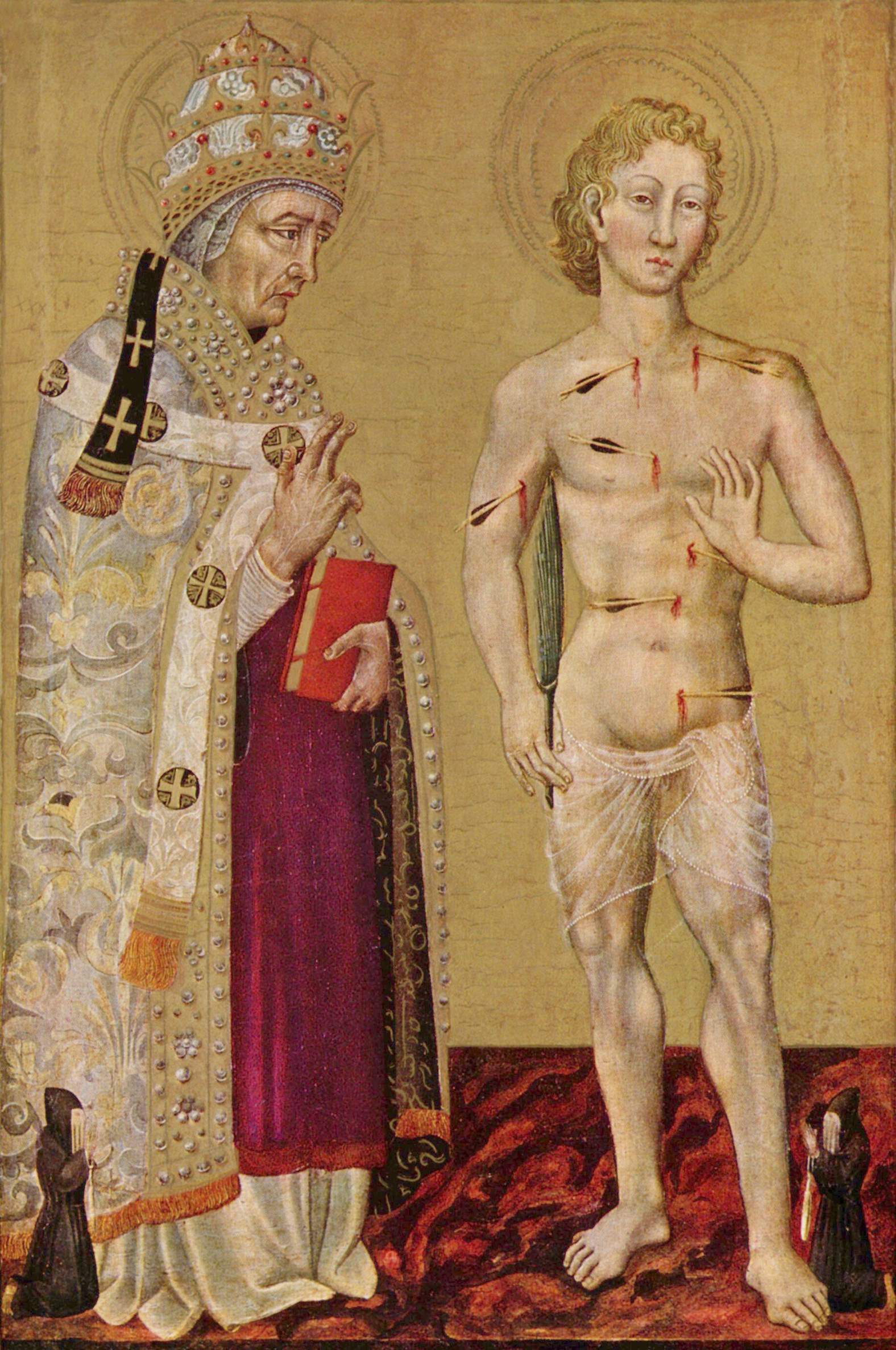
u) as depicted (at right, martyrdom; at left, pope St. Fabian, whose feast day also falls today) in a later fifteenth-century panel painting (c. 1475), attributed to Giovanni di Paolo, in the National Gallery, London:
1) Before cleaning in the 1970s (the National Gallery still calls this cleaning 'recent'):

 https://upload.wikimedia.org/wikipedia/commons/f/fa/Giovanni_di_Paolo_002.jpg


2) After cleaning (the second image is clearer but the colours are off) :
http://tinyurl.com/yczp53u
http://tinyurl.com/ycz7ccx

The Clever Boy will add that the National Gallery website states that: Recent cleaning revealed the original upraised position of Sebastian's hand and forearm and some twenty arrows piercing his body, most of which had been painted out.

At the bottom in each corner is a kneeling Brother of the Confraternity of the Misericordia, a lay brotherhood which was devoted to the Seven Works of Mercy. The brothers, dressed in black with white veils, are holding what may be spoons used for collecting alms.

This is a complete votive picture - one promised and offered in thanks for the favourable answer to a prayer - and is probably one of Giovanni di Paolo's late works.

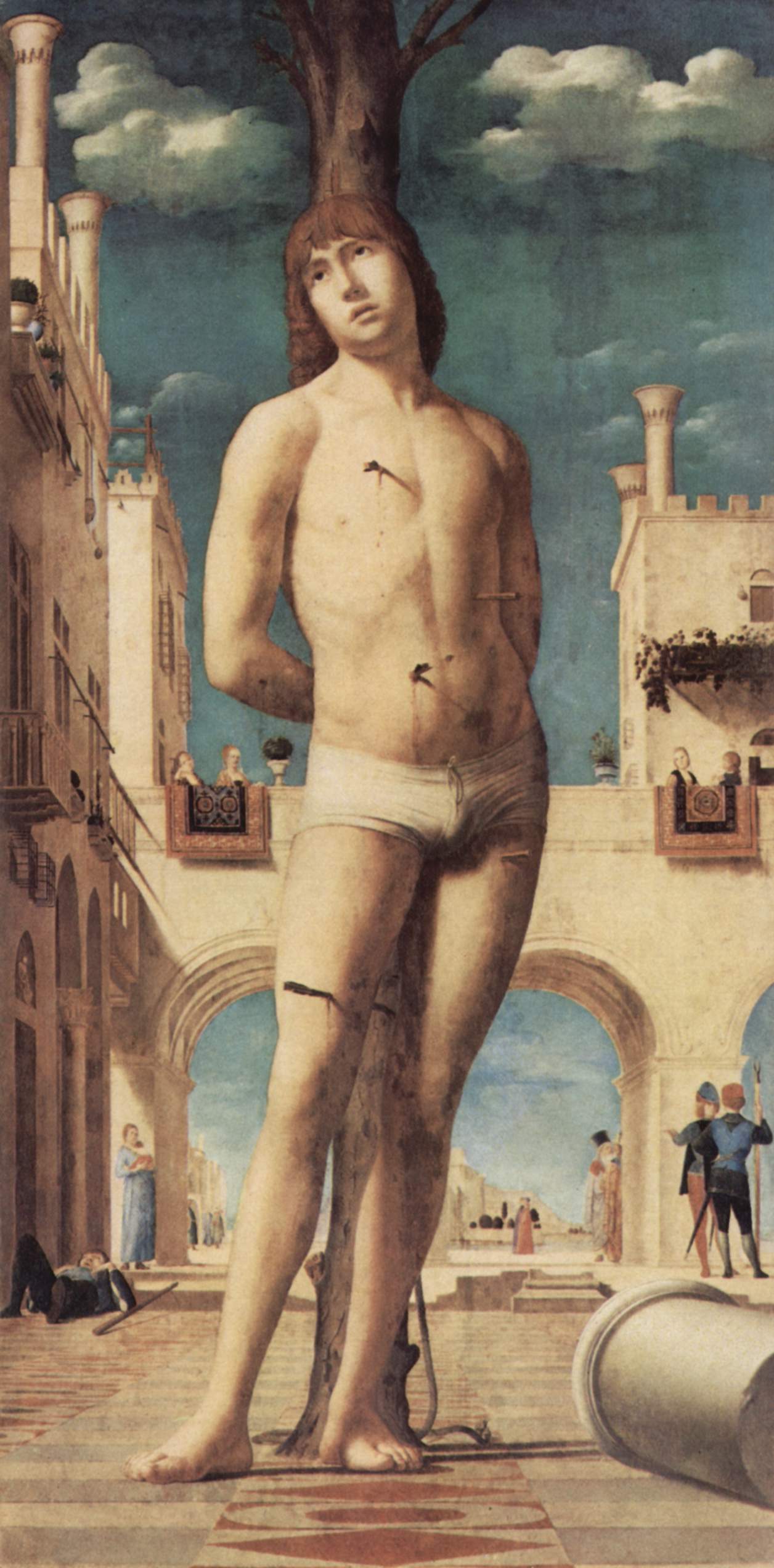
v) as depicted by Antonello da Messina (martyrdom) in a later fifteenth-century panel painting (c. 1476) in the Gemäldegalerie, Dresden:


https://upload.wikimedia.org/wikipedia/commons/4/47/Antonello_da_Messina_018.jpg


w) as depicted by Andrea Mantegna (martyrdom) in a later fifteenth-century panel painting (c. 1480) in the Musée du Louvre, Paris:


https://upload.wikimedia.org/wikipedia/commons/c/c1/Andrea_Mantegna_088.jpg


x) as depicted (martyrdom) in the later fifteenth-century Hours of Dionora of Urbino (c. 1480; London, BL, MS Yates Thompson 7, fol. 93v):
http://www.bl.uk/catalogues/illuminatedmanuscripts/ILLUMIN.ASP?Size=mid&IllID=6000

y) as depicted by Giovanni Baleison (martyrdom) in a late fifteenth-century fresco by Giovanni Baleison in the Chapelle Saint-Sebastien, Saint-Étienne-de-Tinée (Alpes-Maritimes):
http://www.culture.gouv.fr/culture/medieval/en/b036.htm

z) as depicted (at left; at right, St. Anthony of Egypt) in a late fifteenth-century stained glass roundel in the Museum Schnütgen, Köln:
http://tinyurl.com/hq9nvte

aa) as depicted (martyrdom) in a late fifteenth-century stained glass roundel in the Musée national du Moyen Âge (Musée de Cluny), Paris:
http://therosewindow.com/pilot/Paris-Musee-Cluny/w61.htm

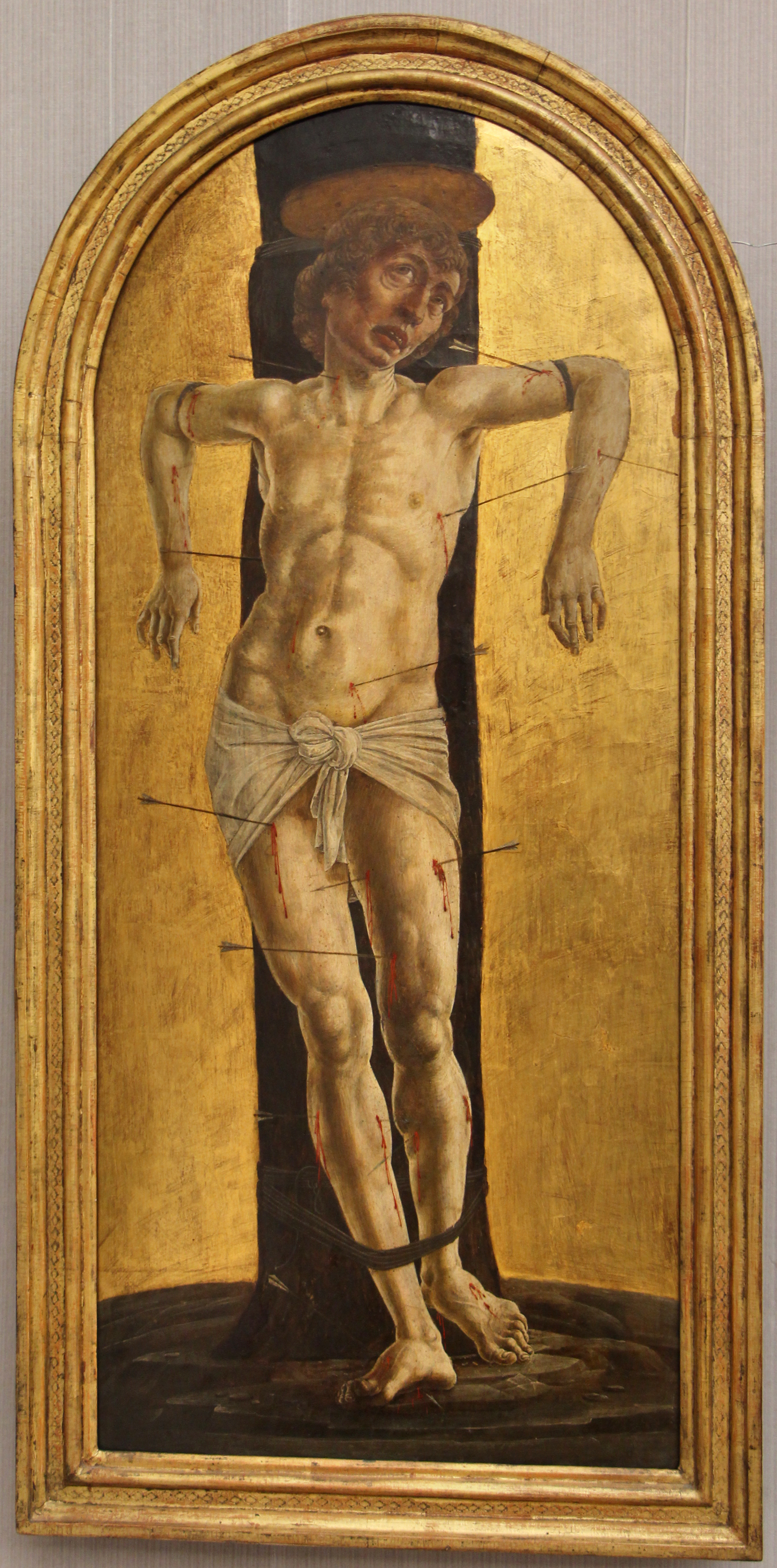
bb) as depicted by Cosmè Tura (martyrdom) in a late fifteenth-century panel painting (c. 1484) in the Gemäldegalerie, Berlin:

 https://upload.wikimedia.org/wikipedia/commons/8/8c/Cosm%C3%A8_tura%2C_san_sebastiano%2C_1484_ca.JPG


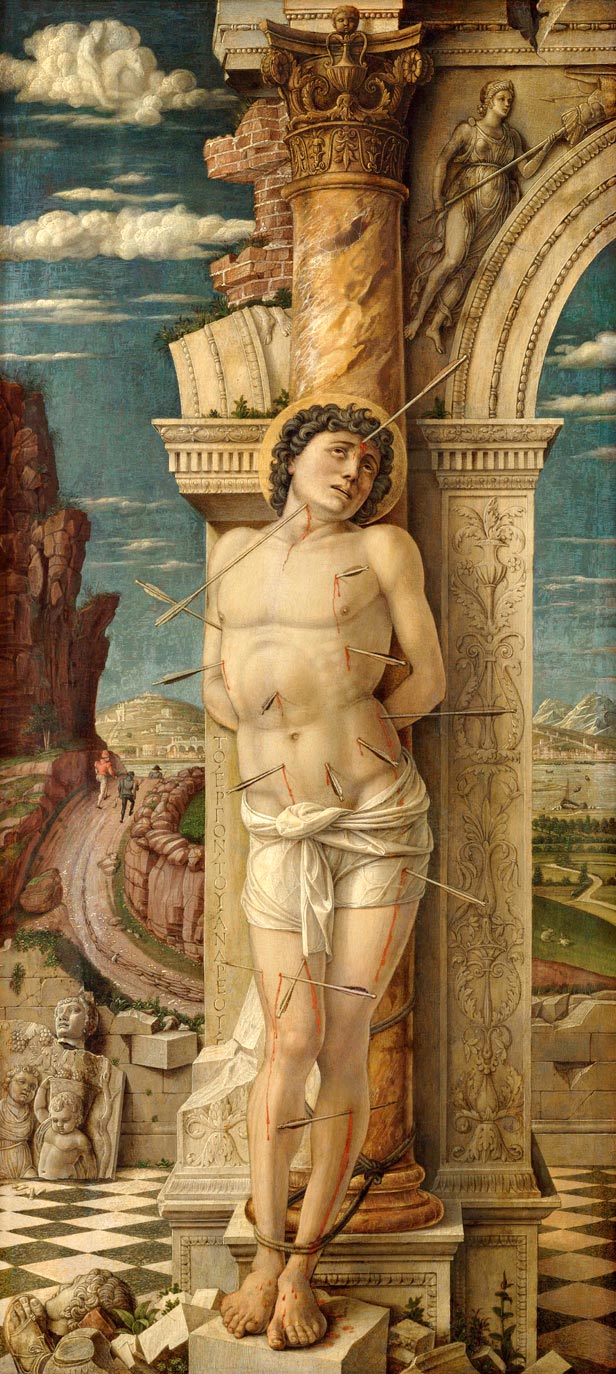
cc) as depicted by Andrea Mantegna (martyrdom) in a late fifteenth-century panel painting (c. 1490) in the Galleria Giorgio Franchetti alla Ca' d'Oro, Venice:


https://upload.wikimedia.org/wikipedia/commons/a/aa/St_Sebastian_3_Mantegna.jpg


dd) as portrayed (martyrdom) in a late fifteenth-century silver and silver gilt reliquary (c. 1497) from Augsburg in the Victoria and Albert Museum in London:


In addition here are some glass images added by Gordon Plumb:

St-Nicolas-de-Port, Bay 105, 5a-7a, 5b-7b, martyrdom of Sebastian,
early 16thC.:
https://www.flickr.com/photos/22274117@N08/4127966209
and detail:
https://www.flickr.com/photos/22274117@N08/4128739542

St-Nicolas-de-Port, Bay 113, 2c-4c:
https://www.flickr.com/photos/22274117@N08/4137043660

Bourges, Cathédrale Saint-Étienne, Bay 27, Virgin and Child with
Sebastian and another saint:
https://www.flickr.com/photos/22274117@N08/4266380565

Monday, 7 December 2015

St Ambrose


John Dillon posted on the Medieval Religion discussion group the following for today. I have added a few comment in [ ]:

In the Roman Calendar and in Ambrosian Calendar December 7th is the feast day of Ambrose of Milan (d. 397). Not to be confused with the Blessed Ambrose of Milan (Franciscan; d. 1525), this Ambrose is a Saint and a Doctor of the Church. A member of the imperial aristocracy, he was governor of Milan when he was elected bishop of that city in 374. Ambrose became an extraordinarily influential preacher, theologian, and ecclesiastical administrator. Along with St. Augustine of Hippo (whom he baptized) and St. Jerome he is one of the great western Christian churchmen of the fourth century.

Ambrose's dies natalis is 4. April (his feast day in the ninth-century martyrologies of St. Ado of Vienne and Usuard of Saint-Germain) but today, the anniversary of his consecration as bishop, was his feast day in some places since at least the ninth century, though what it represented was not always perfectly understood (the earlier ninth-century Marble Calendar of Naples describes it as the day of Ambrose's laying to rest). In the medieval Greek church today was Ambrose's feast day in both the later tenth-century Metaphrastic Menologion and the initially tenth- and eleventh-century Synaxary of Constantinople, as it also is now in some but not all Byzantine-Rite churches. Today was also Ambrose's principal feast day in the late medieval breviary of the Roman curia and from there the commemoration was continued in the later sixteenth-century Tridentine Calendar (as well of course as in the late sixteenth-century Roman Martyrology that was built around it).

An English-language translation of Ambrose's Vita by his former secretary Paulinus of Milan, written in Roman Africa at the behest of St. Augustine of Hippo, is here:
http://www29.homepage.villanova.edu/christopher.haas/Life%20of%20Ambrose.html

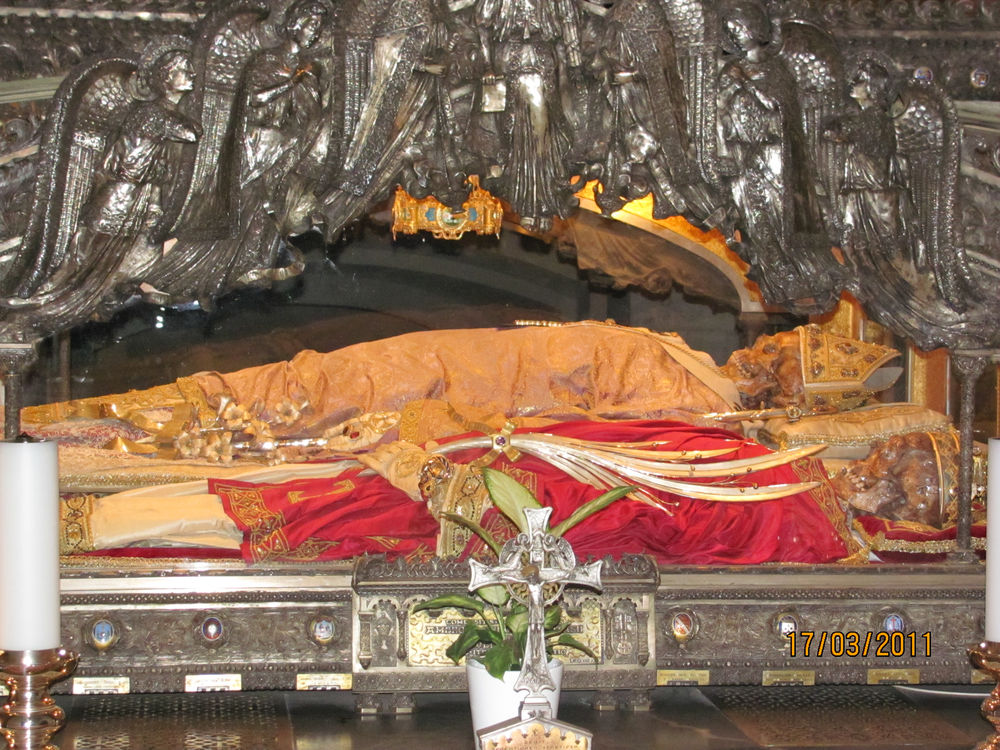
Skeletal remains believed to be those of St. Ambrose repose between those of Sts. Gervasius and Protasius in the cripta di Sant'Ambrogio in Milan's basilica di Sant'Ambrogio (the martyrs in red, Ambrose in white):


Supplementing Gordon Plumb's post from earlier today:

Wells Cathedral, SIII, 2b-3b, 2nd. qr. 14thC.:
https://www.flickr.com/photos/22274117@N08/14786023498

Bourges, Cathédrale Saint-Étienne, Bay 35, figure on right, c.1462:
https://www.flickr.com/photos/22274117@N08/4257386374

herewith are some links to other period-pertinent images of St. Ambrose of Milan:

a) as depicted in a restored fifth-century mosaic portrait in the basilica di Sant'Ambrogio's sacello di San Vittore:
http://www.atlantedellarteitaliana.it/immagine/00007/3858OP6466.jpg
http://tinyurl.com/2875f6x

b) as portrayed in relief in three panels on the rear side of the earlier to mid-ninth-century Golden Altar ("Pala d'Oro"; between 824 and 859, restored in 1966) in Milan's basilica di Sant'Ambrogio:
1) the miracle of the bees:


2) journeying on horseback from Liguria to Emilia:


http://img.over-blog-kiwi.com/0/54/79/43/20140626/ob_13819b_image5.jpg
3) blessing the altar's maker, Magister Wolvinus (or Vuolvinus):


c) as depicted lower register) in an eleventh-century copy of his De bono mortis from Fécamp (Paris: BnF, ms. Latin 2639, fol. 31v):
http://tinyurl.com/y9rm62v

d) as depicted in an eleventh-century manuscript of writings of Church Fathers (Avranches, Bibliothèque d'Avranches, ms. 72, f. 182v):
http://www.enluminures.culture.fr/Wave/savimage/enlumine/irht4/IRHT_074884-p.jpg

e) as depicted in a twelfth-century copy of his Hexaemeron (Charleville-Mézières, Médiathèque Voyelles, ms. 212, t. III, fols. 1-88v, fol. 1r):
http://www.enluminures.culture.fr/Wave/savimage/enlumine/irht6/IRHT_096061-p.jpg

f) as portrayed (at left) in a twelfth-century relief on Milan's Porta Romana:


g) as portrayed in a relief on the earlier twelfth-century west front of Milan's basilica di Sant'Ambrogio:

San Ambrogio


h) as depicted in the mid- or slightly later twelfth-century mosaics of the Cappella Palatina in Palermo:


http://tinyurl.com/3s9uolg

i) as depicted in one of four panels of a full-page illumination in the late twelfth-century so-called Bible of Saint Bertin (c. 1190-1200; Den Haag, KB, ms. 76 F 5, fol. fol. 38v, sc. 1A):
http://manuscripts.kb.nl/zoom/BYVANCKB%3Amimi_76f5%3A038v_min_a1

j) as depicted in two late twelfth-century panels (c. 1180) in a mostly early thirteenth-century composite window in the cathedral of St.-Étienne in Le Mans (photographs by Gordon Plumb):
1) St. Paul in a vision tells the sleeping Ambrose where to find the bodies of Sts. Gervasius and Protasius:
http://www.flickr.com/photos/22274117@N08/2209088732/
2) Ambrose (nimbed) and a brother bishop unearth the bodies of Sts. Gervasius and Protasius:
http://www.flickr.com/photos/22274117@N08/4714852210/

k) as depicted as depicted in a panel of a mid-thirteenth-century glass window (c. 1245-1250; w. 207) in Strasbourg's cathédrale Notre-Dame:


l) as portrayed in relief on a later thirteenth- or early fourteenth-century grosso of eight denari issued by the first Ambrosian Republic (i.e. communal Milan; 1250-1310):
https://www.numisbids.com/n.php?p=lot&sid=323&lot=197

m) as depicted (at right, barring the emperor Theodosius from the cathedral of Milan) in a late thirteenth-century copy of French origin of the Legenda aurea (San Marino, CA, Huntington Library, ms. HM 3027, fol. 47r):
http://digitalassets.lib.berkeley.edu/ds/huntington/images//000866A.jpg

n) as portrayed (flanked by Sts. Gervasius and Protasius) in a fourteenth-century statue on Milan's Pusterla di Sant'Ambrogio:


o) as depicted in the earlier fourteenth-century frescoes (c. 1312-1321) in one of the little domes of the monastery church of the Theotokos at Gračanica in, depending on one's view of the matter, either Serbia's province of Kosovo and Metohija or the Republic of Kosovo:
http://tinyurl.com/ydtx5b7

p) as depicted (upper roundel) in the earlier fourteenth-century frescoes (1330s) of the church of the Hodegetria in the Patriarchate of Peć at Peć in, depending on one's view of the matter, either the Republic of Kosovo or Serbia's province of Kosovo and Metohija:
http://tinyurl.com/ygxkvuw

q) as depicted (at left; at right, St. Patapius) in a December calendar composition in the earlier fourteenth-century frescoes (between 1335 and 1350) in the narthex of the church of the Holy Ascension at the Visoki Dečani monastery near Peć in, depending on one's view of the matter, either the Republic of Kosovo or Serbia's province of Kosovo and Metohija:
http://tinyurl.com/yaswkw7

r) as depicted in a mid-fourteenth-century glass window panel (c. 1340-1350) from Kärnten, now in The Cloisters collection of the Metropolitan Museum of Art in New York:

Saint Ambrose


s) as depicted (the miracle of the bees) in a mid-fourteenth-century copy, from the workshop of Richard and Jeanne de Montbaston, of the Legenda aurea in its French-language version by Jean de Vignay (1348; Paris, BnF, ms. Français 241, fol. 98r):
http://tinyurl.com/ygb8up7

t) as depicted by Vitale da Bologna in a mid-fourteenth-century panel painting (between 1350 and 1353) in the Pinacoteca of the Musei Civici in Pesaro:


v) as portrayed in a statuette and in two panels on St. Augustine's later fourteenth-century tomb in Pavia's basilica di San Pietro in Ciel d'Oro:
1) statuette (second from left; photograph by Genevra Kornbluth):
http://www.kornbluthphoto.com/images/Pavia_249.jpg
Detail (bust):
http://tinyurl.com/24nqhle
2) panel (upper register at right, preaching; Augustine among the listeners):
http://tinyurl.com/2cft8mj
3) panel (at left, officiating at at Augustine's vesting):
http://tinyurl.com/37xxotc
Views of these objects in stronger light will be found at Genevra Kornbluth's Archive page on the Arca di Sant'Agostino:
http://www.kornbluthphoto.com/Arca.html

w) as depicted (at right, barring the Emperor Theodosius from the cathedral of Milan) in a later fourteenth-century copy (c. 1370-1380) of Vincent of Beauvais' Speculum historiale in its French-language version by Jean de Vignay (Paris, BnF, ms. Nouvelle acquisition française 15943, fol. 58r):
http://gallica.bnf.fr/ark:/12148/btv1b8449689s/f123.highres

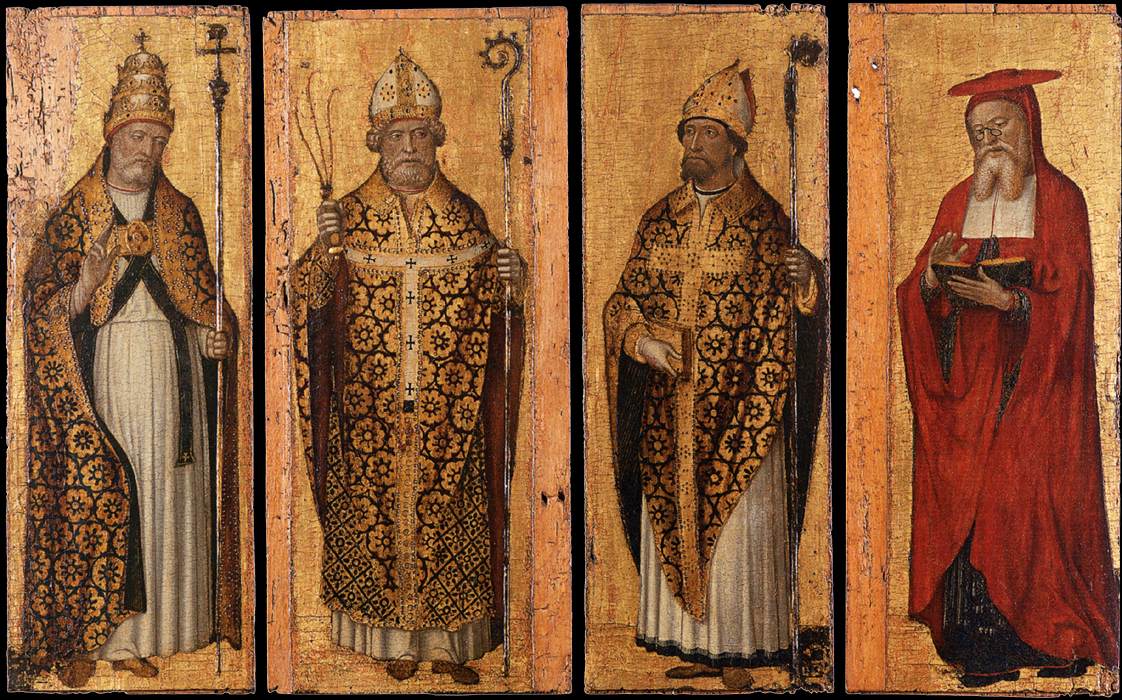
x) as depicted (at far left) by Niccolò di Pietro Gerini in one of four late fourteenth-century panel paintings of the Doctors of the Church (c. 1380) used for the altarpiece in the cappella maggiore of Florence's basilica della Santa Croce:


y) as portrayed (in the lower right-hand corner) by Pietro di Puccio in his late fourteenth-century mosaic (1388; heavily restored) on the facade of Orvieto's basilica cattedrale di Santa Maria Assunta:


z) as depicted (reading) in a late fourteenth- or early fifteenth-century copy of the _Legenda aurea_ in its French-language version by Jean de Vignay (Rennes, Bibliothèque de Rennes Métropole, ms. 266, fol. 105r):
http://tinyurl.com/q3pz84h

aa) as portrayed in high relief (in his study) by Lorenzo Ghiberti in a panel of his early fifteenth-century north doors for the baptistery in Florence:
http://tinyurl.com/yz6jvxn

bb) as depicted (at right; at left, St. Augustine of Hippo) as depicted by Filippo Lippi in an earlier fifteenth-century panel painting (c. 1440) in the Accademia Albertina di Belle Arti, Turin:


cc) as portrayed in relief on a mid-fifteenth-century grosso agontano issued by the second Ambrosian Republic (1447-1450):


dd) as depicted (at right, baptizing St. Augustine) in a mid-fifteenth-century copy of Giovanni Colonna's Mare historiarum (between 1447 and 1455; Paris, BnF, ms. Latin 4915, fol. 277v):
http://gallica.bnf.fr/ark:/12148/btv1b6000905v/f624.item.zoom

ee) as depicted by Giovanni di Paolo in a later fifteenth-century panel painting (c. 1465-1470) in the Metropolitan Museum of Art, New York:

Saint Ambrose


[ Note the use of pearls to decorate the mitre. The emblematic whip - coming from the pen#aence he imposed on Theodosius - is an earlier form of the cat o'nine tails]

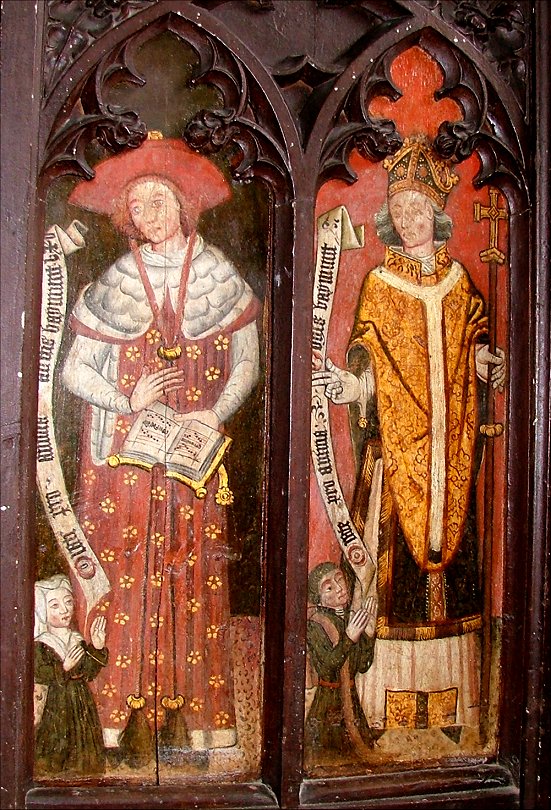
ff) as depicted (at right; at left, St. Jerome) on the late fifteenth-century rood screen in the church of St Thomas, Foxley (Norfolk):


gg) as depicted (at far right) by Michael Pacher on his late fifteenth-century Fathers of the Church altarpiece (c. 1483) in the Alte Pinakothek, Munich:


http://www.wga.hu/art/p/pacher/various/2father1.jpg

hh) as depicted (at left; at right, St. Augustine) by Giovanni Masone in a late fifteenth-century panel painting (Genoa, 1491) in the Musée Jacquemart-André, Paris:


ii) as depicted (left margin at top) in a hand-coloured woodcut in the Beloit College copy of Hartmann Schedel's late fifteenth-century Weltchronik (Nuremberg Chronicle; 1493) at fol. CXXXIIIIv:
http://www.beloit.edu/nuremberg/book/6th_age/left_page/38%20%28Folio%20CXXXIIIIv%29.pdf

jj) as depicted (second from left) by Carlo Bracceso in a late fifteenth-century panel painting (ca. 1495) in the Galleria Franchetti, Ca' d'Oro, Venice:


[I like the idea of unity of doctrine expressed in the same textile being worn in their vestments by SS Gregory, Ambrose and Augustine. I also  like St Jerome's pince nez ]

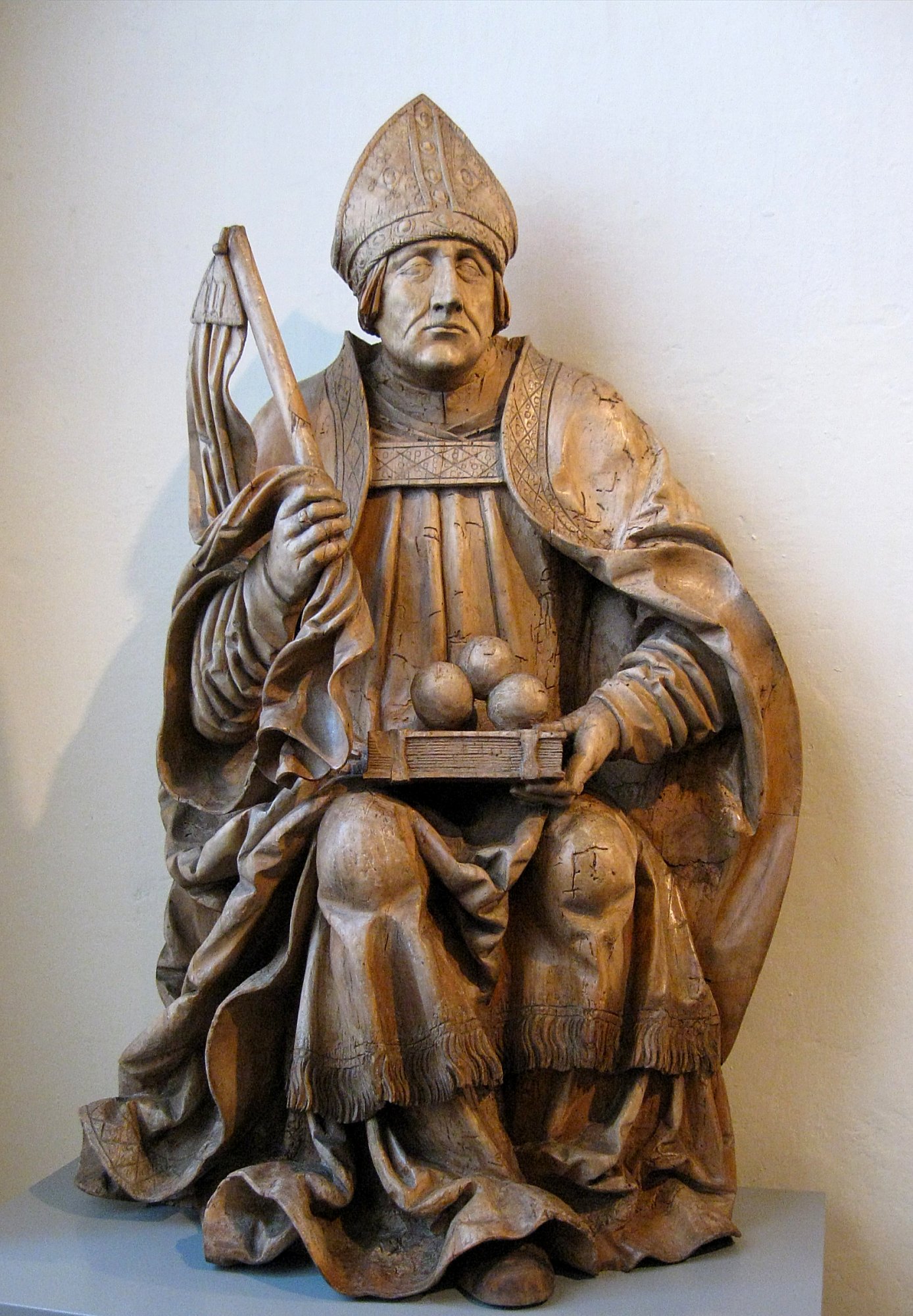
kk) as portrayed (in his study) in a late fifteenth- or early sixteenth-century wooden statue with traces of paint (c. 1500) from Palencia in The Cloisters collection of the Metropolitan Museum of Art in New York:

Saint Ambrose in His Study


Sunday, 6 December 2015

St Nicholas


To mark St Nicholas' day John Dillon posted the following piece on the Medieval religion discussion group, into which I have pasted Gordon Plumb's post of stained glass representations of the saint


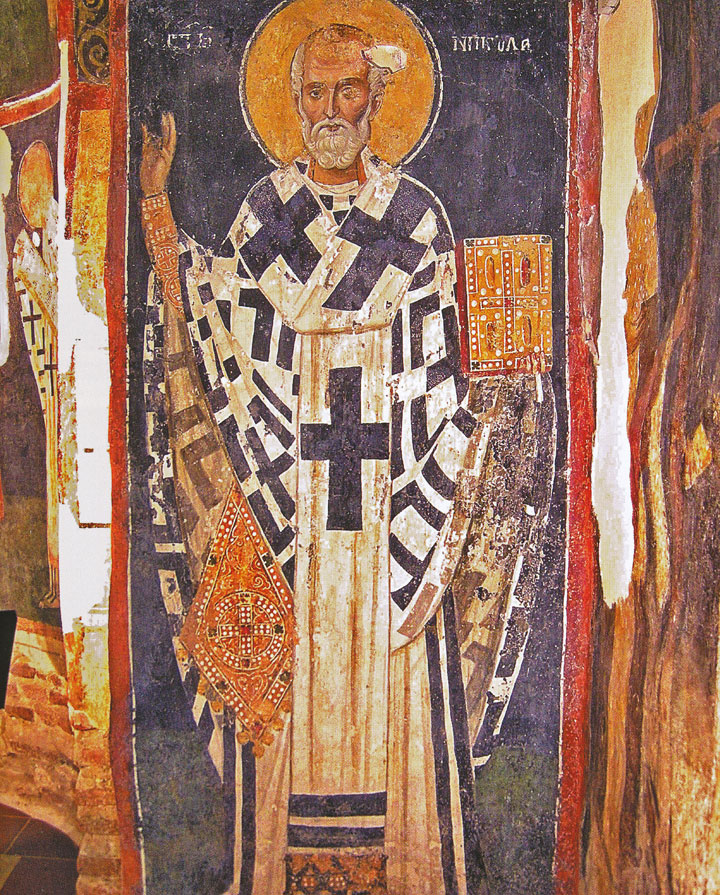
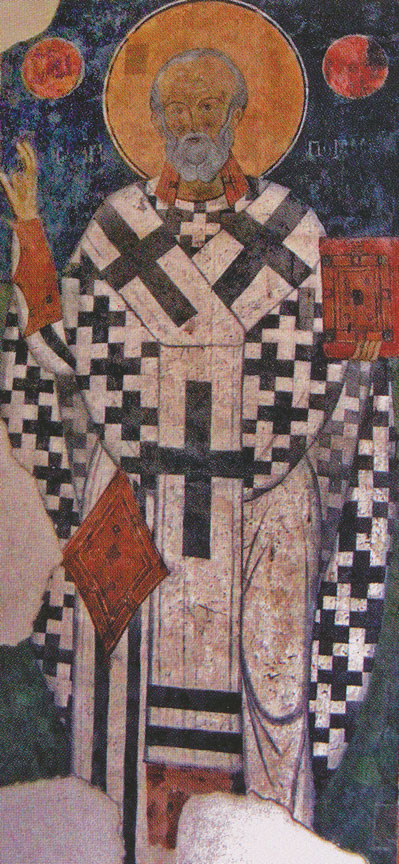
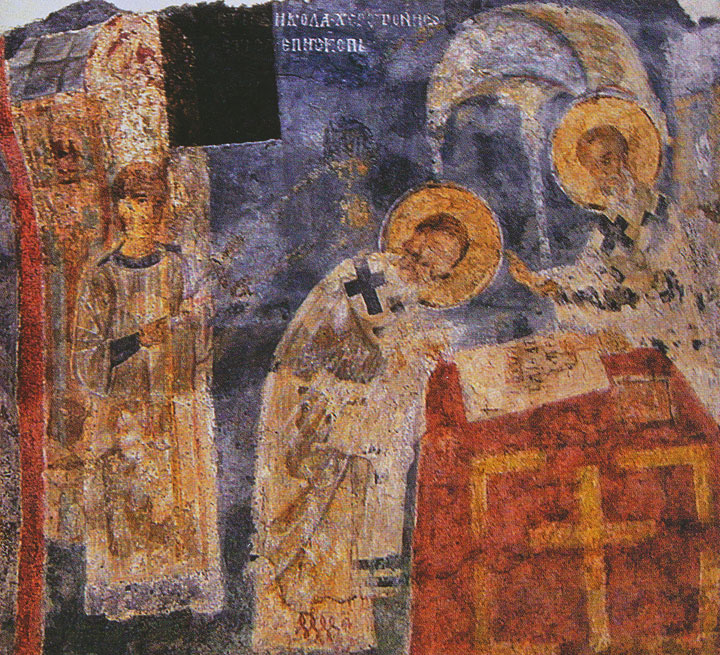
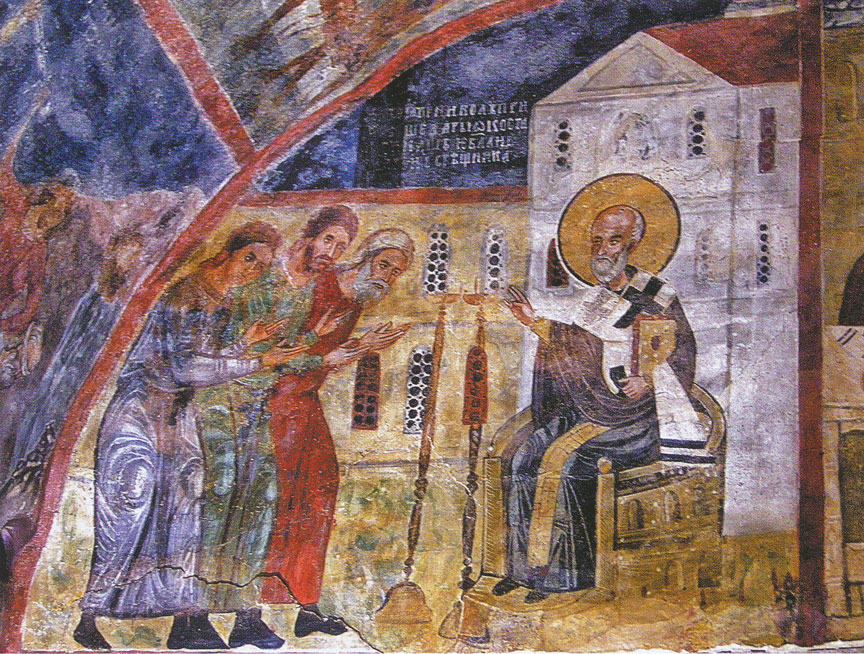
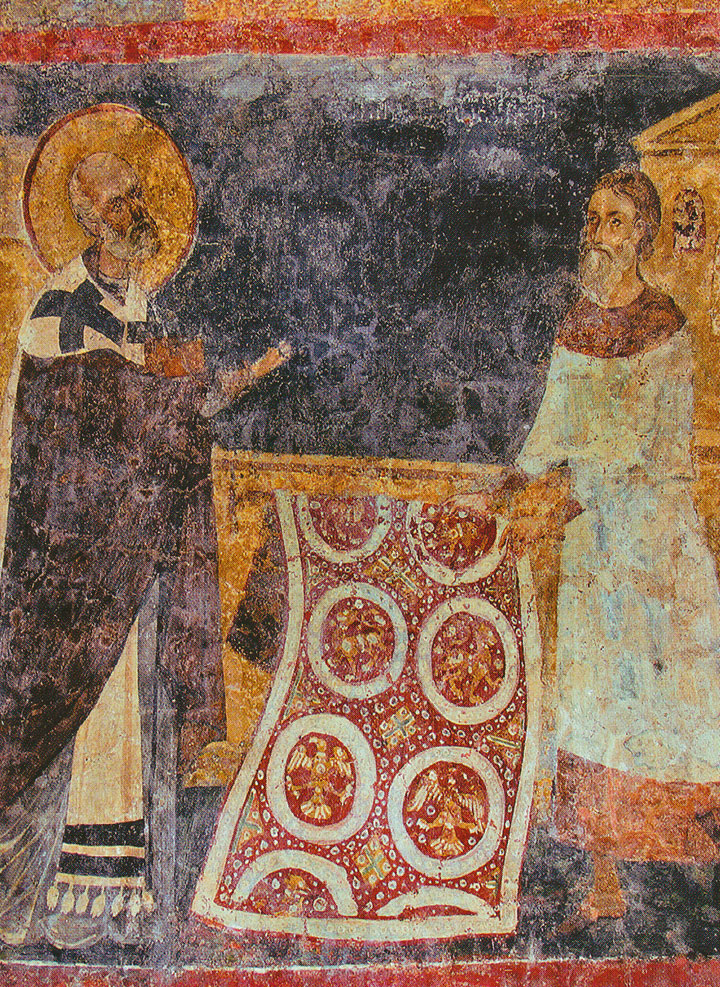
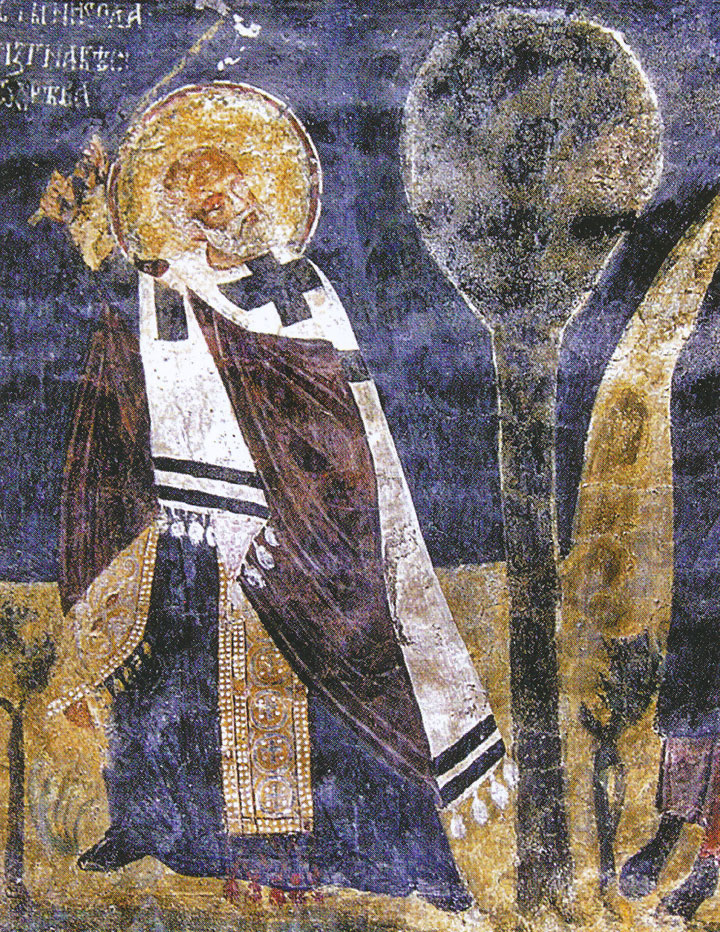
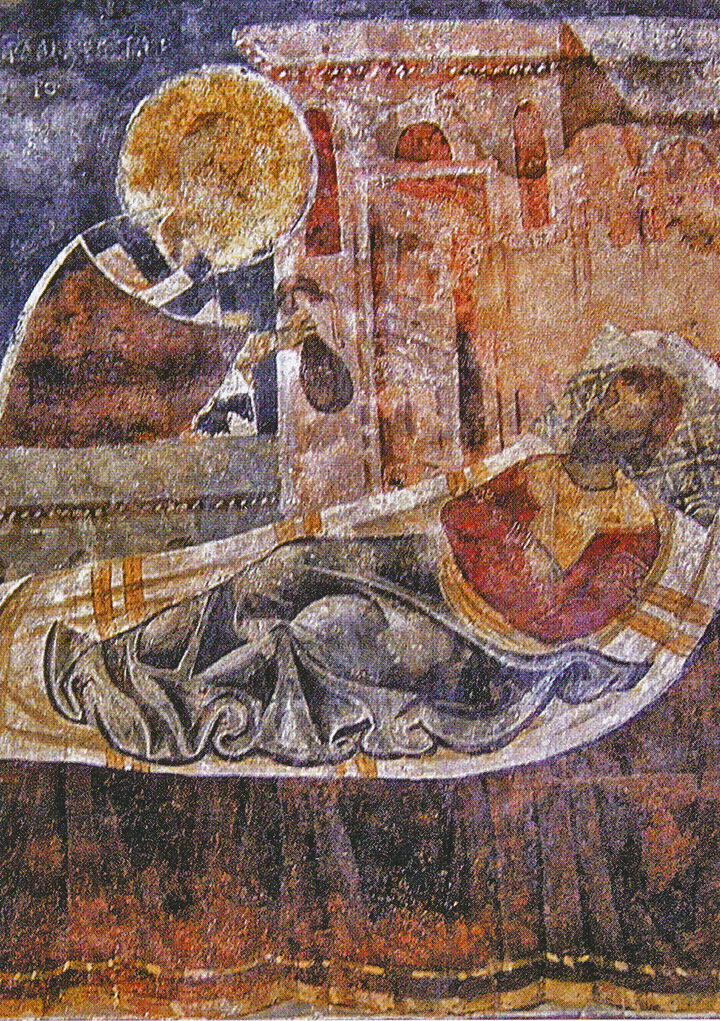
Virtually nothing is known about the historical Nicholas of Myra (d. earlier 4th cent. ?). What gives him a question mark after "4th cent." instead of the "supposedly" one would use for, e.g., the likewise at least very largely legendary St. Panteleimon / Pantaleon of Nicomedia and St. Blasius / Blaise of Sebaste is the presence of bishop Nicholas of Myra in the longer lists of participants in the First Ecumenical Council. Were it certain that Nicholas was among those at Nicaea in 325, as opposed to having been added later when legend had made him a contemporary of St. Constantine I, one could dispense with the question mark altogether. But that would still leave us with a dearth of reliable information about this person's earthly life. While the earliest testimonies both for the existence of his cult at Myra and elsewhere and for his popular construction as a holy man and thaumaturge come from the sixth century, his earliest comprehensive Bios (BHG 1348) and earliest Vita (BHL 6104-6109) seemingly appear only the ninth century (some would date BHG 1348 to the eighth century). These, though they depend ultimately on a source with some knowledge of late antique Myra, are already very largely legendary in character, including such well-known tales as the saving of three condemned soldiers, the providing of dowries for three destitute daughters, and the saving of storm-tossed seamen.

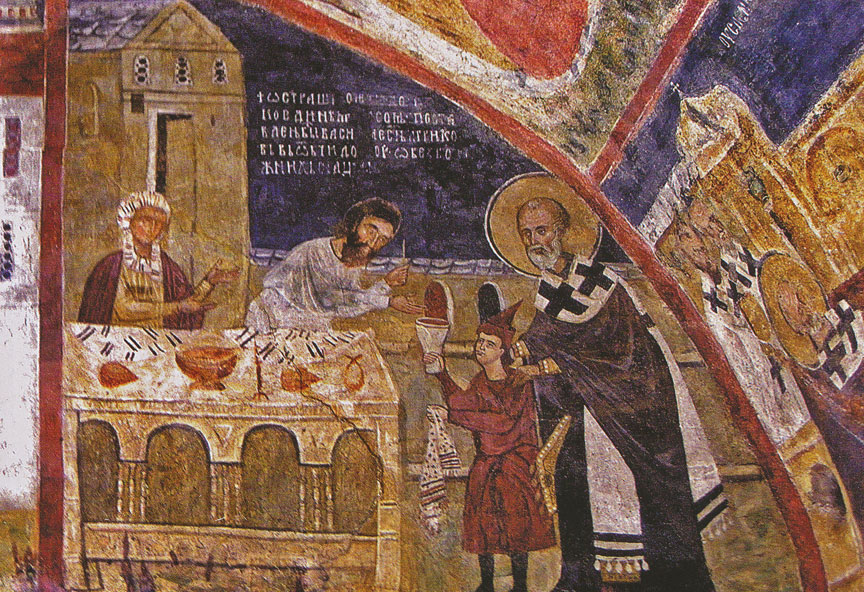
In the tenth century Nicholas' Bios by St. Symeon Metaphrastes (BHG 1349) added other matter, including miracles drawn from the Bios of the earlier sixth-century St. Nicholas of Sion. At this point Nicholas' cult was widespread both in the Greek-speaking world and in places importantly influenced from it. Seemingly new legends continued to spring up: three that are thought to be of "Western" origin are those of the barbarian (later, the Jew) with an icon of Nicholas, of Nicholas reviving three pickled students, and of Nicholas and the boy with the golden cup. In lands that were liturgically Latin Nicholas' cult was to varying degrees already established before his translation to Bari in 1087. But the latter certainly brought him a considerable increase in popularity. In short order he was one of the great saints of Christianity in general.

An illustrated, English-language page on Nicholas' relics:
http://www.stnicholascenter.org/pages/relics/
An illustrated, English-language page on the examinations in the 1950s of the relics at Bari believed to be those of Nicholas:
http://www.stnicholascenter.org/Brix?pageID=943

By way of supplement to Gordon Plumb's posts of earlier today of medieval stained glass depictions:

York Minster, SXXVIII, panel of miracle of St Nicholas, c.1180:
https://www.flickr.com/photos/22274117@N08/3052665759

Chartres, Cathédrale Notre Dame, Bay 39, Life of St Nicholas, a set of images, c.1210-15:
https://www.flickr.com/photos/22274117@N08/albums/72157606508944155

Bourges, Cathédrale Saint-Étienne, Bay 19, St Nicholas window, a set of images, c.1210-15:
https://www.flickr.com/photos/22274117@N08/albums/72157623037192023

Rouen, Cathédrale Notre Dame, Bay 51, a few Nicholas images amongst others, c. 1200-1210:
Birth of Nicholas:
https://www.flickr.com/photos/22274117@N08/15099582913
infant Nicholas refuses breast of mother:
https://www.flickr.com/photos/22274117@N08/15099014864
Nicholas consecrated bishop:
https://www.flickr.com/photos/22274117@N08/15533551768
butcher welcomes three young men:
https://www.flickr.com/photos/22274117@N08/15533791827
butcher murders three young men:
https://www.flickr.com/photos/22274117@N08/15718986445
Jew entrusts his treasure into protection of Nicholas:
https://www.flickr.com/photos/22274117@N08/15534129220
Jew beats statue of Nicholas after treasure stolen:
https://www.flickr.com/photos/22274117@N08/15533547388

Lincoln Cathedral, sXXIX, three scenes from miracles of Nicholas, c.1230:
sXXIX.2, Nicholas stilling storm:
https://www.flickr.com/photos/22274117@N08/5458681395
sXXIX.4, miracle of butcher and the three boys brought back to life:
https://www.flickr.com/photos/22274117@N08/5459294976
sXXIX.5, story of boy with the golden cup:
https://www.flickr.com/photos/22274117@N08/5459297610

Sées Cathedral, St Nicholas Chapel, Bay 13, Nicholas scenes, glass of 1270-80:
St Nicholas provides gold to save three girls from prostitution:
https://www.flickr.com/photos/22274117@N08/4056609262
and detail of Nicholas:
https://www.flickr.com/photos/22274117@N08/4056617082
Butcher kills the three boys, illuminated by wife with candle:
https://www.flickr.com/photos/22274117@N08/4055830710


Chetwode, St Mary and St Nicholas, Buckinghamshire, sII, 1c, 14thC:
https://www.flickr.com/photos/22274117@N08/8040506444

Yarnton, St Bartholomew, Oxfordshire, nIV, A3, c.1400-1420:
https://www.flickr.com/photos/22274117@N08/2967285936

Saint Nicholas-de-Port, Lorraine, Bay 101 1a-4a, by workshop of George le Verrier, c.1508-10:
https://www.flickr.com/photos/22274117@N08/15012189374

Hillesden, All Saints, Buckinghamshire, sIV, a set of images of the window showing early 16th century scenes from the life of St Nicholas displaying Flemish influence:
https://www.flickr.com/photos/22274117@N08/albums/72157604761597066

John Dillon continues herewith links to further period-pertinent images of St. Nicolas of Myra, some probably familiar, others perhaps not:

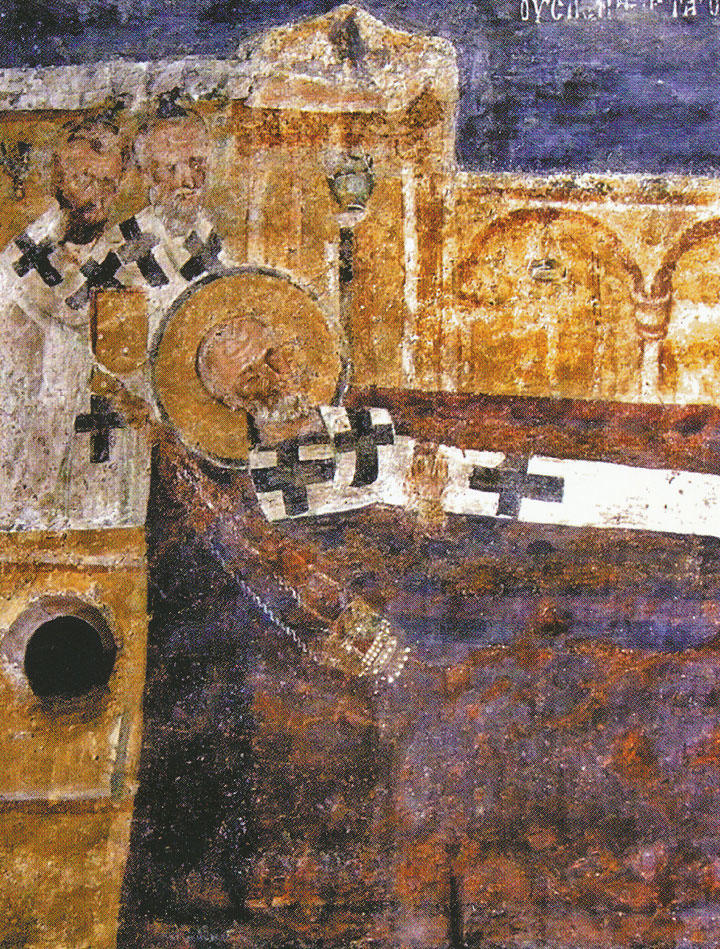
a) as depicted (at lower left; at lower right, St. John Chrysostom) on a pair of leaves from a seventh-century encaustic triptych in the Holy Monastery of the God-trodden Mount Sinai, St. Catherine (South Sinai governorate):

[7thSinaiTripWings.jpg]


b) as depicted in a tenth-century glazed ceramic icon of Byzantine origin in the Walters Art Museum, Baltimore:
http://tinyurl.com/a3cmubb

c) as depicted in the earlier eleventh-century mosaics (restored between 1953 and 1962) in the katholikon of the monastery of Hosios Loukas near Distomo in Phokis:
http://tinyurl.com/d7r8kjz

d) as depicted (at left) in an eleventh- or twelfth-century fresco in the church of the rupestrian Eski Gümüs monastery near Gümüs in Turkey's Niğde province:
http://tinyurl.com/728zxto

e) as depicted in a twelfth-century fresco in the patron niche of the church of Agios Nikolaos tis Stegis at Kakopetria (Nicosia prefecture) in the Republic of Cyprus:
http://www.mlahanas.de/Cyprus/Geo/AgiosNikolaosStegis01.jpg

f) as portrayed (three scenes from his Vita) around the curving head of the mid- or later twelfth-century ivory St. Nicholas crozier (c. 1150-1170) of French or English manufacture in the Victoria and Albert Museum, London:

Staff head - The  St Nicholas Crozier


St Nicholas Crozier
Winchester, England (probably)
1150 - 1170
Carved ivory
Width 11 cm x height 12 cm
Museum No. 218-1865

 This crozier shows scenes relating to Jesus Christ and St Nicholas. At the end of the volute (or scroll) an angel supports the Lamb of God, a symbolic image of Christ. Its head is now missing. On the other side is the Nativity (or birth) of Christ. Angels appear to shepherds and announce Christ's birth on one side of the shaft.
The rest of the crozier shows three scenes from the Life of St Nicholas. The first scene depicts his birth. The choice of scenes suggests that the crozier was made for a bishop or abbot who was either named after the saint or in charge of a foundation dedicated to him. This crozier is one of the finest achievements of the ivory carver's art.

g) as depicted in the later twelfth-century frescoes (1164) in the church of St. Panteleimon at Gorno Nerezi (Skopje municipality) in the Former Yugoslav Republic of Macedonia:
http://tinyurl.com/hvjr5yy
Detail view:
http://tinyurl.com/op3slhf

h) as depicted, in the patron niche, in the later twelfth-century frescoes (betw. 1160 and 1190) of the church of St. Nicholas Kasnitzes in Kastoria in northwestern Greece:
http://www.flickr.com/photos/millinerd/2672308962/in/photostream/lightbox/
Detail view:
http://tinyurl.com/35q6wod

i) as depicted in the later twelfth-century frescoes (c. 1180) of the church of Agioi Anargyroi in Kastoria in northwestern Greece:
http://tinyurl.com/aag4ff7

j) as depicted (at right; at left, St. Achilles / Achillius) in the late twelfth-century frescoes (ca. 1191) in the church of St. George at Kurbinovo (Resen municipality) in the Former Yugoslav Republic of Macedonia:
http://tinyurl.com/paehsta
Detail view (Nicholas):
http://tinyurl.com/hw3vfr8

k) as depicted in a twelfth- or thirteenth-century fresco in the church of St. Peter (and Paul) at Stari Ras (Raška dist.) in Serbia:
http://tinyurl.com/7kjy66l

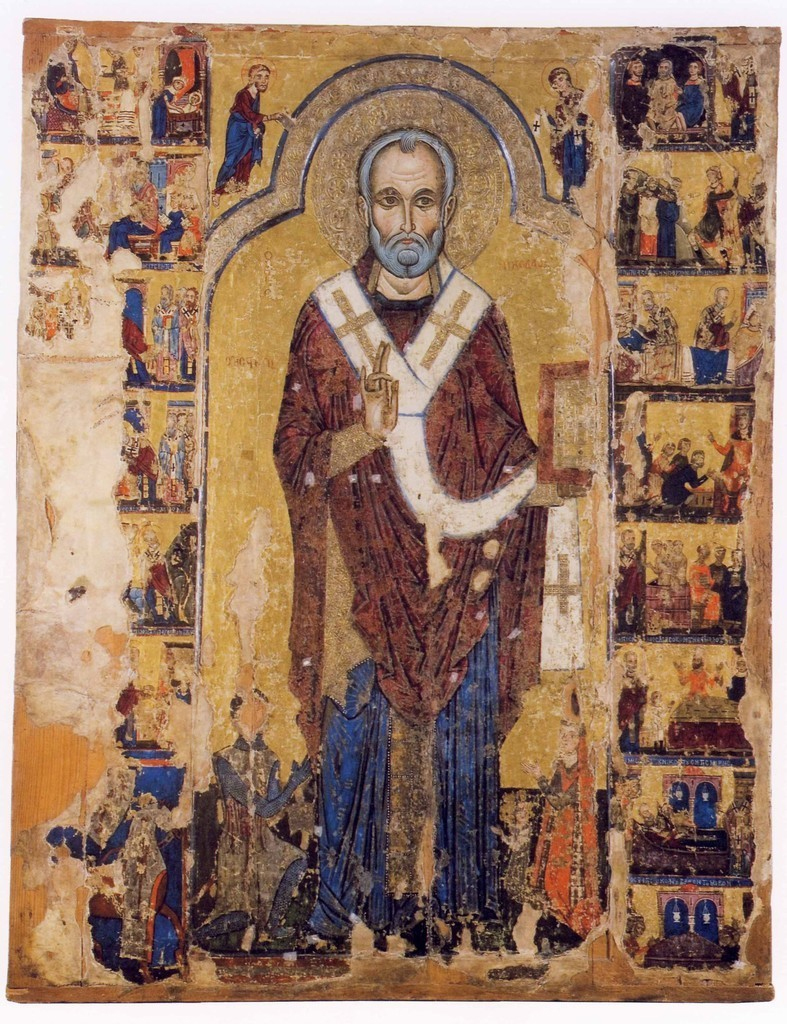
l) as depicted (with scenes from his Bios) in a late twelfth- or early thirteenth-century icon in the Holy Monastery of the God-trodden Mount Sinai, St. Catherine (South Sinai governorate):
http://tinyurl.com/aear2s2

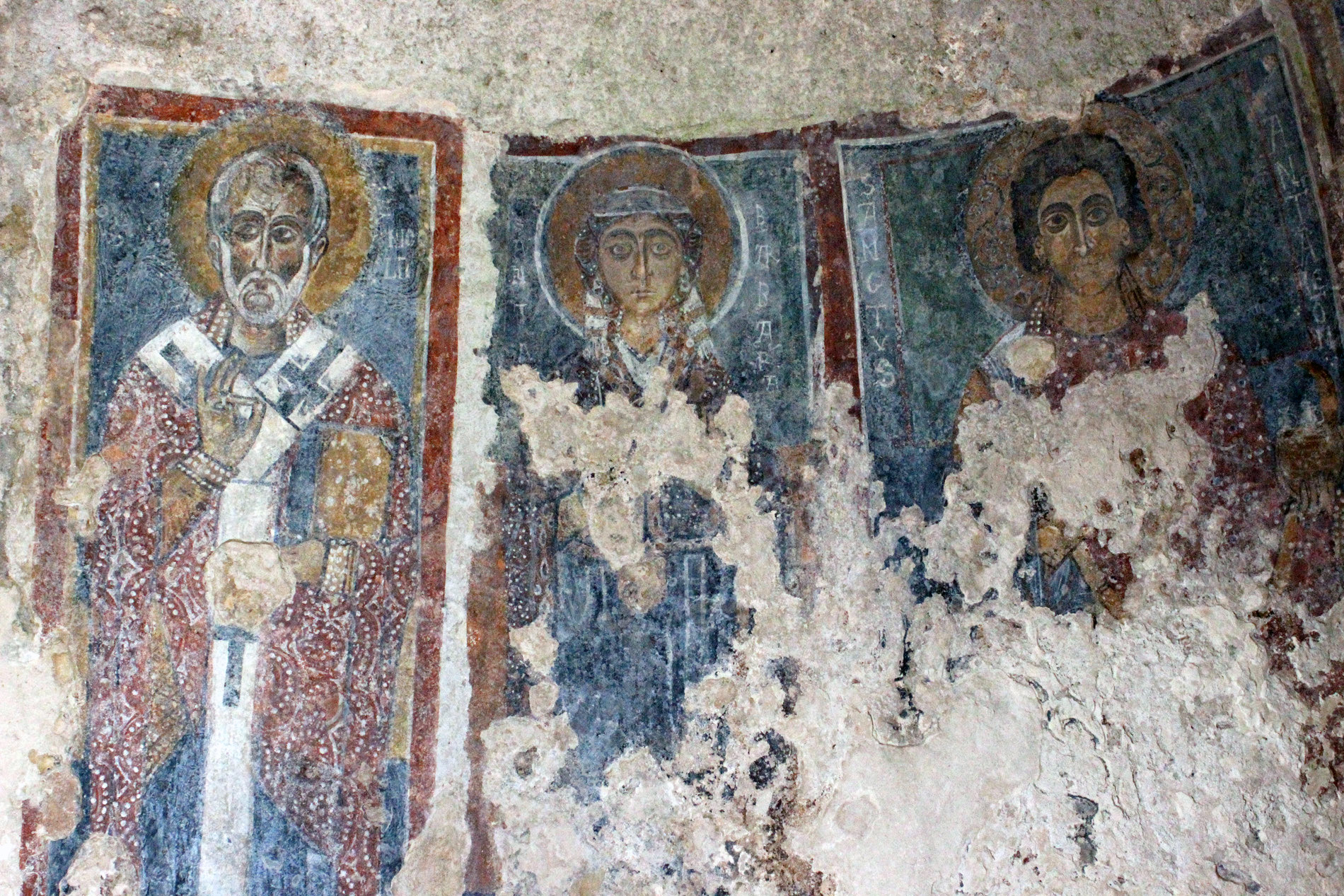
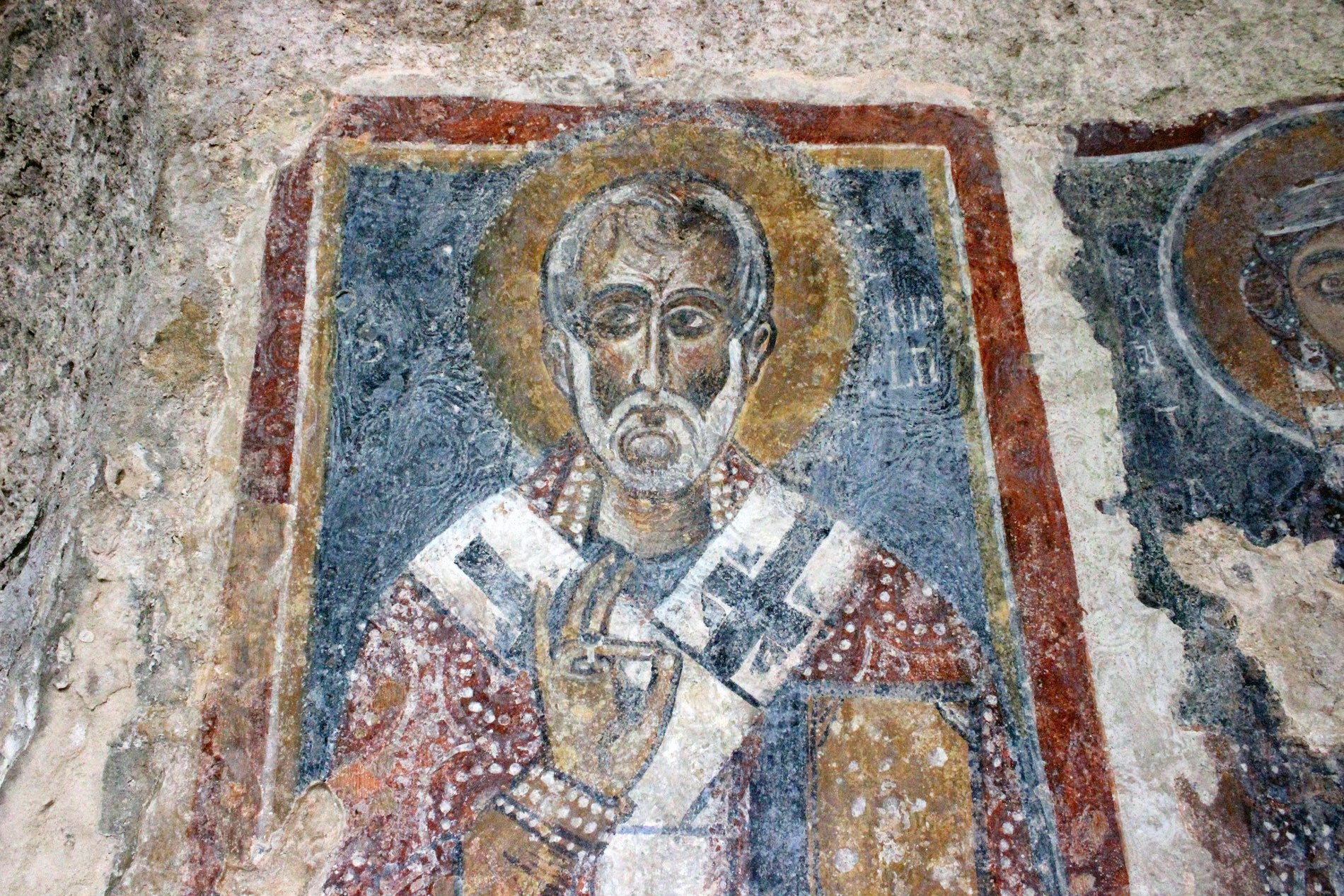
m) as depicted (at left; at centre, St. Barbara; at right, St. Panteleimon) in a thirteenth-century fresco in the rupestrian chiesa di San Nicola dei Greci in Matera:


Detail view (Nicholas):


n) as depicted (at centre; below and to the right, St. Lawrence of Rome) in a thirteenth-century wall painting in Hejdeby kyrka in Hejdeby (Gotlands län):


o) Nicholas as in the earlier thirteenth-century frescoes (1230s) in the narthex of the church of the Ascension in the Mileševa monastery near Prijepolje (Zlatibor dist.) in Serbia:
http://tinyurl.com/bx4cm3f
Detail view:
http://tinyurl.com/a37kwwr

p) as depicted on a seemingly earlier to mid-thirteenth-century map of the Mediterranean (c. 1234-1266; Lyon, Bibliothèque municipale, ms. 175, sheet 8):


q) as depicted (fifteen miracle scenes) in the earlier to mid-thirteenth-century St. Eligius and St. Nicholas window (w. 18; c. 1235-1250) in the cathédrale Saint-Étienne in Auxerre:
http://therosewindow.com/pilot/Auxerre/w18.htm

r) as depicted (reviving the three pickled students) in a mid-thirteenth-century psalter for the Use of Reims (Carpentras, Bibliothèque municipale Inguimbertine, ms. 77, fol. 176v):
http://www.enluminures.culture.fr/Wave/savimage/enlumine/irht4/IRHT_073118-p.jpg

s) as depicted in a mid-thirteenth-century Novgorod School now in the State Russian Museum in Saint Petersburg:
http://www.icon-art.info/masterpiece.php?lng=en&mst_id=446

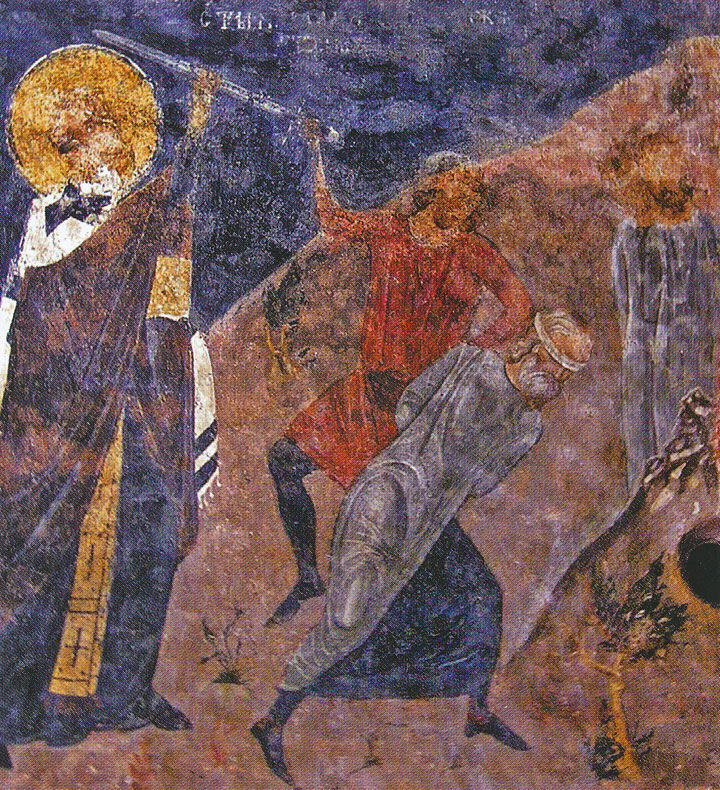
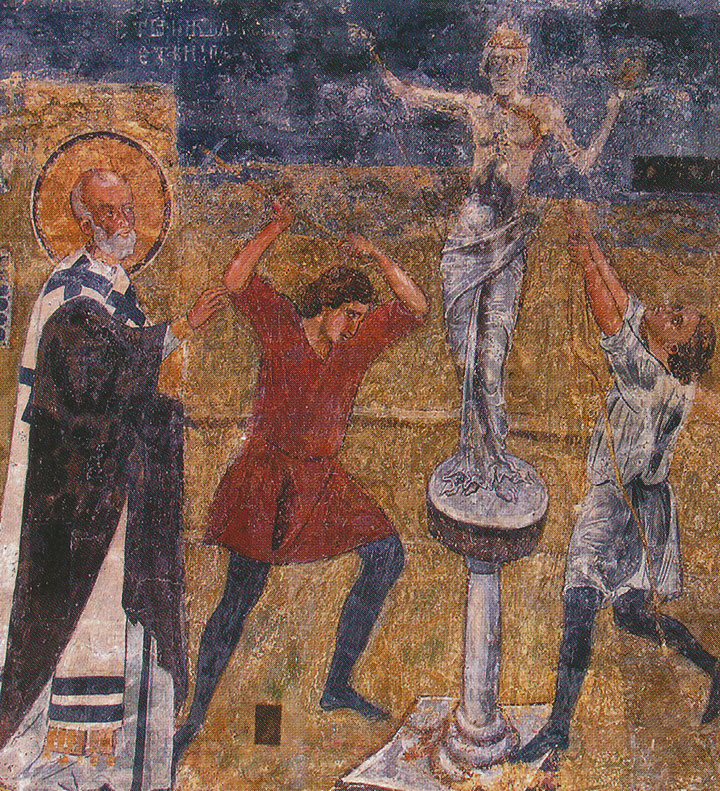
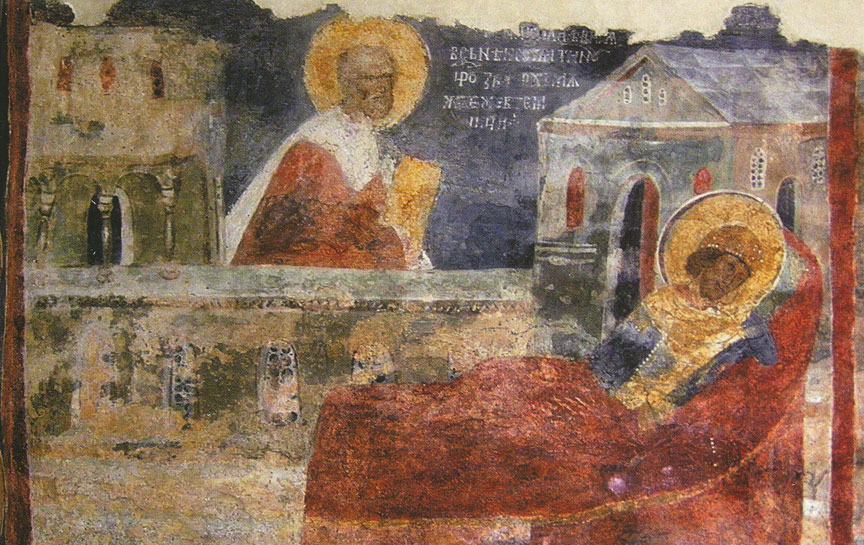
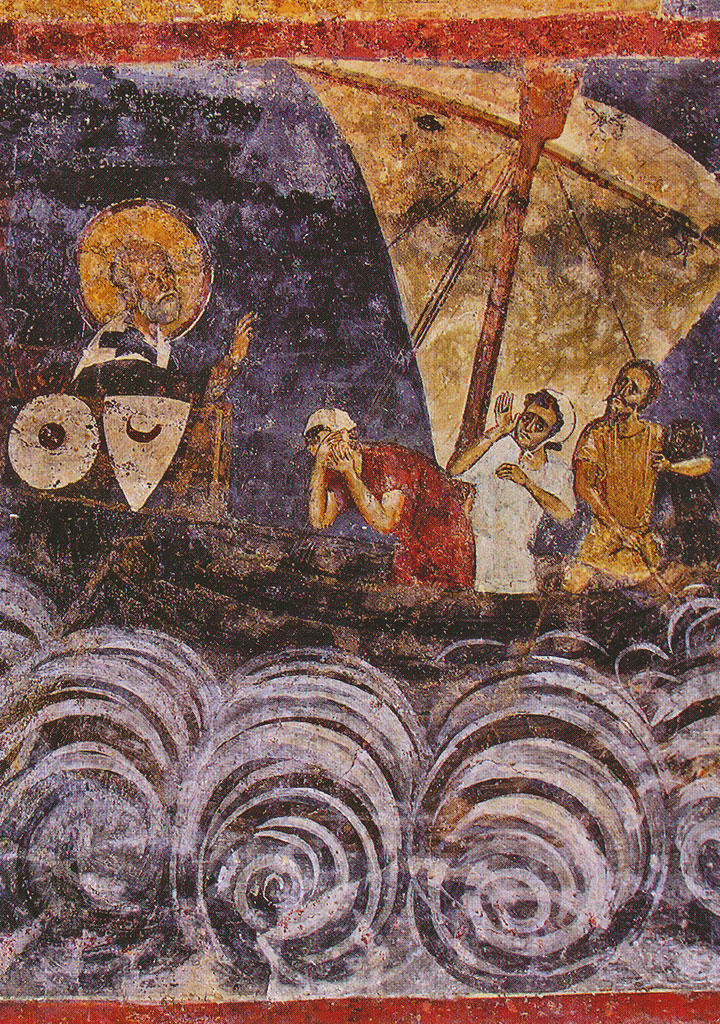
t) Nicholas as depicted in the mid-thirteenth-century frescoes (1259) in the church of Sts. Nicholas and Panteleimon at Boyana near the Bulgarian capital of Sofia:
http://galenf.com/Bulgaria/36/bu_0015.jpg
http://tinyurl.com/d5sdgmf
This fresco's position in the church:
http://www.flickr.com/photos/vintagedept/4967294741/lightbox/
Another portrait of Nicholas and scenes from his Bios in the same mid-thirteenth-century frescoes in this church:
http://galenf.com/Bulgaria/36/bu_0011a.jpg
http://galenf.com/Bulgaria/36/bu_0011b.jpg
http://galenf.com/Bulgaria/36/bu_0012.jpg
http://galenf.com/Bulgaria/36/bu_0012a.jpg
http://galenf.com/Bulgaria/36/bu_0012b.jpg [the idol is that of Artemis / Diana]
http://galenf.com/Bulgaria/36/bu_0013.jpg
http://galenf.com/Bulgaria/36/bu_0013a.jpg
http://galenf.com/Bulgaria/36/bu_0013b.jpg
http://galenf.com/Bulgaria/36/bu_0014c.jpg
http://galenf.com/Bulgaria/36/bu_0014.jpg
http://galenf.com/Bulgaria/36/bu_0011.jpg
http://galenf.com/Bulgaria/36/bu_0014b.jpg

u) as depicted in a later thirteenth-century fresco (between c. 1263 and 1270 or slightly later) in the chapel of St. Symeon Nemanja in the monastery church of the Holy Trinity at Sopoćani (Raška dist.) in Serbia:
http://tinyurl.com/cergvfa

v) as depicted (lower register) in a later thirteenth-century fresco (between 1263 and 1270 or slightly later) in the chapel of St. George in the monastery church of the Holy Trinity at Sopoćani (Raška dist.) in Serbia:
http://tinyurl.com/6lpm895

w) as depicted (standing, with scenes from his Bios) in a late thirteenth-century icon from the church of Agios Nikolaos tis Stegis at Kakopetria in the Republic of Cyprus, now in the Byzantine Museum of the Archbishop Makarios III Foundation, Nicosia:
http://www.noteartistiche.it/traduzioni/files/nicola_kacopedia.jpg

x) as depicted (reviving the three pickled students) in a late thirteenth-century copy of French origin of the Legenda aurea (San Marino, CA, Huntington Library, ms. HM 3027, fol.1r:
http://digitalassets.lib.berkeley.edu/ds/huntington/images//000849A.jpg

y) as depicted (providing dowries for the three destitute daughters) in the late thirteenth-century Livre d'images de Madame Marie (ca. 1285-1290; Paris, BnF, ms. Nouvelle acquisition française 16251, fol. 90v):
http://tinyurl.com/262f2jt

z) as depicted in a late thirteenth-century icon (1294; from the church of St. Nicholas on Lipnya in Veliky Novgorod) in the Novgorod State United Museum:
http://tinyurl.com/28wxm65

aa) as depicted in the late thirteenth-century frescoes (c. 1295) by Eutychios and Michael Astrapas in the church of the Peribleptos (now Sv. Kliment Ohridski) in Ohrid:
http://tinyurl.com/7ar7xzb
Detail view:
http://tinyurl.com/na282ae

bb) as depicted in a late thirteenth- or very early fourteenth-century fresco in the church of the Holy Apostles in the Patriarchate of Peć at Peć in, depending upon one's view of the matter, either the Republic of Kosovo or Serbia's province of Kosovo and Metohija:
http://tinyurl.com/y8wqrl7

cc) as depicted in a late thirteenth or very early fourteenth-century fresco, attributed to Manuel Panselinos, in the bema of the Protaton church on Mt. Athos:
https://www.stnicholascenter.org/galleries/gallery/5657/

dd) as depicted (three scenes from his Vita) in the very late thirteenth- or very early fourteenth-century frescoes (c. 1300-1301), attributed to Guido di Palmerino, in the cappella di San Nicola in the lower church of the basilica di San Francesco in Assisi:
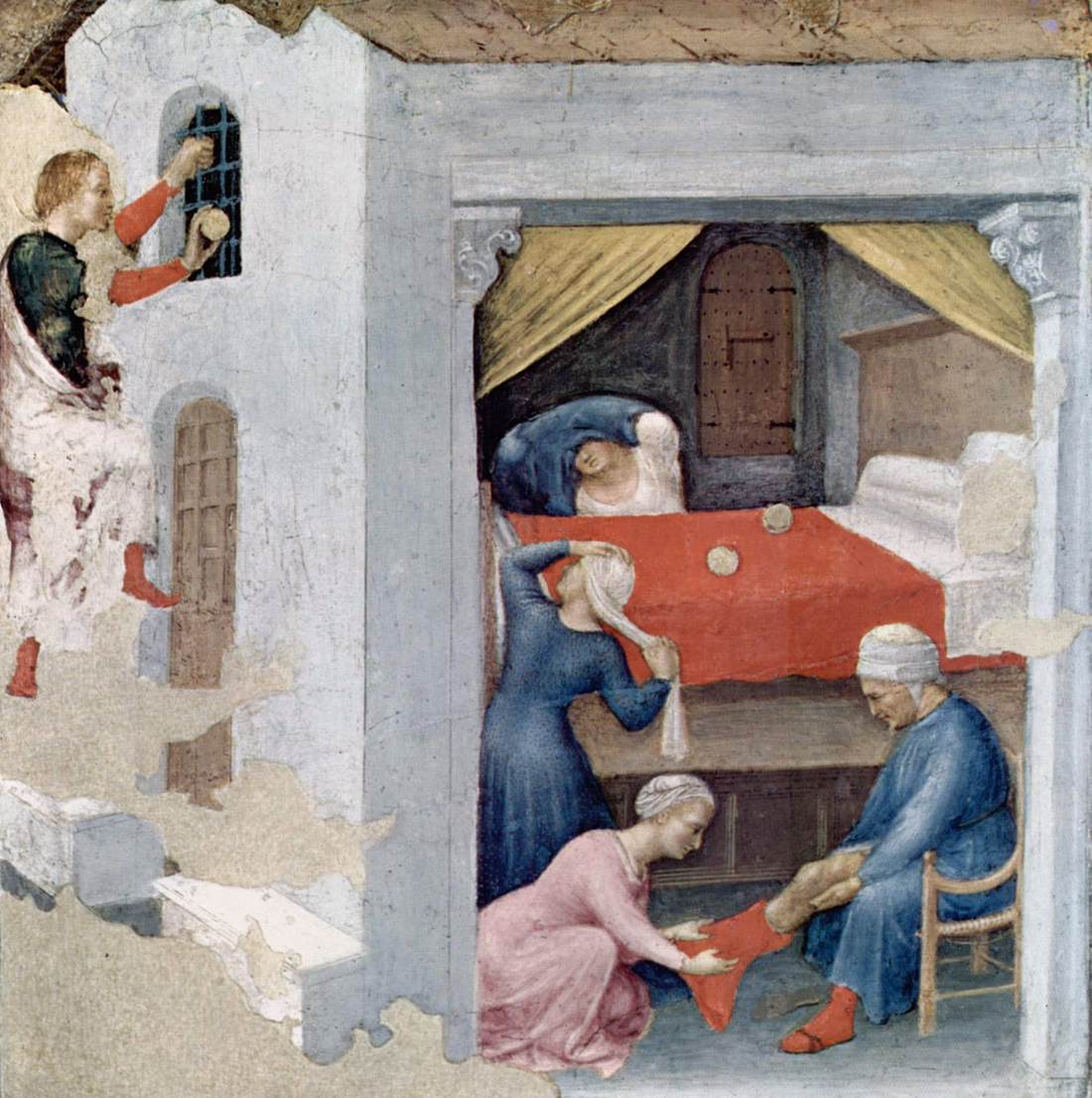
1) providing dowries for the three destitute daughters:


2) halting the execution of the three soldiers:


3) forgiving the corrupt magistrate at Myra:


ee) as portrayed (standing, plus scenes from his Vita) on a fourteenth century relief mounted on the exterior of the basilica di San Nicola in Bari:
http://tinyurl.com/jnolx59

ff) as depicted (at left) in an early fourteenth-century fresco in the apse of the right transept of the basilica di San Nicola in Bari:

La basilique San Nicola

http://www.pbase.com/querido/image/50660484

gg) as depicted (with the boy with the golden cup) in an early fourteenth-century fresco in the rupestrian chiesa di Santa Maria delle Grotte in Rocchetta a Volturno (IS) in Molise:


Detail view (Nicholas):


hh) as depicted in the earlier fourteenth-century frescoes (between c. 1308 and c. 1320) by Michael Astrapas and Eutychios in the church of St. Nicetas the Goth (Sv. Nikita) at Čučer in today's Čučer-Sandevo in the Former Yugoslav Republic of Macedonia:
http://tinyurl.com/hwmgp8d
Detail view:
https://plus.google.com/photos/110067756467697073060/album/5245719451287580257/5245728971001399346

ii) as depicted (scenes from his Bios) in the earlier fourteenth-century frescoes (between c. 1311 and c. 1322) in the church of St. Nicholas Orphanos in Thessaloniki:
http://tinyurl.com/6veqz5c
http://tinyurl.com/74xgadu
http://tinyurl.com/7lnggfe
http://tinyurl.com/bw7r4n8
http://tinyurl.com/cwkvo8h
http://tinyurl.com/czvqzta
http://tinyurl.com/7becpxb
http://tinyurl.com/7r75n56
Nicholas' badly degraded portrait next to the door below those frescoes:
http://tinyurl.com/7svfqqb

jj) as depicted (at lower right) by Simone Martini in an earlier fourteenth-century polyptych (betw. 1320 and 1320) in the Fitzwilliam Museum in Cambridge:


Detail view (Nicholas):


kk) as depicted (providing dowries for the three destitute daughters) in an earlier fourteenth-century copy of the Legenda aurea in its French-language version by Jean de Vignay (c. 1326-1350; Paris, BnF, ms. Français 185, fol. 143r):
http://tinyurl.com/2bovzh4

ll) as depicted in an earlier fourteenth-century icon donated to the church of St. Nicholas in Bari by the Serbian Tsar Stefan Uroš IV Dušan in 1327:

With silver riza, right,  and without

On the left is the icon, and on the right it is shown with its silver riza

Detail view:


mm) as depicted (his birth) in an earlier fourteenth-century French-language legendary of Parisian origin with illuminations attributed to the Fauvel Master (c. 1327; Paris, BnF, ms. Français 183, fol. 141v):
http://tinyurl.com/2fnf2zx

nn) as depicted in the earlier fourteenth-century frescoes (1330s) in the apse of the church of the Hodegetria in the Patriarchate of Peć at Peć in, depending on one's view of the matter, either the Republic of Kosovo or Serbia's province of Kosovo and Metohija:
http://tinyurl.com/yzb6xly

oo) as depicted in the earlier fourteenth-century frescoes (betw. 1335 and 1350) in the nave of the church of the Holy Ascension at the Visoki Dečani monastery near Peć in, depending on one's view of the matter, either the Republic of Kosovo or Serbia's province of Kosovo and Metohija:
http://tinyurl.com/2a4j82d
Detail view:
http://tinyurl.com/2bcl6qc

pp) as depicted (at right; at left, St. Sabas of Jerusalem) in a December calendar composition in the earlier fourteenth-century frescoes (between 1335 and 1350) in the narthex of the church of the Holy Ascension at the Visoki Dečani monastery near Peć in, depending upon one's view of the matter, either the Republic of Kosovo or Serbia's province of Kosovo and Metohija:
http://tinyurl.com/bszau2d

qq) as depicted (scenes from his Bios) as depicted in the earlier fourteenth-century frescoes (betw. 1335 and 1350) of the parecclesion of St. Nicholas in the church of the Holy Ascension at the Visoki Dečani monastery near Peć in, depending on one's view of the matter, either the Republic of Kosovo or Serbia's province of Kosovo and Metohija (three pages beginning here):
http://tinyurl.com/39ajslh

rr) as depicted in the mid-fourteenth-century frescoes of the monastery church of St. Michael the Archangel at Lesnovo in the Former Yugoslav Republic of Macedonia:
http://tinyurl.com/nksu8vp
Detail view:
http://tinyurl.com/pbx9hv8

ss) as depicted (with scenes from his biographies) in a later fourteenth-century Moscow School icon in the State Tretyakov Gallery in Moscow:
http://www.icon-art.info/masterpiece.php?lng=en&mst_id=443

tt) as portrayed by Frà Giovanni di Bartolomeo (a.k.a. the Master of the Magi of Fabriano) in a later fourteenth-century polychromed wooden statue in the chiesa di San Niccolò in Fabriano:


uu) as depicted (two scenes from his Bios) in the later fourteenth-century frescoes (1360s and 1370s; restored in 1968-1970) in the church of St. Demetrius in Marko's Monastery at Markova Sušica (Studeničani municipality) in the former Yugoslav Republic of Macedonia:
1) three innocent generals condemned by Constantine appeal to him:


2) his dormition:


vv) as depicted in a later fourteenth-century fresco (c. 1372) in the church of St. Michael the Archangel in the Varoš monastery in Prilep in the Former Yugoslav Republic of Macedonia:
http://tinyurl.com/z6yqnut

ww) as depicted (reviving the three pickled students) in a late fourteenth- or early fifteenth-century copy of the Legenda aurea in its French-language version by Jean de Vignay (Rennes, Bibliothèque de Rennes Métropole, ms. 266, fol. 12v):
http://tinyurl.com/pentlf6

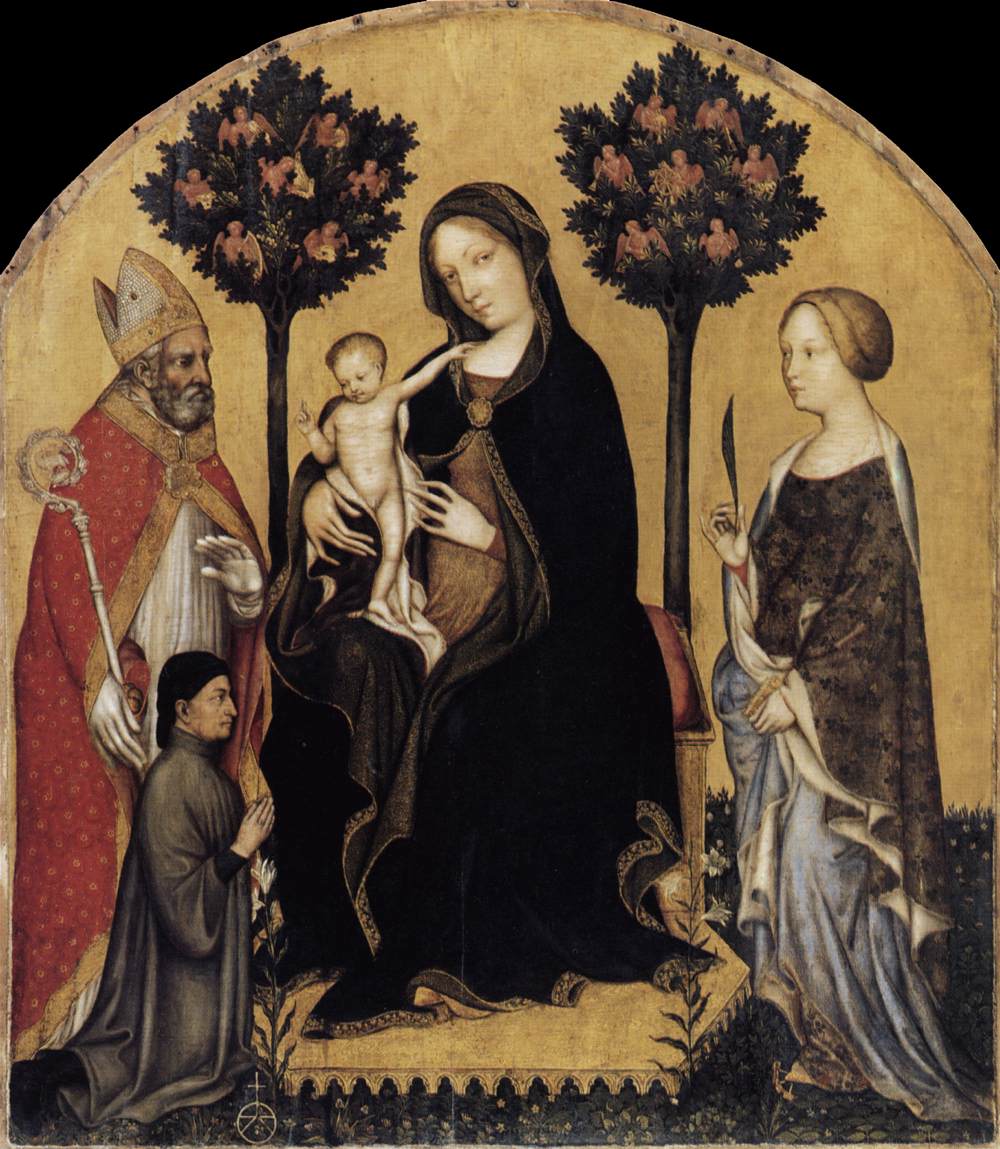
xx) as depicted by Gentile da Fabriano (at left, flanking the BVM and Christ Child; at right, St. Catherine of Alexandria) in a late fourteenth- or early fifteenth-century panel painting (c. 1395-1400 or c. 1405) in the Staatliche Museen in Berlin:


yy) as depicted in a fifteenth-century Novgorod School icon in the Karelian Fine Arts Museum in Petrozavodsk:
http://www.icon-art.info/masterpiece.php?lng=en&mst_id=2770

zz) as depicted (second from left) by Gentile da Fabriano in his dismembered earlier fifteenth-century Quaratesi polyptych (c. 1425):

1) second from left in a panel from the main structure in Galleria degli Uffizi in Florence :


2) four predella panels (scenes) in the Pinacoteca Vaticana:
Overview:
http://mv.vatican.va/3_EN/pages/PIN/PIN_Sala02_02.html

Dowries for the three destitute daughters:


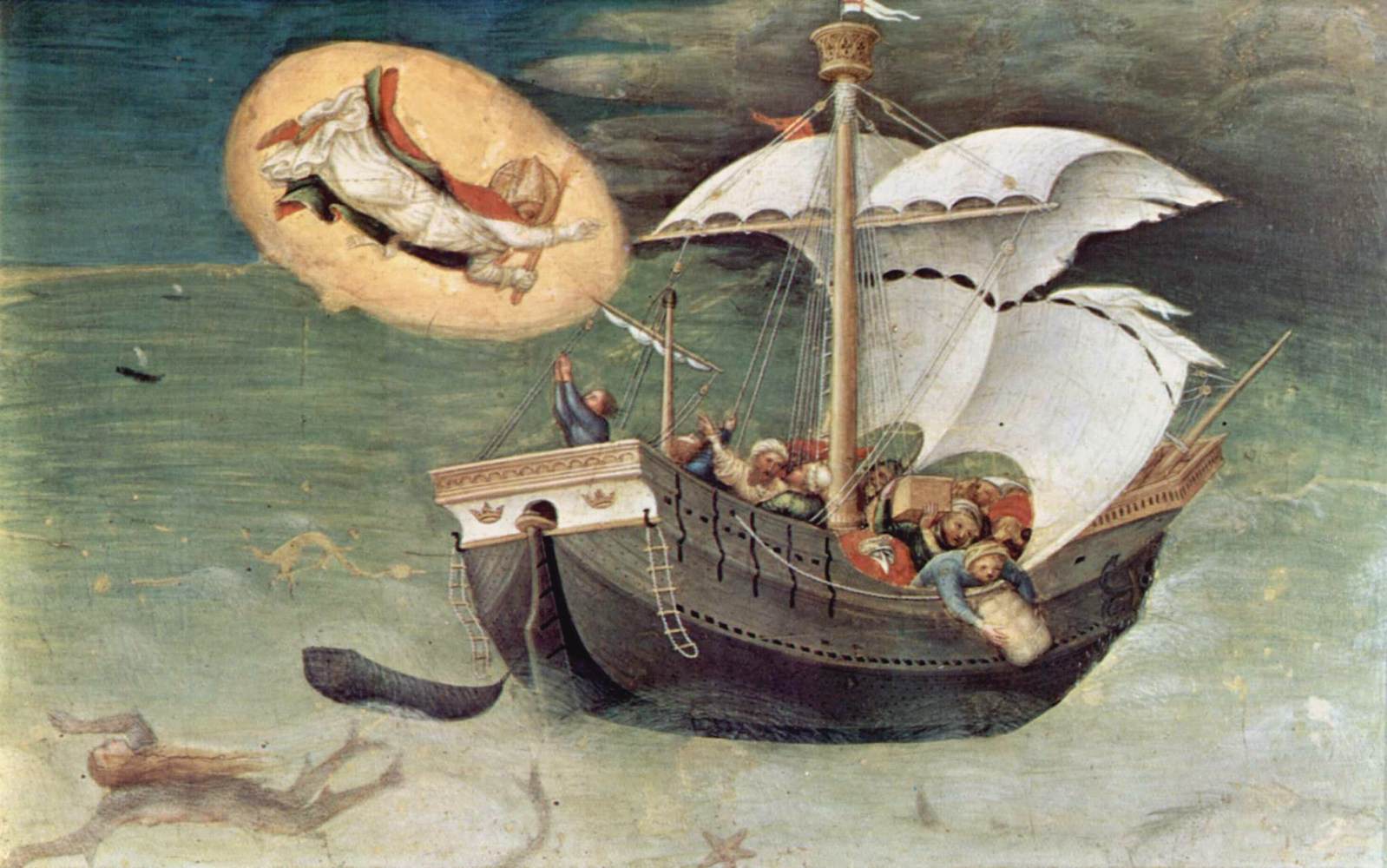
Saving storm-tossed seamen:


Reviving the three pickled students:


aaa) as depicted by Beato Angelico in an earlier fifteenth-century panel painting (c. 1425-1430) in the Arp Museum Bahnhof Rolandseck, Remagen:


bbb) as depicted (reviving the three pickled students) in the earlier fifteenth-century Hours of Marguerite d'Orléans (Paris, BnF, ms. Latin 1156 B, fol. 172r):
http://tinyurl.com/3322ur8

ccc) as depicted (two scenes from his Vita) by Johann of Laibach the son of Friedrich of Villach in the mid-fifteenth-century frescoes (1443) in the cerkev sv. Nikolaja in Visoko pod Kureščkom, Slovenia:
1) halting the execution of the three soldiers:


2) saving storm-tossed seamen:


ddd) as depicted (at right; at left, St. Ulrich) by the Master of Liefering in a later fifteenth-century panel painting (c. 1460-1470; from a dismembered altarpiece) in the Pfarrkirche Liefering (Heilige Petrus und Paulus) in Salzburg-Liefering:


eee) as depicted (scenes from his Vita) in a later fifteenth-century copy (1463) of Vincent of Beauvais' Speculum historiale in its French-language version by Jean de Vignay (Paris, BnF, ms. Français 51, fols. 117v, 118r, 119r, 121r, 122r):
http://tinyurl.com/36fgjjt
http://tinyurl.com/37wdb45
http://tinyurl.com/2vbe4gt
http://tinyurl.com/3y37c7a
http://tinyurl.com/32v9g3b

fff) as depicted by Benozzo Gozzoli in a later fifteenth-century fresco (1465) in the apsidal chapel of the chiesa di Sant'Agostino in San Gimignano:


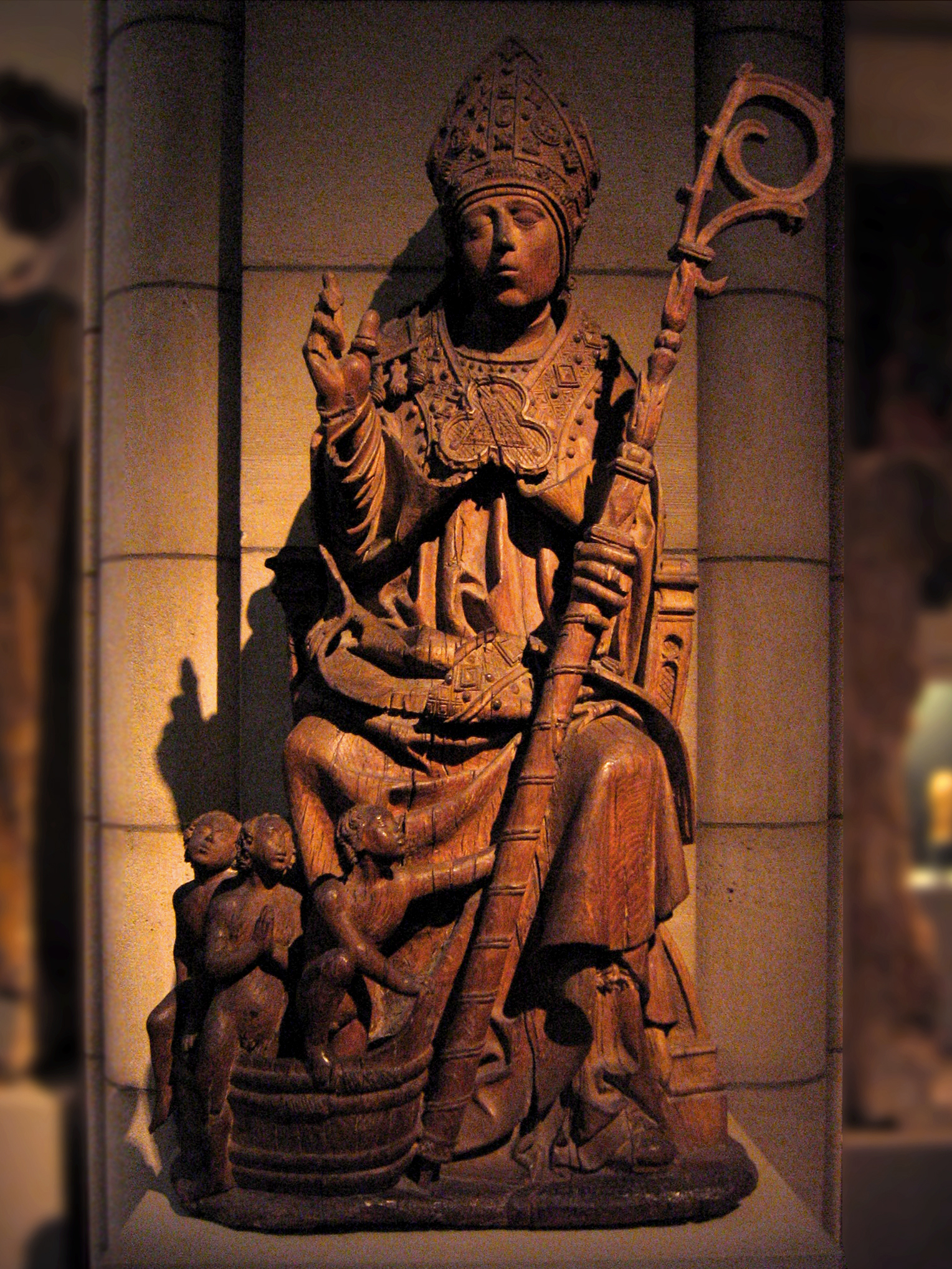
ggg) as portrayed (reviving the three pickled students) in a late fifteenth- or very early sixteenth-century wooden statue of southern Netherlandish origin now in the Metropolitan Museum of Art in New York:


hhh) as depicted in an earlier sixteenth-century Ukrainian icon from the village of Sushystya the Great (Lviv oblast):


iii) as depicted (conch portrait and scenes from his Bios) by Dionisy and sons in the early sixteenth-century frescoes (1502) in the Virgin Nativity cathedral of the St. Ferapont Belozero (Ferapontov Belozersky) monastery at Ferapontovo in Russia's Vologda oblast (expandable images on these pages):
http://www.dionisy.com/eng/museum/1195/
http://www.dionisy.com/eng/museum/1214/?frag
http://www.dionisy.com/eng/museum/1278/?frag

jjj) as depicted by Dionisy in an early sixteenth-century icon (c. 1502) in the icon museum of the Kirillo-Belozersky monastery at Goritsy in Russia's Vologda oblast:
http://tinyurl.com/cm2kpeh
Detail view:
http://tinyurl.com/dxqmhyy

kkk) as portrayed by the Master of the Altötting Doors in an earlier sixteenth-century wooden statue (c. 1520-30; formerly polychromed) in the Bayerisches Nationalmuseum, München:


lll) as depicted by Theofanis Strelitzas-Bathas (a.k.a. Theophanes the Cretan) in the earlier sixteenth-century frescoes (1527) in the katholikon of the monastery of St. Nicholas Anapafsas in Kalambaka (Trikala regional unit) in northern Greece:
http://tinyurl.com/7sswsf6