Once I was a clever boy learning the arts of Oxford... is a quotation from the verses written by Bishop Richard Fleming (c.1385-1431) for his tomb in Lincoln Cathedral. Fleming, the founder of Lincoln College in Oxford, is the subject of my research for a D. Phil., and, like me, a son of the West Riding. I have remarked in the past that I have a deeply meaningful on-going relationship with a dead fifteenth century bishop... it was Fleming who, in effect, enabled me to come to Oxford and to learn its arts, and for that I am immensely grateful.


Showing posts with label Très Riches Heures. Show all posts

Sunday, 9 July 2017

Royal Palaces of the Hundred Years War


History Extra has an illustrated article on Royal palaces of the Hundred Years’ War which is of interest and links in with other posts I have written, such as those on the Très Riches Heures of the Duke of Berry and castles such as Vincennes.


The article is introduced as follows: Made famous in popular history by the battle of Agincourt, Joan of Arc and Edward the Black Prince, the Hundred Years' War was an epic conflict between two nations, England and France. As Anthony Emery explains, over the course of the war the balance of architectural power moved from religious to secular domination; the Gothic style of architecture continued to develop and the palace-fortress became the pre-eminent form of a residence. Read the full story here.

I think it does bring out the point that these really were palace-fortresses, and not just stark military establishments, in what was an age of royal and aristocratic luxurious living.


Saturday, 1 July 2017

July


Image: Wikipedia

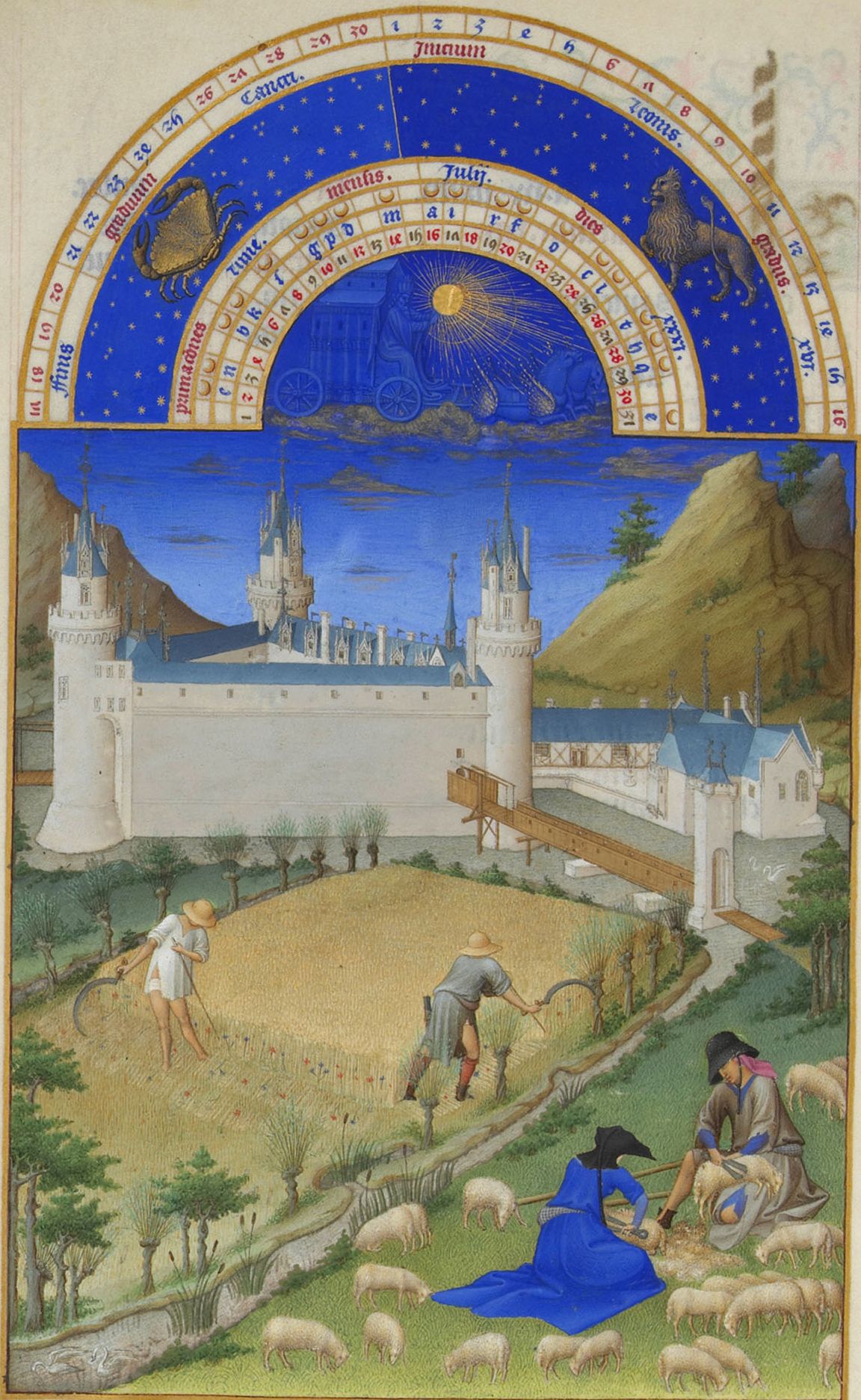
This illumination is attributed to Paul Limbourg and depicts the Chateau or Palace of Poitiers, parts of which still survive. The chateau belonged to the Duke of Berry who had rebuilt portions of it in the decades preceding the painting.
Harvesting and sheep shearing are taking place in the foreground, plenty abounds - all is beginning to be safely gathered in against the winter. As with the other months in the series the scene is idyllic - almost in the tradition of eighteenth century rustic scenes. Swans glide along the clear waters of the moat, the chateau looks trim and well-cared for, as befitted a residence of the Duke of Berry, whilst the landscape is lush and fertile. Here then is once again a scene of tranquility, rather different from the realities of life in northern and central France in the years 1413-16.

More particularly, in July 1417 King Henry V was completing his plans for his second invasion of France. By the end of the month the English King, his army and fleet were asembled ready for the planned conquest of Normandy.


Monday, 1 May 2017

May


https://upload.wikimedia.org/wikipedia/commons/thumb/d/d9/Fr%C3%A8res_Limbourg_-_Tr%C3%A8s_Riches_Heures_du_duc_de_Berry_-_mois_de_mai_-_Google_Art_Project.jpg/494px-Fr%C3%A8res_Limbourg_-_Tr%C3%A8s_Riches_Heures_du_duc_de_Berry_-_mois_de_mai_-_Google_Art_Project.jpg

Image: Wikimedia 

This calendar page from the Très Riches Heures is attributed to Jean de Limbourg.

Here is the aristocratic world of Maying, of courtship and high society in the early fifteenth century. The occasion is the May jaunt, a pageant celebrating the "joli mois de Mai" in which one had to wear green garments known as livree de mai, or at very least as a sign of festivity a garland or sprig of greenery with one's other attire. Looking at the musicians horns or trumpets and simple trombone it must also have been quite a noisy canter through the countryside.

It is an idyllic scene in a world that was far from idyllic, with France beset by internal strife and in 1415 had experienced the first invasion by King Henry V culminating in the English victory at Agincourt. In August 1417 King Henry was back with a campaign of systematic conquest in Normandy. The life of Paris and northern France as recorded in the Journal of the Bourgeois of Paris was grim and violent due to the collapse of the political consensus and the consequent lapse into violent disorder between Burgundians and Orleanists.

The element of escapism is borne out by the fact that in the background, beyond the woodland, is the Hôtel de Neslé, the Duke of Berry's Paris residence, and which was situated on the left bank of the Seine in the heart of the capital.

It is nonetheless idyllic, reminiscent in its ethos of the eighteenth century French school with painters such as Watteau, and a reminder of what the aristocracy - and their imitators no doubt - sought as their lifestyle. This was what life should be like at this time of year, and there was no reason for the artist not to depict it, even if in reality the young men were off fighting and the young women waiting their return in their family chateaux.

Saturday, 1 April 2017

April


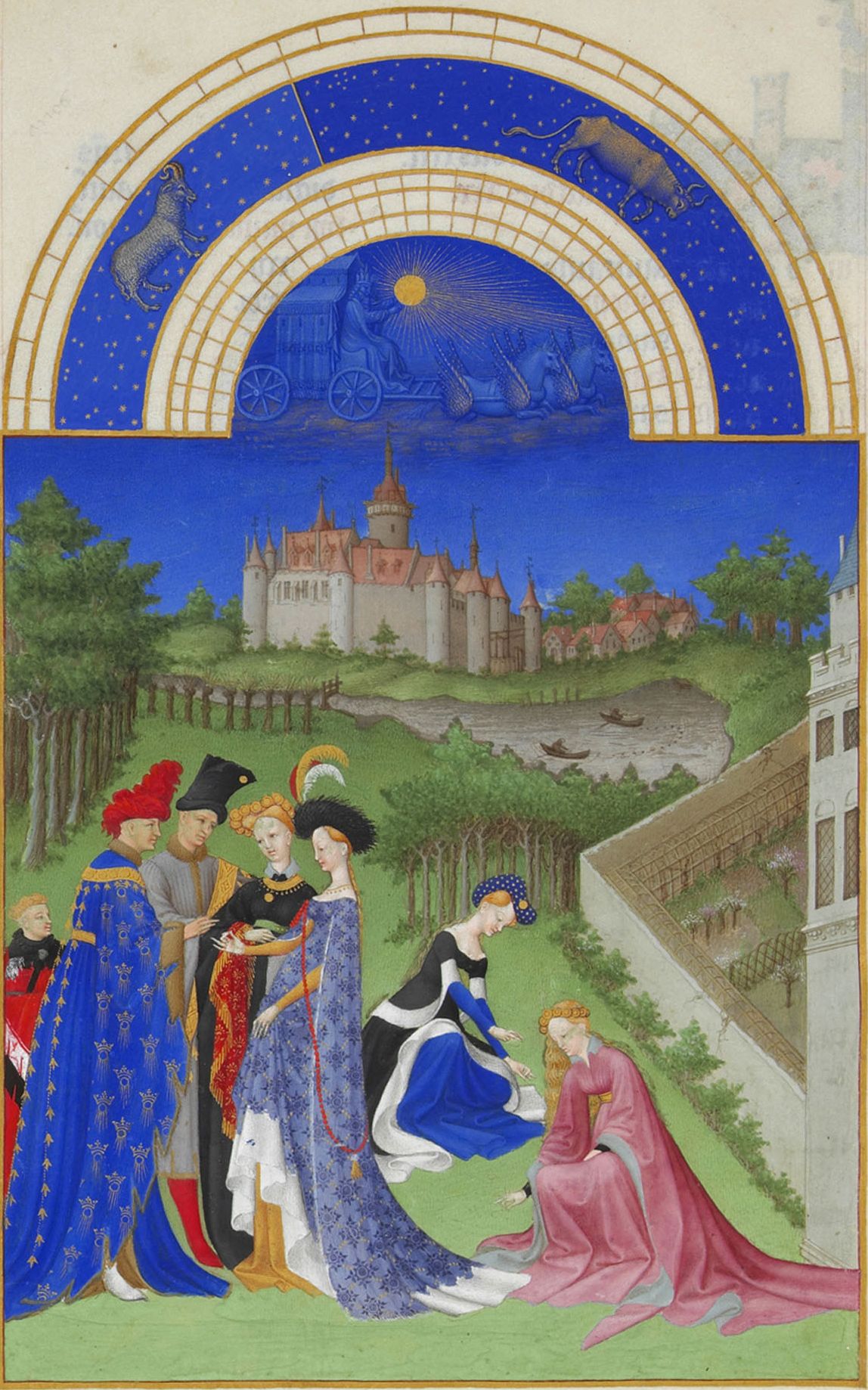
The April calendar page of the Très Riches Heures is attributed to Jean de Limbourg.

The scene depicts a bethrothal before two witnesses whilst two young women in attendance pick flowers. On the right is a walled garden or pleasance, the plants of which are not fully in bloom, but all is prepared for the coming season of growth. In the background is the Château de Dourdan, west of Paris, which had been held by the Duke of Berry since 1385, and of which much of the buildings still survive. There is more about the history of the chateau and many more pictures here.

Romance and the spring clearly went together in the early fifteenth century mind. There is in its aristocratic rural idyll something we recognise in later artists and even in modern advertisements such as those for firms like Barbour.

In 1415, the year of King Henry V's Agincourt campaign, or in 1417 when he invaded Normandy again, not a few married or bethrothed couples, or ones that might have been, were to find death and bereavement, exile or flight as a result of the fighting. There were casualties on both sides amongst both the elite and the common soldiers, but much more so on the French side. Juliet Barker concludes her excellent book Agincourt on the battle with a discussion of this, drawing upon Alain Chartier's 1416 poem, written as a response to the battle, Le Livre des quatre dames  and Christine de Pisan's Epistre de la prison de la vie humaine with its reflections upon the fortunes of war.


Wednesday, 1 March 2017

March


The Château de Lusignan, situated in Lusignan in the modern dèpartement of Vienne, was the seat of the Lusignan family, Poitevan Marcher Lords, who distinguished themselves in the First Crusade and held the crowns of two Crusader kingdoms, the Kingdom of Jerusalem and the Kingdom of Cyprus, and also claimed the title King of Armenia.

Lusignan was constructed, occupying a natural strongpoint: a narrow promontory that overlooked steep valleys on either side. It was already so impressive in the twelfth century that a legend developed to the effect that its founder had faery aid, in the guise of the water spirit Melusine, who built it and its church through her arts, as a gift for her husband Raymondin.

Lusignan at its height in the early fifteenth century, is illustrated in the Très Riches Heures of Jean, Duc de Berri, for whom it was a favorite residence until his death in 1416. It rises in the background of the miniature for the month of March, clearly shown in perspective, with its barbican tower at the left, the clock tower - with the exterior chute of the garderobe to its right - and the Tour Poitevine on the right, above which the gilded dragon flies, the protective spirit of Marc Lacombe.

After the Duc de Berri's death, Lusignan became briefly the property of the Dauphin John, who died in May 1417, and then passed to his brother, Charles, the future King Charles VII.

The village which developed into the town of Lusignan grew up beneath the castle gates, along the slope; it formed a further enceinte or surrounding fortification when it too was later enclosed by walls. Lusignan remained a strategically important place in Poitou, in the heart of France. About 1574, during the Wars of Religion, a plan was made of the castle's defences which is now in the Bibliothèque National. In the following century Lusignan was reinforced in the modern manner by Vauban for King Louis XIV. It was a natural structure to be used as a prison, and later housed a school.

The château was long used as a local quarry of pre-cut stone before it was razed by the Comte de Blossac in the nineteenth century, to make a pleasure ground for the town. Today the remains are largely portions of the foundations, some built into steep hillside, part of the keep, the base of the Tour Poitevine, cisterns and cellars, and remains of a subterranean passage that probably once led to the church.

With acknowledgements to the article on the château on Wikipedia

To those points I would add that the depiction of this and, over the succeeding months, other châteaux associated with the Duc de Berri and his family, indicate a delight in their possession, and convey the fact that these medieval castles, however defensible, were essentially homes in the country, replete with medieval domestic comforts and surrounded with agriculture and other peaceful pursuits.These are residences, more than they are fortifications. The same sense is conveyed, for example, by surviving images of English castles in the sixteenth and early seventeenth centuries.

The plough oxen in the foreground are a reminder that for centuries the ox was the beast of burden in Europe, and their use continued later than one might expect. I have, for example, seen a photograph of someone still ploughing with oxen in Wiltshire in about 1900.

As with the other scenes in the manuscript the landscape is perhaps unnaturally tidy, altough the ploughman in the foreground is wearing patched clothing, and the grey and green tones do convey something of the climate and mood of March as the farming year demands hard work from the husbandmen.

The wayside shrine at the cross roads in the middle distance is an indication of the type of monument which may well have been common, but of which we have few surviving examples - although more modern examples are still to be found in Catholic areas of Europe.


Wednesday, 1 February 2017

February


Image Wikipedia

This scene of rural life illustrating February from the Très Riches Heures is attributed to the artist identified as the 'the courtly painter'.

One group sensibly stays indoors and keeps warm by the fire in some comfort. Outside the sheep huddle under their shelter whilst the birds feed in the farmyard and the bees presumably hibernate in their hives. Some are still at work, including chopping down a tree for fuel, and another goes off to market. Despite the cold weather there is a sense of all being gathered safely in to keep warm and secure through this early fifteenth century winter. It may be idealised - whether places were as neat and tidy as the illuminators depict them throuhout the Très Riches Heures may be a reasonable question to ask - but it is nonetheless a world we can envisage and of which we can have some sense even in today's more hi-tech world.

The painting inspired one of the scenes in Olivier's film of "Henry V" for the aftermath of Agincourt.
The picture is also a reminder that our familiar friend climate change was operating in these years. After a warmer period in the twelfth and thirteenth centuries the climate was getting colder, for which we have evidence in the retreat of the cultivated areas in Scandinavia and in Greenland where the settlements finally failed in this period. This situation continued to develop until the coldest point, the "Little Ice Age" of the seventeenth century, before warming up again. So more severe winters may have been the norm in the years when the Limbourgs were painting their miniatures.


Sunday, 1 January 2017

January


Image:Wikipedia

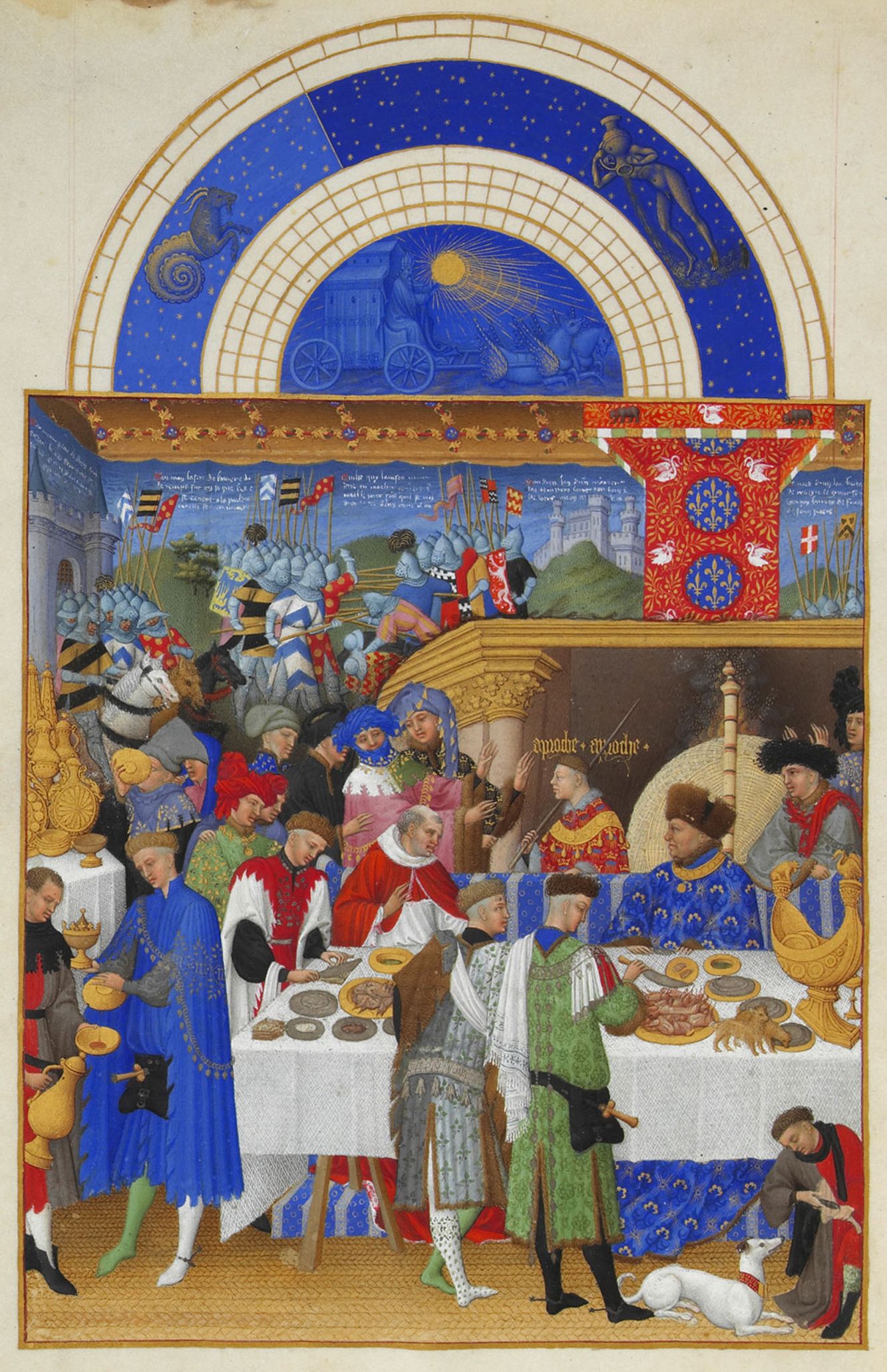
The Duke of Berry (1340-1416), of whom there is an online biography here, is depicted dressed in blue and wearing a livery or chivalric collar and seated to the right, and wearing a handsome fur hat to indicate his status, celebrates the Christmas and Epipany seasons. There appears to be the exchange of gifts - New Year or Epiphany ones - and a cultivated and splendid lifestyle. This is a pattern which would have been replicated or emulated across Europe in royal and aristocratic households.

The importance of the Duke is further indicated by the canopy and cloth of estate with his arms above his head. The tapestries or hangings with their battle scenes which decorate the room are a further sign of wealth. They would have travelled with the household and been hung to decorate whichever residence was in use at the time. What today might appear the rather stark interior of later medieval residences  could have rapidly been transformed by such wallhangings - which also would have provided insulation. A superb contemporary set which depicts the Apocalypse have survived and can be seen at Angers in the castle. In a similar way the trestle table once covered with a fine linen cloth assumes far greater dignity.

The firescreen is also an interesting feature, as is the woven rush matting - rushes on the floor clearly did not mean a strewn hay stack as one might be led to believe, but a fitted covering in such a grand household. Similar floor coverings can be seen today in some National Trust properties such as Hardwick Hall in Derbyshire.

On the left is a sideboard or buffet with a display of gold plate as was expected on such occasions to display princely magnificence, and other splendid plate is in use at the feast, as well as an aquamanile for washing the hands of those dining at the table. The pieces shown are very similar to the relatively few surviving examples from the period in museums and collections such as those of the Oxford and Cambridge colleges. My post The Royal Gold Cup is about another surviving piece, now in the British Museum, of such splendid plate which is specifically linked to the Duke and his nephew King Charles VI.

The whole scene is redolent of courtly life, well mannered, polite, fashionable and stylish - even the greyhound has an air of elegant langour.

The painting is attributed to the artist identified as the 'the courtly painter'. 

The effigy of the Duke in the cathedral of St Etienne in Bourges by Jean de Cambrai shows a great similarity to the figure of him in the illumination:


Tomb of Jean, Duc de Berry

Image:courtauldprints.com


Duc de Berry.jpg

Image:Wikipedia

The Duke was a major player in the French political system both a member of the Royal family, being son of King Charles V, and as a grand seigneur with his appanage of Berry.  That so much of French  politics hinged on the rivalries between Royal Dukes such as Orleans, Burgandy and Berry when King Charles VI was periodically incapacitated by mental illness raised tensions and weakened the ability to respond to the potential threat posed by King Henry V.

Hoever at the beginning of January as the Duke and his court feasted they cannot have imagined the scale of that threat, or of its impact within the coming year.


The Très Riches Heures Calendar pages


I have decided to post once again this year, as I did five years ago and two years ago, the appropriate monthly calendar page from the Très Riches Heures of Jean, Duc de Berry. There is an article about this, probably the most famous Book of Hours here, which has links to articles on the artists involved. 

The manuscript was begun by the Limbourg brothers Herman (b. 1385), Paul (b.1386 or 7) and Jean (b. 1388) in 1412, but left unfinished when they all died, probably of plague, in February 1416. The Duke died that same year and the Hours were completed by other artists, later in the century, in a recognisably different style. The majority of the calendar pages are by the Limbourgs themselves, and include marvellous views of the ducal and of other royal residences in France. 

What they do not indicate in their idyllic representations - and, given the nature of the book, why should they I might add - is that they were produced against the background of civil conflict between the Armagnacs and the Burgundians, as detailed so graphically in the Journal of the Bourgeois of Paris, and, in 1415, King Henry V's invasion and his spectacular defeat of the French at Agincourt, followed by his conquest of Normandy in 1417-19.

I will post each Calendar page separately on the first day of the month with revised notes about the scene and places depicted. This is the period of history in which I might claim to specialise  - it is the one that brought me to Oxford - and I am always keen to share my enthusiasm for it.

Tuesday, 1 December 2015

December


Image: Wikipedia

The December calendar page from the Très Riches Heures is attributed to Paul Limbourg. In the foreground is a hunting scene. Judging from the way the dogs are crowding around the quarry it is difficult to know if much will be left for the seasonal feasting for which it may be intended for in the chateau - but perhaps that is just artistic licence.

In the background is the great French royal palace-fortress of Vincennes. This had originated as a  hunting lodge for King Louis VII about 1150, but had become a major royal residence during the thirteenth century. The donjon in the centre of the view was built by King Philip VI in 1337, and is the tallest building of its type in Europe. It was in the donjon that King Henry V of England and Regent of France was to die in 1422, only a few years after the minature was painted.The towers on the surrounding curtain wall were reduced to the height of the walls with one exception in the early 1800s.

There is more about the history and architercture of the fortress to be read at the link Château de Vincennes.


Sunday, 1 November 2015

November


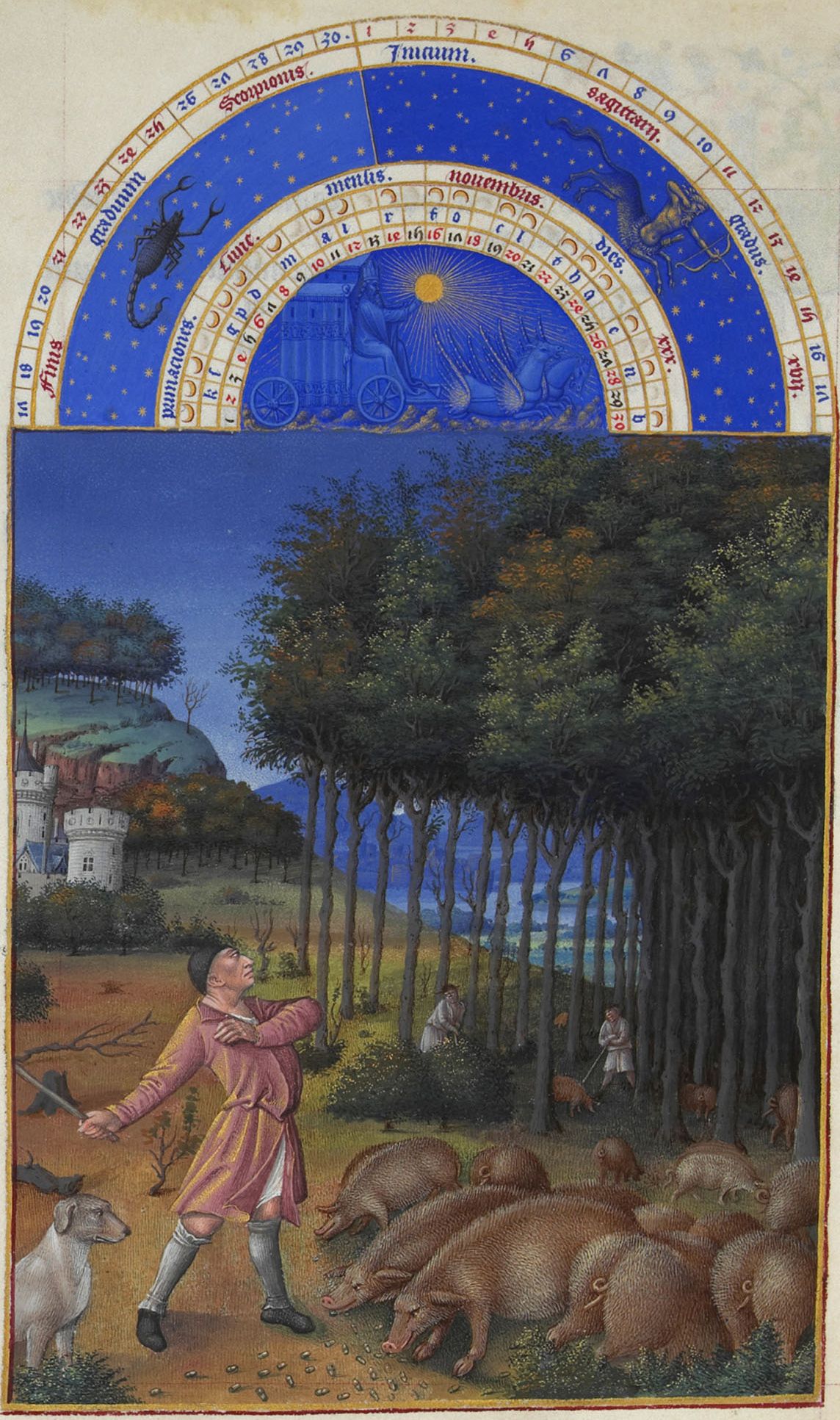
The November page in the Très Riches Heures is attributed entirely to Jean Colombe and dates from the completion of the manuscript in the later 1480s. Unlike the other pages by the Limbourg brothers seventy or so years earlier it does not show a specific place, but rather a scene of rustic life. In that sense it is, I think, less interesting than the other calendar pages. The landscape does perhaps suggest that of Savoy, for whose Duke Colombe worked. What is depicted is the fattening of pigs on acorns and beech mast - the right of pannage. There is presumably the suggestion of plenty of pork and pork products to eat at the approaching Christmas season.

November 1415 witnessed the triumphant entry of King Henry V into London following his victory at Agincourt.


Thursday, 1 October 2015

October


Image: Wikipedia

This calendar page in the Très Riches Heures of John Duke of Berry is attributed to Paul Limbourg, with possible additions by Jean Colombe in the 1480s

The scene in the foreground is winter sowing and harrowing, with crows and magpies eating some of the seeds. The harrow is shown as horse drawn rather than by oxen. Beyond there is an archer in the middle ground with pollarded willows on the river bank. Meanwhile in the background people walk by the Seine, across which small boats ply. Once again this is a tranquil, reassuring scene of agricultural harmony. This is an idealised view as the building which dominates the scene is the palace of the Louvre, then at the western end of Paris, but the foreground would have been built up as it would be part of the Ile de la Cite or the left bank of the Seine.

The Louvre was originally built by King Philip II (1180-1223)  - the impressive foundations of his fortress are once again visible in the basement of the museum complex - but the Louvre as depicted was the result of its  remodelling as a residence by Duke John's elder brother, King Charles V, after his accession to the throne in 1364. As at Saumur in last month's illustration the palace fortress is decorated with elaborate finials and the chimneys point to domestic comfort inside the royal residence.

October 1415 was to see the English army make its doubtless in many ways weary way north-eastwards on the route towards Calais, with King Henry V seeking, it would appear, to avoid engagement with the French. That was not to be and the road to Calais was the road to the battle of Agincourt.... 


Monday, 14 September 2015

The Exaltation of the Holy Cross


Gordon Plumb has posted on the Medieval Religion discussion group as follows to mark today's Feast of the Exaltation of the Holy Cross, and which I have slightly revised and supplemented:

The Feast of the Exaltation of the Holy Cross celebrates two historical events: the discovery of the True Cross [ The now discontinued Feast of the Invention of the Holy Cross on May 3rd, a feast which appears to originate in seventh century Gaul - so not exactly a new feature - and dropped 1960 from the Calendar commemorted that more specifically] by Saint Helena, the mother of the Emperor Constantine, in 320 under the temple of Venus in Jerusalem, and the dedication in 335 of the basilica and shrine built on Calvary by Constantine, which mark the site of the Crucifixion. This feast was observed in Rome before the end of the seventh century. It also commemorates the recovery of the Holy Cross, which had been placed on Mount Calvary by St. Helena and preserved in Jerusalem, but then had fallen into the hands of Chosroes, King of the Persians. The relic was recovered and returned to Jerusalem by Emperor Heraclius in 629.


Here are some late medieval stained glass images for the feast of St Helena:

Tattershall, Holy Trinity, Lincolnshire, East window, 3d, 1482 by Robert Power of Burton upon Trent:
https://www.flickr.com/photos/22274117@N08/9121552138

Ashton-under-Lyne, Greater Manchester, album of images of the south aisle windows depicting the story of St Helen. The fullest coverage of the Helen legend in English glass, c.1497-1512:
https://www.flickr.com/photos/22274117@N08/albums/72157652182098552
This series depicts the discovery of the Cross and also its recovery by Heraclius.

To this I will add this other depiction from the fifteenth century and from a manuscript I often feature

File:Folio 193r - The Exaltation of the Cross.jpg 

The Exaltation of the Holy Cross
From the Très Riches Heures of the Duke of Berry

Image: Wikimedia


Tuesday, 1 September 2015

September


The painting is attributed to Paul Limbourg and, in part, to the later painter who worked on the manuscript in the 1480s, Jean Colombe.

September is the time of the grape harvest. Five people gather the grapes whilst another man, who looks to be sampling the vine crop, and a woman, apparently pregnant and perhaps stretching after bending to gather the grapes, watch them. The bunches of grapes are put first into baskets and than transferred to paniers which are borne by mules. The paniers are then loaded into larger whicker containers on carts drawn by oxen, presumably to the winepress linked to the château of Saumur in Anjou which forms the backdrop to the scene.The towers are decorated with gilt fleurs de lys, similar to the details shown on English castles in sixteenth century survey drawings for the Duchy of Lancaster.

Once again in the Limbourg's scenes there is the sense of peace and tranquility, of plenty and a confident enjoyment of the good things of life.

Anjou is still a wine producing region and, unlike some others of  the Duc be Berry's residences, the castle is still excellently preserved as can be seen at the link Château de Saumur. The survival of the château and of parts of other ducal residences confirm the accuracy of the depictions by  the Limbourgs. Even if allowance is made for elements of idealisation in the warm sunlight of the artists' creation, and recalling that France in these years of 1412-16 was a very troubled realm, this is nonetheless confirmation of the medieval castle as primarily an aristocratic residence rising out of its agricultural base. Saumur may well be a fortification of considerable strength, but the message conveyed by the artist, and that expected by the patron, is peaceful.

In September 1415 the English army led by King Henry V was at Harfleur. They began the investment of the port on August 18th, but it did not surrender until September 22nd. this delay was accompanie dby the outbreak of diseae which claimed a considerable number of lives, including the Earl of Suffolk and the King's close friend the Bishop of Norwich. As aresult with men invalided home or left to defend the newly conquered town by the end of the month it was a reduced army that the King led northwards on the road towards Calais, the road that brought him to Agincourt. There is an online introduction to the siege at Siege of Harfleur

Saturday, 1 August 2015

August


Image:Wikipedia


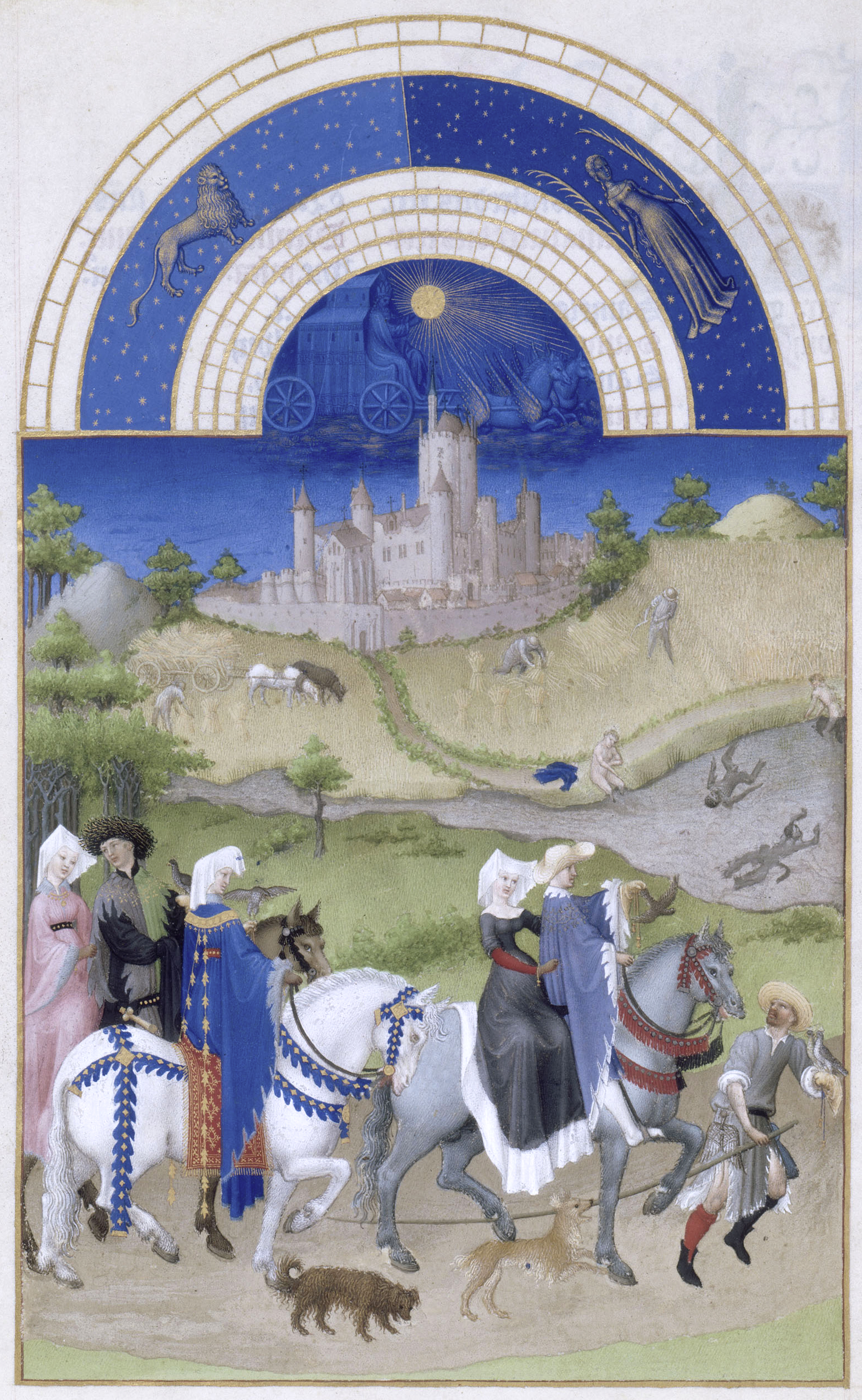
The August illumination in the Très Riches Heures of the Duke of Berry is attributed to Jean Limbourg. In the foreground it depicts an aristocratic falconry party. The young man on the leading horse as well as the huntsman or groom wears a straw hat that looks very contemporary to the modern viewer, and is presumably the type of headgear, "a sorry straw hat", in which Henry Beaufort  Duke of Somerset was recorded as wearing on his head whilst jousting in 1463. Here once again the fashionable members of the aristocratic world of the early fifteenth century are out and about enjoying themselves in traditional country pursuits, and also courtly dalliance.

In the background are a group of bathers enjoying swimming in the warm weather whilst others gather in the harvest. The mood is relaxed and prosperous, suggesting long lazy days for some, and, for those working, warmth and sunshire, and the promise of plenty for the coming autumn.

In the background is the Château d'Étampes. Today, as the link explains, only the keep remains of the castle. This great tower of Étampes is of particular interest to me as it may have inspired the design of Clifford's Tower at York in the thirteenth century, and that in turn may have influenced, in the fourteenth century, the design of the great tower, the so called Round Tower, of the castle in my home town of Pontefract, and that at the nearby castle at Sandal.

In August 1415 King Henry V was in the last stages of preparing to invade France. At the very beginning of the month his whole plan of campaign was threatened by the discovery of the Southampton Plot, about which there is an online account and discussion at here.

With that problem dealt with,  on August 11th the King and his army sailed across the Channel, and began the siege of Harfleur.

Wednesday, 1 July 2015

July


Image: Wikipedia

This illumination is attributed to Paul Limbourg and depicts the Chateau or Palace of Poitiers, parts of which still survive. The chateau belonged to the Duke of Berry who had rebuilt portions of it in the decades preceding the painting.
Harvesting and sheep shearing are taking place in the foreground, plenty abounds - all is beginning to be safely gathered in against the winter. As with the other months in the series the scene is idyllic - almost in the tradition of eighteenth century rustic scenes. Swans glide along the clear waters of the moat, the chateau looks trim and well-cared for, as befitted a residence of the Duke of Berry, the landscape is lush and fertile. Here then is once again a scene of tranquility, rather different from the realities of life in northern and central France in the years 1413-16.

More particularly, in July 1415 King Henry V was completing his plans for his invasion of France.By the end of the month the English King, his army and fleet were asembled between Southampton and Porchester.


Monday, 1 June 2015

June


Image:Wikipedia

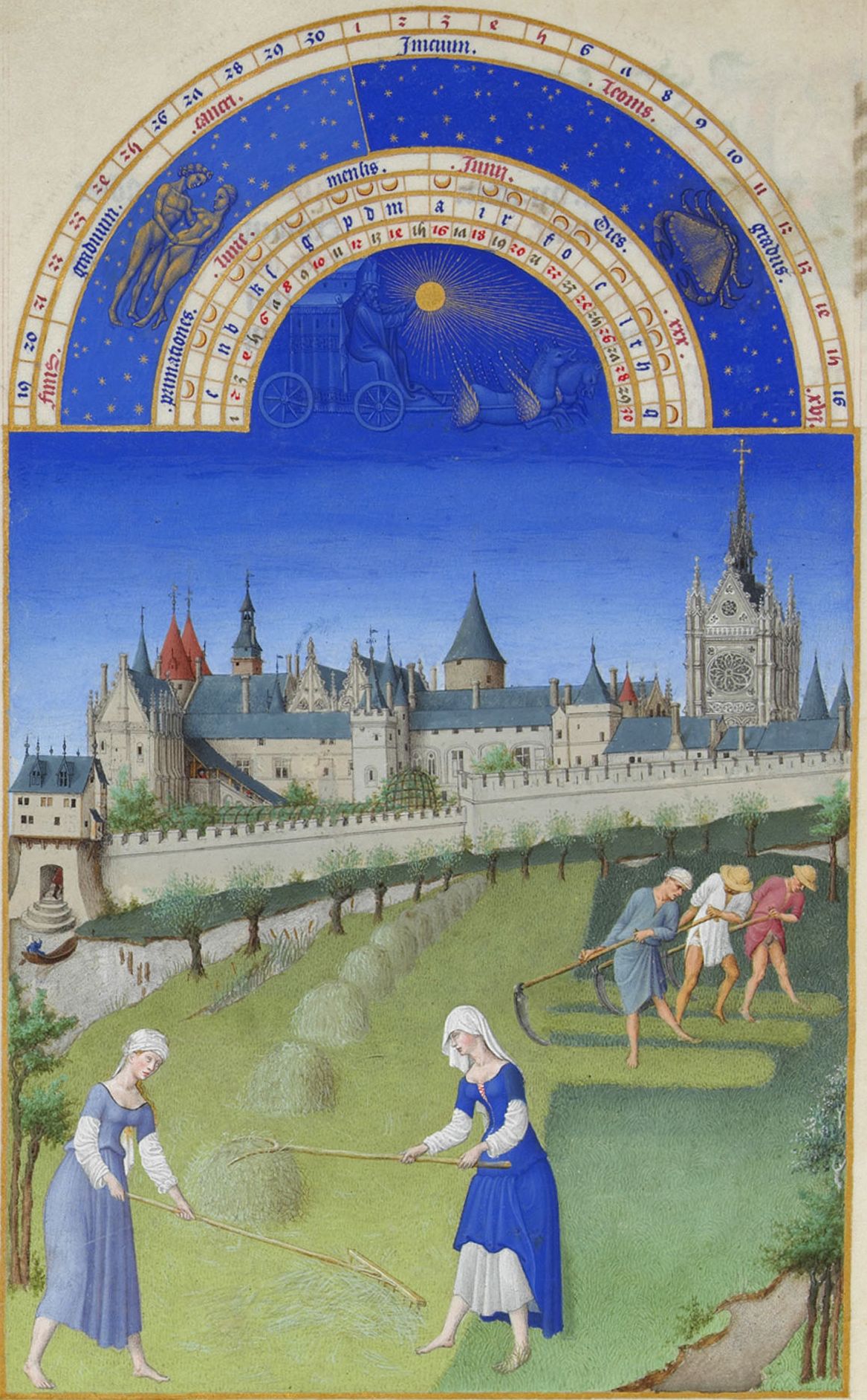
All three Limbourg brothers, Jean, Paul and Herman, are believed to have had a hand in producing this page, as well as, possibly, Jean Colombe, the artist who continued the work on the Book of Hours in the years 1485-89.

Here, as in the May page, is a depiction of a royal residence in central Paris but it is shown with a rural scene of hay making in the foreground. Once again the image is idyllic - in contrast to the often violent urban life of Paris in these years.

 The buildings are the the Palais de la Cité with the Sainte Chapelle, built by St Louis, which is clearly identifiable on the right. In addition to the Chapel considerable  parts of the other buildings still survive. This was the seat of much of the royal administration of Capetian and Valois France, although the King had largely given it up as a royal residence by this date in favour of the Louvre or other palaces.

It was in and around the court that the factions developed which undermined the Valois monarchy in these years. King Charles VI was a sufferer from bouts of mental illness, and his male relatives, notably his brother the Duke of Orleans, and, after his murder in 1407, his son, and the King's cousin, the Duke of Burgundy, vied for power and influence. The Duke of Berry, as an older member of the family, was one who may be seen as seeking to stabilise an increasingly unstable political situation. Into that situation in the summer of 1415 stepped King Henry V and his invasion army.


Friday, 1 May 2015

May


This calendar page is attributed to Jean de Limbourg.

Here is the aristocratic world of Maying, of courtship and high society in the early fifteenth century. The occasion is the May jaunt, a pageant celebrating the "joli mois de Mai" in which one had to wear green garments known as livree de mai, or at very least as a sign of festivity a garland or sprig of greenery with one's other attire. Looking at the musicians horns or trumpets and simple trombone it must also have been quite a noisy canter through the countryside.

It is an idyllic scene in a world that was far from idyllic, with France beset by internal strife and in 1415 was to experience the first invasion by King Henry V culminating in the English victory at Agincourt. The life of Paris and northern France as recorded in the Journal of the Bourgeois of Paris was grim and violent due to the collapse of the political consensus and the consequent lapse into violent disorder.

The element of escapism is borne out by the fact that in the background, beyond the woodland, is the Hôtel de Neslé, the Duke of Berry's Paris residence, and which was situated on the left bank of the Seine in the heart of the capital.

It is nonetheless idyllic, reminiscent in its ethos of the eighteenth century French school with painters like Watteau, and a reminder of what the aristocracy - and their imitators no doubt -  sought as their lifestyle. This was what life should be like at this time of year, and there was no reason for the artist not to depict it, even if in reality the young men were off fighting and the young women waiting their return in their family chateaux.


Wednesday, 1 April 2015

April


Image: Wikipedia
 
The April calendar page of the Très Riches Heures is attributed to Jean de Limbourg.

The scene depicts a bethrothal before two witnesses whilst two young women in attendance pick flowers. On the right is a walled garden or pleasance, the plants of which are not fully in bloom, but all is prepared for the coming season of growth. In the background is the Château de Dourdan, west of Paris, which had been held by the Duke of Berry since 1385, and of which much of the buildings still survive.  There is more about the history of the chateau and many more pictures here.

Romance and the spring clearly went together in the early fifteenth century mind. There is in its aristocratic rural idyll something we recognise in later artists and even in modern advertisements such as those for firms like Barbour.

In 1415, the year of King Henry V's Agincourt campaign, not a few married or bethrothed couples, or ones that might have been, were to find death and bereavement, exile or flight as a result of the fighting. There were casualties on both sides amongst both the elite and the common soldiers, but much more so on the French side. Juliet Barker concludes her excellent book Agincourt on the battle  with a discussion of this, drawing upon Alain Chartier's 1416 poem, written as a response to the battle, Le Livre des quatre dames  and Christine de Pisan's Epistre de la prison de la vie humaine with its reflections upon the fortunes of war.


Thursday, 12 March 2015

Images of St Gregory the Great


Today is the traditional feast day of Pope St Gregory the Great.

Here, from contributors to the Medieval Religion discussion group, are a selection of images of him.

Gordon Plumb posted the following images in stained glass:

York Minster, NXI, 2b-4b (right-hand light)

Winchester, Hospital of St Cross & St Faith, South Transept, North-East Clerestory window:
and detail:

Saint-Nicholas-de-Port, Bay 101, 6a-10a, (left-hand light):

Genevra Kornbluth added a page of sculpted and painted depictions of St Gregory, and dating from the 14th-16th centuries:

Jim Bugslag posted the manuscript illumination in the Très Riches Heures of Gregory's procession in Rome against the plague, when he saw the apparition of St Michael sheathing his sword atop Hadrian's Tomb, aka the Castel S. Angelo.

There are aselection of images of him from over the centuries illustrating the Wikipedia biography and article about him at Pope Gregory I 

The nearest thing we possess as a contemporary likeness of St Gregory is one which depicts him, flanked by his parents, but which I cannot track down on the internet today.


A very popular dedpiction of him in the later middle ages was in the context of the story of the Mass of St Gregory, when there was vouchsafed a vision of Our Lord whilst St Gregory was celebrating Mass, so as to confound a member of the congregation who doubted Transubstantiation.

Simon Marmion_Mass of St. Greg_Bk Hrs_Belgium_1475-85_Morgan_m6.154ra

Image:traditionalcatholicpriest.com


Sunday, 1 March 2015

March


The Château de Lusignan, situated in Lusignan in the modern dèpartement of Vienne, was the seat of the Lusignan family, Poitevan Marcher Lords, who distinguished themselves in the First Crusade and held the crowns of two Crusader kingdoms, the Kingdom of Jerusalem and the Kingdom of Cyprus, and also claimed the title King of Armenia.

Lusignan was constructed, occupying a natural strongpoint: a narrow promontory that overlooked steep valleys on either side. It was already so impressive in the twelfth century that a legend developed to the effect that its founder had faery aid, in the guise of the water spirit Melusine, who built it and its church through her arts, as a gift for her husband Raymondin.

Lusignan at its height in the early fifteenth century, is illustrated in the Très Riches Heures of Jean, Duc de Berri, for whom it was a favorite residence until his death in 1416. It rises in the background of the miniature for the month of March, clearly shown in perspective, with its barbican tower at the left, the clock tower - with the exterior chute of the garderobe to its right - and the Tour Poitevine on the right, above which the gilded dragon flies, the protective spirit of Marc Lacombe.

After the Duc de Berri's death, Lusignan became briefly the property of the Dauphin John, who died in May 1417, and then passed to his brother, Charles, the future King Charles VII.

The village which developed into the town of Lusignan grew up beneath the castle gates, along the slope; it formed a further enceinte or surrounding fortification when it too was later enclosed by walls. Lusignan remained a strategically important place in Poitou, in the heart of France. About 1574, during the Wars of Religion, a plan was made of the castle's defences which is now in the Bibliothèque National. In the following century Lusignan was reinforced in the modern manner by Vauban for King Louis XIV. It was a natural structure to be used as a prison, and later housed a school.

The château was long used as a local quarry of pre-cut stone before it was razed by the Comte de Blossac in the nineteenth century, to make a pleasure ground for the town. Today the remains are largely portions of the foundations, some built into steep hillside, part of the keep, the base of the Tour Poitevine, cisterns and cellars, and remains of a subterranean passage that probably once led to the church.

With acknowledgements to the article on the château on Wikipedia

To those points I would add that the depiction of this and, over the succeeding months, other châteaux associated with the Duc de Berri and his family, indicate a delight in their possession, and convey the fact that these medieval castles, however defensible, were essentially homes in the country, replete with medieval domestic comforts and surrounded with agriculture and other peaceful pursuits.These are residences, more than they are fortifications. The same sense is conveyed, for example, by surviving images of English castles in the sixteenth and early seventeenth centuries.

The plough oxen in the foreground are a reminder that for centuries the ox was the beast of burden in Europe, and their use continued later than one might expect. I have, for example, seen a photograph of someone still ploughing with oxen in Wiltshire in about 1900.

As with the other scenes in the manuscript the landscape is perhaps unnaturally tidy, altough the ploughman in the foreground is wearing patched clothing, and the grey and green tones do convey something of the climate and mood of March as the farming year demands hard work from the husbandmen.

The wayside shrine at the cross roads in the middle distance is an indication of the type of monument which may well have been common, but of which we have few surviving examples - although more modern examples are still to be found in Catholic areas of Europe.