Once I was a clever boy learning the arts of Oxford... is a quotation from the verses written by Bishop Richard Fleming (c.1385-1431) for his tomb in Lincoln Cathedral. Fleming, the founder of Lincoln College in Oxford, is the subject of my research for a D. Phil., and, like me, a son of the West Riding. I have remarked in the past that I have a deeply meaningful on-going relationship with a dead fifteenth century bishop... it was Fleming who, in effect, enabled me to come to Oxford and to learn its arts, and for that I am immensely grateful.


Thursday, 30 April 2026

A Marian Pilgrimage in May


Tomorrow is May Day and the beginning of Mary’s Month.

As I have done since 2020 I am going to post the itinerary day by day of a virtual Pilgrimage around the Marian shrines of medieval England, together with something of their  history.

Rather than write out again the background to this pilgrim journey I will link to my introduction to last year’s peregrination, which can be seen at May Marian Pilgrimage

I am also reposting the equivalent article from the previous year which gives more about the origins of this convoluted route and the historical evidence behind it. That can be seen at May Marian Pilgrimage

The daily posts will include the consolidated posts and links as I published them last year, together with any additional facts or reflections, plus one new addition to the itinerary. 

As I write each year I always intend to rewrite the posts, but never seem to find the time to consolidate them. However their existing discursive style is very much how I speak when with friends, so you will get a flavour of my own verbal presentation as we ramble in spirit through the landscape and along the roads of later medieval England. Whether we are like Chaucer’s fellow pilgrims to Canterbury in their variety and idiosyncrasy I will leave to readers to decide.

May Our Lady accompany us on this journey and ever assist us with her prayers. 

Jesu mercy Mary pray


Wednesday, 29 April 2026

How many people did you need to build a medieval cathedral?


The answer to the question I posed in the title of this post is, according to the author of a recent article on Medievalists.net, not what you might expect.

The evidence comes from the civic records of the city of Girona in Catalonia, and relates to the building in the fifteenth century of the nave of the cathedral. This was in itself a radical departure in its design from the choir and ambulatory erected at an earlier date.


Identifying the Picts


Questions such as “Who were the Picts?” and “What happened to the Picts?” have dominated the historiography of early Scotland for certainly decades, and in many ways, for centuries. As a result the Picts have been left in a historical Highland mist, a group who intrigue, but continued to elude us.

Recent sequencing of some Pictish DNA does appear to have answered these questions. This research is presented in a short video from The Helix Report which can be seen here 

There is more about this new view of the Picts and their true place in the history of Scotland in another video, from Origin Decoder which can be seen here

Tuesday, 28 April 2026

Anne Boleyn sat here?


I continue to be surprised by the number of people - mainly women I think - who have a sentimental fascination with Anne Boleyn. Whilst not on a par with the extremes of Ricardian enthusiasts it is somewhere in the same part of the field.

Personally I am more inclined to see her as one of, if not the, most evil women in English history. 

The current exhibition about her at Hever Castle includes a substantial chair which appears to have been made for her in the years she was at the French Court and before she returned to England. If it really did belong to her then it is a rare survival and link to her.

Artnet reports on the chair and what can be deduced about its history in an illustrated article which can be seen at Was This Anne Boleyn's Seat? Rare 500-Year-Old Chair Linked to the Tudor Queen

Seeking to identify the ‘Persian Lady’


Amongst the Elizabethan era paintings in the Royal Collection one that has attracted considerable speculation is what is often known as the ‘Persian Lady’. The lady herself is obviously western, not Persian, but clad in a voluminous robe in a style identified as being Persian. She is obviously wealthy and also expecting a child. The great question is her identity.

Attempts to answer that have included several distinctly eccentric theories over the years. However the Daily Telegraph recently reported on what appears a much more likely theory that the Subject was Penelope Lady Rich, later Lady Mountjoy and briefly Countess of Devonshire. A very well connected and significant figure at the Elizabethan and Jacobean Court, as the daughter of Lettice Knollys and sister of the ill-fated Earl of Essex, and thus step-daughter of the Earl of Leicester, she was an ultimately scandalous one.
 
The article about the suggested identification can be seen at Mystery of ‘Persian Lady’ in Elizabethan masterpiece solved
  
Wikipedia has biographies of Penelope at Penelope_Blount,_Countess_of_Devonshire
.
The article on Charles Mountjoy mentions that his marriage to the divorced Penelope was solemnised by his chaplain, William Laud. It does not refer to the fact that for the rest of his life the future Archbishop observed the anniversary by fasting in repentance for conducting the marriage service.

Sunday, 26 April 2026

Render unto your parish church

 
I have written before in Render unto God … about the fact that many medieval English  parish churches, as well as castles and town walls, were originally rendered and painted to seal the walls against damp ingress. With ashlar built churches this was not necessary, but in areas lacking good building stone it was a practical necessity. Where ashlar was used in architectural details such as quoins and other details that masonry was left exposed to provide contrast.
 
This is a topic which is not discussed much in books on parish church architecture, and overly enthusiastic nineteenth century restores often stripped surviving rendering off medieval churches along with the internal plaster. The exterior may now look pleasantly rural and traditional, but it is not what the builders intended.

I came by chance upon a video about this subject, and looks at several examples. The practical need to protect the fabric against the weather is shown, and some of the comments make interesting points. It can be accessed at Thundridge Old Church

The history of the church and parish at Thundridge is introduced on Wikipedia in articles which can be seen at Thundridge and in another about a hamlet within the parish at Cold_Christmas

The website of a voluntary trust which seeks to preserve the tower can be accessed at Protect and Share Thundridge Bury History

Amongst its illustrations is a charming view of the church before its demolition in 1853. Its loss appears to be very regrettable indeed.

There is now a new video online about the tower which, despite its eye-catching title, as actually very optimistic about future plans. It can be viewed at Thundridge Old Church

The church of St Curig at Porthkerry in the Vale of Glamorgan is an example of a medieval church that is still a striking white building in the landscape.


Porthkerry Church 
Image: N.Kaye on Flickr

Examples of surviving medieval rendering on castles can be seen at Conwy and on the shell keep of Totnes. These were castles that were meant to be seen with their gleaming white walls, not structures that blended into the landscape. A later twelfth century reference to a newly built castle within the Angevin lands in France lays stress on its white walls. 


A gown belonging to Bess of Hardwick


Hardwick Hall and its contents in Derbyshire offers a unique insight into the life of its formidable creator, Elizabeth, Countess of Shrewsbury, better known as Bess of Hardwick. From a minor gentry background at Hardwick through four marriages, each one raising her status, and through shrewd estate management, she was the central figure in establishing the Cavendish children from her second marriage as the Devonshire ducal family and their place in the political and social history of succeeding centuries.

I have visited Hardwick on several occasions and never failed to be impressed by what the building is, and the collection of portraits and furniture from the Countess’s time. Amongst these are embroidered pieces created both by the Countess and also by Mary Queen of Scots whilst she was lodged with the Earl of Shrewsbury and his wife, together with her royal household-in-exile, in the 1570s and early 1580s.

A new exhibition about Bess of Hardwick promises another remarkable survival in the form of a violet dress listed in a 1601 inventory as one of her possessions. The gown is illustrated and placed in its context in a BBC News report which can be seen at Rare gown dating back to 1600s to go on display at Hardwick Hall

Saturday, 25 April 2026

Shakespeare was here


St George’s Day on April 23rd is also, apparently, the date of both Shakespeare’s birth in 1564 and of his death in 1616. He is a writer who, not surprisingly, is still frequently in the news. 

His most recent appearance is in connection with a property he bought in the last years of his life, close to one of the theatres he acted in and wrote for. This had been created in part of the remains of the dissolved monastery of Blackfriars close to the Thames and in the western part of the City of London. The fact of him having a house in the vicinity was known but a recent discovery has revealed a plan of the house and its precise location.

The discovery is set out in a recent BBC News article which can be seen at Shakespeare's 'missing' Blackfriars home mapped with discovery

Thursday, 23 April 2026

St George’s Day


St George and the Dragon
Rogier van der Weyden
1432-35
National Gallery of Art, Washington 


Looking online I came upon a blog post by Professor Sarah Peverley about the cult of St George in later medieval England. It is quite short but includes a range of themes and insights, as well as some good illustrations. It can accessed at Saint George

May St George ever pray for England, its people and institutions, and for all who seek his intercession.
 
St George, Pray for us!


Tuesday, 21 April 2026

The continuing saga of the Sigena murals


 The Art Newspaper reported recently on the latest falling out over the twelfth century ceiling paintings from the chapter house of the monastery at Sijena/Sigena in Aragon. This is but part of a story that could be said to begin with the painting of the ceiling around 1200, but which really becomes active with the burning of the monastery - clearly an historic monument - by fanatical anti-clerical Republicans in the summer of 1936 at the outbreak of the Spanish Civil War. What survived of this great cycle of paintings was transferred to Barcelona, but now there is strong pressure to relocate them in their original setting, and equally pressure to keep the surviving portions in Barcelona.


The Wikipedia articles about the monastery and its history are not that detailed, but do show how the murals belonged to the shared artistic culture that linked Aragon to both England and Sicily in the period. This was no doubt a consequence of the diplomatic and dynastic alliances forged by King Henry II. As the article mentions the artists who worked at Sijena were, or were linked to, the artists who illuminated the Winchester Bible.
 
The articles can be viewed at Villanueva_de_Sigena

It is good to read that not only are the monastery buildings being restored, but that a community of nuns has been restablished at Sigena. The story of the destruction of so much at Sigena is a continuing reminder of the forces of hatred and evil the Nationalists were fighting against in the Spanish Civil War and why we should be grateful that they prevailed.

The Paschal Candle in Milan Cathedral


The distinctive customs of the Ambrosian Rite and the usages of the cathedral in Milan include a very striking positioning of the Pascal Candle.

The Liturgical Arts Journal recently had an article about this tradition which can be accessed at The Monumental, Suspended Paschal Candlestick of the Duomo of Milan

In 2020 I wrote about the cathedral Pascal Candlestick in connection with its part in the ceremonies of Ascension Day in Milanese Ascension Spectacle

More about Papal Agnus Deis


Following on from my last post here are two more articles from the New Liturgical Movement about the rite of blessing of these wax medallions. 

The first is about the rite as used in recent centuries, and the second an earlier form from the late fifteenth century. How far back the latter form dates is not clear.


Wednesday, 15 April 2026

Rediscovering the seal of King Edward the Confessor


There is a particular nightmare that affects archivists And research as in respect of historic manuscript collections.

That is that material gets misfiled - returned to the wrong box, or the file misplaced in the stacks, whatever - and when it goes missing, no one knows when, if ever, it will come to light. The next person who wants to consult the file may not come along for a year, or for a decade, or for a century. Virtually anonymous boxes in amongst so many others that look almost identical are far less easy to monitor than books in a library store, and that is no easy matter in itself.

The phys.org website reports the happy and fortuitous rediscovery in 2021 in the Archives Nationales in Paris of the best surviving example of the seal of King Edward the Confessor. Dated to the years 1053 to 1057 and authorising a grant to the abbey of St Denis it has become detached from the original charter, and disappeared without trace into the depths of the Archives Nationales some forty years ago.

The article discusses the emergence of this, the first English Great Seal, and what it reveals about St Edward’s concept of his kingship as well as what it indicates about his chancery.

It is the prototype of all its successors as the ultimate authentication of the Sovereign’s will and authority down to that created the other year for King Charles III.

The article, which has photographs of the recovered seal, can be accessed at Lost seal of Edward the Confessor resurfaces after going missing for 40 years

Tuesday, 14 April 2026

The Papal Blessing of Agni Dei

  
Six years ago I wrote a post about the traditional blessing by Popes in their first Eastertide of the wax Agni Dei made from the wax of the previous year’s Paschal Candles in the churches of Rome, and their distribution as sacramentals. That article linked to one on the Liturgical Arts Journal website and can be viewed at The Paschal Blessing of the “Agnus Dei”
 
The tradition was cast aside in the wake of Vatican II, but had it survived, or been revived, last week would have witnessed the ritual being celebrated by the Pope in his first year. Maybe if he had he could have sent one to Mr Trump. 

The New Liturgical Movement website now has an article with archive film about the Agnus Dei which can be seen at Pope St John XXIII Blessing the <i>Agnus Deis</i>

The journal Catholic History has a detailed, and well illustrated, article from 2018 about the place of the Agnus Dei in the devotional life of English Catholics in the Elizabethan persecution - their import was prohibited and possessing one could cost someone their life on the scaffold - and it can be accessed at The agnus dei, Catholic devotion, and confessional politics in early modern England

It will be no surprise to my readers to add that I cannot in all conscience see why this ancient tradition was jettisoned, and would very much like to see it revived.


Monday, 13 April 2026

Remembering Evelyn Waugh


April 10th was the sixtieth anniversary of the death, on Easter Day 1966, of Evelyn Waugh.

I recall the news at the time and from what little I knew of him had a vague sense of loss of a figure in the landscape. Over succeeding years and decades I came to know his works by reading and viewing adaptations, and to appreciate his literary skill, his brilliant humour and his Catholic insight. Apart from the obvious and easily accessible ones, his is the only literary grave I have sought out and visited. In my opinion, for what it is worth, he is not only a master craftsman of the language but also the greatest English novelist of the twentieth century.

Most writers of fiction go, to some extent, out of fashion very soon after their deaths. Waugh however, who had been seen as unfashionable in his last years, was suddenly rediscovered and his reputation and popularity have continued to grow. This has been aided by the publication of his letters and diaries, by television and to a lesser extent film, but also by 
an awareness of his consummate literary skills on the printed page.

The Daily Telegraph has had two quite short articles about Waugh and his place as a Catholic literary figure which can be seen at Sixty years on, it’s time to revive Evelyn Waugh’s lost Catholic civilisation
Finally an impish, but also serious suggestion. I have referred before to my, shall we say, lack of appreciation of G.K.Chesterton and his extensive literary outpourings. I cannot see why anyone would want him canonised, good Catholic that he doubtless was.

Now, if people want an English man of letters who came to a deep devotion to the Catholic faith, wrote about it, and continues to provide great entertainment in his novels, as a canonised saint, then in Evelyn Waugh there is indeed a candidate. 

Never mind about youthful follies ( ask St Augustine, de Rancé, Charles de Foucauld and many others about those), scoffing the children’s bananas, the sharp tongue, but remember the loyal friend, the loving father whose own father had probably made him inhibited in expressing paternal affection, and the author of prose in the service of Catholicism. There you have a real candidate for raising to the altars. Think about it, pray about it.


Thursday, 9 April 2026

Medieval Parisian Vespers


The New Liturgical Movement has an article and video on its website reporting upon the celebration of the Solemn Vespers of Easter Day - and thus the Octave of Easter Week - according to the Gallican Parisian Use. The article explains that despite its abandonment in 1871 one church, St Eugène, was given the privilege of still using this form.

The singers are from the splendid Schola Ste Cecile, whom I had the good fortune to hear a few years ago when they spent a week in Oxford whilst on a tour of England.

The report and video can be accessed at Video of Medieval Vespers of Easter in Paris

The Turin Shroud in the news again


The Holy Shroud of Turin is back in the news with the publication of a new scientific study of the DNA contaminants on its surface. The hope is that such microscopic details will help reveal where it has been and what it has been exposed to.

The results show a vast variety of material, some of which are clearly from the last five or so centuries as they are from plant varieties introduced from the New World. Other material might well suggest that the shroud was in the Middle East, or indeed that it might originate in India. It is rather a case of “you pays your money and takes your choice”.

The first report I saw was from the Vatican centred website Zenit which tends to take a favourable view of the evidence as indicative of the authenticity of the Shroud. The article can be read at New Study Reopens the Case of the Turin Shroud’s Origins: what the DNA says

The second report is from Live Science which seems very anxious to stress the results of the 1980s Carbon 14 dating to the later medieval centuries.This dating is a matter of considerable academic debate. I rather regret the way the article is written, if not indeed skewed, to support the case for the Shroud being a forgery. However, in the interests of impartiality I am giving the link, which is accessible at Shroud of Turin, claimed to be Jesus' burial cloth, contaminated with carrot and red coral DNA

As I have written before on this subject I am definitely inclined to believe the Shroud is genuine, but accept that we shall probably never know with certainty this side of Judgement Day.


Sunday, 5 April 2026

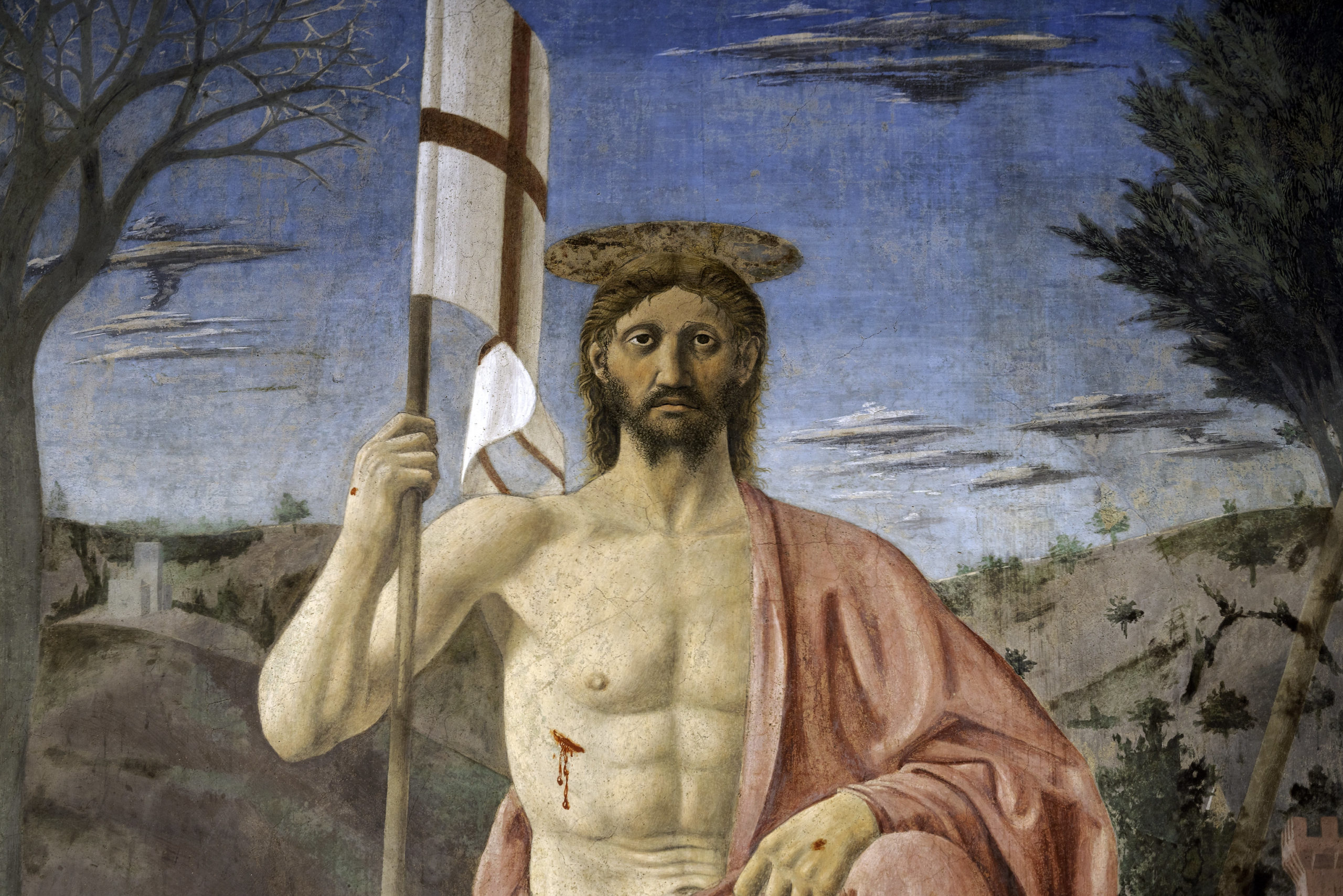
Christ is Risen Alleluia!


Christ is Risen, Alleluia!
He is Risen indeed, Alleluia!

Piero della Francesca, Resurrection, detail 

Detail from The Resurrection 
Piero della Francesca
1463-65

Image: Finestre sull’ Arte

Looking back to my post for Easter Day last year and also to the fact that it was well received, I have done as I did last year and reproduced Pietro della Francesca’s depiction of The Resurrection, and an giving a link to last year’s article, which I definitely recommend because of its Patristic content, and which can be accessed at Christ is Risen Alleluia!

To supplement that and to provide some reflective and art historical reading about the painting and its survival as readers digest their Easter lunch, chocolate eggs, or relax on Easter Monday, here are three articles about it.

The first is a discussion of the work in its historical context and can be accessed at Piero della Francesca | The Resurrection, Museo Civico, Sansepolcro | Art in Tuscany

The second can be viewed at Travel Notebooks - Finestre sull'Arte

The third concentrates on the near miraculous survival of the fresco in 1944 and can be viewed at HOW ONE MAN SAVED THE "GREATEST PICTURE IN THE WORLD"


 I wish a holy, blessed, joyful and happy Easter to all my readers 

Alleluia!

Saturday, 4 April 2026

Traditional Good Friday Chasubles


Yesterday the Liturgical Arts Journal had an article to mark Good Friday about traditional black vestments, as per the usage before Pope Pius XII’s changes in the 1950s. It has some splendid examples of the vestment maker and embroiderers arts in its illustrations. Some are antique, others from the later nineteenth and earlier twentieth centuries. It also includes a folded chasuble, which would only have been used on Good Friday.

The aricle can be seen at Historical Chasubles for Good Friday   


Thursday, 2 April 2026

The medieval view of Judas


The always useful website Medievalists.net has an interesting article about how Judas and his fate, as well as an involved biography to shoe just how unsavoury he was, were presented by medieval writers.

Illustrated with illuminations from medieval books it can be accessed at Judas in the Middle Ages: The Making of an Anti-Hero 


Gethsemene by Giotto


Detail of the Kiss of Judas by Giotto, 
1304-6, in the Scrovegni Chapel, Padua

Image: Formae Divinae Wordpress

I think the fresco of the Kiss of Judas is the finest, or most powerful, of these early fourteenth century masterpieces in the Scrovegni Chapel, and one which commands attention and invites reflection and meditation.  

The way in which the lumpen figure of Judas envelops Jesus is striking, signifying the loss of personal autonomy of the Redeemer in the Passion - He is now in His enemies’ power. yet the serenity of expression points to the Divine self-surrender central to the Triduum. 

The website from where I found this image has a meditation on the painting and this central feature which can be read at “The Kiss of Judas” by Giotto