Once I was a clever boy learning the arts of Oxford... is a quotation from the verses written by Bishop Richard Fleming (c.1385-1431) for his tomb in Lincoln Cathedral. Fleming, the founder of Lincoln College in Oxford, is the subject of my research for a D. Phil., and, like me, a son of the West Riding. I have remarked in the past that I have a deeply meaningful on-going relationship with a dead fifteenth century bishop... it was Fleming who, in effect, enabled me to come to Oxford and to learn its arts, and for that I am immensely grateful.


Showing posts with label Tattershall church. Show all posts

Monday, 14 September 2015

The Exaltation of the Holy Cross


Gordon Plumb has posted on the Medieval Religion discussion group as follows to mark today's Feast of the Exaltation of the Holy Cross, and which I have slightly revised and supplemented:

The Feast of the Exaltation of the Holy Cross celebrates two historical events: the discovery of the True Cross [ The now discontinued Feast of the Invention of the Holy Cross on May 3rd, a feast which appears to originate in seventh century Gaul - so not exactly a new feature - and dropped 1960 from the Calendar commemorted that more specifically] by Saint Helena, the mother of the Emperor Constantine, in 320 under the temple of Venus in Jerusalem, and the dedication in 335 of the basilica and shrine built on Calvary by Constantine, which mark the site of the Crucifixion. This feast was observed in Rome before the end of the seventh century. It also commemorates the recovery of the Holy Cross, which had been placed on Mount Calvary by St. Helena and preserved in Jerusalem, but then had fallen into the hands of Chosroes, King of the Persians. The relic was recovered and returned to Jerusalem by Emperor Heraclius in 629.


Here are some late medieval stained glass images for the feast of St Helena:

Tattershall, Holy Trinity, Lincolnshire, East window, 3d, 1482 by Robert Power of Burton upon Trent:
https://www.flickr.com/photos/22274117@N08/9121552138

Ashton-under-Lyne, Greater Manchester, album of images of the south aisle windows depicting the story of St Helen. The fullest coverage of the Helen legend in English glass, c.1497-1512:
https://www.flickr.com/photos/22274117@N08/albums/72157652182098552
This series depicts the discovery of the Cross and also its recovery by Heraclius.

To this I will add this other depiction from the fifteenth century and from a manuscript I often feature

File:Folio 193r - The Exaltation of the Cross.jpg 

The Exaltation of the Holy Cross
From the Très Riches Heures of the Duke of Berry

Image: Wikimedia


Monday, 12 January 2015

The Rite of Baptism


Following on from yesterday's Feast of the Baptism of Our Lord I am reproducing the text of a post on the Medieval religion discusion group about the change in practice from total immersion to pouring or sprinkling - technically described as affusion - the baptismal candidate. It came from the Rev. Gordon Plumb in answer to a query about this from another list member.

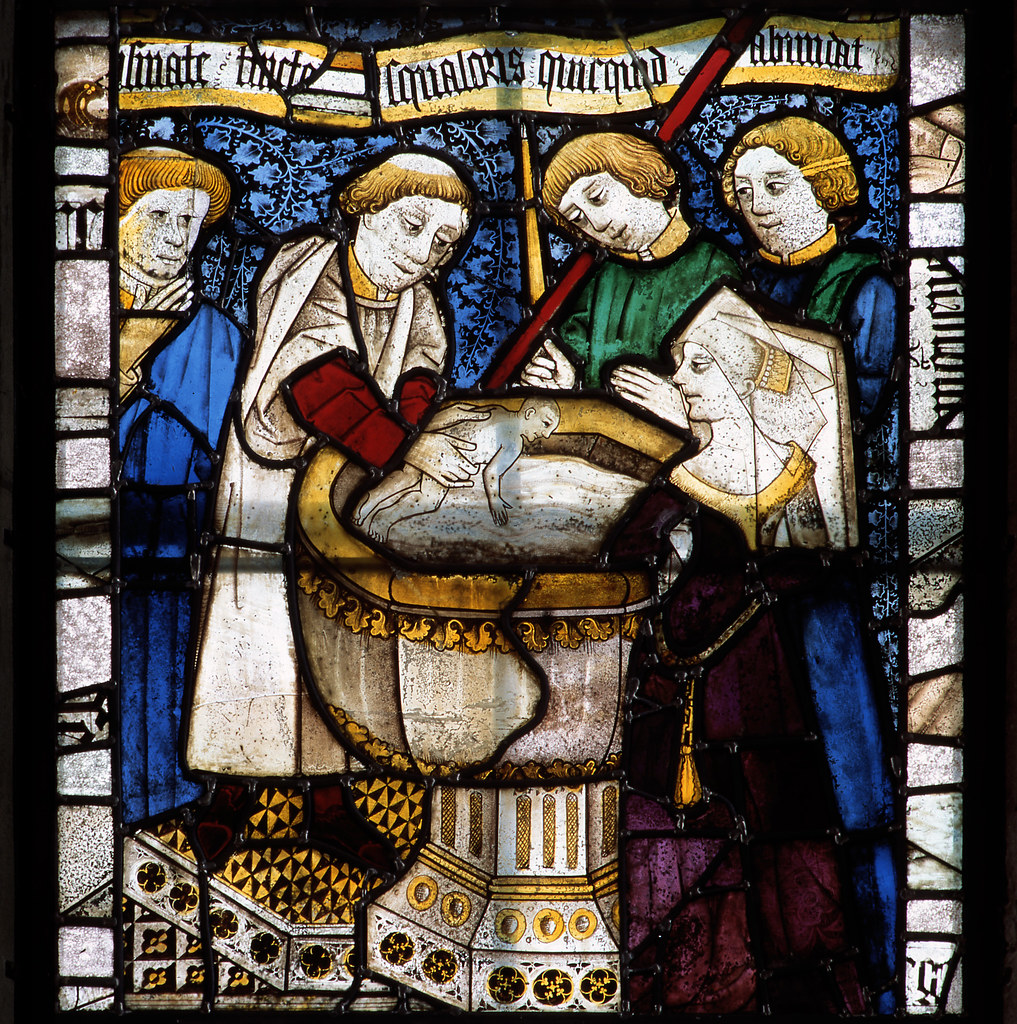
Towards the end of the Middle Ages images show that baptism of infants was by total immersion as here:

  photo

Scene of Baptism from a Seven Sacraments window painted by Richard Twygge and Thomas Wodshawe in 1482 for the collegiate church at Tattershall in Lincolnshire. 

Coming down to the font from the top right is the stream of Christ's blood, flowing originally from a central figure of Christ himself - symbolizing that all the sacraments derive their virtue from the sacrifice of Christ on the cross. Note how the priest is shown as having rolled up his surplice sleeves to avoid them getting wet during the immersion of the child!
The father is probably the figure behind the priest, and the other three figures are the sponsors or godparents. (Since the mother was unclean for 40 days after childbirth and baptism usually took place within days of birth, she was not usually present).
 
Image and comments: Gordon Plumb om Flickr

Maxwell E. John in his The Rites of Christian Initiation: their  Evolution and Interpretation, Collegeville, Minnesota, 1999 writes at page 217,

"While liturgical documents still indicated a preference for immersion or submersion, and baptismal fonts generally remained large enough to accommodate easily the immersion or submersion of infants, there does develop, in France primarily, a marked preference for pouring or sprinkling the water on the candidate during the baptismal formula. Although, as we have seen, this practice of "affusion" is also a very ancient practice in the history of baptism (see the 'Didache'), by the end of the Middle Ages it had tended to replace immersion and submersion as the common and regular practice".

It appears that affusion must have become the norm in the West sometime between the 900s and 1400s since it was never adopted as normative in the East - which still practices triple immersion of the infant, as I have witnessed in Oxford - but it is normal in most forms of Protestantism, although adult total immersion is, of course, practised by some reformed groups.


I would add that the church at Tattershall is very well worth visiting. Less well known than the spectacular brick great tower of the castle, both are the creation of Ralph Lord Cromwell, Lord Treasurer under King Henry VI.