Once I was a clever boy learning the arts of Oxford... is a quotation from the verses written by Bishop Richard Fleming (c.1385-1431) for his tomb in Lincoln Cathedral. Fleming, the founder of Lincoln College in Oxford, is the subject of my research for a D. Phil., and, like me, a son of the West Riding. I have remarked in the past that I have a deeply meaningful on-going relationship with a dead fifteenth century bishop... it was Fleming who, in effect, enabled me to come to Oxford and to learn its arts, and for that I am immensely grateful.


Showing posts with label Royal Gold Cup. Show all posts

Sunday, 1 January 2017

January


Image:Wikipedia

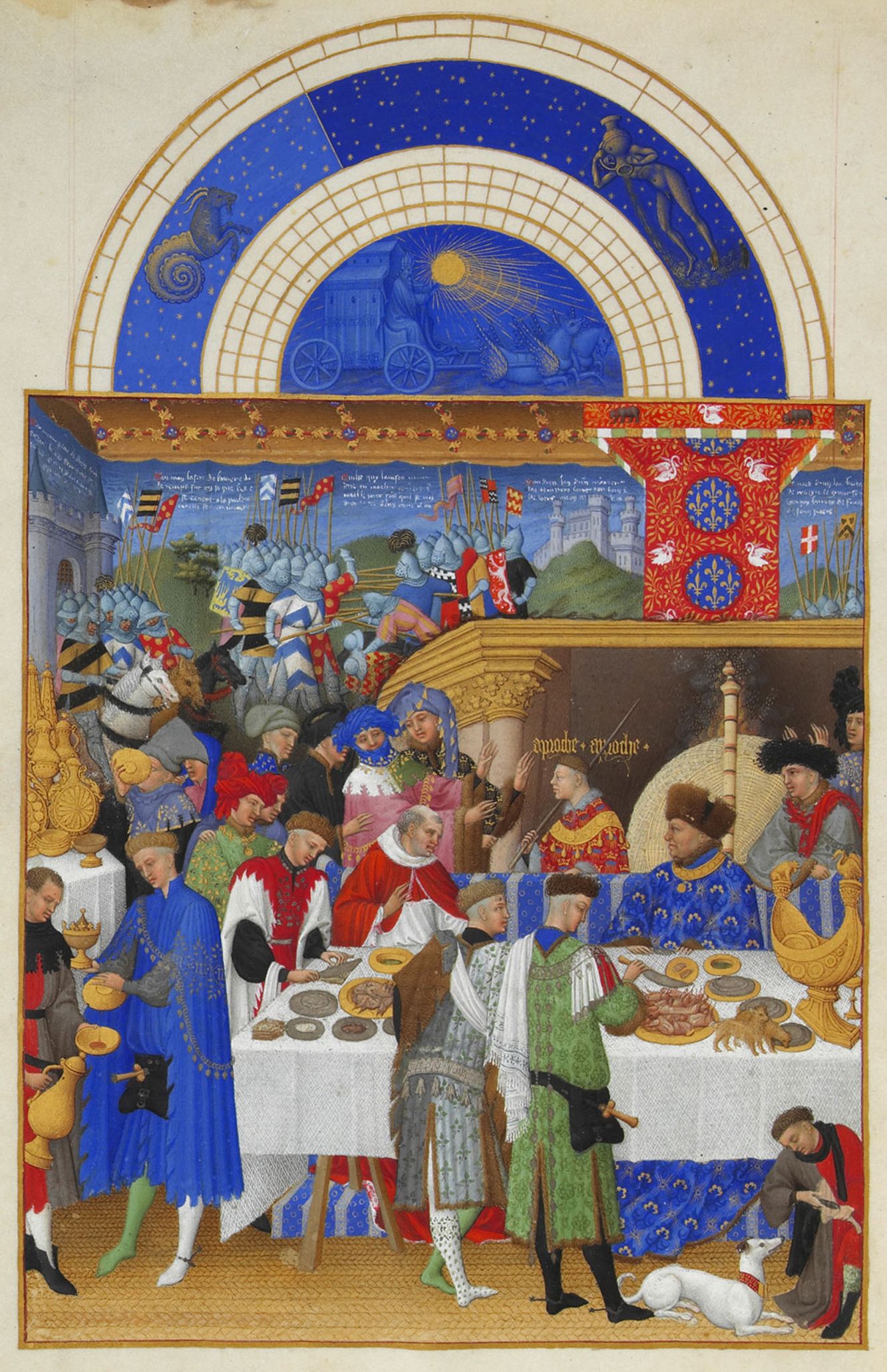
The Duke of Berry (1340-1416), of whom there is an online biography here, is depicted dressed in blue and wearing a livery or chivalric collar and seated to the right, and wearing a handsome fur hat to indicate his status, celebrates the Christmas and Epipany seasons. There appears to be the exchange of gifts - New Year or Epiphany ones - and a cultivated and splendid lifestyle. This is a pattern which would have been replicated or emulated across Europe in royal and aristocratic households.

The importance of the Duke is further indicated by the canopy and cloth of estate with his arms above his head. The tapestries or hangings with their battle scenes which decorate the room are a further sign of wealth. They would have travelled with the household and been hung to decorate whichever residence was in use at the time. What today might appear the rather stark interior of later medieval residences  could have rapidly been transformed by such wallhangings - which also would have provided insulation. A superb contemporary set which depicts the Apocalypse have survived and can be seen at Angers in the castle. In a similar way the trestle table once covered with a fine linen cloth assumes far greater dignity.

The firescreen is also an interesting feature, as is the woven rush matting - rushes on the floor clearly did not mean a strewn hay stack as one might be led to believe, but a fitted covering in such a grand household. Similar floor coverings can be seen today in some National Trust properties such as Hardwick Hall in Derbyshire.

On the left is a sideboard or buffet with a display of gold plate as was expected on such occasions to display princely magnificence, and other splendid plate is in use at the feast, as well as an aquamanile for washing the hands of those dining at the table. The pieces shown are very similar to the relatively few surviving examples from the period in museums and collections such as those of the Oxford and Cambridge colleges. My post The Royal Gold Cup is about another surviving piece, now in the British Museum, of such splendid plate which is specifically linked to the Duke and his nephew King Charles VI.

The whole scene is redolent of courtly life, well mannered, polite, fashionable and stylish - even the greyhound has an air of elegant langour.

The painting is attributed to the artist identified as the 'the courtly painter'. 

The effigy of the Duke in the cathedral of St Etienne in Bourges by Jean de Cambrai shows a great similarity to the figure of him in the illumination:


Tomb of Jean, Duc de Berry

Image:courtauldprints.com


Duc de Berry.jpg

Image:Wikipedia

The Duke was a major player in the French political system both a member of the Royal family, being son of King Charles V, and as a grand seigneur with his appanage of Berry.  That so much of French  politics hinged on the rivalries between Royal Dukes such as Orleans, Burgandy and Berry when King Charles VI was periodically incapacitated by mental illness raised tensions and weakened the ability to respond to the potential threat posed by King Henry V.

Hoever at the beginning of January as the Duke and his court feasted they cannot have imagined the scale of that threat, or of its impact within the coming year.


Thursday, 1 January 2015

January


Image:Wikipedia

The Duke of Berry (1340-1416), of whom there is an online biography here, is depicted dressed in blue and wearing a livery or chivalric collar and seated to the right, and wearing a handsome fur hat to indicate his status, celebrates the Christmas and Epipany seasons. There appears to be the exchange of gifts - New Year or Epiphany ones - and a cultivated and splendid lifestyle. This is a pattern which would have been replicated or emulated across Europe in royal and aristocratic households.

The importance of the Duke is further indicated by the canopy and cloth of estate with his arms above his head. The tapestries or hangings with their battle scenes which decorate the room are a further sign of wealth. They would have travelled with the household and been hung to decorate whichever residence was in use at the time. What today might appear the rather stark interior of later medieval residences  could have rapidly been transformed by such wallhangings - which also would have provided insulation. A superb contemporary set which depicts the Apocalypse have survived and can be seen at Angers in the castle. In a similar way the trestle table once covered with a fine linen cloth assumes far greater dignity.

The firescreen is also an interesting feature, as is the woven rush matting - rushes on the floor clearly did not mean a strewn hay stack as one might be led to believe, but a fitted covering in such a grand household. Similar floor coverings can be seen today in some National Trust properties such as Hardwick Hall in Derbyshire.

On the left is a sideboard or buffet with a display of gold plate as was expected on such occasions to display princely magnificence, and other splendid plate is in use at the feast, as well as an aquamanile for washing the hands of those dining at the table. The pieces shown are very similar to the relatively few surviving examples from the period in museums and collections such as those of the Oxford and Cambridge colleges. My post The Royal Gold Cup is about another surviving piece, now in the British Museum, of such splendid plate which is specifically linked to the Duke and his nephew King Charles VI.

The whole scene is redolent of courtly life, well mannered, polite, fashionable and stylish - even the greyhound has an air of elegant langour.

The painting is attributed to the artist identified as the 'the courtly painter'. 

The effigy of the Duke in the cathedral of St Etienne in Bourges by Jean de Cambrai shows a great similarity to the figure of him in the illumination:


Tomb of Jean, Duc de Berry

Image:courtauldprints.com


Duc de Berry.jpg

Image:Wikipedia

The Duke was a major player in the French political system both a member of the Royal family, being son of King Charles V, and as a grand seigneur with his appanage of Berry.  That so much of French  politics hinged on the rivalries between Royal Dukes such as Orleans, Burgandy and Berry when King Charles VI was periodically incapacitated by mental illness raised tensions and weakened the ability to respond to the potential threat posed by King Henry V.

Hoever at the beginning of January as the Duke and his court feasted they cannot have imagined the scale of that threat, or of its impact within the coming year.


Tuesday, 17 June 2014

Vikings at the British Museum


Yesterday I visited the British Museum to see their current exhibition Vikings:life and legend. The day was organised by the new Director of the Museum of the History of Science here in Oxford for the permanent staff of the Museum and those of us who work there part-time.

This was therefore another early start but it did mean we were able to fit a lot into the day. On arrival we were welcomed and given a tour of the new World Conservation and Exhibition Center, which is linke dto the new sainsbury exhibition centre. The WCEC enables conservation and lending or receipt of items with state of the art technology, and is still in the process of being commissioned.

After this, and atour of parts of the labyrinth of passageways under the Museum, we broke for lunch. At this time of year the British Museum is very busy indeed and the Great Court around the old Reading Room is like the concourse of a railway station, not least in its echoing sounds. Nonetheless it is an imaginative use of the space.

Early afternoon we met up again to look at the recent redisplay of the Sutton Hoo finds. En route I did manage to have a reasonably good look at the Royal Gold Cup, about which I have written previously, and some other objects from medieval England and Europe.

The redisplay of the medieval material is a significant improvement on the previous dispalys, and the Sutton Hoo treasure is very much, and rightly, centre stage. The designer of the display spoke about the use of new technology as it had been used to highlight these wonderful things, and the helmet and other items from the seventh century court of a dynasty with strong Scandinavian was an excellent lead-in to the exhibition on the ninth to eleventh century Vikings.

We were given an introduction to the exhibition by Gareth Williams, one of the organisers and co-editor of the accompanying book. The BM's website has an introductory press-release which can be read at Vikings: life and legend.

The Museum's last exhibition on the theme had been in 1980, and this one, organised in conjunction with the National Museum of Denmark in Copenhagen and one in Berlin was built around a core of objects which each participating museum then presented in their own way. One change since 1980 was a change in official thinking in Russia - no longer is the period seen as purely Slavic - the Vikings of Rus are no longer air-brushed out of history. and on Now there is access to material from there and from the Ukraine. The present exhibition focussed on new discoveries the extent of Scandinavian migration and trade links in what nmight be termed the late Iron Age, but that the term Viking was an infinitely better selling ploy to modern audiences! Whilst it brought out the wealth of the period, it did not seek to avoid the fact that this was also a violent age - the "Fluffy Vikings" of a few years ago in historical presentation are consigned to their own interpretive past.

The exhibition is in the new sainsbury gallery, but the first two rooms were crowded and the expereince somewhat uncomfortable, with low light levels, other than that illuminating the objects, background dialogue in Scandinavian languages to provide a type of "mood-music" and crowds pressing around the display cases. Once you got accustomed to that then there were splendid things to see.

I was struck by the richness and splendour of the material culture of the Viking elite with their jewellery for both men and women and splendid swords, and records of red cloaks and evidence of substantial houses - as illustrated by the reconstrucyted example at Borg in Norway.

Amongst the discoveries on display was the Vale of York hoard, found a few years ago near Harrogate, and apparently buried about 927 when King Athelstan first occupied the Kingdom of York.

In the main exhibition space wa steh highlight of the whole display - the largest Viking ship found (to date), from Roskilde. Ironically it came to light as plans were carried out to extend the ship museum there. It probably required forty pairs of rowers, and though only about 20% of the timbers survive the cradle in which it is displayed indicated the scale of the vessel. In its day it was, I suspect, the equivalent of later ships such as the Grace Dieu of King Henry V, the Vasa of King Gustavus Adolphus, a pre-1914 Dreadnought or a modern aircraft carrier. Dated to circa 1025 it may well have been commissioned by King Cnut following his conquest of Norway and using timber from there to impress his subjects and potential enemies by his authority. In that sense it still works.


Nearby was a facsimile of the  Jellinge stone erected at Jellinge in Jutland to commemorate King Gorm the Old and his Queen by their son King Harold Bluetooth in the late tenth century. Coloured as it would have been originally, and with the Crucifixion on one side and a distinctive dragon on the other - hence the use of the term Jellinge style - and its inscription in which King Harold listed his achievements of ruling Denmark, acquiring Norway and making the Danes Christian, it is, like the ship, an expression of growing royal authority in Scandinavia. That process, which included the development of coinage, derived no doubt from contact with Englsih and Frankish society on raids and traing expeditions.

Showing that not all Viking raids were successful there was a display of some of the remains of the Vikings killed in the Ridgeway Hill massacre near Weymouth about the year 1000. Clearly the Anglo-Saxons were not always defeated, and quite nifty at eliminating what may well be the fifty or so members of a Viking ship crew with raiding in mind which ventured onto the Dorset coast.

There were interesting displays about Viking pre-Christian religious belief - which now appears shamanistic in may respects, and included the warrior tradition of going berserk in battle, that is believing oneself to have bear-like strength and fighting without armour, being probably under the influence of hallucinogenic plants. The Lewis chessmen, who were on display, biting the tops of their sheilds are possibly under such influence. There was also a stone Manx cross fragment linking Christ and the Norse gods.

The legacy of the Vikings was illustrated not only by place-names, especially in counties such as Lincolnshire, and the many words in English of Viking origin, but also a map illustrating Norwegian DNA and its distribution, and indeed concentrations, in the areas of Scandinavian settlement in Britain - the Vikings are still with us in England because they are, so to speak, part of us.

The exhibition shop was very tempting, and with awide range of goods to buy. I managed not to succumb, but did rather fancy a tie with parts of the Bayeux tapestry reproduced on it and cuff-links with the Sutton Hoo helmet as their face.

A splendid exhibtion once one got through the initial log-jam of visitors and plenty to feast the eyes and the historical imagination. Many thanks indeed to the Directory of the Oxford MHS for organising the day.


Wednesday, 1 January 2014

January


File:Les Très Riches Heures du duc de Berry Janvier.jpg

Image:Wikipedia

The Duke of Berry (1340-1416), of whom there is an online biography here, is depicted dressed in blue and wearing a livery or chivalric collar and seated to the right, and wearing a handsome fur hat to indicate his status, celebrates the Christmas and Epipany seasons. There appears to be the exchange of gifts - New Year or Epiphany ones - and a cultivated and splendid lifestyle. This is a pattern which would have been replicated or emulated across Europe in royal and aristocratic households.

The importance of the Duke is further indicated by the canopy and cloth of estate with his arms above his head. The tapestries or hangings with their battle scenes which decorate the room are a further sign of wealth. They would have travelled with the household and been hung to decorate whichever residence was in use at the time. What today might appear the rather stark interior of later medieval residences  could have rapidly been transformed by such wallhangings - which also would have provided insulation. A superb contemporary set which depicts the Apocalypse have survived and can be seen at Angers in the castle. In a similar way the trestle table once covered with a fine linen cloth assumes far greater dignity.

The firescreen is also an interesting feature, as is the woven rush matting - rushes on the floor clearly did not mean a strewn hay stack as one might be led to believe, but a fitted covering in such a grand household. Similar floor coverings can be seen today in some National Trust properties such as Hardwick Hall in Derbyshire.

On the left is a sideboard or buffet with a display of gold plate as was expected on such occasions to display princely magnificence, and other splendid plate is in use at the feast, as well as an aquamanile for washing the hands of those dining at the table. The pieces shown are very similar to the relatively few surviving examples from the period in museums and collections such as those of the Oxford and Cambridge colleges. My post The Royal Gold Cup is about another surviving piece, now in the British Museum, of such splendid plate which is specifically linked to the Duke and his nephew King Charles VI.


The whole scene is redolent of courtly life, well mannered, polite, fashionable and stylish - even the greyhound has an air of elegant langour.

The painting is attributed to the artist identified as the 'the courtly painter'. 

The effigy of the Duke in the cathedral of St Etienne in Bourges by Jean de Cambrai shows a great similarity to the figure of him in the illumination:


Tomb of Jean, Duc de Berry

Image:courtauldprints.com


Duc de Berry.jpg

Image:Wikipedia


Saturday, 21 January 2012

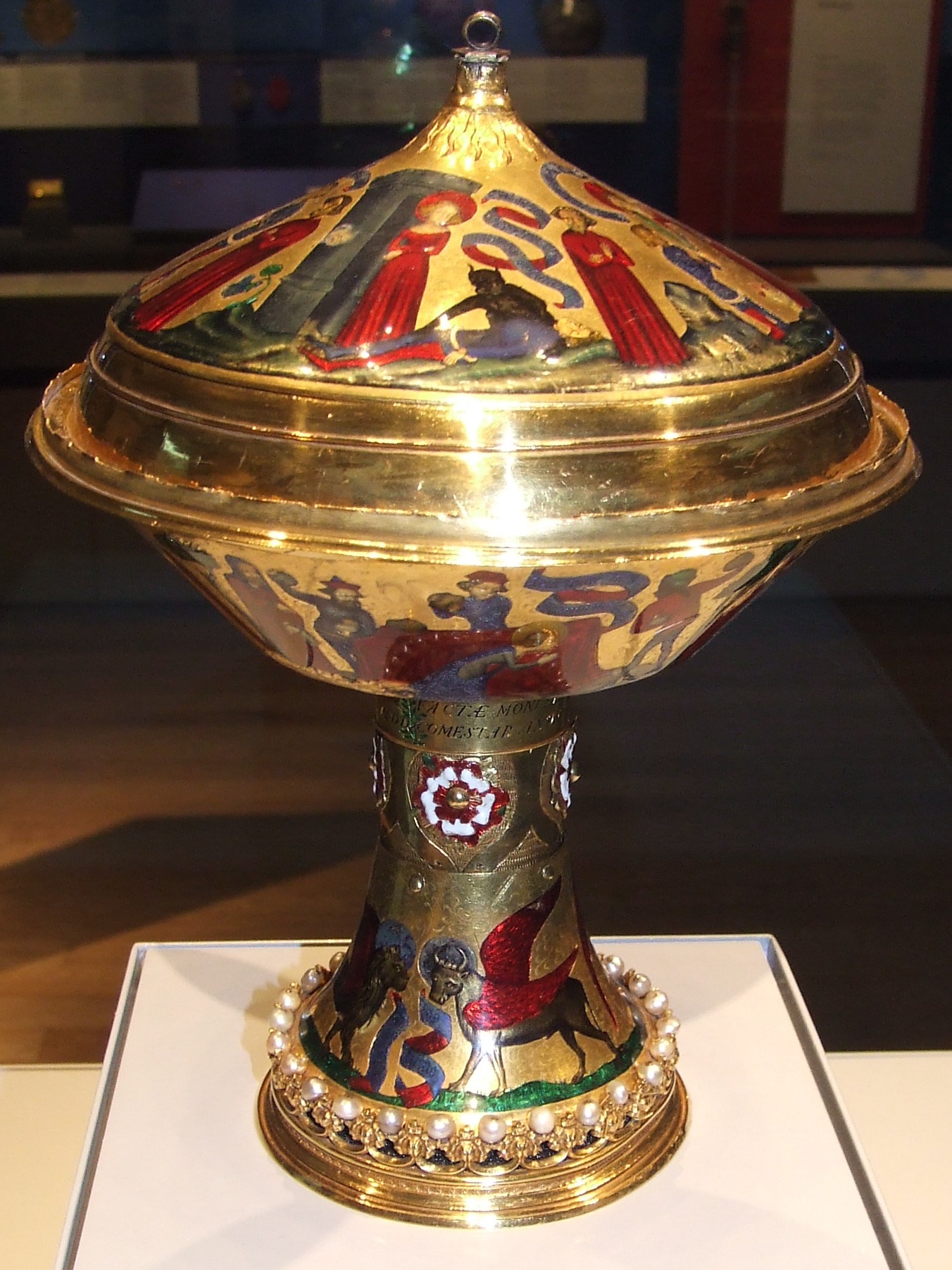
The Royal Gold Cup


As today is the feast of St Agnes it seems not inappropriate to draw attention to the Royal Gold Cup, which is now in the British Museum. The Cup is decorated with enamelled scenes which narrate the story of St Agnes. The cup is a rare and spectacular survival of late medieval French goldsmiths' work, and is of the highest quality. A detailed account of the cup, its dating and history as well as of its decoration can be read here.