The BBC History Magazine website reproduces an article which, being by background an historian of the later middle ages, caught my eye. I have copied the article and then added some comments of my own.
The secret intimacies of Edward IV: multiple marriages and a same-sex affair?
King Edward IV is remembered by many for his role in the Wars of the Roses, the 30-year struggle between the Houses of Lancaster and York for the English throne, and for his relationship with Elizabeth Woodville.
Here, historian John Ashdown-Hill re-examines what is known about the private life of the monarch, from his possible bigamy to secret same-sex intimacies, and questions many ‘facts’ traditionally assigned to the first Yorkist king of England…
My research on the story of King Richard III began in the 1990s, and focused initially upon the allegation that he was a ‘usurper’. That was a story which was later initiated by Henry VII, who seized Richard’s throne, killed him, and then blackened his reputation. But the truth is that Richard was offered the throne by the three estates of the realm on the grounds that his elder brother, Edward IV, had committed bigamy, making Edward’s children by Elizabeth Widville illegitimate. (Her maiden surname is commonly spelt ‘Woodville’, but contemporary sources suggest that Widville or Wydville were more commonly employed in the 15th century. I therefore use ‘Widville’.)
The story of Edward IV’s bigamy intrigued me. As a result, my initial research focused upon the true story of Eleanor Talbot – the lady who was formally acknowledged in an Act of Parliament of 1484 as “married” to King Edward. Although some historians have questioned Eleanor’s existence, I established clearly her identity, with the support of solid evidence. A picture emerged that supported the proposition that she had a relationship with King Edward IV. For example, the king appears to have given her land. Also he sent presents to her former father-in-law, Lord Sudeley, while Eleanor was alive – though following her death he changed tack and destroyed Lord Sudeley. It was also clear that the legality of Edward IV’s subsequent marriage with Elizabeth Widville had always been questioned.
A new date of birth?
My research on the bigamy accusations led me to investigate all the other alleged stories about Edward IV and his private life. Once I’d started, it rapidly emerged that, while most biographies of the king have traditionally claimed that he was born on 28 April 1442, most of them cite no source for that assertion. This is a problem, because some historians have used this birth date to back a claim that Edward himself was illegitimate.
A political story, promoted by the French government and other opponents of Edward IV after he became king of England, hinted that his mother had a love affair with an archer. As a result, it was suggested that the archer, rather than Richard Duke of York, was Edward’s biological father. Some modern historians have sought to back that claim by asserting that the Duke of York was not with his wife at the time of Edward’s conception. But of course, that claim is based upon Edward IV’s alleged birth date.
When I sought out evidence for the date in question, I discovered that actually only one 15th-century source mentions 28 April 1442. Unfortunately, that source erroneously claims that the day in question was a Monday. What’s more, another source offers a different date for Edward’s birth. In short, I believe we can no longer claim to know for certain precisely when Edward was born.
Who was Edward’s real father?
The allegations of illegitimacy have, of course, thrown Edward’s relationship with his theoretical father, Richard Duke of York, into question. However, letters written by the Duke of York to King Charles VII of France – attempting (and failing) to set up a prestigious marriage for Edward with one of the daughters of the king of France – indicate that the duke considered Edward to be his son. That point is proved even more clearly by the wording that the duke used. In the surviving letters, he repeatedly refers to Edward as his son and heir. In his own writing, Edward naturally addressed the duke as his father. His letters suggest that a good relationship existed between them.
Same-sex relationships
When the Duke of York was killed in 1460, young Edward was still unmarried – and remained so when he became king of England. Shortly after his accession, however, Edward became involved with the beautiful Eleanor Talbot, and the most likely date for their secret marriage seems to have been Monday 8 June 1461, when the itinerary of Edward IV, as published in my latest book, reveals that Edward was in the vicinity of Eleanor’s Warwickshire manor houses.
Eleanor had produced no children by her first husband, Sir Thomas Boteler, and she doesn’t seem to have become pregnant as a result of her relationship with the king. Edward IV therefore found himself confronted by a fruitless relationship. But about 18 months after his secret marriage with Eleanor, Edward encountered one of her first cousins, who may well have shared Eleanor’s good looks, and who also, it seems, attracted the king. The cousin in question was Henry Beaufort, Duke of Somerset. A wealth of clear contemporary evidence suggests that Edward loved Henry and that the two men slept together.
This is by no means the only instance of an English king having a same-sex relationship. Earlier examples involved both Richard the Lionheart and King Edward II. Although Richard I’s same-sex relationship worried his father, Henry II, the intimacy took place in France, and aroused no hostile response in England. Edward II wasn’t so lucky. Likewise the relationship between Edward IV and the Duke of Somerset aroused opposition in some quarters. This led to an attack on the Duke of Somerset, which finally helped to break up his relationship with the king.
Another secret marriage?
Later accounts – beginning with the version of ‘history’ written by the Tudor grandee Sir Thomas More – suggest that, around this time, Edward IV took on a relationship with another young woman, Elizabeth Lucy. More even went as far as to claim that Edward IV was believed, in some quarters, to have secretly married Elizabeth Lucy. More offers a detailed story of how the young king’s mother supposedly knew of this relationship. He also asserts that Richard III’s subsequent claim to the throne was based upon the premise of Edward and Lucy’s marriage.
More goes on to say that the claim was false – making Richard III a usurper. While the offering of the English crown to Richard III was indeed based upon evidence that Edward IV had committed bigamy, the evidence clearly shows that the alleged first (and legal) wife of the young king was not called Elizabeth Lucy. She was, in fact, Lady Eleanor Talbot.
Sadly, there’s not a shred of contemporary evidence that a woman called Elizabeth Lucy ever existed – let alone that she had a relationship with Edward IV. The logical conclusion is that Thomas More’s allegations were simply part of the attempt made by Henry VII and his successors to ensure that the name of Eleanor Talbot was written out of history. Henry VII had initiated this process in 1485, when he repealed unquoted the 1484 act of parliament that had acknowledged Eleanor as “married” to King Edward. On that occasion, Henry VII stated specifically that his aim was “that all thinges said and remembered in the said Bill and Acte thereof maie be for ever out of remembraunce and allso forgot”.
However, surviving letters written in 1533 and 1534 by Eustace Chapuys, the ambassador of Emperor Charles V at the court of Henry VIII, show that Henry VII hadn’t succeeded in putting the story of Eleanor’s marriage to Edward IV “out of remembraunce” on the European mainland. Therefore ongoing work was required for the sake of England’s new reigning dynasty.
Thomas More also asserted that the king had a love affair with a “Mistress Shore”. But, as in the case of Elizabeth Lucy, not a single shred of contemporary evidence exists to show that Edward IV had anything to do with Mistress Shore. Unlike Elizabeth Lucy, however, Mistress Shore definitely did exist. Her maiden name was Elizabeth Lambert.
A marriage for her was arranged by her family, and her first husband was called William Shore. Unfortunately, that marriage proved difficult, and the young wife appealed to the church for its annulment. Eventually she married again. Before that, however, she had two love affairs: one with Lord Hastings, and the other with Edward IV’s step-son, the Marquis of Dorset. Curiously, a number of sources prove that her first husband, William Shore, was a supporter of Edward IV, and worked with him. However, no contemporary sources ever claim that Mistress Shore had a relationship with the king.
Heaps of illegitimate children?
The traditional story of Edward IV’s private life asserts not only that he had mistresses, but also that he produced heaps of illegitimate children. However, that too proves to be untrue. The king is recorded as only acknowledging one illegitimate child during his reign. It was a boy, but his name is unknown. Previous historians tended to assume that the boy in question was Arthur Wayte/Plantagenet, later Lord Lisle. However, the evidence clearly shows that Arthur was only finally acknowledged as a royal ‘bastard’ many years after the death of his alleged father. So he cannot have been the illegitimate child who was accorded formal recognition by Edward IV himself.
Curiously, however, one or two girls also seem to have been recognised as illegitimate daughters of Edward IV years later, during the reign of Henry VII. One possible explanation for this is that Richard III was offered the throne on the assumption that Edward’s children by Elizabeth Widville were illegitimate!
The power behind the throne
For all the question marks hanging over her marriage to the king, Elizabeth Widville seems to have exercised a great deal of influence over Edward IV. Despite later stories that he had many love affairs, from 1464 until his death in 1483, Edward seems to have been rather fond of his wife.
Elizabeth Widville was acknowledged as Edward’s legal wife during his reign, and her children were also officially recognised as the heirs to the throne. However, their status was always questioned in some quarters. Even members of the royal family – including the king’s own middle brother, George, Duke of Clarence – disputed their claims. One result was that George was imprisoned and executed – apparently on the orders of Elizabeth Widville herself. A contemporary report written by Italian diplomat Domenico Mancini certainly suggests that this was the case.
Elizabeth’s later conduct confirms that she took a strong role in politics. Following Edward IV’s death, with the aid of members of her own family, she attempted a coup to enable herself to act as regent for her young son. But in 15th-century England, regency powers were always assigned to the senior living prince of the blood royal – not to the mother. Thus when Edward IV died, according to English custom, power belonged in the hands of his surviving brother: Richard, Duke of Gloucester, who would, of course, go on to become King Richard III…
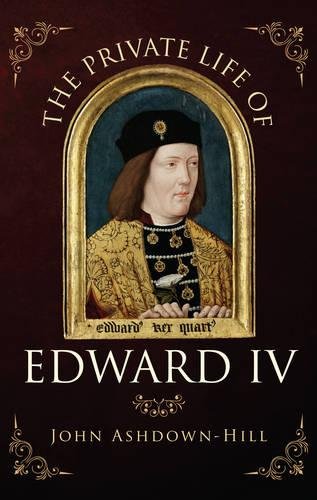
Image: Amazon
John Ashdown-Hill is a historian and the author of The Private Life of Edward IV (Amberley Publishing, November 2016). To find out more, click here.
To find out more about the author, visit www.johnashdownhill.com.
The Clever Boy would wish to add the following coments:
I have only read the article not the book, but it certainly raises some interesting questions
The questions raised by Ashdown-Hill about King Edward's date of birth and possible illegitimacy are interesting. King Richard III's DNA suggests something was wrong in his descent from King Edward III as well - historians tend to suggest Richard of Conisburgh was not the son of Edmund Duke of York, as in the post from Matt's history Blog Was Richard of Conisburgh Illegitimate? and “Much Ado About Nothing?” – Pondering Richard III's DNA from Unofficial Royalty.
The concern with dates and places of birth in fifteenth century lists suggests a keen interest in astrology and that was one of the contributory causes of the downfall of George Duke of Clarence in 1477-78, as it had been with the Duchess of Gloucester in 1441.
The allegation of bigamy makes me wonder if this somehow was a a ghost haunting King Henry VIII and the issue of remarriage and begetting heirs. As it was he was, by Catholic rules, a bigamist and by virtually everyone's rules one or other of his two daughters who succeeded to the throne was illegitimate.
I would have thought that King Edward would have had enough common sense not to commit bigamy because of its likely impact on the succession. It is possible that a relationship with Lady Eleanor Talbot/Boteler was one of those whereby you could be deemed to be married by exchange of personal vows and physical consummation, and one that the eighteen year old Edward stumbled into thinking he was merely having an affair, and which came back to haunt his family. Both Lady Eleanor and his recognised wife the former Lady Grey show distinct similarities in their social and political positions. Did the young King have a penchant for attractive widows, only to find himself snared in different ways by both ladies, and so unable to contract the more prestigious marriage that might be expected for him?
The possibility of a King Edward having a same-sex relationship with Henry Duke of Somerset is very interesting, but I am not at all sure I am convinced. Both men were certainly heterosexual at other times, the King producing a large family with his Queen and, it appears, some illegitimate children, whilst Somerset's illegitimate son Charles Somerset is the progenitor of the line of the Dukes of Beaufort.
To share a bed with Somerset, and in that sense to literally sleep with him, may have been a political gesture - it showed that Somerset was taken into royal favour and trusted ( he had been the Lancastrian commander at Towton ) and was calculated to show the young King's independence of and indeed to irritate the Nevilles. In that it succeeded. Until relatively recently for two men to share a bed whilst travelling was no more than a practical matter, and need not imply any sexual relationship
If the two actually did have an affair - well that could explain why, given that Somerset could be held accountable for the death of Edward's father and brother, that the King was so willing to forgive him and take into his favour, and that this was not just not just a political one in eye for Warwick. Edward had few scruples when eliminating others, including his brother Clarence, if they were seen as a threat, although lesser Lancastrian supporters might be received into favour - not least his future Queen Elizabeth. The King and Duke were part of the wider cousinage that linked the Crown and nobility. Such an affair is not impossible one must suppose, but more evidence or interpretation is required.
As to King Richard I being homosexual I do have to ask if that story true - there seems no clear report earlier than late 1940s with John Harvey's book The Plantagenets: he cites Richard doing penance for a whole range of sins, including that, but this may refer to one incident in the past rather than a consistent life-style choice ( to be horribly modern). The largely all-male world of military life led by Richard may have led to such encounters without denominating them as his sole preference.
Ashdown-Hill's questioning of the historicity of Jane Shore is interesting as she is so well established in tradition, as in the story of her pleas ensuring the survival of King Henry VI's foundation of Eton. To some to suggest that Thomas More could ever be wrong will send out shock waves...
So I suppose the answer is to read the complete book and see what I think then...