Once I was a clever boy learning the arts of Oxford... is a quotation from the verses written by Bishop Richard Fleming (c.1385-1431) for his tomb in Lincoln Cathedral. Fleming, the founder of Lincoln College in Oxford, is the subject of my research for a D. Phil., and, like me, a son of the West Riding. I have remarked in the past that I have a deeply meaningful on-going relationship with a dead fifteenth century bishop... it was Fleming who, in effect, enabled me to come to Oxford and to learn its arts, and for that I am immensely grateful.


Showing posts with label Beaufort family. Show all posts

Wednesday, 21 October 2015

Ralph Neville Earl of Westmoreland


Today is the 590th anniversary of the death in 1425 of Ralph Neville, first Earl of Westmorland.

The Oxford DNB life of him by Anthony Tuck can be read at  Neville, Ralph, first Earl of Westmorland (c.1364–1425), and there is another online life at Ralph Neville, 1st Earl of Westmorland

The Earl was a major figure in the politics of the country as well as of northern England. He is buried in Staindrop church, close to his family seat at Raby Castle in county Durham. His tomb, with effigies of him and his his two wives - who are buried at the church in Brancepeth and in Lincoln cathedral respectively - has been moved from its original place in the middle of the choir to the west end of the church where it is next to the monuments of the later lords of Raby and nineteenth century Dukes of Cleveland.

 https://upload.wikimedia.org/wikipedia/commons/thumb/c/c9/Ralph_Neville.jpg/200px-Ralph_Neville.jpg

The head of the Earl's effigy

Image: Wikipedia 

http://www.luminarium.org/encyclopedia/ralphneville1effigy.jpg


Image:luminarium.org
 

image:r3.org

The anniversary of his death give me an opportunity to post images of him and his second wife and all his children at prayer - images of considerable charm and also not as well known as they should be. To understand them it will help if I also reproduce from the second link above a list of his numerous progeny - the Earl was clearly a dutiful husband:


Neville married firstly, Margaret Stafford (d. 9 June 1396), the eldest daughter of Hugh Stafford, 2nd Earl of Stafford, and Philippa Beauchamp, the daughter of Thomas Beauchamp, 11th Earl of Warwick, by Katherine Mortimer, the daughter of Roger Mortimer, 1st Earl of March. They had two sons and six daughters:
  • Maud Neville (d. October 1438), who married Peter de Mauley, 5th Baron Mauley..
  • Elizabeth Neville, who became a nun.
  • Margaret Neville (d. 1463/4), who married firstly, before 31 December 1413, Richard Scrope, 3rd Baron Scrope of Bolton, and secondly, William Cressener, esquire.
Neville married secondly, before 29 November 1396 Joan Beaufort, the widow of Robert Ferrers, 2nd Baron Ferrers. Joan was the legitimated daughter of John of Gaunt, 1st Duke of Lancaster, by his mistress and later third wife, Katherine Swynford. They had nine sons and five daughters:
A very well connected family indeed, with links to so many of the leading families of the time.


Image:Wikipedia Pol de Limbourg

The collars of park palings, with a stag, are clearly a family livery badge; on his tomb the Earl wears the Lancastrian SS collar. 

Unfortunately the reproductions on line of the other page are slightly less good, both having been cropped:

Image:geni.com


Image;pinterest.com


The painting are clearly done after the death of the Earl - his son Robert did not become a bishop until 1427 and Countess Joan appears to be shown as a widow


Alas the adage that the family that prays together stays together was not true for the Nevilles - as the ODNB life shows the Earl all but disinherited the family he had with his first wife in favour of his second family, and in the later conflicts of Lancastrians and Yorkists the two branches were on seperate sides more often than not, with the elderWestmormnd branch remaining loyal to the Lancastrian dynasty, and the second family, despite their Beaufort ancestry, being Yorkist - including, of course, Duchess Cicely herself.

Friday, 22 May 2015

The First Battle of St Albans


Today is the 560th anniversary of the First Battle of St Albans in 1455, which is usually considered the first battle in the Wars of the Roses. That, of course, depends on whether you see the conflicts of the mid to later fifteenth century as one or a set of wars, or rather see the variousshort-lived outbreaks of violence as not necessarily directly related, or indeed much out of the ordinary for later medieval politics in England or Europe as a whole.

There is an online account of the day at First Battle of St Albans. One distinguished historian summed it up as little more than a scuffle in a street, which is not altogether unfair.


First Battle of St Alban by Graham Turners

A modern painting of the aftermath of the battle by Graham Turner

(www.studio88.co.uk)

Image:richardiii.net

The battle or scuffle was an assault by the Yorkist faction on those escorting King Henry VI northwards, the victims leading members of the Court faction - the Lancastrians. The number of deaths was probably quite low, but what mattered were the specific casualties.

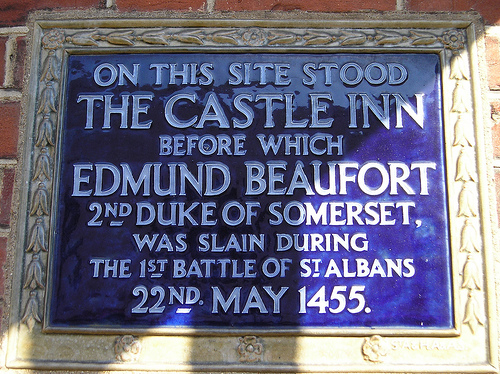
The most prominent amongst the dead was Edmund Beaufort, 2nd Duke of Somerset


death of Somerset

A plaque marking the site of the Duke of Somerset's death

Image:dodgingarrows.wordpress.com


The antagonism between the Dukes of Somerset and York was a major factor in the politics leading up to this first outbreak of actual fighting. The rivalry between Somerset and the Earl of Warwick, York's nephew, over the inheritance of the Beauchamp family - their wives being co-heiresses to the earlier earls of Warwick - added a strong financial and personal element to the vendetta.


File:St Albans Abbey before dissolution painting 2011-06-20.jpg

St Albans Abbey before the dissolution
- a modern reconstruction by Joan Freeman

Image: Wikimedia

The conflict thus begun would not go away, despite peace-initiatives by King Henry VI. The Yorkists officially blames Somerset and teh other dead Lancastrian commanders for starting the fighting, leacving their sons and heirs to seek redress and revenge.

Thus Duke Edmund's son, the nineteen year old Earl of Dorset, carried away "soe injured" in a cart from the battle was to become as third Duke of Somerset aleasing lancastrian commander. He died on the scaffold after the battle of Hexham in 1464. His brother and heir, Edmund the (titular) fourth duke, died similarly after the battle of Tewkesbury in 1471, a battle which claimed the life of the last male legitimate Beaufort, Lord John, who aged about sixteen, can only have just been born when his father was killed at St Albans.

Lord Clifford, another casualty in 1455 was succeeded by his som, the so-called "Butcher"Clifford, whom Shakespeare uses to typify the mindset of the revenge killings that ensued. So in the Shakespearean depiction of the battle of Wakefield in 1460 Clifford kills the Earl of Rutland, York's second son, saying "Thy father slew my father and I will slay thee" before going off to assist in killing the Duke of York. He himslf was killed in the early stages of the battle of Towton a few months later. As written by the Bard of Avon well over acentury later it may well be fiction, but it captures the politics of faction.

File:St Albans Cathedral Lady Chapel.jpg

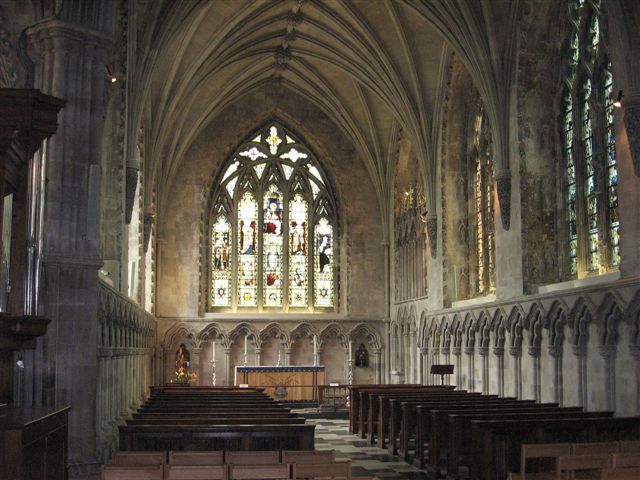
The Lady Chapel, St Albans

Image:Wikimedia

The prominent victims of the battle were interred in the Lady Chapel of the abbey.

Thursday, 15 May 2014

The Battle of Hexham


Today is the 550th anniversary of the battle of Hexham in 1464. This Yorkist victory over the Lancastrians resulted in the end of the ule of part of northern Northumberland by the supporters of King Henry VI. The Lancastrians, led by Henry Beaufort Duke of Somerset, had been defeated with ome losses at the battle of Hedgeley Moor on April 25th and the battle at Hexham finished them as a group - probably more were beheaded after the battle than died in combat

There is an online account of the earlier battle here , and another discussion - perhaps more scholarly, from the US based Richard III Foundation - at Hedgeley Moor.

The battle at Hexham is again covered online at  Battle of Hexham and by Luminarium at  The Battle of Hexham (May 15, 1464). The Richard III Foundation piece about the battle, again with more recent scholarship, is at the site Battle of Hexham.

An article about new interpretations of the battle from the local newspaper the Hexham Courant can be seen at  Debunking myths about the real Battle of Hexham, and the website of a re-enactment group The Beaufort Companye has a useful illustrated feature on the battle at The Battle of Hexham - Beaufort Companye

As I wrote above the result of the battle was the capture and summary decapitation of the Lancastrian leadership, most notably the 28 year old Duke of Somerset. He was beheaded the same day in Hexham market place, and buried in the adjacent Augustinian monastery. Technically a priory it is now known as Hexham abbey, and is treasure-house of medieval ecclesiastical art. A plaque in the Market Place commemorates his death.


Image:jenblackauthor.blogspot.co.uk

The new Oxford DNB life of him by Michael K. Jones can be read here, and there is another useful biographical article about him here. Although by no means always successful as a military commander Somerset had shown himself a resourceful and determined figure, and indeed jouster, whilst still managing in 1462-3 to make his temporary peace with King Edward IV, before heading north to raise the border area for King Henry.

His death meant that his younger brother Edmund (b.1438) succeeded to the leadership of the Beaufort connection and claim until his execution after the battle of Tewkesbury in 1471, a battle in which their youngest brother John (b.circa 1455) had been killed. With them ended the legitimate male line of the Beauforts. Any claim they might have to the throne - notwithstanding King Henry IV's formal denial of it - now resided with their cousin Lady Margaret Beaufort, and her son, Henry Tudor Earl of Richmond.

However Duke Henry had left an illegitimate son, Charles Somerset, born about 1460 to his mistress Joan Hill. Under the rule of King Henry VII and King Henry VIII Charles married a south Wales heiress and rose to become Baron Herbert and in 1514 Earl of Worcester, as well as a Knight of the Garter. There is an introductory account of him here, and Jonathan Hughes' comprehensive Oxford DNB biography can be read here. He died in 1526 , leaving his titles and estates to his son and his descendants. Prompted to the Marquessate of Worcester by King Charles I they hoped to regain the Duchy of Somerset. The revival of the Seymour title to that in 1660 frustrateds that plan, so in 1684 the Somersets became Dukes of Beaufort - an elegant solution to patronymics and titles for the lineal descendants of those Beauforts Dukes of Somerset.

Today the title is held by the eleventh Duke, who is thus in direct male line of decent from John of Gaunt, the progenitor of the Beauforts. The late Duke in his memoirs pointed out the strong family resemblance of his father to King Henry VIII, and he, the tenth Duke, in his youth and as a young man certainly had a strong resemblance to the quintessential Plantagenet image. In the portrait and effigy of the first Earl of Worcester there is not only that cast of features but maybe some idea of what his father and uncles, of whom no portraits survive, looked like.

  Charles Somerset (c.1460–1526), by unknown sculptor 

  Charles Somerset (c.1460–1526), by an unknown sculptor. 
Effigy on his tomb at St George's Chapel Windsor


Image:Oxford DNB

File:Charles Somerset, 1st Earl of Worcester.jpg

Charles Somerset, Earl of Worcester, son of Henry, Duke of Somerset - a posthumous portrait

Image:Wikipedia 


Friday, 17 January 2014

Ockwells Manor


Earlier today I had the good fortune to visit Ockwells Manor near Bray in Berkshire with the Oxford University Heraldry Society and the Maidenhead Civic Society. This mid-fiteenth century house is in private ownership and not usually open for visitors, so this was a rare opportunity to visit this important building.


Ockwell's Manor

Ockwells Manor
Image: Maidenhead Civic Society

There is a short online account of the house here, and a somewhat longer one from David Nash Ford's Royal Berkshire History website here. There are some fine black and white photographs of the house from the English Heritage NMR site here. There is a detailed account of the house and its related buildings from Anthony Emery's 2006 book which can be viewed at Greater Medieval Houses of England and Wales, 1300-1500 - Google Books


Ockwells Manor, Bray, Berkshire


The east front of Ockwells in 1928
The oriel windows are additions of 1889-93, when the dorrway was widened to the full width of the porch. The archway on the far left led to the chapel.

Image:© English Heritage.NMR  Ref.no. CC000307


Ockwells Manor is a manor house begun in the years 1446 - 1450 by John Norreys , Keeper of the Great Wardrobe of King Henry VI, and Treasurer of the Chamber and Keeper of the Queen's Jewels to Queen Margaret of Anjou. He remained in office under King Edward IV after 1461, and was indeed made a Knight of the Bath by the Yorkist king. There is a life of him here. The house does not appear to have been completed until about the time of Sir John's  death in 1466. Norreys imself is linked to the origin of civic life in Maidenhead; in 1451 Norreys and his brothers helped to found a guild based at a chapel in the middle of the High Street.

The house was described by Sir Nikolaus Pevsner as “the most refined and the most sophisticated timber-framed mansion in England” (The Buildings of England: Berkshire, 1966). Although it has lost its flanking wings, which contained a chapel - still being built in 1465 - and presumably lodgings for retainers, and of which only fragments survive, in the eighteenth and early nineteenth centurie, the main house has survived, as have a gateway and the barns and dovecote which face the manor across the courtyard. From about 1625 until the 1880s Ockwells was leased out, and declinedinto being a farmhouse - neglect which in many ways was benign, although there were significant losses, but by 1880 there was a serious risk that the dilapidated house would collapse or be demolished.Ockwells was one of the cases that inspired William Morris to found the Society for the Protection of Ancient Buildings. It was rescued by succesive tenants and is now, following further restoration in the 1980s, in beautiful condition.

The especial glory of Ockwells is the armorial stained glass installed by Norreys depicting the arms of his patrons and friends in the Lancastrian establishment and which is still in its original position in the windows of the Great Hall. There are views of some of these panels on the Corpus Vitrearum Medii Aevi website which can be seen here.


 http://www.countrylifeimages.co.uk/ResizedImages/VeryLarge/525974.jpg

The Great Hall
The long table, shown here on the left, is original to the building

Image: countrylifeimages.co.uk 


Armorial Stain Glass


The arms of Queen Margaret of Anjou, the Duke of Suffolk and King Henry VI in the Great Hall

Image: Maidenhead Civic Society


http://www.fromoldbooks.org/OldEngland/pages/HallAtOckwells-Berkshire/HallAtOckwells-Berkshire-500x378.jpg


The Hall at Ockwells
From Charles Knight Old England: A Pictorial Museum 1845

Image: fromoldbooks.org

The windows were removed for safety for part of the nineteenth century, and some losses have occurred to the original heraldry, and the name sof the bearers have also been lost.

The two windows in the body of the Hall show on the right the arms of John Norreys and his first wife, and his Berkshire connections, and on the left his arms impaling those of his second wife and his Worcestershire connections.Behind the glass has Norreys' motto "Faithfully Serve" and his badge of three distaffs. Along with the arms of the King and Queen only Norreys' own arms have supporters, who literally do so, hol;ding the shields up above their heads.

The bay window has at the side the mitred arms of the Abbot of Abingdon and of Bishop Richard Beauchamp of Salisbury, appointed in 1450, and there was once another ecclesiastical shield, possibly that of the Abbot of Reading. In the main section are the arms of the Duke of Warwick ( d.1446), of the Duke of Somerset (killed in 1455 at the first battle of St Albans), Queen Margaret, who married the King in 1445, the Duke of Suffolk (exiled and murdered in 1450), King Henry VI and the Earl of Wiltshire and Ormond (executed by the Yorkists in 1461). Our guide, Anne Darracott, who has done extensive research on the glass thinks the window commemorates the negotiations leading to the royal wedding, and the wedding itself, in which many of those whose arms appear were major participants.

The crowns and mitres are "jewelled" with the glass indicating the stones set into that of the insignia, and similar to glass in the Beauchamp chapel at Warwick, built after 1439.

I knew the glass from photographs, but to actually see it was privilege I very much appreciated.  A visit to Ockwells, despite all the changes of five and half centuries, does admit one to the world of the rising courtier John Norreys, his fine house and service buildings, his friends and connections and the great ones he met with in his life at Court around 1450.


Saturday, 19 February 2011

Heraldry for Bastards


The most recent meeting of the Oxford University Heraldry Society was addressed by Steve Slater from Wiltshire on the subject of the heraldry associated with bastards.

The bastard is a filius nullius, a man with no rights to his father's property, including his arms.

Althogh the bend sinister is the classic symbol of bastardy in heraldry there are really no fixed conventions about the matter, which for some might be sensitive, but the higher up the social scale the more people were prepared to flaunt heraldically their parentage - to be bastard may be awkward, but being aroyal bastard has a cachet all its own - and medieval kings often found their illegitimate offspring more relaible than their legitimate ones

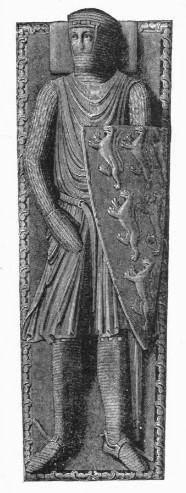
The earliest example of a bastard's use of heraldry is the effigy of William Longespee, Earl of Salisbury (d.1226) in Salisbury cathedral. He was the illegitimate son of King Henry II, and bore the arms of the king's father Geoffrey Count of Anjou recorded when he married the Empress Matilda in 1128 Azure, six lions rampant or, 3,2 and 1 and shown on his famous enamelled tomb cover from Le Mans:


Geoffrey Count of Anjou

Image: Wikipedia

Earl William's effigy still has traces of colour to indicate that the arms were of the same tincture. This is an early instance of the heritability of arms, even if it bypasses a generation.


Effigy of William Longespee, Earl of Salisbury

Image: Wikipedia

Royal bastards offer some of the best examples. Sir Roger de Clarendon, illegitimate son of Edward Prince of Wales, derived his arms from the arms of peace borne by his father, and bore Or, a bend noir with three ostrich plumes.

Richard Plantagenet, one of the two illegitimate sons of King Richard III, and who lives at Eastwell in Kent until c.1540 is credited with the arms Per pale argent and azure, on a bend sable sanglier blanc [White Boar] His father's livery colours formed the field, and the charge on the bend was his father's badge.

The Beauforts, the familiy of Duke John of Lancaster and his mistress Katherine Swynford, bore a coat based on their father's livery colours of blue and white, with the arms of the Duchy on a bend:


Following their partents marriage in 1396 they were legitimised by both the Pope and the King, and used a coat of arms of France modern and England quarterly ( the Royal arms as used by their half brother King Henry IV) with a bordure company argent and azure:


Following the marriage of Joan Beaufort to King James I of Scots in 1425 the bordure company became, somewhat ironically given that for the Beauforts it was a sign of legitimacy, the norm in Scotland for denoting bastardy.

A manuscript of a herald of the Duke of Burgundy in the fifteenth century shows a bend sinister as the indicator of illegitimacy. The classic sign of bastardy was already established. It can be seen in the arms on the Garter Roll of Arthur Plantagenet, Viscount Lisle K.G.(d.1542), the son of King Edward IV - 1 France and England quarterly, 2 and 3 de Burgh, 4 Mortimer, and over all a bend sinister.

These early examples tend to show a very narrow bend sinister, minimising its visual effect, and there appears to have been a practice whereby after three generations the bend sinister was discarded. Although not part of official heraldic practice this appears to have been tacitly accepted. Similarly Charles Somerset, first Earl of Worcester, bastard son of Henry Beaufort Duke of Somerset, originally bore his father's arms with a bend sinister, or, on a gold ground the Beaufort arms on a fess, but subsequently he, and certainly his descendants, the Marquesses of Worcester and Dukes of Beaufort, have borne the undifferenced arms of the medieval Beauforts.

The bend sinister came to be shortened to be a baton in the centre of the shield.

The eldest of King Charles II's illegitimate sons, the Duke of Monmouth bore two successive coats of arms, both of which were differenced by a baton sinister. In his case it was plain white, comparable to the label of a legitimate eldest son.


The second coat of arms of the Duke of Monmouth and Buccleuch
The Royal arms differenced with the baton sinister and the inescutcheon of Buccleuch

This quartering is still borne as part of the achievement of his descendents the Dukes of Buccleuch and Queensbury. Of the other ducal descendants of King Charles II, Grafton and St Albans bear his Royal arms with an appropriate baton, now quartered with those of the de Vere Earls of Oxford in the case of the Dukes of St Albans. The Duke of Richmond bears the Royal arms with a bordure company and an inescutcheon, quartered with other arms:

Duke of richmond.svg


The heraldic blazon is: Quarterly: 1st and 4th grand quarters, the Royal Arms of King Charles II (viz. quarterly: 1st and 4th, France and England quarterly; 2nd, Scotland; 3rd, Ireland); the whole within a bordure company argent charged with roses gules barbed and seeded proper and the last; overall an escutcheon gules charged with three buckles or (the Dukedom of Aubigny); 2nd grand quarter, argent a saltire engrailed gules between four roses of the second barbed and seeded proper (Lennox); 3rd grand quarter, quarterly, 1st, azure three boars' heads couped or (Gordon); 2nd, or three lions' heads erased gules (Badenoch); 3rd, or three crescents within a double tressure flory counter-flory gules (Seton); 4th, azure three cinquefoils argent (Fraser).

The Earls of Munster (title created 1831 and extinct in 2000), descended from King William IV and Mrs Jordan, bore the King's arms, with the inescutcheon of Hanover, differenced with a baton azure, charges with three anchors or.

For those of less exalted parentage the addition of a bordure wavy has become the modern sign of illegitimate descent.

English arms difference the supporters and the crest was well as the arms, but this is not the practice in Scotland.

Today the trend is to design a new coat for those of illegitimate stock using charges from the father's arms rather than to petition the Sovereign to assume the paternal arms. In 1717 the College of Arms held that bastards could can inherit paternal arms arms, but the Garter King of Arms from 1754-73 held that they had no right to their father's quarterings.