Once I was a clever boy learning the arts of Oxford... is a quotation from the verses written by Bishop Richard Fleming (c.1385-1431) for his tomb in Lincoln Cathedral. Fleming, the founder of Lincoln College in Oxford, is the subject of my research for a D. Phil., and, like me, a son of the West Riding. I have remarked in the past that I have a deeply meaningful on-going relationship with a dead fifteenth century bishop... it was Fleming who, in effect, enabled me to come to Oxford and to learn its arts, and for that I am immensely grateful.


Showing posts with label Oxford University Heraldry Society. Show all posts

Thursday, 30 March 2017

Clerkenwell, Smithfield and Charterhouse


Today I went on a visit to London organised by the Oxford University Heraldry Society. As always on their excursions one was taken to places of great historic as well as heraldic interest, and on this occasion all of the places I visited were for the first time.

Our first visit was to the headquarters in Clerkenwell of The Most Venerable Priory of the Order of St John of Jerusalem in the British Realm - the Anglican version of the Order of Malta, which was re-established in the nineteenth century under the patronage of Queen Victoria and her successors. There is an online history and introduction to the Order at Order of Saint John.

The site in Clerkenwell is that of the medieval Preceptory, and although only the gatehouse and part of the church survives, and now separated from each other by a road and other buildings they are still a remarkable survival.

The Church originally had a circular nave modelled on the Holy Sepulchre and similar to that of the Temple Church. That was replaced in the middle ages by a rectangular nave, but a curving foundation wall has been exposed. The chancel survived the dissolution and evolved into a fairly typical London eighteenth century church, which was a casualty of the Blitz. The post-war rebuilding emphasised the
medieval remains in a light and airy church, which displays the banners of the knights and of the modern Commonwealth preceptories.

 Image result for St John of Jerusalem Clerkenwell

The restored Priory Church

Image: museumstjohn.org.uk
 
The crypt underneath has survived from the thirteenth century chancel and has monuments reaching back to the middles ages. I must admit that I was unaware of the church other than the Hollar engraving - and assumed it all lost - so this was a genuine surprise.

 Image result for St John of Jerusalem Clerkenwell

The Crypt

Image: museumstjohn.org.uk

The Museum and headquarters of the Order are housed in the much better known early sixteenth century gatehouse to the original complex.

 Image result for St John of Jerusalem Clerkenwell

The Gatehouse

Image: Wikipedia

Here were displays and material including portraits and pictures of Malta illustrating the history of the original unified Order, and the attempt by Tsar Paul I to take it over at the very end of the eighteenth century. The Chapter Hall and Council Chamber were richly decorated with the arms of Royal and aristocratic members of the Order.

 http://museumstjohn.org.uk/wp-content/uploads/2015/01/Chapter_Hall2-1170x636.jpg

The Chapter Hall

 Image: museumstjohn.org.uk

There are pictures of the interiors and more information on the Museum's website at The Church - Museum of the Order of St John.

There is more about the history of the site at Clerkenwell Priory and about the church at St John Clerkenwell. There are more detailed accounts at St John's Church and St John's Square | British History Online from the Survey of London and at Clerkenwell Priory · Medieval London


When we came outside I was struck by the warmth of the air - the first real indicator that spring is here.

After walking through Smithfield market - the same place I remember as a child seeing burning down on television in the late 1950s and now handsomely restored - we had lunch in Smithfield and walked round the open space, noting the plaque commemorating William Wallace's execution there in 1305  and thinking of King Richard II's meeting with the Kentish peasants there in 1381 and the death of Wat Tyler. We also noted the gate to St Bart's Hospital and its statue of King Henry VIII and the tower of St Bartholomew the Less within the hospital.

We met up again as a group at St Bartholomew the Great on the eastern side of Smithfield. The remains of the priory church are hidden away through a timber gatehouse that leads to a oath on the site of the nave. At first the church with its relatively modern tower in the Tudor style is a little confusing, but what survives are parts of the transepts, the twelfth century choir and chapels of the ambulatory and a thirteenth century Lady Chapel.
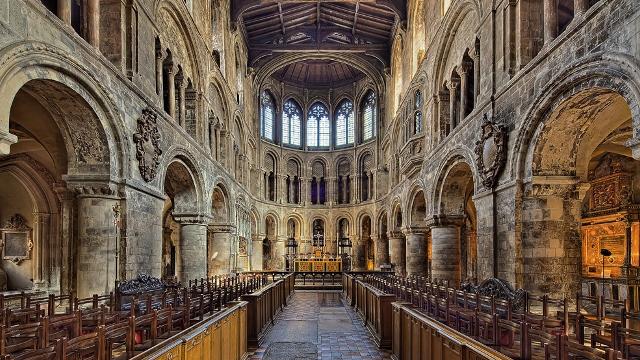

Image result for St Bartholomew-the-Great

The choir of St Batholomew the Great
The apse is a skillful nineteenth century restoration

Image: Visit London


Image result for St Bartholomew-the-Great

The oriel window in the triforium for Prior William Bolton (1505-32) to observe the church and canons

Image:Britain Express

What remains is very impressive and it must have been a very fine building indeed before the sixteenth century depredations. It was really quite amazing to be standing in part of medieval London, a building which had survived so substantially intact the ravages and rebuildings of the last five centuries. Our visit was enhanced by the fact that we had an excellent guide from the church.

Image result for st bartholomew the great

The choir elevation and the tomb of the founder Rahere

Image: Britain Express

There is more about the history of the Priory and church at The History of St Bartholomew the Great
and at St Bartholomew-the-Great 

After that the formal tour was over but together with a friend I explored the area round about and walked up to look at the exterior of Charterhouse. Not only is this the site of the medieval London Carthusian house founded in 1371 with its great spiritual reputation and martyrs of the 1530s but it has a connection with Bishop Fleming - he blessed a bell for the community in the late 1420s when he had the semi-official role of patron of the English Carthusians. Having served as the home of the unfortunate fourth Duke of Norfolk, the present charitable foundation of Charterhouse owes its establishment in 1611 to Thomas Sutton ( 1532-1611). The Oxford DNB life of him can be viewed at here . There is more about it at the homepage The Charterhouse

 Image result for London Charterhouse

The front of Charterhouse

Image: Diverting Journeys: WordPress.com

This was a most enjoyable and informative day out and one on which one learned a lot.


Thursday, 24 November 2016

Lecturing to the Oxford University Heraldry Society


This teatime I spoke to the Oxford University Heraldry Society at Christ Church, delivering the first of two illustrated lectures on "Arms and Insignia of Heirs Apparent".

I originally planned this as a single lecture but finding I had more than enough material I arranged with the Society to split it into two, giving the first part tonight.

This concentrated on why and when and how hereditary monarchs started indicating in heraldry, in ceremonial and in insignia their heir apparent, and then looked at the evolution of this from crowning an heir in his father's lifetime  ( the Empire, France, England in 1170 and Hungary as late as 1830 - and considered there in the 1870s or 80s)  to distinguishing him with a title and arms as well as an appanage, beginning with the earliest such consistently applied title, that of the Prince of Wales.

I also spoke about the insignia of the Duchy of Cornwall and the Earldom of Chester, as well as my theory that the badge of the three feathers for the Prince of Wales derives from him holding three Palatinates - Wales, Cornwall and Chester - and with an ostrich plume being the symbol of a palatine authority the use of three as badge by Edward of Woodstock Prince of Wales in the mid-fourteenth century.


The Arms of HRH The Prince of Wales

Image:Wikipedia

I spoke also about the ceremonial investiture of the Princes and their coronet with its single arch, and then turned to the topic of the same person in Scotland, where he is, of course, Duke of Rothesay, Earl of Carrick, Baron Renfrew, Prince and Great Steward of Scotland and Lord of the Isles.


Coat of Arms of the Duke of Rothesay.svg 

The Arms of HRH The Duke of Rothesay

These were granted to him by The Queen in 1974

Image: Wikipedia

On February 23 I shall be giving the second lecture, on that occasion time on European heirs apparent, and looking at figures such as the Dauphin and the Prince or Princess of Asturias, again at 5.30 in Lecture Room 2 at Christ Church.


Friday, 2 September 2016

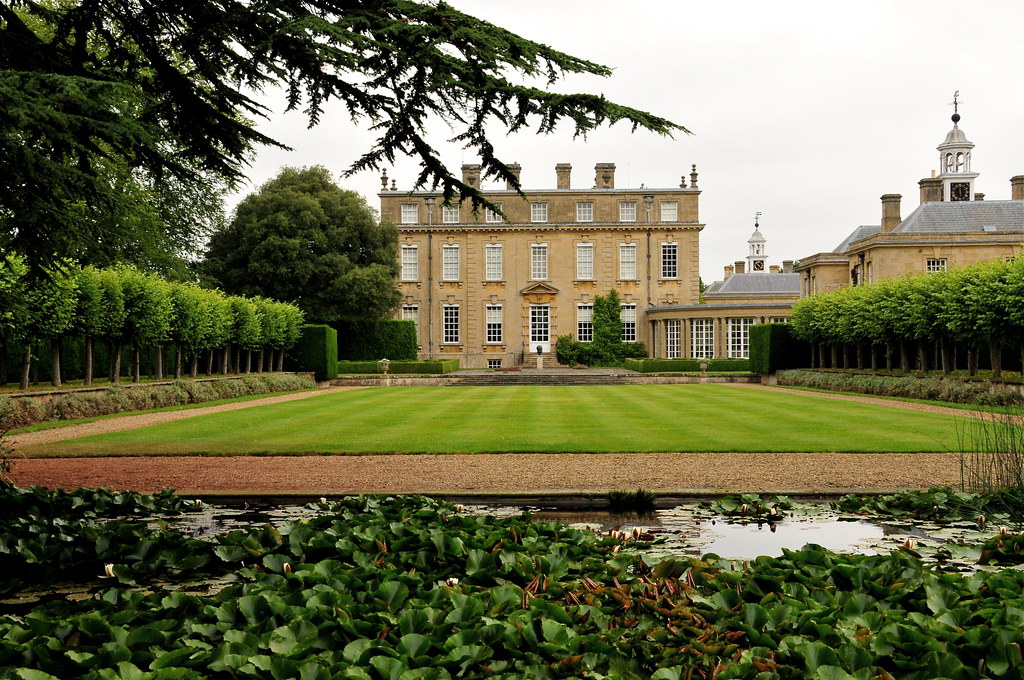
Ditchley Park


Today I had a wonderful day out with the Oxford University Heraldry Society. Their visits are always extremely civilised and informative, and this was no exception.
 Image result for Ditchley park

Ditchley Park

Image: The Ditchley Foundation

Our main destination was the early eighteenth century Ditchley Park near Charlbury, and we met up at Charlbury Station late in the morning. Before visiting Ditchley itself we went to Spelsbury Church, which contains the monuments of the Lee family, the builders of the house. The church is in origin medieval, but is now very much an eighteenth century reconstruction thereof. Within were the Lee family monuments and a group of coffin plates from the vaults, including that of one of their extended family, the Restoration rake John Wilmot Earl of Rochester. The monuments are a fine selection from the early-seventeenth century through to the mid-nineteenth century

 Image result for Spelsbury Church

Tomb of Sir Henry Lee (d.1631) and his wife in Spelsbury Church
Their children are grouped arond them on the tomb

Image: Church Monuments Society

After a sandwich lunch at a local pub we drove up to Ditchley - it takes its name from a prehistoric earthwortk in the Park - and wound along atree-line drive to find the house, which is both majestic and approachable, grand yet secreted away. Apart from Blenheim and Heythrop it is probably the most impressive Georgian country house in the historic county of Oxfordshire.

Ditchley Park is now owned by the Ditchley Foundation and I have somewhat adapted and edited the following few paragraphs fom their website:

Related image 

The South Front of Ditchley Park

Image:www.tvchp.com

The Ditchley estate was bought by Sir Henry Lee in 1580 when he was made the Ranger of the Wychwood Forest, the royal hunting forest based round the hunting-lodge at Woodstock. Queen Elizabeth I visited him at Ditchley in 1592, after he had an alliance with one of her Ladies-in-Waiting without her permission. Annoyed at this, so the story goes, the Queen stayed rather longer than she might otherwise have done, putting her host to considerable extra expense.  The visit is commemorated in the painting by Marcus Gheeraerts the Younger, “The Ditchley Elizabeth”, which shows Elizabeth with her foot on Oxfordshire and her toe on Ditchley.  This hung in the house until 1932 and is now in the National Portrait Gallery.


Image result for Ditchley park

The Ditchley Portrait of Queen Elizabeth I

Image:Thames Valley Country House Partnership

Four generations later Sir Henry’s heir, Edward Henry Lee, was created the 1st Earl of Litchfield (sic) in 1676 when he married Charlotte Fitzroy, the illegitimate daughter of King Charles II and Barbara Villiers, the Duchess of Cleveland, both of whose portraits hang in the White Drawing Room.
Image result for Ditchley park

The first Countess and Earl of Litchfield
Portraits in the White Drawing Room
 Image: The Ditchley Foundation

Their son, the 2nd Earl, built the present Ditchley Park in 1722, to a design by James Gibbs, architect of St Martins in the Fields and the Radcliffe Camera.  My reaction to the house was to see that despite its Palladian pavilions and curving links it still looked back to the style of the 1680s - the entrance floor is only slightlty raised, rather than being a piano nobile and the elevations are not those of Lord Burlington, Colen Cambell or James Paine. The interior was richly decorated by William Kent and Henry Flitcroft.
Image result for Ditchley park

The Entrance Hall

Image: The Ditchley Foundation

A somewhat curious feature are the misproportions of the staircases which suggest Gibbs was unsure as to how to make his design work out - it is an eccentric feature which mak s the house somehow more rather than less appealing.

In the grounds the fish pond was extended to form the lake in 1746.  After 1760 the Park was “naturalised”, with smooth lawns sweeping down to the lake, and the Great Temple or Rotunda was built in about 1760 by Stiff Leadbetter.

The 4th Earl died in 1776 without heir, and the estate passed to his niece, Lady Charlotte Lee, who had married the 11th Viscount Dillon, an Irish Peer. The Dillons had "Wild Geese" relatives in ancien regime France, some of whom were casualties of the Terror.

In 1807 the 12th Viscount employed Louden to build the Ha Ha, further extend the lake and plant tree avenues, many of which survive today. At that stage the family funds began to run short, so no alterations were made to the house in the subsequent century, when much modernisation altered the character of other country houses


Image result for Ditchley park

 Ditchley Park from the west

Image: UltraPanavision on Flickr

The 17th Viscount Dillon died in 1932, leaving his family asset rich but cash poor when faced with the pernciousfact of death duties and the estate was sold to Ronald Tree, the Conservative MP for Market Harborough, a very wealthy Anglo-American (his description). Born here to American parents and educated in England he had returned to the US when his father died in 1914. He met and married Nancy and, after they returned to England, he was elected to Parliament and they bought Ditchley in 1933.  They restored the house sympathetically and with great taste.  Nancy subsequently married Colonel Lancaster, and as Nancy Lancaster became one of England’s premier interior designers as proprietor of Colefax and Fowler in the 1950’s and 60’s. Ronald and Nancy employed Geoffrey Jellicoe, then a relatively unknown young garden designer, to remodel the grounds. He laid out the Italian style sunken garden immediately west of the main house and resurrected the terrace to the north, part of the original Gibbs design. Under the Trees Ditchley regained some of its earlier social prominence, most notably through several visits there by Winston and Clementine Churchill.

Having visited Germany in the mid-1930s Ronald Tree sided with Anthony Eden and Winston Churchill against the more accommodating Government line and  made speeches in the House of Commons warning of Hitler’s intentions.

In 1937 Churchill and Eden visited Ditchley for a house party and clearly enjoyed the Tree's hospitality.  When the Battle of Britain started in 1940 Churchill was advised not to go to Chequers, the Prime Minister’s official country residence in Buckinghamshire, “when the moon was high” (the title of Ronald Tree’s autobiography), as German bombers were expected to attack it - the drive reflected the moonlight and this was thought to make it an easy target.  He invited himself (and members of his War Cabinet) to Ditchley for the weekend of 9-11 November 1940, and subsequently came for a further twelve weekends up to September 1942. Ronald Tree was at that time a Junior Minister in the Ministry of Information charged with fostering Anglo-American relations and invited many influential friends of Roosevelt, including Harry Hopkins, to meet Churchill during his Ditchley weekends.  The early stages of “Lend Lease” were negotiated at Ditchley.

In the general election in 1945 Ronald Tree lost his seat at Market Harborough and decided against a return to politics. He and Nancy divorced in 1948 and his second wife Marietta was disinclined to live in the English countryside.  He sold Ditchley in 1950 and returned to the US, living in New York and the Bahamas for the rest of his life. He returned to Ditchley posthumously and is buried in the churchyard at Spelsbury.


The estate was owned briefly by Lord Wilton, but he found it too large, and in 1953 it was bought by Sir David Wills, a member of the Wills tobacco family and a great philanthropist.  He donated the Mansion and 290 acres of parkland to the Ditchley Foundation, which was formed in 1958.  Sir David’s vision in creating the Foundation was to ensure that the UK and the United States had a venue for strengthening the transatlantic dialogue through discreet and relaxed discussions on matters of mutual concern - Chatham House Rules apply.  The first conference was held in 1962 and they have continued to be held regularly ever since.

The whole website can be seen at The Ditchley Foundation 

Ditchley is open to pre-booked parties, but not to individual visitors, so this was an opportunity less readily available to see the building. The house itself is very fine and the Nancy Tree redecoration sympathetic. Though it is run as a conference centre rather than being a family home it did not feel very "institutional" and one could easily imagine it as a house for entertainment on a grand and gracious scale.  We were given a very full and entertaining tour by the Administrator and he vividly recreated the world of Ditchley in the 1930s and 40s. 

As you leave you retain a sense of this house hidden away in the trees of the Oxfordshire countryside yet a place that deals in and keeps quiet about matters of public consequence.

This was another splendid OUHS day excursion and I am as always very grateful to all who made it possible. 


Friday, 30 May 2014

A visit to St George's Chapel Windsor


Today I went on an excursion organised by the Oxford University Heraldry Society to St George's Chapel at Windsor Castle - my first visit to the castle for over fifty years.

We had a fairly early start from Oxford, as we were booked in at the Chapel for 10.30. So up betimes and off to Summertown in North Oxford for my lift to Windsor. Being between other roadusers travelling times we made good progress. The jorney took us through Slough, and this, my first visit, brought home to me what Betjeman wrote so long ago about it - "Come kindly bombs and fall on Slough/ It isn't fit to live there now"...

On arrival at the King Henry VIII gate of the castle it was a slightly disconcerting sign of the times to be met by the usual attendants plus a policeman armed with a serious looking gun. Nevertheless the welcome to our group was very friendly and we had two of the Military Knights to acts as guides to the chapel and to the Garter plates of the Knights of the Garter in their stalls in the choir.

St George's Chapel.jpg (153080 bytes)


 The choir of St George's Chapel

Image:mrffriends.org

File:Castell de Windsor - Capella de Sant Jordi.JPG

The banners of the Knights of the Garter

Image: Wikipedia 

The tour of the Chapel enabled me to see things I recalled vividly from my previous visit, plus things I had missed, such as the Beaufort chantry with the tomb of the first Earl of Worcester and, in the south choir aisle, the onetime home of the Cross Gneth, plus things that are not always accessible, such as the Rutland chapel with the tomb of Lord and Lady Roos and the brass of her parents Anne Duchess of Exeter, sister of King Edward IV  and King Richard III, and her second husband Sir Thomas St Leger. The chapel is full of  tombs and memorials of interest to anyone with a sense of history and genealogy - you almost fall over deceased monarchs - there are ten sovereigns buried in the chapel.


Stall plates

The earliest surviving Garter plate, which is of Sir Ralph Basset, together with those of later Knights 

Image;stgeorges-windsor.org

The tour of the stalls with the Garter plates was a rare opportunity to get a close view of this amazing collection. To view them all would take an age, but our guide, who has complied a new cross-referenced list of the plates, pointed out those of the first Dukes of Marlborough and Wellington, of Winston Churchill, Clement Attlee, Edward Heath, Margaret Thatcher and John Major amongst Prime Ministers, whilst the array of foreign royalty was amazingly rich. Starting with Charles the Bold of Burgandy and Emperor Maximilian I along the way - and we had to keep moving forward through the lines of the range of stall beneath the Knight's ones, I spotted, inter alia, numerous Portuguese monarchs down to King Manuel II, King Alfonso XIII of Spain, Emperor Haile Selassie,King Ferdinand I of Romania, King Charles X of France, and some other French Kings' plates could be seen in the further distance. There were two plates from the fourteenth century - though possibly not originally in the Chapel - and several of participants in the events of the Wars of the Roses.

I was a little disappointed that some of the most recent plates, such as those of the Earl of Wessex and of the Duke of Cambridge, had abandoned the traditional medieval French for English in their inscriptions - by contrast Lady Thatcher's stall plate was, for all her supposed Euro-scepticism, in traditional French.

After our tour we came out by the Dean's cloister and went for buffet lunch in the basement - the Dungeon - of the Curfew Tower, before having a tour of the Archives of the Chapel and Order. These included displays of early fifteenth century account rolls of the Dean and Chapter with the earliest references to the Garter plates, records of nominations by the Knights to fill vacancies - a practice which durvived until the time of Queen Victoria's widowhood - and which survived in an early sicxteenth century manuscript recovered by chance in London from the clearance of a private collection and returned to King George VI, and plans of the stalls and their plates.

We also were shown items from the library of the Chapel, including a Caxton, and finally the permanent display of treasures, including the illuminated Black Book commissioned by King Henry VIII about 1534-5, and which was on show at the Greenwich exhibition about him in 1991, and has group portraits of the King surrounded by the Knights of the Garter, including Emperor Charles V, King Francis I, King James V and King Ferdinand I.

The Black Book of the Garter 

The Black Book, named after its black velvet binding, is the first surviving register of the Garter. It was begun in 1534 when Henry VIII was married to Anne Boleyn. However it incorporates material from earlier registers (which are now lost) dating to the reign of Henry V. The text is in Latin and it contains statutes, an account of the foundation of the Order and the record of ceremonies and elections. It is finely written and richly illuminated in the Flemish style. There are representations of the founder of the order, Edward III and his wife Philippa along with Henry V.

The pages depicted here are on the reign of Henry VIII and the ceremonies of the Order for 1534. Above left, Henry VIII is surrounded by twenty-five knights in the robes of the Order; bottom left and right, the knights in armorial surcoats, process to chapel where, above right, the three junior knights arrive.

The Black Book shows the impact of the Reformation as in later admissions, various decorations of the Order that are depicted have been mutilated and wiped out to eliminate ‘superstitious’ elements.

Image and text :little-miss-sunnydale on Flickriver.com 


As well there is  in the display the Red Book, commissioned by Queen Elizabeth I, and the Blue Book from the reign of King Charles I. Also on display were a tally list of votes in the papal conclave of 1676 - how that got to Windsor is unknown - and handwritten nominations by several seventeenth century Knights, including the future King James II.

This was fascinating day out, and I am very grateful to the organisers for arranging it. If any reader gets the chance to have such a tour I warmly recommed doing so. In any case Windsor is so rich in fascinating things to see that any visit, or indeed repeated visits, is definitely something to do.


Friday, 2 May 2014

Fr Mark Elvins R.I.P


I was very saddened, although not surprised, to hear this morning of the death of Fr Mark Elvins, OFM. He has been ill for the last year and more, but, even though one knows that a person's death ios fairly imminent there is always asense of surprise when one hears the news.  There is an online biography of him here.

Brought up in Canterbury and Lincoln he studied at St Stephen's House in Oxford and became an Anglican deacon, only to develop what he described as"Roman fever"; sent by his Bishop on a sabbatical to be talked out of it he read in the works of Newman arguments he found unaswerable and was received on Christmas Eve 1968 into the Catholic Church. 

After study at the Beda he was ordained for the diocese of Arundel and Brighton, serving at Arundel itself, including being Chantry Priest to the Duke of Norfolk. He was subsequently at St Mary Magdalene Brighton (Fr Blake's post about his death can be seen here )- where he establishe dthe parish's 365 days a year soup run to the homeless. After being priest at Henfield he entered the Capuchins, being professed in 1999. He served the Order in Preston before returning to Oxford as head of Greyfriars. His Franciscan habit topped by a matching brown beret was a distinctive feature on the Oxford Catholic scene.

I first met him at a Lent Quiet Day he conducted at the Oxford Oratory, and then when he initiated the revival of the Oxford University Heraldry Society. I also got to know him further in the attempt to establish St Bede's Hall as a successor to Greyfriras Hall - an institution he had sought to maintain against the plans of others - and through the Franciscan Studies Centre's lectures here in Oxford.

A man of great charm and good humour, erudite and entertaining, someone with whom I occasionally met up and spent an afternoon with in the Oxford pub the Bird and Baby (the Eagle and Child to give it its proper name). It was there that I saw him last, in the summer last year. He was philosophical and calm about his cancer, which at that time was in remission. It was a convivial occasion for what turns out was our farewell.

I said the Rosary for him this afternoon and invite others to pray for the repose of his soul. May he rest in peace.  

Monday, 28 April 2014

Stonor


Yesterday I visited for the first time Stonor Park, the home of Lord Camoys and one of the most famous rescusant country houses in England. I went on a visit organised by the Secretary of the Oxford University Heraldry Society and I am very grateful to her and her husband for providing me with transport and the opportunity to visit Stonor.


The journey was delightful with the trees and hedges of south Oxfordshire displaying a wondrous array of foliage, leaves of every shape and shade at their freshest and most varied. Stonor itself is hidden away in a valley in the edge of the Chilterns - off the beaten track even now, let alone in the recusant period.

StonorHouse.jpg

Stonor Park

Image:Maidendead.cc

Given the very serious doubts in the mid 1970s as to the survival of the house and its link with the family, who have lived there since at least 1156, the situation today is very positive. The present Lord and Lady Camoys have not only restored the building and created a garden, but have also redecorated the interior and they have refunished it, adding a fine bequest of furniture from a cousin to the rooms and showing to advantage the fine collection of family portraits.
  
The Stonor Park website can be seen here, and there are online accounts of the village here, of the house and its history here, and of the Camoys peerage, an early fifteenth century creation for a Sussex family, which passed through co-heiresses until called out of abeyance in 1839, here.

The late thirteenth century century chapel, which incorporates one of the stones of the standing circle which, along with the other glacial erratics around the valley, gave the place its name, has a brick tower built in 1416-17, the earliest datable brick building in the south-east, and the interior is an attractive example of Gothick from the 1790s. Mass has been celebrated there continuously since the chapel was built.


Stonor Park: Chapel in the foreground

The Chapel of the Holy Trinity

Image:tripadvisor.co.uk


The interior of the Chapel 


Image;rural-setates.co.uk

Stonor is famous as the site of the recusant printing press which in June 1581 produced 400 copies of St Edmund Campion's Decem Rationes, which were left in St Mary's in Oxford as a surprise for those attending a University event that month - a typical example of St Edmund's bravado and verve. The room  whixch he is beleived to have used at Stonor is now furnished with an exhibition about him.

http://college.holycross.edu/projects/catholiccollecting/images/CHRatioOpen.JPG

One of the ten surviving copies of the Decem Rationes, now preserved at Campion Hall in Oxford

Image: college.holycross.edu


The full text of the Decem Rationes, with an introduction, including details of its printing at Stonor, can be read at "Ten reasons proposed to his adversaries for disputation ... and there is a translation at Campion Englished. Or A translation of the Ten reasons 

I thoroughly enjoyed my visit to Stonor, with its rich history, its very attractive interiors and furnishings, fine gardens and setting and good tea room, and would recommend it to anyone intersted in the past or in visting country houses.


Friday, 17 January 2014

Ockwells Manor


Earlier today I had the good fortune to visit Ockwells Manor near Bray in Berkshire with the Oxford University Heraldry Society and the Maidenhead Civic Society. This mid-fiteenth century house is in private ownership and not usually open for visitors, so this was a rare opportunity to visit this important building.


Ockwell's Manor

Ockwells Manor
Image: Maidenhead Civic Society

There is a short online account of the house here, and a somewhat longer one from David Nash Ford's Royal Berkshire History website here. There are some fine black and white photographs of the house from the English Heritage NMR site here. There is a detailed account of the house and its related buildings from Anthony Emery's 2006 book which can be viewed at Greater Medieval Houses of England and Wales, 1300-1500 - Google Books


Ockwells Manor, Bray, Berkshire


The east front of Ockwells in 1928
The oriel windows are additions of 1889-93, when the dorrway was widened to the full width of the porch. The archway on the far left led to the chapel.

Image:© English Heritage.NMR  Ref.no. CC000307


Ockwells Manor is a manor house begun in the years 1446 - 1450 by John Norreys , Keeper of the Great Wardrobe of King Henry VI, and Treasurer of the Chamber and Keeper of the Queen's Jewels to Queen Margaret of Anjou. He remained in office under King Edward IV after 1461, and was indeed made a Knight of the Bath by the Yorkist king. There is a life of him here. The house does not appear to have been completed until about the time of Sir John's  death in 1466. Norreys imself is linked to the origin of civic life in Maidenhead; in 1451 Norreys and his brothers helped to found a guild based at a chapel in the middle of the High Street.

The house was described by Sir Nikolaus Pevsner as “the most refined and the most sophisticated timber-framed mansion in England” (The Buildings of England: Berkshire, 1966). Although it has lost its flanking wings, which contained a chapel - still being built in 1465 - and presumably lodgings for retainers, and of which only fragments survive, in the eighteenth and early nineteenth centurie, the main house has survived, as have a gateway and the barns and dovecote which face the manor across the courtyard. From about 1625 until the 1880s Ockwells was leased out, and declinedinto being a farmhouse - neglect which in many ways was benign, although there were significant losses, but by 1880 there was a serious risk that the dilapidated house would collapse or be demolished.Ockwells was one of the cases that inspired William Morris to found the Society for the Protection of Ancient Buildings. It was rescued by succesive tenants and is now, following further restoration in the 1980s, in beautiful condition.

The especial glory of Ockwells is the armorial stained glass installed by Norreys depicting the arms of his patrons and friends in the Lancastrian establishment and which is still in its original position in the windows of the Great Hall. There are views of some of these panels on the Corpus Vitrearum Medii Aevi website which can be seen here.


 http://www.countrylifeimages.co.uk/ResizedImages/VeryLarge/525974.jpg

The Great Hall
The long table, shown here on the left, is original to the building

Image: countrylifeimages.co.uk 


Armorial Stain Glass


The arms of Queen Margaret of Anjou, the Duke of Suffolk and King Henry VI in the Great Hall

Image: Maidenhead Civic Society


http://www.fromoldbooks.org/OldEngland/pages/HallAtOckwells-Berkshire/HallAtOckwells-Berkshire-500x378.jpg


The Hall at Ockwells
From Charles Knight Old England: A Pictorial Museum 1845

Image: fromoldbooks.org

The windows were removed for safety for part of the nineteenth century, and some losses have occurred to the original heraldry, and the name sof the bearers have also been lost.

The two windows in the body of the Hall show on the right the arms of John Norreys and his first wife, and his Berkshire connections, and on the left his arms impaling those of his second wife and his Worcestershire connections.Behind the glass has Norreys' motto "Faithfully Serve" and his badge of three distaffs. Along with the arms of the King and Queen only Norreys' own arms have supporters, who literally do so, hol;ding the shields up above their heads.

The bay window has at the side the mitred arms of the Abbot of Abingdon and of Bishop Richard Beauchamp of Salisbury, appointed in 1450, and there was once another ecclesiastical shield, possibly that of the Abbot of Reading. In the main section are the arms of the Duke of Warwick ( d.1446), of the Duke of Somerset (killed in 1455 at the first battle of St Albans), Queen Margaret, who married the King in 1445, the Duke of Suffolk (exiled and murdered in 1450), King Henry VI and the Earl of Wiltshire and Ormond (executed by the Yorkists in 1461). Our guide, Anne Darracott, who has done extensive research on the glass thinks the window commemorates the negotiations leading to the royal wedding, and the wedding itself, in which many of those whose arms appear were major participants.

The crowns and mitres are "jewelled" with the glass indicating the stones set into that of the insignia, and similar to glass in the Beauchamp chapel at Warwick, built after 1439.

I knew the glass from photographs, but to actually see it was privilege I very much appreciated.  A visit to Ockwells, despite all the changes of five and half centuries, does admit one to the world of the rising courtier John Norreys, his fine house and service buildings, his friends and connections and the great ones he met with in his life at Court around 1450.


Tuesday, 13 March 2012

Insignia of Royal Officers


Last Tuesday the Oxford University Heraldry Society had an illustrated lecture from Steve Slater on the insignia of the Officers of State, Court Officers and members of the Royal Household, illustrated by his own pictures - in several instances of pieces of insignia which are rarely seen or documented.

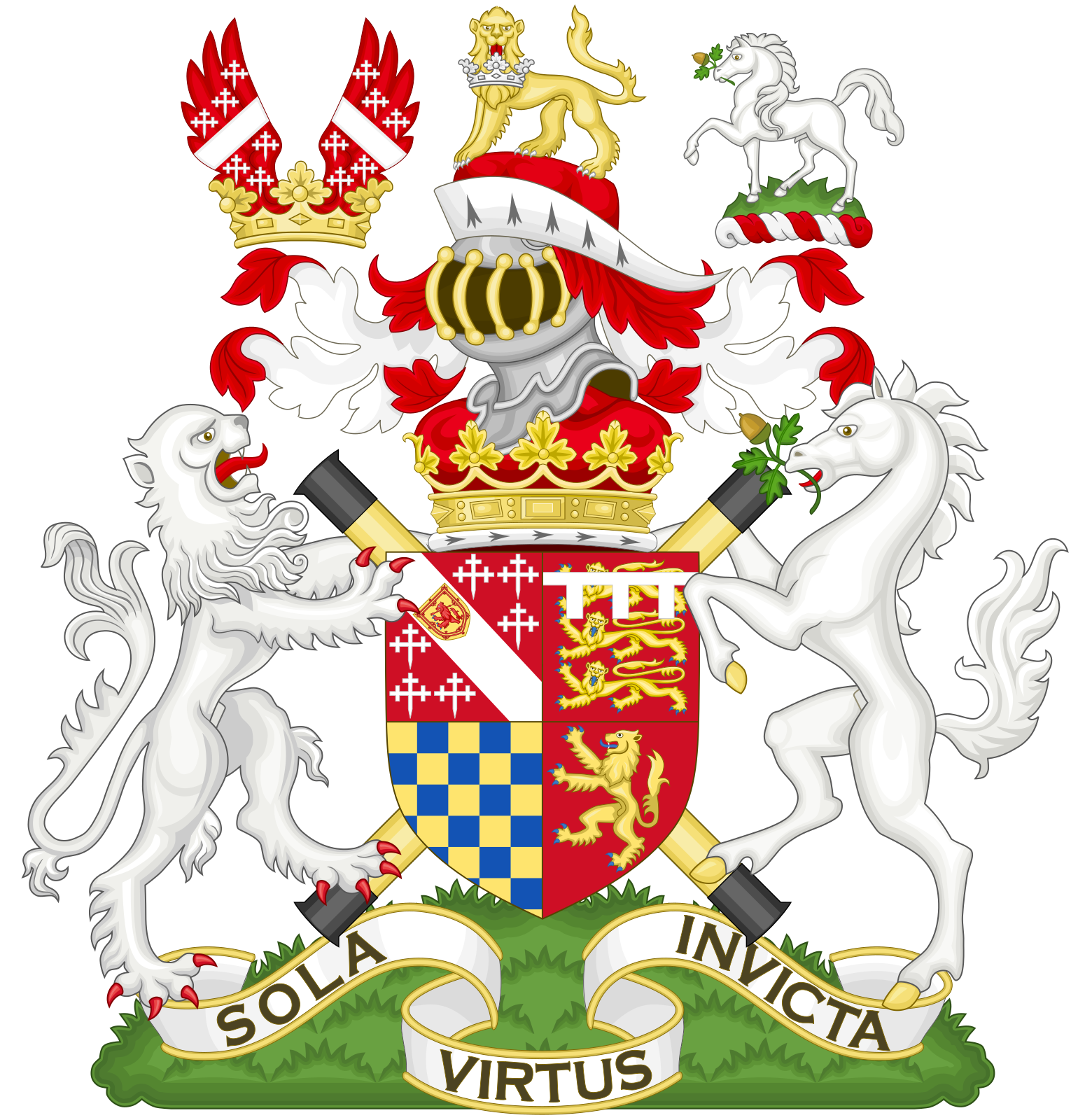
The best known is that of the Earl Marshal, a gold baton tipped in black, the top bearing the Royal arms, the base those of the Marshal. This is prescribed by King Richard II in his grant in 1397 of the office, and a fee of £20 per annum to the first Duke of Norfolk. The current baton can be seen at Arundel Castle.

The Earl Marshal is entitled to bear a representation of two such batons crossed behind his arms, and a Deputy a single baton behind his arms as a bend; this was the custom in the period before 1829 when the Catholic Duke had to appoint an Anglican relative to deputise for him, and also in more recent years when a member of the Howard family has served in the capacity of a Deputy.

File:Coat of Arms of the Duke of Norfolk, the Earl Marshal.svg

The arms of the Duke of Norfolk
The Earl Marshal's baton can be seen behind the shield.

Image:Wikipedia


In addition to the baton as prescribed in the 1397 grant are more elaborate examples such as this:

Earl Marshal's baton presented to the Fifteenth Duke of Norfolk on his first marriage by the College of Arms, 1877 (gold) (see also 279117) (detail)

Gold Earl Marshal's baton presented to the Fifteenth Duke of Norfolk on his first marriage by the College of Arms in 1877 and made by Robert Garrard II (1793-1881)

Image :
His Grace The Duke of Norfolk, Arundel Castle / The Bridgeman Art Library

Also entitled to a ceremonial baton is the Lord High Constable of England, the seventh of the Great Officers of State, ranking beneath the Lord Great Chamberlain and above the Earl Marshal. Since 1521 this office is only appointed for the Coronation and retained by the grantee until their death. The baton carried by Viscount Alanbrooke in 1953 can be seen with his other honours at the Royal Artillery museum in Woolwich. It was clearly modelled on that borne by the Duke of Wellington at the Coronations in 1812,1831 and 1838.

In Scotland the Earl Marischal's title was forfeit through adhesion to the Jacobite cause, but there is still the Lord High Constable of Scotland, an Officership of State hereditary in the family of the Earl of Erroll. The baton is silver, tipped in gold, and is borne behind the shield of arms in saltire two Batons Argent tipped Or


http://www.clanhay.org/wp-content/uploads/James-Hay-15th-Earl-of-Erroll.jpg

The 15th Earl of Erroll (d.1778) holding his baton as Lord High Constable of Scotland

Image:clanhay.org


Another part of the achievement of the Earls of Erroll, and flanking the shield, are a pair of armoured arms protruding from a cloud and brandishing a sword. This is shown in some representations and was used as a badge by the late Countess of Erroll. In Spain the same feature appears on the achievement of the Dukes of Alba as Constables of Navarre.

From 1801 the Lord High Constable of Ireland, had a place at the Coronations until 1911 but the office was abolished (or perhaps not filled again) after the creation of the Irish Free State in 1922.

As with the English post its potential as a centre for armed resistance to a centralising monarchy led to its disappearance or neutralisation in other European kingdoms, as in sixteenth century Spain or in Sweden where the riksmarsk, commonly rendered as Lord High Constable of Sweden in English goes into desuetude in seventeenth century

Alongside these batons are the White wands of the Lord Great Steward and Lord Great Chamberlain, the Lord Steward and the Lord Chamberlain and their deputies. That of the Lord Great Chamberlain can be seen at the State Opening of Parliament, and those of the Lord Steward and the Lord Chamberlain and their deputies are carried on Court occasions.
Today they are made of holly wood - it does not warp unlike ivory which was once used - are are made with a silver screw attachment so that they can be symbolically broken at the end of a term of office and the pieces given to the outgoing office-holder. Ceremonially they are broken at the funeral on the Monarch in this way.

The white wand of the Lord High Steward of Ireland, an office hereditary in the family of the Earl of Shrewsbury and Waterford is discussed in this article. The office of Lord High Steward of England merged with the Crown in 1399 with the accession of King Henry IV, and since then the office was only appointed for a Coronation and for the Trial of a Peer - in that case it was always in recent centuries the Lord Chancellor who received the Lord High Steward's white wand of office.


The Lord Great Chamberlain and the Lord Chamberlain also have as insignia a symbolic gold key, worn on their hip on a Garter blue bow. This is documented in 1808 as established practice, and can be seen on earlier portraits. Mr Slater showed one of Sarah Duchess of Marlborough wearing such insignia as Mistress of the Robes. When she, together with her husband was dismissed in 1710, it was with trepidation that the Duke approached his formidable wife to retrieve the key, bargaining with Queen Anne for more time to persuade his wife. The Queen was unrelenting, reduced the time limit and in the end the Duchess hurled the key across the room and her husband, who pulling it out of the panelling where it had lodged, fled back to return it to the Sovereign.

In Scotland the Hereditary Master of the Household is the Duke of Argyll, whose baton of office, topped with the lion sejant Royal crest is a very handsome replacement of the precious one, lost in a fire at Inverary Castle.

Amongst the other insignia in his slide presentation was the Gold Stick of the officer of that name, a post created by King Charles II in 1678 for an immediate attendent officer of his Life Guards. Amongst the badges was that of the Marshal of the Diplomatic Corps, which was an elegant crowned oval, which swivels, one side showing an arm bearing an olive branch, and on the other ana rm brandishing a sword. There is a theory that this side was displayed when the Marshla had teh responsibility of escorting hostile embassie out of the country when war had broken out.

The batons given to Field Marshals and those occasionally awarded, at the Monarch's discretion, to Admirals of the Fleet derive from those of the French Naoloeonic armies. Following the Battle of Vittoria in 1813 the Prince Regent decided to award them to Field Marshals, and the senior service put in a claim. So in 1821 two naval batons were made for Earl St Vincent and the Duke of Clarence (later Lord High Admiral and eventually King William IV). This latter survives and was shown in a photograph, covered in blue rather than the red cloth used for Field Marshals. As Lord High Admiral the Duke, like Prince Philip today, would be entitled to be accompanied by the Lord High Admiral's Verge, which is kept at Portsmouth, and is a tall silver ornamented stave of office.

Stevel Slater paid tribute to the co-operation he had received from members of the Royal Household in building up his collection of photographs and his research into this aspect of our ceremonial heritage, and his lecture was a very suitable topic in this Jubilee Year.

Thursday, 9 June 2011

Unicorn seen and heard in Oxford


On Tuesday evening I had the interesting expereince of seeing and hearing a Unicorn in Oxford - that is to say I went to hear the Hon. Adam Bruce, Unicorn Pursuivant, address the Oxford University Heraldry Society.

{{{alt text}}}

The heraldic badge of Unicorn Pursuivant of Arms in Ordinary

As a Pursuivant he is a member of the Court of the Lord Lyon, whose official website is here, and there is an article with details of the members and their badges here.

His talk, entitled "The Lyon Rampant: Scottish State Ceremonial in the 21st century" was in part built around the illustrations for a book he is writing with other members of the Lyon Court about its responsibility for state ceremonial in Scotland which will be published next year to mark the Queen's Diamond Jubilee.

The ancient powers of the Lord Lyon are defined by an act of 1672, and the structiure of the court reorganised by another act of 1867.

With ceremonies associated with the Lord High Commissio0ner's residence at Holyrood the annual St Andrew's day service of the Order of the Thistle, the biennial Thistle service with the Sovereign, the triennial admission of a new governor of Edinburgh castle and the formal reading of the notification of the dissolution of the Westminster parliament (only reduced to one day afterwards from the historic three days interval by the Major government) the Scottish heralds are more likely to be seen in their tabards than their English equivalents. The tabards themselves - velvet for the Lord Lyon, silk for the heralds and damask ( but satin in practice) for the pursuivants - date from the coronation of King Edward VII in 1902 and are due for replacement to mark the Jubilee.

He demonstrated how the public actions of members of the Lyon court can be seen as in adirest line from those of their predecessors in the fifteenth century in the reign of King James III (1460-88). I would be inclined to agree with Unicorn's comment that the King is one whose contribution is misunderstood. In 1475 the tyhen Unicorn pursuivant wass ent to summon John Earl of Ross and Lord of the Isles to answer charges of treason laid in the Edinburgh parliament by the King, and his notarised record shows him very publically performing, and being seen to perform the task of the King's messenger.


http://www.englishmonarchs.co.uk/images/stewart/james_iii_james_iv.jpg


I would also agree with Unicorn in looking to the reign of King James for the origins of the Order of the Thistle. He spoke about the recent cleaning of the Thistle Chapel in St Giles Cathedral, and had the entertaining story of how in 1911 at its opening two of the Knights of the Thistle who prersented themselves were unknown to the then Lord Lyon.
With the creation in 1999 of the new Scottish Parliament there was discussion as to how it should be fornmally opened, and precedents were found in part in the Riding to Parliament and "down-sitting"of the ancient Parliament. The opening of the new ly elected one will be included in his book. At this ceremony the Crown of Scotland is carried immediately before the Queen by the Duke of Hamilton, as descendent of the ancient Earls of Fife. This was a further example of the way in which Scottish State ceremonial has developed by building on historic precedents.

http://www.rampantscotland.com/honours471a.jpg

The Honours of Scotland

In the questions afterwards some of us asked his views on the possibilities of reviving the Scottish Coronation. the last Scottish monarch to be crowned as such was King Charles II in 1651 at Scone. Our speaker talked in terms of how the Queen had initiated what became the June 24 1953 National Thanksgiving Serrvice on June 24 1953 in St Giles when the Honours of Scotland were ceremonially presented to her. This had not been without concerns from the Home Office,and the thought that the Minister of St Giles, a keen Scottish Nationalist, might take it upon himself to crown the Queen there and then. Today there is the problem that the sceptre and sword are deemed too fragile to be carried, and that on a future occasion the sword would have to be carried on a tray.


The Coronation of King Alexander III in 1249 on Moot Hill, Scone. He was eight years old at the time. He is being greeted by the ollamh rígh, the royal poet, who is addressing him with the proclamation "Benach De Re Albanne" (= Beannachd Dé Rígh Alban, "God Bless the King of Scotland"); the poet goes on to recite Alexander's genealogy. The successor to the poet is today the Lord Lyon. By King Alexander's side is Maol Choluim II, Earl of Fife holding the sword.
From a fifteenth century MS of the Scotichronicon

Historically one of the problems for the Scottish coronation was that most monarchs succeeded as children, even babies, and the last two such had rites amended by Laudian ideas at Holyrood in 1633 or much reduced by stern presbytrianism in 1651 - although on that occasion, as our speaker told us, it took the Lord Lyon an hour and a half to recite King Charles II's descent from King Fergus.
I have no Scottish ancestry so far as I am aware, but I would, readers will not be surpised to learn, be very keen on seeing a revival of the ancient ceremonial for a Scottish Coronation.


Tuesday, 31 May 2011

Norbury church - heraldry and history


The lecture at last Tuesday evening's meeting of the Oxford University Heraldry Society was given by John Titterton FSA and was about the heraldic glass and the building of the chancel at Norbury church in south west Derbyshire. In recent years the glass has been cleaned and conserved at a cost of £250,000.

St Mary and St Barlok Norbury is one of those medieval churches I have long wanted to visit but not manages to do so far. There are online articles about the church here and here, and two more about St Barlok's cross, an Anglo-Saxon piece preserved in the church and the relatively little known saint himself here and here.

As it stands today the church has an early decorated chancel and a perpendicualr nave with its distinctive tower porch, and adjacent to it the medieval manor house of the Fitzherbert family. The two stand . along with the jacobean manor house, by themselves at the centre of a dispersed settlement.

St. Mary and St. Barlok church, Norbury, Norbury and Roston


Parts of the church and the medieval Hall, Norbury, Roston and Norbury

Photos: Copyright Alan Walker


photo

The chancel of St Mary & St Barlok at Norbury, Derbyshire.

Photo: Aidan Macrae Thompson

Basing his explanation not only on the glass but also the architectural evidence and record evidence he attributed the construction of the chancel to Sir Henry Fitzherbert, who died c. 1315, and to whom one of the tombs in the church is ascribed.

The 'box-like' structure and design of the chancel bears striking resemblances to those of Chartham church in Kent, Checkley church in Staffordshire and to the choir of Merton College Chapel in Oxford, all of which are attributed to the 1290s, as well as the episcopal chapels of St Etheldreda in Holborn (1290) and that at Wells (1292). The presence of ogee arches in the tracery would seem to place it after they frst appear in England on the Queen Eleanor crosses of c.1295.

The design of the window tracery bears strong resemblences in its use of a boss within the tracery to the windows at Chartham, Checkley and Merton.

The original scheme of glazing survives in the north and south set of windows, although the tracery lights have lost their original glass. The east window contains later glass of about a century later. Each light of the windows has grisaille glass according to four different patterns, with an heraldic shield at the top. Some of the lights appear to have been transposed over the centuries, but the scheme is essentially complete. Details of the glass are virtually indistinguishable from other work at Chartham and Merton, both in the grisaille leaf patterns and inserted coloured motifs and in the heraldry, especially the arms of the Clare family.

The arms would suggest a date between 1298-9 (the betrothal and marriage of King Edward I to Margaret of France) and 1305-6 (the arms of Robert the Bruce are included - unlikely to have been done after he had himself crowned as King of Scots in the latter year).

Surviving records refer to building work at Sir Henry's "court" and plans to divert the road from outside it in 1292, 1300 and 1304, which also suggests a majorprogramme of building.

Sir Henry was not an especially prominent man - not in royal service, or important in county matters, yet was employing a team who worked for episcopal or corporate patrons (the Bishops of Ely and Wells, Canterbury cathedral priory, Merton college) and had commissioned a piece of high quality and in the latest style. The glass records contacts with the great and the good of the era, and the suggestion was made that he was remembering comrades in arms and administration from military campaigns.

John Titterton has produced a handsome booklet on the windows in aid of the continuing restoration of the fabric.

This was a remarkable insight into the world of artistic patronage and social networks at the turn of the thirteenth and fourteenth centuries, and I am all the more keen to go and see Norbury church for myself.


Saturday, 19 February 2011

Heraldry for Bastards


The most recent meeting of the Oxford University Heraldry Society was addressed by Steve Slater from Wiltshire on the subject of the heraldry associated with bastards.

The bastard is a filius nullius, a man with no rights to his father's property, including his arms.

Althogh the bend sinister is the classic symbol of bastardy in heraldry there are really no fixed conventions about the matter, which for some might be sensitive, but the higher up the social scale the more people were prepared to flaunt heraldically their parentage - to be bastard may be awkward, but being aroyal bastard has a cachet all its own - and medieval kings often found their illegitimate offspring more relaible than their legitimate ones

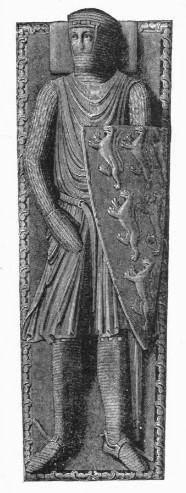
The earliest example of a bastard's use of heraldry is the effigy of William Longespee, Earl of Salisbury (d.1226) in Salisbury cathedral. He was the illegitimate son of King Henry II, and bore the arms of the king's father Geoffrey Count of Anjou recorded when he married the Empress Matilda in 1128 Azure, six lions rampant or, 3,2 and 1 and shown on his famous enamelled tomb cover from Le Mans:


Geoffrey Count of Anjou

Image: Wikipedia

Earl William's effigy still has traces of colour to indicate that the arms were of the same tincture. This is an early instance of the heritability of arms, even if it bypasses a generation.


Effigy of William Longespee, Earl of Salisbury

Image: Wikipedia

Royal bastards offer some of the best examples. Sir Roger de Clarendon, illegitimate son of Edward Prince of Wales, derived his arms from the arms of peace borne by his father, and bore Or, a bend noir with three ostrich plumes.

Richard Plantagenet, one of the two illegitimate sons of King Richard III, and who lives at Eastwell in Kent until c.1540 is credited with the arms Per pale argent and azure, on a bend sable sanglier blanc [White Boar] His father's livery colours formed the field, and the charge on the bend was his father's badge.

The Beauforts, the familiy of Duke John of Lancaster and his mistress Katherine Swynford, bore a coat based on their father's livery colours of blue and white, with the arms of the Duchy on a bend:


Following their partents marriage in 1396 they were legitimised by both the Pope and the King, and used a coat of arms of France modern and England quarterly ( the Royal arms as used by their half brother King Henry IV) with a bordure company argent and azure:


Following the marriage of Joan Beaufort to King James I of Scots in 1425 the bordure company became, somewhat ironically given that for the Beauforts it was a sign of legitimacy, the norm in Scotland for denoting bastardy.

A manuscript of a herald of the Duke of Burgundy in the fifteenth century shows a bend sinister as the indicator of illegitimacy. The classic sign of bastardy was already established. It can be seen in the arms on the Garter Roll of Arthur Plantagenet, Viscount Lisle K.G.(d.1542), the son of King Edward IV - 1 France and England quarterly, 2 and 3 de Burgh, 4 Mortimer, and over all a bend sinister.

These early examples tend to show a very narrow bend sinister, minimising its visual effect, and there appears to have been a practice whereby after three generations the bend sinister was discarded. Although not part of official heraldic practice this appears to have been tacitly accepted. Similarly Charles Somerset, first Earl of Worcester, bastard son of Henry Beaufort Duke of Somerset, originally bore his father's arms with a bend sinister, or, on a gold ground the Beaufort arms on a fess, but subsequently he, and certainly his descendants, the Marquesses of Worcester and Dukes of Beaufort, have borne the undifferenced arms of the medieval Beauforts.

The bend sinister came to be shortened to be a baton in the centre of the shield.

The eldest of King Charles II's illegitimate sons, the Duke of Monmouth bore two successive coats of arms, both of which were differenced by a baton sinister. In his case it was plain white, comparable to the label of a legitimate eldest son.


The second coat of arms of the Duke of Monmouth and Buccleuch
The Royal arms differenced with the baton sinister and the inescutcheon of Buccleuch

This quartering is still borne as part of the achievement of his descendents the Dukes of Buccleuch and Queensbury. Of the other ducal descendants of King Charles II, Grafton and St Albans bear his Royal arms with an appropriate baton, now quartered with those of the de Vere Earls of Oxford in the case of the Dukes of St Albans. The Duke of Richmond bears the Royal arms with a bordure company and an inescutcheon, quartered with other arms:

Duke of richmond.svg


The heraldic blazon is: Quarterly: 1st and 4th grand quarters, the Royal Arms of King Charles II (viz. quarterly: 1st and 4th, France and England quarterly; 2nd, Scotland; 3rd, Ireland); the whole within a bordure company argent charged with roses gules barbed and seeded proper and the last; overall an escutcheon gules charged with three buckles or (the Dukedom of Aubigny); 2nd grand quarter, argent a saltire engrailed gules between four roses of the second barbed and seeded proper (Lennox); 3rd grand quarter, quarterly, 1st, azure three boars' heads couped or (Gordon); 2nd, or three lions' heads erased gules (Badenoch); 3rd, or three crescents within a double tressure flory counter-flory gules (Seton); 4th, azure three cinquefoils argent (Fraser).

The Earls of Munster (title created 1831 and extinct in 2000), descended from King William IV and Mrs Jordan, bore the King's arms, with the inescutcheon of Hanover, differenced with a baton azure, charges with three anchors or.

For those of less exalted parentage the addition of a bordure wavy has become the modern sign of illegitimate descent.

English arms difference the supporters and the crest was well as the arms, but this is not the practice in Scotland.

Today the trend is to design a new coat for those of illegitimate stock using charges from the father's arms rather than to petition the Sovereign to assume the paternal arms. In 1717 the College of Arms held that bastards could can inherit paternal arms arms, but the Garter King of Arms from 1754-73 held that they had no right to their father's quarterings.