Once I was a clever boy learning the arts of Oxford... is a quotation from the verses written by Bishop Richard Fleming (c.1385-1431) for his tomb in Lincoln Cathedral. Fleming, the founder of Lincoln College in Oxford, is the subject of my research for a D. Phil., and, like me, a son of the West Riding. I have remarked in the past that I have a deeply meaningful on-going relationship with a dead fifteenth century bishop... it was Fleming who, in effect, enabled me to come to Oxford and to learn its arts, and for that I am immensely grateful.


Showing posts with label Merton chapel. Show all posts

Wednesday, 25 March 2015

The Annunciation in medieval stained glass


To mark the Feast Annunciation Gordon Plumb posted on the Medieval Religion discussion group a selection of the many images he has of images of the Annunciation in medieval stained glass:


Ashbourne, St Oswald, Derbyshire, nXVII, 1a mid 13thC.

Shelton, St Mary, Norfolk, nII, A3-A4:

Bourges Cathedral, Bay 25, Annunciation window in Jacques Coeur chapel:
and detail:

Cologne Cathedral, St Stephen's Chapel, sX, 1b, formerly in Cologne Dominican Church:

Attleborough, Assumption of the BVM, Norfolk, wI, G1, Mary from Annunciation:

Leicester, Jewry Wall Museum, Roundel, late 15thC.:

Dorchester, Abbey church of St Peter & St Paul, Oxfordshire:

Oxford, Merton College Chapel, west window:

York, St Michael-le-Belfrey, I, 2b:

Newark, St Mary Magdalene, Nottinghamshire, sII, 2b:

Winchester College Chapel, Thurburn's Chantry, south window, D1-D2:

East Harling, St Peter & St Paul, Norfolk, I, 4a:

Stamford, St Martin, Lincolnshire, I, tracery:

Wrangle, St Mary & St Nicholas, nV, 2b-2c, lower parts of Mary and Gabriel from Annunciation:

Clavering, St Mary & St Clement, nIII, A4-A5, fragmentary Annunciation:

Ely, Stained Glass Museum, Annunciation from St John the Baptist, Hadzor, Worcestershire - figure of Gabriel by John Hardman & Co, who also restored the glass:

Bourges Cathedral, Bay 230:

Saint-Nicolas-de-Port, Lorraine, Bay 100, 1-5a, 1-5b:

Chartres, Cathédrale Notre Dame: Bay 150:

Lichfield Cathedral, nII, 1, Herkenrode glass showing Annunciation with Visitation in centre background:

Metz, Cathédrale St Étienne, Bay 19,1240's

Rivenhall, St Mary & All Saints, Essex, I, 1b:, glass originally from St Martin, Chenu, Sarthe:

Cambridge, King's College Chapel, Chapel J, window 37, The Unicorn Hunt, an allegorical form of the Annunciation:


Professor Madeleine Gray added  what she describes as the stunning east window at Gresford - lots of Victorian reconstruction but at its heart a late medieval meditation on Mary's relationship with the three persons of the Trinity (including a depiction of her as her son's daughter).
It is on the Stained Glass of Wales site - http://stainedglass.llgc.org.uk/object/984 - scroll down for the detailed photos.


Wednesday, 15 October 2014

750th Anniversary Mass at Merton


Yesterday evening I attended a Solemn Mass celebrated by the
Archbishop of Birmingham, The Most Rev. Bernard Longley, in 
the chapel of Merton College to mark the 750th anniversary of 
the foundation in 1264 of the College - more properly termed 
The House or College of Scholars of Merton in the University 
of Oxford.

http://www.coolplaces.co.uk/system/images/2167/oxford-see-do-oxford-merton-college-monuments-2167-large.jpg

                         King Edward I and Bishop Merton
                    Fifteenth century statues from the gatehouse of Merton
                 built by Warden Thomas Rudbourne circa 1417
               Image:coolplaces.co.uk

Merton College

Merton Chapel

Image: tripadvisor.co.uk


The Chapel, the choir of which was completed by 1294, is one of 
greatest buildings in Oxford - and arguably the greatest. I cannot 
exactly say why, but it just is. It retains much of its original late
thirteenth or early fourteenth century glazing, and the open space
necessary for the proper celebration of the Sarum liturgy and offices.

Merton College Chapel, Oxford


Wide-angle view of the chapel

Image; Theo Jacobs on photo.net  

The Mass was concelebrated at aforward altar, which I regret
given the very fine high altar the chapel possesses. In his sermon
the  rchbishop made reference to the first Mass celebratedin the 
Chapel since the Reformation, which was in 1967, and to the
continuous tradition of reciting the psalter in the chapel since 
the foundation of the college.


Thursday, 27 February 2014

Mass at Merton with the Order of Malta


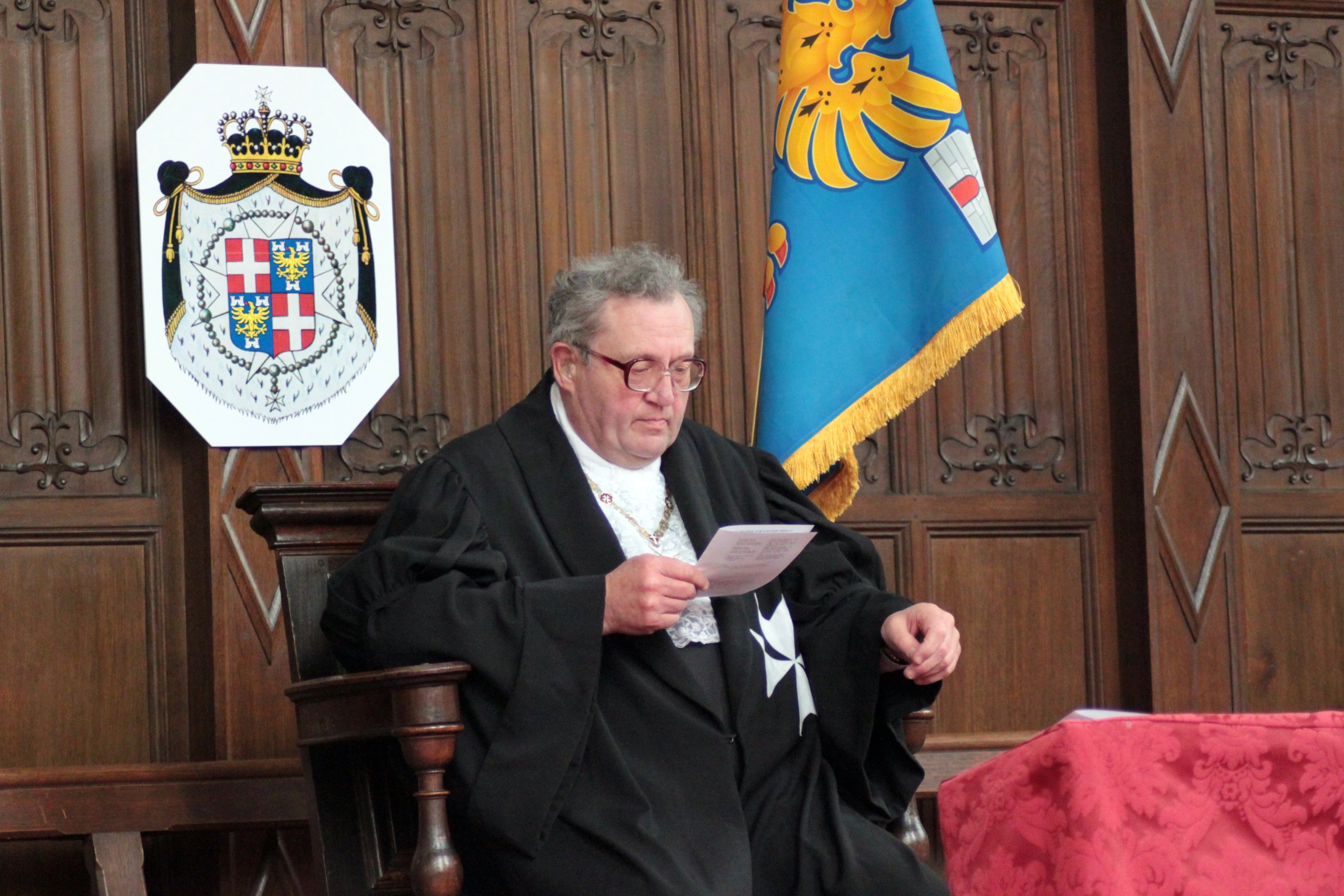
Earlier this afternoon I attended a celebration of Mass in the Extraordinary Form in the glorious setting of the chapel of Merton College. The Mass was attended by HMEH the Prince and Grand Master of the Sovereign Military Hospitaller Order of St John of Jerusalem, of Rhodes and of Malta, Fra' Matthew Festing. The Grand Master is visiting Oxford for a couple of days and is due to address the University Catholic group the Newman Society this evening about the function of the Order in the presert day under the title of Charity in the 21st Century. There is a biography of the Grand Master here.

The Mass was a Missa cantata for the feast of the Passionist St Gabriel of the Sorrows of Maryand was celebrated by Fr John Osman from Dorchester, a chaplain of the Order. This was a rather low-key affair - Fra' Matthew and the other Knights present were in ordinary day dress rather than their habits. Given that it was mid-afternoon on a weekday there was a good congregation - many of them young men who have become Companions of the Order and assist in its extensive care work.

When we arrived we were given prayer cards for the cause of the late Grand Master Fra' Andrew Bertie, of whom there is a biography here.

File:Grand Master Matthew Festing 20100409.jpg

The Grand Master on  previous visit to Merton in 2010

Image;Wikimedia

Thinking about the Sovereign Order it occurred to me that given the variety of options raised in the 1950s and early 60s as to the future of the island of Malta in terms of independence or integration into the UK befoe it became an independent Commonwealth nation in 1965 it might not have been such bad idea to have retuned tit to the Knights. They form a sovereign body - complete with an airforce at one point - , they had ruled the island from the time of the Emperor Charles V and Malta is a notably Catholic place. A missed opportunity?

Thursday, 20 February 2014

Walking round Wyclif's Oxford


This morning I gave a guided tour to some visitors on the Oxford of Wyclif and of the Reformers.

The Oxford DNB has an excellent and extensive biography of John Wyclif by Anne Hudson and Antony Kenny, which must be the best short account available, and one that combines scholarship of a high degree with lucidity and balance. It can be accessed here.

We began in the High Street with St Mary's Church. The thirteenth century tower and early fourteenth century spire are one of the relatively few surviving buildings from Wyclif's time. Along with the adjacent Old Convocation House of 1320, from which the University governed itself, they are buildings Wyclif would have known throughout his time in Oxford. In his time the church was used for meetings of the Masters of the University and for degree ceremonies; in the mid-sixteenth century it was used for the trials of Latimer, Ridley and Cranmer and for the procedural ceremonies before their executions in Broad Street.


The tower and spire of St Mary's Church

Image:gonomad.com 


The Old Convocation House 

Image:university-church.ox.ac.uk

Along the High Street to the east is The Queen's College which was a college for 'Northeners', of which Wyclif was of course, one. He lived in the college in the early 1370s and paid  rent for a room there in 1380. This was one of the leading colleges in the University in these years.  The buildings he knew have all been demolished to be replaced by the present fine example of English Baroque. Fortunately we do possess David Loggan's birds-eye view of the college buildings drawn beforehand,and which show some features which Wyclif would have known.


The Queen's College as it appeared in 1675
The High Street is to the left, and the road in front is Queen's Lane

Image:heatons-of-tisbury.co.uk

On the opposite side of Queen's Lane is the medieval church of St Peter in the East. It now serves as the library of the adjacent St Edmund Hall, but the building must be substantially as it was in Wyclif's time.

St Peter-in-the-East from Queen's Lane

St Peter in the East

Image:oxfordhistory.org.uk

St Edmund Hall became a notable centre for Wycliffite or Lollard academics in the early fifteenth century. Notable amongst these was Peter Payne, master of the adjacent White Hall before becoming Principal of St Edmund Hall and then fleeing to join the Hussites in Bohemia. His remarkable career can be read in the Oxford DNB life of him here

South of the High is Merton. which in the early fourteenth century had been the leading college in the time of the 'Merton calculators'. Wyclif was a Fellow of Merton in 1356, and the chapel he would have worshipped in still survives, with addition of the tower of 1450 and the completion of the transepts. Much of the glazing is glass which would have been there in the 1350s.


5945332-lg

Merton College Chapel

Image:thewayofbeauty.org 

Immediately to the south of the chapel is Mob Quad, the oldest quadrangle in either Oxford or Cambridge; there is an account of it here. The entrance and muniment room is referred to in the college accounts for  1288 -91. The north and east ranges date from 1310-20, whilst the south and west sides were built after Wyclif had left the college, but whilst he was still in Oxford, in 1373-8.


 The north and east sides of Mob Quad, with the chapel behind

Image: Wikipedia

To the west, in Oriel Square, is Canterbury Gate of Christ Church. This and the quadrangle it leads to occupy the site of Canterbury College - a college initially founded by Archbishop Islip to accommodate both secular and monastic clergy and of which Wyclif was a member in the later 1360s. This was until he and the other seculars were removed by the Benedictine monk- Arcbishop Langham in 1370; this was seen by K.B. Macfarlane as part of the origin of Wyclif's hostility to the possessioner monastic orders.
CANTERBURY GATE, CHRISTCHURCH COLLEGE,OXFORD UNIVERSITY antique print 1820
The old gate of Canterbury College before it was taken down in 1775, and the new gate of 1778
A print published by Joseph Skelton in 1820

Image:lindisfarneprints.com

Behind the site of Canterbury College is the cathedral. In Wyclif's time this was the church of the Augustinian priory of St Frideswide, housing the shrine of the patroness of both the town and university. Much of the building as it was in the mid- to later fourteenth century survives despite numerous alterations and adaptations of the church to meet different liturgical fashions and requirements.


The early thirteenth century tower and spire of St Frideswide's Priory from the south-east

Image:chch.ox.ac.uk

In 1382 the Augustinian Canon Philip Repyngdon, then an enthusiastic supporter of Wyclif's ideas, preached a sermon in the priory churchyard at Corpus Christi, June 5th, endorsing Wyclif's ideas. This site is now probablty represented by the Canons' Garden to the north of the cathedral or may lie under part of Tom Quad.  Summoned before the authorities over a series of sermons and disputation speeches  he formally recanted his errors in St Frideswide's on November 18th that same year. Subsequently Canon Repyngdon returned to his home at Leicester abbey, where he may have previously introduced Wycliffite ideas to the town, but now retuned to orthodox belief, went on to became Abbot, confessor to King Henry IV, and was Bishop of Lincoln from 1405-19, and offered a Cardinal's hat by Pope Gregory XII. The Oxford DNB life of him can be read here.

We then walked up Oriel Street - one which Wyclif must have used to cross the High and into Radcliffe Square. In 1378 he was temporarily under house-arrest on the order of the Chancellor in Black Hall which stood on what is now the Square to the north of St Mary's.

The Osney Schools where he would have attended and given lectures were rebuilt after his time and then demolished to make way for Sir Thomas Bodley's extensions to the Divinity School and Duke Humphrey's Library (1420s-1480s), and their site lies just in front of the Proscholium of the Bodleian, which occupies what had been the continuation of School's Lane.

The Austin Friary, where Wyclif was detained in 1378, stood on the site of Wadham College and the King's Arms - a friend of mine used to describe this as wyclif being arrested in the pub.

Along Broad Street lies Balliol, another 'Northern College',where Wyclif was Master in 1361, and where he may have been before his sojourn at Merton. In recent year the college under the Mastership of Sir Antony Kenny has helped advance Wyclif studies, although today nothing remains of the buildings he would have seen - the oldest parts are early fifteenth century, and most of it a handsome Victorian rebuilding of 1863.

Balliol College, University of Oxford

The front of Balliol as rebuilt in 1863

Image:bbc.co.uk 

The executions of 1555 and 1556 took place outside Balliol in what was then the city ditch - Oxford then was still an obviously walled city as it had been in Wyclif's time

File:Ralph Agas map of Oxford 1578.gif

Oxford in 1578
The middle part of Ralph Agas' map shows the city more as Wyclif and the Protestant Reformers would have known it. The map has the south at the top.
St Mary's is centre left, Merton top left, Canterbury College was just above Peckwater Inn, the Schools are just to the left of the lower centre, and Balliol at the lower right. The Queen's College is just off the view to the centre left. The city walls, still unencumbered by housing, can be seen towards the bottom of the view. The Northgate, where the Protestant bishops were imprisoned adjoins St Michael's church (lower right handside)
In Wyclif's time New College was just beginning in 1379 (bottom left), and Lincoln (1427) All Soulds (1438) and Brasenose (1509) in the centre had still to be founded.

Image:Wikipedia


All in all, after more than six centuries there are a surprising number of buildings still surviving and in use in Oxford which Wyclif would have known.


Tuesday, 31 May 2011

Norbury church - heraldry and history


The lecture at last Tuesday evening's meeting of the Oxford University Heraldry Society was given by John Titterton FSA and was about the heraldic glass and the building of the chancel at Norbury church in south west Derbyshire. In recent years the glass has been cleaned and conserved at a cost of £250,000.

St Mary and St Barlok Norbury is one of those medieval churches I have long wanted to visit but not manages to do so far. There are online articles about the church here and here, and two more about St Barlok's cross, an Anglo-Saxon piece preserved in the church and the relatively little known saint himself here and here.

As it stands today the church has an early decorated chancel and a perpendicualr nave with its distinctive tower porch, and adjacent to it the medieval manor house of the Fitzherbert family. The two stand . along with the jacobean manor house, by themselves at the centre of a dispersed settlement.

St. Mary and St. Barlok church, Norbury, Norbury and Roston


Parts of the church and the medieval Hall, Norbury, Roston and Norbury

Photos: Copyright Alan Walker


photo

The chancel of St Mary & St Barlok at Norbury, Derbyshire.

Photo: Aidan Macrae Thompson

Basing his explanation not only on the glass but also the architectural evidence and record evidence he attributed the construction of the chancel to Sir Henry Fitzherbert, who died c. 1315, and to whom one of the tombs in the church is ascribed.

The 'box-like' structure and design of the chancel bears striking resemblances to those of Chartham church in Kent, Checkley church in Staffordshire and to the choir of Merton College Chapel in Oxford, all of which are attributed to the 1290s, as well as the episcopal chapels of St Etheldreda in Holborn (1290) and that at Wells (1292). The presence of ogee arches in the tracery would seem to place it after they frst appear in England on the Queen Eleanor crosses of c.1295.

The design of the window tracery bears strong resemblences in its use of a boss within the tracery to the windows at Chartham, Checkley and Merton.

The original scheme of glazing survives in the north and south set of windows, although the tracery lights have lost their original glass. The east window contains later glass of about a century later. Each light of the windows has grisaille glass according to four different patterns, with an heraldic shield at the top. Some of the lights appear to have been transposed over the centuries, but the scheme is essentially complete. Details of the glass are virtually indistinguishable from other work at Chartham and Merton, both in the grisaille leaf patterns and inserted coloured motifs and in the heraldry, especially the arms of the Clare family.

The arms would suggest a date between 1298-9 (the betrothal and marriage of King Edward I to Margaret of France) and 1305-6 (the arms of Robert the Bruce are included - unlikely to have been done after he had himself crowned as King of Scots in the latter year).

Surviving records refer to building work at Sir Henry's "court" and plans to divert the road from outside it in 1292, 1300 and 1304, which also suggests a majorprogramme of building.

Sir Henry was not an especially prominent man - not in royal service, or important in county matters, yet was employing a team who worked for episcopal or corporate patrons (the Bishops of Ely and Wells, Canterbury cathedral priory, Merton college) and had commissioned a piece of high quality and in the latest style. The glass records contacts with the great and the good of the era, and the suggestion was made that he was remembering comrades in arms and administration from military campaigns.

John Titterton has produced a handsome booklet on the windows in aid of the continuing restoration of the fabric.

This was a remarkable insight into the world of artistic patronage and social networks at the turn of the thirteenth and fourteenth centuries, and I am all the more keen to go and see Norbury church for myself.