Once I was a clever boy learning the arts of Oxford... is a quotation from the verses written by Bishop Richard Fleming (c.1385-1431) for his tomb in Lincoln Cathedral. Fleming, the founder of Lincoln College in Oxford, is the subject of my research for a D. Phil., and, like me, a son of the West Riding. I have remarked in the past that I have a deeply meaningful on-going relationship with a dead fifteenth century bishop... it was Fleming who, in effect, enabled me to come to Oxford and to learn its arts, and for that I am immensely grateful.


Showing posts with label Annunciation. Show all posts

Monday, 4 April 2016

EF High Mass for the Annunciation at the Oxford Oratory


Earlier this evening I attended the EF High Mass for the transferred Feast of the Annunciation at the Oxford Oratory.

Having a High Mass in the Extraordinary Form of the Roman rite on this feast has become part of the Oxford Oratory's liturgical life in recent years, and was a very well attended celebration. The congregation included what might be termed enthusiasts for the traditional form as well as regular attendees of the 6pm Mass and those who had come because it was amajor feast - not either/or but both-and if you follow my mental shorthand. The argument proffered by the declining number of opponents of the older form that people will not attend it was once again disproved

This was a particularly beautiful celebration with the elegant liturgical choreography performed to a very high standard indeed.

The Annunciation in Early Christian Art


Today being the transferred Feast of the Annunciation itv seema asuitable day upon which to post theis link to a post linked at the beginning of February this year by Kurt Sherry on the
Medieval Religion discussion group. His wife thought the lack of a veil on the figure was curious:
http://www.nytimes.com/2016/01/31/opinion/sunday/is-this-the-oldest-image-of-the-virgin-mary.html


Elisabeta Negrău posted the following comments on the depiction:
This Dura-Europos figure of a not-veiled woman, presumptive BVM, is not singular in Paleochristian art.
Other such images can be seen at:
a) the seemingly contemporary Catacomb of Priscilla, a nursing Virgin Mary: https://dlib.york.ac.uk/yodl/app/image/detail?id=york%3A806466&ref=browse

and b) Santa Maria Maggiore (post 431), the Annunciation: https://www.flickr.com/photos/paullew/10974655144

However, this Dura-Europos image might be the first (presumptive) Annunciation at the Well known [to survive] today.


Wednesday, 25 March 2015

The Annunciation in medieval stained glass


To mark the Feast Annunciation Gordon Plumb posted on the Medieval Religion discussion group a selection of the many images he has of images of the Annunciation in medieval stained glass:


Ashbourne, St Oswald, Derbyshire, nXVII, 1a mid 13thC.

Shelton, St Mary, Norfolk, nII, A3-A4:

Bourges Cathedral, Bay 25, Annunciation window in Jacques Coeur chapel:
and detail:

Cologne Cathedral, St Stephen's Chapel, sX, 1b, formerly in Cologne Dominican Church:

Attleborough, Assumption of the BVM, Norfolk, wI, G1, Mary from Annunciation:

Leicester, Jewry Wall Museum, Roundel, late 15thC.:

Dorchester, Abbey church of St Peter & St Paul, Oxfordshire:

Oxford, Merton College Chapel, west window:

York, St Michael-le-Belfrey, I, 2b:

Newark, St Mary Magdalene, Nottinghamshire, sII, 2b:

Winchester College Chapel, Thurburn's Chantry, south window, D1-D2:

East Harling, St Peter & St Paul, Norfolk, I, 4a:

Stamford, St Martin, Lincolnshire, I, tracery:

Wrangle, St Mary & St Nicholas, nV, 2b-2c, lower parts of Mary and Gabriel from Annunciation:

Clavering, St Mary & St Clement, nIII, A4-A5, fragmentary Annunciation:

Ely, Stained Glass Museum, Annunciation from St John the Baptist, Hadzor, Worcestershire - figure of Gabriel by John Hardman & Co, who also restored the glass:

Bourges Cathedral, Bay 230:

Saint-Nicolas-de-Port, Lorraine, Bay 100, 1-5a, 1-5b:

Chartres, Cathédrale Notre Dame: Bay 150:

Lichfield Cathedral, nII, 1, Herkenrode glass showing Annunciation with Visitation in centre background:

Metz, Cathédrale St Étienne, Bay 19,1240's

Rivenhall, St Mary & All Saints, Essex, I, 1b:, glass originally from St Martin, Chenu, Sarthe:

Cambridge, King's College Chapel, Chapel J, window 37, The Unicorn Hunt, an allegorical form of the Annunciation:


Professor Madeleine Gray added  what she describes as the stunning east window at Gresford - lots of Victorian reconstruction but at its heart a late medieval meditation on Mary's relationship with the three persons of the Trinity (including a depiction of her as her son's daughter).
It is on the Stained Glass of Wales site - http://stainedglass.llgc.org.uk/object/984 - scroll down for the detailed photos.


The Annunciation


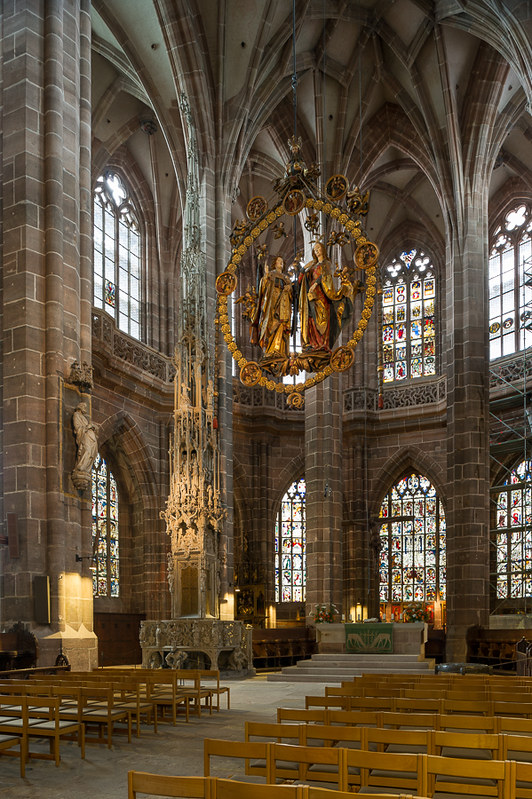
Today is the Feast of the Annunciation, and an appropriate opportunity to post a picture of this famous and lovely sculpture from the church of St. Lorenz in Nuremberg.


The Annunciation

Image:tourismus.nuernberg.de/© Thomas Bachmann


This delightful group of of limewood sculptures celebrating the Annunciation was made by the by the Bavarian artist Veit Stoss in 1518 and is supended above the choir. The history of the work , including  both its symbolism and its survival can be read at the illustrated online article Angelic Salutation (Stoss)


photo

The Choir of St Lorenz

Image; Xavier de Jauréguiberry on Flickr

Wednesday, 26 March 2014

Usus Antiquior Mass for the Annunciation at the Oxford Oratory


Yesterday evening the 6pm Mass for the Annunciation at the Oxford Oratory was a Solemn High Mass in the Extraordinary Form. This has been established as the practice on this particular feast day at the Oratory in recent years. 

The congregation was a good one in numerical terms - not just those who particularly favour the Usus antiquior, but many others drawn from the regular congregation, and considerably more than would usually be present for either the usual 6pm Mass or a celebration in the EF at 12.15 on a feast day. 

This must be a good sign that people are once more getting used to the Extraordinary Form, and the argument that it "puts people off", if it ever had any validity, is shown to be more than ever invalid or a piece of special pleading.


Tuesday, 25 March 2014

St Leo the Great on the Incarnation


The Office of Readings for today's Solemnity of the Annunciation has a splendid passage from one of my favourite Patristic writers, St Leo the Great, who was Pope in the years 440-461. It comes from one of his letters, and combines clear and profound thought with great elegance of expression. In its reflection upon God taking Flesh it is not just immediately applicable to today's feast but to the seasons of Advent and Christmas and indeed to any point in the Christian year.

This is the online Universalis translation, which is slightly different from that version printed in the Divine Office.

The mystery of man's reconciliation with God
 
Lowliness is assured by majesty, weakness by power, mortality by eternity. To pay the debt of our sinful state, a nature that was incapable of suffering was joined to one that could suffer. Thus, in keeping with the healing that we needed, one and the same mediator between God and men, the man Jesus Christ, was able to die in one nature, and unable to die in the other.
 
He who is true God was therefore born in the complete and perfect nature of a true man, whole in his own nature, whole in ours. By our nature we mean what the Creator had fashioned in us from the beginning, and took to himself in order to restore it.
  
For in the Saviour there was no trace of what the deceiver introduced and man, being misled, allowed to enter. It does not follow that because he submitted to sharing in our human weakness he therefore shared in our sins.
  
He took the nature of a servant without stain of sin, enlarging our humanity without diminishing his divinity. He emptied himself; though invisible he made himself visible, though Creator and Lord of all things he chose to be one of us mortal men. Yet this was the condescension of compassion, not the loss of omnipotence. So he who in the nature of God had created man, became in the nature of a servant, man himself.
  
Thus the Son of God enters this lowly world. He comes down from the throne of heaven, yet does not separate himself from the Father’s glory. He is born in a new condition, by a new birth.
  
He was born in a new condition, for, invisible in his own nature, he became visible in ours. Beyond our grasp, he chose to come within our grasp. Existing before time began, he began to exist at a moment in time. Lord of the universe, he hid his infinite glory and took the nature of a servant. Incapable of suffering as God, he did not refuse to be a man, capable of suffering. Immortal, he chose to be subject to the laws of death.
  
He who is true God is also true man. There is no falsehood in this unity as long as the lowliness of man and the pre-eminence of God coexist in mutual relationship.
  
As God does not change by his condescension, so man is not swallowed up by being exalted. Each nature exercises its own activity, in communion with the other. The Word does what is proper to the Word, the flesh fulfils what is proper to the flesh.
  
One nature is resplendent with miracles, the other falls victim to injuries. As the Word does not lose equality with the Father’s glory, so the flesh does not leave behind the nature of our race.
  
One and the same person – this must be said over and over again – is truly the Son of God and truly the son of man. He is God in virtue of the fact that in the beginning was the Word, and the Word was with God, and the Word was God. He is man in virtue of the fact that the Word was made flesh, and dwelt among us.


The Virgin Annunciate at Howden


Today is the feast of the Annunciation and a good day on which to post a picture of a fourteenth century statue which survives in one of my favourite medeival churches, the little known but marvellous minster at Howden in the East Riding of Yorkshire.

The statue is of the Virgin Annunciate, and Our Lady is shown holding the Dove of the Holy Spirit, which speaks into her ear. A rare and delightful representation.


The Virgin Annunciate at Howden

Image:glitterburn.dreamwidth


The photograph is not as clear as I would like, but the only other one I could find online had a reproduction fee.

Howden Minster has an Anglo-Catholic tradition, hence the modern damask hanging behind the statue.  

To whet your appetite for a visit to this great church the local council's tourist website about the Minster can be read here, and here is another view of the building. 

Howden - External View

Howden Minster from the east - the choir has been a ruin since 1696

Image: cornishchurches.com 


Monday, 26 March 2012

The Annunciation by Robert Campin


Today is the transferred Feast of the Annunciation to Our Lady, and not only a cause of great joy to her and all mankind, but also, apart from the Crucifixion, and then the Nativity of Our Lord and depictions of the Virgin and Child, probably the most widely depicted scene in Christian art.

Many are in the tradition of Fra Angelico's delcate and lyrical meetings of Virgin and Archangel. Others from northern artists of the later middle ages include fascinating glimpses of contemporary life as in the works of Robert Campin (active by 1406, died 1444). There is for example his Merode triptych of 1427-32, now in the Metropolitan Museum in New York, and about which there is more information here:

http://www.metmuseum.org/toah/images/hb/hb_56.70.jpg

Image; Metropolitan Museum of Art

In the Prado in Madrid is another Campin depiction of the Annunciation. The first picture I found of it was this:

Annunciation by
Image: friendsofart.net

- which appears well enough until I found another, taken in December last year, which suggests arecent cleaning to reveal the full splendour of the original composition, dated to 1419-20:

photo

Image: petrus agricola on Flickr

What strikes me about this is partly the detailed rendition of the architecture - an interesting contemporary view of the church buildings around the artist. I assume it is meant to represent the temple and the idea of ther Bleesed Virgin vowed to God and resident in the Temple, as in the feast of the Presentation of Our Lady. The Archangel is suitably coped and vested for his important mission and looks with excited anticipation towards the studious Virgin.

A related subject by Campin, amd also in the Prado is this painting of the betrothal of the Virgin:

photo

Robert Campin
The Betrothal of the Virgin, 1420
Madrid Museo del Prado

Image: Petrus Agricola on Flickr

Two scenes are represented in this work. On the left, in a circular, Romanesque interior covered with a dome, we see The Miracle of the Flowered Staff, which designated Joseph as the husband of Mary. In the building's stained-glass windows, capitals and tympana are scenes from the Old Testament that foreshadow or announce others from the New Testament, such as the sacrifice of Isaac, which prefigures the Redemption of Christ.

On the right is a depiction of the betrothal of Mary and Joseph under a gothic portico, announcing the imminent arrival of the New Law.

Amongst Campin's pupils was Rogier van der Weyden, who also depicted the Annunciation in contemporary domestic settings as here:

http://www.art-wallpaper.com/24916/Van+der+Weyden+Rogier/Annunciation-1600x1200-24916.jpg

The Annunciation, Roger van der Weyden

Image:art-wallpaper.com


Friday, 25 March 2011

The Annunciation


Today is the Feast of the Annunciation and an opportunity to share another wonderful early fifteenth century painting by Stefan Lochner.

Photo: © Dombauarchiv Köln, Matz und Schenk

Stefan Lochner
Altar of the Three Kings or the City Patrons, c. 1442.
Cologne Cathedral

Photo: © Dombauarchiv Köln, Matz und Schenk

The wings of the altar-piece can be closed to reveal a painting of the Annunciation to the Virgin. Although the scene is divided among two specially framed panels, it creates the impression of being one single image. The richly patterned gold curtain that stretches from one end of the scene to the other and the fact that the ceiling and the stone floor are both painted in perspective creates a very uniform, naturalistic space. Although the greeting of the angel entering the room through the door on the right-hand side seems entirely realistic and spontaneous, the understated colours used for the figures, the gentleness of the Virgin, and her golden nimbus create the impression of timelessness.

From the cathedral website.

Detailed views of this image:
Altar of the City Patrons, c. 1442, Closed Vase with Lilies from the Annunciation Head of the Angel of the  Annunciation Head of the Virgin of the  Annunciation Clasp of Archangel Gabriel's Coat
Dove of the Holy Spirit Altar