Once I was a clever boy learning the arts of Oxford... is a quotation from the verses written by Bishop Richard Fleming (c.1385-1431) for his tomb in Lincoln Cathedral. Fleming, the founder of Lincoln College in Oxford, is the subject of my research for a D. Phil., and, like me, a son of the West Riding. I have remarked in the past that I have a deeply meaningful on-going relationship with a dead fifteenth century bishop... it was Fleming who, in effect, enabled me to come to Oxford and to learn its arts, and for that I am immensely grateful.


Showing posts with label Lichfield Cathedral. Show all posts

Wednesday, 25 March 2015

The Annunciation in medieval stained glass


To mark the Feast Annunciation Gordon Plumb posted on the Medieval Religion discussion group a selection of the many images he has of images of the Annunciation in medieval stained glass:


Ashbourne, St Oswald, Derbyshire, nXVII, 1a mid 13thC.

Shelton, St Mary, Norfolk, nII, A3-A4:

Bourges Cathedral, Bay 25, Annunciation window in Jacques Coeur chapel:
and detail:

Cologne Cathedral, St Stephen's Chapel, sX, 1b, formerly in Cologne Dominican Church:

Attleborough, Assumption of the BVM, Norfolk, wI, G1, Mary from Annunciation:

Leicester, Jewry Wall Museum, Roundel, late 15thC.:

Dorchester, Abbey church of St Peter & St Paul, Oxfordshire:

Oxford, Merton College Chapel, west window:

York, St Michael-le-Belfrey, I, 2b:

Newark, St Mary Magdalene, Nottinghamshire, sII, 2b:

Winchester College Chapel, Thurburn's Chantry, south window, D1-D2:

East Harling, St Peter & St Paul, Norfolk, I, 4a:

Stamford, St Martin, Lincolnshire, I, tracery:

Wrangle, St Mary & St Nicholas, nV, 2b-2c, lower parts of Mary and Gabriel from Annunciation:

Clavering, St Mary & St Clement, nIII, A4-A5, fragmentary Annunciation:

Ely, Stained Glass Museum, Annunciation from St John the Baptist, Hadzor, Worcestershire - figure of Gabriel by John Hardman & Co, who also restored the glass:

Bourges Cathedral, Bay 230:

Saint-Nicolas-de-Port, Lorraine, Bay 100, 1-5a, 1-5b:

Chartres, Cathédrale Notre Dame: Bay 150:

Lichfield Cathedral, nII, 1, Herkenrode glass showing Annunciation with Visitation in centre background:

Metz, Cathédrale St Étienne, Bay 19,1240's

Rivenhall, St Mary & All Saints, Essex, I, 1b:, glass originally from St Martin, Chenu, Sarthe:

Cambridge, King's College Chapel, Chapel J, window 37, The Unicorn Hunt, an allegorical form of the Annunciation:


Professor Madeleine Gray added  what she describes as the stunning east window at Gresford - lots of Victorian reconstruction but at its heart a late medieval meditation on Mary's relationship with the three persons of the Trinity (including a depiction of her as her son's daughter).
It is on the Stained Glass of Wales site - http://stainedglass.llgc.org.uk/object/984 - scroll down for the detailed photos.


Tuesday, 9 September 2014

English Iconoclasm V


If buildings could be destroyed so thoroughly as I indicated in my previous post on this thread then furnishings stood even less chance, although being portable they were carried off and individual examples do survive. However given that English iconoclasm was so often directed against the images and paraphanalia of Catholic worship the survivals are a miniscule percentage.

The examples I give of survivals are one which my mind or a bit of research turned up - this is in no way an attempt to include all examples, or to assess survival rates. What hopefully this will indicate are the sometimes extraordinary lengths people went to to save what they considered inportant, and also just how much has been lost.

If many medieval paintings were on the walls of churches then they disappeared under whitewash or went down as the building was destroyed.


The Doom painting in the church of St Thomas Salisbury

The painting is dated to about 1475 and is the largest to survive in England.
The figures at either side are thought to be St James, patron of pilgrims and St Osmund, the first bishop of Salisbury. The painting was rediscoverd and restored in the nineteenth century
Image: martinstown.co.uk


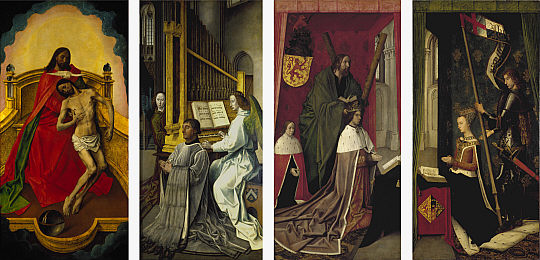
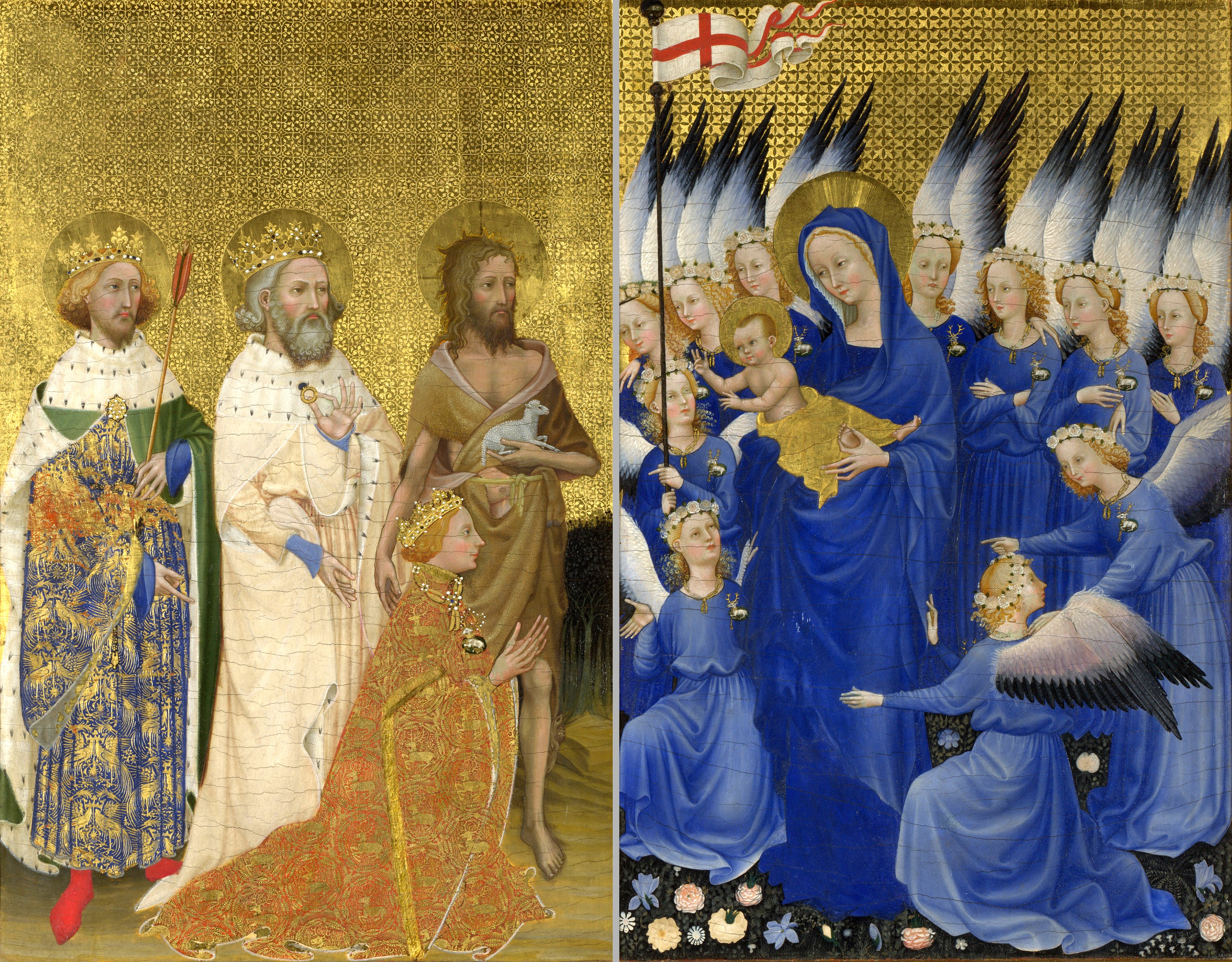
The two greatest surviving British devotional panel paintings of the late middle ages may well have survived because they included royal portraits. Thus in addition to the great Westminster portrait of King Richard II we still have the wonderous Wilton Diptych - but before it was engraved by Wenceslaus Hollar in the 1630s its history is unknown.

Saturday, 2 March 2013

Churches of St Chad


Today is the feast of St Chad, the seventh century bishop first of York and then, after the return of St Wilfrid to that see, he became the founding bishop of Lichfield. There is an account of his life here. Lichfield cathedral became the centre of his cult until the reformation. At that time some of his relics were rescued and in the nineteenth century re-enshrined in St Chad's Catholic cathedral in Birmingham. I have posted about those in previous years in St Chad and his relics and Relics of St Chad.

He is a popular patron of churches in the territory of the ancient diocese of Lichfield, including the chapel founded by the early thirteenth century (now a parish church and a nineteenth century rebuilding) of Saddleworth where my Whitehead forebears lived from the sixteenth century, and of the ancient parish church of the area in Rochdale.


http://ichef.bbci.co.uk/arts/yourpaintings/images/paintings/samg/large/gmi_samg_2001_73_1_large.jpg

The old church at Saddleworth circa 1826
A painting by John Holland of the Rushcarting ceremony, now in Saddleworth Museum.

Image: BBC

http://www.genuki.org.uk/big/eng/LAN/Rochdale/StChad.jpg

St Chad Rochdale

Image:Genuki

The handsome nineteenth century Catholic church of St Chad in Cheetham Hill in Manchester has become the new home of the Manchester Oratory.


St. Chad's Catholic Church on Cheetham Hill Road

Image:Manchesterhistory.net

St Chad's was built between 1846 and 1847 and was designed by the architectural practice of Weightman and Hadfield, who designed a number of  Catholic churches including Salford Cathedral.  


 Image:Manchesterhistory.net

St Chad's is associated with Sister Elizabeth Prout.  As a young woman Elizabeth attended a talk given by Bl. Dominic Barberi, who was a Passionists.  She was so inspired that she converted to Catholicism and then, on the advice of another Passionist, Father Gaudentius Rossi, she joined a Sisterhood in Northampton.  When Rossi was given a parish mission at St. Chad's he persuaded Sister Elizabeth to move there to teach in the parish church.  In the years that followed she worked among the poor of the community and founded a group that was known as the "Institute of the Holy Family" and she became known as Mother Mary Joseph of Jesus.  In 1864 at the age of 43 she died of tuberculosis at the Sutton Convent in Lancashire.  In more recent times she was put forward for canonisation, based on evidence of miraculous cures of people with cancer and severe brain damage.

In recent years the church was in the care of the Premonstratensian canons (Norbertines), but now has been assigned to the Oratorians who used to be at  the church of Holy Name in the city. The website of the new Oratory can be seen here.


Friday, 2 March 2012

The Lichfield Angel


Whilst it is still St Chad's feast day, and indeed the 1340th anniversary of his death, it seems a good opportunity to draw attention to the eighth century carving now known as the Lichfield Angel.

It was discovered, in three pieces, in 2003 beneath the floor of the nave of the present cathedral and recognised as an outstanding survival. Not only is it work of high quality, but unlike much surviving Anglo-Saxon sculpture from standing crosses it has not suffered from weathering, and has retained substantial portions of its original paintwork.


The Lichfield Angel

Image: Lichfield Cathedral website

It is thought to be the left hand side of a representation of the Annunciation - the other portion with Our Lady may still lie under the present cathedral - and may well have formed part of the early tomb or shrine of St Chad. The pigment on it has been compared with that in the St Chad Gospels, also preserved at the cathedral, which date from 730, but the Angel is usually dated to circa 800 - that is from the end of the reign of King Offa, the Mercian overlord of England south of the Humber, who died in 796, and who had secured the temporary elevation of the see of Lichfield to the status of an Archbishopric.

Not only is the carving an indicator of the quality of craftsmanship in a cathedral such as Lichfield but the indications of colour show how splendid the interior must have been. For too long peiopel have had a view of the Anglo-Saxon church as 'home-spun' and impoverished - other than the surviving altar books. Here is proof of a rich decorative tradition that stands fully in the tradition of Catholic worship and devotion.

There is more about the Angel on the Lichfield Cathedral website which can be viewed here.

The Angel and St Chad's Gospels can be seen on display in the chapter house of the cathedral.

Wednesday, 2 March 2011

St Chad and his relics


Today is the feast of St Chad, bishop of York and then of Lichfield, who died in 672. He is the patron of the cathedral of the Archdiocese of Birmingham and a secondary patron of the diocese.

There is a good account of his life here. His episcopal centre at Lichfield became his shrine church, and the present thirteenth and fourteenth century cathedral housed his relics until the reformation.

File:LichCathedral4.jpg

Lichfield Cathedral
Image:Wikipedia

Today they are enshrined above the High Altar in St Chad's Cathedral in Birmingham, seat of the Catholic Archbishop of the see, and the cathedral's website has a section on the survival of the relics.

File:St Chads Cathedral  Birmingham.jpg

St Chad's Cathedral in Birmingham
Designed by AW Pugin in 1840
Image:Wikipedia