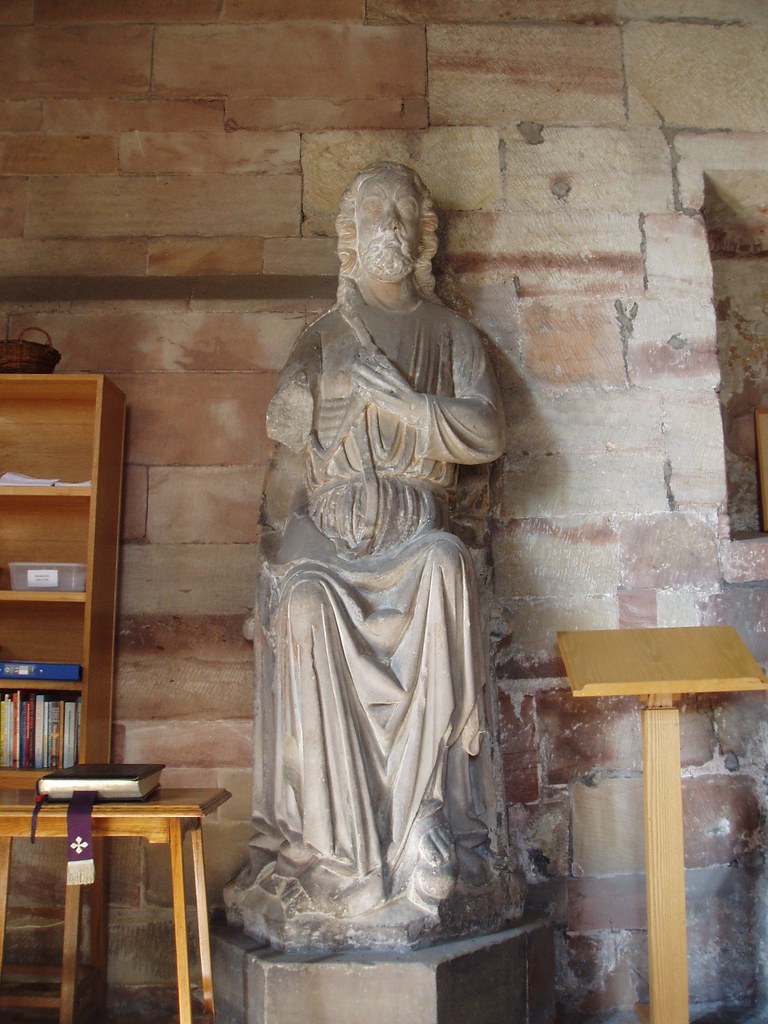
Seated Christ figure from the 13th century in
the south chapel (now used as a vestry)
St Mary's, Swynnerton,
Staffordshire.
The figure (approx 7'6'' in height) was unearthed under the floor close to where it now stands
in the 1800s, but clearly is far too large to have been made for this
church, and appears to have been designed to be viewed from below.
Clearly it was brought from elsewhere presumably at some
post-Reformation point, but from where, and why?
Firstly the church's website must be ignored, as it suggests a theory
that the figure was brought here from Reims, an error that seems to
derive from a very literal misreading of Pevsner's comment on certain
stylistic influences in the carving (he mentions a 'slightly feline
look about the eyes (Reims is the origin)' which refers to the style,
not the literal provenance of the statue!). This is very much an
English sculpture produced in the mid-thirteenth century which
otherwise bears far more comparison with contemporary work at Wells
and York than Northern France!
Secondly the stone is very much the local sandstone of this part of
the Midlands, making Staffordshire itself as likely an origin as
anywhere. But how many buildings within reach of Swynnerton would have
been large enough for such a figure, presumably set in a high niche on
a facade?
Only one candidate seems to make sense, Lichfield Cathedral, as it
fulfils several criteria; prior to the Civil War (and the grevious
damage inficted by it) Lichfield's west front retained it's complete
array of thirteenth century sculpture, including a figure of Christ
like this one in the gable, as can be seen in Wencesllas Hollar's
engraving from the 1630s. Most of the figures were lost in the
subsequent conflictt (except a row of kings and some battered figures
around the central portal, all thoroughly restored and eventually
completely replaced in Gilbert Scott's 'renewal' of the facade. About
four figures alone survive today high up on the north tower). The
stone is also a match for the cathedral.
The main problem is the considerable distance from Lichfield; it seems
safe to presume the statue was buried here to protect it from puritan
iconoclasts, but why Swynnerton and not some spot closer to 'home'?
The most significant connection of this locality to Lichfield could be
the presence nearby of Eccleshall Castle, which was then the private
residence of the Bishops of Lichfield, and would have proved a welcome
retreat for the clergy whilst Lichfield was under siege (on more than
one occaision). Was this figure spirited away from the cathedral after
the first siege had damaged it (worse was inflicted during the
second)? We will probably never know for certain.
All we know for certain is that Lichfield possessed a figure of the
same size and date as this one, which disappeared at some point during
the Civil War and was presumed destroyed. A figure of King Charles II
replaced it at the Restoration, to be in turn replaced by Scott with
the Christ we see on the gable today. (The statue of King Charles II now stands at ground
level at Lichfield and is a reasonable height match for this figure -
did they once both occupy the same niche?)
This theory was mainly supported by Arthur Mee in The King's England
Staffordshire (not the most reliable source!), but later Gerald Cobb in his
excellent English Cathedrals - the Forgotten Centuries 1984. It
seems somewhat under-recognised today.
There is however an alledged link with the local recusant Catholic
family, the Fitzherberts who worshipped in this chapel and are
believed to have place the figure in safety here. Dom Bede Camm in his
book 'Forgotten Shrines' relates the story at the following excerpt given
here.
Alternatively to that we can only assume perhaps a large monastic
building in the area could have also hidden a Christ figure during the
Reformation, and brought it to safety at Swynnerton.
The statue is in good condition and not greatly effected by
weathering (a niche would have afforded some shelter). Traces of red
paint are visible within the sleeve of Christ's gown, proving that the
figure was once, like most medieval sculpture, painted in bright
colours.
Sadly this part of the church is closed off and generally inaccessible
to the ordinary public without prior arrangement. A great pity as it
is little known and one of the rarest and most significant English
works of its date.
Image and text (clightly adapted): Aidan Macrae Thomson on Flickr
In Nottingham Castle Museum are three fine atnding figures in alabaster which were found under teh floor of the demolished church at Flawford in Nottingham shire in 1779. They depict Our Lady, St Peter and a bishop. There is more about the history of the church and figures here.