Once I was a clever boy learning the arts of Oxford... is a quotation from the verses written by Bishop Richard Fleming (c.1385-1431) for his tomb in Lincoln Cathedral. Fleming, the founder of Lincoln College in Oxford, is the subject of my research for a D. Phil., and, like me, a son of the West Riding. I have remarked in the past that I have a deeply meaningful on-going relationship with a dead fifteenth century bishop... it was Fleming who, in effect, enabled me to come to Oxford and to learn its arts, and for that I am immensely grateful.


Showing posts with label English Iconoclasm. Show all posts

Monday, 24 August 2015

Something missing at St Bartholomew the Great Smithfield?


Before leaving today and the feast of St Bartholomew it gives me an opportunity to reprise a point I made in my talk the other week to the Second Spring Summer School on A Shattered Culture, about what we have lost in this country due to active iconoclasm in the sixteenth and seventeenth centuries and through subsequent neglect, and, in this case, from later misunderstanding.

The priory church of St Bartholomew the Great in Smithfield is one of the very few medieval churches to survive in central London, although it is not as well known as it should be. A substantial part of the priory church - presbytery and transepts - survives, and is a fine example of early twelfth century work - the priory was founded by Rahere, jester to King Henry I:


Image: bellatrovata.com


Image: beenthere-donethat.org.uk


When we visit it can be very grateful that it has survived and feel we are seeing something of medieval London. 

However what we are not seeing is the colour that would have enriched the church. This changes the atmosphere  and experience. A medieval church was 'other' than that day to day living because it was, in the modern phrase, 'sacred space.'  Entering a medieval church was to enter a foretaste of Heaven. Yet this point seems still to be lost on so many people. I have even known distinguished academics in medieval history who have dismissed medieval colour schemes as garish and somehow imply we are better off without them.

To visualise the interior of St Bartholomew's as it would once have been is difficult - we have fragments and pieces but little in the way of complete schemes, or if they are they are faded  and pale. At Issoire in central France one such scheme has been recreated in 1857-59 - albeit controversially in the eyes of some, but maybe they also do not like the fact of  colouration. Like St Bartholomew Issoire has stilted arches around the apse making the comparison all the easier:


Image;phototeque-arnaudfiche.com


Image; revue.shakti.pagesperso-orange.fr


Image:auvergnecentrefrance


Image:auvergnecentrefrance


Even if you might quibble about shades and detail as Issoire I still imagine - not having been and only knowing it from photographs - that here one does get and idea of what a great twelfth century church looked like. Just because we have lost that tradition in England does not make it wrong. Scrubbed grey stone is not what twelfth century patrons, architects and artists set out to create. Personally I like the impression I have formed of the interior of Issoire. It's just a case of waking up and smelling the incense...


Image:phototeque-arnaudfrichphoto.com


Image:flickr.com


Image:rando-planetepuydedome.com


Saturday, 8 August 2015

English Iconoclasm revisited


Last year I posted a series of nine pieces under the title English Iconoclasm. these followed on from a lecture I gave to a summer school here in Oxford organised by Second Spring. this year they asked me to give the talk again. This was with a new title, suggested by the organisers, of  " A Shattered Culture: The Impact of the Reformation in England" and, with revisions to the text and a set of illustrations put together online with the technical assistance of a friend, I did so. I am now reposting the links to the posts from last year, which cover some, but not all, of the themes and examples I spoke about. This is inituially for the use of the US students on the course, but may also be, indeed I hope will be, of interest to other readers.


English Iconoclasm I

English Iconoclasm II - the fate of the cult of St George

English Iconoclasm III - An eyewitness account

English Iconoclasm IV

English Iconoclasm V

English Iconoclasm VI

English Iconoclasm VII

English Iconoclasm VIII

English Iconoclasm IX

I am also adding another post from the sme time last year with the same tag

St Modwen and Burton on Trent Abbey

and the following posts from previous years which apply to other places I spoke about:

Disaster at Hereford

Vandalism at Salisbury Cathedral

St Augustine's Abbey Canterbury

 More on St Augustine's Abbey Canterbury

 St John the Baptist Chester

and, from Wikipedia, articles about Reculver at 

St Mary's Church, Reculver  and Reculver


Wednesday, 29 October 2014

St Modwen and Burton on Trent Abbey


The town of Burton on Trent is well known for brewing, but once was better known as a place of prayer and pilgrimage, as it housed the shrine of St Modwen, whose feast day falls today. This post can also be seen as carrying on a theme I considered in the series I posted on English iconoclasm.

There are a series of detailed online accounts from a really excellent website about the history of the town. That about St Modwen and her cult can be viewed here, and the history of the Benedictine abbey founded in 1002 by Wulfric Spot which housed her relics can be seen here. The series of links it gives are well worth following up.

In the middle ages Burton did not have a seperate parish church, and the townspeople used the nave for worship. This was one reason why the abbey church survived the dissolution. Firstly this was as Burton College - I think this was an unfulfilled Henrician plan to make the abbey church a cathedral for a potential Derbyshire diocese - but the college was dissolved in 1545, and no new diocese created, and then it survived as the parish church.  


Burton Abbey 

Burton on Trent Abbey

The most famous image of the abbey is this 1661 engraving from the river by Wenceslas Hollar. The writer of the website point sout that it does not entirely agree with known records, and suggests it uses ‘artistic license’ and is therefore, a partly speculative reconstruction drawing upon other Benedictine abbeys. However it does appear to agree with much of what is known about the abbey, and is a valuable source.

Image:burton-on-trent.org.uk


The webite explains how St. Modwen’s Old Church, predecessor of the current parish church, was part of the former monastic church which was reserved to the parish when the Crown granted the possessions of the dissolved Burton college, which had been temporarily establishedin the former abbey, to Sir William Paget in 1546. It comprised the aisled nave of seven bays, west tower, west porch, crossing with tower and spire, and the transepts. By 1603 the eastern arm, which had been granted to Paget, was in ruins and the arch separating it from the crossing was walled up. 

However the building became dilapidated and in 1719-28 was rebuilt as the present handsome Georgian church. There is a section about this, including a plan indicating the size of the abbey church on the same website and it can be viewed here. 

The abbey buildings now lie under the adjacent market hall in the town centre.

Fine as the present church is I cannot but lament the loss of what looks to have been a very interesting monastic church.


Tuesday, 14 October 2014

English Iconoclasm IX


Nothing so encapsulates English iconoclasm in the Reformation period and in subsequent centuries than the attack on the cult, on the veneration, on almost even the name, of the Blesed Virgin Mary. Mary's Dowry appeared more tha anxious to expunger her from its collective life and worship.

I have already mentioned the 1538 burning of several famous statues of her as well as other devotional imagess, and in the first years of the Elizabethan settlement there were similar scenes - what I wonder did the good people of Sleaford in Lincolnshire think in 1560 when the Crucifix was taken out from their parish church of St Denys and burned in the market place outside?

Lady Chapels in churches attracted the attention of zealous reformers. At Ely cathedral the wondrous fourteenth century Lady Chapel lost all its glass and every statue in the canopy work around the arcades was meticulously decapitated.


 The Lady Chapel of Ely Cathedral

Image: paradoxplace.com

As I heard Eamonn Duffy point out in a lecture here in Oxford folk-memory and shifting blame comes into play here: on a visit to Ely he heard a guide explain that this was all due to Oliver Cromwell (a local boy made bad on emight add), and ignoring the fact that the damage is the responsibility of the Bishop of Ely under King Edward VI... a case of blaming "the other".

(I will not comment on the rather bizarre figure of the Virgin which has been placed there in recent years and can be seen above the altar in the photograph - I am not sure who is to "blame " for that.)

In other case the church might survive, but the Lady Chapel was deemed extraneous and pulled doem to save on repairs or to provide stonework as at Tewkesbury abbey, saved by the townspeople at a scrap value of £453. Nonetheless the chapel, which contained tombs of fifteenth century lords of the manor and patrons of the abbey, was later demolished.


The site of the Lady Chapel at Tewkesbury Abbey

The line of the vault can be seen, and the foundations are marked out in the turf in the foreground

Image:sydneythehoundofheaven.blogspot

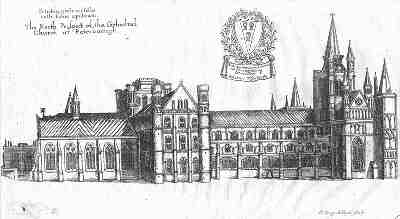
At Norwich cathedral the Lady Chapel was demolished and only partially rebuilt in the twentieth century as a memorial to the Great War, whilst at Peterborough the Lady Chapel, situated rather like that of Ely cathedral to the north-east of the main church, and free standing on three sides was demolished for its stone in the 1650s and a country house, Thorpe Park, built with the materials.
 

Peterborough Cathedral - First Burial, Mary Queen of Scots - Preview Image

Peterborough Cathedral from the north in the seventeenth century by Daniel King 

The Lady Chapel can be seen to the left of the north transept, and flanking the presbytery, whils the north-west tower still has a spire

Image;awesonestories.com

At St Albans and at Sherborne the Lady Chapels survived because they were used as grammar schools until the nineteenth and early twentieth century restorations returned them to ecclesiastical use.

The English liturgy was purged of virtually all Marian devotions in 1548, and little survived beyond the feasts of her birth and, surprisingly perhaps, conception. In Oxford University the feast of the Assumption survived as a lesser commemoration, and as it still exists in the University Calendar.


In Oxford the University Church of St Mary the Virgin had a new porch built in 1636-37 by the mason Nicholas Stone at a cost of £230. This was adorned with a statue of the Virgin and Child, and in 1644 this was one of the capital charges  brought against Archbishop Laud by the Parliamentarians, on the basis that Laud as Chancellor of the University had sanctioned this. The statue had attracted the respect and indeed devotion of some University students and was blasted by a Parliamentarian musket when the army left the city at the beginning of the Civil War. A modern replacement now occupies the niche.


photo

The South porch of St Mary the Virgin Oxford, with the statue of the Virgin and Child

 Image:David Nicholls on Flickr

Medieval statues which survived often did so in exile. Thus the statue now designated Our Lady of Westminster was, as the link explains, rediscovered and on sale in France in 1954, and acquired for Westminster Cathedral. A copy of it is now a replacement for the statue of Our Lady of Pew in Westminster Abbey, which appears to have been the original focus of King Richard II's vow of England to Our Lady as her Dowry in 1381.

http://upload.wikimedia.org/wikipedia/commons/c/c2/OLWestminster.jpg 

Our Lady of Westminster

Image: Wikipedia

In the link about the statue it is worth noting the reference to exports from 1550, with three ships loads heading for French cities. There is also the reference to a near identical figure, but headless, which was found in 1863 buried in the churchyard at Broughton in Craven. That was a recusant area, with the Tempest family as local lords. Maybe they decided decent burial was the appropriate thing for a vandalised statue.

Near Oxford at Sandford on Thames a fine carving of the Assumption was found upside down and being used as a step in the church porch in the eighteenth century. I have posted about it and illustrated it in Assumption at Sandford on Thames.

In the crypt of York Minster is the statue now known as Our Lady of York. I think this was rediscovered during the restoration of the choir after the arson of 1829, and that it was found buried in the east wall. I wonder if, as an already old sculpture that was venerated, it had been re-enthtoned in Archbishop Thoresby's Lady Chapel in the late fourteenth century, vandalised in the sixteenth century and buried in the wall behind where it once was honoured?


  The statue of Our Lady of York

Image: carmelite.org

Vandalising statues in churches in your own country is one thing, but going abroad to do so is adding to the fault, and leads to the story of Our Lady Vulnerata at Vallodolid, which is as follows on the English College website :


In the great reredos of the Chapel of the English College, Valladolid, is the statue of Our Lady Vulnerata. The story of this statue begins in the reign of Queen Elizabeth I of England, in 1596. Spain had recovered from the defeat of the Invincible Armada and was gathering another fleet in the port of Cadiz, on the Atlantic coast of southern Spain. The Earl of Essex, together with Sir Walter Raleigh, led an English fleet into the harbour, destroyed the Spanish fleet and took possession of the city.

Some of the English troops ran riot and dragged a statue of the Virgin Mary and Child from a church to the market square where they desecrated it. They hacked at the face and cut off both arms. All that remained of the Child were parts of his tiny feet on His Mother's knee.


Our Lady Vulnerata

Image:sanalbano.org 
 
The mutilated statue was given greater honour than ever and the Countess of Santa Gadea, wife of the Governor of Castille, gave it place of honour in her chapel in Madrid.
The staff and students of the English College in Valladolid asked the Countess for the right to make reparation for the behaviour of their fellow countrymen who had desecrated the statue. Reluctantly she agreed and the statue was brought to Valladolid and installed with great solemnity in the College Chapel in 1600. Queen Margaret of Austria, wife of King Philip III of Spain, who was present when the statue was installed, had asked for a novena in honour of Our Lady. On the last day of the novena the Bishop of Palencia gave the statue the title of Our Lady Vulnerata (which means wounded and insulted).

The Chapel was renovated in 1979 to mark its third centenary. More recently the façade was restored and the main doors renewed at the end of 1985; and the Chapel was opened to the public.

Every week, to this day, special prayers are offered in reparation for the insults to Our Lady and the Child Jesus and to implore the intercession of Our Lady Vulnerata for the conversion of the people of England and Wales. 


Every year during Holy Week the statue is processed along the street, where it is met by a huge 'paso' or float, which has a large depiction of the Crucified Christ resting on top of it. The two images meet, and dance to each other for a brief period,  - then the Vulnerata comes back to the College.
The story of the statue is depicted in eight paintings around the walls of the College Chapel.
The Mass of Our Lady Vulnerata is celebrated in the College by special indult on the Sunday following the feast of the Immaculate Conception.
In the year 2000, the fourth Centenary of the arrival of the statue of Our Lady Vulnerata, after further renovation of the College Chapel, the statue was given a new crown, a gift from the old boys of the College, at a solemn ceremony on the Feast of the Forty Martyrs of England and Wales.

Text adapted from: sanalbano.org 


Prayer to Our Lady Vulnerata

Dear Mother, as I gaze on your wounded and mutilated image, I humbly beg your pardon for the grievous insults to you, great Mother of God. Help me to notice the wounded children of the world, and see your beauty in the faces of the poor and disfranchised. Let me love them better, as your Son commanded. I praise you through the faith, loyalty and blood of the missionaries who prayed for courage before your image, and I ask you to keep today’s missionaries in your loving care as they, too, carry the Good News throughout the world. Amen

Image and text: whitesmokeahoy.blogspot.co.uk 


Concluded 

Wednesday, 8 October 2014

English Iconoclasm VIII


Tombs did not fare too well with the iconoclasts of sixteenth and seventeenth century England. Some tombs and the remains they enclosed were moved to new sites - so King Henry VIII (or perhaps his brother-in-law Charles Brandon) moved his sister Mary, sometime Queen of France and then Duchess of Suffolk from Bury St Edmunds abbey into the nearby parish church of St Mary, and his grandfather Edmund Tudor, Earl of Richmond, was moved from the Greyfriars in Carmarthen to St David's Cathedral. Nothing however was done for Edmund's father Owen, buried in the Hereford Greyfriars, let alone King Henry I at Reading or King Stephen at Faversham or King Richard of the Romans, brother of King Henry III, at Hailes, or his widow at Oxford Greyfriars. As we know, and this is perhaps less surprising, King Richard III, was left to wait a twenty-first century re-discovery and re- burial in Leicester. At Fotheringhay Queen Elizabeth I did order the construction of new monuments to the Dukes of York in what remained of the collegiate church - but in so doing largely obliterated
the original memorial brass of the second Duke who had died in 1415 at Agincourt.

It was indeed the risk of the destruction of tombs and family arms which the Queen cited in her proclamation against iconoclasm early in her reign, and that may have saved some things from the enthusiasm of reform minded clergy, churchwardens and busybodies.

Quite apart from casual damage there was clearly the deliberate destruction of saints images on tombs and the loss of liturgical accouterments such as hearses.

In the parish church of St Nicholas at West Tanfield in Yorkshire is the alabaster tomb commemorating Sir John Marmion who died in 1387, and his widow Lady Elizabeth Marmion ( nee St Quintin) , who died in 1400. It still has the wrought-iron hearse has prickets for candles which it was customary to light at anniversary Masses when the iron hearse would be covered with a pall. It is believed to be the only one of its kind to survive in England. At Warwick there is a different type of pall support included in the bronze work around the effigy of the Earl of Warwick.


photo 

The Marmion tomb at West Tanfield

Image: Spen Valley Wanderer on Flickr


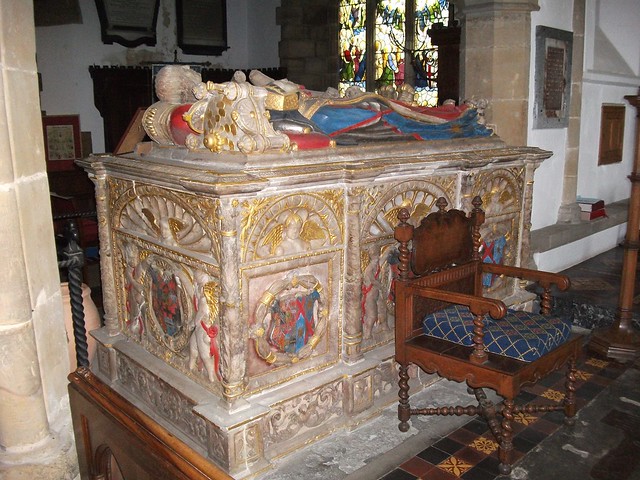
In the really impressive church at Tickhill in the southern West Riding is the tomb of Sir Thomas and Lady Fitzwilliam, which was made circa 1525. This was moved from the Austin Friary in the town at its dissolution. Lady Fitzwilliam was the daughter of Marquess Montagu, and thus niece to Warwick the Kingmaker, and cousin to his daughters Isabella Duchess of Clarence and Anne, succesively Princess of Wales to Edward of Westminster and Queen to King Richard III, as well as being kin to the Yorkists and thence the Tudors.

 Click to view full size image

The Fitzwilliam Tomb at Tickhill

Image:tickhillhistorysociety.co.uk

This, however, is not just an example of a tomb that was moved, but a rare survival, indicating what might have been the style of English Catholic Renaissance monuments. Apart from the tombs of King Henry VII and his Queen, and of Lady Margaret Beaufort in Westminster Abbey this is probably the earliest to survive, or have been commissioned, and that 150 miles or so north of the metropolis.

A second example in this style is in Sussex at Battle, and commemorates a courtier of King Henry VIII. :

photo

Tomb of Sir Anthony Browne KG (d.1548) and his wife (d.1540)
Battle Church Sussex

 Image: Heraldic Tyger on Flickr 

Most impressive of all are the Howard tombs at Framlingham in Suffolk. To the church the third Duke of Norfolk brought his father's remains and tomb from Thetford Priory and buried thee his son-in-law, Henry FitzRoy, Duke of Richmond, as well as commissioning a grand tomb for himself and his two wives, the design of which was copied by his grandson the fourth Duke for his second and third wives, and planned to be buried there himself; fate and the headsman's axe left him in St Peter ad Vincula in the Tower of London.


Framlingham, St Michael's Church photo, Thomas Howard tomb

The tomb of the third Duke of Norfolk (d.1554) and his two wives
Framlingham church in Suffolk

Image:britainexpress.com

These two Ducal tombs are extraordinary, with their figures of saints in Classical niches, surrounding the tomb chest, a suggestion of what the Marian restoration might have produced in England. Whatever the third Duke may have done in support of the King' spolicy in the years after 1529, by the time of his death his conservative religious tendencies were clearly indicated, and the fourth Duke did not repudiate them with his choice of monument.

There is more about these wonderful tombs here.

After the consolidation of Protestant practice funerary monuments loose religious figures, the deceased pray into void, surrounded by their families, but without spiritual intercessors.
Similarly saints disappear from wall plaques, and only a few example survive showing the deceased praying to the Virgin Mary. Thereafter families face one another, the gap where the saint once stood closed up by the kneeling family membersthey very occasionally families face one another.

Monumental brasses appear often to have lost the figures and images of saints from the surround or canopy whilst the  figures of the deceased survive, although there were still vast losses, as can be seen in so many churches with rows of matrices, but no brasses.

A friend who is a great expert on monumental brasses has suggested that some at least were ripped up and traded to West Africa as part of the slave trade. They ened up in this theory as part of works such as the Benin bronzes. Certainly such a trade could explain the following, curious but remarkable survival from late medieval England:


Ewer; bronze; with lid and handle; lid with lodged hart of Richard II and lion; sides of ewer with eagles and front with royal Arms of England, crowned; two proverbs inscribed round edge.


The Asante Ewer

Medieval English, circa 1390-1400

Found in the Asante kingdom (modern Ghana), West Africa

This ewer was discovered in 1896 in the Asante kingdom on the west coast of Africa. It represents a rare survival of a lidded bronze vessel from the last years of the fourteenth century. The astonishing fact of its survival is matched by its intriguing find spot, proverbial inscription and royal heraldry.

On the front of the jug are the royal arms of England that were current from 1340 to 1405. The neck of the jug is decorated with six, symmetrically placed roundels containing a falcon with spread wings. Around the belly of the jug is an inscription in Lombardic letters which reads:
He that wyl not spare when he may
He shal not spend when he would
Deme the best in every dowt
Til the trowthe be tryid owte
('He that shall not save when he can
Shall not spend when he wants to.
Suppose the best in every fear
Until the truth is known').

Without the survival of the lid, it would not have been possible to date the ewer to the final years of the fourteenth century. Each of the seven facets of the lid contain a lion facing left and a stag couchant (lying down), without chain, facing right. The use of these devices place the manufacture of the jug firmly in the last years of the reign of Richard II, who used the symbol of the white hart between 1390 and 1399.
What brought the ewer to the west coast of Africa? Two other English bronze jugs from the late fourteenth century were found at Kumasi at the same time as this example. This may suggest that they left England as a set and that they all originated from the household of Richard II. However, the mystery behind their arrival at the Asante kingdom is still unsolved. A photograph from 1887 shows the jug placed under a sacred tree in a royal palace, suggesting that these items were held in high regard by the Asante people.


Ewer; bronze; with lid and handle; lid with lodged hart of Richard II and lion; sides of ewer with eagles and front with royal Arms of England, crowned; two proverbs inscribed round edge.


Images and text : britishmuseum.org

Monday, 6 October 2014

English Iconoclasm VII


Metal objects which were not in themselves made of precious materials, but no longer in use liturgically, such as ciboria, were also unlikely to survive. Occasionally, however, they have.


 Photo : © Victoria and Albert Museum, London

The Warwick Ciborium

Image:mondes-normandes.caen.fr


The Warwick Ciborium was made circa 1150-75, probably in England or possibly in the Meuse valley.  It is decorated with Old Testament scenes, presented as types to prefigure events in the New Testament. So Isaac carrying the wood to his own sacrifice prefigured Christ carrying the cross to the Crucifixion. The verses on the ciborium are the same as captions which appeared with large images in Worcester Cathedral Priory - which shows how closely monumental and small-scale art in the period were related.

There is more about it in this piece by Daniel Mitsui:


This object was first recorded, with its cover already missing, in two eighteenth century watercolours in London and Oxford. A note on the back of the London drawing, by John Talman (died 1726) says: It was bought about August 1717 out of a Brasier's shop in London and is now in the possession of Mr George Holmes Deputy Record Keeper in the Tower of London. The ciborium passed into the collection of the Earls of Warwick in 1851. By the time it was exhibited at Manchester in 1857 the catalogue noted that the enamels are unfortunately nearly all destroyed. Further damage was caused during a fire at Warwick Castle in 1871.

The early history of the object is undocumented. However, the series of verses, some of them incomplete, which form a commentary to the scenes, are known to be based on verses formerly represented in the Norman Chapter House at Worcester Cathedral priory. These verses described a sequence of either paintings or stained glass windows. This fact, along with the English associations of related works, such as the Morgan and Balfour ciboria, and a crozier now in Florence, provide convincing evidence in favour of this piece having been made in England, possibly in the west of England.

The ciborium preserves one half of a decorative scheme known as typology - the systematic paralleling of Old and New Testament scenes, with explanatory verses. The Warwick ciborium lacks the New Testament scenes, but the choice of Old Testament images and the wording of the verses makes clear the original choice of New Testament subjects for the cover. We know that typological schemes of this type were also popular in monumental contexts in England from the work of antiquarians who recorded the verses, but images of this sort have not survived on this scale. The paintings or stained glass in Worcester were not the only images of this type in English Benedictine foundations - similar programmes of images existed in Bury St. Edmunds, Canterbury and Peterborough, although these all used different verses. The Warwick ciborium demonstrates that such systematic image programmes were considered equally applicable to small scale works of art, reflecting what might be characterised as a taste for learned and literate imagery amongst certain clerics at this period...

The Old Testament scenes are as follows: Moses and the burning bush; the Sacrifices of Cain and Abel; the Circumcision of Isaac; Isaac bearing the wood; Abraham about to sacrifice Isaac; Jonah issuing from the whale. Each scene is accompanied by explanatory verses on the border above. Inside, on the bottom of the bowl, is an image of a lamb (the Agnus Dei or Lamb of God).


Image and text: The Lion and the Cardinal

A second example is now also in the Victoria and Albert Museum:
 

File:Balfour ciborium VandA M.1-1981.jpg


The Balfour ciborium

Image:Wikimedia commons

This ciborium is one of the most important survivals of English metalwork from the twelfth century, and is dated to 1150-1175. It is enamelled with complex imagery consisting of complementary scenes from the Old Testament (on the bowl) and the New Testament (on the lid), all accompanied by rhyming verses in Latin. Image programmes of this sort were common on large and small-scale works of art in the twelfth century, reflecting a taste for learned and literate imagery amongst bishops, abbots and other clerics.

There is a tradition that in the sixteenth century, this piece was given to Sir James Balfour of Pittendreich by Mary Queen of Scots. The Queen may have received it as booty after the defeat of the Earl of Huntly in 1562, and it may possibly be identical with the laver 'with a cowp and cover of copper ennamaillet" listed in her inventory of that year.

Vestments were clearly vulnerable - as textiles the likelihood of decay was integral to them.  Not a few were remade as frontals or as coffin palls, as can be seen in various parish churches up and down the country, such as St John's Glastonbury, or in examples such as those I wrote about in  The Skenfrith Cope and in Medieval textiles for auction in Oxford earlier this year.

The Syon Cope, now in the Victoria and Albert Museum, was originally part of a voluminous chasuble made circa  1300-20. It takes its name from the Bridgettine convent of Syon in Middlesex, which was founded by King Henry V in 1414-15. It is probable that the nuns took the cope with them when they went into exile during the reign of Elizabeth I and that it was returned when part of the community was re-established in England in about 1810.


The Syon Cope

Image; collections.vam.ac.uk

On the original vestment there would have been four rows (on the reconstituted cope there are three) of interlaced quatrefoil shaped compartments with scenes from the Life of the Virgin and the Life of Christ and the Apostles; the latter, seen in the fourth dismembered row, are not identifiable. Between the compartments are six winged seraphs and along the upper edge are the remains of angels holding crowns and the figures of two kneeling clerics, possibly representing the priest for whom the vestment was made. They hold scrolls with undecipherable Latin inscriptions.

Unique among surviving examples of opus anglicanum (the Latin term for English work, which was the high quality English embroidery known to have been bought by princes and Popes), the ground is entirely covered in red (now faded to brown) and green silk thread. The orphrey bands (decorative strips) with heraldic shields around the circumference and along the top edge of the cope are made from pieces of contemporary vestments. These may be purely decorative.

The embroidery is worked in silver-gilt and silver thread in underside couching, split, cross and plait stitches and laid and couched work.

Adapted from the Victoria and Albert Museum website 

The Syon Cope on display at the V&A, London.  Made in England 1300 - 1320.  Linen, embroidered with silver-gilt and silver thread.

  Detail of St Michael from the Syon Cope

Image:agnesashe.wordpress.com

In the collection at Towneley Hall at Burnley are a chasuble and dalmatic or tunicle (the third item of the set is in the Burrell Collection in Glasgow), which are the only High Mass set to survive from medieval England. Originally made about 1390-1420 or 1415-1435 (depending upon your expert) and remounted late in the fifteenth century, they were rescued from the Cistercian house of Whalley Abbey by the recusant Towneley family. The red fruits on the ground textile are probably pomegranetes.


The vestments from Whalley Abbey, preserved at Towneley Hall

Image: New Liturgical movement

http://college.holycross.edu/projects/catholiccollecting/images/VWhalleyChasuble.jpg
The front of the chasuble

Images;college holycross.edu

There is more about the vestments at What Might Have Been - The Whalley Abbey Vestments at Towneley

Other like-minded families also preserved vestments , such as those saved by the Arundell family at Wardour in Wiltshire.


Saturday, 4 October 2014

English Iconoclasm VI


Stained glass appears to have suffered particularly in the Civil War, although some figures may have been some decapitated in the sixteenth century - the argument being that it was too expensive to replace all the windows in a parish church. In the seventeenth century such constraints did not work. William  Dowsing in East Anglia managed to destroy vast amounts of glass, and today only fragments survive as at Long Melford in Suffolk of what was once a rich decorative tradition.

The Last Judgement in the west window of Fairford Church

Image:letstourengland.com

There are two useful online pieces about the church windows at   Church of St Mary - Fairford, England - Sacred Destinations and at  Treasures of Fairford - Victoria and Albert Museum

Elswhere the terms of surrender in the Civil War sometimes prohibited vandalism in churches as at York where the saving of the Minster glass and much else in the city churches is attributed to the parliamentarian gneral Lord Fairfax, and in Oxford where the colleges were off limits to iconoclasts. 

Metal work takes a bit effort more to destroy it, but melting it down is very tempting, especially if it is silver or gold. Bronze, or latten, is a bit more likely to survive.

photo 

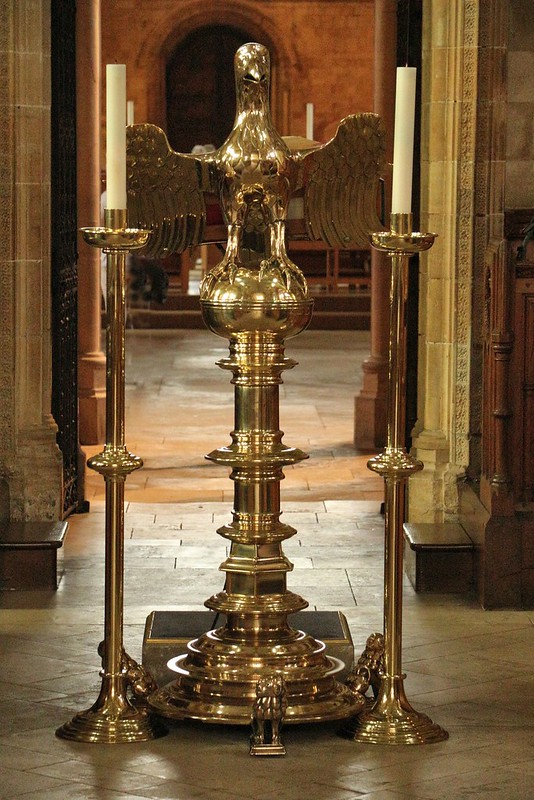
The Eagle Lectern from Newstead Abbey now in Southwell Cathedral

Image: Blue Pelican on Flickr

The brass eagle lectern was made at Tournai in the Low Countries in 1503 for Prior Ralph Savage of the Augustinian house of Newstead Abbey in Nottinghamshire. At the dissolution of the monasteries it was hidden in the lake at the abbey and only rediscovered some 250 years later when the lake was drained. It was auctioned by the 5th Lord Byron, great uncle of the poet, and acquired for Southwell Minster in 1805 by Sir Richard Kaye, then Dean of Lincoln.

Altar plate was too tempting and seized by rapatious governments at the dissolution of the monasteries or in the Edwardian period. Other than some chalices there are few survivals. Here are three, which survived by being abroad, or being dropped into a lake: 

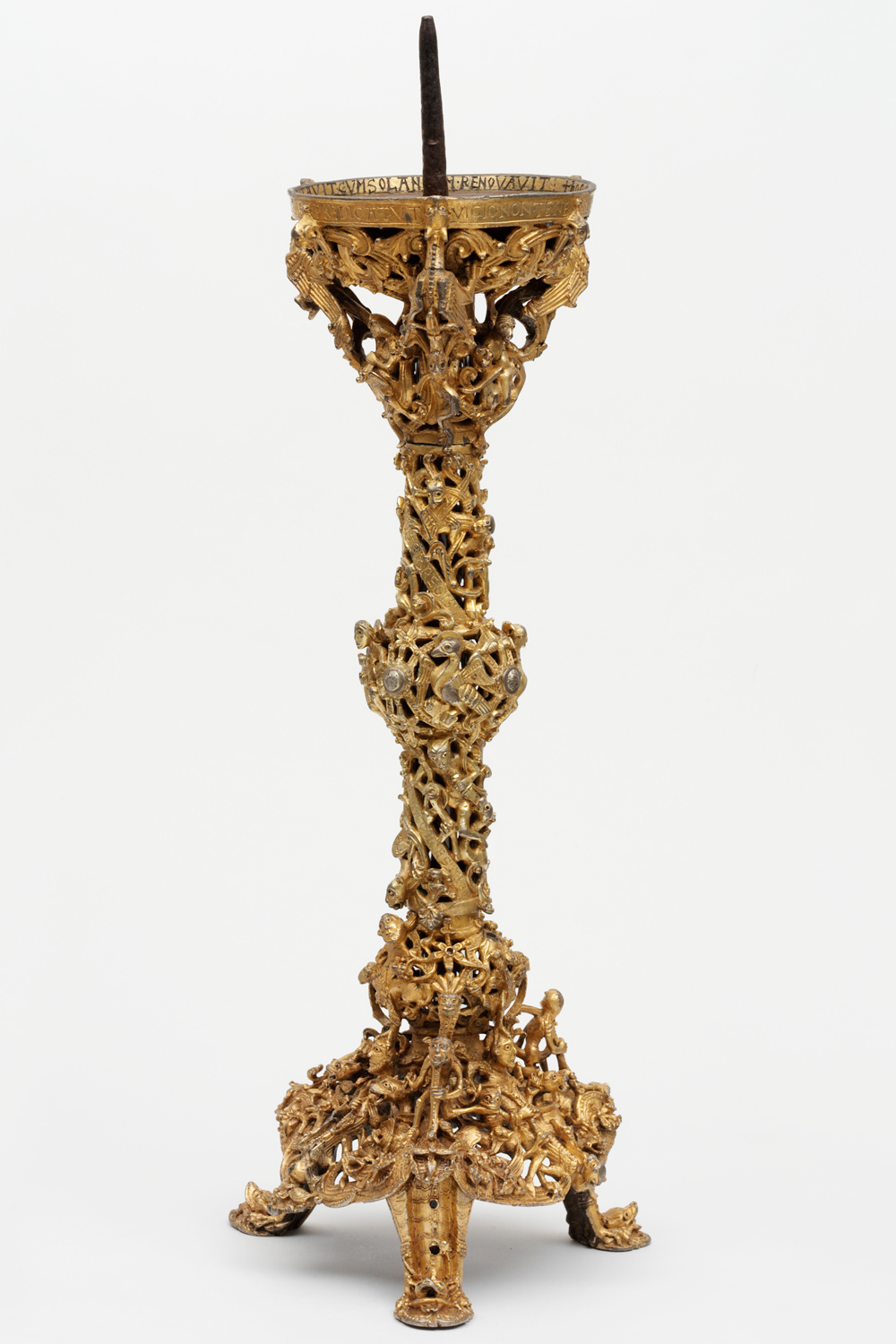
Gilded copper alloy candlestick, known as the 'Gloucester Candlestick', England, UK, early 12th century. Museum no. 7649-1861

The Gloucester Candlestick 

Image:vam.ac.uk

There are online articles about the candlestick at Gloucester Candlestick and, from the Victoria and Albert Museum's own website, at The Gloucester Candlestick
51050380022
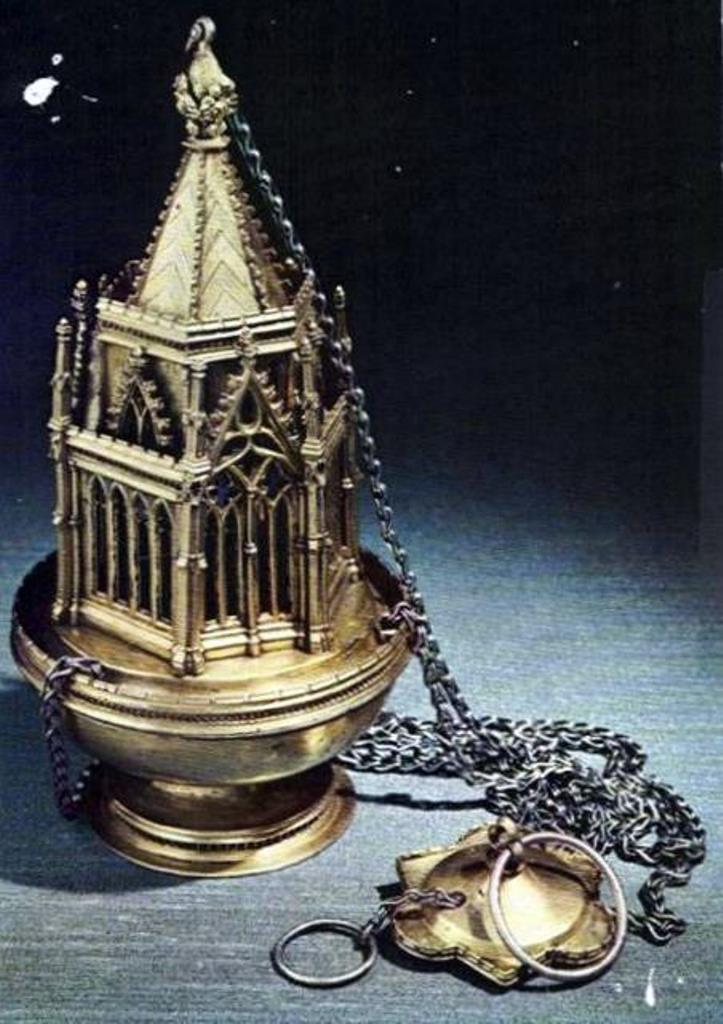
The Ramsey Censer circa 1325
Found, together with its incense boat, decorated with ram's heads, indicating its proveneance, in the draining of Whittlesey Mere in 1850. Now in the Victoria and Albert Museum

Image:yaxley.ccan.co.uk

There is an article with more photographs from the Victorian and Albert Museum website at The Ramsey Abbey Censer and Incense Boat

A piece which survived by going abroad, and which reappeared, but without a history, from somewhere in central Europe after the Second World War is the mid- twelfth century ivory Bury St Edmunds Cross.


The Cross with what is believed to be the original corpus, which is now in a museum in Oslo

Image: tumblr.com


I have posted about this piece, with more illustrations, in The Bury St Edmunds Cross. 


To be continued

Tuesday, 9 September 2014

English Iconoclasm V


If buildings could be destroyed so thoroughly as I indicated in my previous post on this thread then furnishings stood even less chance, although being portable they were carried off and individual examples do survive. However given that English iconoclasm was so often directed against the images and paraphanalia of Catholic worship the survivals are a miniscule percentage.

The examples I give of survivals are one which my mind or a bit of research turned up - this is in no way an attempt to include all examples, or to assess survival rates. What hopefully this will indicate are the sometimes extraordinary lengths people went to to save what they considered inportant, and also just how much has been lost.

If many medieval paintings were on the walls of churches then they disappeared under whitewash or went down as the building was destroyed.


The Doom painting in the church of St Thomas Salisbury

The painting is dated to about 1475 and is the largest to survive in England.
The figures at either side are thought to be St James, patron of pilgrims and St Osmund, the first bishop of Salisbury. The painting was rediscoverd and restored in the nineteenth century
Image: martinstown.co.uk


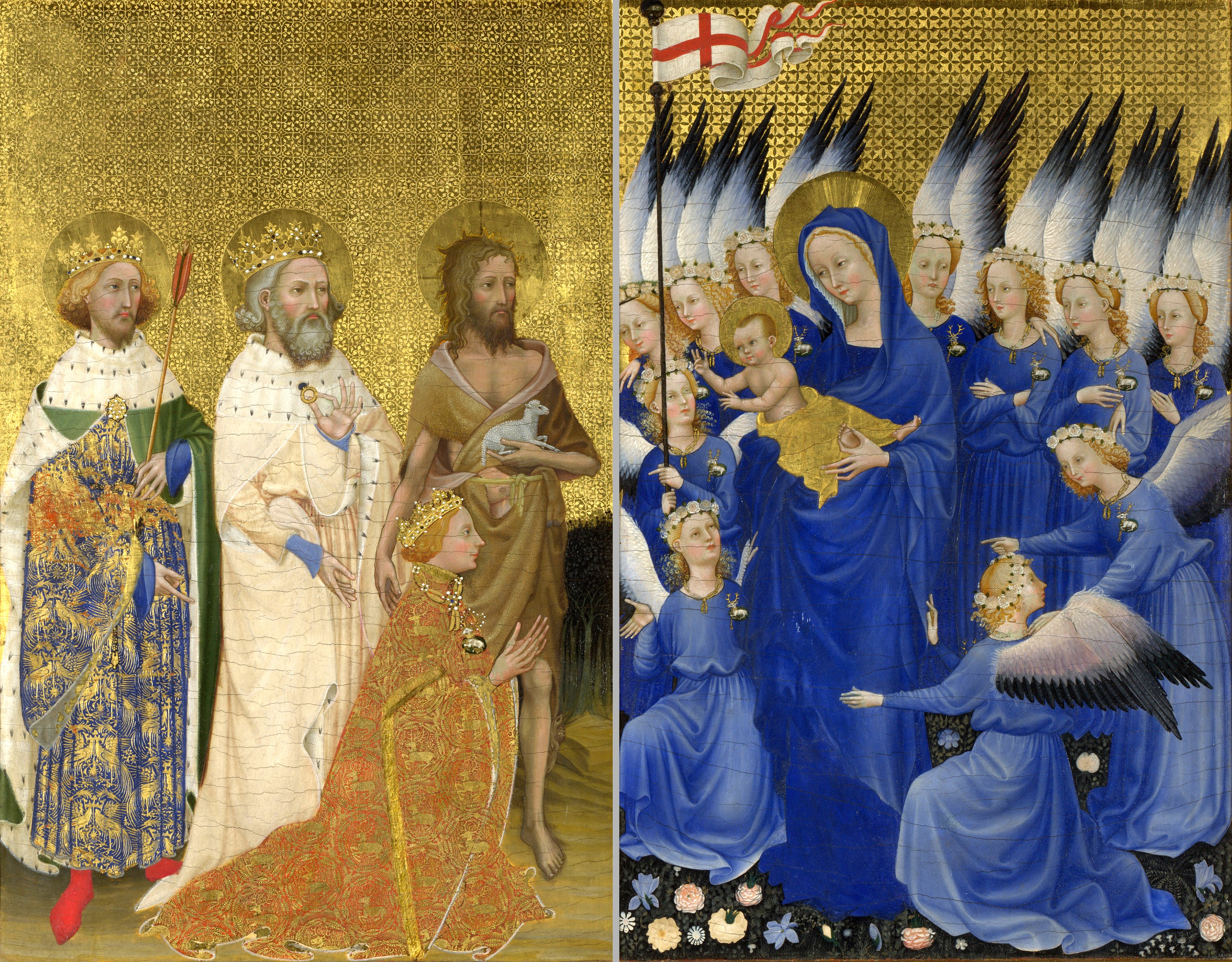
The two greatest surviving British devotional panel paintings of the late middle ages may well have survived because they included royal portraits. Thus in addition to the great Westminster portrait of King Richard II we still have the wonderous Wilton Diptych - but before it was engraved by Wenceslaus Hollar in the 1630s its history is unknown.