Once I was a clever boy learning the arts of Oxford... is a quotation from the verses written by Bishop Richard Fleming (c.1385-1431) for his tomb in Lincoln Cathedral. Fleming, the founder of Lincoln College in Oxford, is the subject of my research for a D. Phil., and, like me, a son of the West Riding. I have remarked in the past that I have a deeply meaningful on-going relationship with a dead fifteenth century bishop... it was Fleming who, in effect, enabled me to come to Oxford and to learn its arts, and for that I am immensely grateful.


Showing posts with label St John the Baptist Chester. Show all posts

Saturday, 8 August 2015

English Iconoclasm revisited


Last year I posted a series of nine pieces under the title English Iconoclasm. these followed on from a lecture I gave to a summer school here in Oxford organised by Second Spring. this year they asked me to give the talk again. This was with a new title, suggested by the organisers, of  " A Shattered Culture: The Impact of the Reformation in England" and, with revisions to the text and a set of illustrations put together online with the technical assistance of a friend, I did so. I am now reposting the links to the posts from last year, which cover some, but not all, of the themes and examples I spoke about. This is inituially for the use of the US students on the course, but may also be, indeed I hope will be, of interest to other readers.


English Iconoclasm I

English Iconoclasm II - the fate of the cult of St George

English Iconoclasm III - An eyewitness account

English Iconoclasm IV

English Iconoclasm V

English Iconoclasm VI

English Iconoclasm VII

English Iconoclasm VIII

English Iconoclasm IX

I am also adding another post from the sme time last year with the same tag

St Modwen and Burton on Trent Abbey

and the following posts from previous years which apply to other places I spoke about:

Disaster at Hereford

Vandalism at Salisbury Cathedral

St Augustine's Abbey Canterbury

 More on St Augustine's Abbey Canterbury

 St John the Baptist Chester

and, from Wikipedia, articles about Reculver at 

St Mary's Church, Reculver  and Reculver


Tuesday, 24 June 2014

St John the Baptist Chester


Today is the feast of the Nativity of St John the Baptist. 

In a previous post Churches of St John the Baptist I wrote about various churches under his patronage which I know and like, and today is an opportunity to say a little more about one of these, the church of St John the Baptist in Chester.


south side of st.john's

St John the Baptist's Church Chester

Image:chesterwalls.info
This remarkably interesting church was in existence by 973, but begun in its present form as the new cathedral of the diocese of Lichfield by the first Norman bishop who transferred the diocesan centre to its largest town, which was Chester. The cathedral was soon after moved to Coventry, and then the co-cathedral restored at Lichfield. St John's remained a collegiate church until 1548, but then fell into decay. Today only part remains, but what does survive is noble and dignified, and rather moving in its wounded state. There is an online introduction to it here.

There is a much more detailed account with photographs, paintings and prints, and links to other sites, at the Chester based account which can be viewed here.

The particular tragedy of this remarkable church came on Good Friday 1881, when the fifteenth century tower collapsed, destroying the thirteenth century porch. The porch was reconstructed, but funds did not appear, or were not sought to rebuild the tower. This seems surprising given the enthusiasm for restoring churches in the nineteenth century, and a most unfortunate and regrettable decision. That said there are, as the second website illustrates, pictures of the tower as it was before 1881, and it is still not too late to rebuild it. Surely that could catch the imagination of the citizens of Chester, or draw upon appeal or commemorative funds, such as the Millenium Fund?

 st. john's from the river

St John's Chester before 1881 from the Dee

Image:chesterwalls.info
 

If you are visiting Chester I would urge anyone interested in history to make a detour to see this church and reflect on all it has witnessed, and suffered, over the centuries.


Monday, 24 June 2013

The Nativity of St John the Baptist


Today is the Solemnity of the Nativity of St John the Baptist, and by tradition Midsummer Day - displacing a pagan festival. The Nativity of St John is one of only three births to be commemorated liturgically - the others are, of course, those of Our Lord and Our Lady. St John has this honour because he is understood to have been pre-santified in the womb of St Elizabeth.

At the Oxford Oratoty last night we had the first Vespers of the Nativity, followed by the Vigil Mass, to begin the observance of the Solemnity.

I have noted in previous posts the point made to me by an Oratorian that whereas in the medieval period devotion to St John was widespread and he frequently appeared in paintings, sculpture and as a patron of churches and other foundations, today his cultus has largely disappeared from popular conciousness. As I think about it church dedications to him may well have developed from the twelfth century in England, rather than earlier, although clearly St John's Chester appears to have had the dedication to him by 973.


St. John the Baptist - El Greco, 1600

Fine Arts Museums of San Francisco
Image:WikiPaintings

Most post-medieval depictions of St John seem to me to lack the spiritual insight of medieval ones. However this painting by El Greco does I think, capture the continuing spirit of medieval devotion, and, I sense, reflects a particular feature of spiritual continuity in the Spain of the reign of King Philip II - late-medieval Catholicism had flowed in an undisturbed stream into the post-Tridentine expression of it.

From a sermon by St Augustine appointed for today's Office of Readings:

" The Church observes the birth of John as in some way sacred; and you will not find any other of the great men of old whose birth we celebrate officially. We celebrate John’s, as we celebrate Christ’s. This point cannot be passed over in silence, and if I may not perhaps be able to explain it in the way that such an important matter deserves, it is still worth thinking about it a little more deeply and fruitfully than usual.

John is born of an old woman who is barren; Christ is born of a young woman who is a virgin. That John will be born is not believed, and his father is struck dumb; that Christ will be born is believed, and he is conceived by faith.

I have proposed some matters for inquiry, and listed in advance some things that need to be discussed. I have introduced these points even if we are not up to examining all the twists and turns of such a great mystery, either for lack of capacity or for lack of time. You will be taught much better by the one who speaks in you even when I am not here; the one about whom you think loving thoughts, the one whom you have taken into your hearts and whose temple you have become.

John, it seems, has been inserted as a kind of boundary between the two Testaments, the Old and the New. That he is somehow or other a boundary is something that the Lord himself indicates when he says, The Law and the prophets were until John. So he represents the old and heralds the new. Because he represents the old, he is born of an elderly couple; because he represents the new, he is revealed as a prophet in his mother’s womb. You will remember that, before he was born, at Mary’s arrival he leapt in his mother’s womb. Already he had been marked out there, designated before he was born; it was already shown whose forerunner he would be, even before he saw him. These are divine matters, and exceed the measure of human frailty. Finally, he is born, he receives a name, and his father’s tongue is loosed.

Zachary is struck dumb and loses his voice, until John, the Lord’s forerunner, is born and releases his voice for him. What does Zachary’s silence mean, but that prophecy was obscure and, before the proclamation of Christ, somehow concealed and shut up? It is released and opened up by his arrival, it becomes clear when the one who was being prophesied is about to come. The releasing of Zachary’s voice at the birth of John has the same significance as the tearing of the veil of the Temple at the crucifixion of Christ. If John were meant to proclaim himself, he would not be opening Zachary’s mouth. The tongue is released because a voice is being born – for when John was already heralding the Lord, he was asked, Who are you and he replied I am the voice of one crying in the wilderness.

John is the voice, but the Lord in the beginning was the Word. John is a voice for a time, but Christ is the eternal Word from the beginning."


I see from an article in The Times today about Midsummer Day that although it is not the longest day - that was three days ago - it is the day with the latest sunset. This is a consequence of the elliptical orbit of earth around the Sun. Similarly the day with the earliest sunrise is June 17th or 18th. According to farming folklore rain on Midsummer Day was deemed to be unlucky as it portended a wet harvest.

As afeast in the pre- hrvest season and when the days were at their longest it was asuitable one for popular gatherings such as the meeting of Tynwald in the Isle of Man, at the parish of St John's, but the 1752 calendar correction meant that Tynwald Day is now on July 5th, so as to keep a full legal year.

I have posted previously about the cult of St John the Baptist in


Saturday, 11 May 2013

The Coronation of King Edgar 973


May 11th 973 was Pentecost Sunday and the day chosen for the coronation - or perhaps or probably - re- coronation of King Edgar at Bath abbey. Today is therefore the 1040th anniversary of that event.


http://www.nndb.com/people/748/000093469/edgar-i-1-sized.jpg

King Edgar
This illumination from 966 shows him already crowned, seven years before the ceremony of 973

Image:nndb.net

The life of the King by Ann Williams from the Oxford Dictionary of National Biography can be read here. He may not have been the most physically impressive of monarchs - William of Malmesbury (c.1080-1143) described his as being " extremely small both in stature and bulk..."  in his Gesta Regum Anglorum - but he was an extremely successful ruler, and his coronation at Bath proved to be the precedent for all subsequent such ceremonies. Thus the coronation of the present Queen 980 years later in 1953, followed the lines laid down for her ancestor.

It was not the first coronation of an English king - Mercian and West Saxon rulers had been crowned before him, but the ceremony at Bath appears to have been conceived to emphasise the divinely sanctioned royal authority of king as not hitherto. It may have originate d in a reworking of the idea of a ceremonial crown wearing, as was certainly the later practice of Anglo-Norman kings at Christmas, Easter and Pentecost, and elevated to a new, amplified  rite of coronation.
King Edgar may had been consecrated first time upon his accession in Mercia c. 957 or in Wessex c. 959, but there is no contemporary source to verify it. A doubtful evidence is given in the work of Ralph of Diceto, who recorded two consecrations of Eadgar. According to Ralph, the allegedly first consecration was performed by Archbishop Oda at Canterbury:
Edgarus rex Anglorum Dunstanus abbas ab eo revocatus, ecclesiae Wigonensis electus antistes, consecratus est ab Odone Cantuariensi archiepiscopo apud Cantuariam.
If Ralph recorded a true historical fact, it could not have happened later than in 961, when Archbishop Oda died, but the validity of this claim is hard to prove. On the contrary, the consecration of Eadgar at Bath in 973 is well documented in the Anglo-Saxon Chronicle, which includes a poetic account of this solemn ceremony held on Pentecost day (11 May 973). Further details are found in John of Worcester's entry for 973:
Edgar the Pacific, king of England, received the benediction of the bishops SS. Dunstan and Oswald, and all the other bishops of England; and was crowned and anointed as king with great pomp and ceremony at the city of Acamann [Bath?] ... on the fifth of the ides of May, being Whitsunday.
Ralph of Diceto recorded that this consecration was performed by two archbishops, Dunstan of Canterbury and Oswald of York:

Eadgarus rex Anglorum ab archiepiscopis Dunstano Dorobernensi et Oswaldo Eboracensi consecratus est in regem in civitate Acheman, qui duos filios Eadmundum et Egelredum ex Ælfritha Ordgari ducis filia suscepit.

The choice of Bath for this great occasion seems likely to have been dictated by several factors. As the largest town in Somerset it was at the heaert of both the West Saxon dynasty's patrimony, and close to Dunstan's base at Glastonbury abbey. Bath was a Roman settlement in origin, and Anglo-Saxon kings often liked to emphasie ther inhertance from the Roman empire. Like Aachen, coronation place and administrative centre for Charlemagne and his successors, Bath had thermal springs which had been a Roman spa, and continued to be used for healing. The symbolism of baptism and regeneration, of healing and life giving waters would be appreciated by those attending.

The choice of Pentecost also emphasied the King's sacrality, marked out to rule on the great feast of the bestowal of the Holy Spirit. The King and Archbishop stressed this further by holding the coronation when the King was  29, or, more signifiantly, in his 30th year - 30 being the minimum age for episcopal consecration.

Following the coronation the King travelled to Chester, where he was ceremonially rowed along the river Dee from the city to the church of St John the Baptist by six or, according to later writers, eight tributary kings. This symbolised King Edgar's ascendancy as head of the the rulers of Britain. In later centuries it was recalled, notably in the Stuart era, where the scene was depicted on King Charles I's great ship Sovereign of the Seas - and one of the shortlived sons of the future King James II was named Edgar in honour of the Anglo-Saxon monarch.


Something of the politico-religious ethos and culture of the reign can be seen in this complete view of Winchester New Minster charter of 966 - one of the great surviving treasures of the period - showing the King, flanked by saints, offering his charter for the abbey to Christ in Majesty:


New Minster charter of 966
 BL Cottonian MS  Vespasian A viii

Image: Wikipedia

A similar idea of the royal state kept by the King and his archbishop can also be seen here:


King Edgar and St Dunstan


King Edgar and St Dunstan from the Canterbury Regularis Concordia 

Image:traditioninaction.com 

Wednesday, 29 August 2012

Churches of St John the Baptist


Today is the feast of the Decollation of St John the Baptist. My posts about the feast and relics of the Great Forerunner from last year can be read at The Decollation of St John the Baptist and Relics of St John the Baptist.

As an Oratorian pointed out once in conversation with me devotion to St John the Baptist, so popular in the middle ages, has virtually disappeared from popular practice, although, of course he remains central to the liturgical narratives of the Incarnation and proclamation of the Gospel. He was a very popular patron saint for medieval churches, and they are part of our Christian heritage as a country. Here are several churches under his patronage which I recall with particular interest and affection.

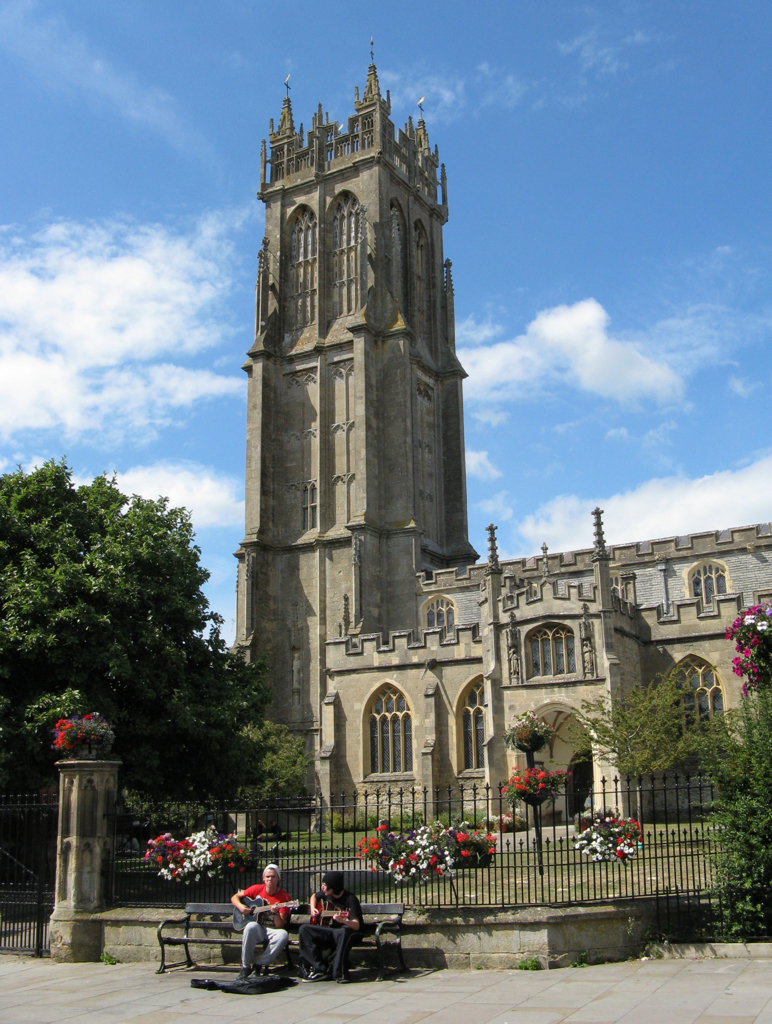
St John the Baptist Royston is a few miles south west of my home town and close to Barnsley. From a rather high and dry Anglo-Catholic tradition it had moved by the late 1980s to a thoughtful modern rite Anglican Catholic style, and it was the focal point for people to gather to go on the local coach to the Anglican National Pilgrimage to Walsingham on Spring Bank Holiday Monday. The church is mainly fifteenth century, and its most noteworthy feature the charming, and almost unique, feature of the oriel window on the west tower:

photo
 
 St John the Baptist Royston

Image:woodytyke's photostream on Flickr

To the west lies the great church of St John the Baptist at Halifax. It is also a largely fifteenth century building at the centre of what was the largest parish in the country. In 1879 it nearly became the cathedral of what was in 1888 became the diocese of Wakefield, and since 2009 it has rejoiced in the status of a Minster. As a building it is a tribute to the piety and prosperity of the Halifax clothiers of the late middle ages, and its rather dour style captures something of the area in which it is situated. There is a good online account of it and its contents here.


Halifax parish church
The church was mainly built by 1438, and the tower 1449-82


Image: Wikipedia

It was at a Walsingham day of devotion in the church - its usual churchmanship is Broad Church - that I first served at Benediction.

Another monument to the medieval cloth industry is the great church of St John the Baptist in Cirencester in Gloucestershire, which I have visited on holiday in the area. More delicate and sophisticated in detail than Halifax it is the largest parish church in the county it too is a celebration of the prosperity of the town even as the cloth trade moved out into the surrounding Cotswold villages.
There is an online introduction to the church here.  


The interior of Cirencester parish church
 
Image: Wikimedia

Further to the south west, in Somerset, is St John the Baptist at Glastonbury. I used to visit this splendid example of the local style when I used to go on retreat to Glastonbury in the late 1980s and early 1990s, and in 1996, when I spent Christmas in the town, I saw specimens of the Glastonbury Thorn which grow in the churchyard in flower. The church contains a gremial that belonged to the Abbots of Glastonbury and some interesting tombs, including one of a fifteenth century bursar of the abbey called Camelford, with splendidly realistic camels carved on his alabaster tomb.


St John the Baptist Glastonbury
The mid to late fifteenth century tower is attributed to Abbot John Selwood.
The Thorn is to the right of the porch.

Image: Wikipedia


Turning to the north west  there is the remarkable and little known church of St John the Baptist at Chester. There is an account of it here. There was a church here, outside the Roman walls of the city, by 973 when King Edgar, following his coronation at Bath, was ceremonially rowed along the Dee from the city to the church by his various under-kings from the British Isles. The present building was begun in 1075 as the cathedral to replace Lichfield but  it fairly soon lost out to the abbey in Coventry, and from the twelfth century until the reformation it served as a pro- or co- cathedral, with a collegiate chapter, for the diocese of Coventry and Lichfield. When the new diocese of Chester was created in 1541 its cathedral was established in the former abbey of St Werbergh. With the dissolution of the college it became a parish church, the choir was demolished and in 1881 the north west tower collapsed, and was not, very regrettably, rebuilt. What remains is nonetheless an eloquent and fascinating building, a case of what was and what might have been.


photo

The interior of St John Chester
Image: Chester Close's photostream on Flickr

photo

The nave looking east
Image: Paul McClure DC's photostream on Flickr

Finally, but still in the old diocese of Coventry and Lichfield, is St John the Baptist Tideswell.  Again a later medieval rebuilding from the fourteenth and fifteenth centuries, there is more about it here
Tideswell church web.jpg

Tideswell church
I
mage:chaplog.co.uk
There are more photographs of the church hereand information about the town here.

As a possession of the Dean and Chapter of Lichfield the church was drawn into the local gangwarfare between local factions in the fourteenth century, as described by my (maternal) second cousin J.G. Bellamy in his Crime and Public Order in Later Medieval England. In the sixteenth century it featured in the lives of the martyrs
Blessed Nicholas Garlick and Blessed Christopher Buxton, who studiesd at Tideswell Grammar school under Nicholas Garlick.

My paternal grandmother was born at Tideswell  in the 1860s and, I assume, baptised in the church. One of my cousins remembers her recalling when she was a girl the difficulties some ladies had found when entering the pews in the church because of  their crinolines.

These are just six, if particularly fine, medieval churches, all very well worth a visit in themselves, but all also a reminder that every historic church is worthy of a visit and study.