Once I was a clever boy learning the arts of Oxford... is a quotation from the verses written by Bishop Richard Fleming (c.1385-1431) for his tomb in Lincoln Cathedral. Fleming, the founder of Lincoln College in Oxford, is the subject of my research for a D. Phil., and, like me, a son of the West Riding. I have remarked in the past that I have a deeply meaningful on-going relationship with a dead fifteenth century bishop... it was Fleming who, in effect, enabled me to come to Oxford and to learn its arts, and for that I am immensely grateful.


Showing posts with label St Augustine. Show all posts

Monday, 7 December 2015

St Ambrose


John Dillon posted on the Medieval Religion discussion group the following for today. I have added a few comment in [ ]:

In the Roman Calendar and in Ambrosian Calendar December 7th is the feast day of Ambrose of Milan (d. 397). Not to be confused with the Blessed Ambrose of Milan (Franciscan; d. 1525), this Ambrose is a Saint and a Doctor of the Church. A member of the imperial aristocracy, he was governor of Milan when he was elected bishop of that city in 374. Ambrose became an extraordinarily influential preacher, theologian, and ecclesiastical administrator. Along with St. Augustine of Hippo (whom he baptized) and St. Jerome he is one of the great western Christian churchmen of the fourth century.

Ambrose's dies natalis is 4. April (his feast day in the ninth-century martyrologies of St. Ado of Vienne and Usuard of Saint-Germain) but today, the anniversary of his consecration as bishop, was his feast day in some places since at least the ninth century, though what it represented was not always perfectly understood (the earlier ninth-century Marble Calendar of Naples describes it as the day of Ambrose's laying to rest). In the medieval Greek church today was Ambrose's feast day in both the later tenth-century Metaphrastic Menologion and the initially tenth- and eleventh-century Synaxary of Constantinople, as it also is now in some but not all Byzantine-Rite churches. Today was also Ambrose's principal feast day in the late medieval breviary of the Roman curia and from there the commemoration was continued in the later sixteenth-century Tridentine Calendar (as well of course as in the late sixteenth-century Roman Martyrology that was built around it).

An English-language translation of Ambrose's Vita by his former secretary Paulinus of Milan, written in Roman Africa at the behest of St. Augustine of Hippo, is here:
http://www29.homepage.villanova.edu/christopher.haas/Life%20of%20Ambrose.html

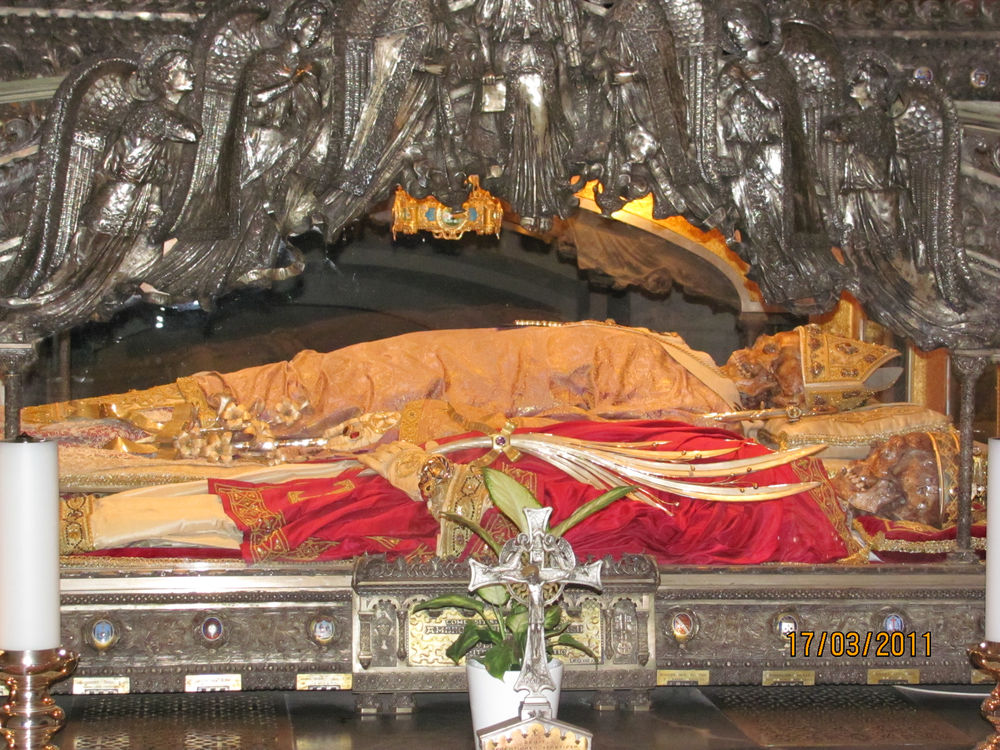
Skeletal remains believed to be those of St. Ambrose repose between those of Sts. Gervasius and Protasius in the cripta di Sant'Ambrogio in Milan's basilica di Sant'Ambrogio (the martyrs in red, Ambrose in white):


Supplementing Gordon Plumb's post from earlier today:

Wells Cathedral, SIII, 2b-3b, 2nd. qr. 14thC.:
https://www.flickr.com/photos/22274117@N08/14786023498

Bourges, Cathédrale Saint-Étienne, Bay 35, figure on right, c.1462:
https://www.flickr.com/photos/22274117@N08/4257386374

herewith are some links to other period-pertinent images of St. Ambrose of Milan:

a) as depicted in a restored fifth-century mosaic portrait in the basilica di Sant'Ambrogio's sacello di San Vittore:
http://www.atlantedellarteitaliana.it/immagine/00007/3858OP6466.jpg
http://tinyurl.com/2875f6x

b) as portrayed in relief in three panels on the rear side of the earlier to mid-ninth-century Golden Altar ("Pala d'Oro"; between 824 and 859, restored in 1966) in Milan's basilica di Sant'Ambrogio:
1) the miracle of the bees:


2) journeying on horseback from Liguria to Emilia:


http://img.over-blog-kiwi.com/0/54/79/43/20140626/ob_13819b_image5.jpg
3) blessing the altar's maker, Magister Wolvinus (or Vuolvinus):


c) as depicted lower register) in an eleventh-century copy of his De bono mortis from Fécamp (Paris: BnF, ms. Latin 2639, fol. 31v):
http://tinyurl.com/y9rm62v

d) as depicted in an eleventh-century manuscript of writings of Church Fathers (Avranches, Bibliothèque d'Avranches, ms. 72, f. 182v):
http://www.enluminures.culture.fr/Wave/savimage/enlumine/irht4/IRHT_074884-p.jpg

e) as depicted in a twelfth-century copy of his Hexaemeron (Charleville-Mézières, Médiathèque Voyelles, ms. 212, t. III, fols. 1-88v, fol. 1r):
http://www.enluminures.culture.fr/Wave/savimage/enlumine/irht6/IRHT_096061-p.jpg

f) as portrayed (at left) in a twelfth-century relief on Milan's Porta Romana:


g) as portrayed in a relief on the earlier twelfth-century west front of Milan's basilica di Sant'Ambrogio:

San Ambrogio


h) as depicted in the mid- or slightly later twelfth-century mosaics of the Cappella Palatina in Palermo:


http://tinyurl.com/3s9uolg

i) as depicted in one of four panels of a full-page illumination in the late twelfth-century so-called Bible of Saint Bertin (c. 1190-1200; Den Haag, KB, ms. 76 F 5, fol. fol. 38v, sc. 1A):
http://manuscripts.kb.nl/zoom/BYVANCKB%3Amimi_76f5%3A038v_min_a1

j) as depicted in two late twelfth-century panels (c. 1180) in a mostly early thirteenth-century composite window in the cathedral of St.-Étienne in Le Mans (photographs by Gordon Plumb):
1) St. Paul in a vision tells the sleeping Ambrose where to find the bodies of Sts. Gervasius and Protasius:
http://www.flickr.com/photos/22274117@N08/2209088732/
2) Ambrose (nimbed) and a brother bishop unearth the bodies of Sts. Gervasius and Protasius:
http://www.flickr.com/photos/22274117@N08/4714852210/

k) as depicted as depicted in a panel of a mid-thirteenth-century glass window (c. 1245-1250; w. 207) in Strasbourg's cathédrale Notre-Dame:


l) as portrayed in relief on a later thirteenth- or early fourteenth-century grosso of eight denari issued by the first Ambrosian Republic (i.e. communal Milan; 1250-1310):
https://www.numisbids.com/n.php?p=lot&sid=323&lot=197

m) as depicted (at right, barring the emperor Theodosius from the cathedral of Milan) in a late thirteenth-century copy of French origin of the Legenda aurea (San Marino, CA, Huntington Library, ms. HM 3027, fol. 47r):
http://digitalassets.lib.berkeley.edu/ds/huntington/images//000866A.jpg

n) as portrayed (flanked by Sts. Gervasius and Protasius) in a fourteenth-century statue on Milan's Pusterla di Sant'Ambrogio:


o) as depicted in the earlier fourteenth-century frescoes (c. 1312-1321) in one of the little domes of the monastery church of the Theotokos at Gračanica in, depending on one's view of the matter, either Serbia's province of Kosovo and Metohija or the Republic of Kosovo:
http://tinyurl.com/ydtx5b7

p) as depicted (upper roundel) in the earlier fourteenth-century frescoes (1330s) of the church of the Hodegetria in the Patriarchate of Peć at Peć in, depending on one's view of the matter, either the Republic of Kosovo or Serbia's province of Kosovo and Metohija:
http://tinyurl.com/ygxkvuw

q) as depicted (at left; at right, St. Patapius) in a December calendar composition in the earlier fourteenth-century frescoes (between 1335 and 1350) in the narthex of the church of the Holy Ascension at the Visoki Dečani monastery near Peć in, depending on one's view of the matter, either the Republic of Kosovo or Serbia's province of Kosovo and Metohija:
http://tinyurl.com/yaswkw7

r) as depicted in a mid-fourteenth-century glass window panel (c. 1340-1350) from Kärnten, now in The Cloisters collection of the Metropolitan Museum of Art in New York:

Saint Ambrose


s) as depicted (the miracle of the bees) in a mid-fourteenth-century copy, from the workshop of Richard and Jeanne de Montbaston, of the Legenda aurea in its French-language version by Jean de Vignay (1348; Paris, BnF, ms. Français 241, fol. 98r):
http://tinyurl.com/ygb8up7

t) as depicted by Vitale da Bologna in a mid-fourteenth-century panel painting (between 1350 and 1353) in the Pinacoteca of the Musei Civici in Pesaro:


v) as portrayed in a statuette and in two panels on St. Augustine's later fourteenth-century tomb in Pavia's basilica di San Pietro in Ciel d'Oro:
1) statuette (second from left; photograph by Genevra Kornbluth):
http://www.kornbluthphoto.com/images/Pavia_249.jpg
Detail (bust):
http://tinyurl.com/24nqhle
2) panel (upper register at right, preaching; Augustine among the listeners):
http://tinyurl.com/2cft8mj
3) panel (at left, officiating at at Augustine's vesting):
http://tinyurl.com/37xxotc
Views of these objects in stronger light will be found at Genevra Kornbluth's Archive page on the Arca di Sant'Agostino:
http://www.kornbluthphoto.com/Arca.html

w) as depicted (at right, barring the Emperor Theodosius from the cathedral of Milan) in a later fourteenth-century copy (c. 1370-1380) of Vincent of Beauvais' Speculum historiale in its French-language version by Jean de Vignay (Paris, BnF, ms. Nouvelle acquisition française 15943, fol. 58r):
http://gallica.bnf.fr/ark:/12148/btv1b8449689s/f123.highres

x) as depicted (at far left) by Niccolò di Pietro Gerini in one of four late fourteenth-century panel paintings of the Doctors of the Church (c. 1380) used for the altarpiece in the cappella maggiore of Florence's basilica della Santa Croce:


y) as portrayed (in the lower right-hand corner) by Pietro di Puccio in his late fourteenth-century mosaic (1388; heavily restored) on the facade of Orvieto's basilica cattedrale di Santa Maria Assunta:


z) as depicted (reading) in a late fourteenth- or early fifteenth-century copy of the _Legenda aurea_ in its French-language version by Jean de Vignay (Rennes, Bibliothèque de Rennes Métropole, ms. 266, fol. 105r):
http://tinyurl.com/q3pz84h

aa) as portrayed in high relief (in his study) by Lorenzo Ghiberti in a panel of his early fifteenth-century north doors for the baptistery in Florence:
http://tinyurl.com/yz6jvxn

bb) as depicted (at right; at left, St. Augustine of Hippo) as depicted by Filippo Lippi in an earlier fifteenth-century panel painting (c. 1440) in the Accademia Albertina di Belle Arti, Turin:


cc) as portrayed in relief on a mid-fifteenth-century grosso agontano issued by the second Ambrosian Republic (1447-1450):


dd) as depicted (at right, baptizing St. Augustine) in a mid-fifteenth-century copy of Giovanni Colonna's Mare historiarum (between 1447 and 1455; Paris, BnF, ms. Latin 4915, fol. 277v):
http://gallica.bnf.fr/ark:/12148/btv1b6000905v/f624.item.zoom

ee) as depicted by Giovanni di Paolo in a later fifteenth-century panel painting (c. 1465-1470) in the Metropolitan Museum of Art, New York:

Saint Ambrose


[ Note the use of pearls to decorate the mitre. The emblematic whip - coming from the pen#aence he imposed on Theodosius - is an earlier form of the cat o'nine tails]

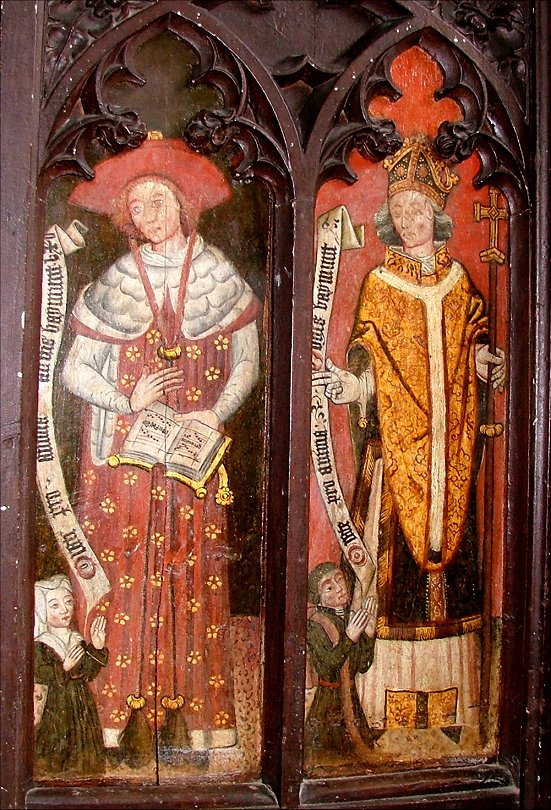
ff) as depicted (at right; at left, St. Jerome) on the late fifteenth-century rood screen in the church of St Thomas, Foxley (Norfolk):


gg) as depicted (at far right) by Michael Pacher on his late fifteenth-century Fathers of the Church altarpiece (c. 1483) in the Alte Pinakothek, Munich:


http://www.wga.hu/art/p/pacher/various/2father1.jpg

hh) as depicted (at left; at right, St. Augustine) by Giovanni Masone in a late fifteenth-century panel painting (Genoa, 1491) in the Musée Jacquemart-André, Paris:


ii) as depicted (left margin at top) in a hand-coloured woodcut in the Beloit College copy of Hartmann Schedel's late fifteenth-century Weltchronik (Nuremberg Chronicle; 1493) at fol. CXXXIIIIv:
http://www.beloit.edu/nuremberg/book/6th_age/left_page/38%20%28Folio%20CXXXIIIIv%29.pdf

jj) as depicted (second from left) by Carlo Bracceso in a late fifteenth-century panel painting (ca. 1495) in the Galleria Franchetti, Ca' d'Oro, Venice:
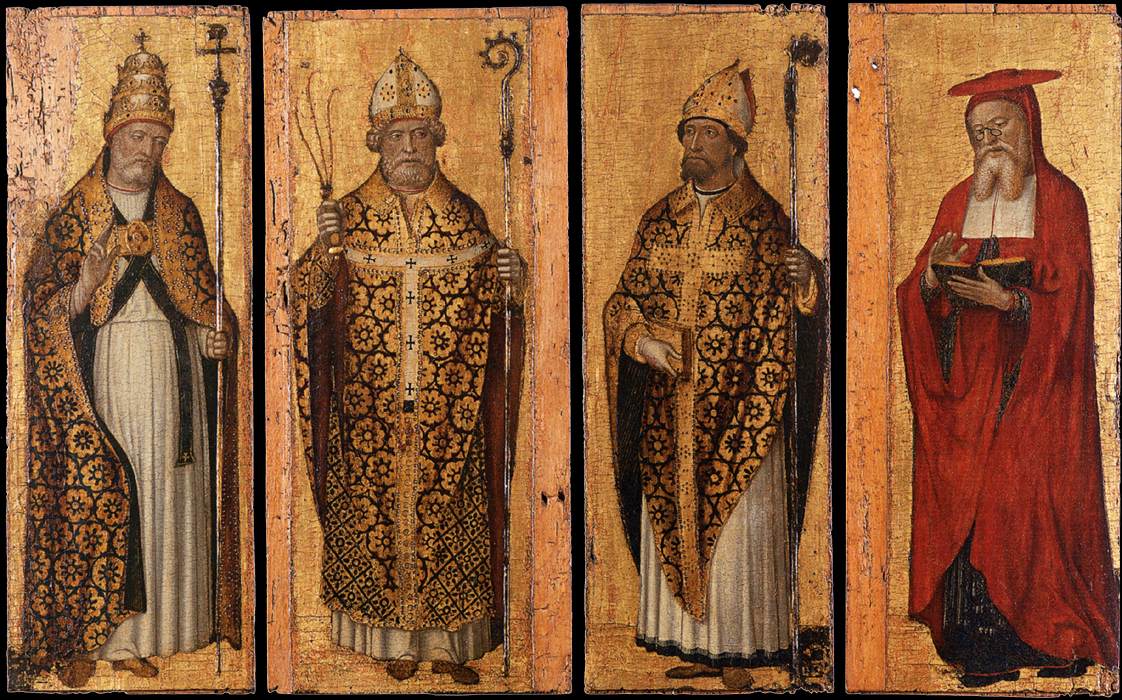


[I like the idea of unity of doctrine expressed in the same textile being worn in their vestments by SS Gregory, Ambrose and Augustine. I also  like St Jerome's pince nez ]

kk) as portrayed (in his study) in a late fifteenth- or early sixteenth-century wooden statue with traces of paint (c. 1500) from Palencia in The Cloisters collection of the Metropolitan Museum of Art in New York:

Saint Ambrose in His Study


Monday, 24 June 2013

The Nativity of St John the Baptist


Today is the Solemnity of the Nativity of St John the Baptist, and by tradition Midsummer Day - displacing a pagan festival. The Nativity of St John is one of only three births to be commemorated liturgically - the others are, of course, those of Our Lord and Our Lady. St John has this honour because he is understood to have been pre-santified in the womb of St Elizabeth.

At the Oxford Oratoty last night we had the first Vespers of the Nativity, followed by the Vigil Mass, to begin the observance of the Solemnity.

I have noted in previous posts the point made to me by an Oratorian that whereas in the medieval period devotion to St John was widespread and he frequently appeared in paintings, sculpture and as a patron of churches and other foundations, today his cultus has largely disappeared from popular conciousness. As I think about it church dedications to him may well have developed from the twelfth century in England, rather than earlier, although clearly St John's Chester appears to have had the dedication to him by 973.


St. John the Baptist - El Greco, 1600

Fine Arts Museums of San Francisco
Image:WikiPaintings

Most post-medieval depictions of St John seem to me to lack the spiritual insight of medieval ones. However this painting by El Greco does I think, capture the continuing spirit of medieval devotion, and, I sense, reflects a particular feature of spiritual continuity in the Spain of the reign of King Philip II - late-medieval Catholicism had flowed in an undisturbed stream into the post-Tridentine expression of it.

From a sermon by St Augustine appointed for today's Office of Readings:

" The Church observes the birth of John as in some way sacred; and you will not find any other of the great men of old whose birth we celebrate officially. We celebrate John’s, as we celebrate Christ’s. This point cannot be passed over in silence, and if I may not perhaps be able to explain it in the way that such an important matter deserves, it is still worth thinking about it a little more deeply and fruitfully than usual.

John is born of an old woman who is barren; Christ is born of a young woman who is a virgin. That John will be born is not believed, and his father is struck dumb; that Christ will be born is believed, and he is conceived by faith.

I have proposed some matters for inquiry, and listed in advance some things that need to be discussed. I have introduced these points even if we are not up to examining all the twists and turns of such a great mystery, either for lack of capacity or for lack of time. You will be taught much better by the one who speaks in you even when I am not here; the one about whom you think loving thoughts, the one whom you have taken into your hearts and whose temple you have become.

John, it seems, has been inserted as a kind of boundary between the two Testaments, the Old and the New. That he is somehow or other a boundary is something that the Lord himself indicates when he says, The Law and the prophets were until John. So he represents the old and heralds the new. Because he represents the old, he is born of an elderly couple; because he represents the new, he is revealed as a prophet in his mother’s womb. You will remember that, before he was born, at Mary’s arrival he leapt in his mother’s womb. Already he had been marked out there, designated before he was born; it was already shown whose forerunner he would be, even before he saw him. These are divine matters, and exceed the measure of human frailty. Finally, he is born, he receives a name, and his father’s tongue is loosed.

Zachary is struck dumb and loses his voice, until John, the Lord’s forerunner, is born and releases his voice for him. What does Zachary’s silence mean, but that prophecy was obscure and, before the proclamation of Christ, somehow concealed and shut up? It is released and opened up by his arrival, it becomes clear when the one who was being prophesied is about to come. The releasing of Zachary’s voice at the birth of John has the same significance as the tearing of the veil of the Temple at the crucifixion of Christ. If John were meant to proclaim himself, he would not be opening Zachary’s mouth. The tongue is released because a voice is being born – for when John was already heralding the Lord, he was asked, Who are you and he replied I am the voice of one crying in the wilderness.

John is the voice, but the Lord in the beginning was the Word. John is a voice for a time, but Christ is the eternal Word from the beginning."


I see from an article in The Times today about Midsummer Day that although it is not the longest day - that was three days ago - it is the day with the latest sunset. This is a consequence of the elliptical orbit of earth around the Sun. Similarly the day with the earliest sunrise is June 17th or 18th. According to farming folklore rain on Midsummer Day was deemed to be unlucky as it portended a wet harvest.

As afeast in the pre- hrvest season and when the days were at their longest it was asuitable one for popular gatherings such as the meeting of Tynwald in the Isle of Man, at the parish of St John's, but the 1752 calendar correction meant that Tynwald Day is now on July 5th, so as to keep a full legal year.

I have posted previously about the cult of St John the Baptist in


Sunday, 17 February 2013

The Temptation of Christ


I was particularly struck by the second reading in today's Office of Readings - it provides considerable food for thought, an ideal piece to reflect upon in doing lectio divina, and so I thought I would post it for others to reflect upon if they are so inclined.


St Augustine
Sandro Botticelli, 1480

Image: wikipedia
The lection is taken from a commentary on the psalms by Saint Augustine of Hippo, and is about Ps 60, vv2,3:

In Christ we suffered temptation, and in him we overcame the Devil

Hear, O God, my petition, listen to my prayer. Who is speaking? An individual, it seems. See if it is an individual: I cried out to you from the ends of the earth while my heart was in anguish. Now it is no longer one person; rather, it is one in the sense that Christ is one, and we are all his members. What single individual can cry from the ends of the earth? The one who cries from the ends of the earth is none other than the Son’s inheritance. It was said to him: Ask of me, and I shall give you the nations as your inheritance, and the ends of the earth as your possession. This possession of Christ, this inheritance of Christ, this body of Christ, this one Church of Christ, this unity that we are, cries from the ends of the earth. What does it cry? What I said before: Hear, O God, my petition, listen to my prayer; I cried out to you from the ends of the earth.’ That is, I made this cry to you from the ends of the earth; that is, on all sides.

Why did I make this cry? While my heart was in anguish. The speaker shows that he is present among all the nations of the earth in a condition, not of exalted glory but of severe trial.

Our pilgrimage on earth cannot be exempt from trial. We progress by means of trial. No one knows himself except through trial, or receives a crown except after victory, or strives except against an enemy or temptations.

The one who cries from the ends of the earth is in anguish, but is not left on his own. Christ chose to foreshadow us, who are his body, by means of his body, in which he has died, risen and ascended into heaven, so that the members of his body may hope to follow where their head has gone before.
 
He made us one with him when he chose to be tempted by Satan. We have heard in the gospel how the Lord Jesus Christ was tempted by the devil in the wilderness. Certainly Christ was tempted by the devil. In Christ you were tempted, for Christ received his flesh from your nature, but by his own power gained salvation for you; he suffered death in your nature, but by his own power gained glory for you; therefore, he suffered temptation in your nature, but by his own power gained victory for you.

If in Christ we have been tempted, in him we overcome the devil. Do you think only of Christ’s temptations and fail to think of his victory? See yourself as tempted in him, and see yourself as victorious in him. He could have kept the devil from himself; but if he were not tempted he could not teach you how to triumph over temptation.


Note: I have copied the text from the Universalis website, and I have the impression that this is a slightly shortened version from that contained in the printed Divine Office, but I may be wrong on that point.


Tuesday, 28 August 2012

St Augustine's Hedon


St Augustine is not very frequently invoked as a patron saint by English medieval churches, although he became more popular in the nineteenth century. The outstanding medieval church under his patronage is that at Hedon in the East Riding of Yorkshire. There is something about it here.

The town of Hedon is a charming one and in the little known region of Holderness. There is something of the history of this ancient port and borough on the banks of the Humber on the town council's website which can be viewed here. Together with neighbouring towns and villages it is an area well worth exploring if you have an interest in medieval churches - some of which are really superb - or if you are seeking a tranquil, slightly old fashioned England. Philip Larkin describes some of these churches and their setting very well in one of his poems. As buildings they bear witness to the trading wealth of the medieval Humber and the cornlands of Holderness.

Although the town was continually losing out to its much bigger neighbour Kingston upon Hull during the fourteenth and fifteenth centuries  and the haven silted up, it still managed as a parish to complete the wonderful church, sometimes referred to as the King of Holderness, with this great central tower.

St. Augustine, Hedon

St. Augustine, Hedon  from the south east.

The tower has a ring of eight bells, the tenor bell weighing 17cwts 1qr 19lb.

Image: © Copyright Stephen Horncastle and licensed for reuse under this Creative Commons Licence.


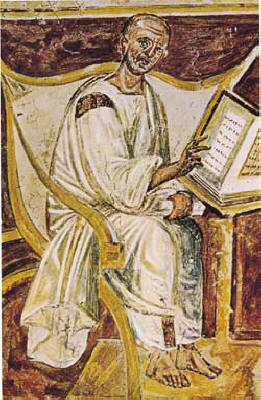
St Augustine


Saint Augustin
This picture, thought to be of St Augustine, is in a Lateran fresco from the late 6th century, and is thought to be the earliest surviving portrait of the saint.

Inscription under the fresco:
DIVERSI DIVERSA PATRES SED HIC OMNIA DIXIT
ROMANO ELOQVIO MYSTICA SENSA TONANS
(Various Fathers spoke about various things, but this one said it all, Proclaiming forcefully in the Roman tongue the mystical senses [of the scriptures] )

Image: Fribourg University

Friday, 27 May 2011

What would St Augustine say?


Today, according to the modern calendar, is the feast of St Augustine of Canterbury . He died on May 26th 605.


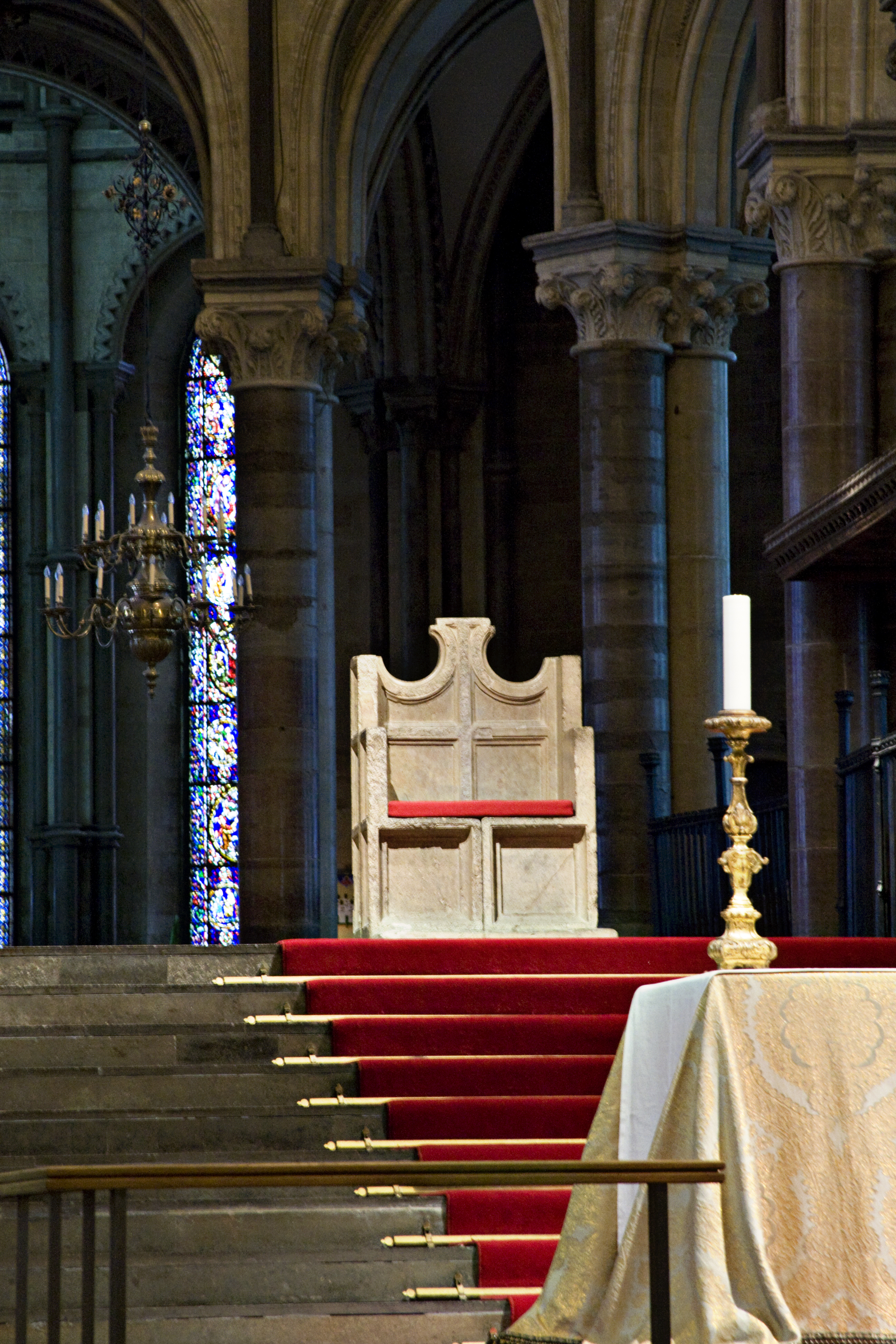
The throne of St Augustine in Canterbury Cathedral

I am tempted to ask the rhetorical question as to what St Augustine would have said about the Ordinariate. Well, the answer is, I think, clear. More particularly I raise the point because of the story of St Augustine's meeting with the British bishops. In adavnce they decided that they would respond positively to what Augustine said if he stood up to receive them, negatively if he did not. Augustine remained seated, and dialogue did not happen. The British bishops, whose community had been formed in large part by reaction to pagan Anglo-Saxons invadors, whom they appear not to have tried to convert, left and headed back to the ever more remote west.

Fourteen centuries later Rome has again made advances to the British clergy of their day, and, metaphorically at least, has stood up to be welcoming. Notwithstanding that I fear that too many clergy and laity may be making the same mistake as those British bishops they sometimes invoke as their patrimony, and not responding positively.

Pre-Augustinian British Christianity was Roman in orgin, and here was a man with a message sent from Rome. Pre-Reformation, pre-Laudian, pre-Tractarian and pre- Ordinariate English and British Christianity was and is Roman in origin, and here are men with a message sent from Rome. Are not the inevitable inferences to be drawn?


Wednesday, 7 July 2010

St Augustine and Anglicans


Whilst finding today's readings in the Divine Office I was struck by yesterday's second reading at Matins - I had read that proper for St Maria Goretti rather than the ferial one. That is from St Augustine's Discourses on the Psalms. In it he addressed as brothers those outside full communion, and sought ecclesial reconciliation with them. He was obviously thinking of the Donatists of his day, but the passage seemed highly relevant to contemporary concerns.

File:Augustine Lateran.jpg
The earliest surviving depiction of St Augustine - a sixth century painting from the Lateran

Next week the General Synod of the Church of England is due to debate further the plans to consecrate women bishops, and this may prove to be the crucial meeting in that process as far as traditional Anglo-Catholics are concerned - but then, it may not. Nevertheless St Augustine's concern to bring into the one true fold those outside who shared so much with him was palpable, and appears apposite to the situation of not a few Anglicans today. I hope and pray that contemporary Catholics share the same concern for ecclesial unity, and do all they can to bring those who think as they do into full peace and communion. I rather fear too many Catholics do not understand the experience of traditional Anglo-Catholics, and are inclined to see Anglicanism as possessing a coherence it has not possessed since at very least the time of the Tractarians

Wednesday next week is also the 177th anniversary of John Keble's sermon which was seen by Newman and others as inaugurating the Oxford Movement. As Newman approaches beatification this year let us do all we can to realise more fully that vision - by no means clear in 1833 - of the true unity of the Church. It was, of course, the similarities between the claims of Anglicans vis-a-vis Catholicism and those of dissident groups in the early Church which led Newman to begin to reconsider his position after 1839.