Once I was a clever boy learning the arts of Oxford... is a quotation from the verses written by Bishop Richard Fleming (c.1385-1431) for his tomb in Lincoln Cathedral. Fleming, the founder of Lincoln College in Oxford, is the subject of my research for a D. Phil., and, like me, a son of the West Riding. I have remarked in the past that I have a deeply meaningful on-going relationship with a dead fifteenth century bishop... it was Fleming who, in effect, enabled me to come to Oxford and to learn its arts, and for that I am immensely grateful.


Showing posts with label Ordinariate. Show all posts

Saturday, 14 November 2015

Ordinariate Acolytes


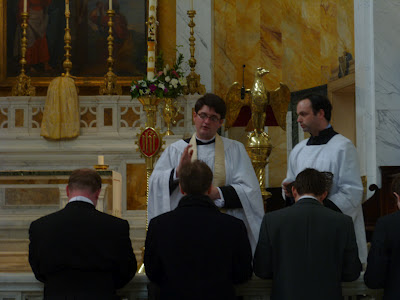
Earlier this evening I attended the Ordinariate Mass at Holy Rood here in Oxford at which Jonathan Creer and Thomas Mason were admitted as Lectors and Acolytes by the Ordinary, Mgr Keith Newton.

Jonathan and Thomas are now studying at Oscott, but in addition to some students from there who had come to support them there were Oratorians, Dominicans and Franciscans sitting in choir who were their fellow students at Blackfriars in previous years.

The Mass was well attended and it was an opportunity to see the Ordinary celebrate in pontificals the Ordinariate Rite.

At the reception afterwards it was an opportunity to congratulate the new Lectors-Acolytes and to catch up with friends.

Friday, 27 June 2014

Why are they waiting?


Fr Hunwicke has an interesting post reflecting on those Anglicans who indicated they sought full communion with the Holy See, but who went very quiet and stayed put when Anglicanorum Coetibus actually appeared. It can be read at The Parting of Friends.

I m particularly interested by his seven diocesan bishops (Note the number - an Anglican phenomenon is such circumstances perhaps?) plus two others whi secretly indicated their desire for reconciliation. Whilst I appreciate Fr John's concern that those who do eventually join the Roman obedience should be made welcome with no public remarks of "What took you so long?" and the like, I am intrigued by these episcopal aspirants. Maybe Fr HUnwicke should name and shame them if they do not make the move after next month's General Synod vote on Women Bishops.

I can understand why people may have waited in the past. There were, or are, often good reasons - responsibility for a parish or church be you cleric or lay, the need for econonmic security for clergy and their families and such like. Some may wonder why I waited as long as I did. My answer is that I went when I was called to do so. I would add that having received the call I did move, but more on that in the next post.


Thursday, 29 May 2014

Oak Apple Day


In addition to being Ascension Day this year May 29th is always Oak Apple Day, the anniversary of entry on his thirtieth birthday of King Charles II into London in 1660, and seen as the symbolic date of the Restoration. 

Samuel Pepys recorded that "Parliament had ordered the 29 of May, the King's birthday, to be for ever kept as a day of thanksgiving for our redemption from tyranny and the King's return to his Government, he entering London that day." Until 1859 it was observed as a public holiday, and I see no reason for not re-instating it - the average churlish republican (and you have to be churlish to be a republican in my opinion...) is not going to look too good opposing a public holiday.

One year I did manage to get some oak leaves to wear on May 29th - not that that was as easy as getting arose for St George's day.


Image;calendarcustoms.com

Maybe the Church of England, which would not have itself been restored without the Restoration settlement, should re-introduce in Common Worship the special service of thanksgiving for May 29th which was was removed from the Book of Common Prayer in 1859. Given that King Charles II died a Catholic, and showed himself favourable to Catholicism, it could be restored as Anglican patrimony in the Ordinariate.

There is an online account, with links, of surviving commemorations of Oak Apple Day here. In Worcester the day is still marked by decorating the Guildhall gates and railings with oak leaves.Worcester was named as “the faithful city” for its Royalist allegiance during the Civil Wars. The celebrations at Worcester are illustrated, and others at Northampton, Castleton (which is surely a much older tradition converted into a celebration of the Restoration and Aston-on-Clun are all covered in the blogpost Oak Apple Day by Elizabeth Hanbury, which also refers to other surviving celebrations.


The oak is a reference of course to the King hiding in the oak tree at Boscobel House in Shropshire during his flight after the battle of Worcester in 1651. The oak tree where King Charles hid at Boscobel is not the original but is a direct descendant of the original. there is more about it at Royal Oak.

https://blogger.googleusercontent.com/img/b/R29vZ2xl/AVvXsEieZT4CuzO0mmoY_zw8bKhU_YEghAKYBZOV7w1m37HeHQzsKCJom3ptyM2dXmY66gM98SLlmndvpSI6JDLUqTwIS6KMzYDK_MOxtqVZ_EL2f9udN-FGbBD-fNz_RABV6NNz0BrG4FogxDc/s1600/ROYAL_OAK_BOSCOBEL.jpg

The Royal Oak at Boscobel

Image: Ana the Imp


Happy Oak Apple Day!

Saturday, 5 April 2014

New Ordinariate Liturgical Book


Earlier this evening at Holy Rood after the Ordinariate Mass I was shown the new volume of Divine Worship: Occasional Servives produced by the Catholic Truth Society for the three Ordinariates.

Divine Worship - Occasional Services


Image:Catholic Truth Society

This provides liturgies for baptisms, weddings and funerals, and is extremely handsomely produced - a good quality volume,  clear typeface and on excellent paper, bound in red with the ancient Canterbury cross on the cover and complete with gilt edges. It also uses illustrations by Martin Travers (1886-1948), who undertook many commissions for Anglo-Catholics in the tradition of the Society of SS Peter and Paul. There is an introduction to his work here.

If the Ordinariate Missal is produced in a similar style - and we assume it will be - then these will be dignified and beautiful books to assist the celebration of the Ordinaraite liturgy. CTS are to be congrtaulated on their work on this project.

Monday, 31 March 2014

Nine years peace and full communion


Nine years ago today I was received into full peace and communion with the Catholic Church in the Oxford Oratory. As is my habit on this significant personal anniversary I am re-posting my reasons for that decision and also some of my reflections on the subsequent years. I do not think I have anything to add to what I wrote last year, so to read something of my spiritual history - or to re-read it if you have done so before - follow the link to the post from twelve months ago Eight years in peace and full communion.

Friday, 28 March 2014

Fr Longenecker on the Ordinariates


I saw on the Zenit website an interesting and forceful piece by Fr Dwight Longenecker about the place of the Anglican Ordinariates in the contect both of the ARCIC discussions and of the future of Ecumenical schemes. He sees the Ordinariates as a rather surprising fruit of the Anglican-Catholic dialogue, and as offering real hope for drawing people into the Catholic Church. His article, which is trenchent and not afraid of being blunt about both communions,  can be read at A-new-ecumenism.


Saturday, 15 February 2014

Septuagesima


Tomorrow is in the Usus Antiquior Septuagesima Sunday, and the beginning of the Pre-Lent season - and in some circumstances of the Lenten fast. There is an online introduction to the history and practice of Septuagesima here. I wrote last year about this season and the debate about its position in the liturgical year in The Season of Septuagesima.

My copy of the excellent St Andrew Missal (reprinted by the St Bonaventure Press) gives a good introduction to the development of this season, and explains it as originating in the liturgical themes of the three Sundays - the Fall, Noah and Abraham - and a consequential extension backwards of Lenten themes. One summary I have seen is that in Septuagesima we recognise that we are a fallen humanity, and in Lent by penitence we try to do something about it.


Image:wlms.blogspot.com


Earlier this evening I was at the Ordinariate Mass here in Oxford. In their calendar this weekend is called Septuagesiama, the next two Sundays have their traditional names. These terms were retained in the Book of Common Prayer, and have returned to the Catholic Church with the Ordinariate Use. 

However more than the name there is no change to Novus Ordo useage with this newly approved Use. The vestments are green not purple, the Gloria and Alleluia are not suppressed, and the readings are those of, this year, Sunday of Week 6 of Ordinary Time. Returning to the issue I linked to in my post Reform of the Reform or Reversal of the Reform? last week this is perhaps an indication of how far the Reform of the Reform could go at the moment. It is perhaps a pity that room for more provision of ancient uses has not been found with this liturgy. Maybe time will bring organic development.


Update Monday February 17th

The blog Rorate Caeli has this post about Septuagesima and its significance: Septuagesima: Christianity is as old as the world


Sunday, 31 March 2013

Eight years in peace and full communion


Today is the eighth anniversary of my reception into full peace and communion with the Church, and I am following my practice from previous years and reproducing a piece I wrote in my early days of blogging about my reasons for so doing, and in the form I published it last year with some slight emendations and additions.

It was Thursday in the Octave of Easter 2005, and chosen because it enabled friends and relatives who would not have been able to attend at the Easter Vigil to be present and, in one case, to be my sponsor.

I took as my confirmation name Philip - not only the name of the founder of the Oratory and of an Apostle, but also my father's first name and one that I had always liked. So John Robert became John Robert Philip. I subsequently went to the not inconsiderable expense of adding the name by deed poll, so I can insist on officialdom recognising my spiritual journey.

As it happened, by being received when I was, I thereby became one of the very last Catholics to be received into the Church in the pontificate of Pope John Paul II - I feel I squeezed through the door of history in that respect. There are those converts who used to describe themselves as "John Paul II Catholics" or similar phrases. I am, by historic fact and by sympathy a "Benedict XVI Catholic", but, and it is a very important "but", I am a Catholic first - Popes inevitably come and go. That said I consider it an enormous good fortune for the Church and, for me as an individual member of it, to have had His Holiness in the Chair of Peter. His pontificate has been a great blessing for the whole church. Much of what we have already heard from Pope Francis indicates continuity on expressing the faith as his predecessor did, and in bringing a serious Christian awareness to the current social and economic ills of the world.

As I made my decision to seek reception I codified my ideas into nine categories or groups. St Edmund Campion had his Decem Rationes which he placed so provocatively in St Mary's Church in Oxford in 1581. Mine are more personal perhaps, but, in that they may interest others, here are my Novem Rationes of 2005:

1. I believed all that the Catholic Church believed - so why was I not in full communion with it? I read the Catechism through and found nothing from which to dissent within it.

2. In particular I accepted the claims of the Papacy and its necessity in order to maintain orthodoxy and unity.

3. As a historian I appreciated the Catholic case for the nature of the Church and the Papacy, and the fact of its historical continuity - Walter Ullman's point that the Papacy is the one institution that links the Apostolic age to the Atomic age reverberates in my mind.

4. The call to Unity - not only the principal of Ut unum sint but also the specific claims to expressing that unity with all other Catholics through the Holy See as described by the Fathers.

5. The Catholic Church was seen to act on issues contingent upon Christian belief - Life issues might be the most obvious, but there were others, and with an authentic response being made.

6. I realised that my historic sympathies were with Catholicism - which side would I have been on, or at least believed I would have been on or wanted to be on in say, the Reformation? Well it was clear. My heart lay with the Catholic cause.

7. The state of Anglicanism was not encouraging. For Traditionalist Anglo-Catholics the situation was one of increasing isolation, and the sense that a Third Province would not be granted.

8. Much as I loved my Anglican places of worship - Pusey House and St Thomas in Oxford - I felt that I was called to move on. I was at an age when I still could make a change, but that there was not time to delay. If this was the time, then so be it.

9. I thought that many of my Anglican friends were moving or would move into full communion with Rome. Those friendships, based and rooted in a shared spiritual life, were very important to my own spiritual development, and they were pointing all in the same direction.

Looking back from this point, seven years later, I have never had cause to regret my decision. There is no "seven year itch."

I still endorse those nine sets of ideas.

The last three invite some additional comments.

The Church of England has continued on its way, and has failed to have the generosity to provide for Traditionalist Anglo-Catholics. The issue of women bishops remains unresolved and even more divisive it would seem in the wake of alst november's failure to vote the matter through the General Synod.

Anglicanorum Coetibus has been issued - I pray it will be successful in extending the unity of the Church to others of like faith and mind outside its formal bounds. Since 2011 we have witnessed the establishment of the Ordinariate first in England and more recently in the USA. I have been able to help to support those joining it by acting as a pro-sponsor in two cases, or simply by turning up to support their Masses, and, of course, by praying for it.

Summorum Pontificum reasserted the right to have traditional forms of the liturgy and it has been followed by a strong and positive response, and that needs to be continued - as has been said what was sacred once is sacred now.

I am still on excellent terms with friends from Pusey House and St Thomas', and I rejoiced at Fr Hunwicke's appointment to the latter in 2007. It has been good to see all that is happening at both institutions for the Catholic cause. It was very good for my humility that they could manage and survive without me. I retain enormously happy memories of my time at both places and at the churches I worshipped at in Yorkshire before I came to Oxford.

Nonetheless I increasingly find it difficult to see why more people in the Anglo-Catholic tradition are not availing themselves of all - and it is so much - that is offered by the Ordinariate. It is all they have ever said they wanted or indeed hoped for - bar, possibly, taking their church buildings with them, and though I can sympathise to a great extent, but not to the exclusion of what ultimately matters.

As to my friends - well, I was the second of our group to make the move, and three more had followed by last year. In the last two years two more married couples, one with three children, from that set of friends have made that same move. Four of the men have either been ordained or are preparing for ordination.

Along the way I have made many other new friends amongst those converting, and I have been made very welcome in my new spiritual home. I am extremely lucky to have the Oratory and also SS Gregory and Augustine and Blackfriars as places in which to worship regularly here in Oxford.

A friend and I likened the process of conversion and reception not to swimming the Tiber, but to paddling across - when we reached the opposite bank we found friends waiting in the deck-chairs to hand one a towel to dry one's feet and then to hand you a missal or breviary to read as you sat down to watch who would be next to come over.

May St Philip Neri, Bl. John Henry Newman and all the saints continue to pray for me, and for those seeking their home in the Church.


Wednesday, 2 January 2013

Ordinariate Epiphany Carol Service - January 10


Advance notice of a forthcoming event from the Ordinariate of Our Lady of Walsingham in the New Year:
A festival of carols and readings for the Epiphany of the Lord will be held on Thursday 10 January 2013 at the church of St Mary, Cadogan Street, London  (Nearest Tube station: Sloane Square) at 7pm. The celebration will mark the second anniversary of the establishment of the Personal Ordinariate of Our Lady of Walsingham and is being organised and hosted by the Friends of the Ordinariate.

Music at the service will be provided by the Schola Cantorum of the Cardinal Vaughan Memorial School, and readings will be taken from sacred scripture and the newly published Customary.

The Friends  are particularly pleased to welcome the Duke of Norfolk and a number of Catholic authors and journalists, who will read at the service. 

A special invitation is extended to those who are not members of the Ordinariate, but who wish to contribute to, and support, our life and mission in a particular way.


Tuesday, 1 January 2013

New Year, new beginnings


This morning eleven sisters from the Anglican Community of St Mary the Virgin at Wantage were received into the Ordinariate at the Oxford Oratory by the Ordinary, Mgr. Newton, and, together with a Sister from Walsingham who was received earlier, will form the Sisters of the Blessed Virgin Mary.

Unfortunately, being away from Oxford, I was unable to attend the Mass, but here are two posts from the Oxford Oratory website about the morning's events, including the sermon by the Provost, Fr Daniel Seward Cong.Orat., and a series of photographs which can be seen at The Reception into full Communion with the Catholic Church of the Sisters of the Blessed Virgin Mary and at More pictures from the Reception of the Sisters .

Friday, 12 October 2012

Ordinariate Conference November 9th


I have received this from the Ordinariate, and thought it might interest readers, though I regret that I doubt if I shall be free to attend myself.
 
I came to know and respect Fr Richardson when we used to meet in Oxford at Pusey House and elsewhere.

Photo: Charlotte Bromley Davenport
Join us as we look to the future, to growth in Christ and for his Church...
 
Inspired by the Year of Faith, which opened this week, the Personal Ordinariate of Our Lady of Walsingham is hosting a one day conference on mission and evangelisation for members and supporters of Pope Benedict’s vision for the reunion of Anglicans with the See of Peter.

The conference, which will take place at the church of St Patrick, Soho Square - itself described as ‘a beacon of hope’ for the New Evangelisation - will have keynote presentations from experienced ‘practitioners’, and the opportunity for discussion, questions, and answers.

Fr Allan Hawkins, Parish Priest of St Mary the Virgin in Arlington, Texas, is a former Anglican clergyman who was received into the Catholic Church and ordained under the Pastoral Provision of Blessed John Paul II. Since the advent of the Pastoral Provision, Fr Hawkins has grown and developed a Catholic parish community within the Anglican liturgical and spiritual tradition. Earlier this year it was announced that the parish will transfer to the Personal Ordinariate of the Chair of Saint Peter.

Fr Paul Richardson is a priest of the Archdiocese of Westminster. He was formerly Assistant Bishop of Newcastle in the Church of England, previously working in Norway, and as a missionary in Nambaiyfa, Papua New Guinea. He was Principal of Newton Theological College, Popondetta, Dean of Port Moresby, and subsequently Bishop of Aipo Rongo, Papua New Guinea, and later Bishop of Wangaratta in Australia.

A spokesman for the Ordinariate said, “This is an exciting opportunity for us and our supporters to begin to think in a strategic way about the development of our mission. We are integrated into the Catholic Church by virtue of our communion, but the Year of Faith presents us with an opportunity to think about the ways in which we can contribute - as the Personal Ordinariate of Our Lady of Walsingham - to the work of the New Evangelisation, claiming back these lands for Mary’s Dowry’.

The conference takes place on Friday 9 November 2012 from 11.00 a.m. to 4.30 p.m. All are welcome to attend. No charge is made, but a donation of £10 is requested, plus a further donation to help cover the cost of lunch, which will be provided. To register your interest, please email media@ordinariate.org.uk 

The conclusion of the conference will be a Solemn Mass, celebrated by the Ordinary, Mgr Keith Newton, according to the Book of Divine Worship - the Eucharistic liturgy drawn from the Anglican tradition, currently permitted for use in the Personal Ordinariates.

The programme for the day is as follows:
11.00 a.m. Coffee available11.30 a.m. First Session: Fr Allan Hawkins12.30 p.m. Q&A, discussion1.00 p.m. Lunch (provided, donations please)1.45 p.m. Second Session: Fr Paul Richardson2.45 p.m. Q&A, discussion3.15 p.m. Solemn Mass, celebrated by the Ordinary
Clergy wishing to assist in choir at the Mass should bring cassock, surplice/cotta, and white stole.

Monday, 14 May 2012

News from John Hunwicke


John Hunwicke of the Ordinariate group here in Oxford has some good News to report - read what he says. My continuing prayers and good wishes for him and Pam.

Thursday, 26 April 2012

First Blessings, First Masses


I now have some pictures of last weekend's first blessings and first Masses of  Fr James Bradley and Fr Daniel Lloyd.

Here they can be seen giving First Blessings in St Patrick's Soho:

 
Father James Bradley


Father Daniel Lloyd


Images: Fr Ray Blake blog and Andrew Wagstaff.

There is an illustrated report from the New Liturgical Movement on The First Mass of a Young Ordinariate Priest: Fr. James Bradley which was celebrated on Sunday morning at Balham.

That evening I attended Fr Lloyd's First Mass at Holy Rood here in Oxford. It was well attended, with a well conducted liturgy in the best Ordinariatre style, with excellent music to accompany the liturgical action, and an inspiring and moving sermon from Fr John Saward on the infinite benefits of the Mass and the high calling of the priesthood. The NLM has pictures of the Mass at First Mass of Fr. Daniel Lloyd, Holy Rood, Oxford.

On Monday I attended Fr Lloyd's second Mass, again at Holy Rood, on the Solemnity of St George.

Tuesday, 3 April 2012

Ordinariate Chrism Mass


Yesterday morning I went to London to attend the Chrism Mass for the Ordinariate of Our Lady of Walsingham which was celebrated by the Papal Nuncio, H.E. Archbishop Antonio Mennini, at St James Spanish Place.

The setting was splendid, there was a good line-up of priests in choir and the body of the church was filled by the laity as well as some non-participating priests.


The Papal Nuncio, the Ordinary and the clergy of the Ordinariate.
The photograph also indicates how splendid setting for the liturgy is the church.

Image: Ordinariate

The New Liturgical Movement blog has an illustrated report in First Chrism Mass of UK Ordinariate at St. James, Spanish Place. The Ordinariate Portal has a link to a full set of photographs of the liturgy here.

photo

The Archbishop mixes the Chrism

Image:Ordinariate on Flickr/© Mazur/catholicnews.org.uk


photo

The Archbishop bestows the blessing at the end of Mass

Image: Ordinariate on Flickr/© Mazur/catholicnews.org.uk

Beforehand a friend had expressed the view that the Chrism Mass is merely a modern invention. Whilst it is true tht it is, in its present form, a product of the liturgical changes of the 1950s and 1960s, it is nonetheless a restoration of an ancient practice. My 1930s edition of the St Andrew's Missal refers to its former existence. I assume that at some point the idea that there should only be one solemn Mass on Maundy Thursday, or sheer fatigue at the liturgical schedule, led to it being subsumed within the Bishop's Mass in his cathedral (or wherever he was celebrating Easter), accompanied by twelve priests, seven deacons and seven sub-deacons.

Reinstating a separate liturgy strikes me as a recovery of tradition rather than the invention of tradition. Once the ceremonies of Maundy Thursday moved back to the evening there are practical issues of time to determine events. In its present form, with the modern re-statement of priestly vows, it does serve to be a reaffirmation of priestly responsibility and duty, and, in a somewhat demotic way, by making it a public liturgy, brings that home to the laity as well.

In the context of the novus ordo liturgy and the thought which inspired it this does seem an appropriate occasion for concelebration, as is indicated by the interview to which I linked in my recent post Concelebration. The liturgy so celebrated does assert the unity of the local church around the bishop.

On the other hand it can equally well be argued, on a more traditionalist basis, that here, as elsewhere, concelebrants are not necessary at all, and that the key figure is the bishop as celebrant. Indeed it is important to stress the episcopal function as consecrator of the oils, that this is an hierarchical event, indeed a quintessentially one. The bishop is the mediator of the descent of Grace through tangible sacramental means, and requires no more than the appropriate traditional priestly and diaconal support.

Looking at the older liturgy I see that there, following the blessing of the oil of the sick, the oil of Chrism was consecrated first, and then the oil of the catechumens was blessed. The modern rite reverses this, concluding with the Chrism. This suggests an element of theatricality in the minds of the compilers, rather than adhering to the traditional order of proceeding, and is, I think, to be regretted.

So perhaps I favour restoring a separate Chrism Mass, but would favour a more traditional form, and indeed understanding of its theology.

Saturday, 31 March 2012

Seven years on


Today is the seventh anniversary of my reception into the Church at the Oxford Oratory.

I am adapting and editing the piece I wrote a year ago about the sixth anniversary, itself a reissue with a few emendations and additions, of the previous year's post.

It was Thursday in the Octave of Easter 2005 , and chosen because it enabled friends and relatives who would not have been able to attend at the Easter Vigil to be present and, in one case, to be my sponsor.

I took as my confirmation name Philip - not only the name of the founder of the Oratory and of an Apostle, but also my father's first name and one that I had always liked. So John Robert became John Robert Philip. I subsequently went to the expense of adding the name by deed poll, so I can insist on officialdom recognising my spiritual journey.

As it happened, by being received when I was, I thereby became one of the very last Catholics to be received into the Church in the pontificate of Pope John Paul II - I feel I squeezed through the door of history in that respect. There are those converts who used to describe themselves as "John Paul II Catholics" or similar phrases. I am, by historic fact and by sympathy a "Benedict XVI Catholic", but, and it is a very important "but", I am a Catholic first - Popes inevitably come and go. That said I consider it an enormous good fortune for the Church and, for me as an individual member of it, to have His Holiness in the Chair of Peter. His pontificate is a great blessing for the whole church and may it long continue, ad multos annos.

As I made my decision to seek reception I codified my ideas into nine categories or groups. St Edmund Campion had his Decem Rationes which he placed so provocatively in St Mary's Church in Oxford in 1581. Mine are more personal perhaps, but, in that they may interest others, here are my Novem Rationes of 2005:

1. I believed all that the Catholic Church believed - so why was I not in full communion with it? I read the Catechism through and found nothing from which to dissent within it.

2. In particular I accepted the claims of the Papacy and its necessity in order to maintain orthodoxy and unity.

3. As a historian I appreciated the Catholic case for the nature of the Church and the Papacy, and the fact of its historical continuity - Walter Ullman's point that the Papacy is the one institution that links the Apostolic age to the Atomic age reverberates in my mind.

4. The call to Unity - not only the principal of Ut unum sint but also the specific claims to expressing that unity with all other Catholics through the Holy See as described by the Fathers.

5. The Catholic Church was seen to act on issues contingent upon Christian belief - Life issues might be the most obvious, but there were others, and with an authentic response being made.

6. I realised that my historic sympathies were with Catholicism - which side would I have been on, or at least believed I would have been on or wanted to be on in say, the Reformation? Well it was clear. My heart lay with the Catholic cause.

7. The state of Anglicanism was not encouraging. For Traditionalist Anglo-Catholics the situation was one of increasing isolation, and the sense that a Third Province would not be granted.

8. Much as I loved my Anglican places of worship - Pusey House and St Thomas in Oxford - I felt that I was called to move on. I was at an age when I still could make a change, but that there was not time to delay. If this was the time, then so be it.

9. I thought that many of my Anglican friends were moving or would move into full communion with Rome. Those friendships, based and rooted in a shared spiritual life, were very important to my own spiritual development, and they were pointing all in the same direction.

Looking back from this point, seven years later, I have never had cause to regret my decision. There is no "seven year itch."

I still endorse those nine sets of ideas.

The last three invite some additional comments.

The Church of England has continued on its way, and has failed to have the generosity to provide for Traditionalist Anglo-Catholics. Anglicanorum Coetibus has been issued - I pray it will be successful in extending the unity of the Church to others of like faith and mind outside its formal bounds. Since 2011 we have witnessed the establishment of the Ordinariate first in England and more recently in the USA. I have been able to help to support those joining it by acting asa pro-sponsor in two cases, or simply by turning up to support their Masses, and, of course, by praying for it.

I am still on excellent terms with friends from Pusey House and St Thomas', and I rejoiced at Fr Hunwicke's appointment to the latter in 2007. It has been good to see all that is happening at both institutions for the Catholic cause. It was very good for my humility that they could manage and survive without me. I retain enormously happy memories of my time at both places and at the churches I worshipped at in Yorkshire before I came to Oxford.

Nonetheless I increasingly find it difficult to see why more people in the Anglo-Catholic tradition are not availing themselves of all - and it is so much - that is offered by the Ordinariate. It is all they have ever said they wanted or indeed hoped for - bar, possibly, taking their church buildings with them, and though I can sympathise to a great extent, but not to the exclusion of what ultimately matters.

As to my friends - well I was the second of our group to make the move, and three more had followed by last year. In the last two years two more married couples, one with three children, from that set of friends have made that same move. Both husbands are now preparing for ordination.

Along the way I have made other new friends amongst those converting, and I have been made very welcome in my new spiritual home. I am extremely lucky to have the Oratory and also SS Gregory and Augustine and Blackfriars as places in which to worship regularly here in Oxford.

A friend and I likened the process of conversion and reception not to swimming the Tiber, but to paddling across - when we reached the opposite bank we found friends waiting in the deck-chairs to hand one a towel to dry one's feet and then to hand you a missal or breviary to read as you sat down to watch who would be next to come over.

May St Philip Neri, Bl. John Henry Newman and all the saints continue to pray for me, and for those seeking their home in the Church.


Monday, 12 March 2012

Back to the future


Fr Blake has a very interesting and hopeful post today about the latest liturgical trends and straws in the wind which is very heartening to read. It begins with news about the US Ordinariate calendar and its adoption of traditional nomenclature for seasons and the inclusion of Ember and Rogation days, as well as the Octave of Pentecost.

From that starting point Fr Ray proceeds to examine the way things appear to be moving within the Church as a whole as well as in a sector such as the Ordinariates. I think that if the provision for the Ordinariates serves as a catalyst or agent for such renewal then that in itself justifies the provision for former Anglicans and the patrimony they have retained.

Fr Blake's post can be read at Rome Restores... A New Missal.


Friday, 20 January 2012

John Hunwicke preaching in Latin


The official language of the University of Oxford is still Latin, and each January there is a Latin Sermon preached before the University in the Church of St Mary the Virgin - Newman's church from 1828 until 1843.

Last Sunday the preacher was John Hunwicke, a former Anglican priest and member of the Personal Ordinariate of Our Lady of Walsingham, and for many years a teacher of Classics at Lancing College. He is not unknown to many readers of this blog I suspect. For those who have not seen it his sermon, complete with a translation, can be read by following this link: Legite plura...

With acknowledgements to the website of Personal Ordinariate of Our Lady of Walsingham


Monday, 9 January 2012

Celebrating a year of the Ordinariate


Monsignor Newton will preside at this commemoration celebration, which has been organised by Fr Christopher Pearson and the Marylebone Ordinariate Group, and to which all are invited.

The music for the event has been chosen to reflect some of the familiar repertoire of the Anglican Choral Tradition and will include works by Sir Charles Hubert Hastings Parry, Sir Charles Villiers Stanford, Henry Balfour Gardiner and Sir Edward Elgar.


Thursday, 24 November 2011

Praying for The Queen


I was pleased to see the following announcement from the Bishops of England and Wales:

The Bishops’ Conference requests that on the Solemnity of the Most Holy Trinity, Sunday 3 June 2012, each parish will celebrate a Mass with prayers to commemorate the Diamond Jubilee of Her Majesty Queen Elizabeth II. During this Mass, the first reading is replaced by 1 Kings 3:11–14 and the Prayer for the Queen, which has been approved by the Bishops, is used after the Post Communion Prayer and before the Final Blessing.

Prayer for the Queen

V. O Lord, save Elizabeth, our Queen.
R. And hear us on the day we call upon you.

V. O Lord, hear my prayer.
R. And let my cry come before you.

V. The Lord be with you.
R. And with your spirit.

Almighty God, we pray,
that your servant Elizabeth, our Queen,
who, by your providence has received the governance of this realm,
may continue to grow in every virtue,
that, imbued with your heavenly grace,
she may be preserved from all that is harmful and evil
and, being blessed with your favour
may, with her consort and the royal family,
come at last into your presence,
through Christ who is the way, the truth and the life
and who lives and reigns with you
in the unity of the Holy Spirit, God,
for ever and ever.
Amen

Image: LMS Chairman blog

As the LMS Chairman has pointed out the Domine salvum /salvam fac* has been prayed for the monarch since at least 1815. It was dropped in 1964, the Bishops requesting that prayers for ther Sovereign be included in the Bidding prayers instead - though one suspects that, as in the Church of England, this is more observed in the breach than in the observance.

Under the Use of Sarum the King's name was entered in the Canon after that of the Pope and Bishop ( given there was a silent recitation of the Canon that could have avoided problems in the Wars of the Roses) and the King's name was prominent in the Canon as translated in the 1549 Prayer Book, but it disappeared in 1552 and subsequent reissues. On the continent the use of the monarch's name in the canon also survived in use. This is surely a point where the Ordinarite can set a good example or maintain the Book of Common Prayer state prayers.

Reviving the Domine salvam fac for the Jubilee is fine, but why should not parishes say it as a devotion every Sunday? Why indeed should not the laity recite it as a private devotion? I do - and have done for a while.

* Salvum for a King, salvam for a Queen

Saturday, 1 October 2011

Ordinariate Liturgical Patrimony lecture on October 15th


From Fr Ray Blake's blog:


Mgr Andrew Burnham of the Ordinariate of Our Lady of Walsingham, the former Anglican Bishop of Ebbsfleet, is visiting this parish on 15th October and will celebrate a Solemn Mass at 12 noon.


This event is organised by the “Association for Latin Liturgy”. He will also speak on “The Liturgical Patrimony of the Ordinariate and the Reform of the Reform” at 2.15pm. Later he will celebrate First Vespers.