Once I was a clever boy learning the arts of Oxford... is a quotation from the verses written by Bishop Richard Fleming (c.1385-1431) for his tomb in Lincoln Cathedral. Fleming, the founder of Lincoln College in Oxford, is the subject of my research for a D. Phil., and, like me, a son of the West Riding. I have remarked in the past that I have a deeply meaningful on-going relationship with a dead fifteenth century bishop... it was Fleming who, in effect, enabled me to come to Oxford and to learn its arts, and for that I am immensely grateful.


Showing posts with label Oxford Ordinariate Group. Show all posts

Friday, 20 February 2015

EF Mass at Holy Rood


This lunchtime I attended the EF Mass at Holy Rood in Oxford.

The Mass had been organised between the new parish priest, Fr Stanislaw Gibzinski, and the Oxford Ordinariate group. The parish website can be seen at  Holy Rood, Oxford - Thames Isis.

The celebrant was Fr Daniel Lloyd from the Ordinariate.

By everyone's reckoning this was the first such celebration of the Tridentine form in nearly fifty years in the church. By the mid-sixties the variations of the interim rite were appearing and certainly this was the first Mass from the Missal promulgated in 1962 by St John XXIII since the introduction of the Missal of Pope Paul VI in 1970.

Although there was not an enormous congregation - although some people had made the effort to come from  other parts of the city - this was the first of a series advertised for Lent, and on Friday lunchtime, so it was a good base upon which to build.


Wednesday, 21 May 2014

Ordinariate Evensong in Oxford next week


On Wednesday May 28th the Oxford Ordinariate Group  - or Mission as it is now styled - will celebrate their termly Solemn Evensong and Benediction at Blackfriars at 7.30. The service will be a votive of Our Lady to mark the Marian month of May. 

The preacher will be Fr Daniel Lloyd, and the music provided by the Newman Consort.

There will be refreshments afterwards in the Priory.

If you have not attended one of these syntheses of the Anglican office in the context of the Catholic Church and appreciate fine music you will be assured of a warm welcome.


Image: Ordinariate website

Saturday, 8 March 2014

Ordinariate Evensong this Wednesday


The Oxford Ordinariate Mission will hold their termly service of Solemn Evensong and Benediction at Blackfriars on St Giles this coming Wednesday, March 12th at 7.30pm. The preacher will be Msgr. Andrew Burnham, and the music provided by the Newman Consort.

Evensong, page 1 

Merbecke's The Book of Common Prayer Noted - 1550

Image;justus.anglican.org


This is an opportunity to experience the Ordinariate Office in the prayerful setting of the church at Blackfriars, and to see how the Ordinariate has blended the BCP with the Roman Office. A way of introducing Anglican friends who might be thinking about the possibilities the Ordinariate offers to see what it does, and perhaps to think more deeply about joining.


Monday, 3 February 2014

Celebrating Candlemas


With Candlemas falling at the weekend I, and indeed all the faithful,  had more opportunity than usual to join in celebrations of this lovely feast.

The collects and other prayers as well as the antiphons and other propers are particularly rich and apposite in symbolism - a re-statement of the themes of Christmas and Epiphany at the end of the season of forty days, and full of things to reflect upon.

On Saturday evening I went to the vigil Mass of the Oxford Ordinariate group at Holy Rood. We began with the blessing of candle sin the vestibule - narthex if you will -  of the church and then entered the darkened building in procession as the Newman Consort sang. The Mass was in the Ordinariate Use, which the community here are using at all these Masses until Easter preparatory to an assessment of which forms of the Rite to use on a regular basis.

Talking afterwards some of use reflected whether the ceremonies of Candlemas originate in a dawn
liturgy following a vigil - this would make sense of the bearing of lights, although this was done as a mark of honour at all times in the ancient world. Something I ought to look up in the expert literature.

On Sunday I was at the Oxford Oratory for the 11 am Solemn Mass. This is a special day for the Oratory in that in addition to being Candlemas it is also the anniversary of the foundation in 1848 by Bl. John Henry Newman of the English Oratory. As the Provost, Fr Daniel, and I were agreeing after the Mass it looks as if  Newman chose this feast as it was also the feast day of Oriel, his former college, and he had chosen the Oratorian model as being close in structure to the life of an SCR in an Oxford college.

Following the blessing of the candles we went in procession round the inside of the  church, which was a bit difficult as there was briefly a traffic-jam of the altar party and the faithful at the back of church for a period - the church is not big enough for us all - which is a good sign really.

In the evening we had Solemn Vespers sung by the choir, and more processing - although this time by the officiants and servers only - to have the incensing of the Lady Altar. This was followed by Benediction of the Blessed Sacrament

Afterwards I was talking to two friends who had been to the FSSP Mass at St William of York in Reading in the morning. There they had enjoyed a celebration of Candlemas according to the 1962 Missal with all the ceremonies, including a procession round the outside of the church. As Fr Armand de Malleray had pointed to in his sermon - when the candles had guttered or blown out it was like our difficulties in attempting to live the Christian life, but that the important thing was to continue to do so through the adverse times. A good image of the pilgrim Church. 

All in all this was a very good celebration of Candlemas, rounded off by dinner with a fellow Orielensis and saying the College grace together. 


Saturday, 30 November 2013

The Ordinariate Use


Earlier this evening I attended the Mass in the Ordinariate use celebrated at Holy Rood here in Oxford. This was the first opportunity I have had to attend this liturgy, and the first time it had been celebrated in Oxford as a Missa cantata.

My first reaction to the liturgy was to see it as a reinvention of the English Missal - I understood a  while ago there was hope that this might, at some future date, be authorised as an Extraordinary Form for the Ordinariate - and others commented afterwards on its resemblances to the Interim Rite of 1965. The source for those aspects doubtless is in Rome itself.

Looked at in these respects the Use should be seen in the context of the Reform of the Reform. It is centred on the Roman Canon, used elevated language and restores the prayers at the foot of altar, the last Gospel and threefold prayers with elements such as the "Lord I am not worthy..."

This was augmented by the liturgical style that former Anglo-Catholics have brought to the Ordinariate that serious concern to offer Mass worthily and with appropriate vesture - the maniple had reappeared on Fr Lloyd's wrist I noticed - and that very real concern, in my opinion, may well be the most important part of Anglican patrimony that the Ordinariate has to offer to the wider Church.

For these reasons I know it appeals to some cradle Catholics who like the return to greater dignity and a more traditional tone. It should on that basis appeal to a considerable number outside the formal; structure of the Ordinariate.

The use of familiar prayers and phrases from the pen of Cranmer did at times seem odd in an emphatically Catholic liturgy - you are somewhat surprised to suddenly have the Comfortable Words addressed to you in a Catholic Mass. Yes they were from Cranmer's better effort with scissors and paste in 1549 rather than 1552, and they certainly are in dignified English (as, of course, Cranmer consciously intended himself) but they can seem like odd interpolations in the adapted/restored Novus Ordo. At times the links seemed awkward, causing jerks in the tempo - yet the texts are, and have been approved as being, theologically eminently orthodox, and the phraseology is very much that of Transubstantiation.

The congregational Confession is before the Offertory - I suspect that most Anglo-Catholics have got used as I did to having that moved to the beginning of the service - and the use of the old General Confession sits a little oddly alongside the introductory prayers for the priest and servers, or if you interpolate yourself the traditional Confiteor immediately before Communion.


Those points made this is a dignified serious liturgy, accessible for former Anglicans and lifelong Catholics alike. It ought to attract, but I suspect many ex-Anglicans have probably become used to the latest version of the current Roman Missal, or have tended towards the Extraordinary Form. I suspect that the Use may prove to be maybe more important in the US or Australia with the Ordinariates there than it will in England.

For Catholics interested in the Reform of the Reform it is an important example, indeed proof of what can be achieved under the auspices of the Holy See. It is, in its significant points of obvious restoration, a heartening example of what can and will be permitted. In that sense it is a real tribute to Pope Benedict XVI's vision both for the liturgy and for the Ordinariates.

One friend, who had not been present, opined that Newman himself would not liked such a mixed rite, and that may indeed be true, but that is not the point about this newly authorised Use

It ought to be sampled by those interested in vernacular liturgical developments in the English speaking world, and judged on its own merits.

The Oxford group are intending to use the Use in Advent at least for the Sunday Vigil Mass  - so if you are interested or intrigued come along to Holy Rood at 6pm on Saturdays and see for yourselves.


Saturday, 16 November 2013

The Ordinariate Use in Oxford - November 30th


On the vigil of Advent Sunday, November 30th, the Oxford Ordinariate group will hold an Advent Carol Service of music and readings at 4pm in Holy Rood Church, followed by refreshments.

Following this at 6pm their Mass for Advent I will be a Sung Mass in the newly authorised Ordinariate Use. The preacher will be Fr Mark Woodruff, Priest-Director of the Catholic League.

The Ordinariate Use was first publicly celebrated some weeks ago at their Warwick Street church in London. Here in Oxford it has been used on Thursdays by the local group for the celebration of Low Mass, and has been well received by those who have been present, although so far I unfortunately have not been able to attend. However on November 30th there will be this sung celebration, and that will be the pattern for the other Sunday Vigil Masses of Advent so as to present this new Use to the congregation.
For both services music will be provided by the Newman Consort, so it will be a display of patrimony and shared heritage at its musical best.

Wednesday, 29 May 2013

Ordinariate Evensong of the Blessed Sacrament


Following the lecture at Oriel I hurried across a drizzle spattered city centre to attend the Ordinariate's Votive Vespers of the Blessed Sacrament at Blackfriars. This was their way of observing the traditional date for Corpus Christi tomorrow


Image: cathapol.blogspot.uk

Music was provided by the Newman Consort  with settings of the Magnificat and Nunc Dimittis by Palestrina, and the motet Ave Caro Christi Cara, by the late medieval Flemish composer Noel Bauldeweyn. This is  a setting of a text which appeared in both Flemish and English (Sarum Use) collections of devotion to the Blessed Sacrament.

Fr Daniel Lloyd preached the sermon; typically rich in its literary allusions he also recounted to us the Roman tradition of eating gnocci on Thursday as a custom to recall the institution on that day of the Blessed Sacrament. This led him to the point that traditional practice lays emphasis on specific days and actions as a way of celebrating the Faith day by day, week by week, year by year.

Following this there was Benediction of the Blessed Sacrament to conclude this beginning to the celebration of Corpus Christi.


Wednesday, 22 May 2013

Ordinariate Evensong on May 29th


Next week, on Wednesday May 29th, the Oxford Ordinariate Group will again celebrate Solemn Evensong and Benediction according to their approved books in the church at Blackfriars in the city. The service will be at 7.30, and the office will be a votive of the Blessed Sacrament, to coincide with the traditional eve of Corpus Christi.

The music will be provided again  by the Newman Consort, who have developed a formidable repertoire of early modern music in the service of the Ordinariate's liturgies.

If you are free to attend please do so, and if you have not attended beforehand at on eof these services you are assured of a warm welcome.

Monday, 25 February 2013

Oxford Ordinariate Oratorio


This coming Saturday, March 2nd, the Newman Consort, who provide the music for the Oxford Ordinariate group's liturgies, will perform the oratorio Jephte by Giacomo Carissimi (1605-1674) at 4pm in Holy Rood church, which is in Abingdon Road in Oxford. 

There is a longstanding Oxford connection with Carissimi in that Henry Aldrich, Dean of Christ Church from 1689 until 1710, collected copies of nearly all of the composer's works and these are still in the library at Christ Church.


File:Giacomo Carissimi.jpg

Giacomo Carissimi

Image: Wikipedia

Admission is free, and afterwards there will be refreshments, before the Ordinariate Mass at 6pm.

Wednesday, 24 October 2012

Ordinariate Evensong


This evening I went to the Oxford Ordinariate Evensong and Benediction at Blackfriars. The sermon was preached by Mgr Burnham and in it he looked at the aims and intentions of the Year of Faith. The service was sung by the Newman Consort, who have established themselves with a considerable repertoire and style in the musical life of Catholicism in Oxford.

At the reception afterwards I was talking to someone from an Anglo-Catholic background who is considering joining the Ordinariate. I clearly encouraged this, and talked to him about my own experience of conversion and reception over seven years ago. What was gratifying was his obvious appreciation of what the Ordinariate offers to people like himself, and I not only hope and pray he makes the transition, but that others may do the same. This is not only the Year of Faith, but this is supposed to be the year in which the Church of England finally(?) makes up its mind about legislating for women bishops - though maybe I won't hold my breath on that one.

Thursday, 27 September 2012

The Newman Consort in concert


Next week there will be two concerts given in Oxford by the Newman Consort, who provide music for the Oxford Ordinariate Group and for the FSSP Masses at St William of York in Reading.

The first concert is on Thursday October 4th at 7.30 pm in Holy Rood church in Abingdon Road, Oxford, following the regular Ordinariate Mass there at 6.30 pm, and there will be refreshments afterwards.

The second concert is the following Saturday, October 6th at 2 pm in Exeter College Chapel.

The Newman Consort will be joined by Martin Kondziella, organist and Regens chori at the Institute of St Philip Neri's church of St Aphra in Berlin.

There is no admission charge for the concerts, but there will be a retiring collection on each occasion.


Saturday, 30 June 2012

Fr Hunwicke's first Mass for the Ordinariate


Earlier this evening I attended the first Mass Fr Hunwicke celebrated for the Oxford Ordinariate Group at the church of Holy Rood. As for his Ordination one again  friends had travelled a considerable distance to show their support. His homily was a fine example of  his skills as a scholarly preacher, combining theological and historical erudition with a leaven of humour as he explored and expounded the tradition of devotion to the Precious Blood on the eve of the month dedicated to it, and, indeed, onthe Vigil in the pre-1970 Calendar of the Feast of the Precious Blood.

As on Wednesday I gave thanks for Fr John's Ordination and for the many gifts he brings to the life of the Catholic Church, and I look forward to seeing them bear fruit in the local group and in the wider community of the Church.

Thursday, 28 June 2012

Fr Hunwicke's Ordination


Yesterday evening I attended the Ordination to the priesthood in the Catholic Church of my good friend John Hunwicke from the Ordinariate. The service was held at the Oxford Oratory and the ordination itself conducted by Bishop William Kenney, who referred in his homily to Fr Hunwicke's many years of priestly experience.

In the crowded sanctuary there were diocesan and Ordinariate clergy, the Provost of the Oxford Oratory, the Prior of Blackfriars and Fr Aidan Nicols from the Dominicans, Fr Tim Finigan and two Sons of the Most Holy Redeemer from the Orkneys.

The congregation included an Orthodox priest, family and friends from Oxford, including Fr Hunwicke's former churchwardens from St Thomas', now both in the Ordinariate, members of the Ordinariate and old friends from his days at Lancing - one former pupil, living on the south coast and unable to attend himself had summoned his parents from Birmingham to represent him.

Afterwards as I knelt to receive his First Blessing in the courtyard it was a great joy to be able to congratulate Fr Hunwicke and to say that he was now where he should be in the wider unity of the Catholic priesthood. I think there was widespread sense of gratitude that this long-delayed ordination had now occurred.

The reception afterwards was in the garden of St Benet's Hall, and an opportunity to catch up with old friends and reflect upon the number of us who, either individually or through the Ordinariate, have entered into full peace and communion in recent years.

There will, I am sure, be pictures available soon of the evening, and I will link to them once they are available.

Sunday, 3 June 2012

Rejoicing in the Holy Trinity


I managed on my return to Oxford yesterday to attend the Ordinariate Group's Mass at Holy Rood where the preacher was John Hunwicke, and exercising his ministry as a Deacon following his Ordination thereto last week.

In his sermon on the Holy Trinity he drew attention to the point that what we are called to do on Trinity Sunday is to celebrate the One in Three and Three in One, and not to attempt, with all the attendent theological dangers, to seek to understand it. Thus, as he pointed out, the customary antiphons for the day suggest an intellectual intoxication with the idea of the Trinity, a sheer delight in its wonderous unity and self-sufficiency that commands our worship and celebration.

This, it seems to me, is a very good point, and far better than trying to re-invent the Trinity, or at least Trinitarian theology in a parish sermon. Much more sensible, celebrate the Mystery, and rejoice in what has been revealed to us. When the composer of the Athanasian Creed said the Trinity was incomprehensible he knew what he was saying, and knew what he could not say, and did not try to.


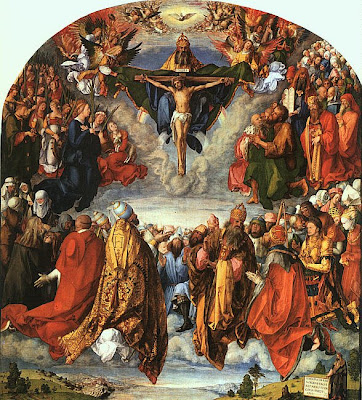
https://blogger.googleusercontent.com/img/b/R29vZ2xl/AVvXsEiVYi0nzBmUYMomJomwQubWOi-Hkro-UHVembPkEnx2bSWVDEMc6sx5zN3xBjcJY2k4BzC5C8uqGsVdK1UsRlPY2pPLgREZkmV913spKlhS8vIsG-iB_A688VUCNkU8_5QIr9HPKMSkIrs/s400/adoration+of+the+trinity++durer.jpg

The Adoration of the Holy Trinity
Albrecht Dürer, 1511

Image:idlespeculations

There is an online article about the painting at Adoration of the Trinity
 

Thursday, 31 May 2012

Ordinariate Evensong at Blackfriars


Last night I attended the Ordinariate Solemn Evensong for Whitsuntide at Blackfriars here in Oxford which I publicised the other week.

The Newman Consort were once again in good voice, and sang the early sixteenth century Magnificat Regale by Robert Fayrfax; Msgr Burnham said in his words of thanks that this was rather rarely performed - I think its length may inhibit its use on other than grand festal occasions - and as something wrtten for the Court had been chosen to mark the Jubilee. The Monseigneur also made the point that such music is part of that patrimony the Ordinariate is seeking to recover and share with other Catholics. The Anglican choral tradition is indeed well suited to use such splendid pre-Reformation music which is very much part of a common patrimony for Catholics and Anglicans.

The church at Blackfriars is a very dignified setting for such services, and it was good to see the very handsome red cope and stole, together with the matching humeral veil, all decorated with fine gold embroidery, which belongs to the Priory being used.
 

Monday, 28 May 2012

Something of a liturgical extravaganza


Regular readers may have worked out that the Clever Boy rather likes going to church, and this last weekend has provided him with several splendid opportunities to do so.

On Friday evening at the Oxford Oratory there was, following the 6 pm Mass for St Bede, Solemn First Vespers for the Solemnity of St Philip, with the psalmody sung by the choir,and three coped sacred minsters, followed incensation of the relic and altar of St Philip, followed by Benediction of the Blessed Sacrament and by the Veneration of another of the relics of the saint.

Lummis portrait St Philip 5.JPG

St Philip Neri - and his cat
A painting by Anthony Lummis,
one of the Brothers of the External Oratory at Oxford.

Image: Anthony Lummis/Oxford Oratory

On Saturday morning there was the Solemn Mass for the feast, with the sermon being preached by Msgr Marcus Stock, Secretary of the Bishops Conference of England and Wales. At the heart of his homily was the concept of St Philip being like the Apostles with his immediate experience of the Pentecostal fire in 1544.

The Monseigneur set this within his own reminiscences of times spent at the church. One was of his praying there, as an undergraduate of an Anglican Evangelical background, in 1978 for guidance as to being received into the Catholic Church. Another was from 1990 when as a priest he was very temporarily in charge of the church and parish before the first Oratorians arrived from Birmingham. At that time the relic cupboards were empty - their contents had been cremated some years previously, but, intrigued by a locked cupboard underneath the others, he had picked the lock and found inside, covered in dust, two pieces of the orginal collection given at the beginning of the last century. There, in glass cases, were a copy of the death-mask of St Philip and a copy of the sixteenth century printing of the hymns of the late thirteenth century Franciscan ecstatic Jacapone da Todi, complete with on the title page, the former owner's signature - Philip Neri. He had placed the two relics on the altar and sung a Te Deum in thanksgiving, assured that St Philip had arrived well before his sons and, one might add, as in Newman's hymn to St Philip, that he had journeyed on after his death and sought the very heart of England.

He concluded the sermon with a reading of one of Jacapone's hymns, full of the spiritual joy which inflamed St Philip.

Afterwards there was the opportunity to see both death-mask and hymn book in the relic chapel - itself now happily restocked with relics and objects of devotion collected by the Fathers of the Oxford Oratory.

In best Oratorian tradition there was an enjoyable reception afterwards and the opportunity to talk to friends and visitors who had come to the feast day.

Not having yet acquired the charism of quadlocation I had to miss out on attending the Westminster Ordinariate Diaconal Ordinations, the London Oratory's celebration of St Philip's day with Cardinal Burke and the chance to join a patronal pilgrimage to Pugin's St Augustine's Ramsgate with the parish of SS Gregory and Augustine. One cannot, alas, do everything.

In the evening I went to the Mass of the Oxford Ordinariate group at Holy Rood, where to celebrate Pentecost we had music by Haydn and a sermon from Fr Richard Duffield of the Oxford Oratory, and the congregation was afforced by a number of German and US visitors.

Unfortunately I did not make it later on to Blackfriars for their First Vespers, Vigil and First Mass of Pentecost, about which I posted the other day - but perhaps on a warm day that might have been a bit much, and might even suggest religious mania on my part...

On Sunday, due to a committment in the late morning, I went to the well attended 8am EF Mass at the Oratory rather than my usual attendance at the 11am celebration, and in the evening I was back again for Solemn Vespers.

Once again it was a three cope occasion, and all the more striking with the clergy vested in Whitsun red. The Office was all sung by the Oratorians and the church choir, and, as usual, followed by Benediction. This was the second year in succession that Vespers for Pentecost has been a fully musical service, as is the established custom on Easter Day, and a very fine celebration it proved to be. I shall be writing more about how I think Pentecost should be marked liturgically.


Wednesday, 23 May 2012

Ordinariate Evensong May 30th


On the evening of the Wednesday in the Octave of Pentecost - for such it will be in the Calendar of the English Ordinariate - that is May 30th, there will be another Solemn Evensong followed by Benediction and celebrated by the Oxford Ordinariate Group in the church at Blackfriars here in the city at 7.30.

The preacher will be the Rev’d Professor Allan Brent. He is the assistant Chaplain at Fisher House in Cambridge and the Professor of Early Christian History and Iconography at King's College in the University of London, as well as being Professore Invitato at the Augustinianum in the Lateran University in Rome.

The music for the service will be provided by the Newman Consort, the Oxford Ordinariate Group's own schola.

If you have not previously attended one of these occasions and are able you would be made most welcome and have the opportunity to see what the Ordinariate groups can offer and appreciate Anglican patrimony in the form of BCP propers in a fully Catholic context.


Monday, 14 May 2012

News from John Hunwicke


John Hunwicke of the Ordinariate group here in Oxford has some good News to report - read what he says. My continuing prayers and good wishes for him and Pam.

Tuesday, 27 March 2012

Celebrating the Annunciation with the Ordinariate


Having attended and communicated at the lunchtime EF Mass at the Oxford Oratory yesterday I decided to attend also the Solemn Mass offered by my friends at the Oxford Ordinariate Group at the church of the Holy Rood in the evening. I had been unable to join them last week for a similar Mass for St Joseph, but I made the (relative) effort to go and was impressed by what I found.

This was a Mass celebrated in a style Mgr Burnham and his group are developing which appeals to a wider congregation than just the members of the Ordinariate as such. So we had the novus ordo in English, but with the Latin propers from the Gradual sung by the members of the Newman Consort, and with congregational participation in the Missa de Angelis.

This worked very well as a liturgical style, and coincides with my sense that Anglican patrimony is more about how you do things than sticking to the BCP or specific, legitimised, Anglican forms, and that such developments can assist the wider Church.

It also worked well in the spare, austere interior of Holy Rood. In many ways it is far too plain as a church for my taste, but it has in that austerity and in the relief behind the altar of Christ in Majesty, a hint of the Romanesque. Add to that plainsong and lashings of incense, and you have a very prayerful setting for dignified, serious, liturgy.

With that in mind, and as it was the Mass Rorate, it seems not inappropriate to illustrate this post with this illustration and accompanying description, courtesy of John Dillon and the Medieval Religion discussion group:


The Initial R, with the Annunciation, from a Gradual, ca. 1300
German. Probably made at the convent of Sankt Katharinenthal, Lake Constance.

4 x 3 1/16 in. (10.2 x 7.8 cm) Tempera and gold leaf on parchment

Metropolitan Museum of Art :Purchase, Gift of J. Pierpont Morgan, by exchange, 1982 (1982.175)

Protected by the arching curve of the blue-and-white letter R, the standing figures of the archangel Gabriel and the Virgin Mary are set against a burnished gold background.

The barefoot Archangel wears a simple salmon-colored tunic, belted at the waist, and holds a staff. His right hand raised and his wings outstretched, he addresses the Virgin Mary, who stands before him and lifts both hands as the dove of the Holy Ghost whispers in her ear.

The letter R is the opening of the Introit Rorate caeli de super (Drop down dew, you heavens, from above), sung on the Feast of the Annunciation, to celebrate the Archangel Gabriel's announcement to the Virgin Mary that she would be the mother of Jesus.

The cutting was once part of a gradual, a book containing the choral parts of the Mass. It was probably painted about 1300 by the Dominican nuns at the convent of Sankt Katharinenthal on Lake Constance.


Saturday, 24 March 2012

Oxford Ordinariate Passiontide Service - March 31st


http://www.lostseed.com/extras/free-graphics/images/jesus-pictures/jesus-crucified.jpg

Image: lostseed.com

Next Saturday, March 31st, the Oxford Ordinariate Group will hold a Passiontide devotion at Holy Rood church in Abingdon Road in preparation for Holy Week. As they are having Mass for Palm Sunday at 9 am the following day, they are holding this at the time they usually have the Saturday Vigil Mass.

The Newman Consort, under its new director, Paul Kolb, will singing items of music for Passiontide. There will also be hymns and readings. The format is described as being very similar to the Nine Lessons and Carols or, indeed, the Passiontide Oratory at St Aloysius on Wednesday.