Once I was a clever boy learning the arts of Oxford... is a quotation from the verses written by Bishop Richard Fleming (c.1385-1431) for his tomb in Lincoln Cathedral. Fleming, the founder of Lincoln College in Oxford, is the subject of my research for a D. Phil., and, like me, a son of the West Riding. I have remarked in the past that I have a deeply meaningful on-going relationship with a dead fifteenth century bishop... it was Fleming who, in effect, enabled me to come to Oxford and to learn its arts, and for that I am immensely grateful.


Showing posts with label St Philip Neri. Show all posts

Thursday, 27 April 2017

The Patronage of St Philip Neri in Oxford


Today has been the feast of the patronage of St Philip at the Oxford Oratory, being the anniversary of the establishment of the Oxford Oratory by decree of the Holy See in 1993. Each Oratory observes the feast of its patronage of St Philip on the equivalent day.


Image result for St Philip Neri

St Philip Neri

Saint Philip was reported to be have been seen levitating in spiritual ecstasy
whilst celebrating Mass
Image:Denver Catholic


Friday, 27 May 2016

Celebrating St Philip's Day


This evening the Oxford Oratory celebrated the feast of St Philip Neri. This was a day late because as in 1595, the year when St Philip died, May 26th was the feast day of Corpus Christi.

The Solemn Mass this evening had as its preacher the Provost of the London Oratory, Fr Julian Large.
 
St Philip Altarino 2016.JPG

The statue of St Philip in place for the preparatory Novena

Image: Oxford Oratory

As is usual we had a novena leading up to St Philip's Day to prepare for the celebration of his feast and to ask for his prayers for the Oratory and parish.

Thursday, 3 December 2015

St James of the March


November 28th was the feast day of the Franciscan St James of the March. John Dillon posted the following piece on the Medieval Religion discussion group:

James of the March (Giacomo della Marca; Jacobus Picenus) was born at Monteprandone in today's Ascoli Piceno province of the Marche. He was christened Domenico and studied first at Ascoli Piceno and then at Perugia, where he obtained doctorates in civil and in canon law. After a few years in minor posts at Florence and at Bibbiena he entered the Franciscan order in 1416 at the convent of Santa Maria degli Angeli at Assisi. There he took the Christian name by which he is known and studied under St. Bernardino of Siena.

James was ordained priest in or shortly after 1420 and began to preach extensively in north central Italy, founding as he went numerous Monti di Pietà (low-interest pawn and credit funds), which latter the Franciscans were promoting actively. He also travelled widely in northern and eastern Europe, both as a diplomat and as an inquisitor. From 1435 to 1438 James was his order's vicar in Bosnia. In the 1450s he preached crusade against the Turks; in 1456 he succeeded St. John of Capestrano in János Hunyadi's campaign in Bosnia and Serbia. Back in Italy he continued to preach and was also called upon to resolve numerous local disputes. In his last few years James was based at Naples. He was buried there at the Franciscan convent of Santa Maria La Nova; miracles were reported at his tomb and in fairly short order his remains were given an Elevatio. James was canonized in 1726. His largely incorrupt body reposed in Santa Maria La Nova until 2001, when it was translated to the convento / santuario di Santa Maria delle Grazie in Monteprandone.

Herewith some views of James in his present earthly state:
1) On display:
http://tinyurl.com/jj2ebkg
http://tinyurl.com/hj343bc


2) Undergoing a recognition in 2008:
http://www.paleopatologia.it/immagini/2008/SanGiacomo1.jpg
http://www.paleopatologia.it/immagini/2008/SanGiacomo2.jpg
http://www.paleopatologia.it/immagini/2008/SanGiacomo4.jpg

James is one of Naples' patron saints. An early poem (Elegiae, 1. 7) by the late fifteenth- and early sixteenth-century Neapolitan humanist Jacobo Sannazaro honors him.

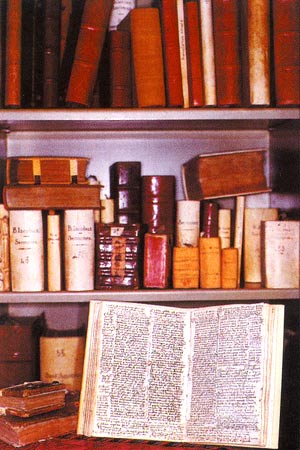
James founded the aforementioned convent of Santa Maria delle Grazie in his native Monteprandone in 1449. The convent's library, now city property and housed in Monteprandone's Museo civico dei Codici di San Giacomo della Marca (housed in the Palazzo comunale), has a nucleus of manuscript books that once belonged to the saint, including four so-called autographs that are really working texts dictated by him. Most of James' sermons have not been edited but the two published in the the conference volume San Giacomo della Marca nell'Europa del '400 (Padova: Centro Studi Antoniani, 1997) show considerable skill. (James was given to quoting pertinent bits of Italian poetry in these Latin texts: at least one has a few lines from Dante and many quote Laude by or attributed to Jacopone of Todi). [Sounds rather like St Philip Neri - Clever Boy]

 Herewith some views of the library and of selected contents:
http://giornale.regione.marche.it/archivio/num0102/foto17a.htm
http://www.sangiacomodellamarca.net/o_sgiacomo/manoscritti.jpg
Expandable views of pages from individual codices are at lower right here:
http://www.sangiacomodellamarca.net/biblioteca_san_giacomo.htm#target
Other views (also expandable)
http://tinyurl.com/ozfkmu4
http://web.tiscali.it/corradettiivan/text/allcodici.htm

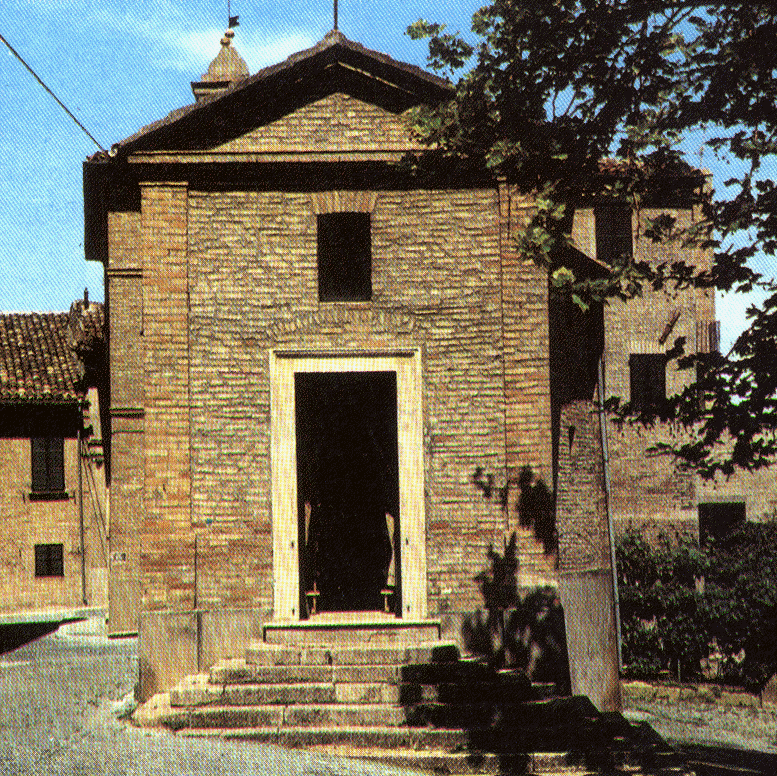
At Monteprandone one may also see a house where James is said to have been born:
http://web.tiscali.it/corradettiivan/images/fotogr3.gif
Also at Monteprandone, in the Museo del Santuario di San Giacomo della Marca, one may see various objects said to have been his. The last four images (all expandable) on this page are of a chalice, two crucifixes, a chest for relics, and an ivory triptych said to have belonged to James.:
http://web.tiscali.it/corradettiivan/text/allfoto.htm
More views (also expandable) are at lower right here:
http://www.sangiacomodellamarca.net/MUSEO.htm

Some period-pertinent images of St. James of the March:

a) as depicted in a later fifteenth-century panel painting by Carlo Crivelli (1477; Paris, Musée du Louvre):
http://cartelen.louvre.fr/cartelen/visite?srv=car_not_frame&idNotice=13752
http://tinyurl.com/jz557gv

b) as depicted in a later fifteenth-century panel painting by Carlo Crivelli (1487; Venice, Gallerie dell'Accademia):
http://www.beniculturali.marche.it/Ricerca.aspx?ids=53205

c) as depicted in a later fifteenth-century panel painting by Vittore Crivelli (Ripatransone, Polo Museale di Palazzo Bonomi Gera):


http://pintura.aut.org/SearchProducto?Produnum=133063

d) as depicted in a later fifteenth-century panel painting by Vittore Crivelli (Perugia, Galleria nazionale dell'Umbria):


http://pintura.aut.org/SearchProducto?Produnum=133069
http://www.beniculturali.marche.it/Ricerca.aspx?ids=53205

e) as depicted in a later fifteenth-century panel painting by Pietro Alemanno (Ascoli Piceno, Palazzo dei Capitani):


http://www.sangiacomodellamarca.net/arte/3.htm

f) as depicted in a later fifteenth-century panel painting by Cola d'Amatrice (Urbino, Galleria nazionale delle Marche):


The similarity among the foregoing portraits is probably the result of the circulation among Franciscan houses of copies of James' death mask. One may compare the similarly uniform later fifteenth-century Italian portraiture of St. Bernardino of Siena (20. May; d. 1444; canonized, 1450).

g) as depicted (at right; at left, St. Jerome; at centre, the Archangel Michael) in a late fifteenth-century panel painting by an Italo-Flemish artist (c. 1490; Naples, Museo nazionale di Capodimonte):


h) as depicted (at right; at left, St. Catherine of Alexandria; at centre, St. Anthony of Padua) by Tuccio d'Andria in a late fifteenth- or early sixteenth-century panel painting (Bari, Pinacoteca di Bari "Corrado Giaquinto"):


i) as depicted in an early sixteenth-century panel painting by Pietro Perugino (c. 1512-1515; Perugia, Galleria nazionale dell'Umbria):


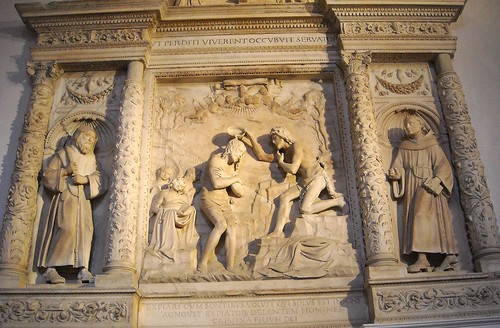
j) as portrayed in high relief (at right; at left, St. Francis of Paola; at center, the Baptism of Christ) by Giovanni da Nola in an earlier sixteenth-century marble sculpture (1534) in the Ravaschieri chapel of Naples' basilica di San Giovanni Maggiore:


Friday, 20 November 2015

St Philip has arrived


From the Oxford Oratory website:
"And here at length is he" *

Regular readers will know that there is a travelling bust of St Philip, made in Seville for his five-hundredth anniversary year, which has been travelling around the Oratories of the world. We had been expecting it some time ago, but heard that it was delayed, somewhere between Maastricht and Alcala de Henares.
Then, quite unexpectedly, and enormous crate was delivered last week:

20151118_093447

The box took quite a lot of effort and ingenuity to open, but when we succeeded, inside was the bust of our Holy Father.

20151118_092430

The bust shows St Philip, filled with the Holy Spirit, pointing to his heart, which was enlarged by the Spirit's action. The bust contains a relic of St Philip's body.

20151118_092502

We have put the bust on St Philip's altar to give people the opportunity to pray before it. As to when and where the image will go next: St Philip has a habit of surprising!

20151118_092413

Text and images: Oxford Oratory
 

The Clever Boy will add that one person here was inclined to describe the bust as reminiscent of Medallion Man...

Perhaps one should say that the bust may well be as bright and striking as older examples in churches and museums were when they were new.

* A quotation from Bl. John Henry Newman's hymn to St Philip "On Northern Shores our lot is cast" which speaks of the Saint travelling in spirit and in his sons, the Oratorians, to England.

Friday, 21 August 2015

Celebrating and commemorating St Philip in Florence


Oxford Oratory website has two handsomely illustrated posts about the celebrations in Florence last month of the 500th anniversary of the birth of St Philip Neri, and of the participation in them of members of the Oxford Oratory and also of some of the regular congregation.
They can seen at Celebrations of St Philip's Birthday in Florence and at More Photos from St Philip's Birthday Celebrations in Florence


Tuesday, 11 August 2015

St Philip Neri and Bl. John Henry Newman


Today is the 125th anniversary of the death of Bl. John Henry Newman at the Birmingham Oratory in 1890


Cardinal Newman lying-in-state in the Oratory Church, Edgbaston, prior to his Funeral Mass on Tuesday 19 August 1890.

Image: Valle Adurni


Recently I was asked to answer, as someone who worships at the Oxford Oratory, and who is a Brother of the Secular Oratory, four questions to illustrate or illuminate a school project comparing and contrasting St Philip Neri and Bl. John Henry Newman, and I  thought readers might be interested to see my answers to those:

1) What do you find inspiring in the example of St Philip Neri?

I think what is most inspiring is to understand that it is not the stories of him as practical joker that matter as the "Saint of Joy " but his profound closeness to God - above all in the indwelling of the fire of the Holy Spirit from Pentecost 1544 - and the way in which he brought that Divine Love to the people of Rome. It proved so very attractive to so many.

2) What do you find inspiring in the example of John Henry Newman?

As a convert from Anglo-Catholicism myself ( sand a member of Oriel ) it is first of all his example of pursuing his pilgrimage of Faith, and what an extraordinary journey that was. His intellectual honesty and his concern for souls are also very important, as is his determination to hold to the path he had chosen.

3) What do you think they had in common?

I think that is both their adherence to their personal pilgrimage and their concern for saving souls, be they in Rome, Oxford or Birmingham

4) What do you think it means to be an Oratorian today?

As a Brother of the Secular Oratory and regular worshipped at the Oxford Oratory I think it is a case of living out and working out my own spiritual journey in the light of what they taught and did themselves, and of following on their footsteps - however falteringly. I esteem what they did and established, and in being grateful for that support their continuing legacy in terms of liturgical and devotional life as well as trying to show concern for those I meet in my life.

Tuesday, 28 July 2015

Oratorians commemorate St Philip Neri in Florence


A friend has very kindly sent me the link to a video of some of the celebrations last week in Florence to mark the 500th anniversary of the birth of St Philip Neri. These included the unveiling of a plaque on his birthplace, as can be seen in the clip by following the link at  https://youtu.be/NWzfIwdg9y4


Wednesday, 22 July 2015

St Philip Neri 500


Yesterday was the 500th anniversary of the birth in Florence of St Philip Neri, the founder of the Oratorians.

To mark the occasion all the Masses at the Oxford Oratory were votives of St Philip, followed by veneration of a relic of him. At the 6pm Mass which I attended there was also Benediction of the Blessed Sacrament before the veneration of the reliquary.

Given St Philip's profound assimilation to the will of God, above all in the physical enlargement of his heart following the inflowing of the Holy Spirit at Pentecost 1544, this seemed to be, as both the homily from Fr Joseph  and the prayers at Benediction from Fr Jerome indicated, a very appropriate way for us to draw closer to God and to the force which transformed and motivated St Philip.

File:Giuseppe Passeri - Vision of St Philip Neri - WGA17070.jpg

 The Vision of St Philip Neri

Giuseppe Passeri

Image: Wikimedia


Friday, 29 May 2015

St Philip's Day with HE Cardinal Burke

Last Wednesday evening the Oxford Oratory was honoured to welcome His Eminence Cardinal Burke to our Church to celebrate a Solemn Pontifical Mass for the feast of Our Holy Father St Philip, in the fifth centenary of his birth. These images are all from the Oratory website, with a few additional comments which I have added.

IMG_7795 (562x800)

We were joined by many friends and visitors, including the Rt Rev. Hugh Allan O.Praem., Prior of the Norbertine community in Chelmsford, and many local clergy and Knights of Malta.

IMG_7796 (800x517)

The Cardinal entered the Oratory church in his cappa magna :

IMG_1536 (800x526)


IMG_1538 (800x436)

After praying before the Blessed Sacrament the Cardinal went to vest for Mass in the Sacristy:

 IMG_1541 (800x600)

 IMG_7803 (800x580)

In the procession was a new banner of St Philip, commissioned to mark his fifth centenary:

 IMG_7808 (800x510)

 IMG_7811 (585x800)

 IMG_7818 (800x531)

IMG_7816 (800x533)

 IMG_7821 (800x544)

IMG_7823 (800x534)

 IMG_7838 (800x519)

In his sermon, the Cardinal encouraged each one of us to take St Philip as an example of how to transform the world in Christ. His full sermon can be read here.

FullSizeRender

IMG_7855 (800x533)

IMG_7858 (800x511) 

IMG_7869 (800x516)

IMG_7882 (800x553) 

IMG_7896 (800x526) 

IMG_7888 (800x555)

IMG_7900 (800x531)

IMG_7903 (800x511)

IMG_7907 (800x521)

 IMG_7940 (800x535)

 IMG_7947 (800x534)

 IMG_7958 (800x500)

The Archbishop of Birmingham very kindly leant us Bishop Ullathorne's crozier for the Cardinal to use:

IMG_7855

On Wednesday, Fr Daniel took the Cardinal on a tour of Oxford. Here he is pictured next to the bust of Blessed John Henry Newman in Trinity College. He also visited Christ Church where he was able to view what is believed to be Cardinal Wolsey's red hat, which he received in 1515, the year of St Philip's birth.

photo

Images: Oxford Oratory

Tuesday, 26 May 2015

First Vespers of St Philip at the Oxford Oratory


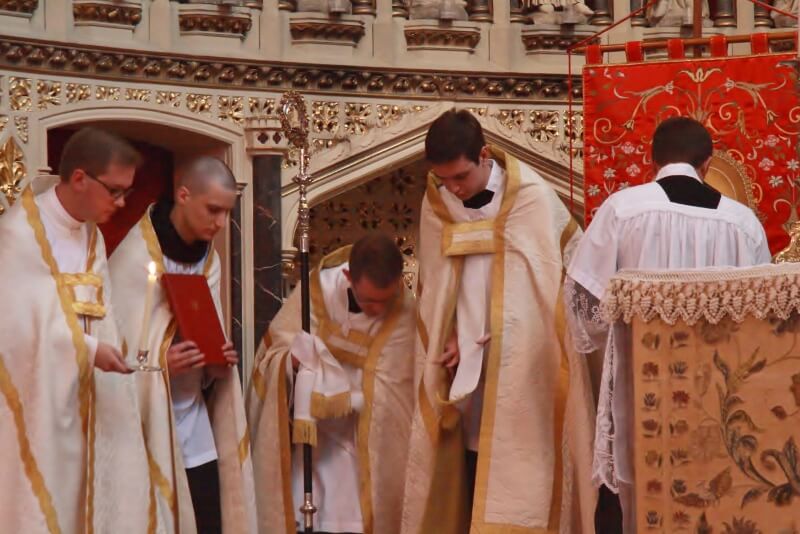
Yesterday evening the Oxford Oratory celebrated First Vespers for the Feast of St Philip Neri, concluding with Benediction and Veneration of the Relic of our Holy Father. Here are the pictures of the liturgy posted on the Oratory website, with some comments of my own:

IMG_7708 (800x498)

St Philip's Altar decorated with a reliquary bust, candles and flowers

IMG_7738 (800x536)

There was a good congregation

IMG_7693 (800x533)

This was a Five Cope celebration of Vespers - including Br. Gregory a Norbertine currently studying in Oxford


IMG_7754 (800x577)


 IMG_7752 (800x585)


The votive statue of St Philip and Fra' Julian of the Order of Malta

IMG_7749 (800x512)

Fr Dominic and Br Oliver assist the Provost, Fr Daniel, with his cope

 IMG_7765 (800x542)

Exposition of the Blessed Sacrament, and, below, Benediction is given by the Provost
  
IMG_7770 (800x616)


IMG_7788 (800x517)
 
The Altar party leave the Sanctuary

 IMG_7785 (800x512)

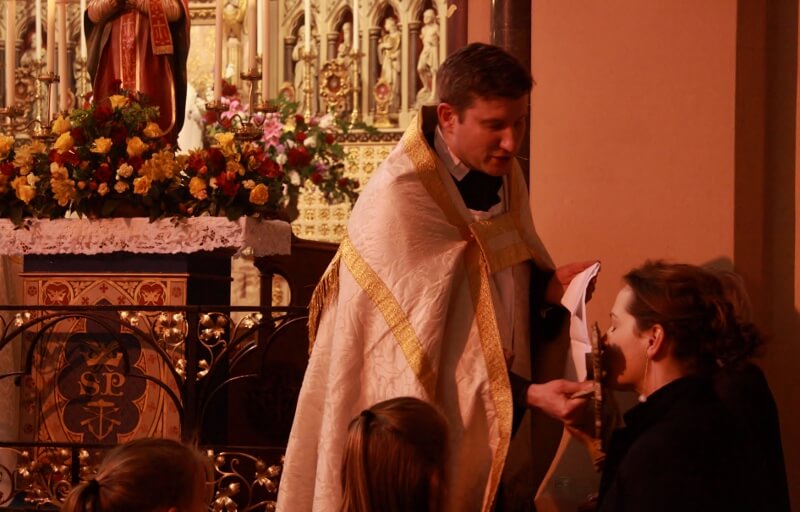
Veneration of the relic of St Philip


Images:Hannah Chegwyn on Oxford Oratory website

Following the ceremonies in church the Oratory Fathers entertained many of its regular congregation and supporters to a generous reception in the parish centre, which was a most enjoyable occasion.