Once I was a clever boy learning the arts of Oxford... is a quotation from the verses written by Bishop Richard Fleming (c.1385-1431) for his tomb in Lincoln Cathedral. Fleming, the founder of Lincoln College in Oxford, is the subject of my research for a D. Phil., and, like me, a son of the West Riding. I have remarked in the past that I have a deeply meaningful on-going relationship with a dead fifteenth century bishop... it was Fleming who, in effect, enabled me to come to Oxford and to learn its arts, and for that I am immensely grateful.


Showing posts with label St Michael. Show all posts

Sunday, 29 September 2024

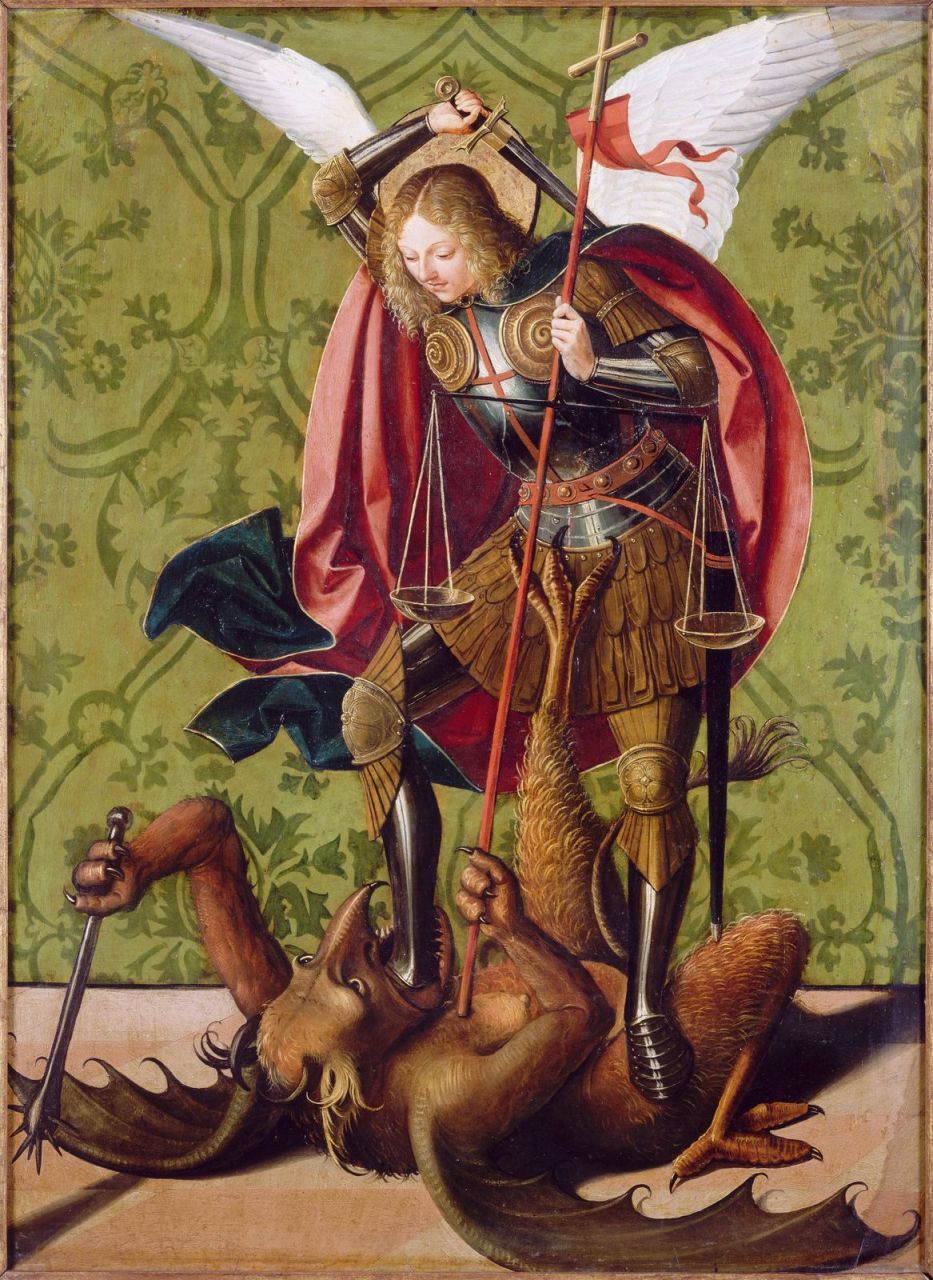
St Michael the Archangel


Today is the Feast of St Michael the Archangel.

The New Liturgical Movement has an article on their website from 2018 about the observance of the day, and which can be seen at Liturgical Notes on the Feast of St Michael and All Angels

For the May feast which commemorates the Archangel’s Apparition at Monte Gargano they had an article earlier this year which is to be found at The Apparition of St Michael

The blog of A Clerk of Oxford has a beautifully illustrated article from 2013 about medieval devotional texts for both clerical and lay audiences addressing St Michael which can be seen at Four Medieval Texts for Michaelmas

File:Josse Lieferinxe — St. Michael Killing the Dragon — 1493-1505.jpg


St Michael killing the Dragon

Josse Leiferinxe fl.1493-1503/8
Musée de Petit Palais Avignon

Image: meisterdrucke.uk/Wikimedia


Holy Michael Archangel
Defend us in the day of battle.
Be our safeguard against the wickedness and snares of the Devil,
And do thou, O Prince of the Heavenly Host,
By the power of God
Thrust down into Hell Satan and all who wander through the world to the ruin of souls


Thursday, 3 December 2015

St James of the March


November 28th was the feast day of the Franciscan St James of the March. John Dillon posted the following piece on the Medieval Religion discussion group:

James of the March (Giacomo della Marca; Jacobus Picenus) was born at Monteprandone in today's Ascoli Piceno province of the Marche. He was christened Domenico and studied first at Ascoli Piceno and then at Perugia, where he obtained doctorates in civil and in canon law. After a few years in minor posts at Florence and at Bibbiena he entered the Franciscan order in 1416 at the convent of Santa Maria degli Angeli at Assisi. There he took the Christian name by which he is known and studied under St. Bernardino of Siena.

James was ordained priest in or shortly after 1420 and began to preach extensively in north central Italy, founding as he went numerous Monti di Pietà (low-interest pawn and credit funds), which latter the Franciscans were promoting actively. He also travelled widely in northern and eastern Europe, both as a diplomat and as an inquisitor. From 1435 to 1438 James was his order's vicar in Bosnia. In the 1450s he preached crusade against the Turks; in 1456 he succeeded St. John of Capestrano in János Hunyadi's campaign in Bosnia and Serbia. Back in Italy he continued to preach and was also called upon to resolve numerous local disputes. In his last few years James was based at Naples. He was buried there at the Franciscan convent of Santa Maria La Nova; miracles were reported at his tomb and in fairly short order his remains were given an Elevatio. James was canonized in 1726. His largely incorrupt body reposed in Santa Maria La Nova until 2001, when it was translated to the convento / santuario di Santa Maria delle Grazie in Monteprandone.

Herewith some views of James in his present earthly state:
1) On display:
http://tinyurl.com/jj2ebkg
http://tinyurl.com/hj343bc


2) Undergoing a recognition in 2008:
http://www.paleopatologia.it/immagini/2008/SanGiacomo1.jpg
http://www.paleopatologia.it/immagini/2008/SanGiacomo2.jpg
http://www.paleopatologia.it/immagini/2008/SanGiacomo4.jpg

James is one of Naples' patron saints. An early poem (Elegiae, 1. 7) by the late fifteenth- and early sixteenth-century Neapolitan humanist Jacobo Sannazaro honors him.

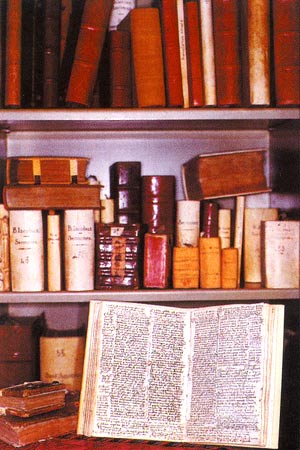
James founded the aforementioned convent of Santa Maria delle Grazie in his native Monteprandone in 1449. The convent's library, now city property and housed in Monteprandone's Museo civico dei Codici di San Giacomo della Marca (housed in the Palazzo comunale), has a nucleus of manuscript books that once belonged to the saint, including four so-called autographs that are really working texts dictated by him. Most of James' sermons have not been edited but the two published in the the conference volume San Giacomo della Marca nell'Europa del '400 (Padova: Centro Studi Antoniani, 1997) show considerable skill. (James was given to quoting pertinent bits of Italian poetry in these Latin texts: at least one has a few lines from Dante and many quote Laude by or attributed to Jacopone of Todi). [Sounds rather like St Philip Neri - Clever Boy]

 Herewith some views of the library and of selected contents:
http://giornale.regione.marche.it/archivio/num0102/foto17a.htm
http://www.sangiacomodellamarca.net/o_sgiacomo/manoscritti.jpg
Expandable views of pages from individual codices are at lower right here:
http://www.sangiacomodellamarca.net/biblioteca_san_giacomo.htm#target
Other views (also expandable)
http://tinyurl.com/ozfkmu4
http://web.tiscali.it/corradettiivan/text/allcodici.htm

At Monteprandone one may also see a house where James is said to have been born:
http://web.tiscali.it/corradettiivan/images/fotogr3.gif
Also at Monteprandone, in the Museo del Santuario di San Giacomo della Marca, one may see various objects said to have been his. The last four images (all expandable) on this page are of a chalice, two crucifixes, a chest for relics, and an ivory triptych said to have belonged to James.:
http://web.tiscali.it/corradettiivan/text/allfoto.htm
More views (also expandable) are at lower right here:
http://www.sangiacomodellamarca.net/MUSEO.htm

Some period-pertinent images of St. James of the March:

a) as depicted in a later fifteenth-century panel painting by Carlo Crivelli (1477; Paris, Musée du Louvre):
http://cartelen.louvre.fr/cartelen/visite?srv=car_not_frame&idNotice=13752
http://tinyurl.com/jz557gv

b) as depicted in a later fifteenth-century panel painting by Carlo Crivelli (1487; Venice, Gallerie dell'Accademia):
http://www.beniculturali.marche.it/Ricerca.aspx?ids=53205

c) as depicted in a later fifteenth-century panel painting by Vittore Crivelli (Ripatransone, Polo Museale di Palazzo Bonomi Gera):


http://pintura.aut.org/SearchProducto?Produnum=133063

d) as depicted in a later fifteenth-century panel painting by Vittore Crivelli (Perugia, Galleria nazionale dell'Umbria):


http://pintura.aut.org/SearchProducto?Produnum=133069
http://www.beniculturali.marche.it/Ricerca.aspx?ids=53205

e) as depicted in a later fifteenth-century panel painting by Pietro Alemanno (Ascoli Piceno, Palazzo dei Capitani):


http://www.sangiacomodellamarca.net/arte/3.htm

f) as depicted in a later fifteenth-century panel painting by Cola d'Amatrice (Urbino, Galleria nazionale delle Marche):


The similarity among the foregoing portraits is probably the result of the circulation among Franciscan houses of copies of James' death mask. One may compare the similarly uniform later fifteenth-century Italian portraiture of St. Bernardino of Siena (20. May; d. 1444; canonized, 1450).

g) as depicted (at right; at left, St. Jerome; at centre, the Archangel Michael) in a late fifteenth-century panel painting by an Italo-Flemish artist (c. 1490; Naples, Museo nazionale di Capodimonte):


h) as depicted (at right; at left, St. Catherine of Alexandria; at centre, St. Anthony of Padua) by Tuccio d'Andria in a late fifteenth- or early sixteenth-century panel painting (Bari, Pinacoteca di Bari "Corrado Giaquinto"):


i) as depicted in an early sixteenth-century panel painting by Pietro Perugino (c. 1512-1515; Perugia, Galleria nazionale dell'Umbria):


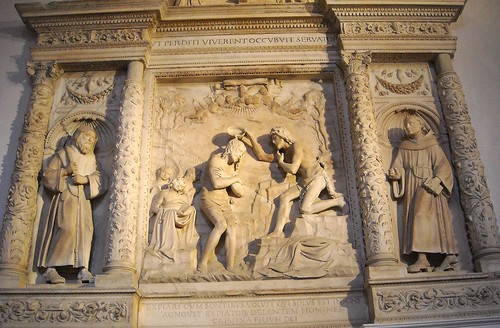
j) as portrayed in high relief (at right; at left, St. Francis of Paola; at center, the Baptism of Christ) by Giovanni da Nola in an earlier sixteenth-century marble sculpture (1534) in the Ravaschieri chapel of Naples' basilica di San Giovanni Maggiore:


Sunday, 1 November 2015

All Saints


Today is the Feast of All Saints, and John Dillon has posted some images of them on the Medieval Religion discussion group:

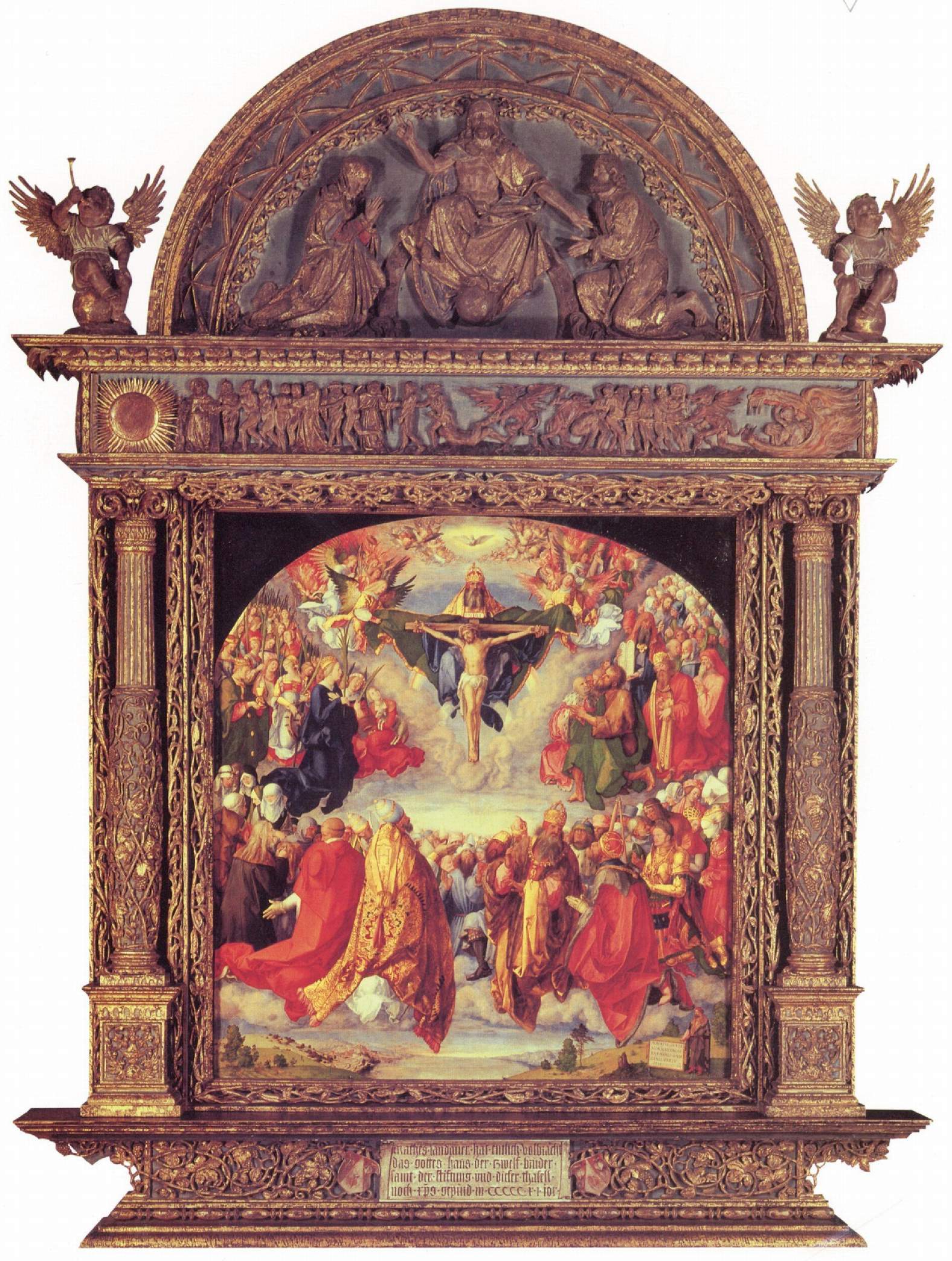
Today, being both November 1st and the Sunday in the octave around November 1st, is in Latin-rite churches and in others influenced by their festal calendars, the feast of All Saints (in Eastern-rite churches, where the observance arose, their celebration falls rather on the first Sunday after Pentecost). Herewith some period-pertinent images associated directly with this veneration in that they either accompany texts for or describing the feast in question or else are parts of altars devoted principally to the cult of All Saints (as opposed, say, to images of the Coronation of the BVM drawing upon the traditional imagery of All Saints). Also included (item k) is one well known image of the saints in their multitude arrayed about the Godhead where a direct connection to the liturgical celebration is not immediately evident.

a) as depicted in a later tenth-century sacramentary from Fulda (c. 975; Göttingen, Niedersächsische Staats- und Universitätsbibliothek, 2 cod. Ms. theol. 231 Cim., fol. 111r):

 https://upload.wikimedia.org/wikipedia/commons/0/09/G%C3%B6ttinger_Sakramentar_fol._111r.jpg


b) as depicted in the earlier eleventh-century Sacramentary of Robert of Jumièges (c. 1020; Rouen, Bibliothèque Jacques Villon, ms. 274, fol. 158v):

 http://www.culture.gouv.fr/Wave/savimage/enlumine/irht6/IRHT_100581-p.jpg

Detail view (losing most of the frame):
http://www.culture.gouv.fr/Wave/savimage/enlumine/irht6/IRHT_100582-p.jpg

c) as depicted in a later twelfth-century sacramentary for the abbaye de St.-Martin in Tours (c. 1170-1180; Tours, Bibliothèque municipale, ms. 193, fol. 115r):

 http://www.culture.gouv.fr/Wave/savimage/enlumine/irht9/IRHT_150416-p.jpg


d) as depicted in a later twelfth-century sacramentary from the abbaye de St.-Amand in Saint-Amand (c. 1170-1180; Valenciennes, Bibliothèque de Valenciennes, ms. 108, fol. 46v):
http://www.culture.gouv.fr/Wave/savimage/enlumine/irht4/IRHT_075465-p.jpg

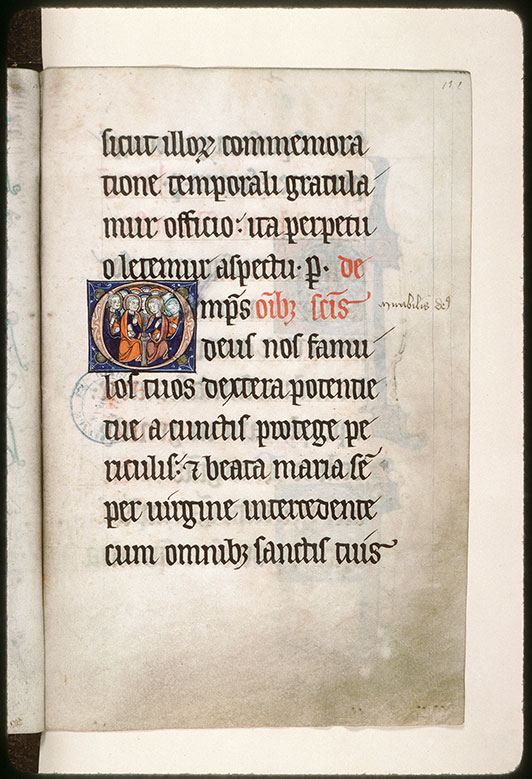
e) as depicted in a perhaps mid-thirteenth-century pontifical and collects concordant with the Use of the abbaye de St.-Pierre at Corbie (Amiens, Bibliothèque Louis Aragon, ms. 195, fol. 132r):
http://www.culture.gouv.fr/Wave/savimage/enlumine/irht3/IRHT_061417-p.jpg
Textual context:
http://www.culture.gouv.fr/Wave/savimage/enlumine/irht3/IRHT_061416-p.jpg

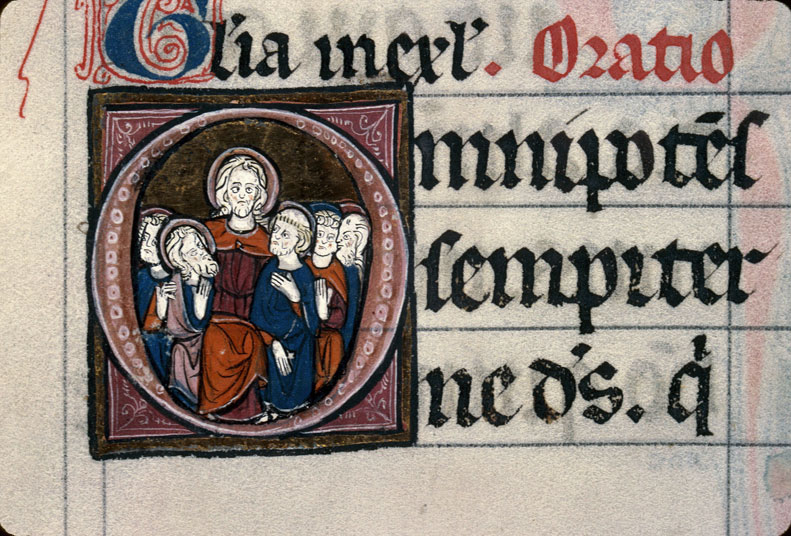
f) as depicted in a later thirteenth-century breviary perhaps from Cambrai (c. 1275-1300; Den Haag, KB, ms. 76 J 18, fol. 470v):
http://manuscripts.kb.nl/zoom/BYVANCKB%3Amimi_76j18%3A470v_init

g) as depicted in a late thirteenth-century missal from Auvergne (c. 1280-1290; Clermont-Ferrand, Bibliothèque du Patrimoine, ms. 62, fol. 267v):
http://www.culture.gouv.fr/Wave/savimage/enlumine/irht4/IRHT_081167-p.jpg

h) as depicted in a late thirteenth-century copy of French origin of the Legenda aurea (c. 1280-1300; San Marino, CA, Huntington Library, ms. HM 3027, fol. 150v):
http://digitalassets.lib.berkeley.edu/ds/huntington/images//000921A.jpg

i) as depicted in the earlier fourteenth-century Taymouth Hours (c. 1326-1350; London, BL, Yates Thompson MS 13, fol. 87v):
http://www.bl.uk/manuscripts/Viewer.aspx?ref=yates_thompson_ms_13_f087v

j) as depicted in a later fourteenth-century Roman Missal of north Italian origin (c. 1370; Avignon, Bibliothèque-Médiathèque Municipale Ceccano, ms. 136, fol. 279r):
http://tinyurl.com/6edcqwo

k) as depicted by Giusto de' Menabuoi in his later fourteenth-century frescoes (later 1370s) in the central cupola of the battistero di San Giovanni in Padua:

 http://www.conciliarpost.com/wp-content/uploads/2015/01/Padua-Baptistry-Ceiling.jpg


l) as depicted in a late fourteenth-century missal from Autun concordant with the Use of Beaune (1394; Dijon, Bibliothèque municipale, ms. 110, fol. 387r):
http://www.enluminures.culture.fr/Wave/savimage/enlumine/irht6/IRHT_093978-p.jpg

m) as depicted in a late fourteenth- or early fifteenth-century altarpiece of Spanish origin in the Metropolitan Museum of Art, New York:

 The Trinity Adored by All Saints


n) as depicted in an early fifteenth-century missal concordant with the Use of Tours (Tours, Bibliothèque municipale, ms. 185, fol. 251r):
http://www.enluminures.culture.fr/Wave/savimage/enlumine/irht9/IRHT_150324-p.jpg

o) as depicted in the early fifteenth-century Belles Heures of Jean de France, Duc de Berry (New York, Metropolitan Museum of Art, The Cloisters Collection, ms. 1954 (54.1.1), fol. 218r):
 http://blog.metmuseum.org/artofillumination/images/BH_Lg13V_218r.EL.JPG


p) as depicted (right-hand column) in the early fifteenth-century Hours of René of Anjou (c. 1405-1410; London, BL, Egerton MS 1070, fol. 103v; image zoomable):
http://www.bl.uk/catalogues/illuminatedmanuscripts/ILLUMIN.ASP?Size=mid&IllID=48373

q) as depicted by the Boucicaut Master in an earlier fifteenth-century book of hours made in Paris (c. 1415-1420; Los Angeles, The J. Paul Getty Museum, ms. 22):
http://tinyurl.com/p4jnyxy

r) as depicted by Beato Angelico (probably) in two corresponding panels, flanking the central one of Christ in glory with angels, on the predella of his earlier fifteenth-century San Domenico Altarpiece (1423-1424) in the National Gallery of Art, London:
1) http://tinyurl.com/q4tbmb2
2) http://tinyurl.com/p9ac548
The predella in its entirety:
http://www.wga.hu/art/a/angelico/00/11fieso1.jpg

s) as depicted in the earlier fifteenth-century Breviary of Marie de Savoie (c. 1430; Chambéry, Bibliothèque municipale, ms. 4, fol. 637v):
http://www.culture.gouv.fr/Wave/savimage/enlumine/irht1/IRHT_035765-p.jpg

t) as depicted in the Suffrages in an earlier fifteenth-century prayer book seemingly from Brabant (c. 1430-1440; Baltimore, Walters Art Museum, Walters ms. W.164, fol. 177r):
http://tinyurl.com/o5ch3by

u) as depicted in a mid-fifteenth-century missal concordant with the Use of Nantes (Le Mans, Médiathèque Louis Aragon, ms. 223, fol. 201r):
http://www.enluminures.culture.fr/Wave/savimage/enlumine/irht5/IRHT_082520-p.jpg

v) as depicted in grisaille by Jean le Tavernier in the mid-fifteenth-century Hours of Philip of Burgundy (c. 1451-1460; Use of Paris; Den Haag, KB, ms. 76 F 2, fol. 283r):
http://manuscripts.kb.nl/zoom/BYVANCKB%3Amimi_76f2%3A283r_min

w) as depicted by Jean Fouquet at the conclusion of the Suffrages in the now dismembered mid-fifteenth-century Hours of Étienne Chevalier (1450s; this folio in the Musée Condé, Chantilly [Oise], ms. 71, fol. 113r):


x) as depicted at the conclusion of the Suffrages in a later fifteenth-century book of hours made in Bruges (c. 1460; Baltimore, The Walters Art Museum, Walters ms. W.186, fol. 293r):
http://tinyurl.com/okqny92

y) as depicted by Willem Vrelant in the later fifteenth-century Arenberg Hours (early 1460s; Los Angeles, J. Paul Getty Museum and Library, Ms. Ludwig IX 8, fol. 81v):
http://tinyurl.com/pe8l4p8

z) as depicted in a later fifteenth-century prayer book of Viennese origin (c. 1460-1470; Vienna, ÖNB, cod. s. n. 2599, fol. 160r):
http://tarvos.imareal.oeaw.ac.at/server/images/7008981.JPG

aa) as depicted in the later fifteenth-century Ranworth Antiphonal (c. 1460-1480; Ranworth [Norfolk], church of St. Helen, unnumbered ms., fol. 271v):

 http://www.english.cam.ac.uk/medieval/images/uea-19allsaints.jpg


bb) as depicted by Lieven van Lathem in the later fifteenth-century Prayer Book of Charles the Bold (1469; Los Angeles, J. Paul Getty Museum and Library, Ms. 37, fol. 43r):
http://tinyurl.com/q3fs4p4

cc) as depicted in a late fifteenth-century copy of the Legenda aurea in its French-language version by Jean de Vignay (1493; Angers, Université Catholique de l'Ouest, Bibliothèque universitaire, incunable non coté, fol. 241v):

 http://www.enluminures.culture.fr/Wave/savimage/enlumine/irht16/IRHT_043113-p.jpg


dd) as depicted by Albrecht Dürer in his early sixteenth-century All Saints altarpiece (1511; a.k.a. the Landauer Altar) in the Kunsthistorisches Museum in Vienna:

 https://upload.wikimedia.org/wikipedia/commons/4/4e/Albrecht_D%C3%BCrer_053.jpg

The painting at higher resolution:

 https://upload.wikimedia.org/wikipedia/commons/6/61/Albrecht_D%C3%BCrer_-_Adoration_of_the_Trinity_%28Landauer_Altar%29_-_Google_Art_Project.jpg

ee) as portrayed in high relief on the early sixteenth-century altar (1518) in the Allerheiligenkapelle of the Pfarrkirche St. Benedikt in Altmünster (Land Oberösterreich):

 http://tarvos.imareal.oeaw.ac.at/server/images/7017914.JPG

Detail view:

 http://tarvos.imareal.oeaw.ac.at/server/images/7017915.JPG


Tuesday, 29 September 2015

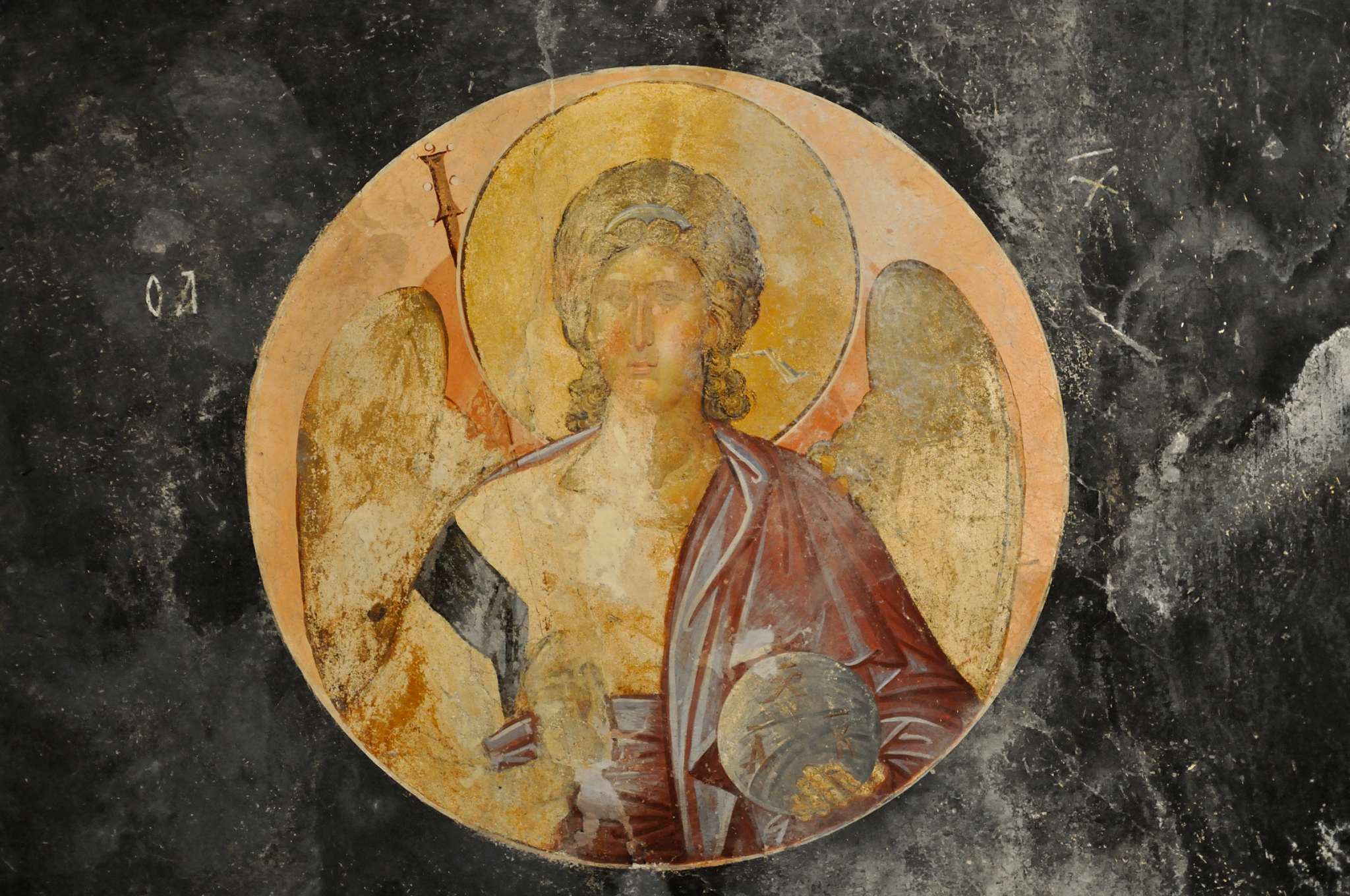
St Michael the Archangel in art


John Dillon posted as follows on the Medieval Religion discussion group for today's feast of St Michael:

A few further period-pertinent images of St. Michael the Archangel (with some corresponding images of fellow archangels):

a) as portrayed in relief on an earlier sixth-century ivory panel (c. 525-550) from a dismembered diptych of Constantinopolitan origin in the British Museum, London:
http://tinyurl.com/nuv22op

b) as depicted (at right; at left, the Theotokos) in an enameled plaque in the central portion of the upper cover of the mid-tenth-century Limburger Staurothek (betw. 945 and 959; reliquary of the True Cross) in the Domschatz- und Diözesanmuseum in Limburg an der Lahn:
https://www.flickr.com/photos/28433765@N07/3767872473
In a corresponding plaque on the other side of the cover's central figure of the Pantocrator, Gabriel is at left and John the Forerunner is at right:
https://www.flickr.com/photos/28433765@N07/3767872589
The upper cover as a whole:
http://tinyurl.com/nqskjxl

c) as depicted in a later tenth- or earlier eleventh-century portable icon (fourteenth- and nineteenth-century reworking and restorations) in the treasury of the basilica cattedrale patriarcale di San Marco in Venice:


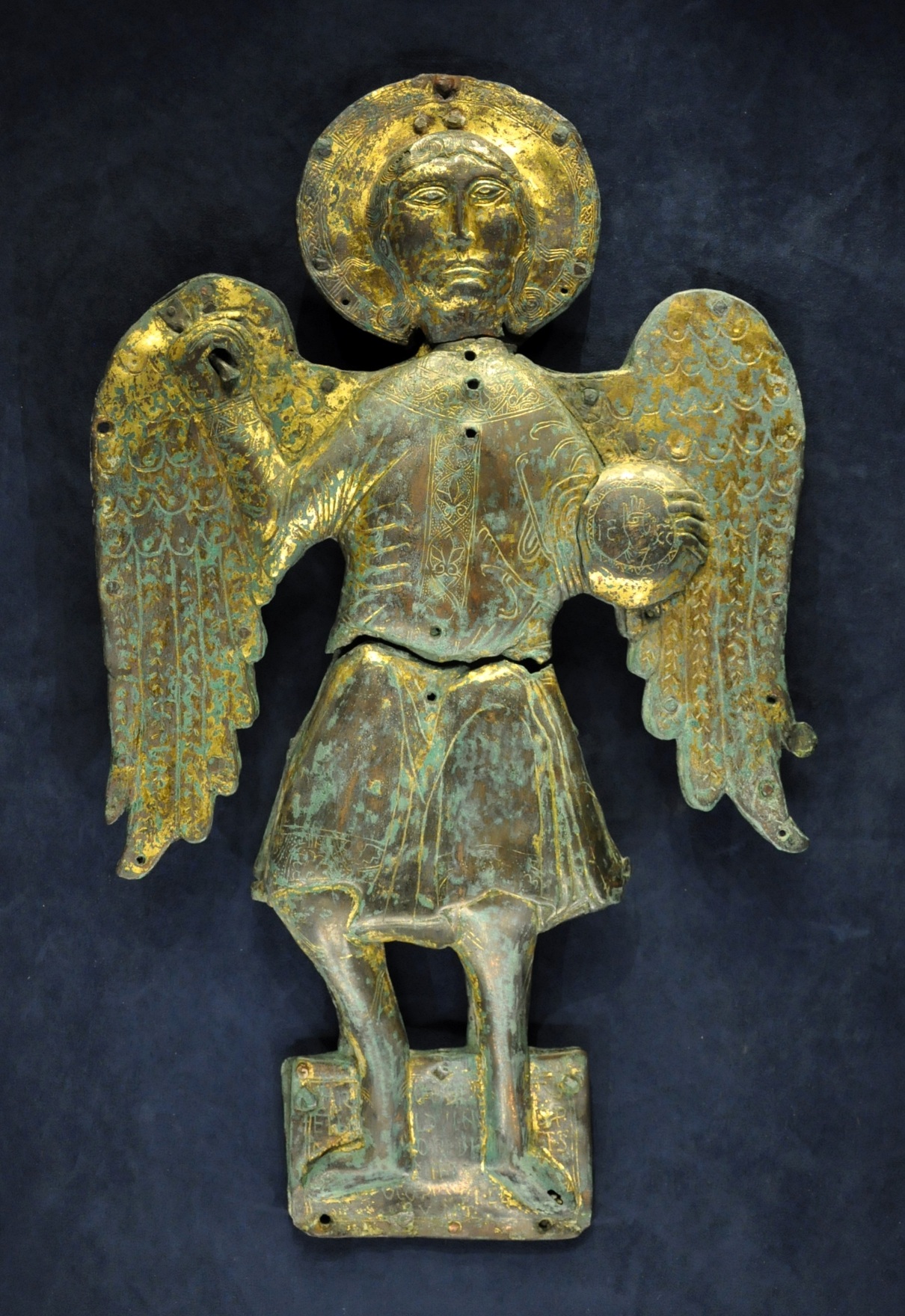
d) as portrayed in an earlier eleventh-century bronze gilt ex-voto in the Lapidarium e Museo devozionale di San Michele arcangelo at Monte Sant'Angelo (FG) in Apulia:


e) as depicted (at left) in an earlier eleventh-century vault mosaic (restored between 1953 and 1962) in the narthex of the church of the Theotokos in the monastery of Hosios Loukas near Distomo in Phokis:
http://tinyurl.com/pfxhxc4
Detail view (Michael):
http://tinyurl.com/ne5c6cy
The angel in the vault field opposite Michael is the archangel Gabriel. A detail view: http://tinyurl.com/p2ajxuj

f) as depicted (at left, sharing a labarum with an Emperor Michael at right) on the reverse of an earlier eleventh-century histamenon (early 1040s) struck by either Emperor Michael IV or Emperor Michael V:
http://tinyurl.com/n9g9xe2

g) as depicted in an earlier to mid-eleventh-century fresco (1040s or 1050s) in the cathedral of St. Sophia in Kyiv / Kiev:

The Archangel Michael


h) as depicted (at right) in the presentation illumination of a later eleventh-century copy of Constantinopolitan origin of the sermons of St. John Chrysostom (Paris, BnF, ms. Coislin 79, fol. 2b):
http://gallica.bnf.fr/ark:/12148/btv1b8470047d/f10.image

i) as depicted in the later eleventh-century apse fresco (between 1058 and 1073; restoration work in the 1980s) in the basilica di Sant'Angelo in Formis on Monte Tifata in today's Capua:


j) as depicted in a twelfth-century portable icon in the Holy Monastery of the God-trodden Mount Sinai, St. Catherine (South Sinai governorate), Egypt:
http://www.touregypt.net/images/touregypt/cart23.jpg

k) as depicted in a twelfth-century fresco (photographed before 1974) in the katholikon of the Antiphonitis monastery near Kalogrea (Girne [Kyrenia] dist.) in Turkish-dominated northern Cyprus:


Archangel Gabriel in another twelfth-century fresco (also photographed before 1974) in the same church:


Frescoes in this church, including that of Michael linked to above, have since been defaced, with others plundered outright.

l) as depicted in an early twelfth-century enamelled plaque (between 1102 and 1118) on the lower portion of the Pala d'oro in the basilica cattedrale patriarcale di San Marco in Venice:


m) as depicted (lower register at left; at right, the archangel Gabriel) in the mid-twelfth-century apse mosaics (betw. 1145 and 1148) in the basilica cattedrale della Trasfigurazione in Cefalù:


Detail view (Michael):


Detail view (Gabriel):


Not appearing in those views, and barely visible here, are the archangels Raphael (at far left) and Uriel (at far right):


n) as depicted in a mid-twelfth-century mosaic (between 1146 and 1151) on an intrados in the chiesa di Santa Maria dell'Ammiraglio (a.k.a. chiesa della Martorana) in Palermo:
http://tinyurl.com/ph2pzsm

A detail view in better light:

[St_Michael_La_Martorana_Palermo_2008-08-27.jpg]

The archangel Gabriel on the same intrados:


o) as depicted (at upper left) in a mid-twelfth-century dome mosaic (between 1146 and 1151) in the chiesa di Santa Maria dell'Ammiraglio (a.k.a. chiesa della Martorana) in Palermo:


The other angels in this circle are the archangels Raphael (upper right), Uriel (lower right), and Gabriel (lower left).

p) as depicted (third from left, wearing a loros) in the mid- to slightly later twelfth-century mosaics in the Cappella Palatina in Palermo:


Detail view (Michael):


The other angels holding orbs are, from left to right, are Michael's fellow archangels Raphael, Gabriel, and Uriel.

Detail view (Raphael):
http://tinyurl.com/qykndf7

Detail view (Michael, Gabriel and, in part, Uriel):


q) as depicted in a later twelfth-century fresco (between 1176 and 1200) in St. George's Church, Staraya Ladoga in Russia:
http://tinyurl.com/5txqyse

r) as depicted (at centre left, flanking the BVM; at centre right, the archangel Gabriel) in the late twelfth-century frescoes (1180s) of the central apse in the basilica cattedrale di Santa Maria nuova in Monreale (image greatly expandable):
https://www.flickr.com/photos/iharsten/15496966194

In different light:


s) as depicted in a late twelfth-century fresco (1191) in the church of St. George at Kurbinovo (Resen municipality) in the Former Yugoslav Republic of Macedonia:
http://www.icon-art.info/hires.php?lng=en&type=1&id=3678

t) as depicted in a late twelfth-century fresco (1199; damaged in World War II) in the church of the Transfiguration of the Saviour on Nereditsa near Veliky Novgorod:
http://www.icon-art.info/masterpiece.php?lng=en&mst_id=4544


u) as depicted in a thirteenth-century Yaroslavl School icon in the State Tretyakov Gallery, Moscow:
http://tinyurl.com/6zqgqya

v) as portrayed in a later thirteenth-century marble capital (between 1250 and 1300) from Constantinople in the Metropolitan Museum of art, New York:
http://www.metmuseum.org/collection/the-collection-online/search/466108
http://tinyurl.com/nodftyw

w) as depicted in a later thirteenth-century fresco (between 1250 and 1300) in the rupestrian chiesa di Santa Lucia alle Malve in Matera:
http://tinyurl.com/nbb245h

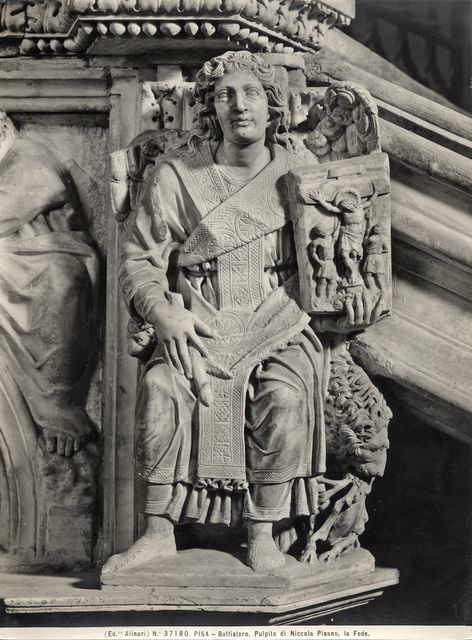
x) as portrayed (seated, holding an image of the Crucifixion) by Nicola Pisano in a statue placed just below the Last Judgment panel on his later thirteenth-century pulpit (1257-1260) in the baptistery of Pisa:
http://catalogo.fondazionezeri.unibo.it/foto/160000/142400/142128.jpg


y) as depicted in the later thirteenth-century frescoes (either ca. 1263-1270 or slightly later) of the monastery church of the Holy Trinity at Sopoćani (Raška dist.) in Serbia:
http://tinyurl.com/3u5euyk
http://tinyurl.com/3v5gemc

z) as depicted in a late thirteenth- or very early fourteenth-century Yaroslavl School icon in the State Tretyakov Gallery, Moscow:
http://www.icon-art.info/masterpiece.php?lng=en&mst_id=414

aa) as depicted in a late thirteenth- or earlier fourteenth-century fresco in the rupestrian chiesa di Santa Margherita in Melfi:


bb) as depicted in a fourteenth-century icon of Constantinopolitan origin in the Byzantine and Christian Museum, Athens:
http://tinyurl.com/oxevut9

cc) as depicted (at left, flanking the Theotokos; at right, the archangel Gabriel) in the earlier fourteenth-century frescoes (between c. 1311 and c. 1322) in the church of St. Nicholas Orphanos in Thessaloniki:
http://tinyurl.com/q7hc7aq

dd) as depicted in the earlier fourteenth-century frescoes (between 1313 and 1318; conservation work in 1968) by Michael Astrapas and Eutychios in the church of St. George in Staro Nagoričane in the Former Yugoslav Republic of Macedonia:
http://tinyurl.com/pgzkzgo

ee) as depicted in the earlier fourteenth-century frescoes (between c. 1314 and c. 1320) by Michael Astrapas and Eutychios in the church of St. Nikita at Čučer in today's Čučer-Sandevo in the Former Yugoslav Republic of Macedonia:
http://tinyurl.com/o55cpcm

ff) as depicted in an earlier fourteenth-century fresco (between 1315 and 1321) on an intrados in the parecclesion of the Chora church (Kariye Camii) in Istanbul:


gg) as depicted (at left, flanking the Theotokos; at right the archangel Gabriel) in an earlier fourteenth-century fresco (1330s) in the calotte of the apse in the church of the Hodegetria in the Patriarchate of Peć:


Detail view (Michael):


Detail view (Gabriel):
http://tinyurl.com/puepcn8

hh) as depicted in an earlier fourteenth-century fresco (1330s) in the diakonikon of the church of the Hodegetria in the Patriarchate of Peć:
http://tinyurl.com/yac98xz
The matching figure of the archangel Gabriel at the other end of the same wall is better preserved:
http://tinyurl.com/y9vdgrp

ii) as depicted (at right; at left, and slightly larger, the despotes Jovan Oliver with a model of the church) in the mid-fourteenth-century frescoes (1340s) of the monastery church of St. Michael the Archangel at Lesnovo (Probištip municipality) in the Former Yugoslav Republic of Macedonia:


jj) as depicted in an earlier fifteenth-century Tver School icon in the State Tretyakov Gallery, Moscow:
http://www.icon-art.info/masterpiece.php?lng=en&mst_id=1464

kk) as depicted in an early fifteenth-century panel painting (ca. 1408; previously attributed to Andrej Rublev) from the iconostasis of the Dormition cathedral in Vladimir and now in the State Tretyakov Gallery, Moscow:
http://tinyurl.com/pzhykxo
The matching painting of the archangel Gabriel (also in the Tretyakov):
http://tinyurl.com/opkyabe

ll) as depicted by Andrej Rublev (attrib.) in an early fifteenth-century panel painting (early 1410s) from the Deesis range in the Dormition cathedral in Zvenigorod and now in the State Tretyakov Gallery, Moscow:
http://tinyurl.com/q3e6vcd

mm) as depicted by Dionisy and sons in the early sixteenth-century frescoes (1502) in the Virgin Nativity cathedral of the St. Ferapont Belozero (Ferapontov Belozersky) monastery at Ferapontovo in Russia's Vologda oblast:
http://www.dionisy.com/eng/museum/1028/1443/index.shtml
The corresponding depiction of the archangel Gabriel:
http://www.dionisy.com/eng/museum/1028/1444/index.shtml
The corresponding depiction of the archangel Uriel:
http://www.dionisy.com/eng/museum/1028/1448/index.shtml