Once I was a clever boy learning the arts of Oxford... is a quotation from the verses written by Bishop Richard Fleming (c.1385-1431) for his tomb in Lincoln Cathedral. Fleming, the founder of Lincoln College in Oxford, is the subject of my research for a D. Phil., and, like me, a son of the West Riding. I have remarked in the past that I have a deeply meaningful on-going relationship with a dead fifteenth century bishop... it was Fleming who, in effect, enabled me to come to Oxford and to learn its arts, and for that I am immensely grateful.


Showing posts with label St Michael the Archangel. Show all posts

Tuesday, 30 September 2025

More for Michaelmas


Following on from my post yesterday for Michaelmas here are two pieces from websites which were published yesterday.

The New Liturgical Movement had republished another excellent article from 2018 by Gregory DiPippo about the history of the feast and with some fine illustrations, including Roger van der Weyden’s famous depiction of the Archangel from 1446-52. Unlike most later medieval images of St Michael, such as those by Crivelli I cited yesterday which show an armed figure with sword and scales, here the Archangel weighs souls dressed in cope, stole and alb.

The article can be seen at The Feast of St Michael and All Angels.

The Liturgical Arts Journal had a lavishly illustrated account by J.P. Sonnen of St Michael’s Abbey at Farnborough which was founded by the Empress Eugenie as a sepulchre and memorial for her husband the Emperor Napoleon III, for their only child the Prince Imperial, and for herself. The monastic church is a vision of late French Flamboyant architecture in rural - or suburban - Home Counties England. 

That article can be seen at St. Michael's Abbey in Farnborough, England


Monday, 29 September 2025

St Michael the Archangel


Today is Michaelmas, the principal feast of St Michael the Archangel.

The Catholic Online website says that St Michael has four main responsibilities or offices, as we know from scripture and Christian tradition.

The first is to combat Satan.
The second is to escort the faithful to heaven at their hour of death.
The third is to be a champion of all Christians, and of the Church itself.
The fourth is to call men from life on Earth to their heavenly judgment.

He is also the patron of banking, grocers, the police and the armed forces. I assume the first two came about through his attribute of the scales of judgement, and the third as being a heavenly defender of law and order, with the fourth as a further instance of his being a defender of the community of the faithful as leader of the Heavenly Host against the Enemy.

Wikipedia has a lengthy, and well illustrated account of his cult in Judaism as well as the different branches of Christianity and other faiths at Michael (archangel)

I wanted to include an image of the painting of St Michael the Archangel by Carlo Crivelli and dated to circa 1476 and now in the National Gallery. However none of the images of it on the internet would actually copy and paste. This is all part of an irritating trend in copyright over the last year or so - very frustrating. So I shall have to refer readers to the illustrated article about the panel, which comes from an altarpiece, and with expandable images, on the National Gallery website at Carlo Crivelli | Saint Michael | NG788.11 | National Gallery, London

The painting is also discussed on the Kultura website at Saint Michael - Carlo Crivelli

Crivelli produced several images of Saint Michael in his very distinctively detailed and meticulously posed style.

St Michael the Archangel Pray for us

Sunday, 29 September 2024

St Michael the Archangel


Today is the Feast of St Michael the Archangel.

The New Liturgical Movement has an article on their website from 2018 about the observance of the day, and which can be seen at Liturgical Notes on the Feast of St Michael and All Angels

For the May feast which commemorates the Archangel’s Apparition at Monte Gargano they had an article earlier this year which is to be found at The Apparition of St Michael

The blog of A Clerk of Oxford has a beautifully illustrated article from 2013 about medieval devotional texts for both clerical and lay audiences addressing St Michael which can be seen at Four Medieval Texts for Michaelmas

File:Josse Lieferinxe — St. Michael Killing the Dragon — 1493-1505.jpg


St Michael killing the Dragon

Josse Leiferinxe fl.1493-1503/8
Musée de Petit Palais Avignon

Image: meisterdrucke.uk/Wikimedia


Holy Michael Archangel
Defend us in the day of battle.
Be our safeguard against the wickedness and snares of the Devil,
And do thou, O Prince of the Heavenly Host,
By the power of God
Thrust down into Hell Satan and all who wander through the world to the ruin of souls


Thursday, 29 September 2016

St Michael the Archangel


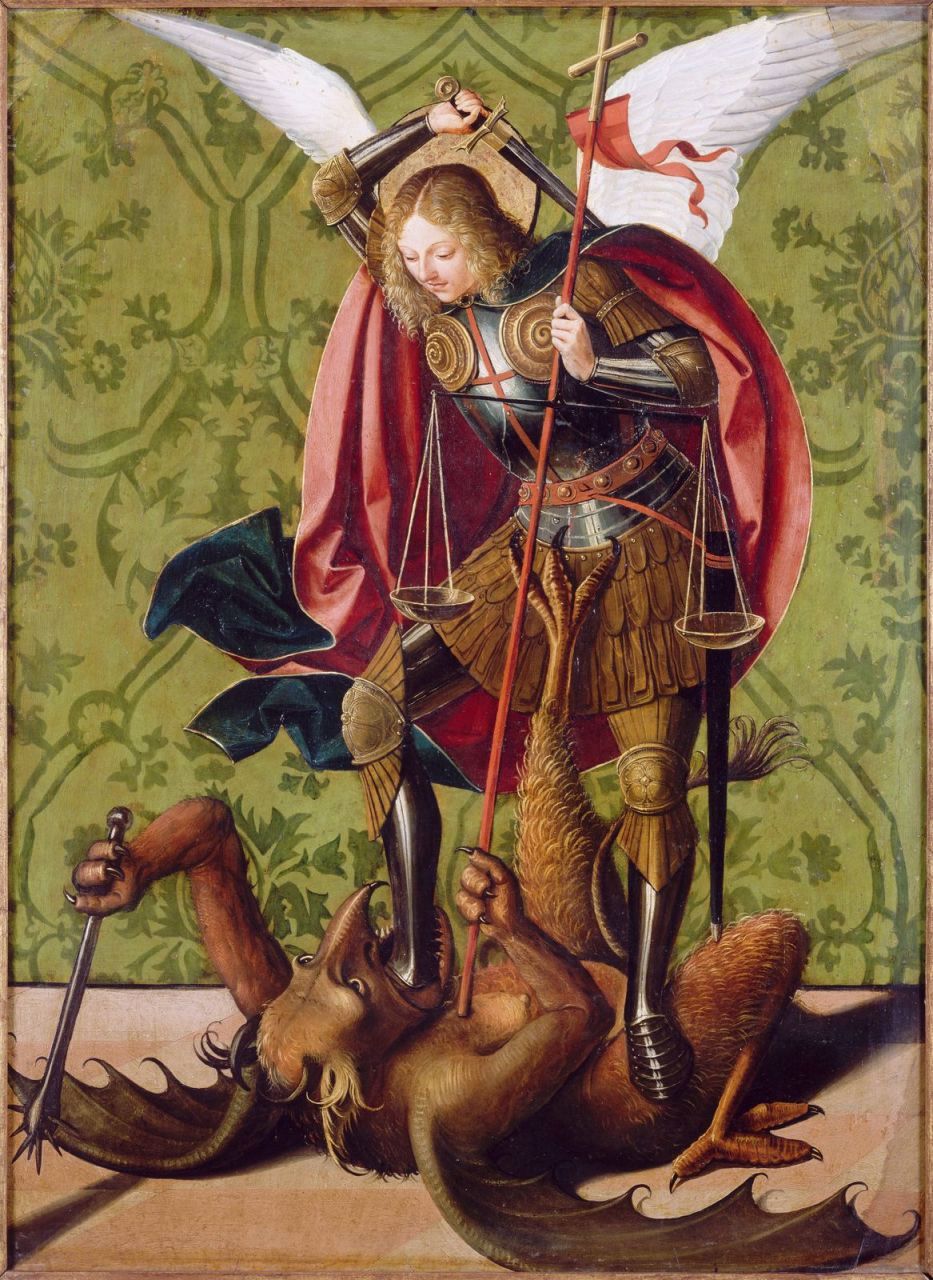
Today is the Feast of St Michael the Archangel, and to mark the day here is a rather splendid late medieval depiction of him dealing with a satanic dragon.


Image:Breviary.net 

Holy Michael Archangel defend us in the day of battle and be our safeguard against the wickedness and snares ot the Devil. May God rebuke him we humbly pray and do thou O Prince of the Heavenly Host by the power of God thrust down into hell Satan and all wicked spirits who wander through the world to the ruin of souls.Through Christ our Lord. Amen.

Friday, 22 January 2016

St Vincent


Today is the feast of St Vincent, whose depiction in art I have featured before but this year Gordon Plumb and John Dillon have provided a most impressive series of pictures of the saint's story on the Medieval Religion discussion group. Many of these are very interesting as to what later medieval life and liturgy were like, and hence this rather lengthy post. Larger views of the pictures I have posted can be obtained by clicking on the appropriate link at the bottom right.

Gordon Plumb started the series of images as follows:

St Vincent of Saragossa:
The 22nd of January is the feast of St Vincent of Saragossa, who died in 304 and was a deacon and the first Spanish martyr. He was trained by Valerius, bishop of Saragossa. Of his martyrdom there is no doubt, though there is considerable uncertainty about exactly how it occurred. Prudentius is our first witness and Augustine attests that the cult was known all over the Roman Empire. According to the ancient Legend, he suffered under the edicts of Diocletian and Maximian. At first imprisoned and kept short of food, he refused to sacrifice and was then racked, roasted on a grid, imprisoned and put into the stocks. He died as a result of his sufferings. He is often shown as a deacon holding a palm, or else suffering on the grid.

Angers, Cathédrale Saint-Maurice, Bay 121, Martyrdom of St Vincent, c.1180:
https://www.flickr.com/photos/22274117@N08/16237364432
and detail of Vincent's body protected by crows:
https://www.flickr.com/photos/22274117@N08/16237383302
of Vincent being flogged:
https://www.flickr.com/photos/22274117@N08/15618333743
of Vincent being visited by angels in prison:
https://www.flickr.com/photos/22274117@N08/16052356717
Vincent on the grill:
https://www.flickr.com/photos/22274117@N08/16050686738
Death of Vincent:
https://www.flickr.com/photos/22274117@N08/16212308586
Vincent and Valerian before Decius:
https://www.flickr.com/photos/22274117@N08/15615773394

Oxford, St Peter in the East, North Chapel, North window, right-hand light, part of deacon holding palm (St Vincent of Saragossa): This glass was given by Vincent Wycking, Vicar in 1433.
https://www.flickr.com/photos/22274117@N08/2762050523

Heydour, St Michael, nV, 2a-3a:
https://www.flickr.com/photos/22274117@N08/3452347882

Harpley, St Lawrence, wI, D2, Vincent and Ledger:
https://www.flickr.com/photos/22274117@N08/3320378464

Panel in the Collections of the Victoria &Albert Museum showing Vincent burnt on the rack from Saint-Germain-des-Près, Paris of c.1240-45.
http://collections.vam.ac.uk/item/O8588/saint-vincent-burnt-on-the-window-unknown/
The church was originally dedicated to St Vincent, later being redecicated to St Vincent and St Germanus. On this window see Mary B Shepard in Gesta, Vol. 37, No, 2, 1998.
Further panels in the Metropolitan Museum, New York can be seen here:
http://www.metmuseum.org/collection/the-collection-online/search/466580

Bourges Cathedral, Bay 12, St Vincent of Saragossa window, with facility to see excellent images of each panel by clicking on the window outline. To get to Bay 12 click on the appropriate box in the
general plan of the Bourges windows:
http://www.medievalart.org.uk/Bourges/12_pages/Bourges_Bay_12_key.htm


John Dillon then posted his selection, again with an introduction to the cult:

A popular martyr of early Christian Iberia, Vincent (d. 304?) was a deacon at Zaragoza (a.k.a. Saragossa) who did a lot of preaching for his Bishop, Valerius.  The latter (in some accounts) had a speech impediment.  At the outbreak of the Diocletianic persecution they were both arrested and hauled off to Valencia, where they were imprisoned pending a hearing.  When that hearing came, Vincent did most of the talking and spoke so ably that the presiding magistrate concluded that the really dangerous one was the deacon, not the bishop.  Consequently, Valerius was exiled but Vincent remained in prison, where he underwent a series of tortures before being executed.

Early witnesses to Vincent's cult include St. Paulinus of Nola, Prudentius, and St. Augustine of Hippo.  The last named eulogized Vincent annually on this day and we have from his pen no fewer than six sermons celebrating this saint.  Vincent's Passio in its standard form (BHL 8631) was in existence by the middle of the sixth century.  A briefer text (BHL 8638) may be close in content to a Passio that circulated in the fifth century.  On Vincent's early medieval cult in general, with editions of major texts, see Victor Saxer, Saint Vincent diacre et martyr: Culte et légendes avant l'An Mil (Bruxelles: Société des Bollandistes, 2002; Subsidia Hagiographica, vol. 83).


Some period-pertinent images of Vincent of Zaragoza (or, if you prefer, of Saragossa; also V. of Huesca, V. of Valencia, and V. the Martyr) :

a) as depicted (third from left; after Sts. Demetrius and Polycarp) in the heavily restored, later sixth-century mosaics (c. 561) in the nave of Ravenna's basilica di Sant'Apollinare Nuovo:
http://tinyurl.com/2foe88u

b) as depicted in the late tenth- or very early eleventh-century so-called Menologion of Basil II (Città del Vaticano, BAV, cod. Vat. gr. 1613, p. 342):


c) as depicted (two scenes from his Passio) in the early eleventh-century frescoes of the central apse in the basilica di San Vincenzo in Galliano, a frazione of Cantù (CO) in Lombardy:
1) Undergoing torture by hot lead:
http://tinyurl.com/pgmpc2w
2) His corpse guarded by birds and being prepared for burial:
http://tinyurl.com/pt5qdy3

d) as depicted (in the soffit at right, second roundel from bottom) in the earlier twelfth-century mosaics (c. 1143) of the chiesa di Santa Maria dell'Ammiraglio (a.k.a. chiesa della Martorana) in Palermo:
http://tinyurl.com/7kxovph

e) as depicted (at right; at left, St. Germanus of Paris) in the frontispiece to a mid-twelfth-century collection of writings by Origen from the abbey of St.-Germain-des-Prés in Paris (Paris, BnF, ms. Latin 11615, fol. 2v):
http://tinyurl.com/phxpbpn

f) as depicted (centre register, second from left, between his fellow deacons Sts. Peter of Marcellinus-and-Peter and Lawrence of Rome) in a probably mid- or slightly later twelfth-century mosaic (restored, 1859) in the choir of the basilica cattedrale della Trasfigurazione in Cefalù :


This second view  is greatly expandable:

g) as portrayed (martyrdom scenes) in a perhaps later twelfth-century relief (after c. 1160) in the Münster in Basel:


h) as depicted (at right; at left, St. Victor of Syria) in the later twelfth-century frescoes (1164) in the church of St. Panteleimon (Pantaleon) at Gorno Nerezi (Skopje municipality) in the former Yugoslav Republic of Macedonia:
http://tinyurl.com/h2jgbg4
In Byzantine-rite churches both Victor and Vincent are celebrated on 11. November (in the Synaxary of Constantinople Vincent also occurs by himself under 22. January). That is also the feast day of St. Men(n)as the Egyptian, whose church in Constantinople is reported from the twelfth century as possessing relics of Vincent and Victor.

i) as portrayed in high relief (scenes) on his late twelfth-century polychromed stone cenotaph in the Basilica de los Santos Hermanos Mártires, Vicente, Sabina y Cristeta in Ávila:
http://tinyurl.com/z6fnpka
http://tinyurl.com/h5g48nc

The Clever Boy would add that these are a wonderful series of pictures of late Romanesque sculpture which has retained its paintwork - a delight to peruse.

j) as depicted (martyrdom) in one of four panels of a full-page illumination in the late twelfth-century so-called Bible of Saint Bertin (c. 1190-1200; Den Haag, KB, ms. 76 F 5, fol. 28v, sc. 1B):
http://manuscripts.kb.nl/zoom/BYVANCKB%3Amimi_76f5%3A028v_min_b1

k) as portrayed in high relief (birds guarding his corpse at sea) on the left pillar of the left portal of the late twelfth or early thirteenth-century south porch (by 1210) of the basilique cathédrale Notre-Dame in Chartres:


l) as depicted (scenes of his life and martyrdom) in the early thirteenth-century St. Vincent window (bay 12; c. 1215) in the ambulatory of the cathédrale Saint-Étienne in Bourges:
http://www.medievalart.org.uk/bourges/12_pages/Bourges_Bay_12_key.htm

m) as depicted (scenes from his Passio) in panels from a mid-thirteenth-century glass window (1240s; from the abbey church of Saint-Germain-des-Prés in Paris) in the Walters art Gallery and Museum, Baltimore:
http://art.thewalters.org/detail/77393/stained-glass-window-with-scenes-from-the-life-of-saint-vincent/
Gordon Plumb's post has links to other panels from the same window in the Victoria and Albert Museum in London and the Metropolitan Museum of Art in New York.

n) as depicted (martyrdom) in a panel of a mid-thirteenth-century ambulatory window (Bay 201, panel A1; c. 1254) in the cathédrale Saint-Julien, Le Mans:
http://www.medievalart.org.uk/lemans/Clerestory/jpeg/Le_Mans_Bay_201_Panel_A1.jpg

o) as depicted (scenes of his life and martyrdom) on a later thirteenth-century altar frontal (parchment over wood; from the church of Santa María de Monte at Liesa [Huesca]) in the possession of the Diputación Provincial de Huesca (for better views click on the individual frames):


p) as depicted (sixth from left, after an archangel, St. Peter, the Christ child, the BVM, and St. Paul; the remaining two are St. Ambrose of Milan and St. Augustine's son Adeodatus, venerated in medieval Milan as a saint) in a later thirteenth-century fresco on the parapet of the Gospel ambo in the basilica di San Vincenzo in Galliano, a _frazione_ of Cantù (CO) in Lombardy:
http://tinyurl.com/mf7gqks
Detail view (Vincent):


q) as depicted (martyrdom) in a late thirteenth-century copy of French origin of the Legenda aurea (San Marino, CA, Huntington Library, ms. HM 3027, fol. 24v):
http://digitalassets.lib.berkeley.edu/ds/huntington/images//000967A.jpg

r) as depicted (martyrdom) in the late thirteenth-century Livre d'images de Madame Marie (ca. 1285-1290; Paris, BnF, ms. Nouvelle acquisition française 16251, fol. 78r):
http://tinyurl.com/yj8su7y
https://lafrancechretienne.files.wordpress.com/2014/12/martyr_de_saint_vincent.png

s) as depicted in the earlier fourteenth-century frescoes (between c.1312 and 1321/1322) in the monastery church of the Theotokos at Gračanica in, depending upon one's view of the matter, either Serbia's province of Kosovo and Metohija or the Republic of Kosovo:
https://kb.osu.edu/dspace/handle/1811/40826

t) as depicted (second from right, lower register, in the panel at lower left; martyrdom) in an earlier fourteenth-century pictorial menologion from Thessaloniki (between 1322 and 1340; Oxford, Bodleian Library, MS Gr. th. f. 1, fol. 16v):
http://image.ox.ac.uk/images/bodleian/msgrthf1/16v.jpg

u) as depicted (two scenes: preaching and undergoing martyrdom) in an earlier fourteenth-century copy of the Legenda aurea in its French-language version by Jean de Vignay (c. 1326-1350; Paris, BnF, ms. Français 185, fol. 101v):
http://tinyurl.com/yd8s4pf
Note that in these illuminations we seem to have evidence of that rare figure in church annals, the mitred deacon. In the first of these, the figure robed in blue is thought to depict Vincent's actual bishop, the confessor St. Valerius of Zaragoza.

v) as depicted in a panel of the mid-fourteenth-century great window (c. 1340-1350) in the choir of the Kirche St.-Vinzenz in Segringen (Lkr. Mittelfranken) in Bavaria: 

http://id.corpusvitrearum.de/images/3419.html

w) as depicted (martyrdom) in an earlier fourteenth-century copy of the Legenda aurea, from the workshop of Richard and Jeanne de Montbaston, in its French-language version by Jean de Vignay (1348; Paris, BnF, ms. Français 241, fol. 46v):
http://tinyurl.com/y8snjlq

x) as depicted (portrait; scenes) by the Master of Estopiñán in a later fourteenth-century triptych (c. 1350-1370) in the Museo Nacional de Arte de Cataluña, Barcelona:


y) as depicted (the finding of his body) in a late fourteenth- or early fifteenth-century copy of the Legenda aurea in its French-language version by Jean de Vignay (Rennes, Bibliothèque de Rennes Métropole, ms. 266, fol. 48v):
http://tinyurl.com/jqau7dc

z) as depicted (his body about to be cast into the sea) in an early fifteenth-century copy of the Elsässische Legenda aurea (1419; Heidelberg, UB, Cod. Pal. germ. 144, fol. 295v):
http://digi.ub.uni-heidelberg.de/diglit/cpg144/0614

aa) as depicted (at left, martyrdom; at right, St. Vincent Ferrer) by Bernard (Bernat) Martorell in an earlier fifteenth-century panel painting in the State Hermitage Museum, St. Petersburg:


bb) as depicted (martyrdom) by the court workshop of Emperor Frederick III in a mid-fifteenth-century copy of the Legenda aurea (1446-1447; Vienna, Österreichische Nationalbibliothek, cod. 326, fol. 38v):
http://tarvos.imareal.oeaw.ac.at/server/images/7006832.JPG

cc) as depicted in grisaille by Jean le Tavernier in the mid-fifteenth-century Hours of Philip of Burgundy (c. 1451-1460; Den Haag, KB, ms. 76 F 2, fol. 257v):
http://manuscripts.kb.nl/zoom/BYVANCKB%3Amimi_76f2%3A257v_min

dd) as depicted (scenes) by Nuno Gonçalves on several later fifteenth-century panels (c. 1451-1475) in the Museu Nacional de Arte Antiga in Lisbon:
https://www.flickr.com/photos/andrepipa/5632595721/
A closer view of a copy:
http://upload.wikimedia.org/wikipedia/commons/c/c7/Lagos40_kopie.jpg

I posted about these great panels in St Vincentin 2011.

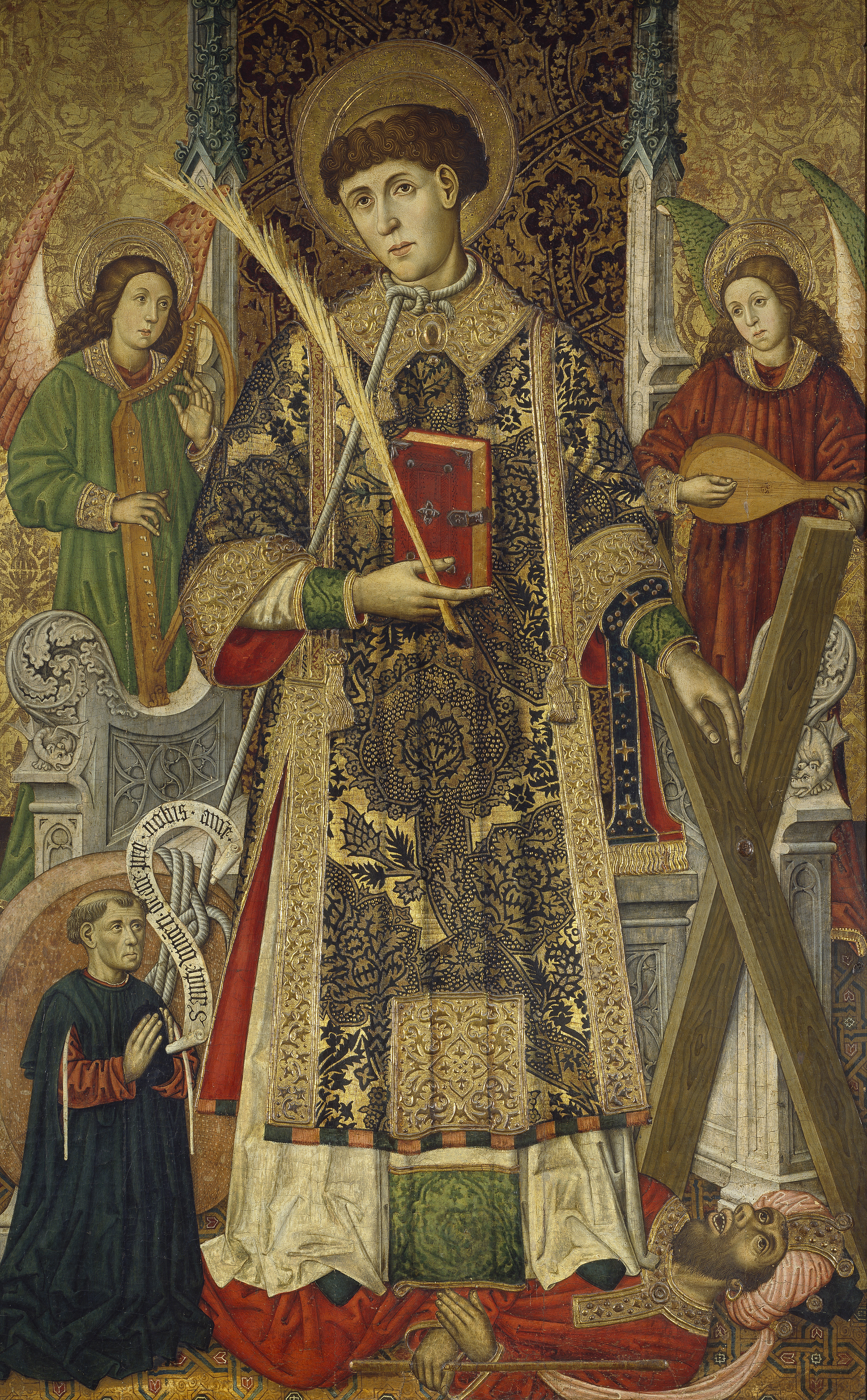
ee) as depicted by Jaume Huguet in five mid-fifteenth-century panels from a never-finished altarpiece (c. 1455-1460; for Barcelona's església de Sant Vicenç de Sarrià) in the Museo Nacional de Arte de Cataluña, Barcelona:
1) Ordained priest by St. Valerius of Zaragoza:


2) Brought before the proconsul Datianus / Dacianus:


3) Martyrdom - torture by fire:


4) Martyrdom - torture on a cross-shaped eculeus:


5) Seekers for cures at his tomb:


ff) as depicted by Tomás Giner in a later fifteenth-century panel painting (between 1462 and 1466) in the Museo del Prado, Madrid:


gg) as depicted (at left; at centre, St. James the Great; at right, St. Eustace) by Antonio and Piero del Pollaiolo in a later fifteenth-century panel painting (c. 1466-1468) in the Galleria degli Uffizi, Florence:
http://tinyurl.com/hu4or78


hh) as depicted (martyrdom) in a late fifteenth-century copy of the Legenda aurea in its French-language version by Jean de Vignay (c. 1480-1490; Paris, BnF, ms. Français 244, fol. 54v):
http://tinyurl.com/ydw94le

ii) as depicted (at centre, between St. Michael the Archangel and St. Lawrence of Rome) in the central panel of the late fifteenth-century retable in the iglesia de San Vicente Mártir at San Vicente de Labuerda in Labuerda (Huesca):


jj) as portrayed in relief (image at right) on a guldiner of 1493 from Bern:
http://tinyurl.com/lfxwdh4

kk) as depicted (martyrdom) in the earlier sixteenth-century portion (c. 1540) of a window in the église Saint-Ouen at Pont-Audemer (Eure):

http://tinyurl.com/l29vh9d

Later John posted some additional images of St. Vincent:

1) as depicted (two scenes) in an eleventh-century troper from Autun (Paris, BnF, ms. Arsenal, 1169):
a) Martyrdom on a cross-shaped eculeus (fol. 14v, bas-de-page):
http://gallica.bnf.fr/ark:/12148/btv1b52000516z/f34.item.r=Arsenal%201169.zoom
b) Martyrdom by fire (fol. 15r):
http://gallica.bnf.fr/ark:/12148/btv1b52000516z/f35.item.r=Arsenal%201169.zoom

2) as depicted (beaten with clubs) in an earlier fourteenth-century French-language legendary of Parisian origin with illuminations attributed to the Fauvel Master (c. 1327; Paris, BnF, ms. Français 183, fol. 215v):
http://tinyurl.com/hdruag4

3) as depicted (four scenes) in an earlier fourteenth-century copy of books 9-16 of Vincent of Beauvais' Speculum historiale in its French-language version by Jean de Vignay (c. 1335; Paris, BnF, ms. Arsenal 5080):
a) With St. Valerius of Zaragoza before Datianus / Dacianus (fol. 263r):
http://gallica.bnf.fr/ark:/12148/btv1b55000813g/f531.item.r=arsenal%205080.zoom
b) Martyrdom on a cross-shaped _eculeus_ (fol. 263v):
http://gallica.bnf.fr/ark:/12148/btv1b55000813g/f532.item.r=arsenal%205080.zoom
c) Martyrdom by fire (fol. 264r):
http://gallica.bnf.fr/ark:/12148/btv1b55000813g/f533.item.r=arsenal%205080.zoom
d) Datianus / Dacianus orders the disposal of V.'s body; ravens protect it from a wolf (fol. 264v):
http://gallica.bnf.fr/ark:/12148/btv1b55000813g/f534.item.r=arsenal%205080.zoom

4) as depicted in the very late fourteenth- or earlier fifteenth-century Breviary of Martin of Aragon (Paris, BnF, ms. Rothschild 2529, fol. 306v):
http://gallica.bnf.fr/ark:/12148/btv1b52000996s/f614.item.zoom

5) as depicted by the Portuguese artist Frei Carlos (attrib.) in an earlier sixteenth-century panel painting (c. 1520-1530) in the Metropolitan Museum of Art, New York. The Museum website can be seen here: http://www.metmuseum.org/collection/the-collection-online/search/435847

https://upload.wikimedia.org/wikipedia/commons/5/54/Saint_Vincent%2C_Patron_Saint_of_Lisbon%2C_by_Frei_Carlos.png


Thursday, 3 December 2015

St James of the March


November 28th was the feast day of the Franciscan St James of the March. John Dillon posted the following piece on the Medieval Religion discussion group:

James of the March (Giacomo della Marca; Jacobus Picenus) was born at Monteprandone in today's Ascoli Piceno province of the Marche. He was christened Domenico and studied first at Ascoli Piceno and then at Perugia, where he obtained doctorates in civil and in canon law. After a few years in minor posts at Florence and at Bibbiena he entered the Franciscan order in 1416 at the convent of Santa Maria degli Angeli at Assisi. There he took the Christian name by which he is known and studied under St. Bernardino of Siena.

James was ordained priest in or shortly after 1420 and began to preach extensively in north central Italy, founding as he went numerous Monti di Pietà (low-interest pawn and credit funds), which latter the Franciscans were promoting actively. He also travelled widely in northern and eastern Europe, both as a diplomat and as an inquisitor. From 1435 to 1438 James was his order's vicar in Bosnia. In the 1450s he preached crusade against the Turks; in 1456 he succeeded St. John of Capestrano in János Hunyadi's campaign in Bosnia and Serbia. Back in Italy he continued to preach and was also called upon to resolve numerous local disputes. In his last few years James was based at Naples. He was buried there at the Franciscan convent of Santa Maria La Nova; miracles were reported at his tomb and in fairly short order his remains were given an Elevatio. James was canonized in 1726. His largely incorrupt body reposed in Santa Maria La Nova until 2001, when it was translated to the convento / santuario di Santa Maria delle Grazie in Monteprandone.

Herewith some views of James in his present earthly state:
1) On display:
http://tinyurl.com/jj2ebkg
http://tinyurl.com/hj343bc


2) Undergoing a recognition in 2008:
http://www.paleopatologia.it/immagini/2008/SanGiacomo1.jpg
http://www.paleopatologia.it/immagini/2008/SanGiacomo2.jpg
http://www.paleopatologia.it/immagini/2008/SanGiacomo4.jpg

James is one of Naples' patron saints. An early poem (Elegiae, 1. 7) by the late fifteenth- and early sixteenth-century Neapolitan humanist Jacobo Sannazaro honors him.

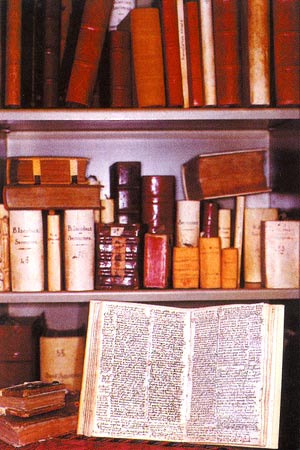
James founded the aforementioned convent of Santa Maria delle Grazie in his native Monteprandone in 1449. The convent's library, now city property and housed in Monteprandone's Museo civico dei Codici di San Giacomo della Marca (housed in the Palazzo comunale), has a nucleus of manuscript books that once belonged to the saint, including four so-called autographs that are really working texts dictated by him. Most of James' sermons have not been edited but the two published in the the conference volume San Giacomo della Marca nell'Europa del '400 (Padova: Centro Studi Antoniani, 1997) show considerable skill. (James was given to quoting pertinent bits of Italian poetry in these Latin texts: at least one has a few lines from Dante and many quote Laude by or attributed to Jacopone of Todi). [Sounds rather like St Philip Neri - Clever Boy]

 Herewith some views of the library and of selected contents:
http://giornale.regione.marche.it/archivio/num0102/foto17a.htm
http://www.sangiacomodellamarca.net/o_sgiacomo/manoscritti.jpg
Expandable views of pages from individual codices are at lower right here:
http://www.sangiacomodellamarca.net/biblioteca_san_giacomo.htm#target
Other views (also expandable)
http://tinyurl.com/ozfkmu4
http://web.tiscali.it/corradettiivan/text/allcodici.htm

At Monteprandone one may also see a house where James is said to have been born:
http://web.tiscali.it/corradettiivan/images/fotogr3.gif
Also at Monteprandone, in the Museo del Santuario di San Giacomo della Marca, one may see various objects said to have been his. The last four images (all expandable) on this page are of a chalice, two crucifixes, a chest for relics, and an ivory triptych said to have belonged to James.:
http://web.tiscali.it/corradettiivan/text/allfoto.htm
More views (also expandable) are at lower right here:
http://www.sangiacomodellamarca.net/MUSEO.htm

Some period-pertinent images of St. James of the March:

a) as depicted in a later fifteenth-century panel painting by Carlo Crivelli (1477; Paris, Musée du Louvre):
http://cartelen.louvre.fr/cartelen/visite?srv=car_not_frame&idNotice=13752
http://tinyurl.com/jz557gv

b) as depicted in a later fifteenth-century panel painting by Carlo Crivelli (1487; Venice, Gallerie dell'Accademia):
http://www.beniculturali.marche.it/Ricerca.aspx?ids=53205

c) as depicted in a later fifteenth-century panel painting by Vittore Crivelli (Ripatransone, Polo Museale di Palazzo Bonomi Gera):


http://pintura.aut.org/SearchProducto?Produnum=133063

d) as depicted in a later fifteenth-century panel painting by Vittore Crivelli (Perugia, Galleria nazionale dell'Umbria):


http://pintura.aut.org/SearchProducto?Produnum=133069
http://www.beniculturali.marche.it/Ricerca.aspx?ids=53205

e) as depicted in a later fifteenth-century panel painting by Pietro Alemanno (Ascoli Piceno, Palazzo dei Capitani):


http://www.sangiacomodellamarca.net/arte/3.htm

f) as depicted in a later fifteenth-century panel painting by Cola d'Amatrice (Urbino, Galleria nazionale delle Marche):


The similarity among the foregoing portraits is probably the result of the circulation among Franciscan houses of copies of James' death mask. One may compare the similarly uniform later fifteenth-century Italian portraiture of St. Bernardino of Siena (20. May; d. 1444; canonized, 1450).

g) as depicted (at right; at left, St. Jerome; at centre, the Archangel Michael) in a late fifteenth-century panel painting by an Italo-Flemish artist (c. 1490; Naples, Museo nazionale di Capodimonte):


h) as depicted (at right; at left, St. Catherine of Alexandria; at centre, St. Anthony of Padua) by Tuccio d'Andria in a late fifteenth- or early sixteenth-century panel painting (Bari, Pinacoteca di Bari "Corrado Giaquinto"):


i) as depicted in an early sixteenth-century panel painting by Pietro Perugino (c. 1512-1515; Perugia, Galleria nazionale dell'Umbria):


j) as portrayed in high relief (at right; at left, St. Francis of Paola; at center, the Baptism of Christ) by Giovanni da Nola in an earlier sixteenth-century marble sculpture (1534) in the Ravaschieri chapel of Naples' basilica di San Giovanni Maggiore:


Sunday, 1 November 2015

All Saints


Today is the Feast of All Saints, and John Dillon has posted some images of them on the Medieval Religion discussion group:

Today, being both November 1st and the Sunday in the octave around November 1st, is in Latin-rite churches and in others influenced by their festal calendars, the feast of All Saints (in Eastern-rite churches, where the observance arose, their celebration falls rather on the first Sunday after Pentecost). Herewith some period-pertinent images associated directly with this veneration in that they either accompany texts for or describing the feast in question or else are parts of altars devoted principally to the cult of All Saints (as opposed, say, to images of the Coronation of the BVM drawing upon the traditional imagery of All Saints). Also included (item k) is one well known image of the saints in their multitude arrayed about the Godhead where a direct connection to the liturgical celebration is not immediately evident.

a) as depicted in a later tenth-century sacramentary from Fulda (c. 975; Göttingen, Niedersächsische Staats- und Universitätsbibliothek, 2 cod. Ms. theol. 231 Cim., fol. 111r):

 https://upload.wikimedia.org/wikipedia/commons/0/09/G%C3%B6ttinger_Sakramentar_fol._111r.jpg


b) as depicted in the earlier eleventh-century Sacramentary of Robert of Jumièges (c. 1020; Rouen, Bibliothèque Jacques Villon, ms. 274, fol. 158v):

 http://www.culture.gouv.fr/Wave/savimage/enlumine/irht6/IRHT_100581-p.jpg

Detail view (losing most of the frame):
http://www.culture.gouv.fr/Wave/savimage/enlumine/irht6/IRHT_100582-p.jpg

c) as depicted in a later twelfth-century sacramentary for the abbaye de St.-Martin in Tours (c. 1170-1180; Tours, Bibliothèque municipale, ms. 193, fol. 115r):

 http://www.culture.gouv.fr/Wave/savimage/enlumine/irht9/IRHT_150416-p.jpg


d) as depicted in a later twelfth-century sacramentary from the abbaye de St.-Amand in Saint-Amand (c. 1170-1180; Valenciennes, Bibliothèque de Valenciennes, ms. 108, fol. 46v):
http://www.culture.gouv.fr/Wave/savimage/enlumine/irht4/IRHT_075465-p.jpg

e) as depicted in a perhaps mid-thirteenth-century pontifical and collects concordant with the Use of the abbaye de St.-Pierre at Corbie (Amiens, Bibliothèque Louis Aragon, ms. 195, fol. 132r):
http://www.culture.gouv.fr/Wave/savimage/enlumine/irht3/IRHT_061417-p.jpg
Textual context:
http://www.culture.gouv.fr/Wave/savimage/enlumine/irht3/IRHT_061416-p.jpg

f) as depicted in a later thirteenth-century breviary perhaps from Cambrai (c. 1275-1300; Den Haag, KB, ms. 76 J 18, fol. 470v):
http://manuscripts.kb.nl/zoom/BYVANCKB%3Amimi_76j18%3A470v_init

g) as depicted in a late thirteenth-century missal from Auvergne (c. 1280-1290; Clermont-Ferrand, Bibliothèque du Patrimoine, ms. 62, fol. 267v):
http://www.culture.gouv.fr/Wave/savimage/enlumine/irht4/IRHT_081167-p.jpg

h) as depicted in a late thirteenth-century copy of French origin of the Legenda aurea (c. 1280-1300; San Marino, CA, Huntington Library, ms. HM 3027, fol. 150v):
http://digitalassets.lib.berkeley.edu/ds/huntington/images//000921A.jpg

i) as depicted in the earlier fourteenth-century Taymouth Hours (c. 1326-1350; London, BL, Yates Thompson MS 13, fol. 87v):
http://www.bl.uk/manuscripts/Viewer.aspx?ref=yates_thompson_ms_13_f087v

j) as depicted in a later fourteenth-century Roman Missal of north Italian origin (c. 1370; Avignon, Bibliothèque-Médiathèque Municipale Ceccano, ms. 136, fol. 279r):
http://tinyurl.com/6edcqwo

k) as depicted by Giusto de' Menabuoi in his later fourteenth-century frescoes (later 1370s) in the central cupola of the battistero di San Giovanni in Padua:

 http://www.conciliarpost.com/wp-content/uploads/2015/01/Padua-Baptistry-Ceiling.jpg


l) as depicted in a late fourteenth-century missal from Autun concordant with the Use of Beaune (1394; Dijon, Bibliothèque municipale, ms. 110, fol. 387r):
http://www.enluminures.culture.fr/Wave/savimage/enlumine/irht6/IRHT_093978-p.jpg

m) as depicted in a late fourteenth- or early fifteenth-century altarpiece of Spanish origin in the Metropolitan Museum of Art, New York:

 The Trinity Adored by All Saints


n) as depicted in an early fifteenth-century missal concordant with the Use of Tours (Tours, Bibliothèque municipale, ms. 185, fol. 251r):
http://www.enluminures.culture.fr/Wave/savimage/enlumine/irht9/IRHT_150324-p.jpg

o) as depicted in the early fifteenth-century Belles Heures of Jean de France, Duc de Berry (New York, Metropolitan Museum of Art, The Cloisters Collection, ms. 1954 (54.1.1), fol. 218r):
 http://blog.metmuseum.org/artofillumination/images/BH_Lg13V_218r.EL.JPG


p) as depicted (right-hand column) in the early fifteenth-century Hours of René of Anjou (c. 1405-1410; London, BL, Egerton MS 1070, fol. 103v; image zoomable):
http://www.bl.uk/catalogues/illuminatedmanuscripts/ILLUMIN.ASP?Size=mid&IllID=48373

q) as depicted by the Boucicaut Master in an earlier fifteenth-century book of hours made in Paris (c. 1415-1420; Los Angeles, The J. Paul Getty Museum, ms. 22):
http://tinyurl.com/p4jnyxy

r) as depicted by Beato Angelico (probably) in two corresponding panels, flanking the central one of Christ in glory with angels, on the predella of his earlier fifteenth-century San Domenico Altarpiece (1423-1424) in the National Gallery of Art, London:
1) http://tinyurl.com/q4tbmb2
2) http://tinyurl.com/p9ac548
The predella in its entirety:
http://www.wga.hu/art/a/angelico/00/11fieso1.jpg

s) as depicted in the earlier fifteenth-century Breviary of Marie de Savoie (c. 1430; Chambéry, Bibliothèque municipale, ms. 4, fol. 637v):
http://www.culture.gouv.fr/Wave/savimage/enlumine/irht1/IRHT_035765-p.jpg

t) as depicted in the Suffrages in an earlier fifteenth-century prayer book seemingly from Brabant (c. 1430-1440; Baltimore, Walters Art Museum, Walters ms. W.164, fol. 177r):
http://tinyurl.com/o5ch3by

u) as depicted in a mid-fifteenth-century missal concordant with the Use of Nantes (Le Mans, Médiathèque Louis Aragon, ms. 223, fol. 201r):
http://www.enluminures.culture.fr/Wave/savimage/enlumine/irht5/IRHT_082520-p.jpg

v) as depicted in grisaille by Jean le Tavernier in the mid-fifteenth-century Hours of Philip of Burgundy (c. 1451-1460; Use of Paris; Den Haag, KB, ms. 76 F 2, fol. 283r):
http://manuscripts.kb.nl/zoom/BYVANCKB%3Amimi_76f2%3A283r_min

w) as depicted by Jean Fouquet at the conclusion of the Suffrages in the now dismembered mid-fifteenth-century Hours of Étienne Chevalier (1450s; this folio in the Musée Condé, Chantilly [Oise], ms. 71, fol. 113r):


x) as depicted at the conclusion of the Suffrages in a later fifteenth-century book of hours made in Bruges (c. 1460; Baltimore, The Walters Art Museum, Walters ms. W.186, fol. 293r):
http://tinyurl.com/okqny92

y) as depicted by Willem Vrelant in the later fifteenth-century Arenberg Hours (early 1460s; Los Angeles, J. Paul Getty Museum and Library, Ms. Ludwig IX 8, fol. 81v):
http://tinyurl.com/pe8l4p8

z) as depicted in a later fifteenth-century prayer book of Viennese origin (c. 1460-1470; Vienna, ÖNB, cod. s. n. 2599, fol. 160r):
http://tarvos.imareal.oeaw.ac.at/server/images/7008981.JPG

aa) as depicted in the later fifteenth-century Ranworth Antiphonal (c. 1460-1480; Ranworth [Norfolk], church of St. Helen, unnumbered ms., fol. 271v):

 http://www.english.cam.ac.uk/medieval/images/uea-19allsaints.jpg


bb) as depicted by Lieven van Lathem in the later fifteenth-century Prayer Book of Charles the Bold (1469; Los Angeles, J. Paul Getty Museum and Library, Ms. 37, fol. 43r):
http://tinyurl.com/q3fs4p4

cc) as depicted in a late fifteenth-century copy of the Legenda aurea in its French-language version by Jean de Vignay (1493; Angers, Université Catholique de l'Ouest, Bibliothèque universitaire, incunable non coté, fol. 241v):

 http://www.enluminures.culture.fr/Wave/savimage/enlumine/irht16/IRHT_043113-p.jpg


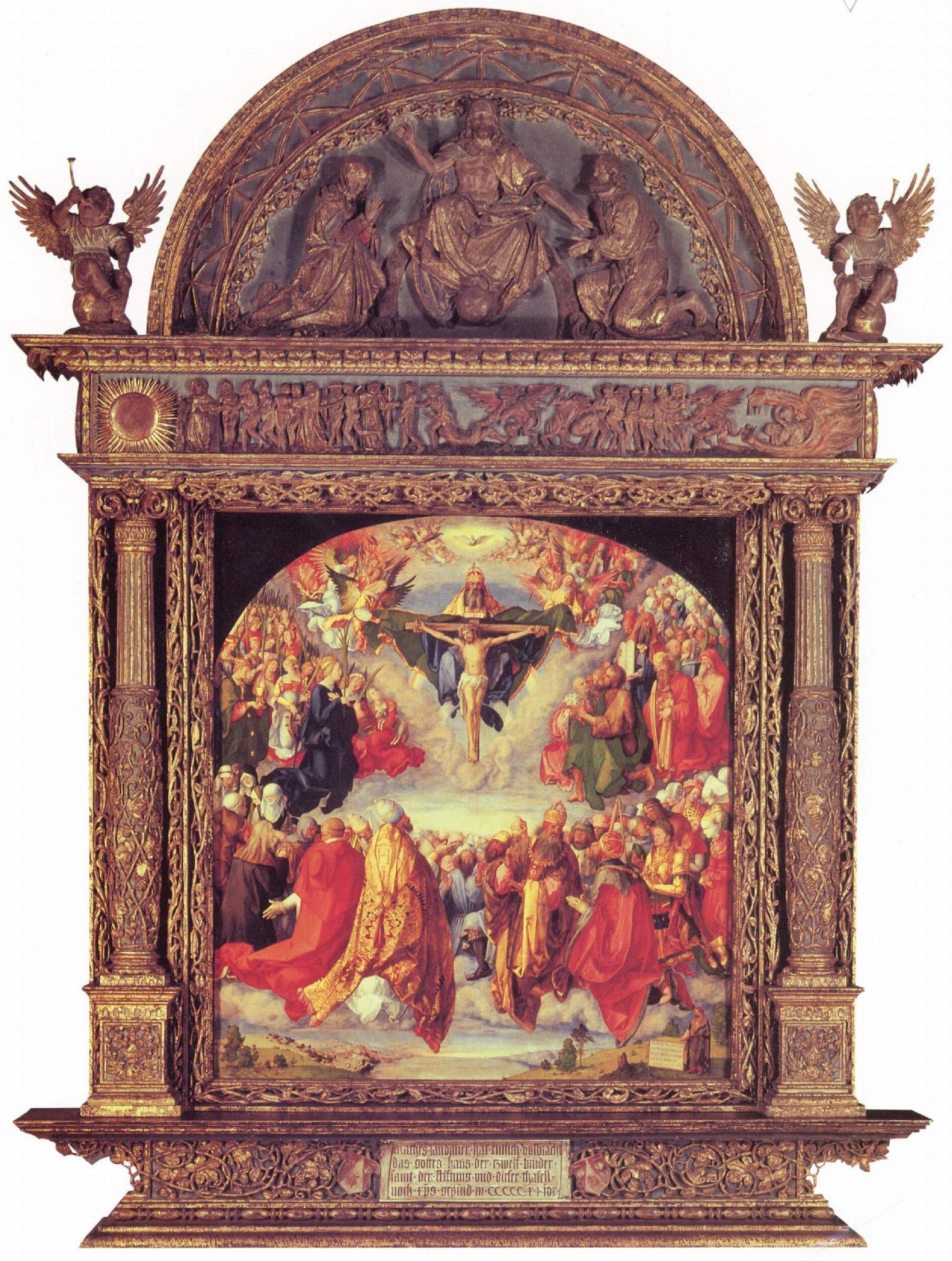
dd) as depicted by Albrecht Dürer in his early sixteenth-century All Saints altarpiece (1511; a.k.a. the Landauer Altar) in the Kunsthistorisches Museum in Vienna:

 https://upload.wikimedia.org/wikipedia/commons/4/4e/Albrecht_D%C3%BCrer_053.jpg

The painting at higher resolution:

 https://upload.wikimedia.org/wikipedia/commons/6/61/Albrecht_D%C3%BCrer_-_Adoration_of_the_Trinity_%28Landauer_Altar%29_-_Google_Art_Project.jpg

ee) as portrayed in high relief on the early sixteenth-century altar (1518) in the Allerheiligenkapelle of the Pfarrkirche St. Benedikt in Altmünster (Land Oberösterreich):

 http://tarvos.imareal.oeaw.ac.at/server/images/7017914.JPG

Detail view:
 http://tarvos.imareal.oeaw.ac.at/server/images/7017915.JPG


Saturday, 31 October 2015

St Quentin


John Dillon posted as follows on the Medieval Religion discussion group; I have added occasional notes in [ ]

Quintinus of Vermand (Quintin, Quentin; d. late 3d cent., supposedly) is the martyr of today's Saint-Quentin (Aisne) in Picardy. His cult there is already recorded by St. Gregory of Tours in the sixth century.

The earliest of his many legendary Passiones (BHL 6999-7012) is commonly dated to the eighth century. According to this account, Quintinus, the son of a senator, was a Christian inhabitant of Rome who had traveled to northern Gaul as a missionary. During a persecution under Maximianus he was arrested on the orders of a Roman official named Rictiovarus or Rictius Varus (the villain of numerous Passiones from northern Francia) and was cruelly tortured in various ways: of these, the one most frequently depicted in the later Middle Ages was having iron nails and iron stakes driven into his body. Quintinus' sufferings ended when he was decapitated at Augusta Viromanduorum, a Roman-period predecessor of Saint-Quentin thought to underlie the modern city's outlying canton of Vermand. His body was then secretly deposited in the river Somme, where it remained incorrupt for about fifty-five years until its miraculous discovery by a Roman matron named Eusebia. Thus far BHL 6999.

Other accounts relate the translation of Quintinus' remains over a century later to a basilica where their location came in time to be forgotten and their subsequent rediscovery by St. Eligius in the seventh century. One may read about the latter finding in Jo Ann McNamara's English-language translation of Dado of Rouen's Life of St. Eligius (scroll down to II, 6):
http://www.fordham.edu/halsall/basis/eligius.html
Excursus: one thing that Dado does not tell us is how St. Eligius (Éloi) advised Dagobert I on matters pertaining to the king's wardrobe (or perhaps he did tell us but it's in one of the lacunae). For that, one has to go to the song "Le bon roi Dagobert":
http://en.wikipedia.org/wiki/Le_bon_roi_Dagobert_%28song%29
An illustrated, French-language summary of Quintinus' legend is here (better views of the illuminations are linked to in "images", below):
http://stqvillhist.free.fr/068Legende.htm

Some period-pertinent images of St. Quintinus of Vermand (the suffix differentiates him from St. Quintinus of Meaux):

a) as depicted in a late eleventh or early twelfth-century copy of a Vita et miracula s. Quintini (Saint-Quentin, Bibliothèque Guy de Maupassant; ms. Église Saint-Quentin 1):
1) leaving Rome with eleven companions (p. 9):
http://www.enluminures.culture.fr/Wave/savimage/enlumine/irht7/IRHT_106546-p.jpg
Detail view (Q. and companions):
http://www.enluminures.culture.fr/Wave/savimage/enlumine/irht7/IRHT_106548-p.jpg
2) preaching in Amiens (p. 20):

 http://www.enluminures.culture.fr/Wave/savimage/enlumine/irht7/IRHT_106560-p.jpg

3) administering baptisms (p. 23):

 http://www.enluminures.culture.fr/Wave/savimage/enlumine/irht7/IRHT_106562-p.jpg

4) undergoing arrest (p. 36):
http://www.enluminures.culture.fr/Wave/savimage/enlumine/irht7/IRHT_106580-p.jpg


5) taken in chains to Augusta Viromanduorum, where he is brought before Rictiovarus (p. 38):

 http://www.enluminures.culture.fr/Wave/savimage/enlumine/irht7/IRHT_106582-p.jpg


http://www.enluminures.culture.fr/Wave/savimage/enlumine/irht7/IRHT_106582-p.jpg
6) undergoing torture; liberated by an angel (pp. 41-42??):

 http://www.enluminures.culture.fr/Wave/savimage/enlumine/irht7/IRHT_106557-p.jpg

7) undergoing further torture (p. 43):

 https://s-media-cache-ak0.pinimg.com/originals/3d/a7/e5/3da7e5aa87182e32eaf5fbfcf2597f01.jpg

8) praying to God; suffering decapitation (pp. 44-45):

 http://www.enluminures.culture.fr/Wave/savimage/enlumine/irht7/IRHT_106591-p.jpg
Detail view (Q. praying):
http://www.enluminures.culture.fr/Wave/savimage/enlumine/irht7/IRHT_106592-p.jpg

b) as depicted (martyrdom) in a late thirteenth-century copy of French origin of the Legenda aurea (San Marino, CA, Huntington Library, ms. HM 3027, fol. 149r; upper image):
http://digitalassets.lib.berkeley.edu/ds/huntington/images//000911A.jpg

c) as depicted (martyrdom) in the late thirteenth-century Livre d'images de Madame Marie (c. 1285-1290; Paris, BnF, ms. Nouvelle acquisition française 16251, fol. 82v):
http://tinyurl.com/yl3ex6n

d) as depicted (at left; at centre, St. Michael the Archangel; at right, St. Romanus of Rouen) in an earlier fourteenth-century glass window (w. 309; before 1325) in the cathédrale Saint-Pierre in Beauvais:


e) as depicted (martyrdom) in an earlier fourteenth-century copy of the Legenda aurea in its French-language version by Jean de Vignay (c. 1326-1350; Paris, BnF, ms. Français 185, fol. 266r):
http://tinyurl.com/ygf2dot

f) as depicted (three scenes) in an earlier fourteenth-century copy of books 9-16 of Vincent of Beauvais' Speculum historiale in its French-language version by Jean de Vignay (c. 1335; Paris, BnF, ms. Arsenal 5080):
1) leaving Rome with fellow missionaries (fol. 268v):
http://tinyurl.com/nqucqf5
2) martyrdom (fol. 269r):
http://tinyurl.com/qy4somw
3) his body discovered by Eusebia (fol. 269v):
http://tinyurl.com/ntgngbj

g) as depicted (martyrdom) in a late fourteenth- or early fifteenth-century copy of the Legenda aurea (Rennes, Bibliothèque de Rennes Métropole, ms. 266, fol. 300r):
http://tinyurl.com/nsobqxp

h) as depicted (left-hand column; martyrdom) in the early fifteenth-century Hours of René of Anjou (c. 1405-1410; London, BL, Egerton MS 1070, fol. 103v; image zoomable):
http://www.bl.uk/catalogues/illuminatedmanuscripts/ILLUMIN.ASP?Size=mid&IllID=48373

i) as depicted (martyrdom) in the earlier fifteenth-century Hours of Jacques Cauchon and Jeanne Bohais (c. 1440), one of the items in the Arcana Collection announced for sale at an auction at Christie's on 7. July 2010:

 http://blog.pecia.fr/public/.cauchon_3_m.jpg


j) as depicted (at right, martyrdom; at left, St. Sebastian) by André Robin and workshop in a mid-fifteenth-century glass window (w. 115; 1450s) in the north transept of the cathédrale Saint-Maurice in Angers:


k) as depicted (at left, martyrdom; at right, his body discovered by Eusebia) in a later fifteenth-century copy from Bruges of the Legenda aurea in its French-language version by Jean de Vignay followed by the Festes nouvelles attributed to Jean Golein (c. 1460-1470; Mâcon, Médiathèque municipale, ms. 3, fol. 11v):

 http://www.enluminures.culture.fr/Wave/savimage/enlumine/irht6/IRHT_095318-p.jpg


l) as depicted (martyrdom) in a later fifteenth-century copy of Vincent of Beauvais' Speculum historiale in its French-language version by Jean de Vignay (1463; Paris, BnF, ms. Français 51, fol. 87r):


m) as depicted on three painted panels of a late fifteenth-century winged altarpiece (ca. 1480-1500) in the kostol sv. Vavrinca in Revúca (Banská Bystrica Region), Slovakia:
1) appearing before Rictiovarus:

 http://tarvos.imareal.oeaw.ac.at/server/images/7013376.JPG

[ I suspect that originally St Quentin's armour was done insilver leaf whuich has flaked away, leaving the brown undercoat - Clever Boy]
2) being stripped and then flogged:

 http://tarvos.imareal.oeaw.ac.at/server/images/7013378.JPG

3) his funeral:

 http://tarvos.imareal.oeaw.ac.at/server/images/7013380.JPG

[Note the seed pearls decorating the mitres -Clever Boy ]


n) as depicted (martyrdom) in the Suffrages of a late fifteenth-century book of hours from the southern Netherlands (Mons?; ca. 1490-1500; Baltimore, The Walters Art Museum, Walters ms. W.431, fol. 111r):
http://tinyurl.com/pacqaz4

o) as depicted (martyrdom) in the Suffrages of an early sixteenth-century book of hours from the southern Netherlands (Cambrai?; c. 1500-1510; Den Haag, KB, ms. 76 F 20, fol. 176v):
http://manuscripts.kb.nl/zoom/BYVANCKB%3Amimi_76f20%3A176v

p) as depicted (martyrdom) in the Suffrages of another early sixteenth-century book of hours from the southern Netherlands (ca. 1500-1510; Den Haag, KB, ms. 133 E 14, fol. 60r):
http://manuscripts.kb.nl/zoom/BYVANCKB%3Amimi_133e14%3A060r

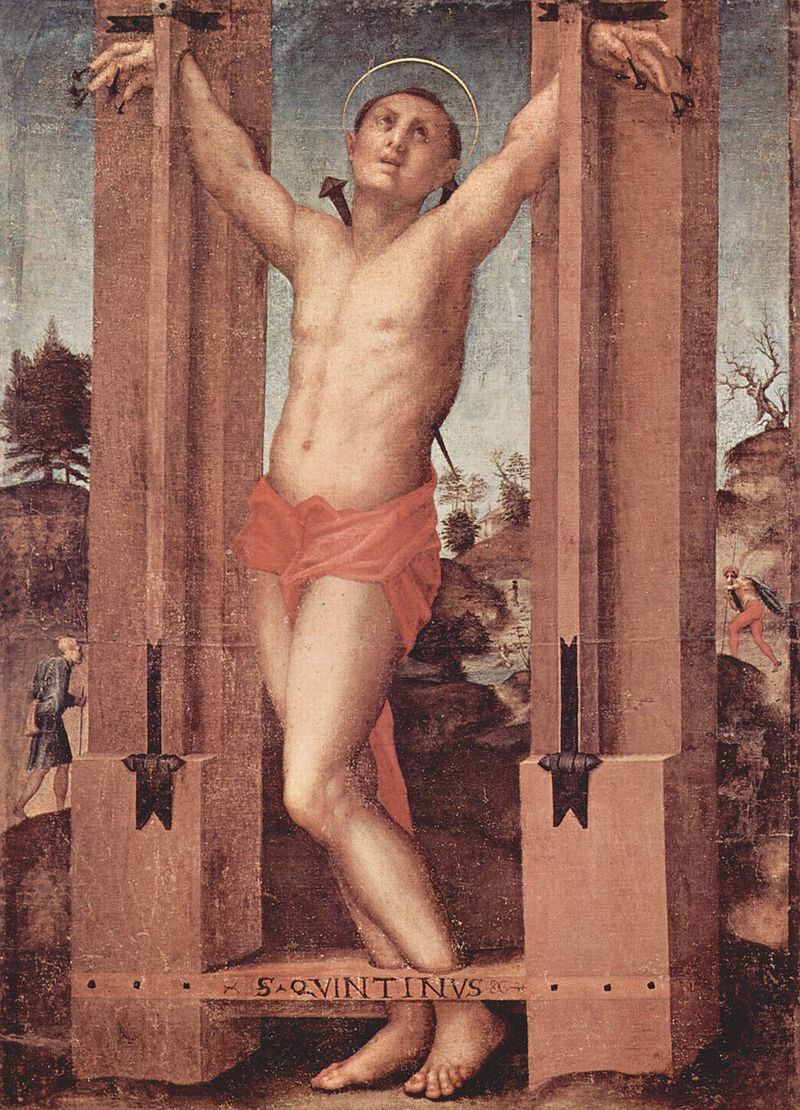
q) as depicted (martyrdom) by Jacopo Pontormo on an early sixteenth-century canvas processional banner (1517) in the Pinacoteca comunale of Sansepolcro (AR) in Tuscany:

 Jacopo Pontormo 043.jpg