Once I was a clever boy learning the arts of Oxford... is a quotation from the verses written by Bishop Richard Fleming (c.1385-1431) for his tomb in Lincoln Cathedral. Fleming, the founder of Lincoln College in Oxford, is the subject of my research for a D. Phil., and, like me, a son of the West Riding. I have remarked in the past that I have a deeply meaningful on-going relationship with a dead fifteenth century bishop... it was Fleming who, in effect, enabled me to come to Oxford and to learn its arts, and for that I am immensely grateful.


Showing posts with label Carlo CrIvelli. Show all posts

Monday, 29 September 2025

St Michael the Archangel


Today is Michaelmas, the principal feast of St Michael the Archangel.

The Catholic Online website says that St Michael has four main responsibilities or offices, as we know from scripture and Christian tradition.

The first is to combat Satan.
The second is to escort the faithful to heaven at their hour of death.
The third is to be a champion of all Christians, and of the Church itself.
The fourth is to call men from life on Earth to their heavenly judgment.

He is also the patron of banking, grocers, the police and the armed forces. I assume the first two came about through his attribute of the scales of judgement, and the third as being a heavenly defender of law and order, with the fourth as a further instance of his being a defender of the community of the faithful as leader of the Heavenly Host against the Enemy.

Wikipedia has a lengthy, and well illustrated account of his cult in Judaism as well as the different branches of Christianity and other faiths at Michael (archangel)

I wanted to include an image of the painting of St Michael the Archangel by Carlo Crivelli and dated to circa 1476 and now in the National Gallery. However none of the images of it on the internet would actually copy and paste. This is all part of an irritating trend in copyright over the last year or so - very frustrating. So I shall have to refer readers to the illustrated article about the panel, which comes from an altarpiece, and with expandable images, on the National Gallery website at Carlo Crivelli | Saint Michael | NG788.11 | National Gallery, London

The painting is also discussed on the Kultura website at Saint Michael - Carlo Crivelli

Crivelli produced several images of Saint Michael in his very distinctively detailed and meticulously posed style.

St Michael the Archangel Pray for us

Thursday, 26 December 2024

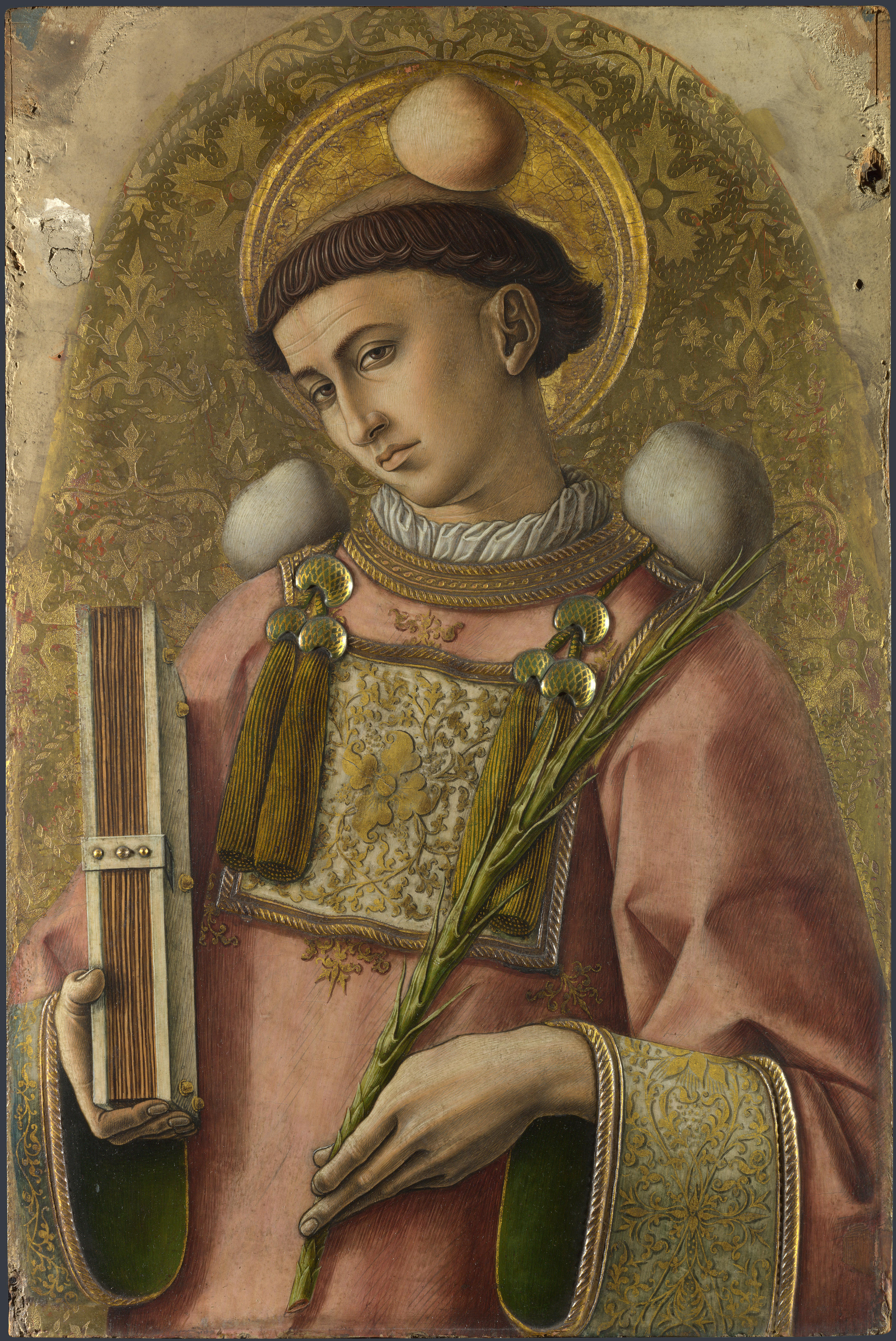
St Stephen

 
Today is the Feast of St Stephen the Martyr.

File:St-stephen.jpg

St Stephen from The Demidoff Altar by Carlo Crivelli. Painted in 1476 it is now in the National Gallery.

Image: Wikipedia 

Wikipedia recounts the life of St Stephen from the Acts of the Apostles and discusses his veneration in Saint Stephen

Ten years ago I wrote about St Stephen and linked several artists depictions of him and his martyrdom in St Stephen's Day

I would add to the notes about the painting of the diagonal ordination a link to the Catholic Encyclopaedia about the delivery of the instruments, in this case the chalice and paten for the deacon to prepare at Mass, which can be seen at Holy Orders


In my post there is also a reference to the sermon of St Fulgentius of Ruspe. This is quoted in the fourth, fifth and sixth lections at Matins in the Traditional Breviary as follows:

Yesterday we were celebrating the birth in time of our Eternal King; today we celebrate the victory, through suffering, of one of His soldiers. Yesterday our King was pleased to come forth from His royal palace of the Virgin's womb, clothed in a robe of flesh, to visit the world; today His soldier, laying aside the tabernacle of the body, entereth in triumph into the heavenly palaces. The One, preserving unchanged that glory of the Godhead which He had before the world was, girded Himself with the form of a servant, and entered the arena of this world to fight sin; the other taketh off the garments of this corruptible body, and entereth into the heavenly mansions, where he will reign for ever. The One cometh down, veiled in flesh; the other goeth up, clothed in a robe of glory, red with blood.

The One cometh down amid the jubilation of angels; the other goeth up amid the stoning of the Jews. Yesterday the holy angels were singing, Glory to God in the highest; today there is joy among them, for they receive Stephen into their company. Yesterday the Lord came forth from the Virgin's womb; today His soldier is delivered from the prison of the body. Yesterday Christ was for our sakes wrapped in swaddling bands; today He girdeth Stephen with a robe of immortality. Yesterday the new-born Christ lay in a narrow manger; today Stephen entereth victorious into the boundless heavens. The Lord came down alone that He might raise many up; our King humbled Himself that He might set His soldiers in high places.

Why brethren, it behoveth us to consider with what arms Stephen was able, amid all the cruelty of the Jews, to remain more than conqueror, and worthily to attain to so blessed a triumph. Stephen, in that struggle which brought him to the crown whereof his name is a prophecy, had for armour the love of God and man, and by it he remained victorious on all hands. The love of God strengthened him against the cruelty of the Jews; and the love of his neighbour made him pray even for his murderers. Through love he rebuked the wandering, that they might be corrected; through love he prayed for them that stoned him, that they might not be punished. By the might of his love he overcame Saul his cruel persecutor; and earned for a comrade in heaven, the very man who had done him to death upon earth.

Quotation from Divinum Officium

A damaged, but still charming, late medieval English depiction of St Stephen from the rood screen in the rural church at Hempstead in north Norfolk can be seen on Flickr Hempstead screen: St Stephen | St Andrew, Hempstead, Norfolk


Wikipedia has a separate article about an old English carol with a wildly implausible account of the saint’s death at Saint Stephen and Herod


JSTOR has an article about an old English and Irish custom, that of killing wrens ( the feathered variety, not the naval ones) to mark St Stephen’s Day. Much as I favour maintaining and reviving old customs I definitely think this one should be relegated to the past. The article can be read at Wren Folklore and St. Stephen's Day - JSTOR Daily


Friday, 29 April 2016

St Catherine of Siena


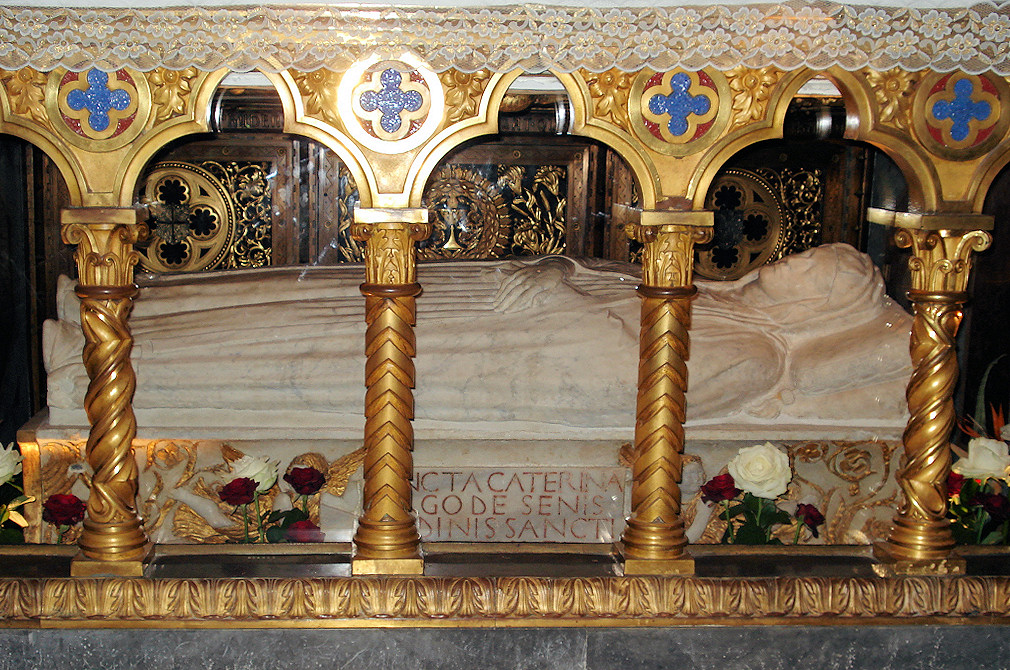
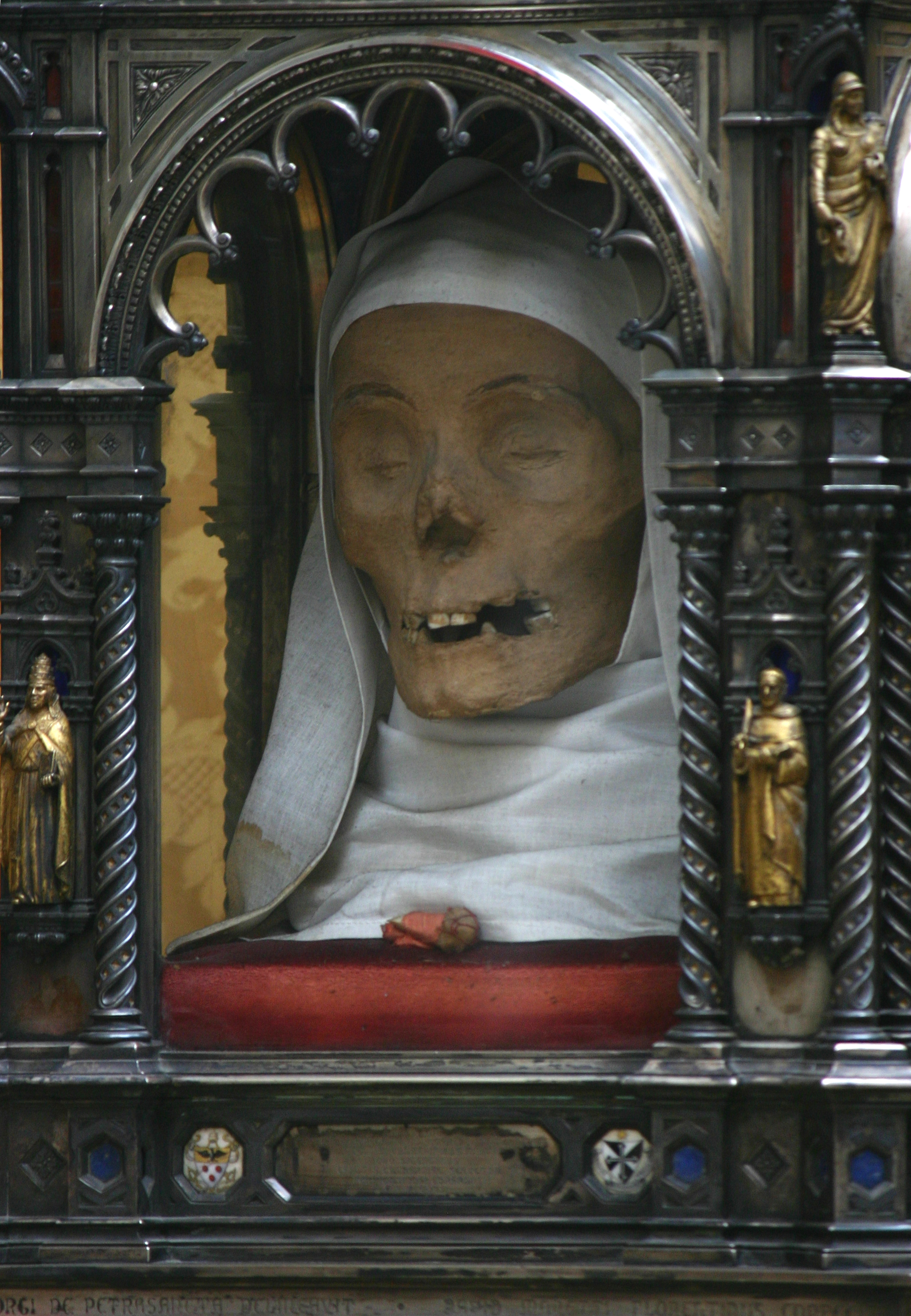
Today is the feast of St Catherine of Siena and John Dillon posted the following images of her on the Medieval Religion discussion group:

The mystic and visionary Catherine of Siena was born in 1347, the umpteenth daughter of a Sienese wool-dyer and his wife.  A professed virgin since childhood, she became a Dominican tertiary at the age of eighteen, living very ascetically and engaging in acts of charity to the sick and the poor.  In 1370 she received a series of visions that impelled her to enter public life.  Catherine then carried on a lengthy correspondence with Pope Gregory XI, touching on many matters and urging church reform.  In 1375 Catherine received the Holy Stigmata.  In 1376 she was in Avignon and from 1378 until her death in 1380 she lived at Rome.

Catherine was buried in her order's Roman church of Santa Maria sopra Minerva.  The subject of an immediately posthumous cult, she has a very impressive Vita (BHL 1702) by her confessor, Bl. Raymond of Capua, who as prior of the Dominican convent erected her first funerary monument in 1380.  The monument was modified in 1430; in 1466 Catherine was translated to her present resting place before the high altar.  Herewith some views of Catherine's tomb in Santa Maria sopra Minerva, with its sculpture of her from 1430 reposing on a sarcophagus added in 1461, the year of her canonization by her fellow Sienese, Pius II:
http://www.flickr.com/photos/rayflynn/2034595233/
http://tinyurl.com/26azt4r
http://tinyurl.com/2c5jcpl

 https://upload.wikimedia.org/wikipedia/commons/0/0d/Caterina_sopra_Minerva.jpg

http://tinyurl.com/2c5jcpl

A distance view:
http://tinyurl.com/gv69w2t

Since 1384 Siena's basilica di San Domenico (a.k.a. Basilica Cateriniana) has had Catherine's head:
http://tinyurl.com/hdg6sxd
http://www.vittoe.com/0205a/p5294692.jpg

https://upload.wikimedia.org/wikipedia/commons/4/45/Head_of_Saint_Catherine_of_Siena.jpg
 
http://tinyurl.com/zzabyy2

It also possesses one of her fingers:


https://blogger.googleusercontent.com/img/b/R29vZ2xl/AVvXsEh5HDPXrid3PQAdpMpMgpTpwiZ3aqDmokSEWM4ekzVA46Rh5h40Kbv-K75NMwuvmXDTWmKqhNDM1d2UWexhhIXnuS7f-80AwqKrC_Vkp-lE3aL2-_qMLbAzsTXBmP4O4iB5eQqgRHFT80w/s1600/Finger+der+hl.+Katharina.jpg

http://tinyurl.com/hfxrsmg

Catherine was named a Doctor of the Church in 1970.  Along with Francis of Assisi, she is a primary patron of Italy.  In 1999 she was proclaimed a patron saint of Europe.


Some period-pertinent images of St. Catherine of Siena:

a) as depicted by the Sienese artist Andrea Vanni in a late fourteenth-century fresco (c. 1390) in the basilica di San Domenico in Siena:
http://images.alinari.it/img/480/CAL/CAL-F-002341-0000.jpg

 http://www.toscanadinico.com/home/wp-content/uploads/2013/04/6.-Intorno-a-Santa-Caterina-da-Siena2.jpg

http://tinyurl.com/jfk7tkf

b) as depicted (at left; at right, St. Cecilia) by Beato Angelico in an earlier fifteenth-century panel painting (between 1420 and 1429) in The Courtauld Gallery, London:
http://static.artuk.org/w944h944/NGS/NGS_NGS_NG_1030.jpg

c) as depicted (with a donor before the BVM and Christ Child) in an earlier fifteenth-century panel painting from Lombardy (c. 1440) in the Metropolitan Museum of Art, New York:


http://www.metmuseum.org/art/collection/search/459040

d) as depicted (receiving the stigmata) by Henri d'Orquevaulz in an earlier fifteenth-century book of hours for the Use of Metz (c. 1440; Paris, BnF, ms. Latin 10533, fol. 134v):

http://gallica.bnf.fr/ark:/12148/btv1b10318624f/f274.highres

http://gallica.bnf.fr/ark:/12148/btv1b10318624f/f274.item

e) as depicted by the Sienese artist Sano di Pietro in a mid-fifteenth-century panel painting (c. 1442) in the Bonnefanten Museum, Maastricht:

 https://upload.wikimedia.org/wikipedia/commons/a/af/Sano_di_Pietro_-_Heilige_Catharina_van_Siena.JPG

http://tinyurl.com/gwp32xf

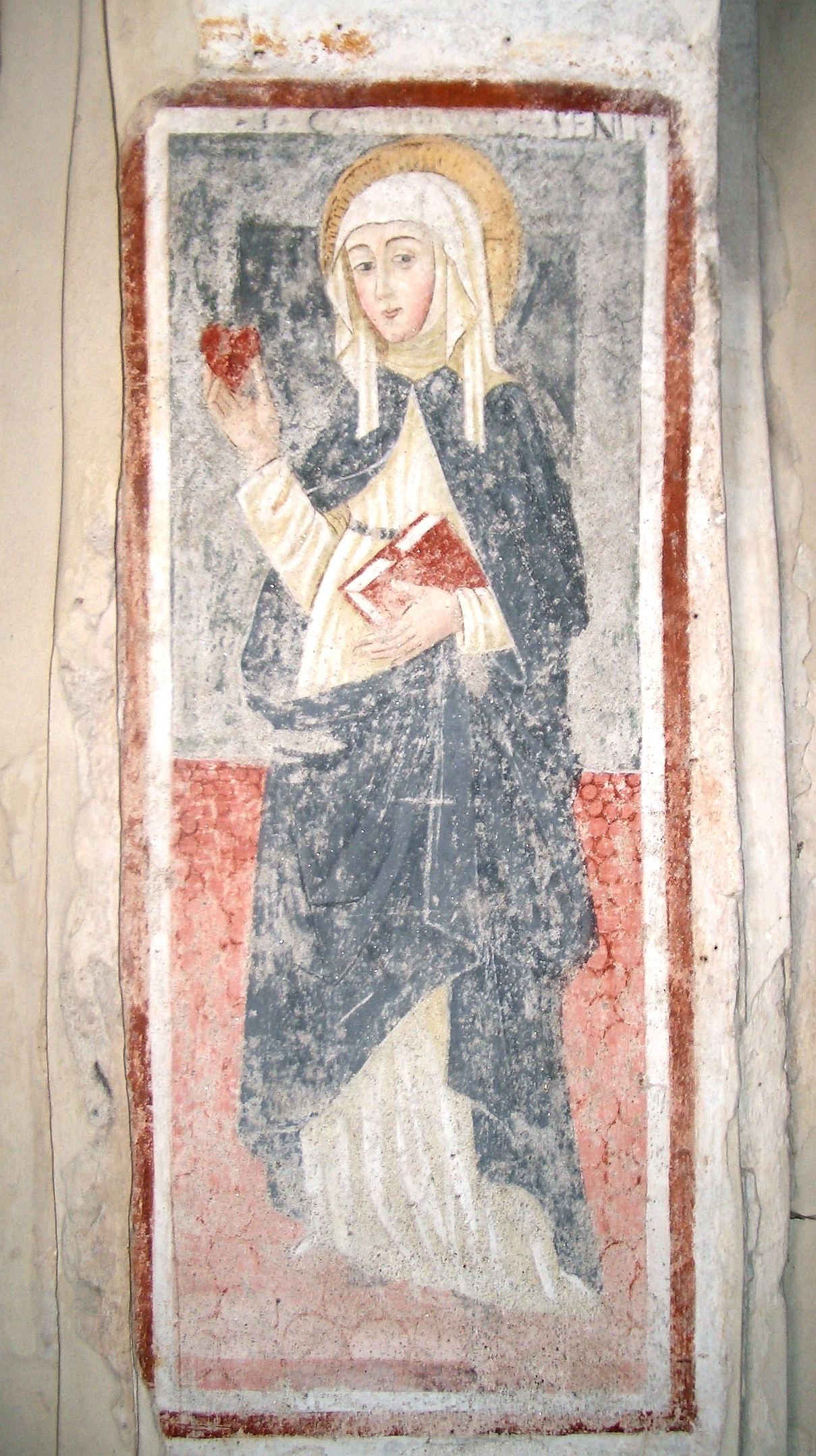
f) as depicted in a later fifteenth-century fresco in the (ex-) chiesa di San Pietro in Carpignano Sesia
(NO) in Piedmont:


https://upload.wikimedia.org/wikipedia/commons/c/c6/Carpignano_Sesia_Immagine_Chiesa_Caterina_da_Siena.JPG

http://tinyurl.com/5792wp

g) as depicted (receiving the stigmata) in a later fifteenth-century copy of her Vita by Bl. Raymond of Capua (Carpentras, Bibliothèque municipale Inguimbertine, ms. 472, fol. 2v):


http://www.enluminures.culture.fr/Wave/savimage/enlumine/irht4/IRHT_074283-p.jpg

http://www.enluminures.culture.fr/Wave/savimage/enlumine/irht4/IRHT_074283-p.jpg

h) as depicted by the Sienese artist Giovanni di Paolo in a later fifteenth-century panel painting (c. 1462) in Harvard University's Fogg Art Museum:


http://ids.lib.harvard.edu/ids/view/43182073?width=3000&height=3000

http://www.harvardartmuseums.org/art/231676

i) as depicted (scenes from her Vita) by the Sienese artist Giovanni di Paolo in a series of later fifteenth-century predella paintings (c. 1462-1470) now in several different museums:

a) receiving the Dominican habit (Cleveland, Cleveland Museum of Art):


https://upload.wikimedia.org/wikipedia/commons/8/8e/Giovanni_di_Paolo_-_Santa_Caterina_da_Siena_investita_con_l'abito_domenicano.jpg

http://tinyurl.com/zzyou2w

b) clothing Christ disguised as a beggar (Cleveland, Cleveland Museum of Art):


http://www.clevelandart.org/art/1966.3

c) exchanging her heart with that of Jesus (New York, Metropolitan Museum of Art):


http://images.metmuseum.org/CRDImages/ep/original/DT508.jpg

http://images.metmuseum.org/CRDImages/ep/original/DT508.jpg

d) her mystic marriage (New York, Metropolitan Museum of Art):


http://images.metmuseum.org/CRDImages/ep/original/DT507.jpg
 
http://images.metmuseum.org/CRDImages/ep/original/DT507.jpg
 
e) her miraculous communion (New York, Metropolitan Museum of Art):


http://www.metmuseum.org/toah/images/hb/hb_32.100.95.jpg

http://www.metmuseum.org/toah/images/hb/hb_32.100.95.jpg

f) receiving the stigmata (New York, Metropolitan Museum of Art):


http://images.metmuseum.org/CRDImages/rl/original/DP366040.jpg

http://images.metmuseum.org/CRDImages/rl/original/DP366040.jpg
g) beseeching Christ to resuscitate her mother (New York, Metropolitan Museum of Art):


http://images.metmuseum.org/CRDImages/rl/original/DP366038.jpg

http://images.metmuseum.org/CRDImages/rl/original/DP366038.jpg
h) before the Pope in Avignon (Madrid, Museo Thyssen-Bornemisza):


http://www.wga.hu/art/g/giovanni/paolo/1/avignon.jpg

http://www.wga.hu/art/g/giovanni/paolo/1/avignon.jpg

j) as depicted in a panel of a later fifteenth-century glass window (Bay 23; c. 1470) in the église Notre-Dame in Carentan (Manche):


http://therosewindow.com/pilot/Carenton/w23-c2.htm
The window as a whole:
http://www.mesvitrauxfavoris.fr/index_htm_files/351134.jpg
http://therosewindow.com/pilot/Carenton/w23-Frame.htm

k) as depicted (at far right) in a late fifteenth-century predella panel painting of Dominican saints in the Musée Unterlinden in Colmar:


http://www.musee-unterlinden.com/assets/images/_nouveau_mecenat/DSC_0024.JPG

http://www.musee-unterlinden.com/assets/images/_nouveau_mecenat/DSC_0024.JPG

l) as depicted (receiving the stigmata) in a late fifteenth-century book of hours for the Use of Autun (c. 1480-1490; Autun, Bibliothèque d'Autun, ms. 269, fol. 170v):


http://www.enluminures.culture.fr/Wave/savimage/enlumine/irht7/IRHT_107589-p.jpg

http://www.enluminures.culture.fr/Wave/savimage/enlumine/irht7/IRHT_107589-p.jpg


m) as depicted (at left, flanking the BVM and Christ Child; at right, St. Sebastian) by the Sienese artist Matteo di Giovanni in a late fifteenth-century panel painting (c. 1480-1490) in the Columbia Museum of Art, Columbia, SC:


https://www.columbiamuseum.org/sites/default/files/styles/customstyle/public/1962_11.jpg?itok=eUgDLZrZ

http://tinyurl.com/hd8pd5c

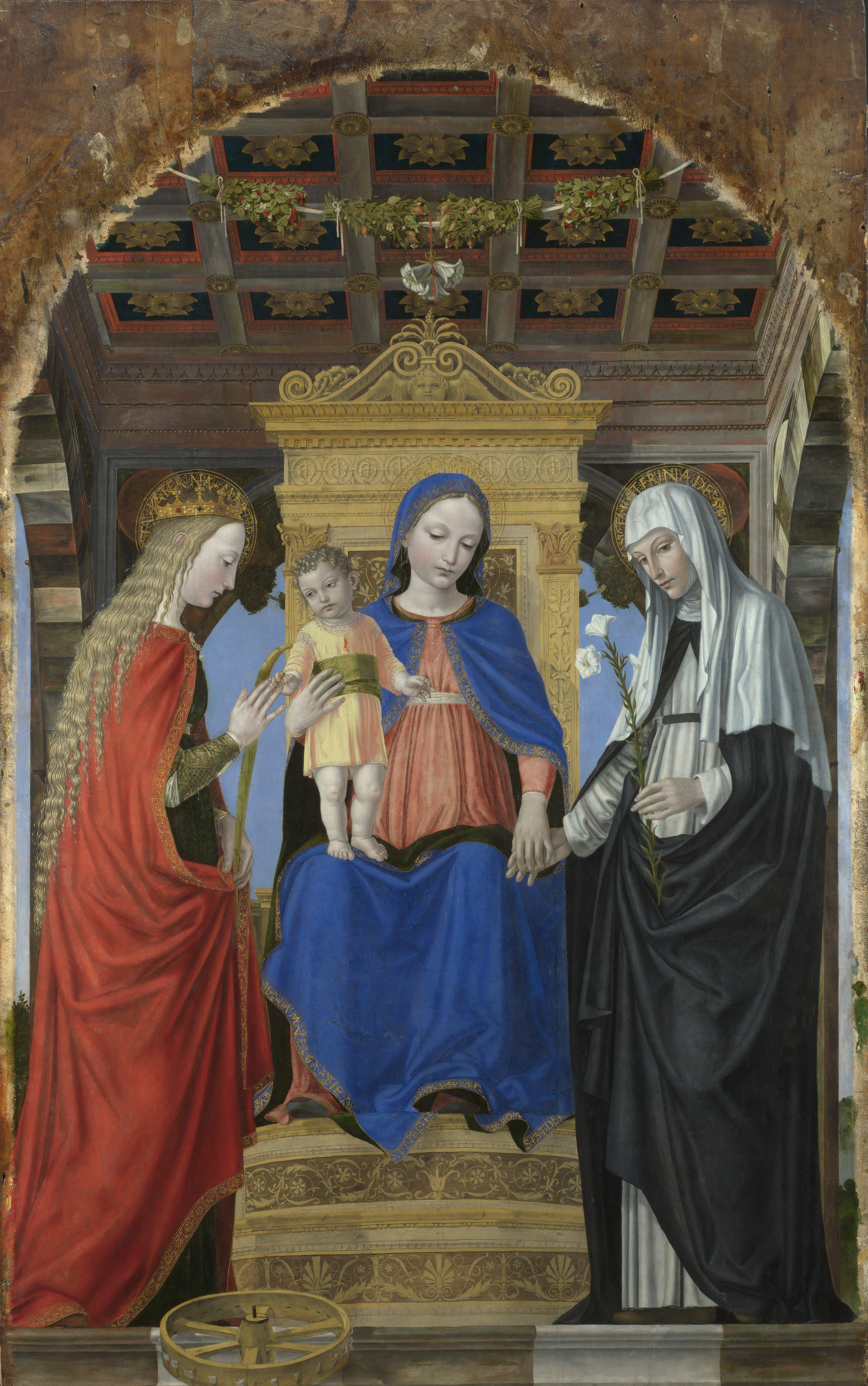
n) as depicted (at right; at left, St. Catherine of Alexandria; their mystical marriages) by Ambrogio Bergognone in a late fifteenth-century panel painting (c. 1490) in the National Gallery, London:


https://upload.wikimedia.org/wikipedia/commons/1/1b/Bergognone_007.jpg

http://tinyurl.com/jswxygt

o) as depicted by Carlo Crivelli in a late fifteenth-century panel painting (c. 1490) in the Musée du Petit Palais, Avignon:


http://www.wga.hu/art/c/crivelli/carlo/candele3.jpg

http://www.wga.hu/art/c/crivelli/carlo/candele3.jpg
p) as depicted (her mystic marriage) by Giovan Pietro Birago in the late fifteenth-century Sforza Hours (between c.1490 and 1494; London, BL, Add MS 34294, vol. 3, fol.  209v):
http://www.bl.uk/manuscripts/Viewer.aspx?ref=add_ms_34294_f209v
Are those bunny pellets at lower left?

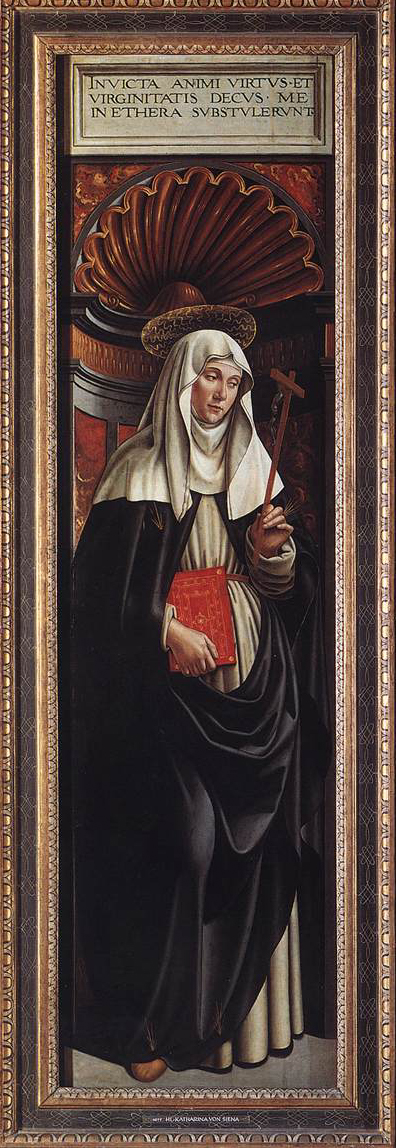
q) as depicted by Domenico Ghirlandaio and workshop in a late fifteenth-century panel painting (between 1490 and 1498; from his dismembered Tornabuoni altarpiece for Florence's basilica di Santa Maria Novella) in the Alte Pinakothek in Munich:


https://upload.wikimedia.org/wikipedia/commons/1/16/Ghirlandaio%2C_santa_caterina_da_siena.jpg

http://tinyurl.com/hd2urhj

r) as portrayed by the Sienese painter and sculptor Neroccio di Bartolomeo de' Landi in a late fifteenth-century polychromed wooden statue (1494) in the oratorio di Santa Caterina in Siena:


http://www.aworldtowin.net/images/images255/RenaissanceW116.jpg

http://tinyurl.com/dfumfs

Detail view:
http://www.thais.it/scultura/image/ALTE/SRIN_340.htm

s) as depicted (as spiritual guide of the second and third orders of Dominicans) by Cosimo Rosselli in a late fifteenth-century panel painting (c. 1499-1500) in the National Galleries of Scotland:


http://static.artuk.org/w944h944/NGS/NGS_NGS_NG_1030.jpg

http://static.artuk.org/w944h944/NGS/NGS_NGS_NG_1030.jpg

t) as depicted (surrounded by demons) in a  late fifteenth- or early sixteenth-century panel painting (c. 1500) in the National Museum in Warsaw:


https://upload.wikimedia.org/wikipedia/commons/f/f5/Lesser_Poland_St._Catherine_of_Siena.jpg

http://tinyurl.com/hyyrwgv

u) as depicted in the early sixteenth-century Hours of Frederick of Aragon (i.e. Federigo d'Aragona, king of [mostly mainland] Sicily, etc.; between 1501 and 1504; Paris, BnF, ms. Latin 10532, fol. 368r):
http://gallica.bnf.fr/ark:/12148/btv1b8427228j/f372.item.zoom

v) as depicted (upper register; her canonization by Pope Pius II) by Pinturicchio in an early sixteenth-century fresco (between 1502 and 1507) in the Piccolomini Library in the cathedral of Siena:


https://upload.wikimedia.org/wikipedia/commons/e/e8/Pinturicchio%2C_liberia_piccolomini%2C_1502-07_circa%2C_Pio_II_canonizza_santa_Caterina_da_Siena_01.JPG

http://tinyurl.com/jjlhsxl

Detail view:


https://upload.wikimedia.org/wikipedia/commons/6/64/Pinturicchio%2C_liberia_piccolomini%2C_1502-07_circa%2C_Pio_II_canonizza_santa_Caterina_da_Siena_02.JPG

http://tinyurl.com/hmy8zsv
w) as depicted (interceding with the devil on behalf of a dying sister) by the Sienese artist Girolamo di Benvenuto di Giovanni del Guasta in an early sixteenth-century panel painting (c. 1505) in Harvard University's Fogg Art Museum:


Saint Catherine Of Siena Intercedes With Christ To Release The Dying Sister Palmerina From Her Pact With The Devil

 
http://www.harvardartmuseums.org/art/229488

x) as depicted (upper register at center, between. SS. Peter Martyr and Margaret of Hungary) by Juan de Borgoña in an early sixteenth-century panel painting (c. 1515) in the Museo del Prado in Madrid:

http://imagencpd.aut.org/4DPict?file=20&rec=15.462&field=2


Here in Oxford the Oratory possesses in its relic collection a letter written by St Catherine, and which is on displayto mark her feast. I understand that the editors of a new definitive edition of her letters are due to visit the Oratory in the near future to copy it for inclusion in their project.


Thursday, 4 February 2016

St Blaise


Yesterday was the feast of St Blaise, and following Mass I had the traditional blessing of my throat.

John Dillon posted an impressive selection of images of St Blaise on the Medieval Religion discussion group:

Not to be confused with his homonyms Blasius of Amorion, Blasius of Caesarea, Blasius of Veroli, and Blasius of Verona, the thaumaturge Blasius of Sebaste (d. circa 316, supposedly) is popularly known in English by a French form of his name (Blaise; other European forms include, but are certainly not limited to, Blasios / Vlasios, Vlaho / Blaž, Blasius, Blas, and Biagio / Biase). His cult is first attested from the sixth century, when the medical encyclopedist Aetius of Amida reports his being invoked in cases of illness of the throat.

Absent both from the earliest witnesses of the pseudo-Hieronymian Martyrology and from the probably originally late fourth-century Syriac Martyrology surviving in a manuscript written at Edessa in c. 411, and thus absent as well from the hypothetical fourth-century Greek martyrology thought to have provided a fund of feasts common to both, Blasius has both a legendary pre-metaphrastic Passio (BHG 276-276c; first attested from the eighth century) and a metaphrastic one (BHG 277); beyond these Greek texts there are versions in Latin and in other languages. These make him a physician of Sebaste in Armenia (now Sivas in Turkey) who is elected bishop, goes into hiding to avoid the Licinian persecution, lives in a cave where with the sign of the cross he cures sick animals, is sought out, arrested and imprisoned, tends the sick, operates miracles, is tortured, and finally is decapitated. Later versions have him flayed with carding combs prior to execution. Blasius' miracles include saving a boy from choking to death on a fishbone and causing a wolf to restore to a widow a piglet that it had taken from her. In the later Middle Ages his reputed care for ailments of the throat caused Blasius to be numbered among the Fourteen Holy Helpers; his association with animals made him a patron of keepers of livestock.

Since the tenth century Blasius has been the patron saint of Dubrovnik (formerly Ragusa), where an originally twelfth(?)-century head reliquary of him, formed as a Byzantine crown, is kept in that city's early modern katedrala Marijina Uznesenja (cathedral of the Assumption of the BVM):


http://www.azad-hye.net/media/e1/bishop-nareg-in-dubrovnik-02.jpg


 http://www.akg-images.de/Docs/AKG/Media/TR5/2/4/1/0/AKG570800.jpg


There is an arm reliquary as well (in these photos shown along with the head reliquary):
http://tinyurl.com/ppqbucl


Supplementing Gordon Plumb's post of earlier today, herewith some links to further period-pertinent images of St. Blasius of Sebaste:

a) Blasius' martyrdom as depicted in the late tenth- or very early eleventh-century so-called Menologion of Basil II (Città del Vaticano, BAV, cod. Vat. gr. 1613, p. 390):
http://tinyurl.com/p4yf9p7

b) Blasius delivering the piglet to the widow (upper register) and Blasius' martyrdom as depicted in the late eleventh- or very early twelfth-century frescoes of the Chapelle des Moines at Berzé-la-Ville (Saône-et-Loire):
http://www.flickr.com/photos/magika2000/8268154248/
Detail view (Blasius delivering the piglet to the widow)
http://www.wga.hu/art/zgothic/mural/11c1/14berze.jpg

c) Blasius' martyrdom (three scenes) as portrayed, perhaps by Roger of Helmarshausen, on a long side of a late eleventh- or early twelfth-century portable altar (copper gilt over wood) executed for the abbey of Abdinghof and now in the Erzbischöfliches Diözesanmuseum und Domschatzkammer in Paderborn:
http://tinyurl.com/jb3gwu6

d) Blasius (at left) as depicted in an early twelfth-century mosaic in the cupola di San Leonardo in Venice's basilica cattedrale patriarcale di San Marco:
http://www.wga.hu/art/zgothic/mosaics/6sanmarc/2cusouth.jpg
Detail views:
http://tinyurl.com/lgjlne4
http://tinyurl.com/lvudkkf

e) Blasius as depicted in the mid- or slightly later twelfth-century mosaics of the Cappella Palatina in Palermo:

http://rubens.anu.edu.au/raid1cdroms/sicily/palermo/churches/cappella_palatina/nave/mosaics_to_north/P1012434.JPG


f) Blasius (lower register, second from left) receiving a book from Duke Henry as depicted in the late twelfth-century Gospels of Henry the Lion (c. 1188; Wolfenbüttel, Herzog August Bibliothek, cod. Guelf. 105 Noviss. 2°, fol. 194r):
http://www.wga.hu/art/zgothic/miniatur/1151-200/1german/2gospel1.jpg

g) Blasius (second from right) as depicted in the late twelfth-century frescoes (1196) of the chiesa rupestre di San Biagio at San Vito dei Normanni (BR) in Apulia:
http://tinyurl.com/ln866mw

h) Blasius as depicted in a late twelfth- or early thirteenth-century fresco in the santuario di Maria SS. Regina (a.k.a. Santa Maria d'Anglona) at Tursi (MT) in Basilicata:
http://tinyurl.com/yhkhges

i) Blasius as depicted in late twelfth- or early thirteenth-century gold and enamel work on his head reliquary in the treasury of Dubrovnik's katedrala Marijina Uznesenja:


j) The widow brings the pig's head to the imprisoned Blasius (below: wolf devouring the pig) as depicted in an initial "T" in a thirteenth-century ms. of Magnum legendarium austriacum (Zwettl, Stiftsbibliothek, cod. 13, fol. 105v):
http://tarvos.imareal.oeaw.ac.at/server/images/7002571.JPG

k) Blasius confronting the Roman governor persecuting him as depicted in a thirteenth-century glass window panel from the area of Soissons, now in the Louvre:
http://tinyurl.com/2lkkb6

l) Scenes from Blasius' legend as depicted in the earlier thirteenth-century St. Blaise lancet of the "St. Blaise window" (Bay 217; c. 1230-1240; the other two lancets depict scenes of St. George and of St. Thomas of Canterbury) in the cathédrale Notre-Dame in Coutances:
http://therosewindow.com/pilot/Coutances/w217c-Frame.htm [with links to detail views]
and at right here:
http://tinyurl.com/j3tuccc
Other detail views:
http://tinyurl.com/j3k94vv
http://tinyurl.com/h28e7cp
http://tinyurl.com/j2zbk78

m) Blasius healing a throat as depicted in a mid-thirteenth-century gradual for the Use of the abbey of Fontevrault (c. 1250-1260; Limoges, Bibliothèque municipale, ms. 2, fol. 63v):
http://www.enluminures.culture.fr/Wave/savimage/enlumine/irht1/IRHT_043441-p.jpg

n) Blasius as depicted (at right, flanking St. John Climacus; at left, St. George of Lydda) as depicted in a later thirteenth-century Novgorod School icon in the State Russian Museum, St. Petersburg:
http://www.icon-art.info/masterpiece.php?lng=en&mst_id=512

o) Blasius' martyrdom as depicted in a late thirteenth-century copy of French origin of the Legenda aurea (San Marino, CA, Huntington Library, ms. HM 3027, fol. 32v; image greatly expandable):
http://digitalassets.lib.berkeley.edu/ds/huntington/images//000962A.jpg

p) Blasius (at left; at right, Pope St. Urban I) in the late thirteenth-century Livre d'images de Madame Marie (c. 1285-1290; Paris, BnF, ms. Nouvelle acquisition française 16251, fol. 91r):
http://tinyurl.com/yk9p76d

q) Blasius (at center, betw. Sts. Eleutherius of Illyria and Hypatius [of Gangra?]) as depicted in the earlier fourteenth-century frescoes (between c. 1312 and 1321/1322) in the nave of the monastery church of the Theotokos at Gračanica in, depending on one's view of the matter, either Serbia's province of Kosovo and Metohija or the Republic of Kosovo:
http://tinyurl.com/d2mrvqk
Detail view (Blasius):
http://tinyurl.com/lm44odu

r) Blasius as portrayed in an earlier fourteenth-century (second quarter) chiefly silver reliquary bust probably of French manufacture, formerly in the collegiate church at Braunschweig dedicated to him (commonly known as the Braunschweiger Dom) and now in the Bode Museum in Berlin:
http://tinyurl.com/pqzvjwv

 http://www.medievalhistories.com/wp-content/uploads/small-buestenreliquiar-des-hl-Blasius-bpk-fofotsudio-bartsch.jpg?35be33

s) Blasius (at left; at right, St. Babylas) as depicted in the earlier fourteenth-century frescoes (betw. 1335 and 1350) in the altar area of the church of the Holy Ascension at the Visoki Dečani monastery near Peć in, depending on one's view of the matter, either the Republic of Kosovo or Serbia's province of Kosovo and Metohija:
http://tinyurl.com/y89acds

t) Blasius' flight from persecution as depicted in a mid-fourteenth-century copy, from the workshop of Richard and Jeanne de Montbaston, of the Legenda aurea in its French-language version by Jean de Vignay (1348; Paris, BnF, ms. Français 241, fol. 65v):
http://tinyurl.com/yzmwu82

u) Blasius (at far right, after Sts. Spyridon the Wonderworker and Clement of Ohrid) as depicted in the later fourteenth-century frescoes (1360s and 1370s; restored in 1968-1970) in the church of St. Demetrius in Marko's Monastery at Markova Sušica (near Skopje) in the Former Yugoslav Republic of Macedonia:
http://tinyurl.com/h5ancvj
Detail view (Blasius):
http://tinyurl.com/zgp4cvb

v) Blasius (at left; at right, St. Prochorus) as depicted in the later fourteenth-century frescoes (1375) in the church of St. George in Longanikos (Laconia administrative region):
http://tinyurl.com/zfpap8g

w) Blasius (at left) as portrayed in relief on a later fourteenth- or fifteenth-century mezzanino struck by the Republic of Ragusa:
http://www.coingallery.de/Heilige/B/Blasius_1.jpg

x) Blasius (while at prayer, attacked by a demon) as depicted in a late fourteenth- or early fifteenth-century copy of the Legenda aurea in its French-language version by Jean de Vignay (Rennes, Bibliothèque de Rennes Métropole, ms. 266, fol. 69v):
http://tinyurl.com/hrb7yk2

y) Blasius as portrayed holding a model of Ragusa in a fifteenth-century silver-gilt statuette kept on the high altar of Dubrovnik's katedrala Marijina Uznesenja:

http://www.total-croatia-news.com/images/news/blaise-dubrovnik%20%282%29.jpg


z) Blasius as depicted (at left; at right, St. Spyridon the Wonderworker; both protecting livestock) in an early fifteenth-century Novgorod School icon (c. 1407) in the State Historical Museum, Moscow:
http://www.icon-art.info/masterpiece.php?lng=en&mst_id=562

aa) Blasius (second from left; at far left, St. Bartholomew the Apostle) as depicted by Masaccio in his earlier fifteenth-century San Giovenale triptych (c. 1424/25) in the chiesa di San Pietro in Cascia di Reggello (FI) in Tuscany:
http://www.wga.hu/art/m/masaccio/z_panels/giovena1.jpg

bb) Blasius' martyrdom as depicted by Mariotto di Nardo in an earlier fifteenth-century predella panel (c. 1425) in the Musée des Beaux-Arts in Rennes:

http://www.culture.gouv.fr/Wave/image/joconde/0677/m021104_894-34-2_p.jpg


cc) Blasius as portrayed (at centre; at left, St. Ulrich; at right, St. Erasmus of Formia) in the earlier fifteenth-century polychromed wooden statues (before 1436) re-used in the central compartment of the otherwise early sixteenth-century winged altarpiece (1517/1518; restored c. 2000) by Jörg Lederer in the choir of the Kirche St. Blasius in Kaufbeuren:


The altarpiece as a whole:
http://tinyurl.com/zwubqp7

dd) Blasius as depicted in a mid-fifteenth-century panel painting (c. 1450), sometimes attributed to Nero di Bicci, in the Musei Capitolini in Rome:
http://tinyurl.com/hyd6xjt
https://christbearers.files.wordpress.com/2012/02/st-blaise-capitoline-museum.jpg?w=837

ee) Blasius as depicted in a mid-fifteenth-century initial (c. 1450-1460) by the Master of the Murano Gradual, cut from a gradual and now in the J. Paul Getty Museum in Los Angeles:
http://www.nga.gov/exhibitions/2005/miniature/index.shtm
http://www.getty.edu/art/exhibitions/power_piety/

ff) Blasius as depicted in a later fifteenth-century Novgorod School icon in the Karelian Fine Arts Museum, Petrozavodsk, Russia:
http://www.icon-art.info/hires.php?lng=en&type=1&id=590

gg) Scenes from Blasius' legend as depicted in a later fifteenth-century copy of Vincent of Beauvais' Speculum historiale in its French-language translation by Jean de Vignay (1463; Paris, BnF, ms. Français 51, fol. 58r):
http://tinyurl.com/yjmvnju

hh) Blasius as depicted in the central panel of Martín de Soria's later fifteenth-century San Blas Altarpiece (1464) in the iglesia de San Salvador at Luesia (Zaragoza):

 [San+Blas.jpg]

The altarpiece as a whole:


[Vista+general.jpg]


Blasius' martyrdom as depicted in one of the predella panels:

[San+Blas++martirizado+con+el+rastrillo.jpg]

Expandable views of panels depicting scenes from Blasius' legend start about halfway down this page:
http://tinyurl.com/ye3b3qn

ii) Blasius as depicted in a detached later fifteenth-century fresco (between 1475 and 1500; from the refectory of the convento di San Biagio in Cesena [FC] in Emilia-Romagna) in that city's Pinacoteca comunale:

Madonna dell' umiltà


jj) Blasius holding a model of Ragusa as portrayed in a later fifteenth-century statue on the Ploče Gate in the same city (now of course Dubrovnik):
https://travelsofed.files.wordpress.com/2011/11/100_4555.jpg

kk) Blasius as depicted (at far right in the lower register above the predella) by Carlo and Vittore Crivelli in their later fifteenth-century polyptych of Monte San Martino (c. 1477-1480) in the chiesa di San Martino vescovo in Monte San Martino (MC) in the Marche:


Detail view of Blasius:


ll) Scenes from Blasius' legend as depicted in twenty late fifteenth-century painted panels (c. 1480-1490) mounted on the north wall of the nave of the Kirche St. Blasius in Kaufbeuren:


Detail view (the women forced into slavery):
http://tinyurl.com/gwdjolo

mm) Blasius (at left, holding a candle; at right, St. John the Baptist) as depicted by Hans Memling on a wing of his Passion (or Greverade) Altarpiece of 1491 in the Museum für Kunst- und Kulturgeschichte in Lübeck:

http://www.wga.hu/art/m/memling/5late/37nogr4.jpg


nn) Blasius (second from right, flanking the BVM; at far right, St. Roch / Rocco) as depicted by a Tuscan follower of Neri di Bicci in a late fifteenth-century panel painting (1498; for the abbey of Santa Maria della Salute et San Niccolao in Buggiano [PT]), exhibited by the Carabinieri in 2015 as part of the exposition "La memoria ritrovata" in Cagliari:

http://www.lamemoriaritrovata.com/img/large/05.jpg


oo) Blasius (third from left; after St. Florus of Illyricum and St. Nicholas of Myra and before St. Anastasia of Sirmium) as depicted in a late fifteenth- or early sixteenth-century Novgorod School wooden triptych in the State Tretyakov Gallery, Moscow:
http://www.icon-art.info/masterpiece.php?lng=en&mst_id=513

pp) Blasius (at left, holding a model of Ragusa; at right, St. Paul the Apostle) as depicted by Nikola Božidarević / Nicholas of Ragusa in his very early sixteenth-century triptych (c. 1501) in the Dominican convent in Dubrovnik:


The triptych as a whole:


qq) Blasius as portrayed holding a model of Ragusa in an early sixteenth-century statue (1503) in the Kulturno-povijesni muzej in Dubrovnik:
http://dumus.hr/files/g/3-28/VA-85.jpg
Detail view (model of Ragusa):
http://dumus.hr/files/g/3-28/530x350-7/VA-85_1.jpg

rr) Blasius as portrayed in a stone bust on the early sixteenth-century Field Gate (1506) at Ragusa's former dependency of Ston (Dubrovačko-neretvanska županija) in Croatia:
http://www.kroatien-netz.de/data/media/148/Ston_Saline_Stadt_Kloster_030_680.jpg

ss) Blasius as portrayed in relief (at far right) among the Fourteen Holy Helpers on the early sixteenth-century tomb of the Kurfürstin Anna (1512) in the Evangelisch-lutherische Pfarrkirche St. Maria in Heilsbronn (Lkr. Ansbach) in Bayern:
http://tinyurl.com/zbdf72j

tt) Blasius as portrayed in an early sixteenth-century ceiling boss (c. 1519) in the choir of the Evangelisch-lutherische Kirche St. Sixti in Northeim (Lkr. Northeim) in Niedersachsen:
http://fotos.verwaltungsportal.de/seitengenerator/viib_blasius_400.jpg

uu) Blasius as depicted by Fermo Stella in an earlier sixteenth-century panel painting of the Madonna between St. Blasius and St. John the Baptist (1536) in the Museo Valtellinese di Storia e Arte in Sondrio (VA) in Lombardy (detail view):
http://www.wwmm.org/immagini/z_848.jpg

vv) Blasius as depicted (at upper right) in an unframed earlier sixteenth-century polyptych (1537) in the chiesa del Purgatorio at Ruvo di Puglia (BA) in Apulia:


Detail view of Blasius as reproduced on a poster; image greatly expandable:
http://www.ruvodipugliaweb.it/sanbiagio/programma_S__Biagio.jpg

ww) Blasius as depicted by Theofanis Strelitzas-Bathas (a.k.a. Theophanes the Cretan) in the mid-sixteenth-century frescoes (1545 and 1546) in the katholikon of the Stavronikita monastery on Mt. Athos:
http://images.oca.org/icons/lg/February/0203Blaise.JPG

xx) Blasius as depicted (twice) by George / Tzortzis the Cretan in the mid-sixteenth-century frescoes (1546/47) in the Dionysiou monastery on Mt. Athos:
1) full-length portrait:
http://tinyurl.com/gtfjwcq
2) martyrdom:
http://tinyurl.com/qhbz2qz