Once I was a clever boy learning the arts of Oxford... is a quotation from the verses written by Bishop Richard Fleming (c.1385-1431) for his tomb in Lincoln Cathedral. Fleming, the founder of Lincoln College in Oxford, is the subject of my research for a D. Phil., and, like me, a son of the West Riding. I have remarked in the past that I have a deeply meaningful on-going relationship with a dead fifteenth century bishop... it was Fleming who, in effect, enabled me to come to Oxford and to learn its arts, and for that I am immensely grateful.


Showing posts with label St Blaise. Show all posts

Thursday, 4 February 2016

St Blaise


Yesterday was the feast of St Blaise, and following Mass I had the traditional blessing of my throat.

John Dillon posted an impressive selection of images of St Blaise on the Medieval Religion discussion group:

Not to be confused with his homonyms Blasius of Amorion, Blasius of Caesarea, Blasius of Veroli, and Blasius of Verona, the thaumaturge Blasius of Sebaste (d. circa 316, supposedly) is popularly known in English by a French form of his name (Blaise; other European forms include, but are certainly not limited to, Blasios / Vlasios, Vlaho / Blaž, Blasius, Blas, and Biagio / Biase). His cult is first attested from the sixth century, when the medical encyclopedist Aetius of Amida reports his being invoked in cases of illness of the throat.

Absent both from the earliest witnesses of the pseudo-Hieronymian Martyrology and from the probably originally late fourth-century Syriac Martyrology surviving in a manuscript written at Edessa in c. 411, and thus absent as well from the hypothetical fourth-century Greek martyrology thought to have provided a fund of feasts common to both, Blasius has both a legendary pre-metaphrastic Passio (BHG 276-276c; first attested from the eighth century) and a metaphrastic one (BHG 277); beyond these Greek texts there are versions in Latin and in other languages. These make him a physician of Sebaste in Armenia (now Sivas in Turkey) who is elected bishop, goes into hiding to avoid the Licinian persecution, lives in a cave where with the sign of the cross he cures sick animals, is sought out, arrested and imprisoned, tends the sick, operates miracles, is tortured, and finally is decapitated. Later versions have him flayed with carding combs prior to execution. Blasius' miracles include saving a boy from choking to death on a fishbone and causing a wolf to restore to a widow a piglet that it had taken from her. In the later Middle Ages his reputed care for ailments of the throat caused Blasius to be numbered among the Fourteen Holy Helpers; his association with animals made him a patron of keepers of livestock.

Since the tenth century Blasius has been the patron saint of Dubrovnik (formerly Ragusa), where an originally twelfth(?)-century head reliquary of him, formed as a Byzantine crown, is kept in that city's early modern katedrala Marijina Uznesenja (cathedral of the Assumption of the BVM):


http://www.azad-hye.net/media/e1/bishop-nareg-in-dubrovnik-02.jpg


 http://www.akg-images.de/Docs/AKG/Media/TR5/2/4/1/0/AKG570800.jpg


There is an arm reliquary as well (in these photos shown along with the head reliquary):
http://tinyurl.com/ppqbucl


Supplementing Gordon Plumb's post of earlier today, herewith some links to further period-pertinent images of St. Blasius of Sebaste:

a) Blasius' martyrdom as depicted in the late tenth- or very early eleventh-century so-called Menologion of Basil II (Città del Vaticano, BAV, cod. Vat. gr. 1613, p. 390):
http://tinyurl.com/p4yf9p7

b) Blasius delivering the piglet to the widow (upper register) and Blasius' martyrdom as depicted in the late eleventh- or very early twelfth-century frescoes of the Chapelle des Moines at Berzé-la-Ville (Saône-et-Loire):
http://www.flickr.com/photos/magika2000/8268154248/
Detail view (Blasius delivering the piglet to the widow)
http://www.wga.hu/art/zgothic/mural/11c1/14berze.jpg

c) Blasius' martyrdom (three scenes) as portrayed, perhaps by Roger of Helmarshausen, on a long side of a late eleventh- or early twelfth-century portable altar (copper gilt over wood) executed for the abbey of Abdinghof and now in the Erzbischöfliches Diözesanmuseum und Domschatzkammer in Paderborn:
http://tinyurl.com/jb3gwu6

d) Blasius (at left) as depicted in an early twelfth-century mosaic in the cupola di San Leonardo in Venice's basilica cattedrale patriarcale di San Marco:
http://www.wga.hu/art/zgothic/mosaics/6sanmarc/2cusouth.jpg
Detail views:
http://tinyurl.com/lgjlne4
http://tinyurl.com/lvudkkf

e) Blasius as depicted in the mid- or slightly later twelfth-century mosaics of the Cappella Palatina in Palermo:

http://rubens.anu.edu.au/raid1cdroms/sicily/palermo/churches/cappella_palatina/nave/mosaics_to_north/P1012434.JPG


f) Blasius (lower register, second from left) receiving a book from Duke Henry as depicted in the late twelfth-century Gospels of Henry the Lion (c. 1188; Wolfenbüttel, Herzog August Bibliothek, cod. Guelf. 105 Noviss. 2°, fol. 194r):
http://www.wga.hu/art/zgothic/miniatur/1151-200/1german/2gospel1.jpg

g) Blasius (second from right) as depicted in the late twelfth-century frescoes (1196) of the chiesa rupestre di San Biagio at San Vito dei Normanni (BR) in Apulia:
http://tinyurl.com/ln866mw

h) Blasius as depicted in a late twelfth- or early thirteenth-century fresco in the santuario di Maria SS. Regina (a.k.a. Santa Maria d'Anglona) at Tursi (MT) in Basilicata:
http://tinyurl.com/yhkhges

i) Blasius as depicted in late twelfth- or early thirteenth-century gold and enamel work on his head reliquary in the treasury of Dubrovnik's katedrala Marijina Uznesenja:


j) The widow brings the pig's head to the imprisoned Blasius (below: wolf devouring the pig) as depicted in an initial "T" in a thirteenth-century ms. of Magnum legendarium austriacum (Zwettl, Stiftsbibliothek, cod. 13, fol. 105v):
http://tarvos.imareal.oeaw.ac.at/server/images/7002571.JPG

k) Blasius confronting the Roman governor persecuting him as depicted in a thirteenth-century glass window panel from the area of Soissons, now in the Louvre:
http://tinyurl.com/2lkkb6

l) Scenes from Blasius' legend as depicted in the earlier thirteenth-century St. Blaise lancet of the "St. Blaise window" (Bay 217; c. 1230-1240; the other two lancets depict scenes of St. George and of St. Thomas of Canterbury) in the cathédrale Notre-Dame in Coutances:
http://therosewindow.com/pilot/Coutances/w217c-Frame.htm [with links to detail views]
and at right here:
http://tinyurl.com/j3tuccc
Other detail views:
http://tinyurl.com/j3k94vv
http://tinyurl.com/h28e7cp
http://tinyurl.com/j2zbk78

m) Blasius healing a throat as depicted in a mid-thirteenth-century gradual for the Use of the abbey of Fontevrault (c. 1250-1260; Limoges, Bibliothèque municipale, ms. 2, fol. 63v):
http://www.enluminures.culture.fr/Wave/savimage/enlumine/irht1/IRHT_043441-p.jpg

n) Blasius as depicted (at right, flanking St. John Climacus; at left, St. George of Lydda) as depicted in a later thirteenth-century Novgorod School icon in the State Russian Museum, St. Petersburg:
http://www.icon-art.info/masterpiece.php?lng=en&mst_id=512

o) Blasius' martyrdom as depicted in a late thirteenth-century copy of French origin of the Legenda aurea (San Marino, CA, Huntington Library, ms. HM 3027, fol. 32v; image greatly expandable):
http://digitalassets.lib.berkeley.edu/ds/huntington/images//000962A.jpg

p) Blasius (at left; at right, Pope St. Urban I) in the late thirteenth-century Livre d'images de Madame Marie (c. 1285-1290; Paris, BnF, ms. Nouvelle acquisition française 16251, fol. 91r):
http://tinyurl.com/yk9p76d

q) Blasius (at center, betw. Sts. Eleutherius of Illyria and Hypatius [of Gangra?]) as depicted in the earlier fourteenth-century frescoes (between c. 1312 and 1321/1322) in the nave of the monastery church of the Theotokos at Gračanica in, depending on one's view of the matter, either Serbia's province of Kosovo and Metohija or the Republic of Kosovo:
http://tinyurl.com/d2mrvqk
Detail view (Blasius):
http://tinyurl.com/lm44odu

r) Blasius as portrayed in an earlier fourteenth-century (second quarter) chiefly silver reliquary bust probably of French manufacture, formerly in the collegiate church at Braunschweig dedicated to him (commonly known as the Braunschweiger Dom) and now in the Bode Museum in Berlin:
http://tinyurl.com/pqzvjwv

 http://www.medievalhistories.com/wp-content/uploads/small-buestenreliquiar-des-hl-Blasius-bpk-fofotsudio-bartsch.jpg?35be33

s) Blasius (at left; at right, St. Babylas) as depicted in the earlier fourteenth-century frescoes (betw. 1335 and 1350) in the altar area of the church of the Holy Ascension at the Visoki Dečani monastery near Peć in, depending on one's view of the matter, either the Republic of Kosovo or Serbia's province of Kosovo and Metohija:
http://tinyurl.com/y89acds

t) Blasius' flight from persecution as depicted in a mid-fourteenth-century copy, from the workshop of Richard and Jeanne de Montbaston, of the Legenda aurea in its French-language version by Jean de Vignay (1348; Paris, BnF, ms. Français 241, fol. 65v):
http://tinyurl.com/yzmwu82

u) Blasius (at far right, after Sts. Spyridon the Wonderworker and Clement of Ohrid) as depicted in the later fourteenth-century frescoes (1360s and 1370s; restored in 1968-1970) in the church of St. Demetrius in Marko's Monastery at Markova Sušica (near Skopje) in the Former Yugoslav Republic of Macedonia:
http://tinyurl.com/h5ancvj
Detail view (Blasius):
http://tinyurl.com/zgp4cvb

v) Blasius (at left; at right, St. Prochorus) as depicted in the later fourteenth-century frescoes (1375) in the church of St. George in Longanikos (Laconia administrative region):
http://tinyurl.com/zfpap8g

w) Blasius (at left) as portrayed in relief on a later fourteenth- or fifteenth-century mezzanino struck by the Republic of Ragusa:
http://www.coingallery.de/Heilige/B/Blasius_1.jpg

x) Blasius (while at prayer, attacked by a demon) as depicted in a late fourteenth- or early fifteenth-century copy of the Legenda aurea in its French-language version by Jean de Vignay (Rennes, Bibliothèque de Rennes Métropole, ms. 266, fol. 69v):
http://tinyurl.com/hrb7yk2

y) Blasius as portrayed holding a model of Ragusa in a fifteenth-century silver-gilt statuette kept on the high altar of Dubrovnik's katedrala Marijina Uznesenja:

http://www.total-croatia-news.com/images/news/blaise-dubrovnik%20%282%29.jpg


z) Blasius as depicted (at left; at right, St. Spyridon the Wonderworker; both protecting livestock) in an early fifteenth-century Novgorod School icon (c. 1407) in the State Historical Museum, Moscow:
http://www.icon-art.info/masterpiece.php?lng=en&mst_id=562

aa) Blasius (second from left; at far left, St. Bartholomew the Apostle) as depicted by Masaccio in his earlier fifteenth-century San Giovenale triptych (c. 1424/25) in the chiesa di San Pietro in Cascia di Reggello (FI) in Tuscany:
http://www.wga.hu/art/m/masaccio/z_panels/giovena1.jpg

bb) Blasius' martyrdom as depicted by Mariotto di Nardo in an earlier fifteenth-century predella panel (c. 1425) in the Musée des Beaux-Arts in Rennes:

http://www.culture.gouv.fr/Wave/image/joconde/0677/m021104_894-34-2_p.jpg


cc) Blasius as portrayed (at centre; at left, St. Ulrich; at right, St. Erasmus of Formia) in the earlier fifteenth-century polychromed wooden statues (before 1436) re-used in the central compartment of the otherwise early sixteenth-century winged altarpiece (1517/1518; restored c. 2000) by Jörg Lederer in the choir of the Kirche St. Blasius in Kaufbeuren:


The altarpiece as a whole:
http://tinyurl.com/zwubqp7

dd) Blasius as depicted in a mid-fifteenth-century panel painting (c. 1450), sometimes attributed to Nero di Bicci, in the Musei Capitolini in Rome:
http://tinyurl.com/hyd6xjt
https://christbearers.files.wordpress.com/2012/02/st-blaise-capitoline-museum.jpg?w=837

ee) Blasius as depicted in a mid-fifteenth-century initial (c. 1450-1460) by the Master of the Murano Gradual, cut from a gradual and now in the J. Paul Getty Museum in Los Angeles:
http://www.nga.gov/exhibitions/2005/miniature/index.shtm
http://www.getty.edu/art/exhibitions/power_piety/

ff) Blasius as depicted in a later fifteenth-century Novgorod School icon in the Karelian Fine Arts Museum, Petrozavodsk, Russia:
http://www.icon-art.info/hires.php?lng=en&type=1&id=590

gg) Scenes from Blasius' legend as depicted in a later fifteenth-century copy of Vincent of Beauvais' Speculum historiale in its French-language translation by Jean de Vignay (1463; Paris, BnF, ms. Français 51, fol. 58r):
http://tinyurl.com/yjmvnju

hh) Blasius as depicted in the central panel of Martín de Soria's later fifteenth-century San Blas Altarpiece (1464) in the iglesia de San Salvador at Luesia (Zaragoza):

 [San+Blas.jpg]

The altarpiece as a whole:


[Vista+general.jpg]


Blasius' martyrdom as depicted in one of the predella panels:

[San+Blas++martirizado+con+el+rastrillo.jpg]

Expandable views of panels depicting scenes from Blasius' legend start about halfway down this page:
http://tinyurl.com/ye3b3qn

ii) Blasius as depicted in a detached later fifteenth-century fresco (between 1475 and 1500; from the refectory of the convento di San Biagio in Cesena [FC] in Emilia-Romagna) in that city's Pinacoteca comunale:

Madonna dell' umiltà


jj) Blasius holding a model of Ragusa as portrayed in a later fifteenth-century statue on the Ploče Gate in the same city (now of course Dubrovnik):
https://travelsofed.files.wordpress.com/2011/11/100_4555.jpg

kk) Blasius as depicted (at far right in the lower register above the predella) by Carlo and Vittore Crivelli in their later fifteenth-century polyptych of Monte San Martino (c. 1477-1480) in the chiesa di San Martino vescovo in Monte San Martino (MC) in the Marche:


Detail view of Blasius:


ll) Scenes from Blasius' legend as depicted in twenty late fifteenth-century painted panels (c. 1480-1490) mounted on the north wall of the nave of the Kirche St. Blasius in Kaufbeuren:


Detail view (the women forced into slavery):
http://tinyurl.com/gwdjolo

mm) Blasius (at left, holding a candle; at right, St. John the Baptist) as depicted by Hans Memling on a wing of his Passion (or Greverade) Altarpiece of 1491 in the Museum für Kunst- und Kulturgeschichte in Lübeck:

http://www.wga.hu/art/m/memling/5late/37nogr4.jpg


nn) Blasius (second from right, flanking the BVM; at far right, St. Roch / Rocco) as depicted by a Tuscan follower of Neri di Bicci in a late fifteenth-century panel painting (1498; for the abbey of Santa Maria della Salute et San Niccolao in Buggiano [PT]), exhibited by the Carabinieri in 2015 as part of the exposition "La memoria ritrovata" in Cagliari:

http://www.lamemoriaritrovata.com/img/large/05.jpg


oo) Blasius (third from left; after St. Florus of Illyricum and St. Nicholas of Myra and before St. Anastasia of Sirmium) as depicted in a late fifteenth- or early sixteenth-century Novgorod School wooden triptych in the State Tretyakov Gallery, Moscow:
http://www.icon-art.info/masterpiece.php?lng=en&mst_id=513

pp) Blasius (at left, holding a model of Ragusa; at right, St. Paul the Apostle) as depicted by Nikola Božidarević / Nicholas of Ragusa in his very early sixteenth-century triptych (c. 1501) in the Dominican convent in Dubrovnik:


The triptych as a whole:


qq) Blasius as portrayed holding a model of Ragusa in an early sixteenth-century statue (1503) in the Kulturno-povijesni muzej in Dubrovnik:
http://dumus.hr/files/g/3-28/VA-85.jpg
Detail view (model of Ragusa):
http://dumus.hr/files/g/3-28/530x350-7/VA-85_1.jpg

rr) Blasius as portrayed in a stone bust on the early sixteenth-century Field Gate (1506) at Ragusa's former dependency of Ston (Dubrovačko-neretvanska županija) in Croatia:
http://www.kroatien-netz.de/data/media/148/Ston_Saline_Stadt_Kloster_030_680.jpg

ss) Blasius as portrayed in relief (at far right) among the Fourteen Holy Helpers on the early sixteenth-century tomb of the Kurfürstin Anna (1512) in the Evangelisch-lutherische Pfarrkirche St. Maria in Heilsbronn (Lkr. Ansbach) in Bayern:
http://tinyurl.com/zbdf72j

tt) Blasius as portrayed in an early sixteenth-century ceiling boss (c. 1519) in the choir of the Evangelisch-lutherische Kirche St. Sixti in Northeim (Lkr. Northeim) in Niedersachsen:
http://fotos.verwaltungsportal.de/seitengenerator/viib_blasius_400.jpg

uu) Blasius as depicted by Fermo Stella in an earlier sixteenth-century panel painting of the Madonna between St. Blasius and St. John the Baptist (1536) in the Museo Valtellinese di Storia e Arte in Sondrio (VA) in Lombardy (detail view):
http://www.wwmm.org/immagini/z_848.jpg

vv) Blasius as depicted (at upper right) in an unframed earlier sixteenth-century polyptych (1537) in the chiesa del Purgatorio at Ruvo di Puglia (BA) in Apulia:


Detail view of Blasius as reproduced on a poster; image greatly expandable:
http://www.ruvodipugliaweb.it/sanbiagio/programma_S__Biagio.jpg

ww) Blasius as depicted by Theofanis Strelitzas-Bathas (a.k.a. Theophanes the Cretan) in the mid-sixteenth-century frescoes (1545 and 1546) in the katholikon of the Stavronikita monastery on Mt. Athos:
http://images.oca.org/icons/lg/February/0203Blaise.JPG

xx) Blasius as depicted (twice) by George / Tzortzis the Cretan in the mid-sixteenth-century frescoes (1546/47) in the Dionysiou monastery on Mt. Athos:
1) full-length portrait:
http://tinyurl.com/gtfjwcq
2) martyrdom:
http://tinyurl.com/qhbz2qz


Sunday, 20 September 2015

St Eustace and his family


Were today, September 20th, not a Sunday it would in the traditional calendar, and would then I suppose at least merit a commemoration, be the feast day of St Eustace or Eustachius and his family.

John Dillon posted the following piece on the Medieval Religion discussion group about the legend and iconography of this once popular but now perhaps little known saint:

Eustachius / Eustathius, Theopista, Theopistus, and Agapius (died c. 118, supposedly). Unknown to early martyrologies and with no known really ancient cult, these saints are the the subject of an extraordinarily popular romance-like Passio whose original version was thought by Delehaye to be best represented by BHG 641 (the latter or a text like it was quoted from by St. John Damascene in circa 730) and that exists in many languages other than Greek. One of those other languages is Latin: a translation into this tongue (BHL 2760), widely available from the early ninth century onward and an ancestor of numerous treatments in several "western" languages, has been assigned conjecturally to the pontificate of St. Gregory II (715-731).

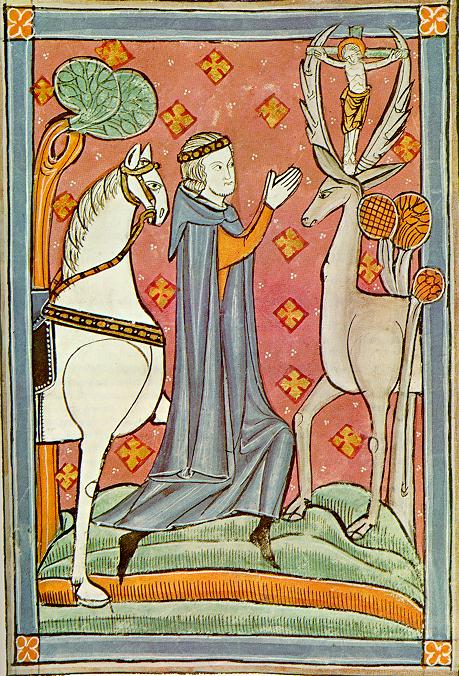
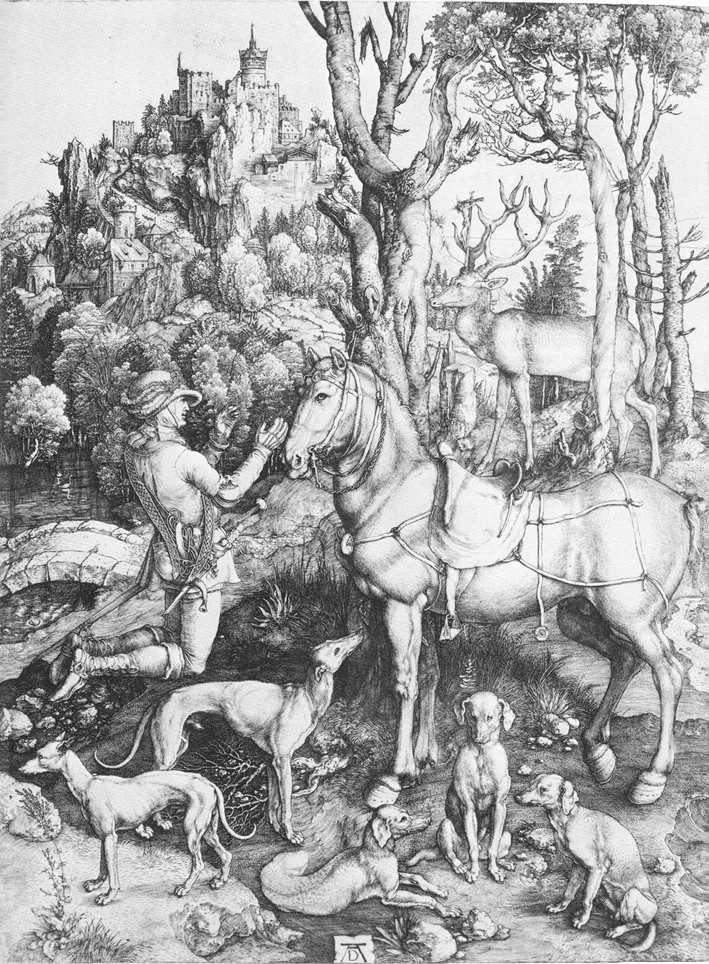
According to this tale, in the reign of Trajan the Roman general Placidas (also Placidus), one of nature's noblemen, was out hunting one day when he saw a stag of surpassing beauty bearing between its horns a luminous cross with the figure of Jesus Christ. This marvelous beast announced its identity to P. as Jesus Christ, asked why it/He was being pursued, and invited P. and P.'s family to accept baptism. Which they did, P. taking the name Eustachius (also Eustathius; when he is so named modern writers sometimes distinguish him by suffixation from saintly homonyms, either as Eustathius Placidas or as Eustathius of Rome), his wife Theopista, and his sons Theopistus and Agapius (all significant names but Eustachius does NOT signify 'Good Stag').

Still according to the legend, E. became a new Job, undergoing all sorts of privations, as did also his immediate family. One of these that was important for their construction in the later Middle Ages was that they lost all their slaves and their horses and cattle to a plague; as they themselves survived, they became plague-saints. At the end of all these adventures, during which E. had been separated at different times from T., T., and A., they were reunited early in the reign of Hadrian to take part in celebrating a military victory that E. had won for the now deceased Trajan. This of course required ritual sacrifice. E. refused, he and his family were brought before Hadrian and condemned, and all four, after exposure to wild beasts had proved ineffectual, found quick death in a bronze bull made red-hot by a fire beneath it. Their miraculously unburnt bodies were buried by fellow Christians. When Constantine had ended the persecutions an oratory was built over their grave. Thus far the legend.

The earliest known dedication to E. is that of a diaconal church in Rome first attested from the time of Gregory II (715-731), a predecessor of today's basilica di Sant'Eustachio in Campo Marzio (a.k.a. Sant'Eustachio in Platana). E., T., T., and A. were entered by Usuard of Saint-Germain under November 2nd in the second edition of his martyrology; this quickly became their usual feast day in the Latin West. That feast, which had been moved to today in accordance with the long-standing practice of the Greek church (in the Synaxary of Constantinople it comes first in the feasts of September 20th), was removed from the general Roman Calendar in the latter's revision of 1969. T., T., and A. were dropped from the Roman Martyrology in its revision of 2001 (in Byzantine-rite churches they are still celebrated today along with E.); E. was retained as the saint of the aforementioned diaconal church. E. is a patron saint of (among others) Madrid, Matera (MT) in Basilicata, Acquaviva delle Fonti (TA) in Apulia, Belforte del Chienti (MC) in the Marche, and Campo di Giove (AQ) in Abruzzo.


Some period-pertinent images of E., T., T., and A.:

a) E. as depicted (with the stag) in a later ninth-century psalter from Constantinople (Paris, BnF, ms. grec 20, fol. 5v):
http://tinyurl.com/2e537bk

b) E. as portrayed in high relief (at right; at left, St. George of Lydda) on the mid-tenth-century Harbaville Triptych in the Musée du Louvre, Paris:

https://upload.wikimedia.org/wikipedia/commons/3/3e/Triptych_Harbaville_Louvre_OA3247_n1.jpg


c) E., T., T., and A. as depicted (in the fiery bull) in the late tenth- or very early eleventh-century so-called Menologion of Basil II (Città del Vaticano, BAV, cod. Vat. gr. 1613, p. 63):
http://tinyurl.com/qxpghj2

d) E., T., T., and A. as depicted (four scenes, starting with E. and the stag and ending with all four saints in the burning bull) in an illuminated eleventh-century copy of the September portion of the Metaphrastic Menologion (London, BL, MS Add 11870, fol. 151r):
http://www.bl.uk/manuscripts/Viewer.aspx?ref=add_ms_11870_f151r

e) E. as depicted (carrying one son into a river while other is taken by a lion) in one of four panels of a full-page illumination in the so-called Bible of Saint Bertin (ca. 1190-1200; Den Haag, KB, ms. 76 F 5, fol. 39r):
http://manuscripts.kb.nl/zoom/BYVANCKB%3Amimi_76f5%3A039r_min_a2
The legend indicates that the scene was intended to represent the loss of both sons: Eustas natorum viduatur gente suorum.

f) E., T., T., and A. as portrayed in high relief (in the fiery bull) in a late twelfth- or earlier thirteenth-century sculpture, now rather worn, on the left pillar of the left portal of south porch of the west face of the basilica cathédrale Notre-Dame in Chartres:
http://tinyurl.com/d3ql3x3

g) E. as portrayed in an early thirteenth-century silver-gilt head reliquary (c. 1210) formerly in the cathedral treasury at Basel and now in the British Museum, London:

Reliquary of St Eustace

This particular head has been associated with St Eustace since 1477.
The reliquary was made in Basle around 1200. The filigree on the band around the saint's head resembles the work on the shrine of Charlemagne in Aachen of 1215. The twelve figures under cusped arches on the base, probably the Apostles, are clearly of the early thirteenth century, both in the early gothic form of the architecture and the gently modelled draperies of the repeated figures formed by the same die. It may be compared with another reliquary now in the Treasury of the abbey of St Maurice d’Agaune (Switzerland).
The reliquary consists of a wooden core of head and base, carved from sycamore, which was later covered with silver plates. The wooden core and the silver covering have been kept as two separate objects since conservation in the 1950s. When the head was conserved in 1955 a number of relics were found wrapped in textiles including nine skull fragments, presumably thought to be relics of St Eustace.

http://www.flickr.com/photos/seriykotik/3898876085 - this shows both the inner wooden core and the outer case

h) E., T., T., and A. as depicted (scenes, starting with E. out hunting and ending with all four saints in the burning bull) in the earlier thirteenth-century St. Eustace window (bay 43; ca. 1210) in the basilica cathédrale Notre-Dame in Chartres (two sets of views):
Photographs by Gordon Plumb:
http://tinyurl.com/2aeeayb
Photographs by Philip Maye (with a key that invites one to read the window from top down rather than, correctly, from bottom up):
http://tinyurl.com/9hhhjwm

i) E., T., T., and A. as depicted (scenes, starting with E. and the stag and ending with all four saints in the burning bull) in the earlier thirteenth-century St. Eustace window (bay 21; ca. 1210-1220) in the cathédrale Saint-Étienne in Sens:
http://www.medievalart.org.uk/Sens/21_Pages/Sens_Bay21_key.htm

j) E. as depicted (with the stag) in a later thirteenth-century psalter of English origin (ca. 1260-1280; Venice, Biblioteca Marciana, ms. lat. I, 77 [2397], fol. 6v):

https://upload.wikimedia.org/wikipedia/commons/a/a7/Saint_eustace.jpg


k) E. as depicted in the very late thirteenth- or very early fourteenth-century frescoes (ca. 1290-1305) attributed to Manuel Panselinos in the Protaton church on Mount Athos:
http://www.myriobiblos.gr/museum/gallery/panselinos/54.jpg

l) E., T., T., and A. as depicted (their baptism; in the fiery bull) in an earlier fourteenth-century French-language Life of St. Eustace (betw. 1301 and 1325; London, BL, MS Egerton 725, fols. 1r and 9r):
1) baptism: http://www.bl.uk/catalogues/illuminatedmanuscripts/ILLUMIN.ASP?Size=mid&IllID=9852
2) in the fiery bull: http://www.bl.uk/catalogues/illuminatedmanuscripts/ILLUMIN.ASP?Size=mid&IllID=9860
For other illuminated pages from this cycle, see:
http://www.bl.uk/catalogues/illuminatedmanuscripts/ILLUMIN.ASP?Size=mid&IllID=9860

m) E., T. and one son in the bull and the other son starting to climb into it as depicted (lower register) in the earlier fourteenth-century frescoes (betw. ca. 1312 and 1321/1322) of the nave of the monastery church of the Theotokos at Gračanica in, depending on one's view of the matter, Serbia's province of Kosovo and Metohija or the Republic of Kosovo:
http://tinyurl.com/36myah3
Detail view (E., his family, and the bull):
http://tinyurl.com/327gy6r

n) E., T., T., and A. as depicted (at right in panel at lower left; in the fiery bull) in an earlier fourteenth-century pictorial menologion from Thessaloniki (betw. 1322 and 1340; Oxford, Bodleian Library, MS Gr. th. f. 1, fol. 10r):
http://image.ox.ac.uk/images/bodleian/msgrthf1/10r.jpg

o) E. as depicted (with the stag) in an earlier fourteenth-century French-language legendary of Parisian origin (ca. 1327), with illuminations attributed to the Fauvel Master (Paris, BnF, ms. Français 183, fol. 231v):
http://tinyurl.com/mc667a

p) E. as depicted in the earlier fourteenth-century frescoes (betw. 1335 and 1350) in the nave of the church of the Holy Ascension at the Visoki Dečani monastery near Peć in, depending on one's view of the matter, either the Republic of Kosovo or Serbia's province of Kosovo and Metohija:
http://tinyurl.com/352glx9
http://tinyurl.com/28kb7pf

q) E., T., T., and A. as depicted (in the fiery bull) in a September calendar scene in the earlier fourteenth-century frescoes (betw. 1335 and 1350) in the narthex of the church of the Holy Ascension at the Visoki Dečani monastery near Peć in, depending on one's view of the matter, either the Republic of Kosovo or Serbia's province of Kosovo and Metohija:
http://tinyurl.com/2eqy6cy

r) E., T., T., and A. as depicted (register below the windows; scenes, starting with E. and the stag and ending with all four saints in the burning bull) by Vitale da Bologna in the mid-fourteenth-century frescoes (1351) in the apse of the basilica di Santa Maria at the abbey of Pomposa in today's Codigoro (FE) in Emilia-Romagna:

https://blogger.googleusercontent.com/img/b/R29vZ2xl/AVvXsEhMEP8spuxHXbDMrqTTaq7zcbLXL1SwCyLIm2gQpyE508FMyGv8LdfTiHfz17L7h-_okaWGYUPLn3X6oBbBrnkBUzMuQ8OGqU5IbDB7jLvimaAvDd5clO5b0EgwUovIrvf1OO74nCn9jjM/s1600/affreschi+dell'abside1.png


https://blogger.googleusercontent.com/img/b/R29vZ2xl/AVvXsEhXk_Sb04Yetu-Y9ox5jhVvA21bZnANFpxPJtNuW7aqPyK-VzFBhgo2RAFKyyyejcwo1b6KhPKVGdJz-10AwXk9byPZWyvTW0uBoMTotdPVBkd8cuL4V1tx-1qo5y7tumxUgxXFXilZMHI/s1600/affreschi+dell'abside2.png


s) E., T., T., and A. as depicted in panels from a now dismembered late fourteenth-century altarpiece of E. (ca. 1380; the latter was reported stolen in 1902 from his church in Campo di Giove (AQ) in Abruzzo; these panels were returned from the United States late in 2008 and are now in the Museo nazionale d'Abruzzo, L'Aquila):
Illustrated, English-language account: http://tinyurl.com/5a8u92
Illustrated, Italian-language account: http://tinyurl.com/po3htta

t) E. as depicted (with the stag) by Pisanello in an earlier fifteenth-century panel painting (ca. 1440; "Vision of St. Eustace") in the National Gallery, London:

https://upload.wikimedia.org/wikipedia/commons/2/23/Pisanello_018.jpg


u) E., T., T. and A. as depicted (E. fed into an unusually realized fiery bull while T., T., and A. look on) by the court workshop of Frederick III in a mid-fifteenth-century copy (1446) of the Legenda aurea (Vienna, Österreichische Nationalbibliothek, cod. 326, fol. 229v):
http://tinyurl.com/oqcbg2e

v) E. as depicted in grisaille (losing, while crossing a river, one son to a wolf and the other to a lion) by Jean le Tavernier in the Suffrages of the mid-fifteenth-century Hours of Philip of Burgundy (ca. 1451-1460; Den Haag, KB, ms. 76 F 2, fol. 263r):
http://manuscripts.kb.nl/zoom/BYVANCKB%3Amimi_76f2%3A263r_min

w) E. as depicted (with the stag) by the Master of the Benedict Passion in a later fifteenth-century panel painting (ca. 1465) variously said to be either in the National Museum in Kraków or else in the Holy Cross chapel of that city's cathedral (can anyone on the list say for certain where this painting now resides?):

Św. Eustachy na łowach


x) as depicted by Giovanni Boccati in a detail of his later fifteenth-century polyptych (1468) in the chiesa di Sant'Eustachio in Belforte del Chienti (MC) in the Marche:

http://politticideimontiazzurri.it/en/wp-content/blogs.dir/2/files/giovanni-boccati/polittico_giovanni_boccati_belforte_chienti05.jpg


The altarpiece as a whole (with four scenes of E.'s life on the predella [to be read from right to left]):

http://www.arteovunque.info/wp-content/uploads/2014/08/belforte-del-chienti-s.eustachio-g.boccati_2.jpg


Clicking on the predella panels in this image will bring up thumbnails leading to larger views of them ( If it does not work from here go to the link at bottom right and then click):

belforte_giovanni_boccati_tot


y) E., T., T., and A. as depicted (scenes, starting with E. and the stag and ending with all four saints in the burning bull) in a late fifteenth-century fresco (ca. 1480) in the Cathedral and Metropolitical Church of Christ, Canterbury:
https://www.flickr.com/photos/chrisjohnbeckett/368385671/
Detail views (E. and the stag):
https://www.flickr.com/photos/chrisjohnbeckett/369230784/

https://s-media-cache-ak0.pinimg.com/originals/cb/53/56/cb5356292e967a0360a4b8202dcd43df.jpg


Detail view (E., T., T., and A. in the fiery bull):
http://tinyurl.com/q427nbx

z) E., T., T., and A. as depicted (scenes: E. and the Stag; E., T., T., and A. receiving baptism) by Jacques de Besançon in a late fifteenth-century copy of the Legenda aurea in its French-language version by Jean de Vignay (ca. 1480-1490; Paris, BnF, ms. Français 245, fol. 152r):
http://gallica.bnf.fr/ark:/12148/btv1b8425999d/f311.image

aa) E. as depicted by Albrecht Dürer on a panel of the Paumgärtner Altarpiece (ca. 1498-1504) in the Alte Pinakothek, Munich:

https://upload.wikimedia.org/wikipedia/commons/2/20/Albrecht_D%C3%BCrer_069.jpg


bb) E. as depicted (at right, after St. Procopius of Caesarea / of Scythopolis and St. Nicetas the Goth) in a late fifteenth- or earlier sixteenth-century Novgorod School icon now in the State Russian Gallery, St. Petersburg:
http://www.icon-art.info/hires.php?lng=de&type=1&id=814

cc) E. as depicted (with the stag) in a late fifteenth- or early sixteenth-century panel painting (c. 1500) in the Museum of the Legion of Honor, San Francisco:

https://upload.wikimedia.org/wikipedia/commons/3/3c/Artista_tedesco%2C_visione_di_sant%27eustachio%2C_1500_ca..JPG


dd) E. as depicted (with the stag) by Albrecht Dürer (1471-1528) in a print from a late fifteenth- or early sixteenth-century engraving (ca. 1501):
1) copy in the Fogg Art Museum, Harvard University:

http://www.wga.hu/art/d/durer/2/13/2/034.jpg

2) copy in the Metropolitan Museum of Art, New York:
http://www.metmuseum.org/collection/the-collection-online/search/336232

ee) E. as depicted (at left, holding a stag's head; at right, St. George) by Hans Süss of Kulmbach (c.1480-1522) in an early sixteenth-century pen-and-ink drawing (c. 1511) in the Metropolitan Museum of Art, New York:

Saint Eustace and Saint George


ff) E. as portrayed in high relief (at center, holding a stag's head surmounted by a crucifix; at left, St. Acacius of Byzantium / Achatius; at right, St. Blasius / Blaise with the attributes of St. Erasmus) on the early sixteenth-century tomb of the Kurfürstin Anna (1512) in the evangelisch-lutherische Pfarrkirche St. Maria in Heilsbronn (Lkr. Ansbach) in Bayern:

https://upload.wikimedia.org/wikipedia/commons/9/90/Heilsbronn_M%C3%BCnster_-_Grab_der_Markgr%C3%A4fin_Anna_01.jpg


gg) E. as depicted by Theofanis Strelitzas-Bathas (a.k.a. Theophanes the Cretan) in an earlier sixteenth-century fresco (1545-1546) in the katholikon of the Stavronikita monastery on Mt. Athos:
http://www.mesageitonias.com/20_sept_eustathius.jpg

Wednesday, 4 February 2015

St Blaise in stained glass and in the blessing of throats


Yesterday was the feast of St Blaise, and about whom there is an online account here. To mark the feast of this popular medieval saint of Armenian origin here are a few images as posted on the Medieval Religion discussion group by Rev. Gordon Plumb:

Poitiers, Cathédrale Saint-Pierre, Bay 113b, some scenes from the story of Blaise:
and:
Another set of images of this window, taken more recently, with details of individual panels:

Wells Cathedral, Somerset, NII, 2a-3a:

Wells Cathedral, nV, A2:

Oxford, Christ Church Cathedral, sVII, A2:

Doddiscombsleigh, St Michael, Devon, nII, B4:

Harpley, St Lawrence, Norfolk, wI, A9:

There is an online account of the Blessing of Throats associated with the feast of St Blaise at Blessing of the Throats 

12hp0062 

The Blessing of Throats at St Wilfrid's in York
 
Image; stwilfridsyork.org.uk


Thursday, 3 February 2011

St Blaise


Today is the feast of St Blaise, Bishop of Sebastea in Armenia, who was martyred in c.316. As he was tortured with iron wool combs he became the patron of cloth workers, and is often depicted holding a wool comb. He is also the patron of those with diseases of the throat.

Blaise/Blasius/Vlaho, bishop of Sebastea (Turkey or Armenia), martyr (316?) He lived and died during the time of Diocletian or Licinius. Legend adds that he became bishop when a young man, retreated to a hermitage when persecutions began, and was brought to official attention by hunters who saw him curing sick and wounded wild animals.He had an affinity with animals usually reserved to Irish saints; his feats included convincing a wolf to return a stolen pig to a poor woman. While in prison, he healed a boy who had a fishbone stuck in his throat; this gave rise to his patronage of those who suffer from maladies affecting the throat. The mother of the child later brought Blaise food and candles in prison, so the blessing of St. Blaise includes the application of two candles to the sufferer's throat. Blaise is also invoked prophylactically on his feast day (which in the Northern Hemisphere occurs during a season when upper respiratory infections are common) to ward off coughs and other afflictions of the throat.
February 3rd is now St Blaise's day in Latin-rite churches. He is said to appear in Carolingian martyrologies under February 15th; whether his feast was moved up under the influence of the candles part of the legend in order to bring it close to Candlemas or whether, instead, that aspect of the legend is a later addition reflecting Blaise's repositioning in the Roman calendar is something that would be worth investigating. Greek-rite churches celebrate the hieromartyr Blasios on February 11th.
One of the Fourteen Holy Helpers of the later Middle Ages, he has been venerated extensively in the West since at least the ninth century. Blasius (Vlaho) has also been venerated as patron saint of Dubrovnik (Ragusa) since the 11th century. His relics are widely distributed.

Adapted from Terri Morgan's post on Saints of the Day on the Medieval Religion Discussion Group

As a saint his cult has remained popular in away that many, more famous, saints have not. Thus long after the reformation "Bishop Blaise" continued to be celebrated by guild processions in English cloth making towns and to appear on trade tokens.

The throat blessing is also still popular - something which I received this evening after the 6.00 Mass at the Oxford Oratory.

photo
Early fourteenth century glass in Christ Church Cathedral Oxford
Photo: Gordon Plumb on Flickr