Once I was a clever boy learning the arts of Oxford... is a quotation from the verses written by Bishop Richard Fleming (c.1385-1431) for his tomb in Lincoln Cathedral. Fleming, the founder of Lincoln College in Oxford, is the subject of my research for a D. Phil., and, like me, a son of the West Riding. I have remarked in the past that I have a deeply meaningful on-going relationship with a dead fifteenth century bishop... it was Fleming who, in effect, enabled me to come to Oxford and to learn its arts, and for that I am immensely grateful.


Showing posts with label Reliquaries. Show all posts

Sunday, 18 September 2016

Reliquary of St Ferreolus


John Dillon posted today on the Medieval Religion discussion group about the several saints called Ferreolus, and one in particular. I have adapted his post as follows:

 http://www.culture.gouv.fr/emolimo/imaz/sept10.jpg

The reliquary of St Ferreolus at Nexon

 Image: culture.gouv.fr

There are at least five saints venerated in the Middle Ages from what is now France who are named Ferreolus. Two are celebrated on September 18th: Ferreolus of Vienne (d. 250 or 251, supposedly) and Ferreolus of Limoges (d. late 6th cent.; perhaps after 591 and the saint of the present notice). According to St. Gregory of Tours, as Bishop of Limoges this Ferreolus (in French, Ferréol; formerly also Forgel) calmed a riot that had broken out there in 579 and, in another action, rebuilt the fire-destroyed basilica of St. Martin at today's Brive-la-Gaillarde (Corrèze). Ferreolus of Limoges is also recorded as having participated in the council of Mâcon in 583. A Vita of St. Aredius of Limoges (BHL 666; earliest witness is of the late ninth or early tenth century) has Ferreolus provide aid to that holy abbot (d. 591) and says that he presided at the latter's funeral. Dillon adds that as the Bollandists have assigned to this Vita the number of the Beast, it would perhaps be unwise to trust that account!

Today is the principal feast day of Ferreolus of Limoges in Nexon (Haute-Vienne) and his day of commemoration in the Roman Martyrology.

http://www.culture.gouv.fr/emolimo/imaz/sept11.jpg

The back of the reliquary

Image: culture. gouv.fr

In addition to the three photographs I have copied there is a description in French of the head reliquary of St Ferreolus made in Limoges in 1346 - as recorded on the back of the amice - for the church at Nexon (Haute-Vienne) and now kept in the treasury of the église de la Décollation-de-Saint-Jean-Baptiste in that town are here:
http://www.culture.gouv.fr/emolimo/chef.htm

http://www.culture.gouv.fr/emolimo/imaz/sept9.jpg

A detail of the mitre

Image: culture.gouv. fr


Thursday, 4 February 2016

St Blaise


Yesterday was the feast of St Blaise, and following Mass I had the traditional blessing of my throat.

John Dillon posted an impressive selection of images of St Blaise on the Medieval Religion discussion group:

Not to be confused with his homonyms Blasius of Amorion, Blasius of Caesarea, Blasius of Veroli, and Blasius of Verona, the thaumaturge Blasius of Sebaste (d. circa 316, supposedly) is popularly known in English by a French form of his name (Blaise; other European forms include, but are certainly not limited to, Blasios / Vlasios, Vlaho / Blaž, Blasius, Blas, and Biagio / Biase). His cult is first attested from the sixth century, when the medical encyclopedist Aetius of Amida reports his being invoked in cases of illness of the throat.

Absent both from the earliest witnesses of the pseudo-Hieronymian Martyrology and from the probably originally late fourth-century Syriac Martyrology surviving in a manuscript written at Edessa in c. 411, and thus absent as well from the hypothetical fourth-century Greek martyrology thought to have provided a fund of feasts common to both, Blasius has both a legendary pre-metaphrastic Passio (BHG 276-276c; first attested from the eighth century) and a metaphrastic one (BHG 277); beyond these Greek texts there are versions in Latin and in other languages. These make him a physician of Sebaste in Armenia (now Sivas in Turkey) who is elected bishop, goes into hiding to avoid the Licinian persecution, lives in a cave where with the sign of the cross he cures sick animals, is sought out, arrested and imprisoned, tends the sick, operates miracles, is tortured, and finally is decapitated. Later versions have him flayed with carding combs prior to execution. Blasius' miracles include saving a boy from choking to death on a fishbone and causing a wolf to restore to a widow a piglet that it had taken from her. In the later Middle Ages his reputed care for ailments of the throat caused Blasius to be numbered among the Fourteen Holy Helpers; his association with animals made him a patron of keepers of livestock.

Since the tenth century Blasius has been the patron saint of Dubrovnik (formerly Ragusa), where an originally twelfth(?)-century head reliquary of him, formed as a Byzantine crown, is kept in that city's early modern katedrala Marijina Uznesenja (cathedral of the Assumption of the BVM):


http://www.azad-hye.net/media/e1/bishop-nareg-in-dubrovnik-02.jpg


 http://www.akg-images.de/Docs/AKG/Media/TR5/2/4/1/0/AKG570800.jpg


There is an arm reliquary as well (in these photos shown along with the head reliquary):
http://tinyurl.com/ppqbucl


Supplementing Gordon Plumb's post of earlier today, herewith some links to further period-pertinent images of St. Blasius of Sebaste:

a) Blasius' martyrdom as depicted in the late tenth- or very early eleventh-century so-called Menologion of Basil II (Città del Vaticano, BAV, cod. Vat. gr. 1613, p. 390):
http://tinyurl.com/p4yf9p7

b) Blasius delivering the piglet to the widow (upper register) and Blasius' martyrdom as depicted in the late eleventh- or very early twelfth-century frescoes of the Chapelle des Moines at Berzé-la-Ville (Saône-et-Loire):
http://www.flickr.com/photos/magika2000/8268154248/
Detail view (Blasius delivering the piglet to the widow)
http://www.wga.hu/art/zgothic/mural/11c1/14berze.jpg

c) Blasius' martyrdom (three scenes) as portrayed, perhaps by Roger of Helmarshausen, on a long side of a late eleventh- or early twelfth-century portable altar (copper gilt over wood) executed for the abbey of Abdinghof and now in the Erzbischöfliches Diözesanmuseum und Domschatzkammer in Paderborn:
http://tinyurl.com/jb3gwu6

d) Blasius (at left) as depicted in an early twelfth-century mosaic in the cupola di San Leonardo in Venice's basilica cattedrale patriarcale di San Marco:
http://www.wga.hu/art/zgothic/mosaics/6sanmarc/2cusouth.jpg
Detail views:
http://tinyurl.com/lgjlne4
http://tinyurl.com/lvudkkf

e) Blasius as depicted in the mid- or slightly later twelfth-century mosaics of the Cappella Palatina in Palermo:

http://rubens.anu.edu.au/raid1cdroms/sicily/palermo/churches/cappella_palatina/nave/mosaics_to_north/P1012434.JPG


f) Blasius (lower register, second from left) receiving a book from Duke Henry as depicted in the late twelfth-century Gospels of Henry the Lion (c. 1188; Wolfenbüttel, Herzog August Bibliothek, cod. Guelf. 105 Noviss. 2°, fol. 194r):
http://www.wga.hu/art/zgothic/miniatur/1151-200/1german/2gospel1.jpg

g) Blasius (second from right) as depicted in the late twelfth-century frescoes (1196) of the chiesa rupestre di San Biagio at San Vito dei Normanni (BR) in Apulia:
http://tinyurl.com/ln866mw

h) Blasius as depicted in a late twelfth- or early thirteenth-century fresco in the santuario di Maria SS. Regina (a.k.a. Santa Maria d'Anglona) at Tursi (MT) in Basilicata:
http://tinyurl.com/yhkhges

i) Blasius as depicted in late twelfth- or early thirteenth-century gold and enamel work on his head reliquary in the treasury of Dubrovnik's katedrala Marijina Uznesenja:


j) The widow brings the pig's head to the imprisoned Blasius (below: wolf devouring the pig) as depicted in an initial "T" in a thirteenth-century ms. of Magnum legendarium austriacum (Zwettl, Stiftsbibliothek, cod. 13, fol. 105v):
http://tarvos.imareal.oeaw.ac.at/server/images/7002571.JPG

k) Blasius confronting the Roman governor persecuting him as depicted in a thirteenth-century glass window panel from the area of Soissons, now in the Louvre:
http://tinyurl.com/2lkkb6

l) Scenes from Blasius' legend as depicted in the earlier thirteenth-century St. Blaise lancet of the "St. Blaise window" (Bay 217; c. 1230-1240; the other two lancets depict scenes of St. George and of St. Thomas of Canterbury) in the cathédrale Notre-Dame in Coutances:
http://therosewindow.com/pilot/Coutances/w217c-Frame.htm [with links to detail views]
and at right here:
http://tinyurl.com/j3tuccc
Other detail views:
http://tinyurl.com/j3k94vv
http://tinyurl.com/h28e7cp
http://tinyurl.com/j2zbk78

m) Blasius healing a throat as depicted in a mid-thirteenth-century gradual for the Use of the abbey of Fontevrault (c. 1250-1260; Limoges, Bibliothèque municipale, ms. 2, fol. 63v):
http://www.enluminures.culture.fr/Wave/savimage/enlumine/irht1/IRHT_043441-p.jpg

n) Blasius as depicted (at right, flanking St. John Climacus; at left, St. George of Lydda) as depicted in a later thirteenth-century Novgorod School icon in the State Russian Museum, St. Petersburg:
http://www.icon-art.info/masterpiece.php?lng=en&mst_id=512

o) Blasius' martyrdom as depicted in a late thirteenth-century copy of French origin of the Legenda aurea (San Marino, CA, Huntington Library, ms. HM 3027, fol. 32v; image greatly expandable):
http://digitalassets.lib.berkeley.edu/ds/huntington/images//000962A.jpg

p) Blasius (at left; at right, Pope St. Urban I) in the late thirteenth-century Livre d'images de Madame Marie (c. 1285-1290; Paris, BnF, ms. Nouvelle acquisition française 16251, fol. 91r):
http://tinyurl.com/yk9p76d

q) Blasius (at center, betw. Sts. Eleutherius of Illyria and Hypatius [of Gangra?]) as depicted in the earlier fourteenth-century frescoes (between c. 1312 and 1321/1322) in the nave of the monastery church of the Theotokos at Gračanica in, depending on one's view of the matter, either Serbia's province of Kosovo and Metohija or the Republic of Kosovo:
http://tinyurl.com/d2mrvqk
Detail view (Blasius):
http://tinyurl.com/lm44odu

r) Blasius as portrayed in an earlier fourteenth-century (second quarter) chiefly silver reliquary bust probably of French manufacture, formerly in the collegiate church at Braunschweig dedicated to him (commonly known as the Braunschweiger Dom) and now in the Bode Museum in Berlin:
http://tinyurl.com/pqzvjwv

 http://www.medievalhistories.com/wp-content/uploads/small-buestenreliquiar-des-hl-Blasius-bpk-fofotsudio-bartsch.jpg?35be33

s) Blasius (at left; at right, St. Babylas) as depicted in the earlier fourteenth-century frescoes (betw. 1335 and 1350) in the altar area of the church of the Holy Ascension at the Visoki Dečani monastery near Peć in, depending on one's view of the matter, either the Republic of Kosovo or Serbia's province of Kosovo and Metohija:
http://tinyurl.com/y89acds

t) Blasius' flight from persecution as depicted in a mid-fourteenth-century copy, from the workshop of Richard and Jeanne de Montbaston, of the Legenda aurea in its French-language version by Jean de Vignay (1348; Paris, BnF, ms. Français 241, fol. 65v):
http://tinyurl.com/yzmwu82

u) Blasius (at far right, after Sts. Spyridon the Wonderworker and Clement of Ohrid) as depicted in the later fourteenth-century frescoes (1360s and 1370s; restored in 1968-1970) in the church of St. Demetrius in Marko's Monastery at Markova Sušica (near Skopje) in the Former Yugoslav Republic of Macedonia:
http://tinyurl.com/h5ancvj
Detail view (Blasius):
http://tinyurl.com/zgp4cvb

v) Blasius (at left; at right, St. Prochorus) as depicted in the later fourteenth-century frescoes (1375) in the church of St. George in Longanikos (Laconia administrative region):
http://tinyurl.com/zfpap8g

w) Blasius (at left) as portrayed in relief on a later fourteenth- or fifteenth-century mezzanino struck by the Republic of Ragusa:
http://www.coingallery.de/Heilige/B/Blasius_1.jpg

x) Blasius (while at prayer, attacked by a demon) as depicted in a late fourteenth- or early fifteenth-century copy of the Legenda aurea in its French-language version by Jean de Vignay (Rennes, Bibliothèque de Rennes Métropole, ms. 266, fol. 69v):
http://tinyurl.com/hrb7yk2

y) Blasius as portrayed holding a model of Ragusa in a fifteenth-century silver-gilt statuette kept on the high altar of Dubrovnik's katedrala Marijina Uznesenja:

http://www.total-croatia-news.com/images/news/blaise-dubrovnik%20%282%29.jpg


z) Blasius as depicted (at left; at right, St. Spyridon the Wonderworker; both protecting livestock) in an early fifteenth-century Novgorod School icon (c. 1407) in the State Historical Museum, Moscow:
http://www.icon-art.info/masterpiece.php?lng=en&mst_id=562

aa) Blasius (second from left; at far left, St. Bartholomew the Apostle) as depicted by Masaccio in his earlier fifteenth-century San Giovenale triptych (c. 1424/25) in the chiesa di San Pietro in Cascia di Reggello (FI) in Tuscany:
http://www.wga.hu/art/m/masaccio/z_panels/giovena1.jpg

bb) Blasius' martyrdom as depicted by Mariotto di Nardo in an earlier fifteenth-century predella panel (c. 1425) in the Musée des Beaux-Arts in Rennes:

http://www.culture.gouv.fr/Wave/image/joconde/0677/m021104_894-34-2_p.jpg


cc) Blasius as portrayed (at centre; at left, St. Ulrich; at right, St. Erasmus of Formia) in the earlier fifteenth-century polychromed wooden statues (before 1436) re-used in the central compartment of the otherwise early sixteenth-century winged altarpiece (1517/1518; restored c. 2000) by Jörg Lederer in the choir of the Kirche St. Blasius in Kaufbeuren:


The altarpiece as a whole:
http://tinyurl.com/zwubqp7

dd) Blasius as depicted in a mid-fifteenth-century panel painting (c. 1450), sometimes attributed to Nero di Bicci, in the Musei Capitolini in Rome:
http://tinyurl.com/hyd6xjt
https://christbearers.files.wordpress.com/2012/02/st-blaise-capitoline-museum.jpg?w=837

ee) Blasius as depicted in a mid-fifteenth-century initial (c. 1450-1460) by the Master of the Murano Gradual, cut from a gradual and now in the J. Paul Getty Museum in Los Angeles:
http://www.nga.gov/exhibitions/2005/miniature/index.shtm
http://www.getty.edu/art/exhibitions/power_piety/

ff) Blasius as depicted in a later fifteenth-century Novgorod School icon in the Karelian Fine Arts Museum, Petrozavodsk, Russia:
http://www.icon-art.info/hires.php?lng=en&type=1&id=590

gg) Scenes from Blasius' legend as depicted in a later fifteenth-century copy of Vincent of Beauvais' Speculum historiale in its French-language translation by Jean de Vignay (1463; Paris, BnF, ms. Français 51, fol. 58r):
http://tinyurl.com/yjmvnju

hh) Blasius as depicted in the central panel of Martín de Soria's later fifteenth-century San Blas Altarpiece (1464) in the iglesia de San Salvador at Luesia (Zaragoza):

 [San+Blas.jpg]

The altarpiece as a whole:


[Vista+general.jpg]


Blasius' martyrdom as depicted in one of the predella panels:

[San+Blas++martirizado+con+el+rastrillo.jpg]

Expandable views of panels depicting scenes from Blasius' legend start about halfway down this page:
http://tinyurl.com/ye3b3qn

ii) Blasius as depicted in a detached later fifteenth-century fresco (between 1475 and 1500; from the refectory of the convento di San Biagio in Cesena [FC] in Emilia-Romagna) in that city's Pinacoteca comunale:

Madonna dell' umiltà


jj) Blasius holding a model of Ragusa as portrayed in a later fifteenth-century statue on the Ploče Gate in the same city (now of course Dubrovnik):
https://travelsofed.files.wordpress.com/2011/11/100_4555.jpg

kk) Blasius as depicted (at far right in the lower register above the predella) by Carlo and Vittore Crivelli in their later fifteenth-century polyptych of Monte San Martino (c. 1477-1480) in the chiesa di San Martino vescovo in Monte San Martino (MC) in the Marche:


Detail view of Blasius:


ll) Scenes from Blasius' legend as depicted in twenty late fifteenth-century painted panels (c. 1480-1490) mounted on the north wall of the nave of the Kirche St. Blasius in Kaufbeuren:


Detail view (the women forced into slavery):
http://tinyurl.com/gwdjolo

mm) Blasius (at left, holding a candle; at right, St. John the Baptist) as depicted by Hans Memling on a wing of his Passion (or Greverade) Altarpiece of 1491 in the Museum für Kunst- und Kulturgeschichte in Lübeck:

http://www.wga.hu/art/m/memling/5late/37nogr4.jpg


nn) Blasius (second from right, flanking the BVM; at far right, St. Roch / Rocco) as depicted by a Tuscan follower of Neri di Bicci in a late fifteenth-century panel painting (1498; for the abbey of Santa Maria della Salute et San Niccolao in Buggiano [PT]), exhibited by the Carabinieri in 2015 as part of the exposition "La memoria ritrovata" in Cagliari:

http://www.lamemoriaritrovata.com/img/large/05.jpg


oo) Blasius (third from left; after St. Florus of Illyricum and St. Nicholas of Myra and before St. Anastasia of Sirmium) as depicted in a late fifteenth- or early sixteenth-century Novgorod School wooden triptych in the State Tretyakov Gallery, Moscow:
http://www.icon-art.info/masterpiece.php?lng=en&mst_id=513

pp) Blasius (at left, holding a model of Ragusa; at right, St. Paul the Apostle) as depicted by Nikola Božidarević / Nicholas of Ragusa in his very early sixteenth-century triptych (c. 1501) in the Dominican convent in Dubrovnik:


The triptych as a whole:


qq) Blasius as portrayed holding a model of Ragusa in an early sixteenth-century statue (1503) in the Kulturno-povijesni muzej in Dubrovnik:
http://dumus.hr/files/g/3-28/VA-85.jpg
Detail view (model of Ragusa):
http://dumus.hr/files/g/3-28/530x350-7/VA-85_1.jpg

rr) Blasius as portrayed in a stone bust on the early sixteenth-century Field Gate (1506) at Ragusa's former dependency of Ston (Dubrovačko-neretvanska županija) in Croatia:
http://www.kroatien-netz.de/data/media/148/Ston_Saline_Stadt_Kloster_030_680.jpg

ss) Blasius as portrayed in relief (at far right) among the Fourteen Holy Helpers on the early sixteenth-century tomb of the Kurfürstin Anna (1512) in the Evangelisch-lutherische Pfarrkirche St. Maria in Heilsbronn (Lkr. Ansbach) in Bayern:
http://tinyurl.com/zbdf72j

tt) Blasius as portrayed in an early sixteenth-century ceiling boss (c. 1519) in the choir of the Evangelisch-lutherische Kirche St. Sixti in Northeim (Lkr. Northeim) in Niedersachsen:
http://fotos.verwaltungsportal.de/seitengenerator/viib_blasius_400.jpg

uu) Blasius as depicted by Fermo Stella in an earlier sixteenth-century panel painting of the Madonna between St. Blasius and St. John the Baptist (1536) in the Museo Valtellinese di Storia e Arte in Sondrio (VA) in Lombardy (detail view):
http://www.wwmm.org/immagini/z_848.jpg

vv) Blasius as depicted (at upper right) in an unframed earlier sixteenth-century polyptych (1537) in the chiesa del Purgatorio at Ruvo di Puglia (BA) in Apulia:


Detail view of Blasius as reproduced on a poster; image greatly expandable:
http://www.ruvodipugliaweb.it/sanbiagio/programma_S__Biagio.jpg

ww) Blasius as depicted by Theofanis Strelitzas-Bathas (a.k.a. Theophanes the Cretan) in the mid-sixteenth-century frescoes (1545 and 1546) in the katholikon of the Stavronikita monastery on Mt. Athos:
http://images.oca.org/icons/lg/February/0203Blaise.JPG

xx) Blasius as depicted (twice) by George / Tzortzis the Cretan in the mid-sixteenth-century frescoes (1546/47) in the Dionysiou monastery on Mt. Athos:
1) full-length portrait:
http://tinyurl.com/gtfjwcq
2) martyrdom:
http://tinyurl.com/qhbz2qz


Wednesday, 20 January 2016

St Sebastian


Being based in Oxford it seems only appropriate when offered by John Dillon via the Medieval Religion discussion group a series of images of St Sebastian to share them with readers on this the feast of the name saint of Lord Sebastian Flyte, the second son of the late Marquess of Marchmain.
Some of the later paintings reflect the choices made in the Italian renaissance by artists and patrons to depict the almost nude male form, as opposed to earlier traditions of representing St Sebastian, and do have, dare I suggest it, something in them of homoerotic sado-masochism - you can't say the Clever Boy fails to cater for all tastes amongst his readers.

Here is John's selection together with his introductory note:


The Roman martyr Sebastian (d. 3d cent.?) is first documented in the Depositio martyrum of the Chronographer of 354, where he is entered under today as a martyr of the Via Appia.  According to St. Ambrose of Milan, Sebastian was a native of that city who was martyred at Rome.  His legendary Passio (BHL 7543; ineptly ascribed to Ambrose) is our earliest source for this saint's frequently depicted attempted execution by arrows, of which so many pierced him that -- still according to the Passio -- he came to resemble a hedgehog.  The same account -- which is set in the the persecution of Diocletian and Maximian and which previously had detailed his support of the twins Mark and Marcellian and many others --  then gives a rapidly healed Sebastian a final colloquy with Diocletian after which the saint is clubbed to death in the Circus and his body is dumped into a nearby sewer.  Instructed by Sebastian in a vision, a Christian matron named Lucina retrieves his body and buries it at a location in the catacombs near the remains of the apostles (Peter and Paul, of course).  When the persecutions have ended Lucina converts her home into a church and gives it to the church of Rome.  Thus far the Passio.  Lucina's church is of course the titulus Lucinae, the predecessor of today's San Lorenzo in Lucina. The burial site specified in the Passio is that of Sebastian's martyrial church on the Via Appia Antica, after several rebuildings over the centuries today's basilica di San Sebastiano ad Catacumbas (or San Sebastiano f. l. M.).


Some period-pertinent images of St. Sebastian of Rome:

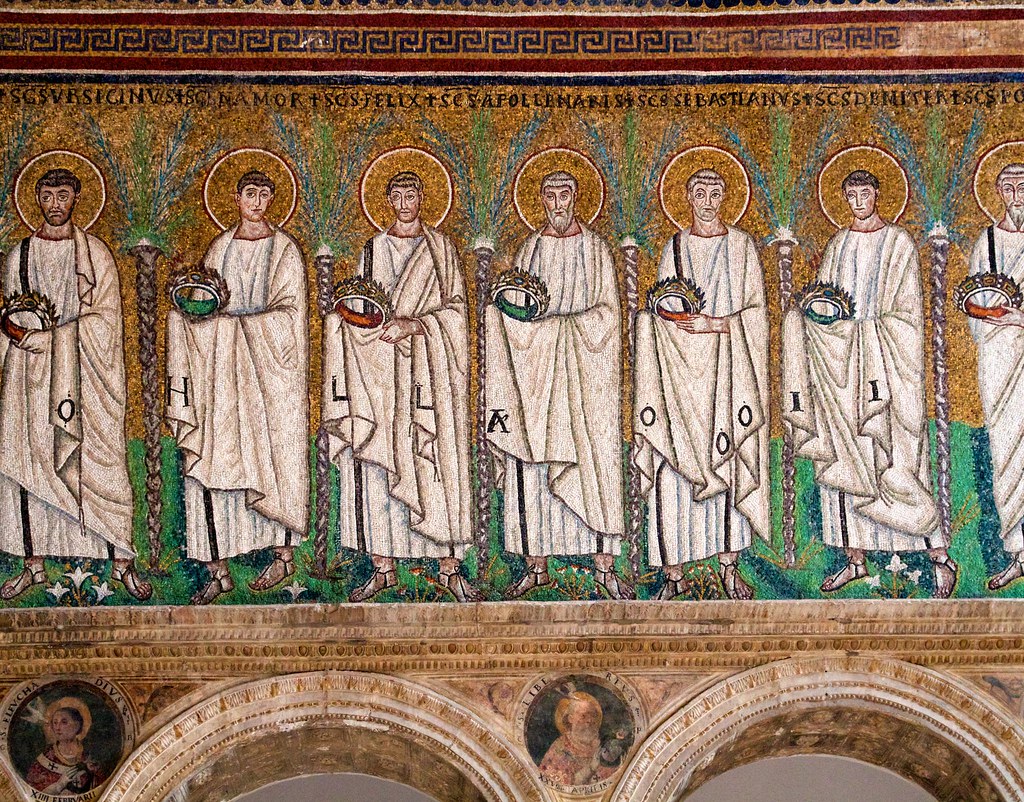
a) as depicted (third from right) in the heavily restored, later sixth-century procession of male martyrs (c. 561) in the nave of Ravenna's basilica di Sant'Apollinare Nuovo:

 
http://tinyurl.com/7lebx8n

b) as depicted in a probably late seventh-century mosaic portrait in Rome's basilica di San Pietro in Vincoli:


http://web.archive.org/web/20080227232948/http://bode.diee.unica.it/~giua/SEBASTIAN/PICS/vincoli.jpg


c) as depicted (upper register, martyrdom; lower register, St. Blasius / Blaise) in a later twelfth-century breviary for the canonesses of Seckau (Graz, UB, cod. 832, fol. 18r):
http://tarvos.imareal.oeaw.ac.at/server/images/7009800.JPG

d) as depicted (martyrdom) in one of four panels of a full-page illumination in the late twelfth-century so-called Bible of Saint Bertin (c. 1190-1200; Den Haag, KB, ms. 76 F 5, fol. 35v, sc. 1B):
http://manuscripts.kb.nl/zoom/BYVANCKB%3Amimi_76f5%3A035v_min_b1

e) as depicted (martyrdom) in an earlier thirteenth-century collection of saint's lives in their French-language translation by Wauchier de Denain (between 1226 and 1250; London, BL, Royal 20 D VI, fol. 48v):
http://www.bl.uk/catalogues/illuminatedmanuscripts/ILLUMIN.ASP?Size=mid&IllID=48231

f) as depicted (at left; St. Mary Magdalene at right) in a mid-thirteenth-century glass window (c. 1250-1260) in the west choir of Naumburg's Dom St. Peter und St. Paul:

 http://www.wga.hu/art/zgothic/stained/13c/12g_1250.jpg


g) as depicted (martyrdom) in a later thirteenth-century Cistercian psalter of upper Rhine origin (c. 1260; Besançon, Bibliothèques municipales, ms. 54, fol. 15r):
http://www.enluminures.culture.fr/Wave/savimage/enlumine/irht5/IRHT_083237-p.jpg

h) as depicted (martyrdom) in the later thirteenth-century frescoes (1278 or 1279) of Rome's chiesa di San Lorenzo in Palatio ad Sancta Sanctorum:
https://www.pemptousia.gr/wp-content/uploads/2014/12/ag.sebastianos22.jpg
A different interpretation (the BVM and St. John disporting themselves at archery?):
http://www.agefotostock.com/age/en/Stock-Images/Rights-Managed/DAE-11285236

i) as depicted (martyrdom) in a late thirteenth-century copy of French origin of the Legenda aurea (San Marino, CA, Huntington Library, ms. HM 3027, fol. 22v):
http://digitalassets.lib.berkeley.edu/ds/huntington/images//000969A.jpg

j) as depicted (at far right, martyrdom; at centre, Sts. Mark and Marcellian) in an earlier fourteenth-century copy of books 9-16 of Vincent of Beauvais' Speculum historiale in its French-language version by Jean de Vignay (c. 1335; Paris, BnF, ms. Arsenal 5080, fol. 218v):
http://gallica.bnf.fr/ark:/12148/btv1b7100627v/f442.item.zoom

k) as depicted (perhaps; the identifying inscription appears to have been re-painted) in the earlier fourteenth-century frescoes (between 1335 and 1350) in the church of the Holy Ascension in the Visoki Dečani monastery near Peć in, depending upon one's view of the matter, either the Republic of Kosovo or Serbia's province of Kosovo and Metohija:
http://tinyurl.com/6uubsp6

l) as depicted by Nicolò Semitecolo in several later fourteenth-century panel paintings (1367) in the Museo diocesano in Padua:
1) supporting Sts. Mark and Marcellian before the emperors:

 http://www.wga.hu/art/s/semiteco/2christi.jpg

2) martyrdom by arrows:

 https://upload.wikimedia.org/wikipedia/commons/6/63/Niccolo_Semitecolo._Sebastiano_trafitto_dalle_frecce._1367._53x60cm._Padova%2C_Museo_Diocesano.jpg

3) martyrdom by clubbing; his body dumped in a sewer:

https://upload.wikimedia.org/wikipedia/commons/f/f8/B_Nicol%C3%B2_Semitecolo._St_Sebastian_Beaten_with_Sticks._1367%2C_Padova%2C_Museo_Diocesano.jpg

4) entombment:
 https://upload.wikimedia.org/wikipedia/commons/4/4c/Nicol%C3%B2_Semitecolo%2C_Deposizione_del_corpo_di_San_Sebastiano_1367%2865%2C5x70cm%29Padova%2C_Museo_Diocesano.jpg


The Clever Boy would ad dthat these four paintings have some lovely fourteenth century details of interest in themselves - click on the link to see them in alarger format.

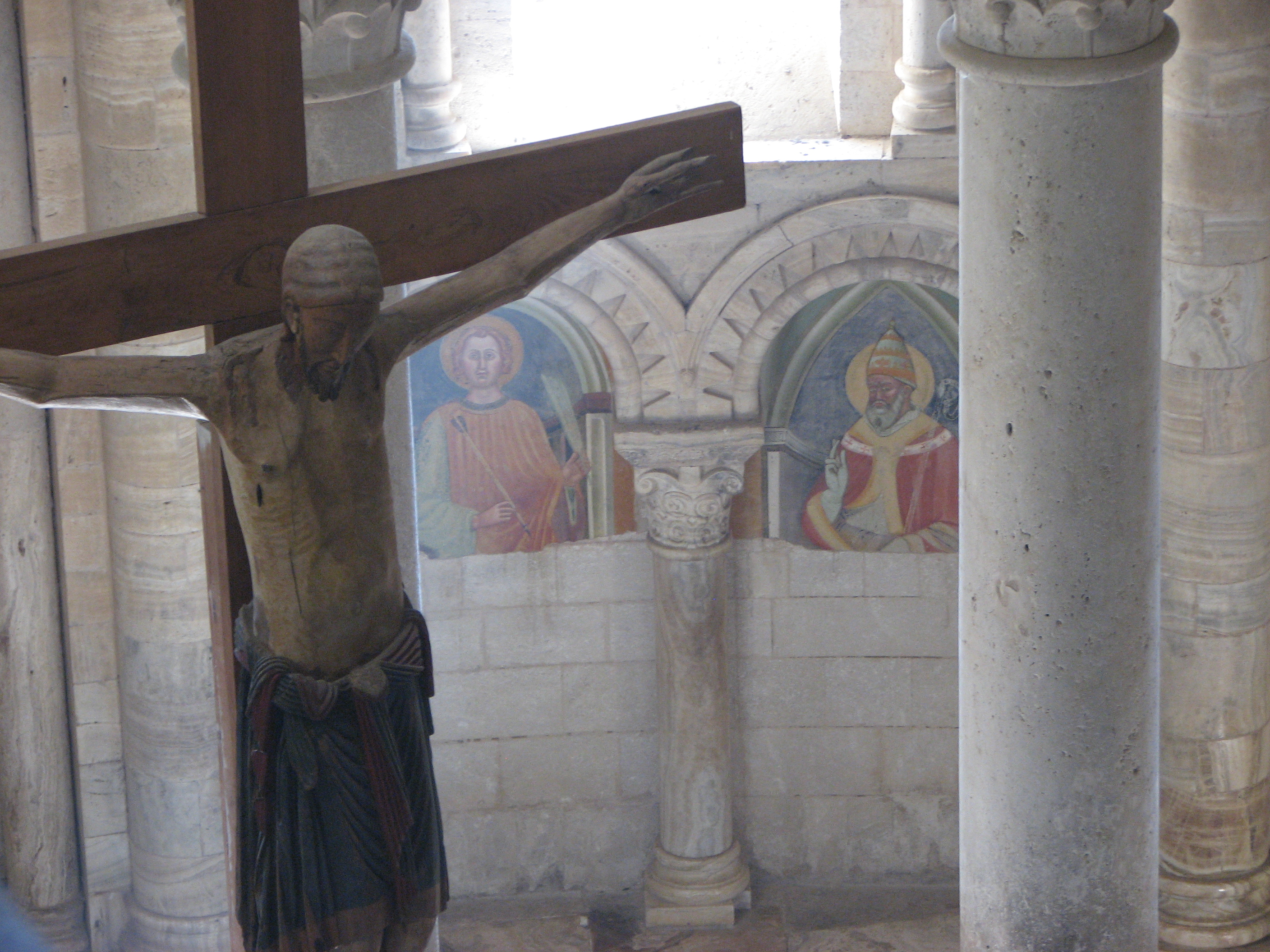
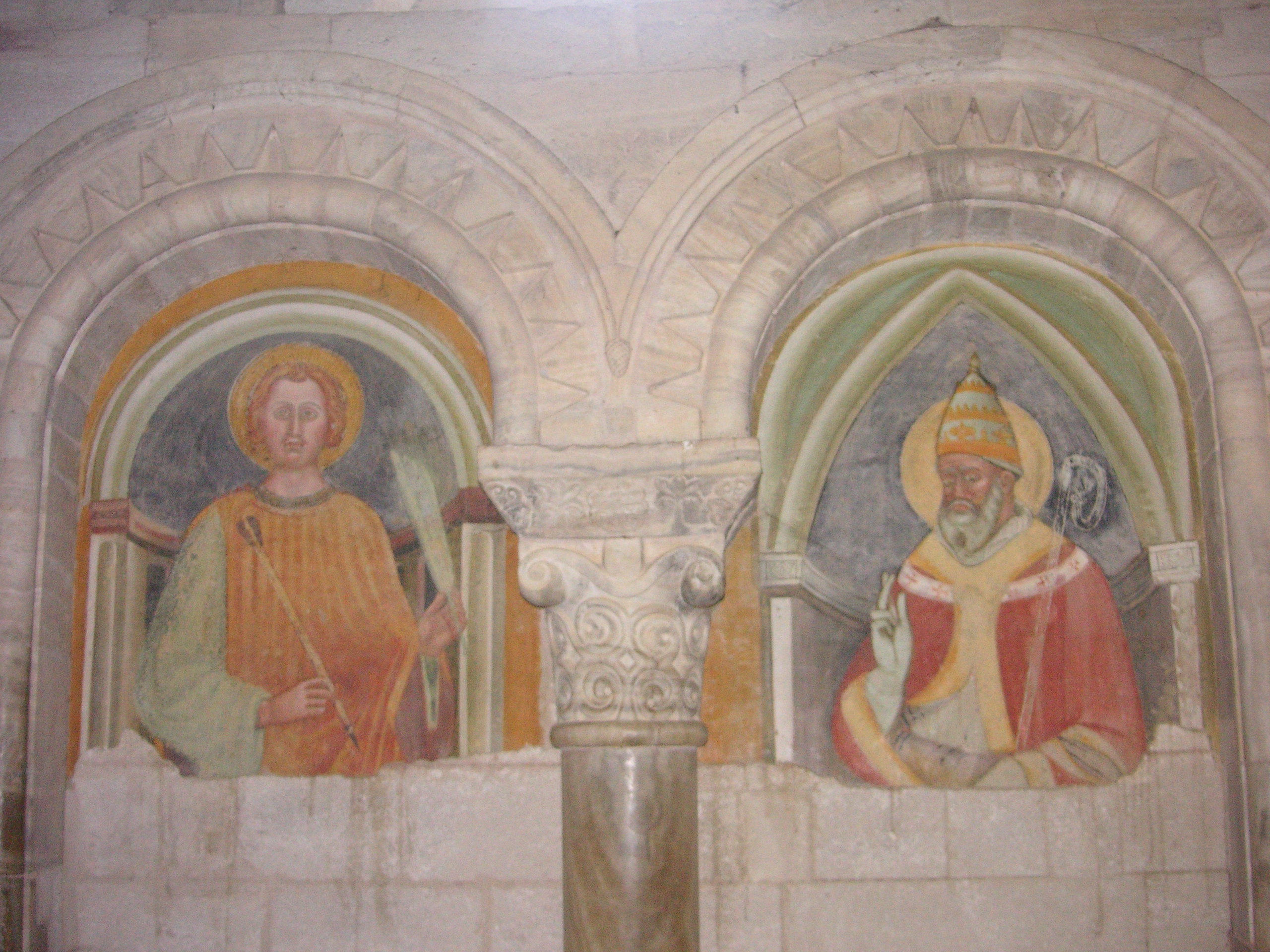
m) as depicted (at left; at right, a sainted pope) in a pair of late fourteenth- or fifteenth-century frescoes in the ambulatory of the abbey church of Sant'Antimo at Montalcino (SI) in Tuscany (the abbey claimed to possess relics of Sebastian given at its foundation in 781 by Pope Hadrian I, who supposedly had received them from Charlemagne):

 https://upload.wikimedia.org/wikipedia/commons/e/e2/Abbazia_di_Sant%27Antimo_-_53_-_Il_crocifisso_e_gli_affreschi_visti_dal_matroneo.jpg

https://upload.wikimedia.org/wikipedia/commons/4/46/Sant%27Antimo_affreschi.JPG


n) as depicted by Taddeo di Bartolo (martyrdom) in a remounted early fifteenth-century fresco (ca. 1400-1410) in Naples' Museo nazionale di Capodimonte:

 https://upload.wikimedia.org/wikipedia/commons/9/98/Taddeo_di_Bartolo_-_Saint_Sebastian.jpg

o) as depicted (martyrdom) in the Suffrages of the earlier to mid-fifteenth-century Hours of Françoise de Dinan (ca. 1435-1450; a.k.a. Hours of Catherine de Rohan and of Françoise de Dinan; Rennes, Bibliothèque de Rennes Métropole, ms. 34bis [pt. 2 of ms. 15942], fol. 87r):
http://www.tablettes-rennaises.fr/app/photopro.sk/rennes/detail?docid=6834#sessionhistory-ready
http://tinyurl.com/jyek5yp

p) as depicted by the Master of the Bodensee (second from left, after St. Anthony of Egypt, and with St George and St Ursula) in an earlier fifteenth-century panel painting in the Staatliche Kunsthalle Karlsruhe:
http://www.ipernity.com/doc/1654608/38630734/

q) as portrayed in a mid-fifteenth-century head reliquary (1450) in the Pfarrkirche St. Sebastian in Ebersberg (Lkr. Ebersberg) in Bavaria:


File:Relic of St. Sebastian 01.JPG

There is anothe rpicture of the reliquary at 
 https://de.wikipedia.org/wiki/Datei:Relic_of_St._Sebastian_02.JPG

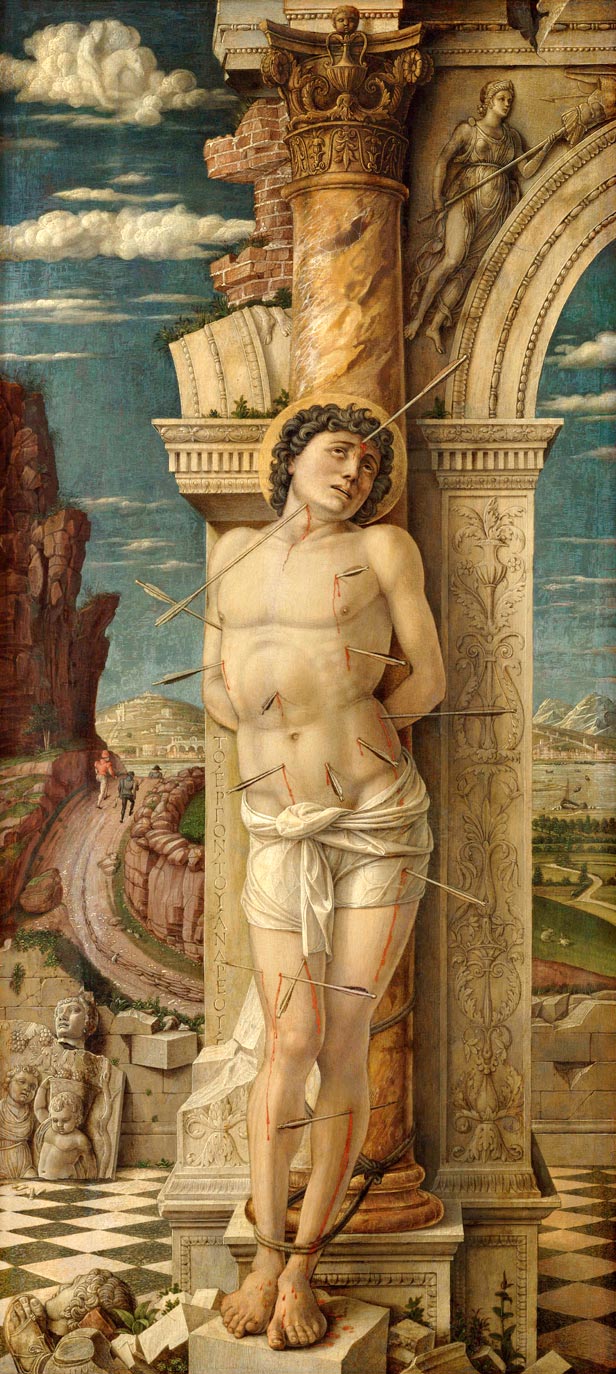
r) as depicted by Andrea Mantegna (martyrdom) in a mid-fifteenth-century panel painting (later 1450s) in the Kunsthistorische Museum, Vienna:


https://upload.wikimedia.org/wikipedia/commons/4/4d/Andrea_Mantegna_089.jpg


s) as depicted in a later fifteenth-century fresco in the left apsidal chapel of the crypt of the chiesa di San Ponziano in Spoleto:
https://www.flickr.com/photos/hen-magonza/9124891102/

t) as depicted by Sandro Botticelli (martyrdom) in a later fifteenth-century panel painting (1473) in the Gemäldegalerie, Berlin:

 https://upload.wikimedia.org/wikipedia/commons/4/4c/Sandro_Botticelli_054.jpg


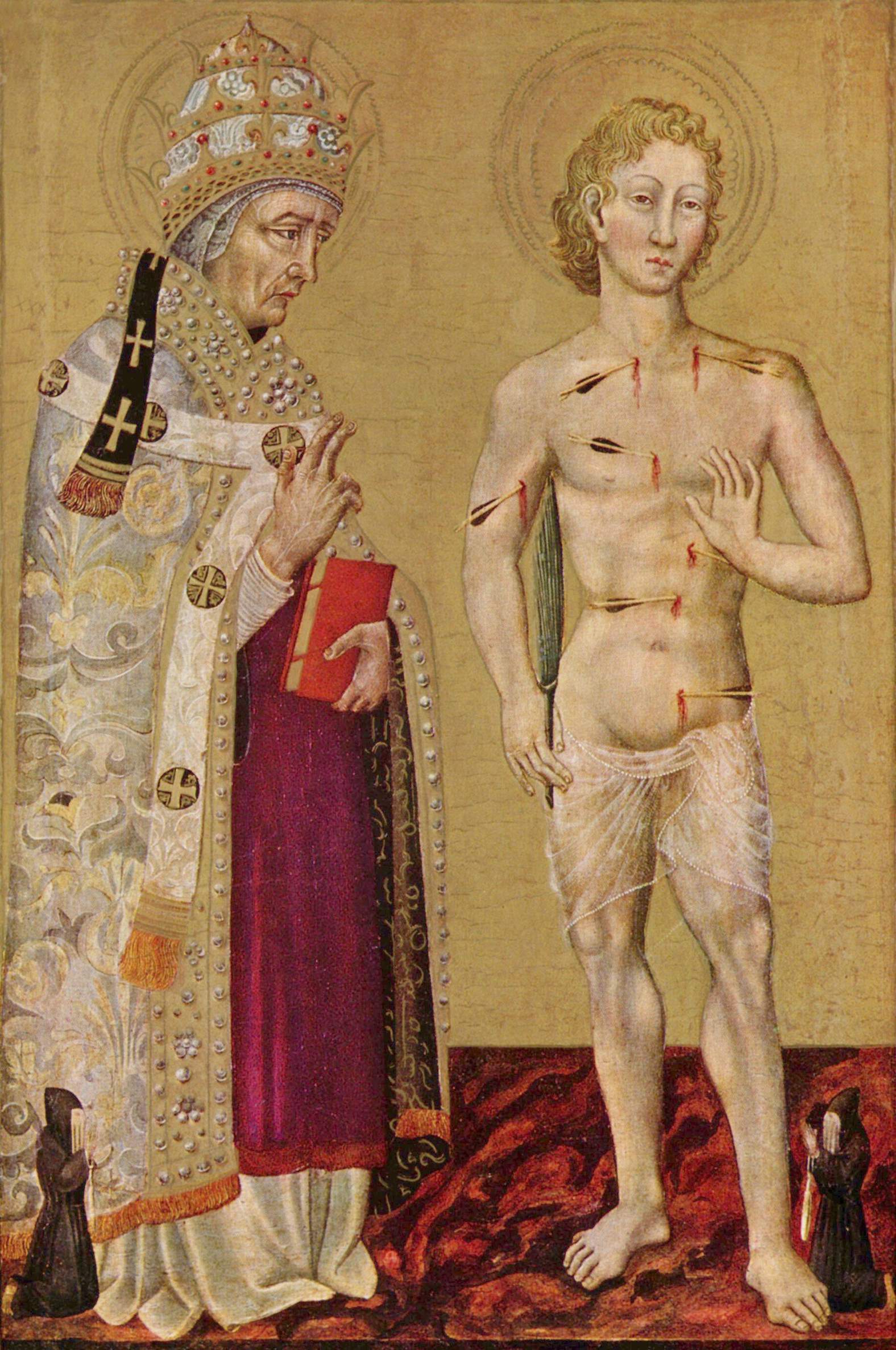
u) as depicted (at right, martyrdom; at left, pope St. Fabian, whose feast day also falls today) in a later fifteenth-century panel painting (c. 1475), attributed to Giovanni di Paolo, in the National Gallery, London:
1) Before cleaning in the 1970s (the National Gallery still calls this cleaning 'recent'):

 https://upload.wikimedia.org/wikipedia/commons/f/fa/Giovanni_di_Paolo_002.jpg


2) After cleaning (the second image is clearer but the colours are off) :
http://tinyurl.com/yczp53u
http://tinyurl.com/ycz7ccx

The Clever Boy will add that the National Gallery website states that: Recent cleaning revealed the original upraised position of Sebastian's hand and forearm and some twenty arrows piercing his body, most of which had been painted out.

At the bottom in each corner is a kneeling Brother of the Confraternity of the Misericordia, a lay brotherhood which was devoted to the Seven Works of Mercy. The brothers, dressed in black with white veils, are holding what may be spoons used for collecting alms.

This is a complete votive picture - one promised and offered in thanks for the favourable answer to a prayer - and is probably one of Giovanni di Paolo's late works.

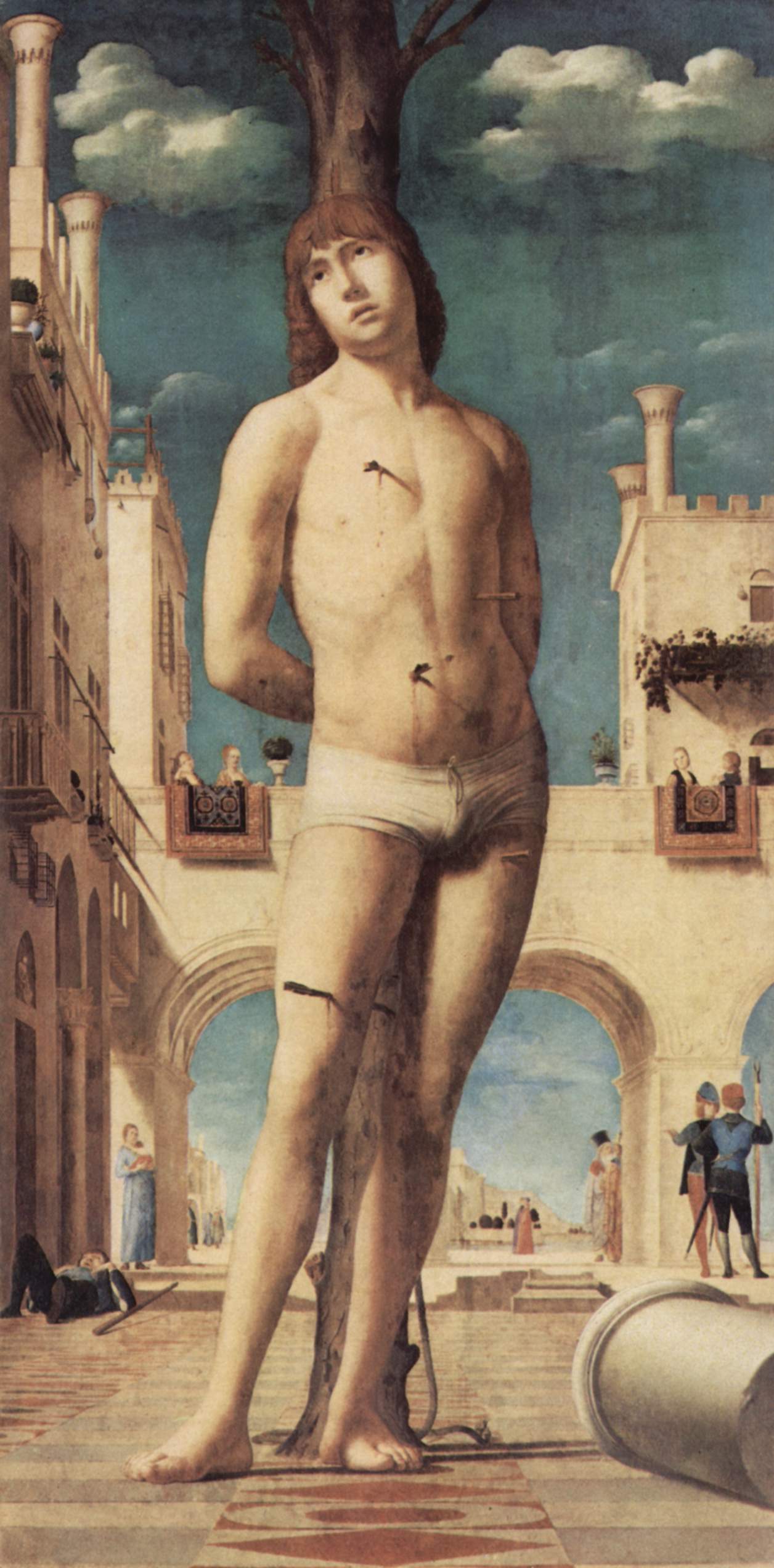
v) as depicted by Antonello da Messina (martyrdom) in a later fifteenth-century panel painting (c. 1476) in the Gemäldegalerie, Dresden:


https://upload.wikimedia.org/wikipedia/commons/4/47/Antonello_da_Messina_018.jpg


w) as depicted by Andrea Mantegna (martyrdom) in a later fifteenth-century panel painting (c. 1480) in the Musée du Louvre, Paris:


https://upload.wikimedia.org/wikipedia/commons/c/c1/Andrea_Mantegna_088.jpg


x) as depicted (martyrdom) in the later fifteenth-century Hours of Dionora of Urbino (c. 1480; London, BL, MS Yates Thompson 7, fol. 93v):
http://www.bl.uk/catalogues/illuminatedmanuscripts/ILLUMIN.ASP?Size=mid&IllID=6000

y) as depicted by Giovanni Baleison (martyrdom) in a late fifteenth-century fresco by Giovanni Baleison in the Chapelle Saint-Sebastien, Saint-Étienne-de-Tinée (Alpes-Maritimes):
http://www.culture.gouv.fr/culture/medieval/en/b036.htm

z) as depicted (at left; at right, St. Anthony of Egypt) in a late fifteenth-century stained glass roundel in the Museum Schnütgen, Köln:
http://tinyurl.com/hq9nvte

aa) as depicted (martyrdom) in a late fifteenth-century stained glass roundel in the Musée national du Moyen Âge (Musée de Cluny), Paris:
http://therosewindow.com/pilot/Paris-Musee-Cluny/w61.htm

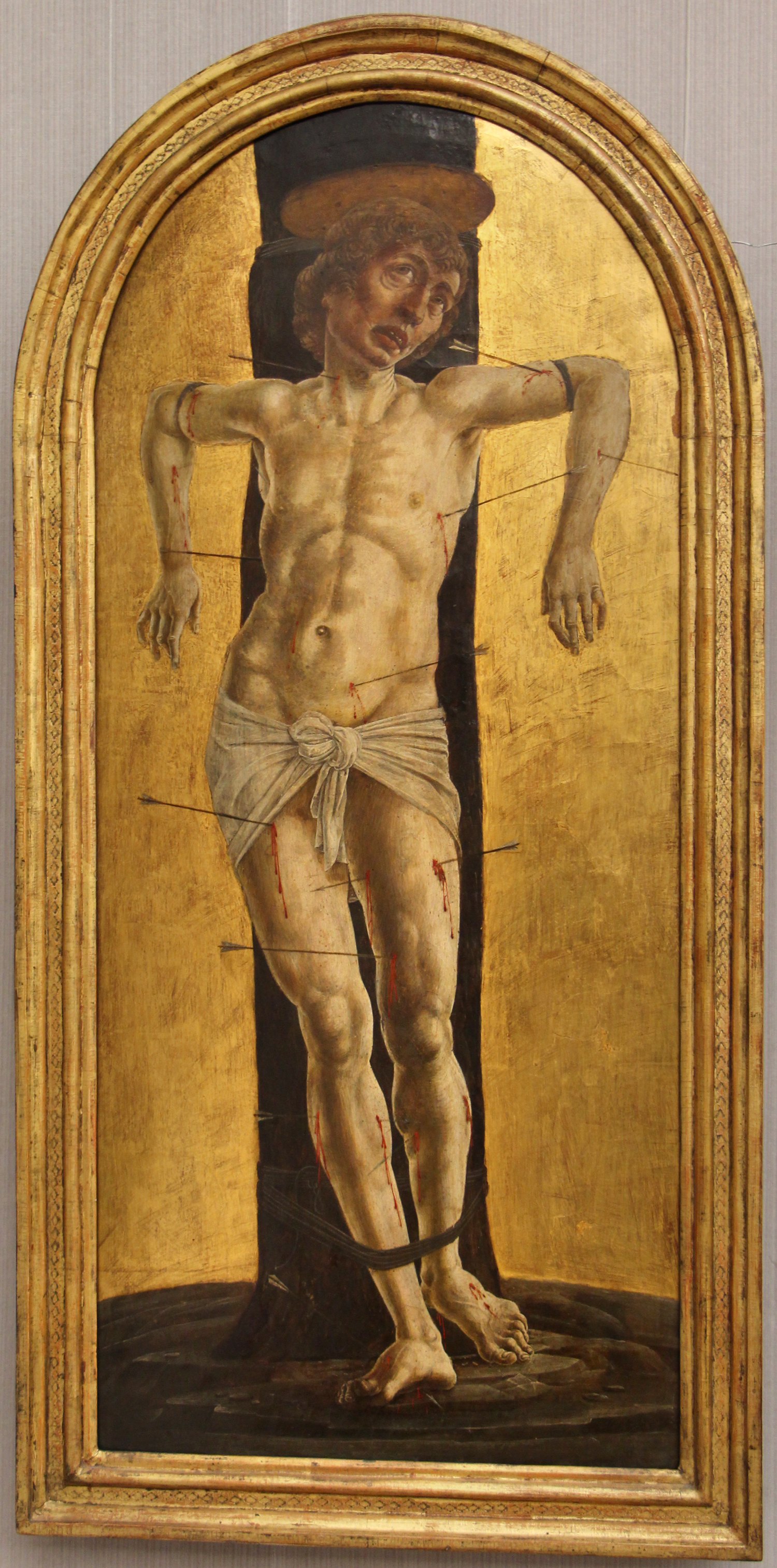
bb) as depicted by Cosmè Tura (martyrdom) in a late fifteenth-century panel painting (c. 1484) in the Gemäldegalerie, Berlin:

 https://upload.wikimedia.org/wikipedia/commons/8/8c/Cosm%C3%A8_tura%2C_san_sebastiano%2C_1484_ca.JPG


cc) as depicted by Andrea Mantegna (martyrdom) in a late fifteenth-century panel painting (c. 1490) in the Galleria Giorgio Franchetti alla Ca' d'Oro, Venice:


https://upload.wikimedia.org/wikipedia/commons/a/aa/St_Sebastian_3_Mantegna.jpg


dd) as portrayed (martyrdom) in a late fifteenth-century silver and silver gilt reliquary (c. 1497) from Augsburg in the Victoria and Albert Museum in London:


In addition here are some glass images added by Gordon Plumb:

St-Nicolas-de-Port, Bay 105, 5a-7a, 5b-7b, martyrdom of Sebastian,
early 16thC.:
https://www.flickr.com/photos/22274117@N08/4127966209
and detail:
https://www.flickr.com/photos/22274117@N08/4128739542

St-Nicolas-de-Port, Bay 113, 2c-4c:
https://www.flickr.com/photos/22274117@N08/4137043660

Bourges, Cathédrale Saint-Étienne, Bay 27, Virgin and Child with
Sebastian and another saint:
https://www.flickr.com/photos/22274117@N08/4266380565

Tuesday, 15 April 2014

Monastic treasures on display at the Louvre


Last week Gregory DiPippo had a post on the New Liturgical Movement about a current exhibition at the Louvre of treasures from the Abbey of St Maurice in Canton Valais in Switzerland. The abbey is on the site of the martyrdom of St Maurice and the Theban Legion.

The items have not been on display outside the abbey previously, and, judging from those pictured in his post, are very fine indeed and precious survivals. Once again we get a fleeting glimpse of the artistic achievements of past centuries and some idea of what once existed but which in so many cases has been destroyed. The abbey of St Maurice has been fortunate to preserve such items. The post, with its pictures, can be seen at Treasures of the Abbey of St. Maurice at the Louvre.

Wednesday, 5 February 2014

St Agatha


Today is the feast of St Agatha, Virgin and Martyr. Her main centre of devotion is Catania in Sicily, where the Festival of Saint Agatha is the most important one, she being the patron of the city and each year her feast is celebrated from February 3rd-5th.

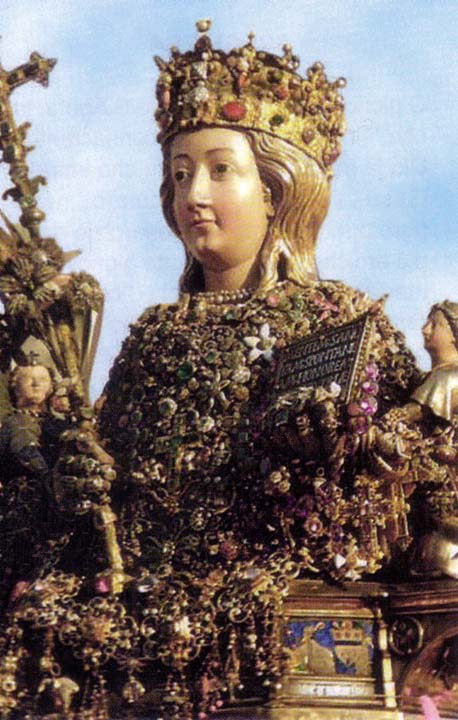
In the cathedral in Catania is this famous and striking reliquary bust:


The Festival of Saint Agatha is the most important religious festival of Catania, Sicily.

Image: nobility.org 
 
 
The bust contains the relics of St. Agatha and many of the jewels that adorn the reliquary are pectoral crosses which belonged to the bishops of Catania, Dusmet, Francica Nava and Ventimiglia. There is also a ring that belonged to Queen Margherita, who gave it in 1881 during a visit to Catania, and a necklace set with emeralds, which was a gift from the Viceroy Ferdinand de Acuna. The crown is said to have been given by given by King Richard the Lionheart when he was on Crusade.

 Sant'Agata

Saint Agatha's reliquary at Catania

Image:goldsmith.it

Saint Agatha's reliquary is attributed to "Giovanni di Bartolo", a goldsmith from Siena who lived in the second half of the fourteenth century.The bust is made of enamelled silver .Two kneeling angels flank it. The saint has a very rich mantle open on the front and adorned with vine shoots and with garlands of flowers partially enamelled. The chromatic effect is increased by the redness, once enamelled, on which a naturalistic colouring has been laid. A hinged window allows a periodic inspection of the relics. The reliquary bust is at present mounted on a sixteenth century base which lies on an octagonal pedestal enlarged on two sides by two small corbels.

On the base is a long inscription in Gothic lettering on a light blue enamel: Virginis istud opus Agathae sub nomine coeptum / Martilias fuerat quo tempore praesul in Urbe / Cataniae cui pastor succesit Helias: / ambos lemovicum clare produxerat arbor / artificis manus hoc fabricabit Marte Foanne / Bartolus et genitor celebrit cui patria Sene / Mille ter et centum post partum Virginis almae / et decies septem sestoq. Fluntibus annis.

Above this a series of eight translucent plates recording the gift of the reliquary: the arms of the Aragonese, who ruled Sicily at the time, of Catania, of the Pope, of the two bishops who paid for it and the images of Saint Catherine of "Alessandria" and of Saint "Lucia ". There are also two rectangular plates that represent the bishops "Marziale and Elia" kneeling as if they were praying to the saint. The first ordered the statue and the second had it finished in 1376.


Image:goldsmith.it

 The details of the figures in enamel show a luxurious effect that "Giovanni di Bartolo" reaches by joining together the painted enamel and the gems, a technique that is foreign to the Sienese jeweller, where "Bartolo" came from, but it was present in the richest French production of the late fourteenth century, which the Tuscan goldsmith seems to follow.

 There is more about the cult of St Agatha from the Catholic Emcyclopaedia, and about the reliquary itself at St. Agatha from the US based Nobility and Traditional Elites blog.


Image: nobility.org