Once I was a clever boy learning the arts of Oxford... is a quotation from the verses written by Bishop Richard Fleming (c.1385-1431) for his tomb in Lincoln Cathedral. Fleming, the founder of Lincoln College in Oxford, is the subject of my research for a D. Phil., and, like me, a son of the West Riding. I have remarked in the past that I have a deeply meaningful on-going relationship with a dead fifteenth century bishop... it was Fleming who, in effect, enabled me to come to Oxford and to learn its arts, and for that I am immensely grateful.


Showing posts with label St George. Show all posts

Sunday, 23 April 2017

Great George


Today is the feast of St George and a day in which in England teh order of the Garter come sto mind as a celebration of knightly virtues on the day of our national patron saint.

In recent months I have found these posts about insignia from the Order in the Royal Collection on Pinterest and thought they could be shared to mark the occasion.

The first is taken from the Royal Collection website and is about the Stuart insignia on display in Edinburgh Castle alongside the Honours of Scotland:

Great George, made by Robert Vyner for Charles II, 1661, thence by descent to Prince Henry Benedict Stuart, Cardinal York; acquired by George IV. Rev.

The back of the figure of St George and the Dragon

Image: Pinterest from Royal Collection Trust website

This magnificent Great George was supplied to Charles II in 1661 by the Royal goldsmith, Robert Vyner. It was described as ‘A v. large enamelled George set with 20 large diamonds and one hundred and odd lesser diamonds’. Charles II is depicted wearing it, together with the new coronation regalia, in John Michael Wright’s portrait of c.1670. The Great George was illustrated with Charles II’s other insignia in Ashmole’s History of the Garter, 1672. It has subsequently lost the flowing cloak worn by St George and the large diamond-set fleur-de-lis suspension loop with which it was attached to the collar. Some of the surviving stones are sixteenth century cuts and indicative of the reuse of stones following the Restoration. The oak leaves on the underside are, perhaps, an allusion to the Boscobel Oak in which Charles II hid to escape from Cromwell’s forces after the Battle of Worcester in 1651.

The Garter collar follows the style of collars produced after the Restoration. Its construction is significantly different from earlier seventeenth century collars and the finish of the reverse suggests hasty production. Collars made immediately after the Restoration included twenty-six roses and knots and weighed around 30 oz. This collar, with its twenty-one knots and weighing 33 oz 10 dwt, is therefore smaller in terms of knots and garters. The Jewel House began supplying heavier collars with twenty-one roses and knots in 1685 and it is therefore likely that this collar was made shortly after James II’s accession.

Both collar and George were taken by James II into exile in France in 1688. They appear as ‘A Collar of the order with a George to it of Diamonds’ valued at 6,000 livres in James II’s posthumous inventory drawn up at Saint-Germain on 20 July 1703. Prince James Edward Stuart is depicted wearing them in Francesco Trevisani’s portrait of c.1719-20.

The collar and George were not listed with other pieces bequeathed to the Prince of Wales by Henry Benedict, Cardinal York, in 1807. The Prince asked for their whereabouts to be investigated and in 1811 William Hill took up the task on the advice of General Mackenzie. Hill discovered that the collar and George, which were described as being ‘once in possession of Charles 2d’ had been given (by Cardinal York?) as security for debts. The whereabouts of the pieces was still unresolved at the time of the Congress of Vienna in 1814 and the topic was raised by the Prince Regent with Cardinal Consalvi when the two men met in July of that year. The Cardinal was able to inform the British Foreign Secretary, Lord Castlereagh, of the condition of the items when they met in Vienna in October 1815.

Although it is not known when the Prince received the collar and George they were certainly in his possession by 1825 when he wore the George at a Waterloo dinner at Carlton House: ‘He [George IV] ... acquainted his guests that the George which he reserved for his own wearing was the same which had been worn by Charles I, Charles II, and James II and was bequeathed by Henry IX, Cardinal of York to the present king’.

In 1830 the collar and George were deposited on loan by William IV in Edinburgh Castle where they remain on display with the Honours of Scotland.

Text adapted from Ancient and Modern Gems and Jewels in the Collection of Her Majesty The Queen, London, 2008


The Royal Collection website has a series of detailed expandable photographs of the items here

Jewel of the English Order of the Garter, Dresden, 1693-1694. Gold, enamel, 23 diamonds, a ruby. H 7,4 cm. Inventory number: VIII 263. Green Vault © Staatliche Kunstsammlungen Dresden 2016

This is a Lesser George  - worn on the riband of the Order - with diamonds and a ruby dated to 1693-4 and in the Green Vault in Dresden

Image: Pinterest

GREAT BRITAIN_From the Royal Collection - Lesser George of gold, jeweled all over, mainly with diamonds, probably made for George II before 1752; possibly remounted for George III, 1765; altered for Queen Victoria, 1858. 

A Lesser George probably made for King George II before 1752 and  possibly remounted for King George III in 1765. It was altered for Queen Victoria in 1858 when the eight large diamonds were replaced and used in the Coronation necklace, and replaced in the badge by clusters of smaller stones

Image: Pinterest from the Royal Collection Trust

George badge of the Order of the Garter, belonging to King George III. 1775-1800 Diamond, ruby, sapphire, amethyst, silver and gold Great

A Great George that belonged to King George III
Dated to 1775-1800

Image: Pinterest from the Royal Collection Trust

https://i.pinimg.com/236x/f3/7f/0c/f37f0c5ba9450f94dfcdc5a4ff8141e0.jpg

The reverse of the Great George 
 
Image: Pinterest from the Royal Collection Trust


One of the magnificent items bequeathed to the Queen Elizabeth from King George VI, was the
The Marlborough Great George
The Royal Collection
badge of the Marlborough Great George. This magnificent diamond and precious stone garter badge of St. George had been made for King George IV by an unknown jeweler, but has been altered by both Rundell, Bridge and Rundell as well as Garrard’s.

This badge was worn by King George VI in 1937 and was later worn by Queen Elizabeth II at her coronation in 1953. Her Majesty always wears it on Garter Day and at the State Opening of Parliament. The creation of the badge came about when King George IV noticed one worn by the Duke og Malborough and ordered a copy of the piece made for himself.

The badge was recently on display at Buckingham Palace as part of the 2010 “Queen’s Year” exhibition which gave citizens of Britain a chance to view objects in use by the Queen throughout her daily life in a year.

Adapted from stalkingthebelleepoque.blogspot.co.uk


Sunday, 24 July 2016

St Christina of Bolsena


Today, were it not a Sunday this year, would be the feast of St Christina of Bolsena.

Phyllis Jestice posted about her cult on the Medieval Religion discussion group in 2004 and 2008 as follows:

Christina of Bolsena (3rd cent.) The Roman Christina converted to Christianity while still a girl throught the influence of her grandmother. Legend says that she then went around her parents' house destroying all the cult images, and when her father reacted by throwing her into Lake Bolsena with a rock tied around her neck she was miraculously saved from drowning. She then---legend goes on to report---had her tongue cut out and survived five days in a furnace, after which she was finally killed with arrows.

Christina of Tyre (?) This Christina's legend seems to be mixed up with that of Christina of Bolsena. She was a young girl, imprisoned for her Christianity, tortured extravagantly---a fire was lit under her but got out of control and burned 100s of people to death; her breasts were cut off and milk flowed from them; her tongue was cut out but she spoke even more clearly than before and when she threw her tongue at the judge he lost the sight of an eye; best of all, when she was thrown into the sea she was baptized by Christ and returned to land by the archangel Michael.

The Wikipedia entry about her can be seen at Christina of Bolsena

This year John Dillon has posted the following piece on the Medieval Religion discussion group:

Christina (variously called "of Tyre" or "of Bolsena") is a martyr of the Via Cassia venerated at today's Bolsena (VT) in the Tuscia section of Lazio in what was once southern Etruria.  Her cult there is attested archeologically from the later fourth century onward and a saint of her name appears among the overwhelmingly Western virgin martyrs in the restored later sixth-century mosaics (ca. 560) in the nave of the basilica di Sant'Apollinare Nuovo in Ravenna.

Christina has similar, legendary Passiones both in Greek and in Latin (BHG 301, 302; BHL 1749-1759); their narrative core is thought to be an expansion of Eusebius of Caesarea's account of the Theodosia of his De martyribus Palaestinae.  The Greek ones, whose oldest known representative is a papyrus fragment of the fifth or early sixth century, make her a martyr of Tyre in Phoenicia, as do also her entry in the (pseudo-)Hieronymian Martyrology and her earlier Latin Passiones.  Apart from these texts there's no ancient indication of Christina's having had a cult at Tyre.  The earlier Passiones present her as a young virgin of Christian faith who refuses to sacrifice to idols set before her by her pagan father (a high public official) and who then undergoes a series of ineffective tortures before being slain by the sword.

The ninth-century martyrologies of St. Ado of Vienne and Usuard of Saint-Germain place Christina's martyrdom at Tyre, a city of Italy; Ado specifies that this is situated at the Lake of Bolsena.  Christina's later Latin Passiones also specify an Italian locale.  These convert an episode in which in earlier texts she is thrown into the sea with a millstone tied to her neck (she survives and is baptized by Christ) into one in which she is instead cast into the Lake of Bolsena.  After various torments she is shot to death with arrows.  How her earlier dossier came to specify Tyre is a mystery; possibly an adjective _Tyrrhena_ ("Etruscan") in a now lost early Passio got corrupted into something that was copied as _Tyria_ ("Tyrian").

A literarily noteworthy Latin Passio of Christina is that by Alfanus of Salerno (BHL 1759; eleventh-century).  Aldhelm has a much briefer version in his prose De laude virginitatis.  Sherry Reames' introduction to her TEAMS edition of William Paris' late fourteenth-century Life of St Christina is here:
http://www.lib.rochester.edu/camelot/teams/40sr.htm
And her text of that Life is here:
http://www.lib.rochester.edu/camelot/teams/41sr.htm

Christina's cult site at Bolsena's basilica di Santa Cristina developed from a late antique martyrium in a subterranean Christian necropolis into the eleventh- and twelfth-century hypogean basilica shown here and called the Grotta di Santa Cristina:
http://farm3.static.flickr.com/2475/3664862548_76faec6091.jpg
http://tinyurl.com/2ao7lqo
http://tinyurl.com/2w68p9w
Early medieval pilgrim itineraries and historical notices attest to the fame of this spot.  Before the apse is Christina's rather grand late antique tomb.  When it was opened in 1880 it was found to contain a fourth(?)-century funerary urn of marble bearing the tenth- or eleventh-century inscription †I·RQES/CP·BAT·X·M
i.e. †HIC REQUIESCIT CORPUS BEATAE CHRISTINAE MARTYRIS
Human bones said to have come from someone not above fourteen years of age were found in the urn and are now kept in a new, silver urn in a chapel in the upper church.  In the eleventh and twelfth centuries other relics said to be Christina's were translated to various places in Christendom.
A view of the adjacent fourth- and fifth-century catacomb:
http://tinyurl.com/fau2s

Just outside the Grotta are an altar and ciborium from the Carolingian period.  Bolsena's Eucharistic Miracle of 1263 or 1264 is said to have occurred here:
http://tinyurl.com/2vy6h5k
http://tinyurl.com/2domlam
http://tinyurl.com/35r8nqm
http://www.comunebolsena.it/Img/da_visitare/sc_6_max.jpg
The altar incorporates a piece of basalt said to have been used to weigh down the saint when she was thrown into the lake and piously believed to bear the imprint of her feet:
http://tinyurl.com/38a5btg
http://tinyurl.com/32lsac6

Christina is entered under today in the (pseudo-)Hieronymian Martyrology, in the ninth-century martyrologies of St. Ado of Vienne and Usuard of Saint-Germain, and in the originally tenth-century Synaxary of Constantinople.  Today (24. July) is her feast day in Byzantine-rite churches and her day of commemoration in the Roman Martyrology.

Some period-pertinent images of St. Christina, virgin martyr:

a) as depicted (at far left) in the heavily restored originally later sixth-century mosaic procession of female martyrs (c. 561) in the nave of Ravenna's basilica di Sant'Apollinare Nuovo:
http://tinyurl.com/zgxb3gj

b) as depicted (at right; at left, St. Theodore of Amasea; at centre, St. Nicholas of Myra) in the tenth- and eleventh-century frescoes of the rupestrian chiesa di Santa Marina e Cristina at Carpignano Salentino (LE) in southern Apulia:
http://tinyurl.com/jgxeaj5
Detail views:
http://tinyurl.com/6bty9z
http://www.leccesette.it/archivio/IMG_20160225_WA0002.jpg

c) as depicted in an eleventh-century fresco in the cathedral of St. Sophia in Kyiv:
http://www.icon-art.info/masterpiece.php?lng=en&mst_id=1073

d) as depicted (martyrdom) in a late thirteenth-century copy of French origin of Jacopo da Varazze's Legenda aurea (San Marino, CA, Huntington Library, ms. HM 3027, fol. 81r):
http://digitalassets.lib.berkeley.edu/ds/huntington/images//000882A.jpg

e) as depicted (at right; at left, St. Juliana of Nicomedia) as depicted in the late thirteenth-century Livre d'images de Madame Marie (c. 1285-1290; Paris, BnF, ms. Nouvelle acquisition française 16251, fol. 102r):
http://tinyurl.com/yggk63b

f) as twice depicted (martyrdom scenes) in bas-de-page illuminations in the early fourteenth-century Queen Mary Psalter (c. 1310-1320; London, BL, Royal MS 2 B VII, fols. 256v, 257r):
1) thrown into the sea and rescued by angels (fol. 256v):
http://www.bl.uk/catalogues/illuminatedmanuscripts/ILLUMIN.ASP?Size=mid&IllID=53524
2) stabbed (fol. 257r):
http://www.bl.uk/catalogues/illuminatedmanuscripts/ILLUMIN.ASP?Size=mid&IllID=53355

g) as depicted (at lower right in the panel at lower left; martyrdom) in an earlier fourteenth-century pictorial menologion from Thessaloniki (between 1322 and 1340; Oxford, Bodleian Library, MS Gr. th. f. 1, fol. 48v):
http://image.ox.ac.uk/images/bodleian/msgrthf1/48v.jpg

h) as depicted (martyrdom) in an earlier fourteenth-century French-language legendary of Parisian origin with illuminations attributed to the Fauvel Master (c. 1327; Paris, BnF, ms. Français 183, fol. 92r):
http://tinyurl.com/28k5744

i) as thrice depicted (martyrdom) in an earlier fourteenth-century copy of Vincent of Beauvais' Speculum historiale in its French-language version by Jean de Vignay (c. 1335; Paris, BnF, ms. Arsenal 5080, fols. 246r-247r):
1) in prison (at right; at left, her mother; fol. 246r):
http://gallica.bnf.fr/ark:/12148/btv1b55000813g/f497.item.zoom
2) scourged (fol. 246v):
http://gallica.bnf.fr/ark:/12148/btv1b55000813g/f498.item.zoom
3) in a burning oven (fol. 247r):
http://gallica.bnf.fr/ark:/12148/btv1b55000813g/f499.item.zoom

j) as depicted in a mid-fourteenth-century copy, from the workshop of Richard and Jeanne de Montbaston, of the Legenda aurea in its French-language version by Jean de Vignay (1348; Paris, BnF, ms. Français 241, fol. 168v):
http://tinyurl.com/2bbc9v6

k) as depicted (martyrdom) in the mid- to later fourteenth-century Breviary of King Charles V (betw. 1347 and 1380; Paris, BnF, ms. Latin 1052, fol. 428v):
http://gallica.bnf.fr/ark:/12148/btv1b84525491/f866.item.zoom

l) as depicted (martyrdom) in a late fourteenth- or early fifteenth-century copy of the Legenda aurea in its French-language version by Jean de Vignay (Rennes, Bibliothèque de Rennes Métropole, ms. 266, fol. 175v):
http://tinyurl.com/jtzyre7

m) as depicted (at lower left in the central panel) by the Master of Saint Veronica in an early fifteenth-century triptych (c. 1410) in the Stiftung Heinz Kisters in Kreuzlingen (Kanton Thurgau):

https://upload.wikimedia.org/wikipedia/commons/2/22/Master_of_Saint_Veronica_-_Triptych_%28open%29_-_WGA14489.jpg


n) as depicted (martyrdom) in the early fifteenth-century Châteauroux Breviary (c. 1414; Châteauroux, Bibliothèque municipale, ms. 2, fol. 242v):
http://www.enluminures.culture.fr/Wave/savimage/enlumine/irht2/IRHT_054081-p.jpg

o) as depicted (martyrdom) in an early fifteenth-century copy of the Elsässische Legenda aurea (1419; Heidelberg, Universitätsbibliothek, Cod. Pal. germ. 144, fol. 29r):
http://digi.ub.uni-heidelberg.de/diglit/cpg144/0073

p) as depicted in an earlier fifteenth-century fresco (c. 1425-1435) in the cloister of the cathedral of Bressanone / Brixen:

http://tarvos.imareal.oeaw.ac.at/server/images/7003973.JPG


q) as depicted (martyrdom) by the court workshop of Frederick III in a mid-fifteenth-century copy of the Legenda aurea (1446-1447; Vienna, Österreichische Nationalbibliothek, cod. 326, fol. 134r):
http://tarvos.imareal.oeaw.ac.at/server/images/7006857.JPG

r) as depicted (martyrdom) in a later fifteenth-century copy of Vincent of Beauvais' Speculum historiale in its French-language version by Jean de Vignay (1463; Paris, BnF, ms. Français 51, fol. 71r):
http://tinyurl.com/3xfm3ep

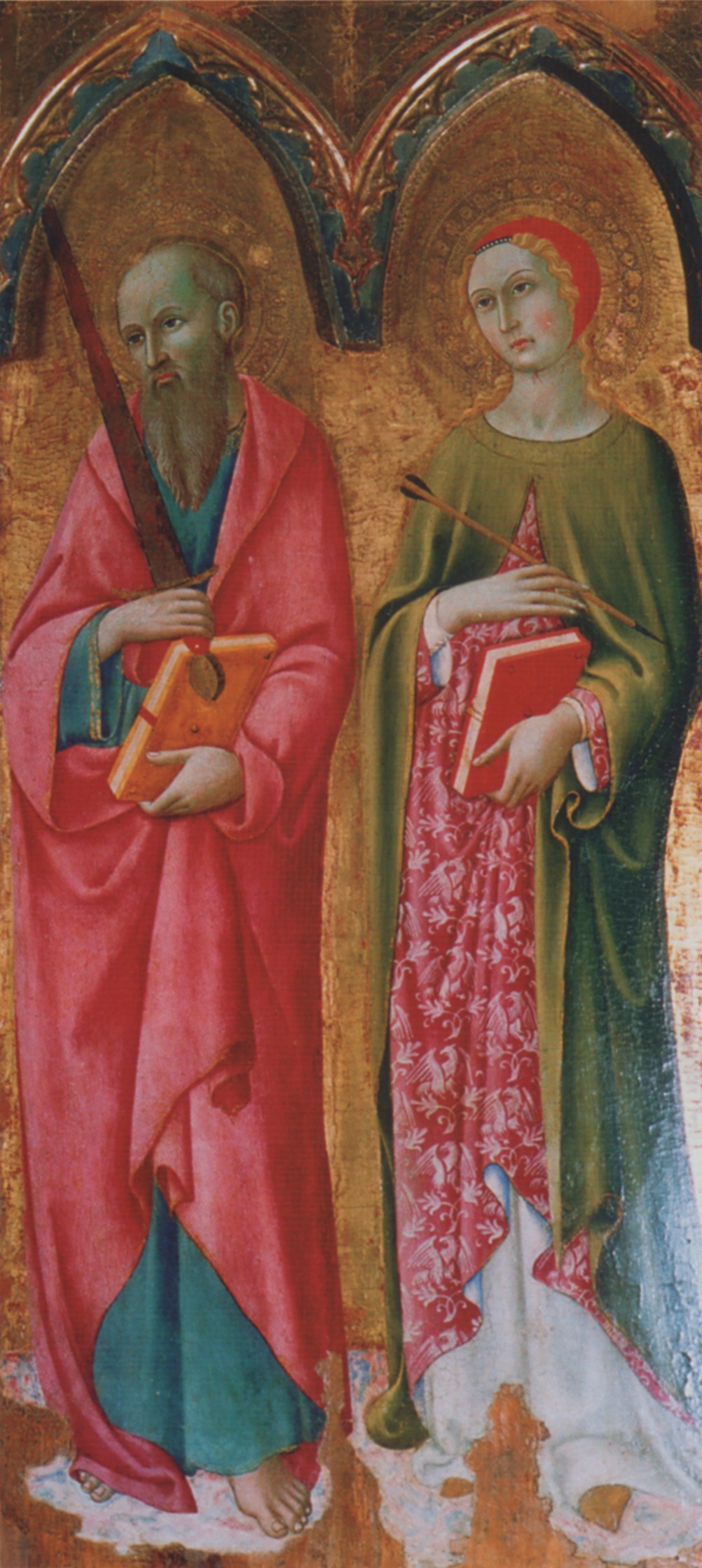
s) as depicted (at right; at left, St. Paul) by Sano di Pietro (d. 1481) in the lower right panel of an altarpiece in the basilica di Santa Caterina in Bolsena:

 https://www.heiligenlexikon.de/Fotos/Christina13.jpg

The altarpiece as a whole:
http://tinyurl.com/2u5nkw2
http://tinyurl.com/znb4a89

t) as depicted (martyrdom; at lower right, her mother) in a late fifteenth-century copy of the Legenda aurea in its French-language version by Jean de Vignay (c. 1480-1490; Paris, BnF, ms. Français 244, fol. 207v):
http://gallica.bnf.fr/ark:/12148/btv1b8442920n/f434.item.r=Fran%C3%A7ais%20244.zoom

u) as depicted (being baptized by Christ) in a late fifteenth-century Roman breviary (after 1482; Clermont-Ferrand, Bibliothèque du patrimoine, ms. 69, fol. 481v):
http://www.culture.gouv.fr/Wave/savimage/enlumine/irht4/IRHT_081340-p.jpg

v) as depicted (left margin at top) in a hand-colored woodcut in the Beloit College copy of Hartmann Schedel's late fifteenth-century Weltchronik (Nuremberg Chronicle; 1493) at fol. CXXVIIv:
https://www.beloit.edu/nuremberg/book/6th_age/left_page/31%20(Folio%20CXXVIIv).pdf

w) as portrayed in relief (martyrdom) by Benedetto Buglioni in three panels of the predella of his late fifteenth-century glazed terracotta tabernacle in the cappella del Santissimo Sacramento in the basilica di Santa Cristina at Bolsena:
1) in the burning oven:
http://tinyurl.com/gns42vb
2) tied to a tree:
http://tinyurl.com/jfw8yrd
2) shot with arrows:
http://tinyurl.com/hlu3t87

x) as portrayed in relief (at left, flanking the BVM and Christ Child; at right, St. George of Lydda) in a late fifteenth-century glazed terracotta sculpture (c. 1495; attributed to Giovanni della Robbia) in the lunette over the main portal of the basilica di Santa Cristina in Bolsena:

[vf3+della+robbia.JPG]


y) as portrayed in a late fifteenth- or early sixteenth-century recumbent sculpture of the saint in terracotta (?1496; ?c. 1503-1508; attributed to Benedetto Buglioni) surmounting her tomb in the Grotta di Santa Cristina in the basilica di Santa Cristina in Bolsena:
http://tinyurl.com/hg8fyec
http://www.comunebolsena.it/Img/da_visitare/sc_7_max.jpg
http://tinyurl.com/254dky5
http://tinyurl.com/2643a2n

z) as depicted (at left; at center, the BVM and Christ Child; at right, St. Lucy) by Giovanni de' Ferrarris da Mondovì in a late fifteenth-century fresco (1498) in the cappella di Santa Lucia in the basilica di Santa Cristina in Bolsena:
http://tinyurl.com/jloegd8
http://www.luoghimisteriosi.it/lazio/bolsena/bolsena%20(17)%20(Large).jpg

aa) as depicted (at right; at left, St. John the Evangelist) in an early sixteenth-century glass roundel of southern Netherlandic origin (c. 1500-1510) in the Metropolitan Museum of Art in New York:
http://www.metmuseum.org/art/collection/search/475652

bb) as depicted in an early sixteenth-century fresco (1506 or 1508), attributed to Giovanfrancesco d'Avanzarano, in the cappella del Santissimo Sacramento in the basilica di Santa Cristina at Bolsena:
http://www.heiligenlexikon.de/Fotos/Christina8.jpg
Detail view:
http://tinyurl.com/23tgpzl

cc) as depicted (central register at right, flanking the BVM and Christ Child) by Luca Signorelli in an early sixteenth-century panel painting of the Virgin with Saints (1515) in the National Gallery in London:
http://tinyurl.com/z2khp7q

 http://www.santacristinadibolsena.it/immagini/storia-santa-cristina/2013/2.jpg


dd) as depicted (at upper left in the wing at right) by Joos van Cleve the Elder in an early sixteenth-century altarpiece (1515) in the Wallraf-Richartz-Museum in Köln [ A fascinating image that will not fit into my format - well worth looking at  - Clever Boy ]:
http://tinyurl.com/jc4j7e8

ee) as depicted by the Master of Georgenberg Legend of St. Anthony in a panel of an early sixteenth-century altarpiece (c. 1515-1520) in the church of St. Margaret in Mlynica (Okres Poprad), Slovakia:

 http://tarvos.imareal.oeaw.ac.at/server/images/7012863.JPG


ff) as depicted (at left; at right, St. Oliva) by Tommaso de Vigilia (attrib.) in a later fifteenth-century remounted fresco (c. 1470; from the chiesa di Santa Maria in Risalaimi, a locality of Misilmeri [PA] in Sicily) in the Galleria regionale di Sicilia in Palermo:
https://misilmeriblog.files.wordpress.com/2009/02/affresco5.jpg


Back in 2008 another contributor to the group posted about the annual pageant of S. Cristina in Bolsena, which I assume originated as a medieval mystery play, as follows:


"At Bolsena Cristina's Passio is re-enacted annually (with hunky male torturers; in the developed legend she's said to have possessed great physical beauty). Views of one such pageant are at the foot of this page:
http://www.basilicasantacristina.it/html/culto.htm
And here are others:
http://www.eventiesagre.it/?id=1266
http://www.canino.info/inserti/tuscia/feste/santa_cristina/index.htm"


Now that really is a case of "Well, we don't do that at our church " and indeed might make even the most fervent supporters of reviving traditional paraliturgical practices think twice. Or perhaps not.

There is more about the history of this celebration at Santa Cristina - ItalyHeritage


Saturday, 23 April 2016

Celebrating St George


Today has been the feast of St George and as he is our national patron here in England a feastday I am always keen to observe.

One way I do so as an individual is by wearing on the day a lapel badge which is a reproduction of a medieval pilgrimage badge from St George's Windsor showing St George and the Dragon. I got this at the British Museum exhibition on Saints and relics the other year.

Yesterday evening I was able to attend at SS Gregory and Augustine an anticipated celebration of the feast with an EF Mass followed by veneration of a relic of St George.

This morning I was at the Oxford Oratory for their 10am Mass  and then this evening I was, in effect by chance, at  Blackfriars and attended their celebration of Mass. This was in a somewhat more traditional liturgical style than I have seen there hitherto - as a friend and I observed to each other more like the Oratory than we had seen there on other high days and holy days, and provided a dignified end to the celebrations. 


Image: Breviary.net 

St George, pray for us 


St George


John Dillon has posted on the Medieval Religion discussion group the following account of St George and his depiction in art:

We know nothing about the historical George.  Lydda (also Diospolis; later also Georgioupolis) in Palestine is now Lod in Israel.  George's cult seems to have arisen there at some time between the early fourth century and the early sixth.  This page on Lod has a good survey on George's cult there over the centuries:
http://198.62.75.1/www1/ofm/mad/discussion/086discuss.html
And the section on Lod on this page (toward bottom) has an illustrated introduction to the sequence of churches on the site:
http://198.62.75.1/www1/ofm/sbf/escurs/TS/02_TSen.html


Some period-pertinent images of St. George of Lydda:

a) as depicted (lower register at right, flanking the BVM and Christ Child; at left, St. Theodore of Amasea) in a sixth-century encaustic icon in the Holy Monastery of the God-trodden Mount Sinai in St. Catherine (South Sinai governorate):

 https://s-media-cache-ak0.pinimg.com/736x/1e/fc/58/1efc5804d1c63e5577b2603ed48a7071.jpg


b) as portrayed in relief (at left; at right, St. Eustachius / Eustathius) on a wing of the tenth-century Harbaville Triptych in the Musée du Louvre in Paris:

https://upload.wikimedia.org/wikipedia/commons/3/3e/Triptych_Harbaville_Louvre_OA3247_n1.jpg


c) as portrayed in relief in an eleventh-century steatite icon in the Vatopedi Monastery at Mount Athos:

 https://korenios.files.wordpress.com/2015/12/st-george-vatopedi-monastery-athos-greece-11cad-v2.jpg?w=410&h=566


d) as depicted in the eleventh-century frescoes of the church of Agios Georgios Diasoritis near Chalki on Naxos:
http://www.azalas.de/bilder/2012-02/P1200833-1_450

e) as depicted in an earlier twelfth-century Novgorod School icon (1130s-1140s) in the State Tretyakov Gallery in Moscow:
http://tinyurl.com/2byzm9y
NB: Three pages of expandable views of many other twelfth- to sixteenth-century Russian icons of George begin here:
http://tinyurl.com/2wcl5cc

f) as portrayed in high relief (slaying the dragon) by Nicholaus in the lunette of the central portal of the earlier twelfth-century facade (1135) of the the basilica cattedrale di San Giorgio in Ferrara:

 https://upload.wikimedia.org/wikipedia/commons/a/a8/Ferrara,_duomo,_nicholaus,_lunetta_04.JPG


g) as depicted (in the roundel at top centre) in the mid-twelfth-century mosaics in the church of Santa Maria dell'Ammiraglio (a.k.a. chiesa della Martorana) in Palermo:
http://tinyurl.com/23oba3r

h) as depicted (slaying the dragon) in the later twelfth-century frescoes (betw. 1176 and 1200) in the church of St. George in Staraya Ladoga in Russia's Leningrad oblast:
http://www.icon-art.info/hires.php?lng=en&type=1&id=1191

i) as depicted in a probably late twelfth-century votive painting, funded by a horse tamer, in the narthex of the church of the Panagia Phorbiotissa at Asinou (Nicosia prefecture) in the Republic of Cyprus:

 https://upload.wikimedia.org/wikipedia/commons/d/d0/Asinou_-_Kirche_Narthex_2_St.Georg.jpg

NB: This image has also been dated to the repainting of the narthex in 1332/1333.

j) as depicted on a seemingly earlier to mid-thirteenth-century map of part of the Atlantic Ocean and the Mediterranean (c.1234-1266; Lyon, Bibliothèque municipale, ms. 175, sheet 4:
http://www.enluminures.culture.fr/Wave/savimage/enlumine/irht8/IRHT_125804-p.jpg

k) as depicted (the torture of the wheel of swords) in a later thirteenth-century Cistercian psalter (c. 1260; Besançon, Bibliothèques municipales, ms. 54, fol. 20r):

 http://www.enluminures.culture.fr/Wave/savimage/enlumine/irht5/IRHT_083249-p.jpg


l) as twice depicted in the later thirteenth-century frescoes (either c.1263-1270 or slightly later) in the chapel of St. George in the monastery church of the Holy Trinity at Sopoćani (Raška dist.) in Serbia:
1) martyrdom:
http://tinyurl.com/ykdjchv
2) disarticulation of his relics:
http://tinyurl.com/ygqs9s5

m) as depicted in the later thirteenth-century frescoes (either c.1263-1270 or slightly later) in the chapel of St. Symeon Nemanja in the monastery church of the Holy Trinity at Sopoćani (Raška dist.) in Serbia:
http://tinyurl.com/yf8u46h
Detail view:
http://tinyurl.com/ybxkrac

n) as depicted (the torture of the wheel of swords) in a late thirteenth-century copy of French origin of the Legenda aurea (San Marino, CA, Huntington Library, ms. HM 3027, fol. 49r):
http://digitalassets.lib.berkeley.edu/ds/huntington/images//000867A.jpg

o) as depicted by Eutychios and Michael Astrapas in the late thirteenth-century frescoes (c.1295) in the church of the Peribleptos (now Sv. Kliment Ohridski) in Ohrid:

 https://upload.wikimedia.org/wikipedia/commons/e/e7/Paintings_in_the_Church_of_the_Theotokos_Peribleptos_of_Ohrid_053.jpg

Detail view:
http://tinyurl.com/j3vtvvd

p) as depicted (with the Princess of Trebizond) in a fourteenth-century wall painting in the church of All Saints in Little Kimble (Bucks):

 St. George & the Princess, Little Kimble (100KB)
The link has more details about the painting

q) as depicted (upper register; lower register: Sts. John of Damascus and Ephraem the Syrian) in an earlier fourteenth-century panel painting in the Holy Monastery of the God-trodden Mount Sinai in St. Catherine (South Sinai governorate):
http://tinyurl.com/5ctk4u

r) as depicted in the earlier fourteenth-century frescoes (between 1313 and 1318; conservation work in 1968) by Michael Astrapas and Eutychios in the church of St. George at Staro Nagoričane in the Former Yugoslav Republic of Macedonia:

 https://upload.wikimedia.org/wikipedia/commons/f/f0/Frescos_in_St._George%27s_Church_%28Staro_Nagoricane%29_0122.jpg

Detail view:
http://tinyurl.com/hy5vylh

s) as depicted in the earlier fourteenth-century frescoes (between 1315 and 1321) in the parekklesion of the Chora church in Istanbul:
https://www.flickr.com/photos/21711359@N08/3923046478/lightbox/
Detail view:
http://tinyurl.com/j3jww5f

t) as depicted (two scenes: the torture of the wheel of swords; his execution) in an earlier fourteenth-century copy of the Legenda aurea in its French-language version by Jean de Vignay (c.1326-1350; Paris, BnF, ms. Français 185, fol. 90r):
http://tinyurl.com/goymvm9

u) as depicted (at left: casting down idols; at right: slaying the dragon) in the earlier fourteenth-century frescoes (between 1335 and 1350) in the chapel of St. George in the church of the Holy Ascension at the Visoki Dečani monastery near Peć in, depending on one's view of recent events, the Republic of Kosovo or Serbia's Kosovo province:


Two pages of expandable views of the cycle of St. George in this chapel start here:
http://tinyurl.com/jjw2xrq

v) as depicted by Vitale da Bologna in a mid-fourteenth-century fresco in the Pinacoteca nazionale di Bologna:

 http://www.wga.hu/art/v/vitale/stgeorge.jpg


w) as depicted (slaying the dragon) in a mid-fourteenth-century copy, from the workshop of Richard and Jeanne de Montbaston, of the Legenda aurea in its French-language version by Jean de Vignay (1348; Paris, BnF, ms. Français 241, fol. 101v):
http://tinyurl.com/zm73cs3

x) as depicted (slaying the dragon, with a capable assist by his intrepid steed) by Giovanni di Benedetto and workshop in a late fourteenth-century Franciscan missal of Milanese origin (ca. 1385-1390; Paris, BnF, ms. Latin 757, fol. 327v):
http://gallica.bnf.fr/ark:/12148/btv1b8470209d/f658.item.r=.zoom

y) as depicted (slaying the dragon) by the Master of 1388 (attrib.) in the later fourteenth-century frescoes in the chiesa di San Giorgio in Lemine at Almenno San Salvatore (BG) in Lombardy:
 https://upload.wikimedia.org/wikipedia/commons/6/68/Affresco_-_%22San_Giorgio_e_la_Principessa%22,_attribuito_al_%22Maestro_del_1388%22.jpg

z) as depicted (slaying the dragon) in a late fourteenth-century copy of the Legenda aurea in its French-language version by Jean de Vignay (1382; London, BL, Royal MS 19 B XVII, fol. 109r):

 George


aa) as depicted (slaying the dragon) in a panel of an earlier fifteenth-century altarpiece (c. 1420) from Valencia in the Victoria and Albert Museum in London:
http://tinyurl.com/yfgl2a4

bb) as depicted (hearing the prayers of the Duke of Bedford) in the earlier fifteenth-century Bedford Hours (c. 1423; London, BL, Add. MS 18850, fol. 256v):
http://www.bl.uk/onlinegallery/sacredtexts/images/zoomify/bedfordzoom.html

cc) as depicted (with the princess of Trebizond) in an earlier fifteenth-century fresco (late 1430s), variously ascribed to Pisanello or to his collaborator Gentile da Fabriano, in the cappella Pellegrini in Verona's chiesa di Sant'Anastasia:

https://upload.wikimedia.org/wikipedia/commons/e/e9/Pisanello_-_St._George_Liberating_the_Princess_of_Trebizond_-_Pellegrini-Chapel_in_Saint_Anastasia,_Verona.jpg

Numerous detail views are accessible from here:
http://www.artcyclopedia.com/commons/pisanello.html

dd) as depicted (slaying the dragon) by the Master of Catherine of Cleves in an earlier fifteenth-century prayer book from Utrecht (1438; Den Haag, Museum Meermanno, cod. 10 F 1, fol. 210v):
http://manuscripts.kb.nl/zoom/BYVANCKB%3Amimi_mmw_10e1%3A082v_min

ee) as depicted (slaying the dragon) by Jost Haller in a detail of a painting from his mid-fifteenth-century Tempelhof Altarpiece (c.1445) in the Musée Unterlinden in Colmar:

 https://upload.wikimedia.org/wikipedia/commons/c/c4/Jost_Haller_-_Saint_George_slaying_the_dragon%2C_Unterlinden_Museum%2C_Colmar.jpg

The painting as a whole:

 http://www.mishanita.ru/data/images/Alsace_2010/Tempelhof-Altar.jpg


ff) as depicted in grisaille (slaying the dragon) by Jean le Tavernier in the mid-fifteenth-century Hours of Philip of Burgundy (c. 1451-1460; Den Haag, KB, ms. 76 F 2, fol. 258v):
http://manuscripts.kb.nl/zoom/BYVANCKB%3Amimi_76f2%3A258v_min

gg) as depicted (slaying the dragon) by Carlo Crivelli in a panel painting from his dismembered later fifteenth-century Porta San Giorgio altarpiece (1470) in the Isabella Stewart Gardner Museum in Boston:

 http://www.gardnermuseum.org/FILE/5917.jpg?w=800&h=750


hh) as depicted (at center, slaying the dragon) in a later fifteenth-century glass window (1470) in the St. Laurentiuskirche in Usingen (Lkr. Hochtaunuskreis) in Hessen:

 http://www.tz-usingen.de/storage/pic/importe/fnpartikel/rhein-main/usingen/894706_1_GlasfensterArnoldshain_2_4c.jpg?version=1421875238

Detail view:
http://tinyurl.com/zhf94jb

ii) as depicted (slaying the dragon) in a late fifteenth-century copy (c. 1480-1490) of the Legenda aurea in its French-language version by Jean de Vignay (Paris, BnF, ms. Français 244, fol. 125v):


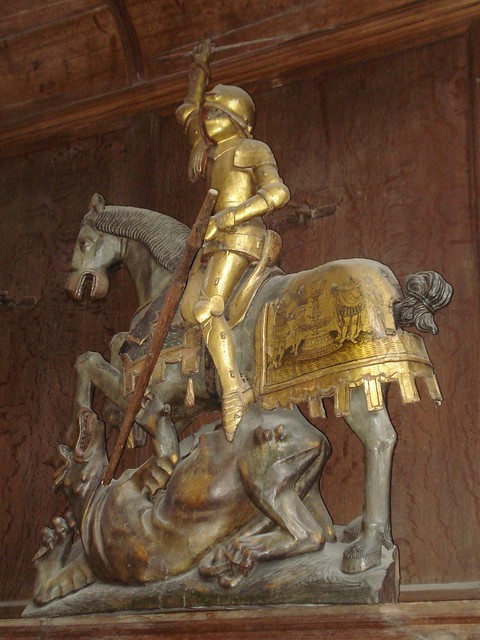
jj) as portrayed (slaying the dragon) by Jan Mertens in a late fifteenth-century partly gilt wooden sculpture (1486) in the Sint-Leonarduskerk in Zoutleeuw (Vlaams-Brabant):

 
Detail view:
http://www.flickr.com/photos/roelipilami/2651856675/

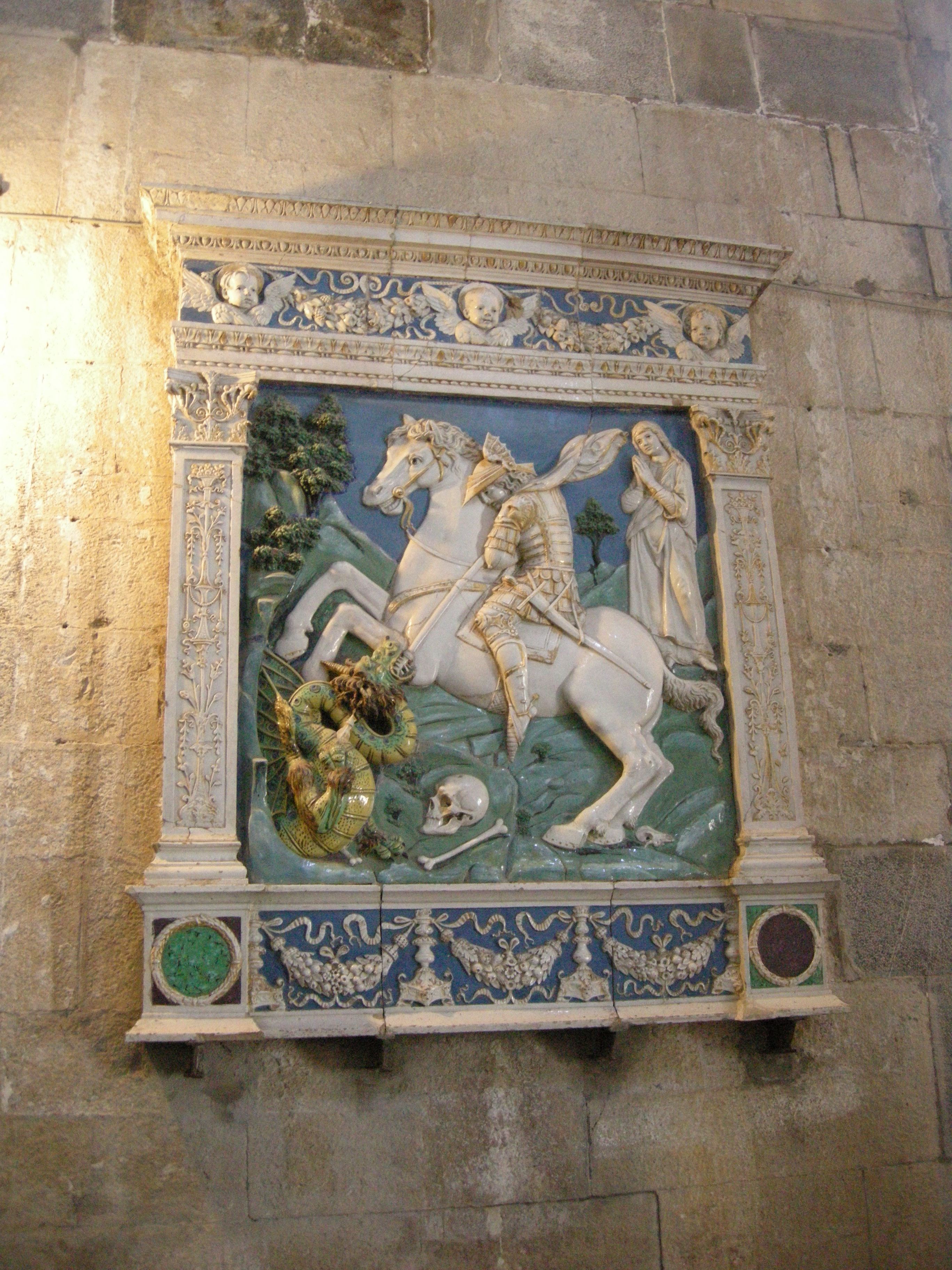
kk) as portrayed by Andrea della Robbia in a late fifteenth-century polychrome ceramic relief (1495) in the pieve di San Giorgio at Brancoli (LU) in Tuscany:

 https://upload.wikimedia.org/wikipedia/commons/f/fa/Pieve_di_brancoli%2C_andrea_della_robbia%2C_san_giorgio%2C_la_principessa_e_il_drago_01.JPG

ll) as depicted (slaying the dragon) in the early sixteenth-century fresco cycle devoted to him (1507) in the earlier fifteenth-century Nibe kirke in Nibe (Aalborg Kommune) in Nordjylland:

 https://upload.wikimedia.org/wikipedia/commons/7/74/St_Georg_and_dragon.jpg

The remainder of the cycle:
http://tinyurl.com/28h6v9n
http://tinyurl.com/28mdc7x

mm) as depicted (at right; at left, St. Eustachius / Eustathius) by Hans Süss of Kulmbach in an early sixteenth-century pen-and-ink drawing (c. 1511) in the Metropolitan Museum of Art, New York:
http://www.metmuseum.org/collection/the-collection-online/search/376653

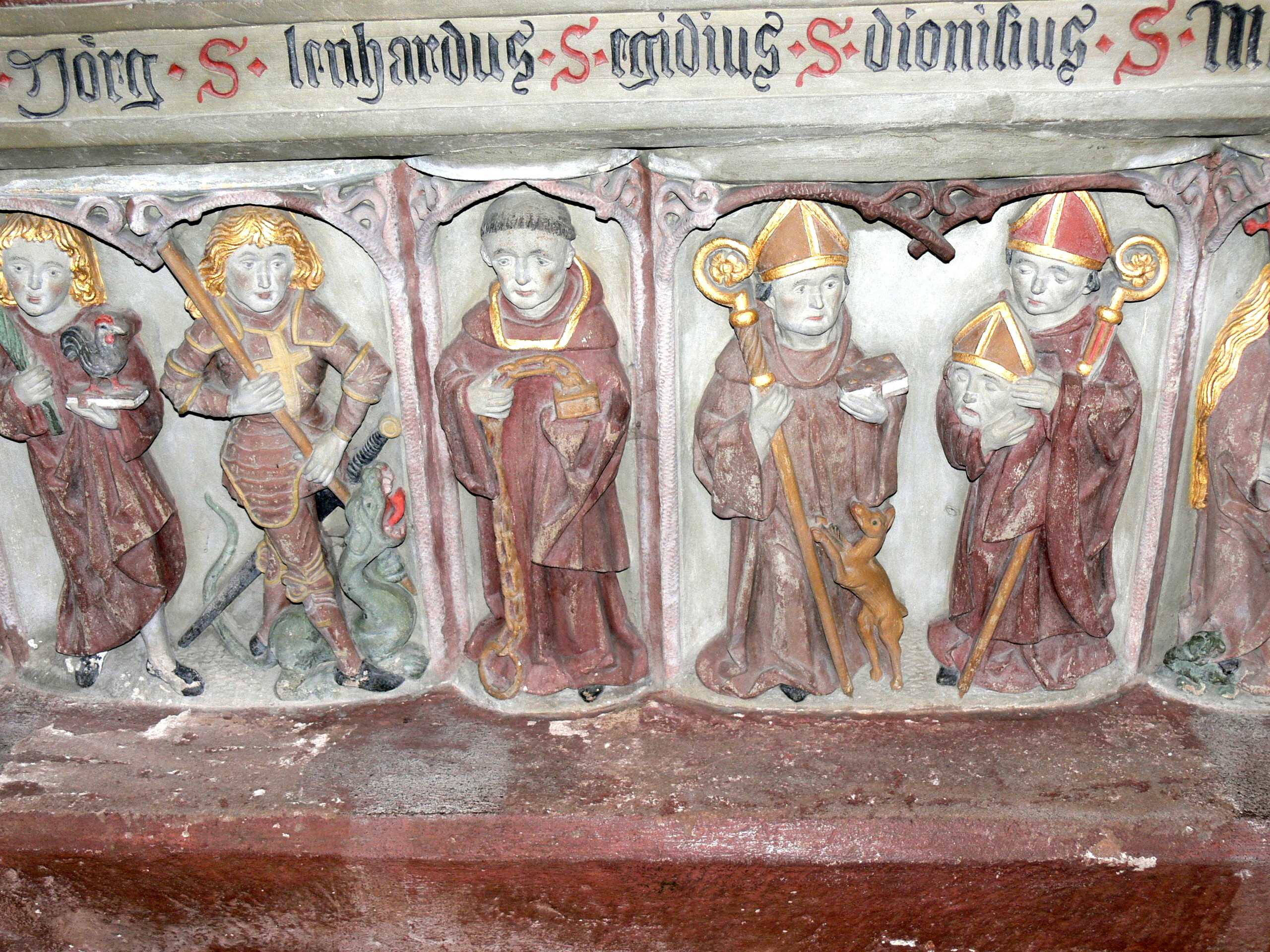
nn) as portrayed in relief (second from left) on the early sixteenth-century tomb of the Kurfürstin Anna (1512) in the Münster St. Marien und Jakobus in Heilsbronn (Lkr. Ansbach) in Bavaria:

 https://upload.wikimedia.org/wikipedia/commons/f/f7/Heilsbronn_M%C3%BCnster_-_Grab_der_Markgr%C3%A4fin_Anna_04.jpg


Madeleine Gray added these notes and images of the wall painting of St George at Llancarfon in south Wales:

There are photos on http://www.walesonline.co.uk/lifestyle/nostalgia/welsh-history-month-lost-treasures-7852432 and Ellie Pridgeon;s wallpaintings web site at https://medievalwallpaintings.wordpress.com/2013/12/26/project-update-st-cadocs-church-llancarfan-vale-of-glamorgan/ ; the church web site leads to some rather out of date interpretative material at http://www.stcadocs.org.uk/en/home.html (conservation has uncovered a lot more since that photo was talen): and there's a short film with rather basic commentary at http://www.bbc.co.uk
/news/magazine-25214557

Rev.Gordon Plumb added these images of English medieval stained glass depictions of St George:

Brinsop, St George, Herefordshire, east window, 2b, St George, 1st half 14thc:

Gloucester Cathedral, East window, figure on right, c.1350-60:

Long Sutton, St Mary, Lincolnshire, sVI, 2b-3b, c.1380-90:

Trull, All Saints, Somerset, sII, 2c, 15thc:

Wells Cathedral,NII, 2b-3b:

York Minster, nXVII, 2a, 15thc.:

Stanford-on-Avon, St Nicholas, Northamptonshire, sVI, 2a, 15thc.:

Oxford, Merton College, West window, 15thc.:

St Winnow, St Winnow, Cornwall, sII, 5a-7a, 15thc.:

York Minster, nXX, lower part of George and dragon, 15thc.:

Fairford, St Mary, Gloucestershire, nVIII, B2 c.1500-1515:

Barton upon Humber, St Peter (in store with English Heritage in York):

Bowness-on-Windermere, St Martin, Cumbria, East window, 2b-4b, 15thc.:

Doddiscombsleigh, St Michael, Devon, nIV, 2b, 15thc.:

Wednesday, 20 January 2016

St Sebastian


Being based in Oxford it seems only appropriate when offered by John Dillon via the Medieval Religion discussion group a series of images of St Sebastian to share them with readers on this the feast of the name saint of Lord Sebastian Flyte, the second son of the late Marquess of Marchmain.
Some of the later paintings reflect the choices made in the Italian renaissance by artists and patrons to depict the almost nude male form, as opposed to earlier traditions of representing St Sebastian, and do have, dare I suggest it, something in them of homoerotic sado-masochism - you can't say the Clever Boy fails to cater for all tastes amongst his readers.

Here is John's selection together with his introductory note:


The Roman martyr Sebastian (d. 3d cent.?) is first documented in the Depositio martyrum of the Chronographer of 354, where he is entered under today as a martyr of the Via Appia.  According to St. Ambrose of Milan, Sebastian was a native of that city who was martyred at Rome.  His legendary Passio (BHL 7543; ineptly ascribed to Ambrose) is our earliest source for this saint's frequently depicted attempted execution by arrows, of which so many pierced him that -- still according to the Passio -- he came to resemble a hedgehog.  The same account -- which is set in the the persecution of Diocletian and Maximian and which previously had detailed his support of the twins Mark and Marcellian and many others --  then gives a rapidly healed Sebastian a final colloquy with Diocletian after which the saint is clubbed to death in the Circus and his body is dumped into a nearby sewer.  Instructed by Sebastian in a vision, a Christian matron named Lucina retrieves his body and buries it at a location in the catacombs near the remains of the apostles (Peter and Paul, of course).  When the persecutions have ended Lucina converts her home into a church and gives it to the church of Rome.  Thus far the Passio.  Lucina's church is of course the titulus Lucinae, the predecessor of today's San Lorenzo in Lucina. The burial site specified in the Passio is that of Sebastian's martyrial church on the Via Appia Antica, after several rebuildings over the centuries today's basilica di San Sebastiano ad Catacumbas (or San Sebastiano f. l. M.).


Some period-pertinent images of St. Sebastian of Rome:

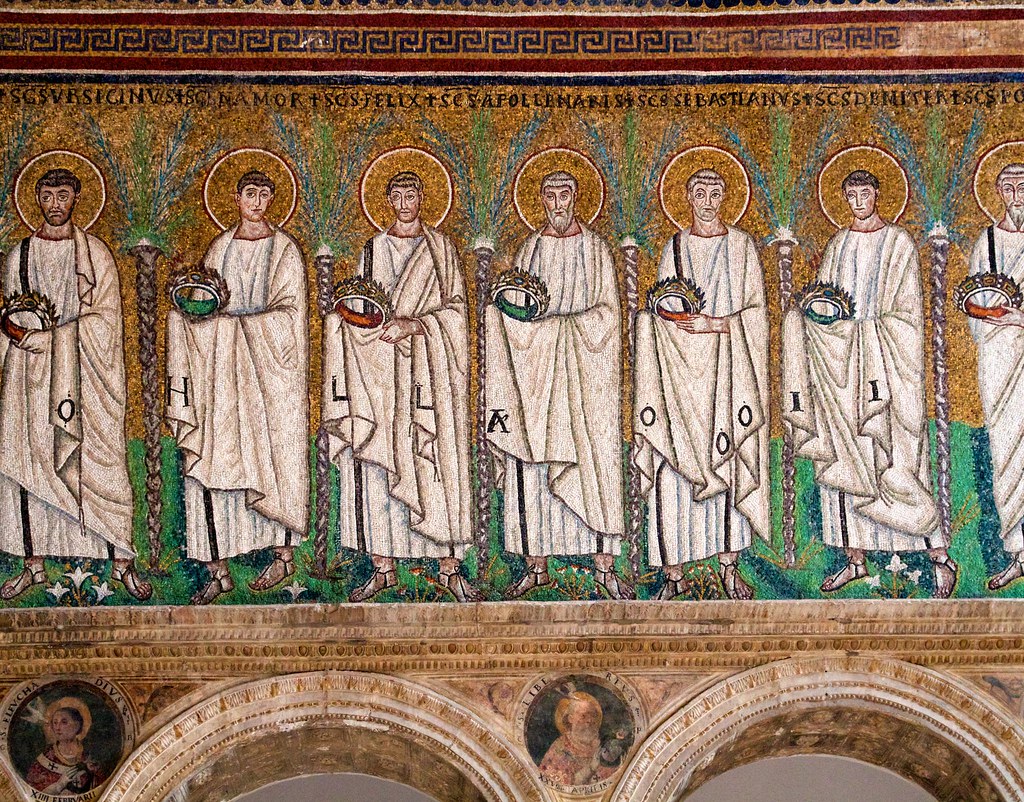
a) as depicted (third from right) in the heavily restored, later sixth-century procession of male martyrs (c. 561) in the nave of Ravenna's basilica di Sant'Apollinare Nuovo:

 
http://tinyurl.com/7lebx8n

b) as depicted in a probably late seventh-century mosaic portrait in Rome's basilica di San Pietro in Vincoli:


http://web.archive.org/web/20080227232948/http://bode.diee.unica.it/~giua/SEBASTIAN/PICS/vincoli.jpg


c) as depicted (upper register, martyrdom; lower register, St. Blasius / Blaise) in a later twelfth-century breviary for the canonesses of Seckau (Graz, UB, cod. 832, fol. 18r):
http://tarvos.imareal.oeaw.ac.at/server/images/7009800.JPG

d) as depicted (martyrdom) in one of four panels of a full-page illumination in the late twelfth-century so-called Bible of Saint Bertin (c. 1190-1200; Den Haag, KB, ms. 76 F 5, fol. 35v, sc. 1B):
http://manuscripts.kb.nl/zoom/BYVANCKB%3Amimi_76f5%3A035v_min_b1

e) as depicted (martyrdom) in an earlier thirteenth-century collection of saint's lives in their French-language translation by Wauchier de Denain (between 1226 and 1250; London, BL, Royal 20 D VI, fol. 48v):
http://www.bl.uk/catalogues/illuminatedmanuscripts/ILLUMIN.ASP?Size=mid&IllID=48231

f) as depicted (at left; St. Mary Magdalene at right) in a mid-thirteenth-century glass window (c. 1250-1260) in the west choir of Naumburg's Dom St. Peter und St. Paul:

 http://www.wga.hu/art/zgothic/stained/13c/12g_1250.jpg


g) as depicted (martyrdom) in a later thirteenth-century Cistercian psalter of upper Rhine origin (c. 1260; Besançon, Bibliothèques municipales, ms. 54, fol. 15r):
http://www.enluminures.culture.fr/Wave/savimage/enlumine/irht5/IRHT_083237-p.jpg

h) as depicted (martyrdom) in the later thirteenth-century frescoes (1278 or 1279) of Rome's chiesa di San Lorenzo in Palatio ad Sancta Sanctorum:
https://www.pemptousia.gr/wp-content/uploads/2014/12/ag.sebastianos22.jpg
A different interpretation (the BVM and St. John disporting themselves at archery?):
http://www.agefotostock.com/age/en/Stock-Images/Rights-Managed/DAE-11285236

i) as depicted (martyrdom) in a late thirteenth-century copy of French origin of the Legenda aurea (San Marino, CA, Huntington Library, ms. HM 3027, fol. 22v):
http://digitalassets.lib.berkeley.edu/ds/huntington/images//000969A.jpg

j) as depicted (at far right, martyrdom; at centre, Sts. Mark and Marcellian) in an earlier fourteenth-century copy of books 9-16 of Vincent of Beauvais' Speculum historiale in its French-language version by Jean de Vignay (c. 1335; Paris, BnF, ms. Arsenal 5080, fol. 218v):
http://gallica.bnf.fr/ark:/12148/btv1b7100627v/f442.item.zoom

k) as depicted (perhaps; the identifying inscription appears to have been re-painted) in the earlier fourteenth-century frescoes (between 1335 and 1350) in the church of the Holy Ascension in the Visoki Dečani monastery near Peć in, depending upon one's view of the matter, either the Republic of Kosovo or Serbia's province of Kosovo and Metohija:
http://tinyurl.com/6uubsp6

l) as depicted by Nicolò Semitecolo in several later fourteenth-century panel paintings (1367) in the Museo diocesano in Padua:
1) supporting Sts. Mark and Marcellian before the emperors:

 http://www.wga.hu/art/s/semiteco/2christi.jpg

2) martyrdom by arrows:

 https://upload.wikimedia.org/wikipedia/commons/6/63/Niccolo_Semitecolo._Sebastiano_trafitto_dalle_frecce._1367._53x60cm._Padova%2C_Museo_Diocesano.jpg

3) martyrdom by clubbing; his body dumped in a sewer:

https://upload.wikimedia.org/wikipedia/commons/f/f8/B_Nicol%C3%B2_Semitecolo._St_Sebastian_Beaten_with_Sticks._1367%2C_Padova%2C_Museo_Diocesano.jpg

4) entombment:
 https://upload.wikimedia.org/wikipedia/commons/4/4c/Nicol%C3%B2_Semitecolo%2C_Deposizione_del_corpo_di_San_Sebastiano_1367%2865%2C5x70cm%29Padova%2C_Museo_Diocesano.jpg


The Clever Boy would ad dthat these four paintings have some lovely fourteenth century details of interest in themselves - click on the link to see them in alarger format.

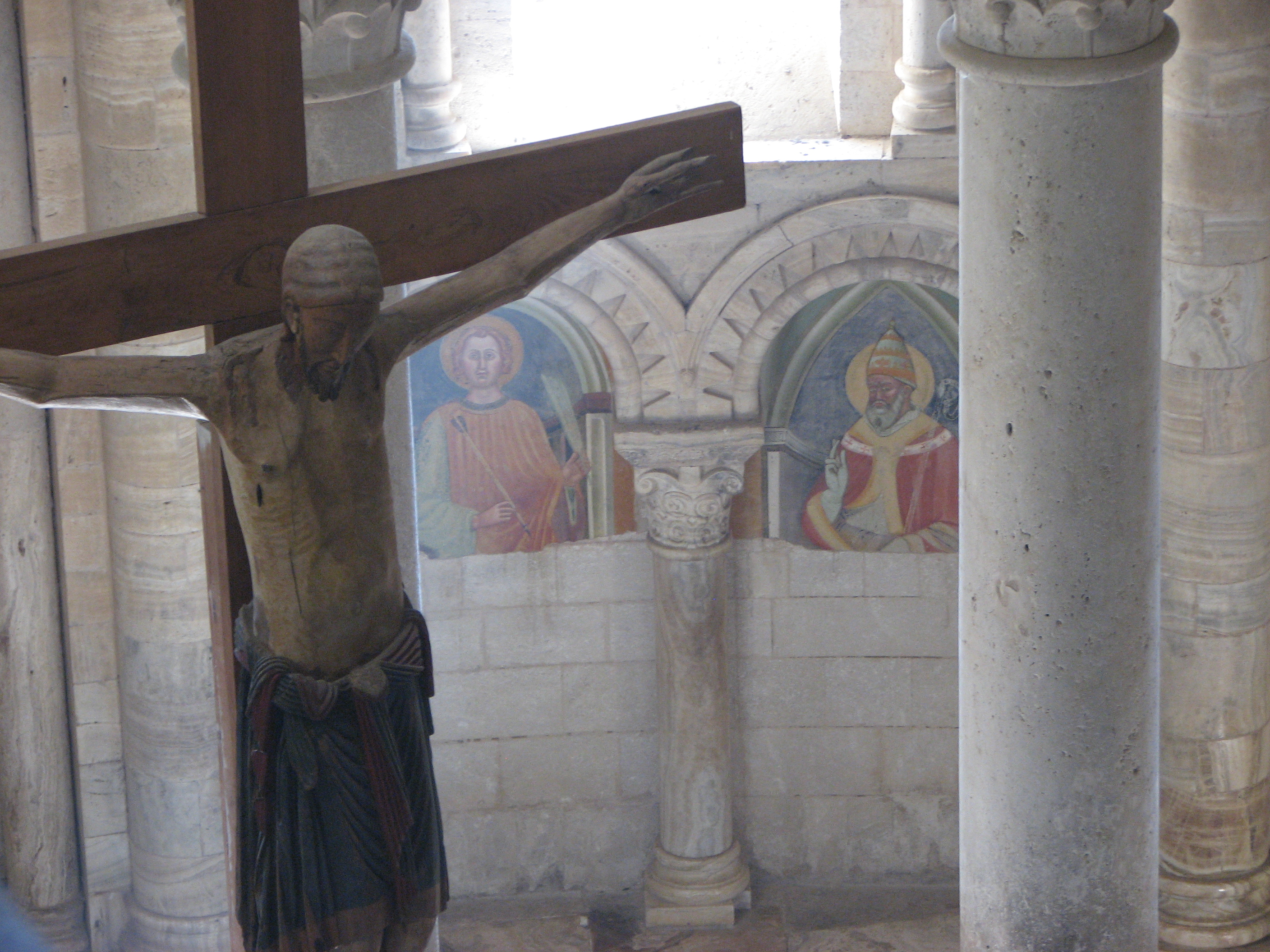
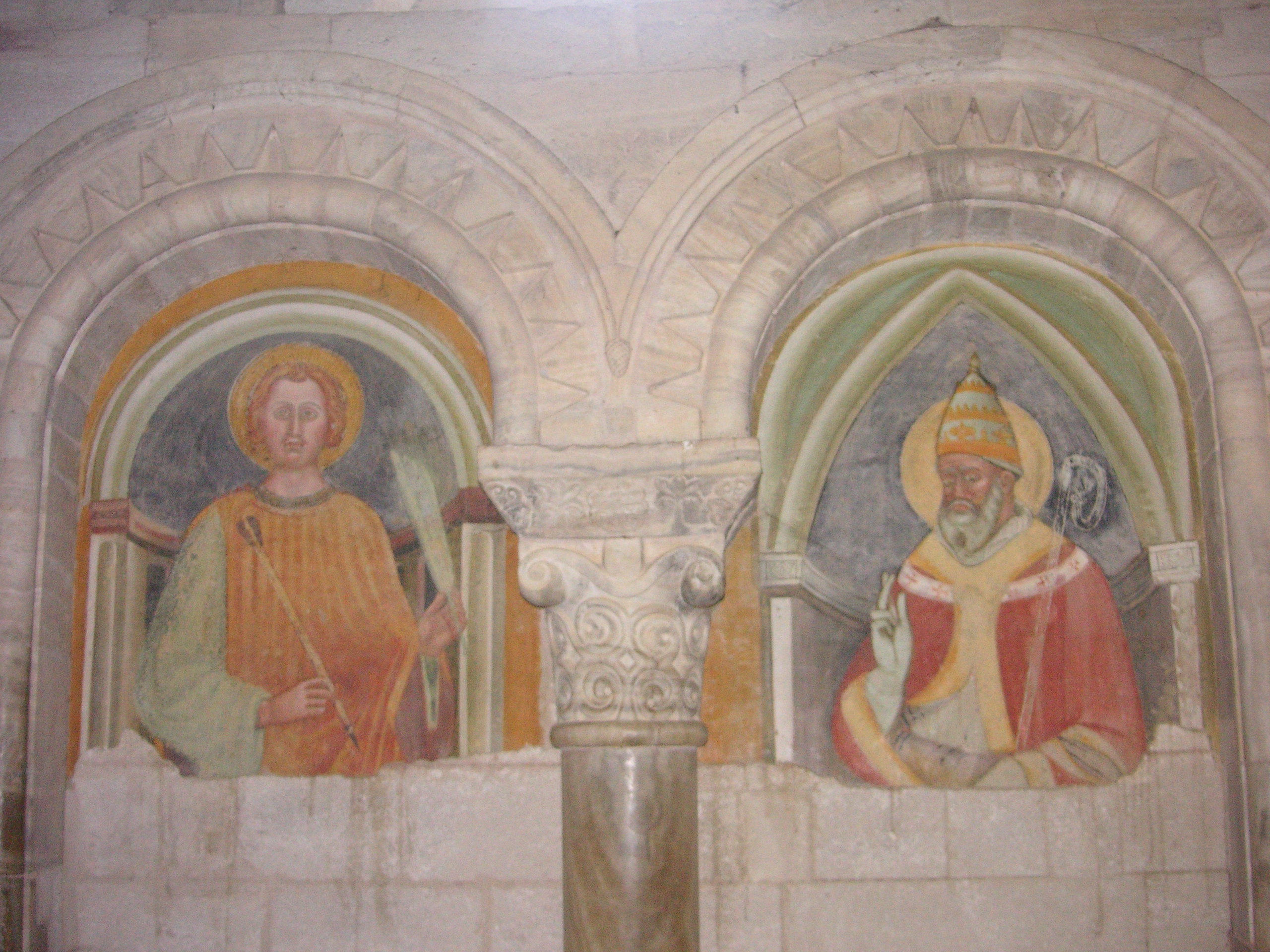
m) as depicted (at left; at right, a sainted pope) in a pair of late fourteenth- or fifteenth-century frescoes in the ambulatory of the abbey church of Sant'Antimo at Montalcino (SI) in Tuscany (the abbey claimed to possess relics of Sebastian given at its foundation in 781 by Pope Hadrian I, who supposedly had received them from Charlemagne):

 https://upload.wikimedia.org/wikipedia/commons/e/e2/Abbazia_di_Sant%27Antimo_-_53_-_Il_crocifisso_e_gli_affreschi_visti_dal_matroneo.jpg

https://upload.wikimedia.org/wikipedia/commons/4/46/Sant%27Antimo_affreschi.JPG


n) as depicted by Taddeo di Bartolo (martyrdom) in a remounted early fifteenth-century fresco (ca. 1400-1410) in Naples' Museo nazionale di Capodimonte:

 https://upload.wikimedia.org/wikipedia/commons/9/98/Taddeo_di_Bartolo_-_Saint_Sebastian.jpg

o) as depicted (martyrdom) in the Suffrages of the earlier to mid-fifteenth-century Hours of Françoise de Dinan (ca. 1435-1450; a.k.a. Hours of Catherine de Rohan and of Françoise de Dinan; Rennes, Bibliothèque de Rennes Métropole, ms. 34bis [pt. 2 of ms. 15942], fol. 87r):
http://www.tablettes-rennaises.fr/app/photopro.sk/rennes/detail?docid=6834#sessionhistory-ready
http://tinyurl.com/jyek5yp

p) as depicted by the Master of the Bodensee (second from left, after St. Anthony of Egypt, and with St George and St Ursula) in an earlier fifteenth-century panel painting in the Staatliche Kunsthalle Karlsruhe:
http://www.ipernity.com/doc/1654608/38630734/

q) as portrayed in a mid-fifteenth-century head reliquary (1450) in the Pfarrkirche St. Sebastian in Ebersberg (Lkr. Ebersberg) in Bavaria:


File:Relic of St. Sebastian 01.JPG

There is anothe rpicture of the reliquary at 
 https://de.wikipedia.org/wiki/Datei:Relic_of_St._Sebastian_02.JPG

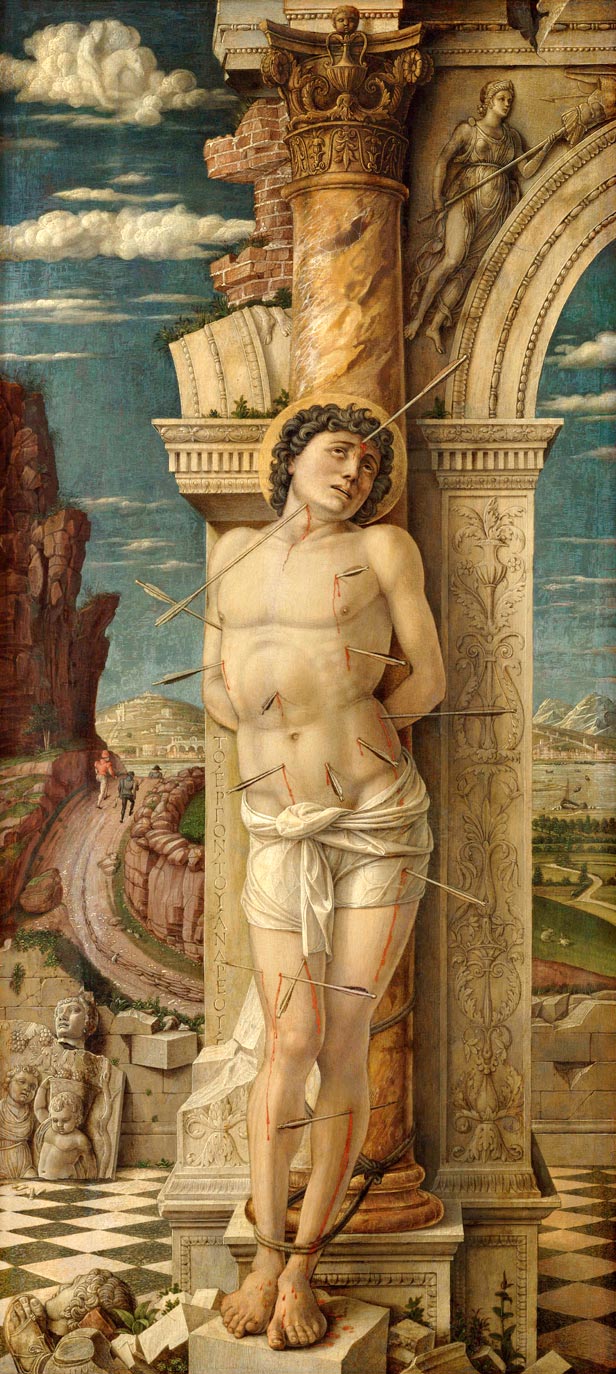
r) as depicted by Andrea Mantegna (martyrdom) in a mid-fifteenth-century panel painting (later 1450s) in the Kunsthistorische Museum, Vienna:


https://upload.wikimedia.org/wikipedia/commons/4/4d/Andrea_Mantegna_089.jpg


s) as depicted in a later fifteenth-century fresco in the left apsidal chapel of the crypt of the chiesa di San Ponziano in Spoleto:
https://www.flickr.com/photos/hen-magonza/9124891102/

t) as depicted by Sandro Botticelli (martyrdom) in a later fifteenth-century panel painting (1473) in the Gemäldegalerie, Berlin:

 https://upload.wikimedia.org/wikipedia/commons/4/4c/Sandro_Botticelli_054.jpg


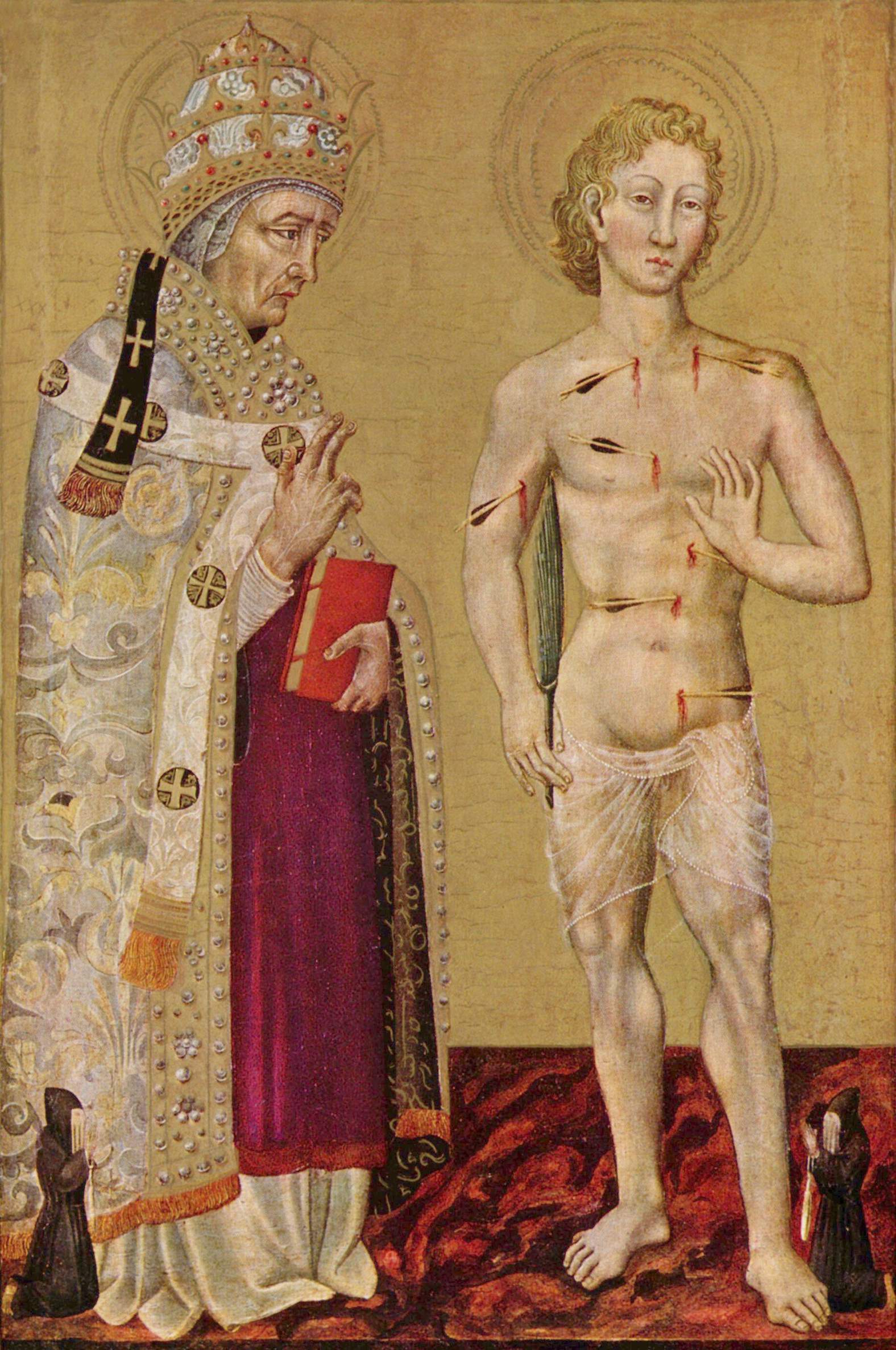
u) as depicted (at right, martyrdom; at left, pope St. Fabian, whose feast day also falls today) in a later fifteenth-century panel painting (c. 1475), attributed to Giovanni di Paolo, in the National Gallery, London:
1) Before cleaning in the 1970s (the National Gallery still calls this cleaning 'recent'):

 https://upload.wikimedia.org/wikipedia/commons/f/fa/Giovanni_di_Paolo_002.jpg


2) After cleaning (the second image is clearer but the colours are off) :
http://tinyurl.com/yczp53u
http://tinyurl.com/ycz7ccx

The Clever Boy will add that the National Gallery website states that: Recent cleaning revealed the original upraised position of Sebastian's hand and forearm and some twenty arrows piercing his body, most of which had been painted out.

At the bottom in each corner is a kneeling Brother of the Confraternity of the Misericordia, a lay brotherhood which was devoted to the Seven Works of Mercy. The brothers, dressed in black with white veils, are holding what may be spoons used for collecting alms.

This is a complete votive picture - one promised and offered in thanks for the favourable answer to a prayer - and is probably one of Giovanni di Paolo's late works.

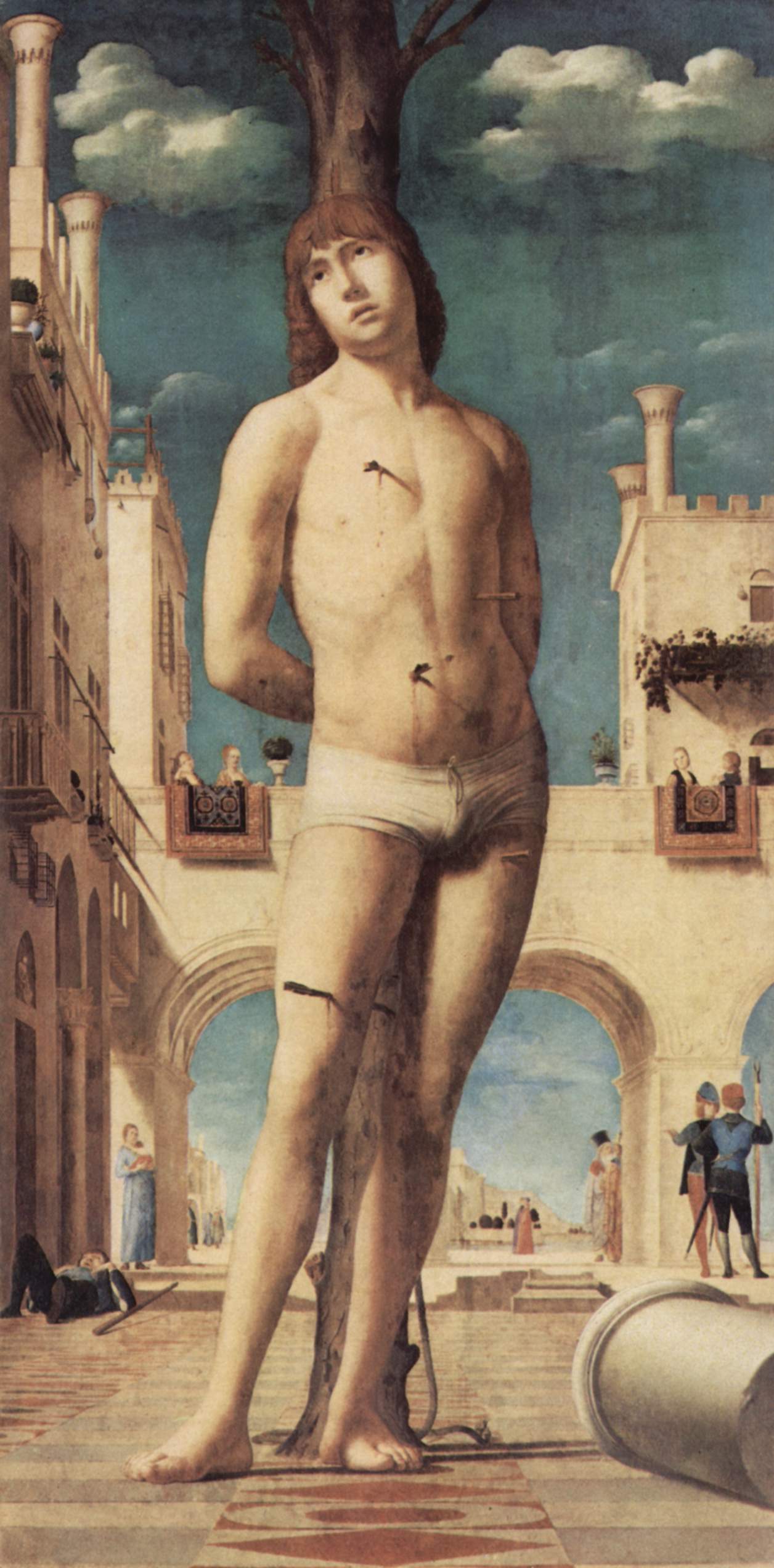
v) as depicted by Antonello da Messina (martyrdom) in a later fifteenth-century panel painting (c. 1476) in the Gemäldegalerie, Dresden:


https://upload.wikimedia.org/wikipedia/commons/4/47/Antonello_da_Messina_018.jpg


w) as depicted by Andrea Mantegna (martyrdom) in a later fifteenth-century panel painting (c. 1480) in the Musée du Louvre, Paris:


https://upload.wikimedia.org/wikipedia/commons/c/c1/Andrea_Mantegna_088.jpg


x) as depicted (martyrdom) in the later fifteenth-century Hours of Dionora of Urbino (c. 1480; London, BL, MS Yates Thompson 7, fol. 93v):
http://www.bl.uk/catalogues/illuminatedmanuscripts/ILLUMIN.ASP?Size=mid&IllID=6000

y) as depicted by Giovanni Baleison (martyrdom) in a late fifteenth-century fresco by Giovanni Baleison in the Chapelle Saint-Sebastien, Saint-Étienne-de-Tinée (Alpes-Maritimes):
http://www.culture.gouv.fr/culture/medieval/en/b036.htm

z) as depicted (at left; at right, St. Anthony of Egypt) in a late fifteenth-century stained glass roundel in the Museum Schnütgen, Köln:
http://tinyurl.com/hq9nvte

aa) as depicted (martyrdom) in a late fifteenth-century stained glass roundel in the Musée national du Moyen Âge (Musée de Cluny), Paris:
http://therosewindow.com/pilot/Paris-Musee-Cluny/w61.htm

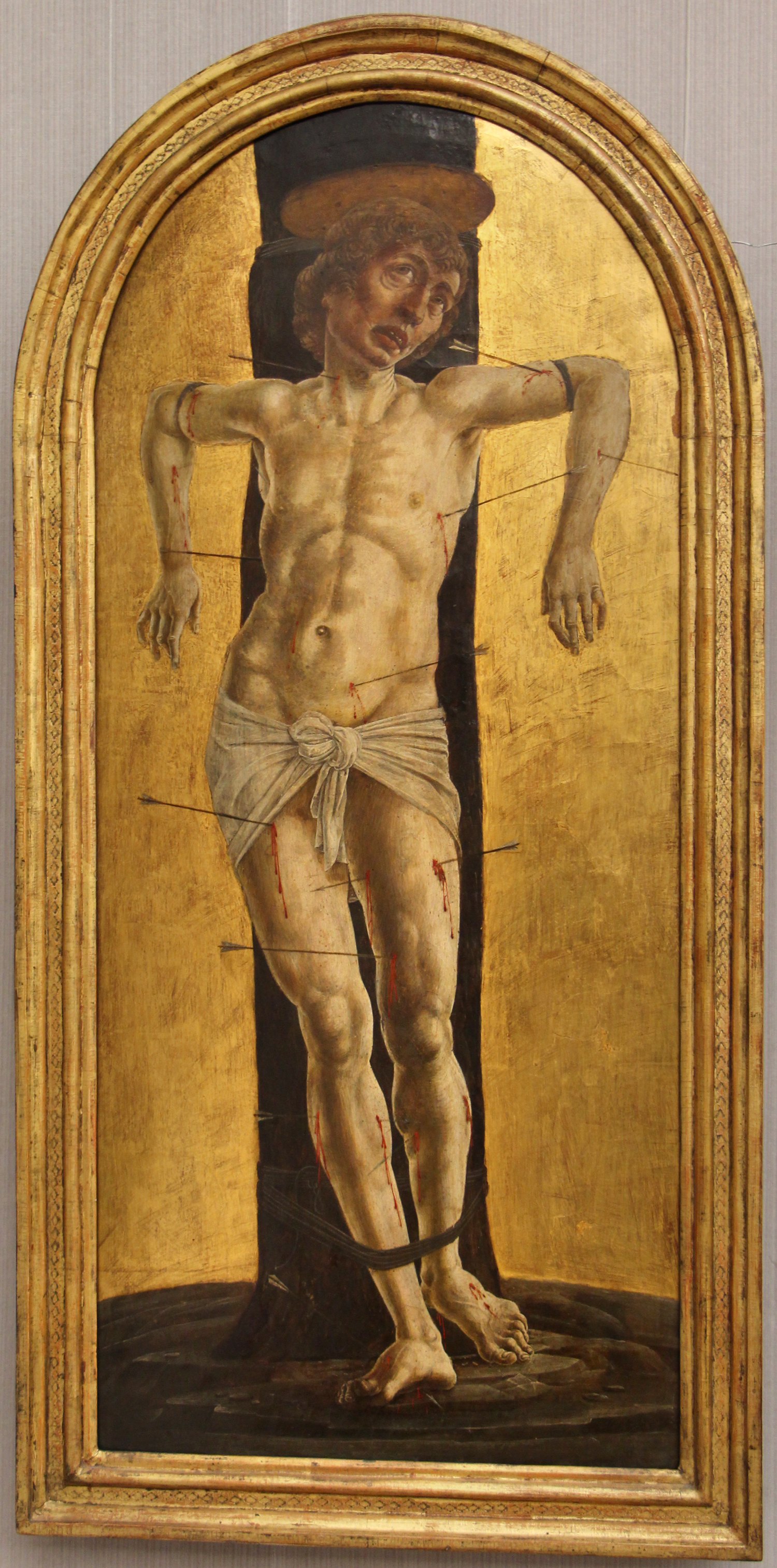
bb) as depicted by Cosmè Tura (martyrdom) in a late fifteenth-century panel painting (c. 1484) in the Gemäldegalerie, Berlin:

 https://upload.wikimedia.org/wikipedia/commons/8/8c/Cosm%C3%A8_tura%2C_san_sebastiano%2C_1484_ca.JPG


cc) as depicted by Andrea Mantegna (martyrdom) in a late fifteenth-century panel painting (c. 1490) in the Galleria Giorgio Franchetti alla Ca' d'Oro, Venice:


https://upload.wikimedia.org/wikipedia/commons/a/aa/St_Sebastian_3_Mantegna.jpg


dd) as portrayed (martyrdom) in a late fifteenth-century silver and silver gilt reliquary (c. 1497) from Augsburg in the Victoria and Albert Museum in London:


In addition here are some glass images added by Gordon Plumb:

St-Nicolas-de-Port, Bay 105, 5a-7a, 5b-7b, martyrdom of Sebastian,
early 16thC.:
https://www.flickr.com/photos/22274117@N08/4127966209
and detail:
https://www.flickr.com/photos/22274117@N08/4128739542

St-Nicolas-de-Port, Bay 113, 2c-4c:
https://www.flickr.com/photos/22274117@N08/4137043660

Bourges, Cathédrale Saint-Étienne, Bay 27, Virgin and Child with
Sebastian and another saint:
https://www.flickr.com/photos/22274117@N08/4266380565