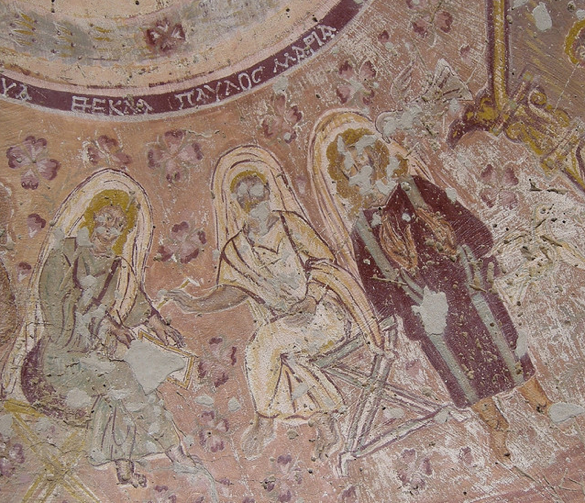
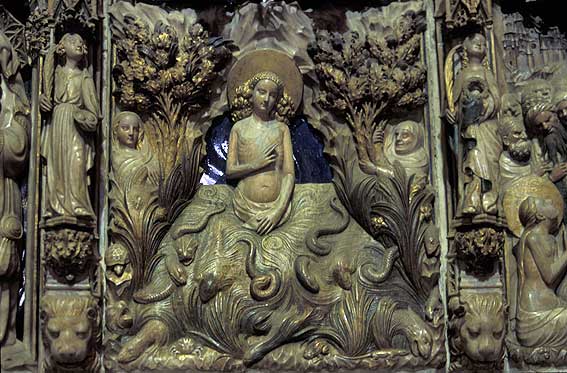
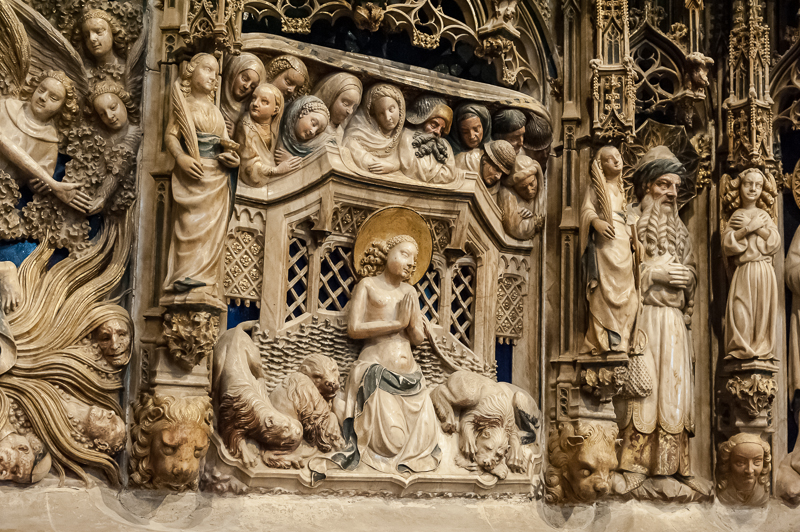
Today, were it not a Sunday this year, would be the feast of St Christina of Bolsena.
Phyllis Jestice posted about her cult on the Medieval Religion discussion group in 2004 and 2008 as follows:
Christina of Bolsena (3rd cent.) The Roman Christina converted to Christianity while still a girl throught the influence of her grandmother. Legend says that she then went around her parents' house destroying all the cult images, and when her father reacted by throwing her into Lake Bolsena with a rock tied around her neck she was miraculously saved from drowning. She then---legend goes on to report---had her tongue cut out and survived five days in a furnace, after which she was finally killed with arrows.
Christina of Tyre (?) This Christina's legend seems to be mixed up with that of Christina of Bolsena. She was a young girl, imprisoned for her Christianity, tortured extravagantly---a fire was lit under her but got out of control and burned 100s of people to death; her breasts were cut off and milk flowed from them; her tongue was cut out but she spoke even more clearly than before and when she threw her tongue at the judge he lost the sight of an eye; best of all, when she was thrown into the sea she was baptized by Christ and returned to land by the archangel Michael.
The Wikipedia entry about her can be seen at Christina of Bolsena
This year John Dillon has posted the following piece on the Medieval Religion discussion group:
Christina (variously called "of Tyre" or "of Bolsena") is a martyr of the Via Cassia venerated at today's Bolsena (VT) in the Tuscia section of Lazio in what was once southern Etruria. Her cult there is attested archeologically from the later fourth century onward and a saint of her name appears among the overwhelmingly Western virgin martyrs in the restored later sixth-century mosaics (ca. 560) in the nave of the basilica di Sant'Apollinare Nuovo in Ravenna.
Christina has similar, legendary Passiones both in Greek and in Latin (BHG 301, 302; BHL 1749-1759); their narrative core is thought to be an expansion of Eusebius of Caesarea's account of the Theodosia of his De martyribus Palaestinae. The Greek ones, whose oldest known representative is a papyrus fragment of the fifth or early sixth century, make her a martyr of Tyre in Phoenicia, as do also her entry in the (pseudo-)Hieronymian Martyrology and her earlier Latin Passiones. Apart from these texts there's no ancient indication of Christina's having had a cult at Tyre. The earlier Passiones present her as a young virgin of Christian faith who refuses to sacrifice to idols set before her by her pagan father (a high public official) and who then undergoes a series of ineffective tortures before being slain by the sword.
The ninth-century martyrologies of St. Ado of Vienne and Usuard of Saint-Germain place Christina's martyrdom at Tyre, a city of Italy; Ado specifies that this is situated at the Lake of Bolsena. Christina's later Latin Passiones also specify an Italian locale. These convert an episode in which in earlier texts she is thrown into the sea with a millstone tied to her neck (she survives and is baptized by Christ) into one in which she is instead cast into the Lake of Bolsena. After various torments she is shot to death with arrows. How her earlier dossier came to specify Tyre is a mystery; possibly an adjective _Tyrrhena_ ("Etruscan") in a now lost early Passio got corrupted into something that was copied as _Tyria_ ("Tyrian").
A literarily noteworthy Latin Passio of Christina is that by Alfanus of Salerno (BHL 1759; eleventh-century). Aldhelm has a much briefer version in his prose De laude virginitatis. Sherry Reames' introduction to her TEAMS edition of William Paris' late fourteenth-century Life of St Christina is here:
http://www.lib.rochester.edu/camelot/teams/40sr.htm
And her text of that Life is here:
http://www.lib.rochester.edu/camelot/teams/41sr.htm
Christina's cult site at Bolsena's basilica di Santa Cristina developed from a late antique martyrium in a subterranean Christian necropolis into the eleventh- and twelfth-century hypogean basilica shown here and called the Grotta di Santa Cristina:
http://farm3.static.flickr.com/2475/3664862548_76faec6091.jpg
http://tinyurl.com/2ao7lqo
http://tinyurl.com/2w68p9w
Early medieval pilgrim itineraries and historical notices attest to the fame of this spot. Before the apse is Christina's rather grand late antique tomb. When it was opened in 1880 it was found to contain a fourth(?)-century funerary urn of marble bearing the tenth- or eleventh-century inscription †I·RQES/CP·BAT·X·M
i.e. †HIC REQUIESCIT CORPUS BEATAE CHRISTINAE MARTYRIS
Human bones said to have come from someone not above fourteen years of age were found in the urn and are now kept in a new, silver urn in a chapel in the upper church. In the eleventh and twelfth centuries other relics said to be Christina's were translated to various places in Christendom.
A view of the adjacent fourth- and fifth-century catacomb:
http://tinyurl.com/fau2s
Just outside the Grotta are an altar and ciborium from the Carolingian period. Bolsena's Eucharistic Miracle of 1263 or 1264 is said to have occurred here:
http://tinyurl.com/2vy6h5k
http://tinyurl.com/2domlam
http://tinyurl.com/35r8nqm
http://www.comunebolsena.it/Img/da_visitare/sc_6_max.jpg
The altar incorporates a piece of basalt said to have been used to weigh down the saint when she was thrown into the lake and piously believed to bear the imprint of her feet:
http://tinyurl.com/38a5btg
http://tinyurl.com/32lsac6
Christina is entered under today in the (pseudo-)Hieronymian Martyrology, in the ninth-century martyrologies of St. Ado of Vienne and Usuard of Saint-Germain, and in the originally tenth-century Synaxary of Constantinople. Today (24. July) is her feast day in Byzantine-rite churches and her day of commemoration in the Roman Martyrology.
Some period-pertinent images of St. Christina, virgin martyr:
a) as depicted (at far left) in the heavily restored originally later sixth-century mosaic procession of female martyrs (c. 561) in the nave of Ravenna's basilica di Sant'Apollinare Nuovo:
http://tinyurl.com/zgxb3gj
b) as depicted (at right; at left, St. Theodore of Amasea; at centre, St. Nicholas of Myra) in the tenth- and eleventh-century frescoes of the rupestrian chiesa di Santa Marina e Cristina at Carpignano Salentino (LE) in southern Apulia:
http://tinyurl.com/jgxeaj5
Detail views:
http://tinyurl.com/6bty9z
http://www.leccesette.it/archivio/IMG_20160225_WA0002.jpg
c) as depicted in an eleventh-century fresco in the cathedral of St. Sophia in Kyiv:
http://www.icon-art.info/masterpiece.php?lng=en&mst_id=1073
d) as depicted (martyrdom) in a late thirteenth-century copy of French origin of Jacopo da Varazze's Legenda aurea (San Marino, CA, Huntington Library, ms. HM 3027, fol. 81r):
http://digitalassets.lib.berkeley.edu/ds/huntington/images//000882A.jpg
e) as depicted (at right; at left, St. Juliana of Nicomedia) as depicted in the late thirteenth-century Livre d'images de Madame Marie (c. 1285-1290; Paris, BnF, ms. Nouvelle acquisition française 16251, fol. 102r):
http://tinyurl.com/yggk63b
f) as twice depicted (martyrdom scenes) in bas-de-page illuminations in the early fourteenth-century Queen Mary Psalter (c. 1310-1320; London, BL, Royal MS 2 B VII, fols. 256v, 257r):
1) thrown into the sea and rescued by angels (fol. 256v):
http://www.bl.uk/catalogues/illuminatedmanuscripts/ILLUMIN.ASP?Size=mid&IllID=53524
2) stabbed (fol. 257r):
http://www.bl.uk/catalogues/illuminatedmanuscripts/ILLUMIN.ASP?Size=mid&IllID=53355
g) as depicted (at lower right in the panel at lower left; martyrdom) in an earlier fourteenth-century pictorial menologion from Thessaloniki (between 1322 and 1340; Oxford, Bodleian Library, MS Gr. th. f. 1, fol. 48v):
http://image.ox.ac.uk/images/bodleian/msgrthf1/48v.jpg
h) as depicted (martyrdom) in an earlier fourteenth-century French-language legendary of Parisian origin with illuminations attributed to the Fauvel Master (c. 1327; Paris, BnF, ms. Français 183, fol. 92r):
http://tinyurl.com/28k5744
i) as thrice depicted (martyrdom) in an earlier fourteenth-century copy of Vincent of Beauvais' Speculum historiale in its French-language version by Jean de Vignay (c. 1335; Paris, BnF, ms. Arsenal 5080, fols. 246r-247r):
1) in prison (at right; at left, her mother; fol. 246r):
http://gallica.bnf.fr/ark:/12148/btv1b55000813g/f497.item.zoom
2) scourged (fol. 246v):
http://gallica.bnf.fr/ark:/12148/btv1b55000813g/f498.item.zoom
3) in a burning oven (fol. 247r):
http://gallica.bnf.fr/ark:/12148/btv1b55000813g/f499.item.zoom
j) as depicted in a mid-fourteenth-century copy, from the workshop of Richard and Jeanne de Montbaston, of the Legenda aurea in its French-language version by Jean de Vignay (1348; Paris, BnF, ms. Français 241, fol. 168v):
http://tinyurl.com/2bbc9v6
k) as depicted (martyrdom) in the mid- to later fourteenth-century Breviary of King Charles V (betw. 1347 and 1380; Paris, BnF, ms. Latin 1052, fol. 428v):
http://gallica.bnf.fr/ark:/12148/btv1b84525491/f866.item.zoom
l) as depicted (martyrdom) in a late fourteenth- or early fifteenth-century copy of the Legenda aurea in its French-language version by Jean de Vignay (Rennes, Bibliothèque de Rennes Métropole, ms. 266, fol. 175v):
http://tinyurl.com/jtzyre7
m) as depicted (at lower left in the central panel) by the Master of Saint Veronica in an early fifteenth-century triptych (c. 1410) in the Stiftung Heinz Kisters in Kreuzlingen (Kanton Thurgau):

n) as depicted (martyrdom) in the early fifteenth-century Châteauroux Breviary (c. 1414; Châteauroux, Bibliothèque municipale, ms. 2, fol. 242v):
http://www.enluminures.culture.fr/Wave/savimage/enlumine/irht2/IRHT_054081-p.jpg
o) as depicted (martyrdom) in an early fifteenth-century copy of the Elsässische Legenda aurea (1419; Heidelberg, Universitätsbibliothek, Cod. Pal. germ. 144, fol. 29r):
http://digi.ub.uni-heidelberg.de/diglit/cpg144/0073
p) as depicted in an earlier fifteenth-century fresco (c. 1425-1435) in the cloister of the cathedral of Bressanone / Brixen:

q) as depicted (martyrdom) by the court workshop of Frederick III in a mid-fifteenth-century copy of the Legenda aurea (1446-1447; Vienna, Österreichische Nationalbibliothek, cod. 326, fol. 134r):
http://tarvos.imareal.oeaw.ac.at/server/images/7006857.JPG
r) as depicted (martyrdom) in a later fifteenth-century copy of Vincent of Beauvais' Speculum historiale in its French-language version by Jean de Vignay (1463; Paris, BnF, ms. Français 51, fol. 71r):
http://tinyurl.com/3xfm3ep
s) as depicted (at right; at left, St. Paul) by Sano di Pietro (d. 1481) in the lower right panel of an altarpiece in the basilica di Santa Caterina in Bolsena:
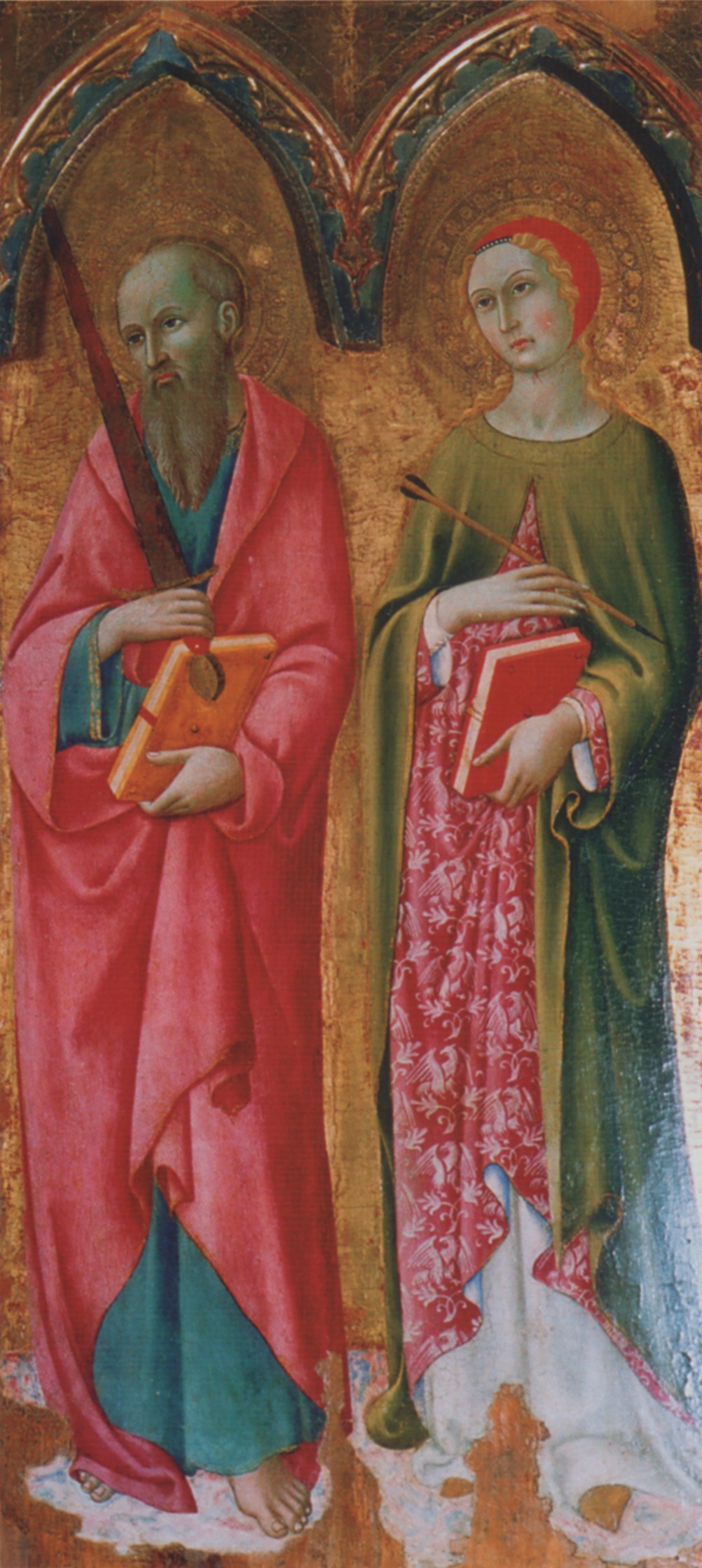
http://tinyurl.com/2u5nkw2
http://tinyurl.com/znb4a89
t) as depicted (martyrdom; at lower right, her mother) in a late fifteenth-century copy of the Legenda aurea in its French-language version by Jean de Vignay (c. 1480-1490; Paris, BnF, ms. Français 244, fol. 207v):
http://gallica.bnf.fr/ark:/12148/btv1b8442920n/f434.item.r=Fran%C3%A7ais%20244.zoom
u) as depicted (being baptized by Christ) in a late fifteenth-century Roman breviary (after 1482; Clermont-Ferrand, Bibliothèque du patrimoine, ms. 69, fol. 481v):
http://www.culture.gouv.fr/Wave/savimage/enlumine/irht4/IRHT_081340-p.jpg
v) as depicted (left margin at top) in a hand-colored woodcut in the Beloit College copy of Hartmann Schedel's late fifteenth-century Weltchronik (Nuremberg Chronicle; 1493) at fol. CXXVIIv:
https://www.beloit.edu/nuremberg/book/6th_age/left_page/31%20(Folio%20CXXVIIv).pdf
w) as portrayed in relief (martyrdom) by Benedetto Buglioni in three panels of the predella of his late fifteenth-century glazed terracotta tabernacle in the cappella del Santissimo Sacramento in the basilica di Santa Cristina at Bolsena:
1) in the burning oven:
http://tinyurl.com/gns42vb
2) tied to a tree:
http://tinyurl.com/jfw8yrd
2) shot with arrows:
http://tinyurl.com/hlu3t87
x) as portrayed in relief (at left, flanking the BVM and Christ Child; at right, St. George of Lydda) in a late fifteenth-century glazed terracotta sculpture (c. 1495; attributed to Giovanni della Robbia) in the lunette over the main portal of the basilica di Santa Cristina in Bolsena:
![[vf3+della+robbia.JPG]](https://blogger.googleusercontent.com/img/b/R29vZ2xl/AVvXsEhO4gvnSbWD5HCKsRq7pZ0-0WlCxk8qnZSYxmEi4UVPhidkRFSWMHHrGy3GHygpu918V8McuGVypvMwE6fKtaVAl69KoD_COYA04Dax8KxAwWRzoiOlkLoSOWqjTfkXVUEh-GHXafdFmnhn/s400/vf3+della+robbia.JPG)
y) as portrayed in a late fifteenth- or early sixteenth-century recumbent sculpture of the saint in terracotta (?1496; ?c. 1503-1508; attributed to Benedetto Buglioni) surmounting her tomb in the Grotta di Santa Cristina in the basilica di Santa Cristina in Bolsena:
http://tinyurl.com/hg8fyec
http://www.comunebolsena.it/Img/da_visitare/sc_7_max.jpg
http://tinyurl.com/254dky5
http://tinyurl.com/2643a2n
z) as depicted (at left; at center, the BVM and Christ Child; at right, St. Lucy) by Giovanni de' Ferrarris da Mondovì in a late fifteenth-century fresco (1498) in the cappella di Santa Lucia in the basilica di Santa Cristina in Bolsena:
http://tinyurl.com/jloegd8
http://www.luoghimisteriosi.it/lazio/bolsena/bolsena%20(17)%20(Large).jpg
aa) as depicted (at right; at left, St. John the Evangelist) in an early sixteenth-century glass roundel of southern Netherlandic origin (c. 1500-1510) in the Metropolitan Museum of Art in New York:
http://www.metmuseum.org/art/collection/search/475652
bb) as depicted in an early sixteenth-century fresco (1506 or 1508), attributed to Giovanfrancesco d'Avanzarano, in the cappella del Santissimo Sacramento in the basilica di Santa Cristina at Bolsena:
http://www.heiligenlexikon.de/Fotos/Christina8.jpg
Detail view:
http://tinyurl.com/23tgpzl
cc) as depicted (central register at right, flanking the BVM and Christ Child) by Luca Signorelli in an early sixteenth-century panel painting of the Virgin with Saints (1515) in the National Gallery in London:
http://tinyurl.com/z2khp7q

dd) as depicted (at upper left in the wing at right) by Joos van Cleve the Elder in an early sixteenth-century altarpiece (1515) in the Wallraf-Richartz-Museum in Köln [ A fascinating image that will not fit into my format - well worth looking at - Clever Boy ]:
http://tinyurl.com/jc4j7e8
ee) as depicted by the Master of Georgenberg Legend of St. Anthony in a panel of an early sixteenth-century altarpiece (c. 1515-1520) in the church of St. Margaret in Mlynica (Okres Poprad), Slovakia:

ff) as depicted (at left; at right, St. Oliva) by Tommaso de Vigilia (attrib.) in a later fifteenth-century remounted fresco (c. 1470; from the chiesa di Santa Maria in Risalaimi, a locality of Misilmeri [PA] in Sicily) in the Galleria regionale di Sicilia in Palermo:
https://misilmeriblog.files.wordpress.com/2009/02/affresco5.jpg
Back in 2008 another contributor to the group posted about the annual pageant of S. Cristina in Bolsena, which I assume originated as a medieval mystery play, as follows:
"At Bolsena Cristina's Passio is re-enacted annually (with hunky male torturers; in the developed legend she's said to have possessed great physical beauty). Views of one such pageant are at the foot of this page:
http://www.basilicasantacristina.it/html/culto.htm
And here are others:
http://www.eventiesagre.it/?id=1266
http://www.canino.info/inserti/tuscia/feste/santa_cristina/index.htm"
Now that really is a case of "Well, we don't do that at our church " and indeed might make even the most fervent supporters of reviving traditional paraliturgical practices think twice. Or perhaps not.
There is more about the history of this celebration at Santa Cristina - ItalyHeritage