Once I was a clever boy learning the arts of Oxford... is a quotation from the verses written by Bishop Richard Fleming (c.1385-1431) for his tomb in Lincoln Cathedral. Fleming, the founder of Lincoln College in Oxford, is the subject of my research for a D. Phil., and, like me, a son of the West Riding. I have remarked in the past that I have a deeply meaningful on-going relationship with a dead fifteenth century bishop... it was Fleming who, in effect, enabled me to come to Oxford and to learn its arts, and for that I am immensely grateful.


Showing posts with label Oxford Oratory Brothers. Show all posts

Wednesday, 24 August 2016

The return journey from Belmont


This morning we packed up and left Belmont after breakfast to make our return to Oxford. I gather that we as the Brothers from the Oratory had managed to impress the monks at Belmont by our assiduity in attending the Offices in church. I think we all wish to return at some time or anothe rto the peace and dignity of the abbey and its community.

https://upload.wikimedia.org/wikipedia/commons/6/6b/Belmont_Abbey_-_geograph.org.uk_-_945221.jpg

Belmont Abbey church from the south east

Image: Wikimedia/geograph.org.uk

Our first stop was in Hereford. Our time there was spent mainly in and around the cathedral, with Fr Jerome checking that all was well with the fine array of monumental brasses the cathedral still posseses despite the depredations of time, destruction and neglect. On ehe poined out to me is the  brass of a Dean from just before the reformation which has two represntations of the Holy Trinity - one being the standard late medieval enthroned father holding the Crucifix with the Holy Spirit hovering and the other, unique in his enormous experience of brass iconography, is the Orthodox equivalent, the Three Angels in the Hospitality of Abraham.

We also went into the Catholic church of St Francis Xavier, which is close by and holds the relic of St John Kemble I posted about in conecction with our pilgrimage to his grave.
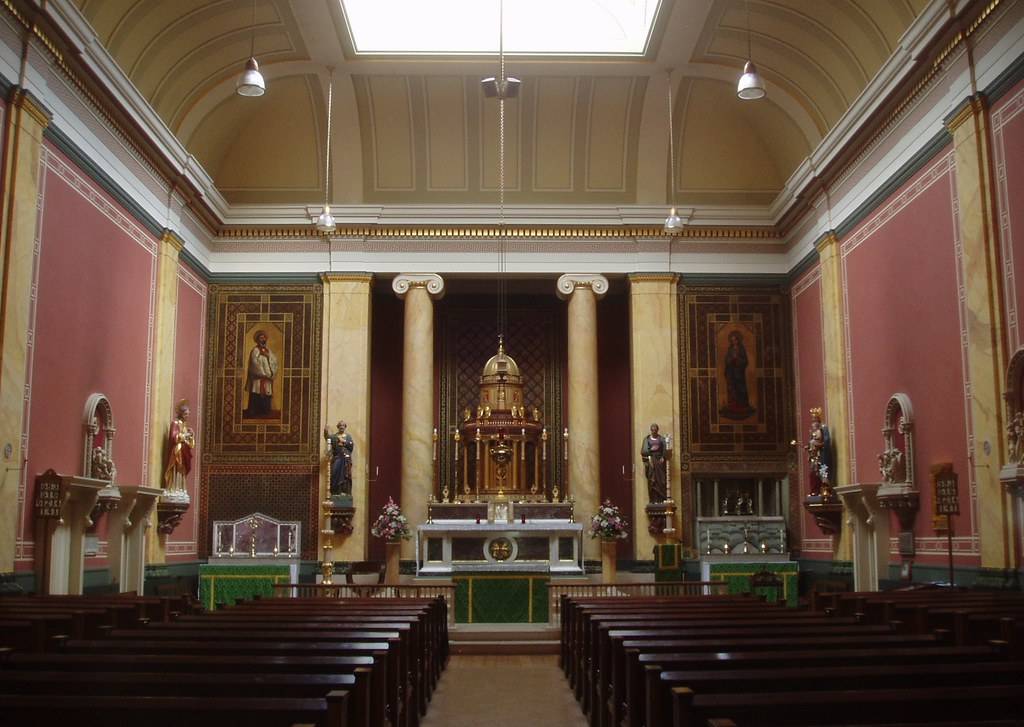
Image result for hereford catholic church

 The interior of St Francis Xavier Hereford
The relic of St John Kemble is at the altar on the right

Image: Flickr

I have visited the church before and it is beautifully appointed and cared for. It is in the care of the monks of belmont, one of whom occupies the Presbytery anmd is Pariah Priest
After a bit of shopping in the open market  we set off, past the remains of the Hereford Blackfriars and the unique survival of the Preaching Cross from their graveyard. This is not far from the site of St John Kemble's martyrdom. We did not stop at the Blackfriars and the following notes and illustrations are taken from an online source:

One of Hereford’s hidden gems is the Black Friars Rose Garden hidden down a passageway in Widemarsh Street.  The garden contains the remains of the friary of the Black Friars, once one of the city’s most important religious houses.  The Black Friars were given the site outside Widemarsh Gate in around 1246 and the monastic buildings were consecrated in around 1276.  The Black Friars were also known as ‘Friars Preachers’ and regularly gave sermons to the local populace from their preaching crosses.  The cross in the grounds is one of the few surviving examples in England and was considerably restored in the 19th century.

IMG_0428

In 1538 the Friary was dissolved by Henry VIII and the buildings were converted into a fine town house by Sir Thomas Coningby of Hampton Court near Dinmore.  This was badly damaged during the Civil War and later became a farm building.  The existing ruins are the Refectory and the Prior’s House dating from about 1322.

IMG_0436

In the 13th century the roadside site was occupied by a house of the Knight’s Hospitallers of St. John of Jerusalem, and parts of the hall and chapel dating from this period are now incorporated into the almshouses built by Sir Thomas Coningsby in 1614.  Grouped around a quiet quadrangle, the twelve separate lodgings were formerly used to accommodate a chaplain and eleven retired soldiers, seamen or servants who were known as ‘The Coningsby Servilors’.

IMG_0429

The preaching cross and monastic ruins are now set in an attractive rose garden

Text and images;shawsseasonalliving.

We called in at a pub for lunch, before our final stop at the church at Stanford Bishop near Bromyard.


Image result for Stanford Bishop church

 Stanford Bishop church

Image: Birmingham Post

This is an intriguing place and raises all manner of historical and archaeological questions. The parish is a scattered community and the church stands by itself on a low eminence. Dedicated to St James it  is not mentioned in Domesday Book, and the present, rather plain structure is mid- to late-twelfth century, when the cult of St James was at its height. There is more about work of that period at St James, Stanford Bishop, Herefordshire · The Corpus of Romanesque Sculpture

However what we had come to see is claimed to be much older - the chair of St Augustine, in which he sat - and continued to sit rather than rise - at his fateful and futile meeting with the British bishops in 603.

http://www.catexpert.co.uk/wp-content/uploads/2012/12/herts-st-augs-chair.jpg 

The reputed Chair of St Augustine

Image: catexpert.co.uk

The story of the chair can be read in an article from the Birmingham Post from 2014 at The battle over a chair once thought to be the oldest in Britain, and from which I quote "The earliest claim for its importance was made in the 1840s. Some years afterwards, the chair was discovered in the church tower, when a restoration of the church was taking place, probably in the 1890s. Later on it was turfed out, and served the church sexton as a piece of garden furniture. Later still (in 1899), when it was recognised that the chair might be of major importance, the church authorities presented it to the Beaney Institute or Royal Museum in Canterbury"

In 1943 it was returned to the church and scholarly opinion at the time thought it might be no earlier than eighteenth century in date.  

This is clearly an ancient site.  There is a prehistoric standing stone by the gate into the churchyard and within an ancient yew - there is more about these at  Stanford Bishop Church Stone Standing Stone (Menhir) It may have once been the site of circle, or perhaps a place of assembly. It lies close to the county boundary with Worcestershirewhich is essesntially the same as that between the seventh century sub-Kingdoms of the Hwicce ( represented by Worcestershire, Gloucestershire and part at lease of Oxfordshire - Hwicce as in Wychwood ) and the Magonsaeten ( the medieval diocese of Hereford ). If the ill-fated meeting did not take place at Aust on the banks of the Bristol Channel, as is usually claimed, could it have taken place ata  recognised place of meeting near the borders of two tribal units? looking around from the slightly raised site occupied by the church it is a tempting hypothesis. Time to get the a dendrochronologists to work I suspect.

We travelled back across Worcestershire - a subtly different landscape from that of Herefordshire - and had time to look slightly wistfully as we drove past at the remains of Pershore Abbey in the middle of that attractive town, but had not the time to stop. Pershore was Benedictine, and today just the choir, south transept and central tower of the monastic church survive:

Image result for Pershore abbey

Pershore Abbey from the south east

Image: Wikimedia

Image result for Pershore abbey

 Pershore Abbey from the south west

Image:pershoreabbey.org.uk

Then we continued our journey ascending Broadway Hill with its panoramic view of the county and on home across the edge of the Cotswolds to the Oratory and Oxford - and the chance to collect my mobile phone which has been in for repair, of which I have been physically and emotionally bereft.

This has been a wonderful break both spiritually and recreationally and I am immensely grateful to all who made it possible, Fr Jerome, the community at Belmont, my fellow Brothers and others besides.

Sunday, 21 August 2016

Pilgrimage to the grave of St John Kemble


Today we continued our retreat at Belmont with the Offices and High Mass, an excellent lunch in the refrectory and then went off in the drizzle on pilgrimage to the grave of St John Kemble, who was martyred in 1679 at Hereford, in the churchyard at Welsh Newton, a few miles to the south west of Hereford.


Welsh Newton, Brothers at St John Kemble's grave (3).JPG

 Fr Jerome and the Brothers on the Retreat in Welsh Newton churchyard

Image: Oxford Oratory 

Fr Jerome had planned to take us there but we found that as tomorrow is the feast day of St John we could join in the annual walking pilgrimage to his grave which took place this afternoon.

There is an online account of St John and his life and martyrdom at John Kemble (martyr) and there is an article about him from the Catholic Herald from 2010 at The English martyr hanged at the age of 80.There is another account of him from the Herefordshire past website at Saint John Kemble – Martyr.

One of the Saint's hands is held as a relic in the church of St Francis Xavier in Hereford, and there is an account of what looks very much like a miracle wrought at his intercession in 1995 through the use of the relic at St. John Kemble's Severed Hand


Saturday, 20 August 2016

A quiet Saturday at Belmont


Today was our first full day at Belmont, and given over to our Retreat. We all turned up for Matins at 6.30 this morning and followed the monastic regime through the day.


Image result for Belmont abbey

Belmont Abbey church from the north

Image: Jason Pacey Photography 

Fr Jerome is giving his retreat addresses on the links between the Days of Creation, the Ages of the World and the Virtues.

For these we meet in a book lined room adjacent to the abbey church and its Holy Door, but otherwise read or walk as we wish in the buildings or grounds.

I have been reading John Cassian's Monastic Institutes - which consists of two parts, On the Training of a Monk and The Eight Deadly Sins  - and which was translated by Fr Jerome and published in a very attractive edition by the Saint Austin Press in 1999.

 http://www.benedictines.org.uk/wp-content/uploads/2013/06/Refectory-960x700.jpg

Grace before a meal in the refectory at Belmont 

Image:benedictines.org.uk 

Friday, 19 August 2016

Going on retreat at Belmont Abbey


Earlier today I travelled from Oxford over to the Benedictine abbey at Belmont on the western edge of Hereford for what is planned as a combined retreat and pilgrimage holiday. This has been arranged for the Brothers of the Secular Oratory of the Oxford Oratory by our Prefect, Fr Jerome Bertram C.O.

The journey across the Cotswolds and then through the lush countryside of Herefordshire was a relaxation in itself and the car I was travelling in managed to arrive just in time for Vespers in the Abbey church despite the potential perila and pitfalls of undertaking ajourney at Friday teatime.

We are staying within the monastic enclosure and taking our meals with the monks so as to follows their horarium. Vespers this evening was my first opportunity to actually attend a service in the monastic church as on my previous stays at Belmont that was out of action due to a major renovation and refit.

Our rooms are quietr and restful, and well appointed and I look forward to the chance to rest and re-create here. I hope the others enjoy their visit - Belmont was my suggestion and apart from Fr Jerome, who came here for his own retreat earlier in the year, none of the others have visited the abbey before.

Image result for Belmont abbey

Belmont Abbey

Image:Belmont Abbey

Tuesday, 11 August 2015

St Philip Neri and Bl. John Henry Newman


Today is the 125th anniversary of the death of Bl. John Henry Newman at the Birmingham Oratory in 1890


Cardinal Newman lying-in-state in the Oratory Church, Edgbaston, prior to his Funeral Mass on Tuesday 19 August 1890.

Image: Valle Adurni


Recently I was asked to answer, as someone who worships at the Oxford Oratory, and who is a Brother of the Secular Oratory, four questions to illustrate or illuminate a school project comparing and contrasting St Philip Neri and Bl. John Henry Newman, and I  thought readers might be interested to see my answers to those:

1) What do you find inspiring in the example of St Philip Neri?

I think what is most inspiring is to understand that it is not the stories of him as practical joker that matter as the "Saint of Joy " but his profound closeness to God - above all in the indwelling of the fire of the Holy Spirit from Pentecost 1544 - and the way in which he brought that Divine Love to the people of Rome. It proved so very attractive to so many.

2) What do you find inspiring in the example of John Henry Newman?

As a convert from Anglo-Catholicism myself ( sand a member of Oriel ) it is first of all his example of pursuing his pilgrimage of Faith, and what an extraordinary journey that was. His intellectual honesty and his concern for souls are also very important, as is his determination to hold to the path he had chosen.

3) What do you think they had in common?

I think that is both their adherence to their personal pilgrimage and their concern for saving souls, be they in Rome, Oxford or Birmingham

4) What do you think it means to be an Oratorian today?

As a Brother of the Secular Oratory and regular worshipped at the Oxford Oratory I think it is a case of living out and working out my own spiritual journey in the light of what they taught and did themselves, and of following on their footsteps - however falteringly. I esteem what they did and established, and in being grateful for that support their continuing legacy in terms of liturgical and devotional life as well as trying to show concern for those I meet in my life.

Saturday, 31 May 2014

Harvington Hall


Today, for the first time, I visited Harvington Hall near Kidderminster in Worcestershire. The visit was organised as a summer excursion for the Brothers of the Oxford Oratory.

Harvington Hall Kidderminster


Harvington Hall from the east

Image: birminghamdiocese.org.uk

The Hall is an Elizabethan moated manor house with rare wall paintings and the greatest series of priests' hiding places in the country - it has seven plus a vestment hide - and they are thought to be the work of St Nicholas Owen. When they were constructed Harvington was owned by Humphrey Packington. There is an illustrated online account of the history of the house at the post Harvington Hall
from the blog Tudor Stuff, and there are more photographs and information here


Model of house

A model of Harvington Hall as it may have appeared when completed by Humphrey Packington.
The demolition and alterations of c.1700 removed the battlements and the three blocks at the rear on the north west. The view is from approximately the same angle as the photograph above.

Image:Thornber.net

In 1696 it passed by inhertance from Humphrey Packington's daughter, Lady Mary Yates, to the  Throckmorton family, who were based at Coughton Court. Probably as an economy measure they demolished the north wing and the Great Hall on the western side about 1700, leaving a rather lop-sided plan. A model in the house indicates the rather grander appearance the Hall originally had. The house was partially occupied by relatives and by the priest but gradually decayed, and by 1826 the family had moved elsewhere and much of the top floor was unfurnished; by 1904 it was described as `hastening to decay'. However in 1923 it was bought by a benefactor, Ellen Grant-Ferris, and given to the Archdiocese of Birmingham and is now managed through a voluntary committee. Restoration work over the years has revealed the wall paintings and is a continuing process to enhance the building and its setting.The wall paintings, though faded, do indicate the often lavish and colourful decoration of houses in the period.

Amongst the items on display are some very fine vestments - one associated with St John Wall, who was martyred in 1679 and who had ministered at the Hall. These are displayed near the old chapel in the upper part of the building. Originally the walls and ceiling were covered with a trailing design of flowers whcih must have made the chapel into a simulation of a floral bower.

The official website of Harvington Hall can be seen here. I would certainly recommend the Hall for a visit by anyone interested in recusant history or more generally in the history of the period.

The Hall offers excellent refreshments - we had a good lunch to set us up for sightseeing - and audio guides as well as several publications on the history of the house. There is also a Heritage Centre in the Malt House at the rear with films about the history of Harvington.

Adjacent to the Malt House, and backing on to the moat, is the Georgian Chapel.

Georgian chapel at Harvington Hall

The Georgian chapel at Harvington Hall

The chapel was created in 1743 by adapting the upper storey of a farm outbuilding, to replace the original chapels on the top floor of the house, and was in use until 1823 when it was damaged by fire. Services were transferred to the new church of St Mary which opened in 1826, and after renovation the chapel was converted into a village school which functioned until 1913. 

In 1987 it was returned to its original use as a chapel and fitted out with contemporary furnishings, including the early 19th-century altar and communion rails which came from a church at Upton upon Severn.
Image:   © Copyright Tiger and licensed for reuse under this Creative Commons Licence./ Geograph


Facing the Hall to the east is the parish church. This is now the official shrine of St John Wall, and there are bronze reliefs of him and St Nicholas Owen in the church.


Interior of St Mary's Church

Interior of St Mary's Church Harvington

The interior of the Gothic church built across the road from Harvington Hall in 1825 for Sir George Throckmorton. The east window with interesting Y-tracery was installed in 1855, probably by C.F. Hanson, and the stained glass by Hardman of Birmingham dates from 1893.
Image:  © Copyright Tiger and licensed for reuse under this Creative Commons Licence/Geograph

It was in the church that we said the prayers used by Brothers at our weekly meetings, to bring to mind that this was a pilgrimage as well as a very enjoyable day out. 

Our jorney back brought us across Worcestershire, and with warm afternoon sunshine and lush foliage all around us a pleasure in itself. We stopped off briefly in Evesham, with me acting as guide, to look at the site of the abbey and to also see for the first time the statue of Eof, the swineherd whose vision led to the foundation of the abbey there - but I will post about that seperately next week.

After that we crossed the remainder of theVale of Evesham, climbed Broadway Hill with its specatular views of the region, and back through Chipping Norton to Oxford. A splendid day out, and my thanks to Fr Jerome for organising it and Mark for bringing his people-carrier to take the brethren out.

Wednesday, 23 October 2013

St Paul in Sussex


Last night Fr Jerome entertained the Brothers of the Oratory with a talk based upon a wonderful mixture of archaeological finds, Biblical references, possible hypotheses and a lot of wishful thinking. this was his retelling of the theories and interpretations in Edwin Wilmshurst's St Paul and Britain;notes on the dedication stone of the temple of Neptune and Minerva, at Chichester, which connects the Roman senator Pudens, the British princess Claudia, and St Paul, with the city of Chichester .This pamphlet was published in Chichester in 1910.

In it the author blends together facts and suppositions to talk of the connections berween St Paul, Caractacus, Old King Coel, Young King Coel, St Helena and a Palestinian-Roman-British dynasty based in what is now Sussex. Heady stuffy, and thought provoking in the bemused scratchings of heads kind of way.

Apart from its entertainment value Fr Jerome was making a serious point. Here, once again, was an attempt to create a British Church anterior to that of Rome - thus the British Christian Llyr becomes Linus successor of Paul, not Peter, as Bishop of Rome...

As Fr Jerome pointed out, and as a historian I quite agree, the "Celtic Church" and analagous institutions are modern - very modern - notions. When St Augustine met the native British episcopate, and tried, not perhaps too tactfully, to get them to co-opertate with him in evangelising the pagan Anglo-Saxons, he recognised them as being, like himself, bishops who derived their authority from the Universal Church, not from some autonomous independent origin. Similarly the Synod of Whitby recognised a common episcopate, and sought to resolve procedural and practical difficulties, not fundamental differences in origin. One cannot create an independent paleo-British Christianity just because it satisfies an emotional or national need centuries later.

Which does not deny the theoretical possibility of St Paul coming to Britannia after preaching in Hispania, or indeed the teenage Jesus coming with Joseph of Arimathea, who, as of course we all know was in the tin-trade, to Glastonbury...


Saturday, 20 July 2013

Back to England


Chamery

Chamery - the village, surrounded by vineyards, clusters round the medieval church

Image: hijack75 on Panoramio

We left Chamery at 8 this morning - another bright and sunny one - and drove past Rheims and Laon towards Calais and the ferry back to England. Seeking to avoid the delay caused by late boarding on the way out we had a fairly long wait on the quayside before embarking. 

As we arrived in Dover, it now being after midday, Fr Jerome was able to tell us the hitherto embargoed news of the project to establish a York Oratory at the church of St Wilfrid and to send Oratorians from Oxford there. This has, I know, been rumoured for a long while,and seems a very positive development. 

Once in Dover we said farewell to John, but before we left we hurried over to inspect the ruins of Old St James church, which was reduced to its present state by bombardment during the Second World War. The remains are of some quite impressive Norman work, and it is, of course, a great pity that the church was wrecked. 

Fr Jerome drove the last leg of the journey via Caterham where we dropped off Daniel, and so back to Oxford. For Fr Jerome this had been quite a haul having had to do all the driving, which amounted to over 1600 miles, with only one rest day. I am sure we are are all very grateful to him for that, and for such smooth travelling

The whole week was splendid, allowing us time to pray and worship, but also to feed our thoughts with great buildings and to spend time together as a group of Oratorians.

May St John Vianney continue to pray for us.

Friday, 19 July 2013

Rheims


We travelled from Clairvaux northwards across the open landscape of Champagne - not that interesting to be honest as landscapes go.

Our first point of call around Rheims was to be the gite where we were to spend the night. this was in the village of Chamery, south west of Rheims, nestling against the foot of the scarp and reached along roads flanked by vineyards.

The gite is the property of an independent champagne producer, the house of Bonnet - Ponson. Upon arrival we were offered, and accepted, a glass of their product, and bottles were bought for consumption with dinner this evening or to take home. We enquired about a tour of the cellars, and this was given to us. The cellars seemed far more extensive than the property at ground level - I wonder if the whole village, which has several such producers, is standing on a  honeycomb of champagne caves. We gathered that there were 500,000 bottles in the cellars, and the method of fermentation and the creation of champagne was explained to us, both in its old methods, and the newer, slightly more technological way of doing these things. Our hostess urges us not to keep champagne for too long - it is designe dto be drunk. Well, I suppose she would say that wouldn't she - but the champagne and the tour were excellent.

On the way back towards Rheims we stopped to look at the exterior of the church at Villers aux Noeuds. This was by the roadside, and, unusually for much of the France we had seen, still a medieval building - albeit missing its nave aisles, but with some nice eleventh or twelfth century work on the tower - a bit reminiscent of the type of churches one finds on the Wolds and other areas of eastern England where the population has shrunk, and the church with it.

Fr Jerome navigated the road system of Rheims through the rush hour traffic of a hot Friday and we parked near the abbey of St Remi.
 
The abbey is far less well known than the cathedral, but very well worth visiting, and geared to visitors and pilgrims. As at the cathedral it had a good guide book section, rather as one would expect in England, but which is much less common in France, and again had a cared for quality that is not always the impression amongst French churches.

The shrine church of St Remi, who baptised King Clovis in 496, the abbey was the repository of the Sainte Ampoule until the reliquary was smashed in 1793. There is a modern statue outside the present church depicting that momentous baptism, and set in the remains of the earlier church.


The Baptism of Clovis

One of our party was concerned that St Remi was not wearing a maniple, until we pointed out that the a baptism is outside the specific liturgy of the Mass

Image:ca.wikipedia

The present church is a very fine, indeed noble building, which was consecrated by Pope Leo IX in 1049 during the meeting of the Council of Rheims, often seen as the effective beginning of the Papal reform movement. Since then the choir has been rebuilt in the late twelfth century and the vave extended westwards by two bays at a similar date. The building was heavily damage din the bombardment of 1918, and the middle largely blown away; restoration was not completed until 1958. Looking at the building this is not apparent, and the result is a tranquil and prayerful building that bears witness to centuries of continuing piety.  Behind the High Altar is the shrine of St Remi - the structure is mostly nineteenth century work of 1847 but with seventeenth century statues of the traditional Twelve Peers of France.  Here one could pray in front of the casket containing the relics of the saint.


The shrine of St Remi, looking west

Image: Wikipedia

There were several medieval or later sculptures in the abbey of the baptism of Clovis, and it was consciously paired and linked to that of Christ. There is more about the abbey in the online article with many links, here.

The exterior of the church is impressive - a rich array of flying buttresses at the eastern apse, and a fine Flamboyant south transept front, but the west end is a little disappointing, and the lack of a dominant tower or spire means the building is not the landmark its architectural and historical importance would justify.


The west front of St Remi

It was in similarly bright  conditions that we saw the abbey

Image;fr.wikipedia

We walked towards the cathedral along what was once one of the coronation processional routes. Today - well it is not The Mall or Whitehall, or Edinburgh's Royal Mile - if anything it seemed more like Oxford's Cowley Road.

The city centre seems rather drab - small businesses in rather run down properties, larger blocks in a Hausmann style and, near St Remi, modern buildings presumably replacing post-1918 rebuilding. Really rather disappointing for so historic a city. Nonetheless the cathedral was in sight, and then, then we rounded the corner to enter the square in front of it...

As with the visit to Cluny I had put forward the suggestion that we visit Rheims, which is another place I have wanted to see for fifty or more years. So now, at last, we were standing in the hot late afternoon sun in front of Notre Dame of Rheims, the coronation church of the King's of France, one of the great monuments of thirteenth century French gothic art and architecture...


The west front of Rheims cathedral

This photograph gives some idea of the impact of our first sight of the building in the late afternoon sun - but no photograph does the cathedral justice
Image:neatnik2009.wordpress.com

However well one knows the west front from photographs or other pictures, nothing prepares you for the impact of this great combination of architecture and sculpture into one soaring, delicate, diffuse yet unified Te Deum or Magnificat. It is truly awe-inspiring, going beyond other related facades I have seen such as  Laon, Chartres and Paris. This is undoubtedly, to my mind, one of the greatest artistic works of Man. As one of our group said you could spend all day looking at the sculpture and still at the end find something more to see and comment upon. I found myself reduced to such meaningless phrases as saying I had seen other great French west fronts but that this really is something else ...  
 
This is art and architecture calling you to worship and veneration. To stand as we did in front of the cathedral was for me at least a momentous experience.


The interior of the cathedral looking east

Image:neatnik2009.wordpress.com

The interior has a solemn grandeur befitting the importance of the see and cathedral, and is of one consistant design, giving it a sense of  unity. It combines grandeur with an elegant simplicity and has spaciousness that is largely uncluttered. Although busy with many visitors, they were not enough to detract from the atmosphere of prayer - there were many candle stands, aglow with votive lights, and the aisles had excellent wall banners outlining the history of the building, begin in 1211, and of the Sacre, last held there in 1825 for King Charles X. I noted with interest that the canopy of the archbishop's throne was hung in blue semee with gold fleur-de-lys. Is it a case of being prepared just in case?


Looking west down the nave

Image:rogersandall.com
Outside we looked at the sculpture of the portal of the north transept, which includes one dorrway from an earlier building programme, before boarding the bus, which Fr Jerome had very kindly gone back and driven up for us. Time did not permit us avisit to the Palace of Tau which adjoins the cathedral and has exhibitions about the history and treasures of this great building. There is more about the cathedral and its history in the online article here.

Then it was off to a supermarket on the edge of the city to buy food for a meal at the gite in Chamery and back there to cook and eat, and relax.
Before leaving the theme of the cathedral here is another photograph which gives a better idea than many of the play of light on the statues and the interplay of structure and space, as well as of the range of detail, but you really need to go and look at Rheims to appreciate it.
 
File:Reims cathedral.jpg

Rheims cathedral


Image: Wikimedia
 

Farewell to Ars


Following our 8am Mass at the Shrine and breakfast we settled our bill at La Providence and began our journey northwards. 

I have greatly enjoyed my time in Ars, which has a charm as well as a prayerfulness that is appealing. 
Here are some more pictures of the Basilica:


http://upload.wikimedia.org/wikipedia/commons/a/a8/Ars_Basilica_2.jpg

The Basilica from the east

Image: Wikimedia

This is how we saw the church as we walked to it from La Providence. For all its "wedding cake" style it has a charm and a joyfulness that is rather engaging as a building.

http://blog-by-the-sea.typepad.com/photos/ars/basilica-3.jpg

The interior of the church St Jean-Marie knew

Image: blog-by-the-sea.typepad.com

As I wrote the other day this must be a rare survival in itself, an early nineteenth century French church interior, quite apart from its essential link to the ministry of the Curé d'Ars.

http://frmarkdwhite.files.wordpress.com/2009/07/ars-ceiling.jpg
The vault of the basilica added in 1862

Image: frmarkdwhite.files.wordpress.com

It struck me this morning that the building of which this kept reminding me vaguely was the Mausoleum at Frogmore, built at almost exactly the same date by Queen Victoria for the body of Prince Albert. Although I only know that from photographs there is adistinct similarity in concept and in their exhuberance as buildings.

http://vultus.stblogs.org/ars%20gisant%20du%20saint.jpg

The saint in his chasse

Image:vultus.stblog.com

http://upload.wikimedia.org/wikipedia/commons/1/12/Chasse_Saint_Cur%C3%A9.jpg

The shrine of St Jean Marie Vianney
It was at this altar that we had our daily celebration of Mass
Image:corjesussanctissimum

Before we finally left we were given a set of hand made rosaries in knotted silk by some American pilgrims who are based in Germany whom we had met at La Providence. That seemed to express something of the friendliness and internationality of the shrine.


Thursday, 18 July 2013

Cluny


From Paray we travelled back in the direction of Ars to visit Cluny and the remains of the abbey. When we were planning this pilgrimage I put in a plea that we should visit Cluny, and I think that was fully justified, and appreciated by the other members of the group.

I have long wanted to visit Cluny, as the medieval priory in my home town of Pontefract was a Cluniac foundation and I was also fascinated by the thought of the great church at Cluny - Cluny III as historians refer to it - built in the late eleventh and early twelfth century, and until St Peter's in Rome was rebuilt in the sixteenth century, the largest church in Christendom. A seminal building in terms of Cluniac art and of the art of the western church nine tenths of it was destroyed in the years from the 1790s until 1821, and only in the twentieth century was it been excavated and conserved. Rebuilding it might be an act of reparation by the French for the impieties (to put it mildly) and vandalism of the revolution.

This then was a particular treat for me, but no amount of anticipation or reading prepared for the scale of what Cluny once was, or indeed of the scale of systematic destruction of so great a building. You realise the scale when you stand in the remians of the narthex and look at the jambs of the west door.


http://mw2.google.com/mw-panoramio/photos/medium/4339381.jpg

The west end of the abbey 
The stone buildings on either side are the bases of the western towers of the narthex
The lefy jamb of the west door can be seen, and in the middle distance the surviving south transept

Image: panoramio


http://www.guideoftravels.com/wp-content/uploads/2011/10/Cluny-Abbey.jpg 

The fourteenth century rebuilding of the palace of Pope Gelasius II, who died at Cluny in 1119
This is the entrance to the site. The remains of the south wall of the narthex are on the left.

Image:guideoftravels.com
Today it is administered and cared for by the state and done so very well, with an excellent guide book shop ( not as common in France as England), an excellent 3D introductory film, displays of surviving sculpture, the actual remains - essentially the south transept - and the eighteenth century rebuilding of the conventual buildings, and the remains of the medieval Chapter House, plus more sculpture and the slab of the high altar in one of the former granaries of the abbey. modern tecnology is skillfully used to evoke the vanished building.

Cluny itself has streets of fine medieval houses, but we did not have time to explore these, or the medieval parish church. The last museum display we visited concentrates on the sculpture recovered from the excavations and is housed in lodgings built by one of the later medieval abbots. 


http://www.france-travel-info.com/images/Cluny-5.jpg

The interior of the south transept
Image:france-travel-info.com

The  scale of what survives is an indicator not only of the sheer size of the building, but also of its beauty and the skills involved in creating it, and the marvellous inventiveness of the design and the delight in God's creation which the monks celebrated in prayer and liturgy, in art and music.


Cluny Abbey, Burgundy Region France

The transept from the south east 

Image:france-travel-info.com


I think we all felt we needed longer to appreciate the place, and I would certainly hope to return on another occasion, and allow more time. Whilst raiding the bookshop - the euros were finally burning their way out of my pocket - I was delighted to find in a book on Cluniac houses across Europe ( a theme that is emphasised at Cluny and through associations and websites ) a page, and indeed a photograph, on the site of the priory at Pontefract, complete with the a contact address of a friend there.


http://www.shafe.co.uk/crystal/images/lshafe/Cluny_Abbey_model.jpg


A card model of Cluny you can buy to make up at the abbey - or via the Internet.
I did not get one, although I was tempted, but maybe a way of whiling away the winter evenings....
Image:shafe.co.uk

Unfortuntely we did not have time to stop to look at the abbey's Chapelle des Moines at Berzé-la-Ville, a few miles away - I did spot the building from the road as we drove past - which has wonderful examples of wall paintings from the time of St Hugh the Great, for whom it was a retreat from the life of the abbey. Another reason for returning to the area another year. There are expandable pictures of the Berzé paintings here.

Back at Ars we were entertained after dinner by some of our fellow guests at La Providence. They are from Tahiti and arrived yesterday; with their French priest they are on an extended pilgrimage that includes Rome, Fatima and Lourdes as well as Ars. They are easily distinguished by their  tee-shirts in flourescent orange or green. The young men and boys gave us a haka, being in the same tradition as the New Zealand Maoris, and one of the women, complete with a wreath of flowers in her hair, performed a traditional dance. This was followed by two of the sisters from La providence performing a traditional Vietnamese dance. Fortunaely we were not called upon to give a traditional English dance - our Morris dancing is simply not up to it.

Afterwards we walked down towards to watch a Rosary procession of Roma gipsies from the Monument de la Rencentre to the Basilica. With them were the sisters and assistants from the shrine, carrying loud speakers on the shoulder holders usually reserved for statues, and also the Bishop of Bellay-Ars. Afterwards we walked up to the monument for a final visit.

So here we were with Tahitians and Roma, not to mention Vietnamese, Germans and Americans in the heart of France - a very real reminder of the universality of the Church and of the appeal of St Jaen-Marie.

Paray-le-Monial


Today we visited Paray-le-Monial and Cluny, and I think they each deserve a post of their own.

We had heavy rain, or at least heard it beating on the roof of the basilicawhilst we were at Mass, and the morning was somehat damp, but still dry as we drove north-west to Paray.

The wonderful Cluniac priory church - now the Basilica of the Sacred Heart - dates, with the exception of the slightly earlier narthex left from the previous church and a fourteenth century rebuilding of the south transept chapel, dates from 1090-1110, the last years of St Hugh the Great as abbot of the mother house at Cluny, and when the great church there, Cluny III, was still under construction.

It is simply stunning as a building, the best preserved Cluniac church of its era and region. It is well maintained, but has lost most of its historic furnishings. Nonetheless very well worth visting as a place of prayer and as an insight into the culture of the Cluniac world. Looking at the east end with its connected apses and chapels one of our party decided it fulfilled the ideal of "noble simplicity", and that is indeed an excellent summary of that Cluniac vision. We did however point out to the Brother that he would not be able to fit it into his back garden in Headington were he to attept to build it at home.

http://louerchezsoi.files.wordpress.com/2010/07/paray-le-monial-2.jpg

The basilica at Paray-le-Monial from the west
On the right are the rebuilt monastic buildings from the seventeenth or eighteenth centuries
Image:louerchezsoi.wordpress

http://cmapspublic.ihmc.us/rid=1237483922824_1008199268_17095/Basilica%20di%20Paray-le-Monial,%201090-1110,%20veduta%20absidale.jpg

 
The apse, tower and north transept
The tower was faithfully restored its original design in the nineteenth century
The north transept door has exquisite carving around it
Image:cmapspublic.ihmc.us

http://www.jamesburge.co.uk/chevagny/chateu.jpg

Noble simplicity - the apse and chevet of Paray le Monial
Image:jamesburge.co.uk

There is a series of more pictures of the basilica on the Art-Roman website here.  

The current dedication of the basilica is because of the because of events of the late seventeenth century at the Visitationist convent nearby where St Margaret Mary Alacoque received, reflected upon and promoted devotion to the  Sacred Heart. In this she was supported by her Jesuit spiritual director St Claude de la Colombière who is also enshrined in the town.


http://www.todayscatholicworld.com/incorrupt-body-saint.jpg

St Margaret Mary Alacoque

Image:intodayscatholicworld.com

We visited the Chapelle des Apparitions attached to the convent of the Visitation Order, so here too was a link to our visit to Annecy yesterday. The chapel is now essentially nineteenth century, and not especially attractive, but it contains the chasse of St Margaret Mary and a striking modern tabernacle in the form of the Sacred Heart - a little difficult to see at first, but an eminently suitable design for the chapel and its dedication.

The church that holds the body of St Claude is round the corner, but unfortunately was closed; Fr Jerome considers it a good example of twentieth century French ecclesiastical decor.

Further along the way we looked at the remians of the old church of St Nicholas  and the very handsome Hotel  Jayet, dating from the 1530s and once decorated with polychrome.


Paray is a very attractive town, what onw expects an old french town to be, with picturesque buildings and small local businesses. The sort of town you could imagine living in.

Stocking up with baguettes and brie we lunched in the gardens outside the west end of the basilica, and facing a tributory of the Loire, before having acoffee and back on to the mini-bus for our next visit, which was to be Cluny.

Wednesday, 17 July 2013

Over the hills to Annecy and back


After our 8 am Mass, a votive of St Jean Marie at his chasse, we set off to visit Annecy, which lies to the east, and close to the Swiss border.

The countryside got increasingly spectacular as we travelled through the Ain gorge to Nantua and on to Bellegarde,which still feels like a frontier town, which it was until the ebvents of 1858-60, and into Haute Savoie. Here is what was until that time part of the Savoyard Kingdom of Sardinia, the modern regional authority uses the Savoy arms of a white cross on red and these were much evidence as asign of local identity. The landscape subtly changed at ground level, whilst at Annecy we were in an Alpine setting, the mountains looking down on the lake. This forms a very spectacular setting for the city. As with so many French cities the outskirts were rather depressing, with a closed up, dusty aspect, and too much architecture in the style of Le Corbusier, but the old city itself is. charming. It is small and the buildings suggest a similarity to the architecture of other Alpine countries such as Switzerland, Germany and Austria - it is not especially French in feeling.

We parked up near the basilica of St Frances and walked down into what is very much the city of St Francis de Sales, the erstwhile Oratorian who based himself in Annecy as Bishop of Geneva, being unable to occupy his episcopal city which was under Calvinist control. There is an online life of St Francis de Sales here.

http://hughosb.files.wordpress.com/2012/01/desales_portrait.jpg

St Francis de Sales

Image: hughosb.files.wordpress.com

Walking in we passed the first two homes of the Sisters of the Visitation, the Order he founded with St Jane Frances de Chantal in 1610, and a handsome statue of him looking out towards the lake. The church of St Francis was the original burial place until 1793 of both St Francis and St Jane Frances, and the sites of their tombs are indicated. The church has a fine series of folk baroque altars in the aisles.


http://www.traditioninaction.org/SOD/SODimages/035_JaneFrances.jpg

St Jane Frances de Chantal
 
Image: traditioninaction.com

Further into the old town was the medieval friary church of St Maurice, which was closed for restoration, and the church of Ste Marie. This has a handsome medieval tower and spire, but the rest is a dignified but not very interesting rebuilding on Classical lines of 1846-53 - it seemed a bit like a rather drab version of the London Oratory. A former collegiate church established by Pope Benedict XIII in the early fifteenth century it was where St Francis de Sales' mother prayed for the gift of a son.

Not far away was the cathedral of St Pierre, established by St Francis as his pro-cathedral, and opposite one of the houses in which he resided when Bishop. Again not an overly impressive church, but interesting to visit.

Following on we came to the Palais de l' Isle, the historic seat of government on a small island in the river just before it flows into the lake. This is Annecy at its quintessentially most picturesque.


http://weadorefrance.com/images/w.800/h.600/c.1/d.guide_photos/sd./i.annecy_01-20130121.jpg

The Palais de l' Isle

Image:weadorefrance.com

We lookedin at a shop which sold local monastic produce - Green Chartreuse - sampled some, and a bottle was purchased to take back for the Fathers at the Oxford Oratory.

We walked uphill, past the chateau and through the city wall towards the Basilica. This was quite a claim on a hot day. The church is early twentieth century, big and somehat showy, but not overly appealing. It has a series of windows depicting the lives of SS Francis and Jane Frances in highly coloured glass and their two shrines are rather understated metallic altar like chasses at the end of the north and south aisles. Not, to my mind, an overly attractiveor appealing building, but quite alandmark with its tall western tower and grand porch entrance. Outside the forecourt looked rather forlorn and the flower beds in need of care and attention.

Following "Toutes directions" proved misleading - it was "toutes" save the one we needed, so we had to do a detour back to the centre to get out again, and follow the road along a lakeside route towards Chambery (once the home of the Shroud of Turin), before turning northwest and back through a tunnel under the mountains and through gorges and more splendid countryside to Belley. This is the diocesan centre for Ars - with which it now shares its title -  but the cathedral was closed. This was an earlier nineteenth century rebuilding in an almost English fourteenth century style. To the north was a very fine eighteenth century episcopal palace.

The journey back was a continuation of spectacular scenery through the steep sided wooded valleys of Bugey back towards the lowlands of the Dombes. At one point I noted a roadside thermomater which put the temperature at 29C, and that was after 6pm, so a very hot day by what I am used to.

Back at Ars we again followed our evening meal with Brothers' prayers in the Lady Chapel of the shrine and then walke dup to the hotel we had visited before for coffee and conversation.