Once I was a clever boy learning the arts of Oxford... is a quotation from the verses written by Bishop Richard Fleming (c.1385-1431) for his tomb in Lincoln Cathedral. Fleming, the founder of Lincoln College in Oxford, is the subject of my research for a D. Phil., and, like me, a son of the West Riding. I have remarked in the past that I have a deeply meaningful on-going relationship with a dead fifteenth century bishop... it was Fleming who, in effect, enabled me to come to Oxford and to learn its arts, and for that I am immensely grateful.


Showing posts with label St Augustine of Canterbury. Show all posts

Wednesday, 24 August 2016

The return journey from Belmont


This morning we packed up and left Belmont after breakfast to make our return to Oxford. I gather that we as the Brothers from the Oratory had managed to impress the monks at Belmont by our assiduity in attending the Offices in church. I think we all wish to return at some time or anothe rto the peace and dignity of the abbey and its community.

https://upload.wikimedia.org/wikipedia/commons/6/6b/Belmont_Abbey_-_geograph.org.uk_-_945221.jpg

Belmont Abbey church from the south east

Image: Wikimedia/geograph.org.uk

Our first stop was in Hereford. Our time there was spent mainly in and around the cathedral, with Fr Jerome checking that all was well with the fine array of monumental brasses the cathedral still posseses despite the depredations of time, destruction and neglect. On ehe poined out to me is the  brass of a Dean from just before the reformation which has two represntations of the Holy Trinity - one being the standard late medieval enthroned father holding the Crucifix with the Holy Spirit hovering and the other, unique in his enormous experience of brass iconography, is the Orthodox equivalent, the Three Angels in the Hospitality of Abraham.

We also went into the Catholic church of St Francis Xavier, which is close by and holds the relic of St John Kemble I posted about in conecction with our pilgrimage to his grave.
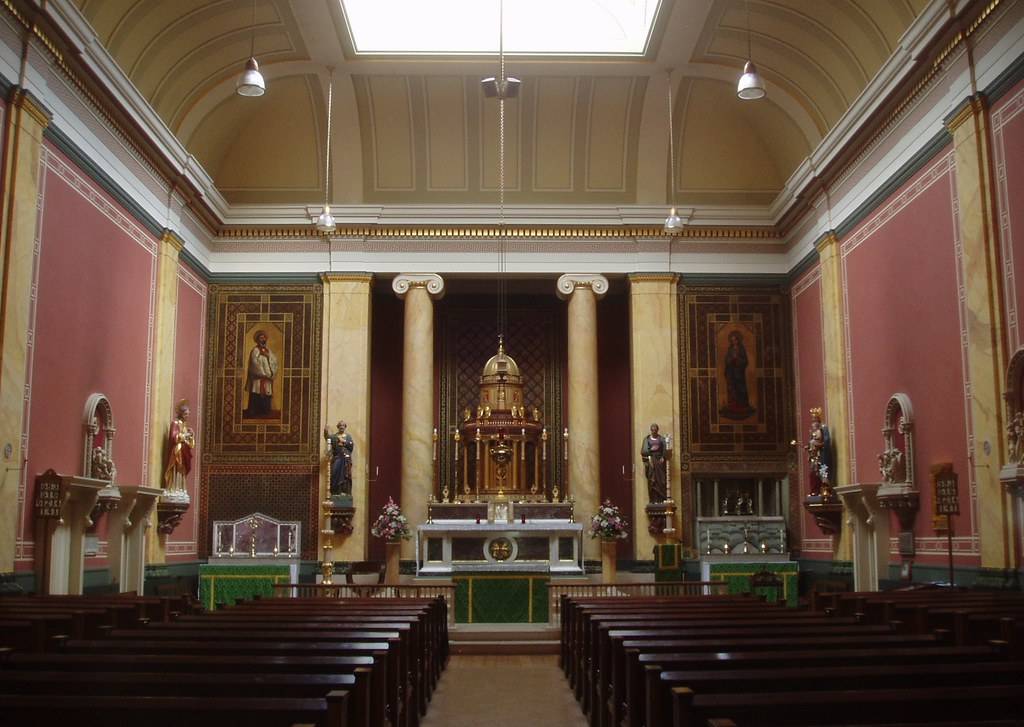
Image result for hereford catholic church

 The interior of St Francis Xavier Hereford
The relic of St John Kemble is at the altar on the right

Image: Flickr

I have visited the church before and it is beautifully appointed and cared for. It is in the care of the monks of belmont, one of whom occupies the Presbytery anmd is Pariah Priest
After a bit of shopping in the open market  we set off, past the remains of the Hereford Blackfriars and the unique survival of the Preaching Cross from their graveyard. This is not far from the site of St John Kemble's martyrdom. We did not stop at the Blackfriars and the following notes and illustrations are taken from an online source:

One of Hereford’s hidden gems is the Black Friars Rose Garden hidden down a passageway in Widemarsh Street.  The garden contains the remains of the friary of the Black Friars, once one of the city’s most important religious houses.  The Black Friars were given the site outside Widemarsh Gate in around 1246 and the monastic buildings were consecrated in around 1276.  The Black Friars were also known as ‘Friars Preachers’ and regularly gave sermons to the local populace from their preaching crosses.  The cross in the grounds is one of the few surviving examples in England and was considerably restored in the 19th century.

IMG_0428

In 1538 the Friary was dissolved by Henry VIII and the buildings were converted into a fine town house by Sir Thomas Coningby of Hampton Court near Dinmore.  This was badly damaged during the Civil War and later became a farm building.  The existing ruins are the Refectory and the Prior’s House dating from about 1322.

IMG_0436

In the 13th century the roadside site was occupied by a house of the Knight’s Hospitallers of St. John of Jerusalem, and parts of the hall and chapel dating from this period are now incorporated into the almshouses built by Sir Thomas Coningsby in 1614.  Grouped around a quiet quadrangle, the twelve separate lodgings were formerly used to accommodate a chaplain and eleven retired soldiers, seamen or servants who were known as ‘The Coningsby Servilors’.

IMG_0429

The preaching cross and monastic ruins are now set in an attractive rose garden

Text and images;shawsseasonalliving.

We called in at a pub for lunch, before our final stop at the church at Stanford Bishop near Bromyard.


Image result for Stanford Bishop church

 Stanford Bishop church

Image: Birmingham Post

This is an intriguing place and raises all manner of historical and archaeological questions. The parish is a scattered community and the church stands by itself on a low eminence. Dedicated to St James it  is not mentioned in Domesday Book, and the present, rather plain structure is mid- to late-twelfth century, when the cult of St James was at its height. There is more about work of that period at St James, Stanford Bishop, Herefordshire · The Corpus of Romanesque Sculpture

However what we had come to see is claimed to be much older - the chair of St Augustine, in which he sat - and continued to sit rather than rise - at his fateful and futile meeting with the British bishops in 603.

http://www.catexpert.co.uk/wp-content/uploads/2012/12/herts-st-augs-chair.jpg 

The reputed Chair of St Augustine

Image: catexpert.co.uk

The story of the chair can be read in an article from the Birmingham Post from 2014 at The battle over a chair once thought to be the oldest in Britain, and from which I quote "The earliest claim for its importance was made in the 1840s. Some years afterwards, the chair was discovered in the church tower, when a restoration of the church was taking place, probably in the 1890s. Later on it was turfed out, and served the church sexton as a piece of garden furniture. Later still (in 1899), when it was recognised that the chair might be of major importance, the church authorities presented it to the Beaney Institute or Royal Museum in Canterbury"

In 1943 it was returned to the church and scholarly opinion at the time thought it might be no earlier than eighteenth century in date.  

This is clearly an ancient site.  There is a prehistoric standing stone by the gate into the churchyard and within an ancient yew - there is more about these at  Stanford Bishop Church Stone Standing Stone (Menhir) It may have once been the site of circle, or perhaps a place of assembly. It lies close to the county boundary with Worcestershirewhich is essesntially the same as that between the seventh century sub-Kingdoms of the Hwicce ( represented by Worcestershire, Gloucestershire and part at lease of Oxfordshire - Hwicce as in Wychwood ) and the Magonsaeten ( the medieval diocese of Hereford ). If the ill-fated meeting did not take place at Aust on the banks of the Bristol Channel, as is usually claimed, could it have taken place ata  recognised place of meeting near the borders of two tribal units? looking around from the slightly raised site occupied by the church it is a tempting hypothesis. Time to get the a dendrochronologists to work I suspect.

We travelled back across Worcestershire - a subtly different landscape from that of Herefordshire - and had time to look slightly wistfully as we drove past at the remains of Pershore Abbey in the middle of that attractive town, but had not the time to stop. Pershore was Benedictine, and today just the choir, south transept and central tower of the monastic church survive:

Image result for Pershore abbey

Pershore Abbey from the south east

Image: Wikimedia

Image result for Pershore abbey

 Pershore Abbey from the south west

Image:pershoreabbey.org.uk

Then we continued our journey ascending Broadway Hill with its panoramic view of the county and on home across the edge of the Cotswolds to the Oratory and Oxford - and the chance to collect my mobile phone which has been in for repair, of which I have been physically and emotionally bereft.

This has been a wonderful break both spiritually and recreationally and I am immensely grateful to all who made it possible, Fr Jerome, the community at Belmont, my fellow Brothers and others besides.

Tuesday, 27 May 2014

St Augustine's Abbey Canterbury


Today is the feast of St Augustine of Canterbury, who died in 605. The monastery of SS Peter and Paul which he founded at Canterbury to the east of his cathedral in 598, became his shrine church. In the tenth century St Dunstan added the dedication to St Augustine, which became the name by which the abbey was known, and it became one of the great Benedictine houses of medieval England - indeed the first where the abbot had the right to wear pontificalia, a papal grant made in 1063. There is an online version of a useful illustrated history of the abbey from 1896 here, and a contemporary online account with illustrations and links here

I recall Fr Hunwicke making the point that the plan of Christian Canterbury was arguably based on that of Rome, with the cathedral church of Christ inside the city as with the Lateran (itself primarily dedicated to Christ) and SS Peter and Paul outside the walls, like the Vatican and St Paul's in Rome, but combined into one in the Kentish city. I cannot find the exact link, but he makes related points about following Roman patterns in Fr Arthur Middleton and my Biretta, a post from 2009.


Other than the fine late medieval gatehouse little of it survives today beyond foundations in the care of English Heritage. Until 1822 however much of one of the western towers of the great romanesque church, known as Ethelbert's tower after the King baptised by St Augustine in 597, survived.


Ethelbert's Tower in 1800

image:anglicanhistory.org


The local historian William Gostling recorded that

"On the morning of the 10th of October, 1822, the S.S.W. corner of the Tower, known by the name of Ethelbert's Tower, comprising about one half of what remained of that venerable edifice, and amounting in weight to many hundred tons, and nearly seventy feet in height, fell with a tremendous crash, cracking by the shock the remaining part, the altitude of which was about one hundred feet, and presenting a grand, but terrifically dangerous appearance. On the Thursday subsequent to the accident, which was occasioned by a tremendous high wind, an attempt was made to pull down that which was left standing, by inserting large timbers through the various fissures; but this trial was extremely futile; a plan of a more formidable kind, (a battering ram) was then adopted, which likewise, in the onset, proved of no avail; but, upon its removal, and being directed in another position, that justly admired and very ancient structure, yielded its majestic head to the force of the machine, in the afternoon of Thursday, October 24th. Its descent was awfully grand, and to the lover of antiquity, grievous. Thus fell an edifice, consecrated by ages, and rendered sacred by its association with some of the most important and intereseting events in our local and national history."

St. Ethelbert's Tower had an internal space about 16 feet square, walls 4 1/2 feet thick. It was erected A.D. 1038-50, and was a fine piece of Norman architecture.

John Bulman, Three drawings of St Augustine's Abbey, Canterbury by John Bulman, 1780 - 1800

Watercolour of St Augustine's Abbey, Canterbury by John Bulman, 1780 - 1800

This was not the only loss in this period. Henry Ward in the Canterbury Guide, published in 1843, records how 

"In the common cemetery which adjoins the church southward, about sixty feet from it, there stood, till lately, a large massive ruin, composed of flint and rubble stone, of an extraordinary thickness, having been to all appearance, two sides of a campanile or bell tower. It was taken down in 1793, by the united efforts of nearly 200 men, the materials, exclusive of rubbish, amounting to nearly 500 cart loads."

With acknowledgements to Machadoinck.com for these quotations 


The remains of St Augustine's Abbey in 1703.
The Ethelbert tower is centre right

 image:anglicanhistory.org

The fate of St Augstine's is reminder of how much has been lost, and indeed how significant remains survived to be recorded by antiquarians but are lost to us other than in their descriptions and drawings.

At Trinity Hall in Cambridge there survives a remarkable piece of late medieval antiquarian information about the abbey. Here is an extract from their blog, which had featured the Canterbury Gospels and their use at the enthronement of the Archbishop of Canterbury:


" One item due to play a key role in the ceremony is the St Augustine’s Gospels (Corpus Christi College MS286). This magnificent manuscript is a vulgate text of the Gospels of Matthew, Mark, Luke and John and was probably brought to England by St Augustine in 597. The practice of using St Augustine’s Gospels for the enthronement of the Archbishops of Canterbury was revived in 1945. The Parker Librarian, Christopher de Hamel, will remain in charge of this precious manuscript throughout the ceremony.

St Augustine's Gospels viewed via the Parker Library on the web

St Augustine’s Gospels viewed via the Parker Library on the web

But why is a Corpus manuscript featuring in our Old Library blog and what its connection to Trinity Hall?

The answer lies in one of our own most precious manuscripts Thomas Elmham Historiae Abbatiae S. Augustini (Trinity Hall, Cambridge, MS1) created in about 1410-1413. On one leaf of Thomas of Elmham’s history is a remarkable early plan of the East end of St Augustine’s Abbey. It is finely drawn in red, blue and black and features the chapels of the East end, various reliquaries, the high altar and the altar screen.

Plan of the East end of St Augustine's Abbey (Trinity Hall Cambridge MS.1)

Plan of the East end of St Augustine’s Abbey (Trinity Hall Cambridge MS.1)

“At the top of the screen are six books identified by a small inscription as the books sent from Pope Gregory (the Great) to Augustine”. The entry in the Cambridge Illuminations exhibition catalogue continues, “It is intrinsically probable that they included the St Augustine’s Gospels.” Thus our manuscript contains the earliest depiction of the Gospels used for the enthronement of the new Archbishop! As one of the holiest works in Britain it is more than likely that St Augustine’s Gospels were kept as an object of veneration with other sacred texts above the high altar of the Abbey.

The six books above the high altar of St Augustine's Abbey

The six holy books above the high altar of St Augustine’s Abbey

The Abbey was destroyed during the dissolution of the monasteries and remains a ruin today. The monastic library was dispersed and its manuscripts came onto the open market. Our manuscript was collected by the antiquarian and Catholic sympathizer, Robert Hare (d. 1611), who was a great donor not only to Trinity Hall but also to the University Library. Thomas Elmham’s Historiae Abbatiae S. Augustini came to us as a result of Hare’s friendship with Henry Harvey (Master of Trinity Hall 1559-1585) and has been a treasured by the College ever since.

Robert Hare's signature

Robert Hare’s signature


Source:oldlibrarytrinityhall.wordpress.com

Here is an engraing of part of the Thorne plan, showing the High Altar and its reliquaries , and which is a very important source for what was the appearance oif the interior of major monastic churches. Its influence can be seen in some of the twentieth century works of that great designer Sir Ninian Comper.

Image:ljudmila.com