Once I was a clever boy learning the arts of Oxford... is a quotation from the verses written by Bishop Richard Fleming (c.1385-1431) for his tomb in Lincoln Cathedral. Fleming, the founder of Lincoln College in Oxford, is the subject of my research for a D. Phil., and, like me, a son of the West Riding. I have remarked in the past that I have a deeply meaningful on-going relationship with a dead fifteenth century bishop... it was Fleming who, in effect, enabled me to come to Oxford and to learn its arts, and for that I am immensely grateful.


Showing posts with label Bl. John Henry Newman. Show all posts

Friday, 30 June 2017

Newman arrives in Oxford


It was in late June 1817, two centuries ago, that John Henry Newman arrived at Trinity College in Oxford. He was 16 and had been admitted the previous year and given a reading list to prepare him for his studies as an undergraduate.

He arrived just as most of the University departed for the Long Vacation - which seems strange to modern generations accustomed to the rigorous demands of University and College schedules.

Newman's early experiences and impressions in Oxford are well set out in Joyce Sugg John Henry Newman: Snapdragon in the Wall, an engaging account of his life, first published in 1965 as an introduction for teenagers, but which has stood the test of time and is now published by Gracewing.

Like any other teenager he could have little idea of what life would hold for him, but he certainly could have had no idea or expectation of what indeed was to follow. The studious violin-playing Evangelical was to follow the kindly light on a journey that was surely beyond the wildest imagination in 1817.


Thursday, 10 November 2016

Book launch at Blackfriars


This afternoon I attended a book launch at Blackfriars here in Oxford.

I got to know the author, Andrew Meszaros, when he was studying here in Oxford and after study at Louvain and in Vienna he is now lecturer in systematic theology at Maynooth.


Image: Amazon

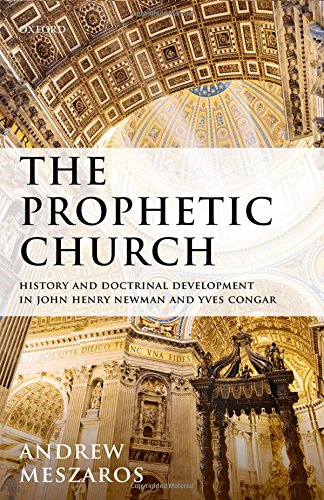
His book is The Prophetic Church: History and Doctrinal Development in John Henry Newman and Yves Congar It is published by Oxford University Press. ISBN 9780198786344

In his book Meszaros argues that dogma is the product of both faith and history, and that in addressing the problems confronting its understanding of its dogmas the Church has always managed to develop the understanding of doctrine in a consistent way.

Fr Timothy RadcliffeOP gave an appreciation of the book and commended it to the audience.

It was a pleasure to meet up with Andrew again and catch up on one another's news.


Saturday, 29 October 2016

LMS Dominican Rite Pilgrimage in Oxford


Today was the Latin Mass Society's Oxford Pilgrimage in honour of the four martyrs of 1589 - the two priests Bl. George Nichols and Bl. Richard Yaxley, and the two laymen Bl. Thomas Belson and Bl. Humphrey Pritchard.

The well attended Mass was celebrated at Blackfriars according to the traditional Dominican Rite by Fr Oliver Keenan OP and the sermon was given by Fr Richard Conrad OP who also served as Deacon.

It was a great pleasure to meet up with my old friend, and indeed my sponsor when I was received as a Catholic in 2005, Br.Andrew from the Birmingham Oratory and some friends of his from the congregation there and to have lunch with them afterwards. I was then able to help Andrew show them around Oxford, concentrating especially on the life here of Bl. John Henry Newman. Being an Oriel man I was fortunately able to show them more of the college than they might otherwise have seen and to talk about Newman where he once lived.

Br. Andrew once paid me the compliment - the great compliment - in  saying he thought I was like Newman in my pursuit of truth, indeed Truth, and which I found a very moving observation.

It was also a pleasure to see Fr Hunwicke and talk to him briefly after the Mass. Although we live in the same city our paths cross far too infrequently.


Sunday, 9 October 2016

Newman celebrations in Oxford


This weekend has seen celebrations of the feast of Bl. John Henry Newman here in Oxford, on the 171st anniversary of his reception into the 'one fold of the Redeemer' by Blessed Dominic Barberi at Littlemore.

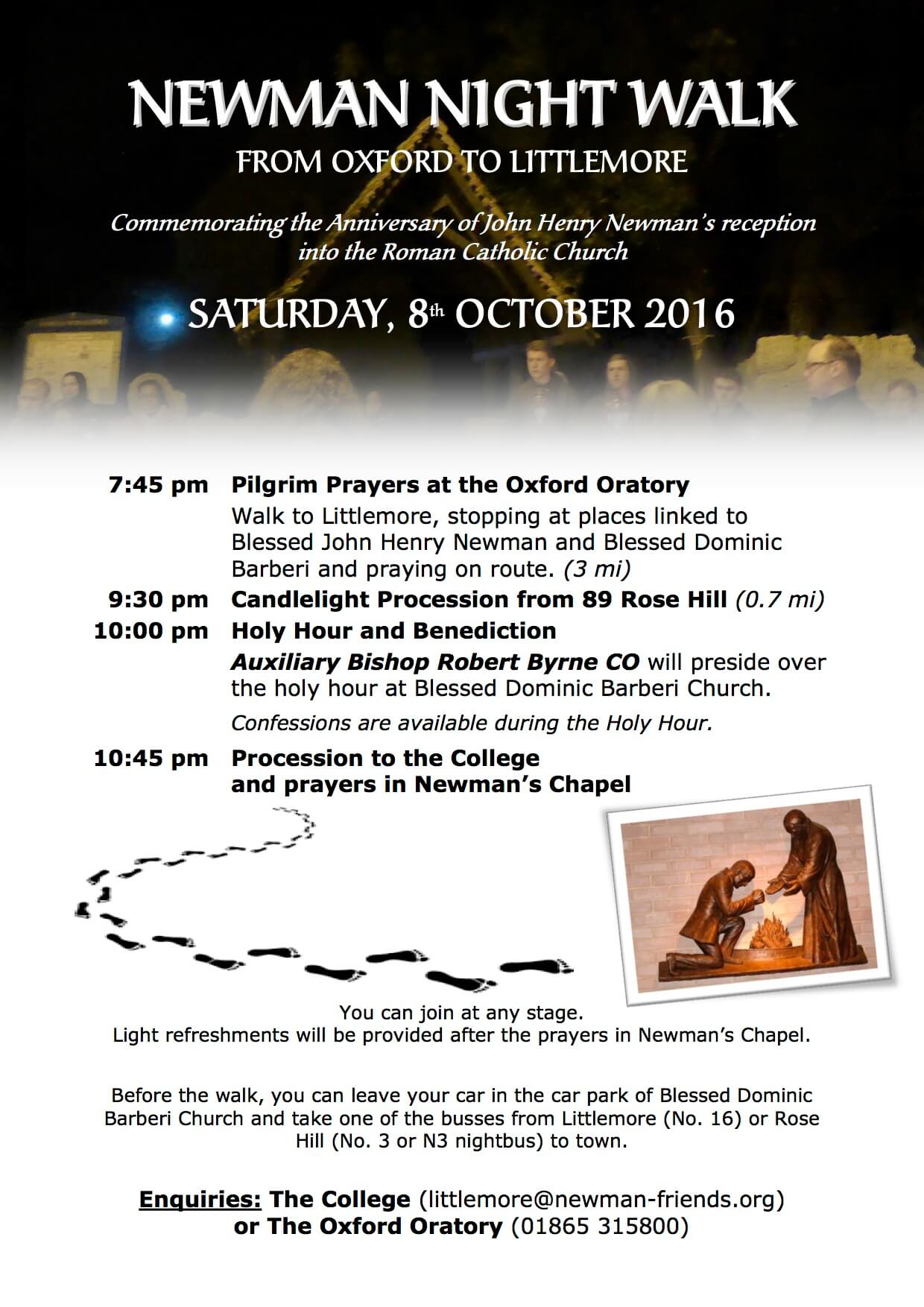
On Saturday night I joined, as I have each year since my own reception in 2005, the traditional Night Walk will take place, beginning at the Oratory at 7.45pm. We followed the more or less usual route to Littlemore, concluding there with a Holy Hour presided over by Bishop Robert Byrne, Cong. Orat., in the modern church dedicated to Bl. Dominic and then finished our pilgrimage in Newman's College with Benediction and veneration of the relic.

With us for part of the walk was Fr Paul Chavasse, Cong. Orat., former Provost of the Birmingham Oratory, and it was intersting to see him standing by the newly installed memorial near Magdalen School to his relative Capt. Noel Chavasse, who was awarded the Victoria Cross twice in the Great War - the later award being posthumous. Only three people have ever been awarded the decoration twice and Noel Chavasse was the only such recipient in World War I.
 
poster-nightwalk-2016
Image: Oxford Oratory website

This morning Bishop Robert celebrated the 11 Solemn Mass at the Oratory, at which Fr Paul preached and based his elegant and thoughtful sermon on a tour of Newman's room which survives as the Cardinal left it at his death in 1890 at the Brimingham Oratory. He stressed the numerous small pictures of his friends with which Newman adorned his room as reminders to pray for them, and urged such a concern for our friends upon us.

http://maryfrancescoady.com/wp-content/uploads/2013/11/Newmans-Room1.jpg

Newman's room at the Birmingham Oratory

Image:maryfrancescoady.com


Tuesday, 19 January 2016

New website about Newman's Idea of a University


Peter Nockles has forwarded to me this message from Paul Shrimpton, whom I also know, and who is based in Oxford:

Many of you may know that in November 2014 my volume on John Henry Newman’s pastoral idea of a university appeared, under the title The ‘Making of Men’: the Idea and Reality of Newman’s University in Oxford and Dublin.

What you probably don’t know is that I have used the book to construct a website which goes by the name ‘Ideaofauniversity’ and that the website was ‘launched’ last week. The ‘launch’ was a very simple affair: four former pupils and one current pupil – the webmaster – came around to Grandpont for Mass (said by former pupil Fr Paul Moss*) followed by lunch, then the launch.

(In case you don’t know what a website launch consists in, we gathered around a computer while I navigated around a few pages.)

The website has around 120 webpages and can be found at: www.ideaofauniversity.website

Please take a look at it and encourage others to do so, too, by passing on the link via Twitter, Facebook, and so on. It is intended for aspiring students, current students, parents of students, academics – indeed all those with an interest in higher education.

Currently the only pages posted are those based on material from my book, but soon I hope that the website will feature other articles about higher education and university life and in that way function as a blog too.

My book continues to receive (positive) reviews – three last month and inclusion in one book-blogger’s top books in 2015 – but at around 560 pages it is too long for most people to read, even for academics, hence the idea of a website.

My conviction is that Newman’s ideas on higher education are as relevant now as they were in his own lifetime (1801-90), so do take a look.

* Deacon of the Gospel at the funeral Mass for Pope John Paul II in 2005.

Tuesday, 11 August 2015

St Philip Neri and Bl. John Henry Newman


Today is the 125th anniversary of the death of Bl. John Henry Newman at the Birmingham Oratory in 1890


Cardinal Newman lying-in-state in the Oratory Church, Edgbaston, prior to his Funeral Mass on Tuesday 19 August 1890.

Image: Valle Adurni


Recently I was asked to answer, as someone who worships at the Oxford Oratory, and who is a Brother of the Secular Oratory, four questions to illustrate or illuminate a school project comparing and contrasting St Philip Neri and Bl. John Henry Newman, and I  thought readers might be interested to see my answers to those:

1) What do you find inspiring in the example of St Philip Neri?

I think what is most inspiring is to understand that it is not the stories of him as practical joker that matter as the "Saint of Joy " but his profound closeness to God - above all in the indwelling of the fire of the Holy Spirit from Pentecost 1544 - and the way in which he brought that Divine Love to the people of Rome. It proved so very attractive to so many.

2) What do you find inspiring in the example of John Henry Newman?

As a convert from Anglo-Catholicism myself ( sand a member of Oriel ) it is first of all his example of pursuing his pilgrimage of Faith, and what an extraordinary journey that was. His intellectual honesty and his concern for souls are also very important, as is his determination to hold to the path he had chosen.

3) What do you think they had in common?

I think that is both their adherence to their personal pilgrimage and their concern for saving souls, be they in Rome, Oxford or Birmingham

4) What do you think it means to be an Oratorian today?

As a Brother of the Secular Oratory and regular worshipped at the Oxford Oratory I think it is a case of living out and working out my own spiritual journey in the light of what they taught and did themselves, and of following on their footsteps - however falteringly. I esteem what they did and established, and in being grateful for that support their continuing legacy in terms of liturgical and devotional life as well as trying to show concern for those I meet in my life.

Thursday, 5 March 2015

Liszt's Via Crucis at the Oxford Oratory


Last night I attended a performance at the Oxford Oratory of Franz Liszt's Via Crucis, a musical following of the Fourteen Stations of the Cross. Interspersed with this were the reading of Bl. John Henry Newman's meditations for each of the Stations.

This was a thoughtful, reflective performance which provided a very suitable Lenten devotion.

Here is abpiece about the Via Crucis from the Oratory website:

57-gesù-caricato-della-croce


Via Crucis is perhaps the closest Liszt came to creating a new kind of church music through combining a new harmonic language with traditional liturgy. While the overall atmosphere is restrained and devout in feeling, the harmony underpinning the music is experimental, including an extensive use of the whole-tone scale. While the composer uses familiar chorale and hymn tunes, the overall impression aurally is of an unsettled tonal language. Three of the 15 numbers (an introduction along with depictions of the 14 Stations of the Cross) employ sliding chromatic lines and harmonies; and when those harmonies do come to rest, they are often diminished or unique. Other Stations use successive chromatic chords and may abruptly end on a single tone.

Image and text: Oxford Oratory website


Saturday, 21 February 2015

Frank Turner on Newman


At New Year I finished reading the late Frank M Turner's study of Newman John Henry Newman: The Challenge to Evangelical Religion, which is published by Yale UP. As today is the anniversary of Newman's birth in 1801 it seems an appropriate date on which to comment on this biography, which covers the first half of Bl. John Henry's life, down to his reception into the Catholic Church in October 1845.

Image: Amazon


When it was published the book caused something of a stir in the circles of Newman scholarship and amongst devotees of the Cardinal, as it was perceived as something of a hatchet job on Newman. Whether that is true or not is a point I shall return to, but the book does self-consciously aim to reinterpret Newman, and seeks to make the point that previous biographers have been overly influenced by the Apologia Pro Vita Sua, and that that work is not necessarily an entirely trustworthy account of Newman's intentions in the 1830s and 40s.

First of all it must be said that this is a very substantial book, and that Prof. Turner in his research had clearly worked through vast quantities of published works and manuscript material by or about the Tractarians. If for no other reason that make his work a valuable addition to Newman studies.

It is an important contribution in that it provides a useful and detailed, indeed valuable, narrative of events to to 1845. Turner brings out much that is insightful about the actual events, and does show, and not merely argue, that the events of the Tractarian enterprise were not as smooth as the Apologia, written twenty and more years later, might suggest.

It is I think the tone, not the content as such, that is the problem in part with book - there are occasionally snide or overly emphasised comments on the motivation of individuals that grate with this reader at least.

This is linked to the question of who it is that Prof Turner saw himself as addressing as his audience. It is seemingly a wide audience, of both scholars of the nineteenth century and those of the Oxford Movement and of Newman - and the groups are not the same.

Reading the book I soon began to feel that Turner did not especially like Newman, if indeed, at all, still less understand the inner processes whereby he was drawn Romewards other than as a rather curious and idiosyncratic career path.

Despite Turner's meticulous work on his sources I would not agree with all his conclusions, especially in his final chapter.

His approach is in many ways too secular. One example can be seen in his exploration of the question as to why Newman did not found his own sect within or alongside Anglicanism in what Turner sees as the religious Market place of the early nineteenth century. This open space for competing religious groups and leaders is an idea he was keen on, and it is not one lacking in merit. However he does not seem to understand the essential call to unity and truth in Newman's spiritual journey, and surely that was Wiseman's point in 1839 in his Dublin Review article. A small community of faithful adherents at Littlemore was not an end in itself, or the beginning of a new venture external to the existing Church (however understood) but rather a way of keeping friends together and seeing if such a shared life had a viable future when lived on its own terms.

Like Geoffrey Faber in Oxford Apostles Frank Turner is, I think, too inclined to psychoanalyse his subject and to stretching these points beyond reasonable interpretations. As a writer Turner was very good at dotting his i's and crossing his t's, but sometimes one felt he was close to ending up crossing his i's and dotting the t's.

Reading the book, and accepting its contention of Newman's concern to maintain orthodox belief - whatever and however he termed his opponants - l found I had increased respect for Newman's prescience and greatness. That may not have been Frank Turner's intention, but the events in the life of the Church of England since 1845 bear out Newman's concerns as to its direction and, ultimately, its validity. That he sought out Rome, even if with often hesitant and faltering steps, in the 1830s and 40s, was a natural consequence of the pursuit of truth.

Reading the book and following that conversion I found it ressonated with memories of my own path to Rome - I recalled similar crises and turning points, similar points of tranquility, similar questions breaking in upon one (if of very much less consequence). That human sympathy for Newman's development made reading the book an insightful process for me, but I am not sure that Frank Turner would have seen it in such a light.


Tuesday, 10 February 2015

Strange thoughts about Newman


I recently read a study of Newman by Msgr Roderick Strange, a former Catholic Chaplain to the University of Oxford and now Rector of the Beda in Rome. Entitled John Henry Newman:A Mind Alive it was published by Darton Longman and Todd in 2008.


Image: Amazon

The book originated in Msgr Strange's interest in, indeed enthusiasm for Newman's work and is based on various articles he has published over the years. For the book he has not just republished them but edited and rewritten to produce a connected account of the Cardinal's thought through his long and varied life.

What results is an extremely useful introduction to the life and ideas of Bl. John Henry, and an account of many facets of his thought and character. It would be very useful for anyone wanting a guide to Newman's life and career, and one that explains points sometimes taken for granted by authors of more substantial studies. In so doing it is also useful for anyone with an existing knowledge of Newman as a succinct series of reflections against which to text one's understanding of the various themes explored.

It can in many ways be no more tham an introduction, but it is more than that term might imply - it provides an excellent series of keys to the often elusive and complex nature of this fascinating man.


Thursday, 9 October 2014

Celebrating Bl. John Henry Newman at the Oratory


Earlier this evening I attended the Solemn Mass for the feast of Bl. John Henry Newman at the Oxford Oratory. The visiting preacher was Fr Paul Keane, Vice-Rector of St Mary's College Oscott. 

After apologising for being a Cambridge man he cited Newman's own, very positive, description of a visit to Cambridge, and spoke of Newman's presence in his own life as a former student of the London Ortory School and of the abiding memory of the Second Spring sermon in the chapel at Oscott.

Then, citing Newman's collection of photographs as aide-memoires in his room and chapel at the Birmingham Oratory and his habit of making lists of people to pray for, Fr Keane urged the importance, the value of making intercessory prayer for friends and strangers alike, and stressed that we may be the only person praying for another at a critical time.

Fr Keane's sermon can be read at Sermon for the Feast of Blessed John Henry Newman

On its website today Rorate Caeli also has a reminder of another key address by Newman, his Bigletto speech of 1879, in a post by Fr Richard Cipolla, which stresses Newman's prescience and significance as a theological and spiritual guide in Blessed John Henry Newman: "I have resisted to the best of my powers the spirit of liberalism in religion."

Wednesday, 27 August 2014

FSSP Newman Pilgrimage


Earlier today I had the pleasure and privilege of guiding some 40 US and Canadian pilgrims around sites in Oxford and Littlemore associated with Bl.John Henry Newman, as well as other places of Catholic and historic interest. This was part of a week long pilgrimage to England organised by the Priestly Fraternity of St Peter, whose website can be seen here.

I admire the energy of the party - so far this week they have visited Walsingham, York, the Birmingham Oratory and Stratford, and have certainly London and Ramsgate to follow.

We began from the Oxford Oratory, going to Trinity where Newman was an undergraduate from 1817 to 1821, to St Mary's, where he was vicar from 1828 until 1843 and to Oriel where he was a Fellow from 1822 until 1845 and his reception into the Catholic Church.

Portrait of John Henry Newman
Bl. John Henry Newman about the time of his reception - a portrait at Keble College

Image: Oriel College website

After a pause for tourist shopping we returned to the Oratory for Mass celebrated by their chaplain, Fr Michael Stinson FSSP. With him, and acting as the server, was one of the Fraternity's seminarians, James Mawdsley, whom readers may recall from his activities as a campaigner for human rights in Burma - there is something about that here. He hopes to be ordained as a deacon next year.

For the Mass and for lunch at a nearby restaurant we were joined by theChairman of the Latin Mass Society, Dr Joe Shaw, who had helped arrange the programme for the group, and indeed suggested me as a tour guide to them.

In the afternoon we travelled down to Littlemore, where Newman built the parish church and school for this outlying part of the parish of St Mary's, and where he largely based himself in the College, which he acquired in April 1842 until he left Oxford early in 1846, and where he was received on October 9th 1845.

The College at Littlemore

The College Littlemore

Image: newmanfriendsinternational.org 

At the College we were welcomed by the Sisters of the Work who administer it on behalf of the Birmingham Oratory.


The garden inside the College

Image: newmanfriendsinternational.org

We had a tour of the library where Newman worked and where he met Bl.Dominic Barberi on the night of October 8th 1845, and the pilgrims were able to receive Benediction in the restored chapel.

This was a particularly appropriate day on which to visit Littlemore as it was the 165th anniversary of the death of Bl.Dominic at Reading in 1849 - his feast day is assigned to yesterday.


Bl. Dominic Barberi

Image:southwarkvocations.blogspot.co.uk

I bade the pilgrims God speed at littlemore and wish them well for the remainder of their stay here in England, and their continuing Christian pilgrimage.


Tuesday, 25 February 2014

Forty Hours at Littlemore this weekend


This coming weekend the Sisters of the Work are organising the Forty Hours Devotion at the College at Littlemore from Friday February 28th until Sunday March 2nd.


chapel
The Forty Hours Devotion
will be held in
in Bl. John Henry Newman's
Chapel at the College in Littlemore,
with prayers for any in need entrusted
to Blessed John Henry Newman’s intercession


Friday February 28th  9am Votive Mass of The Most Holy Eucharist 
followed by Exposition until 9pm

Saturday March 1st  Exposition 7am until 9pm

4.00 pm  Talk by Dr Paul Shrimpton, Magdalen College School, Oxford:

  “Newman's idea of human flourishing at University ”

Dr Shrimpton is the author of A Catholic Eton? Newman's Oratory School (2005) and the forth coming The 'making of men'; Newman's university in Oxford and Dublin (2014)

Sunday March 2nd   Exposition 7am until 9pm


Daily Prayer will be celebrated as follows:
7 am Morning Prayer
12 noon Midday Prayer
5 pm Vespers
8 pm Holy Hour
with meditations and hymns
concluding with Benediction and Night Prayer


Confessions will be available

Images: International Friends of Newman


Monday, 3 February 2014

Celebrating Candlemas


With Candlemas falling at the weekend I, and indeed all the faithful,  had more opportunity than usual to join in celebrations of this lovely feast.

The collects and other prayers as well as the antiphons and other propers are particularly rich and apposite in symbolism - a re-statement of the themes of Christmas and Epiphany at the end of the season of forty days, and full of things to reflect upon.

On Saturday evening I went to the vigil Mass of the Oxford Ordinariate group at Holy Rood. We began with the blessing of candle sin the vestibule - narthex if you will -  of the church and then entered the darkened building in procession as the Newman Consort sang. The Mass was in the Ordinariate Use, which the community here are using at all these Masses until Easter preparatory to an assessment of which forms of the Rite to use on a regular basis.

Talking afterwards some of use reflected whether the ceremonies of Candlemas originate in a dawn
liturgy following a vigil - this would make sense of the bearing of lights, although this was done as a mark of honour at all times in the ancient world. Something I ought to look up in the expert literature.

On Sunday I was at the Oxford Oratory for the 11 am Solemn Mass. This is a special day for the Oratory in that in addition to being Candlemas it is also the anniversary of the foundation in 1848 by Bl. John Henry Newman of the English Oratory. As the Provost, Fr Daniel, and I were agreeing after the Mass it looks as if  Newman chose this feast as it was also the feast day of Oriel, his former college, and he had chosen the Oratorian model as being close in structure to the life of an SCR in an Oxford college.

Following the blessing of the candles we went in procession round the inside of the  church, which was a bit difficult as there was briefly a traffic-jam of the altar party and the faithful at the back of church for a period - the church is not big enough for us all - which is a good sign really.

In the evening we had Solemn Vespers sung by the choir, and more processing - although this time by the officiants and servers only - to have the incensing of the Lady Altar. This was followed by Benediction of the Blessed Sacrament

Afterwards I was talking to two friends who had been to the FSSP Mass at St William of York in Reading in the morning. There they had enjoyed a celebration of Candlemas according to the 1962 Missal with all the ceremonies, including a procession round the outside of the church. As Fr Armand de Malleray had pointed to in his sermon - when the candles had guttered or blown out it was like our difficulties in attempting to live the Christian life, but that the important thing was to continue to do so through the adverse times. A good image of the pilgrim Church. 

All in all this was a very good celebration of Candlemas, rounded off by dinner with a fellow Orielensis and saying the College grace together. 


Tuesday, 1 October 2013

Forthcoming events


For any readers who are able to attend here are some events in Oxford, and in one case London. in October and early November which may be of interest:

Tuesday October 8th Night Walk to Littlemore to commemorate the reception of Bl.John Henry Newman into the Church ( "the one true fold of the Redeemer" ) in 1845. The walk begins at 7.45pm in the Oxford Oratory. 9.30pm Candlelit procession from  Rosehill,  10pm Holy Hour in Bl.Dominic Barberi church, conclusion at The College for devotions in the chapel and refeshments. Lifts are normally available afterwards for the return to Oxford. Always a good occasion to participate in.

Wednesday October 9th  6 pm Solemn Mass in honour of Bl. John Henry Newman at the Oxford Oratory.
  
Saturday October 12th  The Rosary Crusade of Reparation, London. Starting at 2.15pm from Westminster Cathedral, the procession will end at Brompton Oratory with Benediction. More details from: http://rosarycrusadeofreparation.blogspot.co.uk
Friday October 18th- Sunday October 20th Forty Hours Devotion at the Oxford Oratory. A highlight of the year - more details to follow. It is also a busy weekend for those keen on liturgical traditional or devotion:
  
Saturday October 19th Latin Mass Society Pilgrimage to Oxford.The annual pilgrimage in honour of the Oxford Martyrs. High Mass in the Dominican Rite at Blackfriars at 11.00am. This is followed by lunch, then procession, beginning at the end of Cornmarket by the church of St Michael at the North Gate, at 2.00pm. The Pilgrimage will then process through the streets to the site of the martyrdomsof 1589 at the end of Holywell Street, the site of the town gallows, and then returns to Blackfriars for Benediction at 3.00pm. Bring packed lunch or have a pub lunch locally.

Meanwhile there is also on the same day

Saturday October 19th "A Seminar on True Devotion to Jesus through Mary" at Greyfriars in Iffley Road, beginning with Mass at 9.30am and talks from 10 until 1. Refreshments will be provided.

Sunday October 20th 12 noon EF Sung High Mass at SS Gregory and Augustine Oxford.

Sunday October  27th  3pm Church of Bl. Dominic Barberi Littlemore will have the celebration of Vespers with Bishop William Kenney, himself a Passionist, presiding to celebrate the 50th anniversary of Bl. Dominic's Beatification. 

Saturday November 9th  Stabat Mater  - a recital by Camerata of Curiosities at the Oxford Oratory in aid of the Oratory Appeal at 8pm. Music by Bach, Monteverrdi, Grandi and Sances. Tickets for donations fron £10 to £10,000...


Tuesday, 7 May 2013

Pilgrimage to Birmingham


Yesterday I went on a pilgrimage to mark the Year of Faith organised for parishes from the North Oxford Deanery. The idea was to link together visits to places associated with, and indeed the relics, of St Chad, patron of the Archdiocese and cathedral, Bl. John Henry Newman,  and Bl.Dominic Barberi, and to see in them men who had lived by faith.

Our first stop was at the Birmingham Oratory. We joined member sof the congregation in saying the rosary before the  statue of Our Lady, splendidly coped and crowned for May, before Fr Richard Duffield C.O., the main organiser of the pilgrimage, gave a talk about the life of Bl. John Henry and the building of the church - the present structure was erected as a memorial to Newman in the early years of the twentieth century.

photo


The High Altar at the Birmingham Oratory
 
Image: Catholic Church (England and Wales) on Flickr


We then went through to the shrine chapel, the only part of Newman's church to survive, and redecorated in advance of his beatification in 2010. Here we had atime to pray, to view some relics of the Cardinal, including his mitre and crozier and the bull creating him a Cardinal, as well as seeing the modern chasse that contains such few fragments of bone as were found in his grave at Rednall, and which also incorporates the original handles from his coffin. There are mounted so that pilgrims may indeed touch them to establish a tangible, tactile contact with him.


The altar in the shrine chapel of Bl. John Henry Newman

Image:anglicanpatrimony.blogspot

There were too many of us to visit Newman's room, which has been preserved as it was at the time of his death. I have been fortunate enough to do so on three previous visits to the Oratory, and that is very remarkable exprience indeed - it is not areconstruction or redecoration, it is a genuine, undisturbed nineteenth century room, and that of one of the great voices of the age.

I think we could all have spent more time exploring the Oratory church and the other displays about Bl. John Henry, but the exigencies of timing sent us on to the cathedral in the centre of the city for the next stage of our pilgrimage.


photo

The Cathedral and Basilica of St Chad Birmingham

 Image: Simon_K on Flickr


If the Oratory is wonderfully Philippine in its baroque style and decoration, St Chad's cathedral is one of the great workks of A.W.N. Pugin, and built in 1839-41. In recent years a lot of work has been done to restore and reinstate aspects of Pugin's scheme, and the interior is striking and beautiful. like the oratory church, very much a place of prayer.

photo

Interior of St Chad's Cathedral


Aidan MCRae Thomson on Flickr

In the cathedral we had a votive Mass of St Chad, whose relics are preserved in the shrine above the High Altar. and time to look around before having our packed lunch and then back into the cathedral for a group photograph on the steps leading to the altar.

The cathedral has some splendid treasures amongst its furnishings, including late medieval items which were acquired from the Low Countries by Pugin. In the oils chapel is a reliquary with some hair of Bl.John Henry, one of his Cardinal's red zucchettos and his ring.

Either side of the steps leading to the altar are the Coenopium or Ombrellino and the tintinnabulum which indicate its status as a Minor Basilica, and honour granted to mark its centenary in June 1941, and about which there is more here.  

The last stage of our pilgrimage took us north of the city centre to the inner suburb of handsworth and to the Convent of the Sisters of Mercy, and built by Pugin for them in 1841 on land given bt his collaborators the Hardman family. A daughter of the family, Juliana, became the first Mother Superior of the house, and in those early months the foundress of the Sisters, Ven. Catherine McAuley stayed there, before returning to Dublin to die the same year.


http://www.birminghamheritage.org.uk/images/members/stmary.jpg

St Mary's Convent Handsworth

Image: birminghamheritage.org.uk

The convent is typical of Pugin, and was supported not only by the Hardman family but also by his great patron the 16th Earl of Shrewsbury. The church to the east which served as both the sister's church and as parish church was, alas, wrecked by a bomb in 1942, which also destroyed the House of Mercy which had provided shelter for vulnerable women. The descending cloister whuich linke dteh convent and church, atypically Puginesque feature, survives in part, and there are pictures of the lost church - rather like those he designed in Marlow and in Salisbury - on display in the extended house chapel, togetehr with examples of Hardman plate and furnishings.


http://www.english-heritage.org.uk/content/galleries/nuns-and-convent-building/design-by-awn-pugin-for-st-marys-convent-handsworth.jpg

Pugin's original design
Image: English Heritage

In the chapel is a chair and table which were used by Bl. Dominic Barberi when he visited the Sisters as their Extrordinary Confessor. It is also known that Bl. John Henry Newman used to visit the convent as a place of quiet.

Today the conevent continues to work with the local community, serves as a focus for Mercy Associates, and also is a heritage centre, open to visitors, which recounts the history of the Sisters in Handsworth and in the life of the Church and country.

The whole pilgrimage was very enjoyable, and we were blessed with beautiful weather, and the sight of the countryside finally bursting into leaf and flower as we travelled to and from Birmingham.


Monday, 7 January 2013

Showing US Seminarians round Newman's Oxford


Yesterday, for the third year running, I gave a tour of Newman's Oxford to seminarians from the St Paul's Seminary School of Divinity. The visit of twenty or so of them, led by their tutor, Fr Tom Margevicius, on a visit to London, Oxford and Birmingham to learn about Bl. John Henry and his thought has become an annual fixture, and is always a pleasant occasion at the beginning of a new year.
The tour is based around visiting Newman's two colleges,Trinity and Oriel, as well as his parish church of St Mary the Virgin. It is also an opportunity to saying something about Oxford life both in the early nineteenth century and today.

Despite the fading light of afternoon we managed to get round both colleges, their halls and chapels, including the Newman Oratory at Oriel. It also provides an opportunity to explain the thinking behind the Oxford Movement of 1833 and all it achieved.

After the tour we repaired to the Bear, which claims to date from 1242 as a hostelry, and boasts a unique collection of ties from institutions, clubs and societies for a pint and the opportunity to continue the discussion. I do not know if Newman frequented it at all - perhaps unlikely, but it is the Oriel pub.

The young men from St Paul are always good candidates for the priestly life and with a genuine willingness to learn about Newman and his life. I wish them and their colleagues well.


Monday, 8 October 2012

Ordinariate evensong at Spanish Place


Yesterday afternoon I travelled up to London to attend the Ordinariate Solemn Evensong and Benediction to mark the external feast of Bl. John Henry Newman at St James Spanish Place. As with previous Ordinariate liturgies at the church this was a fine occasion.


photo

The interior of St James Spanish Place

Image:simon_white on Flickr

St James' is a very fine church indeed - I got the feeling that this what the great churches of the English middle ages would still have been like if it had not been for the disasters on the mid-sixteenth century. So, despite its origins as the Spanish Embassy chapel and the hadsome nreminders of that inheritance, this felt like patrimony.

The choir sang beautifully and the ceremonial was dignified - although, as I have written before, I have come to genuinely prefer the traditional Catholic structure of Vespers and Compline rather than the Anglican combination of the two.

The sermon was preached by Fr Daniel Seward, Provost of the Oxford Oratory as the advertised preacher, Fr Paul Chavasse from the Birmingham Oratory, was unable to attend due to illness. This was a fine homily, linking Newman's theological contribution and personal search for holiness with the forthcoming Year of Faith and its application to daily Christian living.

Following prayers for the work of the Ordinariate to the exposed Blessed Sacrament and Benediction the service concluded.

Afterwards there was areception in the Social centre under the church and an opportunity to catch up with old friends from Oxford  who are now based in Londobn and to hear their news  and learn how other Ordinariate groups are faring. I received some compliments on this blog from readers - which I appreciated. I also had some banter with Mgr Newton, the Ordinary, about which faction of the Oxford Newman Society my tie represented (this is a highly technical and complicated matter which insiders will appreciate, and others would, probably rightly, think pointless...) and also a conversation with Mgr Robert Mercer.

When photographs of the service are available I will post a link to them.

As always on these large Ordinariate occasions I came away with a confidence in what has been achieved and the promise it holds for the future.

Then, in best Oxford tradition, I moved on from the drinks reception to meet another Oxford friend who lives nearby and to have a drink with him in a nearby pub... ah, the pleasures of church going and friendship!


Monday, 1 October 2012

The feast of Bl.John Henry in Oxford


The Oxford Oratory will begin its celebrations of the feast of Bl. John Henry Newman  with a Triduum of prayers on Saturday October 6th and Sunday October 7th at 6, and on Monday October 8th at 6.30.
Following that on the evening of Monday October 8th there will be the annual Night Walk to Littlemore to commemorate the journey of Bl.Dominic Barberi to receive Bl. John Henry Newman into the Church.
The pilgrimage begins at the Oxford Oratory at 7.45, pausing for readings and prayers at places associated with Newman. At 9.30 there will be a candlelit procession from 89 Rose Hill to the church of Bl. Dominic Barberi in Littlemore for a Holy Hour with Exposition beginning at 10, during which Confessions will be available. Following Benediction, at 10.45 the pilgrims will process to the College at Littlemore to conclude in Newman's Chapel there. Refreshments are available afterwards at the College.


Bl John Henry Hewman asks Bl Dominic Barberi to receive him into the Church

Image: Bl Dominic Barberi church website on Communigate

This is always an enjoyable and interesting occasion, as well as a prayerful one.

On the evening of Tuesday October 9th there will be a Solemn Mass at the Oxford Oratory to mark the feast day of Bl. John Henry at 6.

Friday, 17 August 2012

Walking round Catholic Literary Oxford


Yesterday I gave a walking tour on the theme of Catholic Literary Oxford. I had been asked to do this by my friends who run Second Spring Oxford, which organises a summer school on Catholic culture each year. Having been told that the participants, from the US and from Chile, were particularly interested in J.R.R. Tolkien we started at the Eagle and Child (the "Bird and Baby") where Tolkien used to meet with the other Inklings, including C.S.Lewis and Charles Williams, in the 1930s and 40s to discuss their literary interests.

From there we looked in at St John's College, the alma mater of St Edmund Campion, before moving on to Balliol, the college of Cardinal Manning (no mean wordsmith himself), Gerard Manley Hopkins and that somewhat problematical Catholic Graham Greene. Balliol was also the undergraduate college of Ronald Knox, who went on to become the Anglican chaplain of Trinity, which is next door, on the eve of the Great War. It was in those years that he established himself as a leading Anglo-Catholic preacher and was a great influence in the spiritual life of Harold Macmillan. It was not far away in the Sheldonian Theatre that Knox gave his final public address, the Romanes Lecture, a few weeks before his death.

Trinity is, of course, the undergraduate college of Bl. John Henry Newman, and we took time to visit the chapel and to look at the outside of one of the rooms he occupied there and also the modern memorial bust of him as a Cardinal in the grounds.

Across Broad Street is Exeter, the college originally intended for Newman, and that of Tolkien from 1911-15. From there we walked round to Radcliffe Square to look at Hertford, Evelyn Waugh's college, and to talk about the sources for characters in Bridehead Revisited .

We managed to get into the building site that is currently the interior of the St Mary's University Church to try to see the pulpit from which Newman preached before crossing the High to Oriel, where Newman was a Fellow from 1822 until 1845. This being my own college I was able to take the party inside to show them where he had lived, before going round to Merton, which also has Newman links, but which was Tolkien's base as Professor of English from 1945 until 1959.

By walking into Christ Church Meadow we could view Lewis's Magdalen to the east before going to look at the outside of the Catholic Chapliancy, home to Mgr Knox in the 1920s and 30s, and pointing out Campion Hall - partly funded by Waugh's biography of St Edmund - and Pembroke College where Tolkien was Professor of Anglo-Saxon from 1925-45.

In a relatively short time we were able to cover a good selection of places of interest and a variety of authors. I hope my audience enjoyed their morning, and I certainly enjoyed meeting them.