Once I was a clever boy learning the arts of Oxford... is a quotation from the verses written by Bishop Richard Fleming (c.1385-1431) for his tomb in Lincoln Cathedral. Fleming, the founder of Lincoln College in Oxford, is the subject of my research for a D. Phil., and, like me, a son of the West Riding. I have remarked in the past that I have a deeply meaningful on-going relationship with a dead fifteenth century bishop... it was Fleming who, in effect, enabled me to come to Oxford and to learn its arts, and for that I am immensely grateful.


Showing posts with label Dominican Rite. Show all posts

Thursday, 4 May 2017

A rather Old Rite Bank Holiday


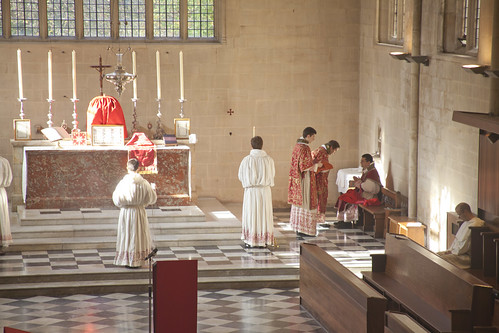
This last few days over the Bank Holiday and since I have been able to enjoy something of a festival of traditional liturgy, or indeed, liturgies.

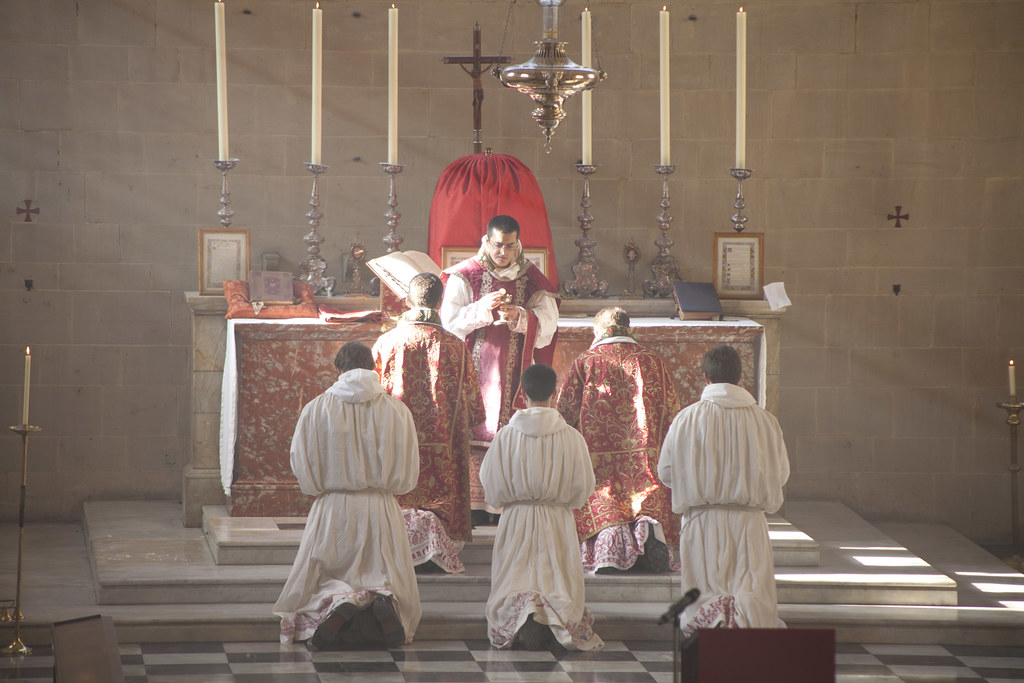
Last Saturday I was at Blackfriars here in Oxford for a celebration of the Dominican Rite by Fr Oliver Keenan O.P. - a young priest whom I had the privilege of teaching medieval church history in 2013.

On Sunday I travelled with a friend to Reading for Mass at the FSSP church of St William of York, so here was the 1962 Rite celebrated , and when we returned to Oxford we were able to go, as usual to traditional Vespers at the Oxford Oratory.

Monday saw another Dominican Rite Mass, this time at SS Gregory and Augustine, and celebrated by Fr Matthew Jarvis O.P., again a fine young priest from Oxford Blackfriars and whom I know from our membership of the committee of Churches Together in Central Oxford.

Today, Thursday, there was a celebration of a High Mass from the 1962 Missal for the feast of the English Martyrs at the Oxford Oratory - this is, of course in effect 'the Mass the Martyrs died for.' Given that historic claim it is a pity that some of the more vocal enthusiasts for the Traditional  Liturgy were not there. I appreciate that not everyone can get to every such celebration, but I sometimes sense that some do not try as hard as others to support public celebrations of something they hold so dear.


Saturday, 29 October 2016

LMS Dominican Rite Pilgrimage in Oxford


Today was the Latin Mass Society's Oxford Pilgrimage in honour of the four martyrs of 1589 - the two priests Bl. George Nichols and Bl. Richard Yaxley, and the two laymen Bl. Thomas Belson and Bl. Humphrey Pritchard.

The well attended Mass was celebrated at Blackfriars according to the traditional Dominican Rite by Fr Oliver Keenan OP and the sermon was given by Fr Richard Conrad OP who also served as Deacon.

It was a great pleasure to meet up with my old friend, and indeed my sponsor when I was received as a Catholic in 2005, Br.Andrew from the Birmingham Oratory and some friends of his from the congregation there and to have lunch with them afterwards. I was then able to help Andrew show them around Oxford, concentrating especially on the life here of Bl. John Henry Newman. Being an Oriel man I was fortunately able to show them more of the college than they might otherwise have seen and to talk about Newman where he once lived.

Br. Andrew once paid me the compliment - the great compliment - in  saying he thought I was like Newman in my pursuit of truth, indeed Truth, and which I found a very moving observation.

It was also a pleasure to see Fr Hunwicke and talk to him briefly after the Mass. Although we live in the same city our paths cross far too infrequently.


Saturday, 19 September 2015

Dominican Rite Mass for St John Macias


Yesterday evening I attended with a friend the 6pm Mass at SS Gregory and Augustine here in Oxford. Instead of the usual Friday evening celebration of the EF the liturgy was the traditional Dominican rite, celebrated by Fr Richard Conrad O.P.

September 19th is the feast of the Dominican lay brother St John (Juan) Macias, 1585-1645, of whom there is a biography here.

St John Macias

Image: lasagradaexpedicion.weebly.com

St John, who was canonized in 1975, and having been born in Spain, worked feeding the poor in Lima in Peru. Fr Conrad recounted in his homily how the saint trained his donkey to go to the houses of benefactors by itself and to wait until gifts of food were placed in the panniers on its back. His canonization followed from a miracle in the twentieth century - a Spanish priest's housekeeper was accustomed to cook and provide meals for the poor on a daily basis. On one occasion she found she had only a few grains of rice and invoked the then Bl. John Macias' aid. The resulting, overflowing multiplication of rice was attested to be many independent witnesses.

I have attended the Dominican Rite celebrated by Fr Conrad in its Solemn form at Blackfriars here in Oxford on LMS Pilgrimage days, but this was the first opportunity I had to attend it in the Low form. The differences in form from the EF are not many - the most obvious being the preparation of the chalice at the beginning of the liturgy - as in the Sarum Use -  and we were provided with very clear service booklets. The Mass wasa quiet and meditative one - ideal at the end of a day -  and one came away feeling refreshed but also privileged not just in attending  Mass at all, but one in so venerable and elegant a form.


Monday, 27 October 2014

Oxford LMS Pilgrimage


Last Saturday the Latin Mass Society held its annual Oxford Pilgrimage. This year it commemorated Bl.George Napier, or Napper, a local man, born in the city in 1550, who suffered martyrdom at Oxford Castle for being a priest on November 9th 1610. He was beatified in 1929. The account of his life from the 1913 Catholic Encyclopedia can be read at Ven. George Napper

We had a Solemn Mass in the traditional Dominican Rite celebrated in the church at Blackfriars. It was rather a pity that the numbers were not, I think, as good as in previous years for this rare occasion to see the Dominican liturgy being celebrated. This is a form of Mass with close similarities to the Use of Sarum, and certainly would have been celebrated in medieval English Dominican houses. I know some regular attenders had other commitments, but such an event should draw in new recruits if the ideals of the LMS are to be diffused more widely.

The Chairman of the LMS was not only organising and singing as part of the schola but was also busy photographing the Mass and the other events of the day.


IMG_0491

photo


Images: Joseph Shaw on Flickr

His complete set of pictures are available on Flickr at:

Oxford LMS Pilgrimage 2014

After a break for lunch we reassembled at Carfax with a processional cross, a statue of Our Lady of Walsingham and the Banner of the LMS to go to the remains of the castle and the site of Bl. George's imprisonment and martyrdom. As we went along through the Saturday afternoon shoppers we sang the Great Litany. At the plaque, itself unveiled on a previous Pilgrimage in 2010 by Archbishop Longley, marking the site of the martyrdom, we sang the Te Deum.


On the way back from the castle along Worcester Street (negotiating the roadworks as we went along) we sang Faith of Our Fathers and the Song of the English Zouaves ("Aniraa mia, anima mia, Ama Dio e tira via.") from the 1860s. As this is less well known I have retrieved the text from the Internet and will reproduce it:

Saint George and old England for ever!
Once more her sons arm for the fight,
With the cross on their breasts, to do battle
For God, Holy Church, and the right.
Twine your swords with the palm branch, brave comrades,
For as Pilgrims we march forth to-day ; —
Love God, O my soul, love Him only,
And then with light heart go thy way.

We come from the blue shores of England,
From the mountains of Scotia we come.
From the green, faithful island of Erin, —
Far, far, from our wild northern home.
Place Saint Andrew's red cross in your bonnets.
Saint Patrick's green shamrock display ; —
Love God, O my soul, love Him only.
And then with light heart go thy way.

Dishonour our swords shall not tarnish.
We draw them for Rome and the Pope ;
Victors still, whether living or dying.
For the Martyr's bright crown is our hope ;
If 'tis sweet for our country to perish.
Sweeter far for the cause of to-day ; —
Love God, my soul, love Him only.
And then with light heart go thy way.

Though the odds be against us, what matter ?
While God and Our Lady look down.
And the Saints of our country are near us.
And Angels are holding the crown.
March, march to the combat and fear not,
A light round our weapons will play ; —
Love God, O my soul, love Him only,
And then with light heart go thy way.

From Joseph Powell Two Years in the Pontifical Zouaves 1871


Note: I do not know why this speaks of St Andrew's cross as red - red for martyrdom of course, but the saltire is normally depicted white.

We sang the Litany of Loretto as we processed along Beaumont Street past the Ashmolean and so back to Blackfriars for Benediction.

photo

Image: Joseph Shaw on Flickr


Thursday, 7 August 2014

Liturgical Notes for early August


The New Liturgical Movement has two interesting pieces about liturgical customs for these first days of August. One refers to yesterday's lovely feast of the Transfiguration and a particular custom associated with it, which can be seen in Transfiguration of the Lord: Blessing of the Grapes.

The other refers to the forthcoming feast (if you are on the Novus Ordo calendar) or recent one (if you follow older practice) of the founder of the Dominicans, and can be read at Liturgical Notes on the Feast of Saint Dominic.


Monday, 21 October 2013

Oxford LMS Pilgrimage


Saturday was the day of the annual Latin Mass Society's Pilgrimage to Oxfordand once again Mass was offered in the traditional Dominican Rite at Blackfriars by Fr Richard Conrad. The Deacon was Fr John Saward, the priest of SS Gregory and Augustine, but who is also a Dominican tertiary, as well as a tutor at Blackfriars so very much at home in the priory.

The Dominican form of the Mass has many similarities to the Sarum Use, and, apart from a few post-Tridentine additions, very much what  a medieval Dominican in Oxford or throughout the breadth of Christendom would have celebrated and known.  It is very beautiful and it is a delight to see it being made available again to the faithful.

After Mass I went off for lunch with an old friend from the Birmingham Ortatory who had come for the Pilgrimage, and after catching up on news and ideas, we rejoined the other pilgrims by the tower of St Michael at the Northgate, and on the site of the Bocardo prison over the city's north gate, for the Procession. Here my friend was commandeered to act as crucifer as we set off towards the site of the martyrdom in July 1589 of Bl. George Nichols, Bl.Richard Yaxley, Bl.Thomas Belson and Bl.Humphrey Pritchard. This took us past the site of their arrest, the Catherine Wheel inn - now covered by an eighteenth century extension of Balliol - and along Broad Street.
 
Now not only was this a Saturday but it was also Matriculation Day, so there were many fresher students around in sub fusc, gown and mortar board, and the tourist and general public just took us all in their stride as part of the Oxford scene -  which of course we are. 

As is our custom on this occasion, awaiting us at the end of Holywell Street was a gallows with four nooses dangling from it - a temporary but striking feature which is set up on these occasions near the site of the martyrdoms in 1589. Looking at a friend who had been assigned the task of looking after this another mutual friend pointed out that the other was, after all, a Daily Mail reader...

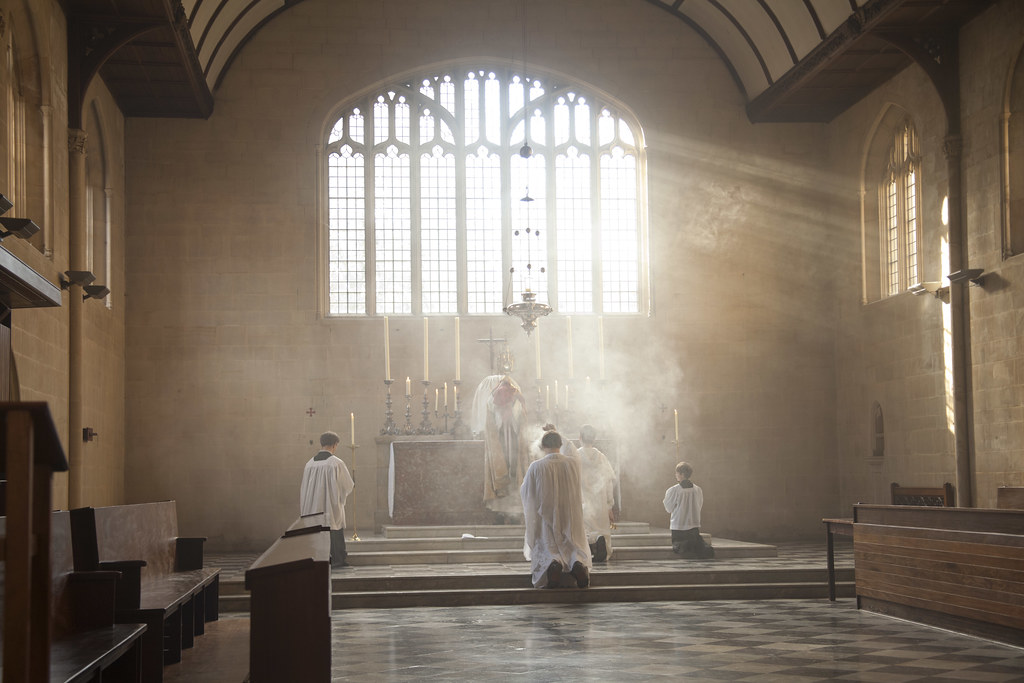
We returned along Holywell to Broad Street and Blackfriars, where we concluded with Benediction in the priory church, the incense rising through the afternoon sunbeams in the sanctuary, and sang the Salve Regina in the Dominican Tone.

There are a series of pictures, both of the liturgy and of the procession, together with a report on the Pilgrimage, and a link to more photographs, on the LMS Chairman's blog at Oxford Pilgrimage: Procession and Benediction.

Afterwards my friend from Birmingham and I revisited one of our old haunts on St Giles - the Eagle and Child - aka the Bird and Baby - to see if the local ale was still up to standard before he caught his train home.

A fine occasion, pious and beautiful, but also gregarious and cheering.


Tuesday, 8 October 2013

Confession and Absolution with the Dominicans


The New Liturgical Movement has another post by Fr Augustine Thompson O.P. about the traditional Dominican usage, this time with regard to Confession and Absolution. Fr Augustine is always an informed and lucid exponent of his Order's traditions. As I go fairly often to Blackfriars in Oxford, and am looking forward to the Traditional Dominican Mass there on October 19th, and as I also have a continuing interest in the history of the medieval Dominican house in my home town of Pontefract, I am always attracted to his posts. This latest one can be read at Penance According to the Dominican Rite.


Saturday, 5 October 2013

The Last Gospel in the Dominican Rite


Given that the forthcoming Latin Mass Society Oxford Pilgrimage on October 19th will have a celebration at Blackfriars of the traditional Dominican Mass a post yesterday on the New Liturgical Movement is of interest. It is by Fr Augustine Thompson O.P., and can be read at The Last Gospel in the Dominican Rite, and relates the history of this part of the Order's liturgy.


Wednesday, 13 February 2013

Re-burying King Richard III


In a comment on my post The King under the car park a friend asked me my views as to where the newly identified bones of King Richard III should be buried, and whether, as some want, he should have a state funeral.

Given that his bones have been in Leicester since 1485 it seems reasonable to leave him there, and, as the proposal stands, to bury him in the city's Anglican cathedral. The cathedral already has a modern ledger stone in memory of him, and the Greyfriars site is in the parish.


Leicester Cathedral 

Leicester Cathedral 
The building is medieval, but much restored, and the tower and spire date from 1862

Image:cathedralexhibition.co.uk

I am not sure where the idea that he wanted to be buried at York comes from - I doubt if it is at all accurate. Queen Anne was buried at Westminster, but where King Richard himself thought he might be buried is unclear. Westminster is likely, but both his brother King Edward IV and King Henry VI are at Windsor - though for differing reasons he might not have wanted to be with them.


The present memorial  placed in the choir of the cathedral in 1980

Image: calmaxinengland.blogspot.com


Whatever was done with his interment in 1485 - he rather looks to have been bundled into his grave - King Richard has had a funeral already.

A State Funeral has, I gather been ruled out by the Queen, and to hold such an event would, frankly smack of  a stunt, though some peopel writing in the press, such as Andrew Roberts, appear to favour such a thing. As others have pointed out there remain unresolved issues as to how King Richard came to the Crown, and of various of his actions in respect of relatives, erstwhile friends and opponants. You do not have to go from not doubting the version of his career presented by Shakespeare in a play a century later than the King's death to believe the more extravagant claims of his modern partisans, who manage, at times, to present him as a virtual candidate for canonisation.

The proposed form of service at the reburial in the cathedral next year is an ecumenical one. Now this does raise issues. Ecumenism was not a big issue for King Richard III or his contemporaries. Leicester cathedral is part of the established national church, but Richard was a Catholic - and he would expect Catholic Rites. Given Leicester's Lollard tradition in the preceding century he might have been very cool towards "ecumenical" services with their successors.

Given that the cathedral is part of the national body established by his great-nephew in the 1530s I imagine some sort of compromise liturgy is inevitable. The unknown sailor from the Mary Rose received a Sarum Requiem in the Anglican cathedral in Portsmoth, but in 1545 the country was not in communion with Rome.  A deceased fifteenth century King does deserve the liturgies and practices he would have known. That would mean a Requiem - and as Desmond Seward points out in his book  Richard III; England's Black Legend, this was a man with a strong penchent for establishing requiems for the departed, including those for whom he might well be held accountable for their deaths.

Despite what Cranmer says in the BCP there does not appear, acording to the latest thinking, to have been a seperate Lincoln Use, but rather a local varient on Sarum in the diocese in which both Bosworth and Leicester lay. So a Sarum Requiem celebrated by a Catholic seems to be called for, or at least a modern OF or EF Requiem. I have heard that Bishop Macmahon of Nottingham has expressed his willingness to celebrate a Requiem for King Richard III. As the Bishop is a Dominican maybe a traditional Requiem in the Dominican Rite would be suitable.

On a different point, it is noteworthy how much interest has been raised by the discovery of the King's skeleton. That must be good for encouraging awareness of the fifteenth century in the wider public.


Monday, 22 October 2012

LMS Pilgrimage Mass and Procession in Oxford


On Saturday I attended the Latin Mass Society's Oxford Pilgrimage, with a Solemn High Mass at Blackfriars in the traditional Dominican Rite, and, in the afternoon, a procession to the site of the martyrdom of Bl.George Napier in Oxford Castle and Benediction, again at Blackfriars.

Dr Joe Shaw, the Chairman of the LMS has now posted on his blog two reports about the day, complete with fine sets of photographs. The first covers the Mass and can be viewed at Oxford Pilgrimage 2012. The photographs show very well the beauty of the Dominican liturgy, which is very similar to the Use of Sarum. The second report covers the procession and Benediction, and can be seen at Oxford Pilgrimage: Procession and Benediction. Those readers who know me should be able to spot me in at least one photograph of the procession.

Here is one of the photographs of the Mass, showing the elevation of the chalice:

IMG_1210

Image:LMS Chairman blog

There is also a report from two years ago of the Pilgrimage Mass, also celebrated in Blackfriars, but on that occasion in the Extraordinary Form, and in the presence of the Archbishop of Birmingham. I am partly (but only partly) including the link out of vanity (sic) as I appear as thurifer in some of the pictures - you have been warned... The article can be seen at LMS Pilgrimage to Oxford 2010.


Monday, 1 October 2012

Latin Mass Society Pilgrimage to Oxford - October 20th


The annual Latin Mass Society Pilgrimage to Oxford will take place on Saturday October 20th.

The Solemn Mass will, as last year, be offered in the traditional Dominican Rite  at Blackfriars at 11. This is a particularly beautiful form of the Mass, and close to the Use of Sarum in its structure and ceremonial.


The Kyrie and Gloria at last year's Pilgrimage Mass
Image: Dominican Liturgy blogspot

 
There are more pictures from last year's Mass here
 
After lunch there will be the usual procession commemorating the Catholic Martyrs of Oxford at 2 and there will be Benediction at 3.


Tuesday, 25 October 2011

Dominican Rite in pictures


Dr Joseph Shaw of the Latin Mass Society has very kindly sent me the link to his set of photographs of the LMS Oxford Pilgrimage last Saturday. He appears to have made a comprehensive record of the Mass, and the set repays study. The 143 photographs certainly convey the beauty of the liturgy, as well as something of the Pilgrimage procession.

photo

The elevation of the Host

Image: Joseph Shaw1's photostream on Flickr


Dr Shaw's own account of the day can be read and viewed at Oxford Pilgrimage photos: Mass and Oxford Pilgrimage: Procession

Monday, 24 October 2011

Dominican Rite in Oxford


On Saturday I took part in the annual LMS Oxford Pilgrimage. The High Mass was celebrated at 11 am in the church of Blackfriars on St Giles, and this year was in the traditional Dominican Rite. I do not know when such a Mass was last celebrated in the church, but I suspect it was forty odd years ago, and it was a wonderful and beautiful occasion.

The celebrant was Fr Richard Conrad, the deacon Fr Thomas Crean and the sub-deacon fr Gregory Pearson, with other Dominicans providing the team of acolytes and thurifer. This was the Mass for which the church was designed, and the dignity and solemnity of the occasion was enhanced by the sunlight streaming in through the windows and the clouds of incense within the sanctuary. One could not imagine a more beautiful way of celebrating the Sacrament, and the consequent ability to be drawn into a prayerful relation with the Divine. It is a precious part of the Dominican heritage, and that of the wider church, and I sincerely hope that it will be celebrated again there in the not too distant future and that others may both witness and benefit by it. I do hope that individual Dominicans and Dominican houses avail themselves of their recently confirmed right to celebrate Mass in this form.

It was very moving to attend Mass in a form with a continuous liturgical history and usage from the thirteenth century, and one which closely parallels the Sarum and other Uses of medieval England, as well as of other monastic orders. Thus it would be largely indistingishable from the Mass as celebrated in, for example, the Dominican friaries in Oxford or in my home town of Pontefract before their dissolution in 1538. There was, of course, something of the liturgical train-spotter about some of us, observing the various features specific or unique to the Rite, but, I hasten to add, it was the totality of the offering which really concerned us, not the minutiae.

The Mass offered was one special to the Dominican Missal - the feast of dedication of all Dominican churches which is assigned to October 22nd - and Fr Conrad preached an elegant and eloquent homily linking the dedication of particular church buildings to the dedication of the believer.

The Pilgrimage was well attended, with some travelling up from the south coast or the south-west to attend. When I can find some photographs online I will post them or links to them.

Following the Mass I had a most enjoyable Italian lunch with my good freinds Andrew Wagstaff of The Noise of the Crusade aka The Last Knight and John Hunwicke, before Andrew and I joined the procession commemorating the Oxford martyrs of 1589. Starting from the site of the Bocado prison adjacent to the tower of St Michael att the Northgate we processed with Fr Crean behind the cross and a statue of Our Lady of Walsingham along the route of the martyrs journey to execution, and past the site of their capture at the Catherine Wheel Inn - now covered by part of Balliol. In warm autumnal sunshine we made our way past tourists and shoppers as well as graduands and their families at a degree day, and the animal rights protesters by the Sheldonian, along Broad Street and Holywell Street to the site of the gallows. Returning the same way we sang the Te Deum in thanksgiving for the martyrs' witness (and, yes, we did genuflect at the appropriate point) and concluded with Benediction given by Fr Crean in the church at Blackfriars.

After that Andrew and I had our own nostalgic pilgrimage to the Eagle and Child (aka the Bird and Baby) before joining other pilgrims - including Paul Smeaton of Smeaton's corner and Sean Wright of Juventutem Oxford- in the Lamb and Flag for further refreshment. After this Andrew and I adjourned to the bar of the Oxford Union before heading off for supper and his departure on the London coach. So, all in all, a very pious and a very convivial day.

Saturday, 8 October 2011

Latin Mass Society Pilgrimage to Oxford on October 22nd


A fortnight today, on Saturday October 22nd, the Latin Mass Society will hold its annual Pilgrimage to Oxford.

The Mass will be celebrated at 11 am in the church of Blackfriars on St Giles, and we are promised the traditional Dominican Rite. This is a very welcome reassertion of rites and rights.

Lunch will be available in the local hostelries or through the numerous sandwich shops which adorn central Oxford.

At 2 pm there will be the procession with the rosary from the site of the Bocardo prison by the tower of St Michael at the Northgate to the site of the gallows at the far end of Holywell Street where the Oxford Martyrs of 1589 suffered, and are commemorated by a modern plaque, dedicated in 2008. The Pilgrimage is usually marked by the erection of a reconstruction of the gallows at this point to concentrate thoughts.

The Pilgrimage will conclude with Benediction in Blackfriars at 3 pm.

http://farm4.static.flickr.com/3604/3325039351_10ba8e4cc1_z.jpg

The blessing of the memorial plaque at Holywell by Bishop William Kenney on the 2008 LMS Pilgrimage.
A number of the usual suspects were there...

Image: Joe Shaw on Flickr

Thursday, 24 June 2010

Traditional Dominican Liturgy


I have recently discovered through NLM Fr Augustine Thompson O.P.'s blog Dominican Liturgy. This is concerned with all aspects of the ancient Dominican rite, and a valuable resource for historians of the liturgy and the Church as well as for the Blackfriars themselves. It is well worth looking at and I have added it to my blogroll.

My own interest is increased in it by the fact that not only do we have an excellent Dominican house here in Oxford today but one of those little historical projects that I mean to do sometime is a new edition of the history of the medieval Dominican house in my hometown of Pontefract. Founded in 1256 it was closed in 1538, but a local historian produced in the late nineteenth century a study of the house that in its detail was unusual and poneering, basing his research on bequests and other sources. Over a century and a quarter later that could be supplemented by new research in the sources, archeological evidence from the site and by the wider scholarship on mendicant history. This is something I would like to do, and the work of Fr Thompson would be of great assistance.