Once I was a clever boy learning the arts of Oxford... is a quotation from the verses written by Bishop Richard Fleming (c.1385-1431) for his tomb in Lincoln Cathedral. Fleming, the founder of Lincoln College in Oxford, is the subject of my research for a D. Phil., and, like me, a son of the West Riding. I have remarked in the past that I have a deeply meaningful on-going relationship with a dead fifteenth century bishop... it was Fleming who, in effect, enabled me to come to Oxford and to learn its arts, and for that I am immensely grateful.


Showing posts with label Transfiguration. Show all posts

Saturday, 6 August 2016

Transfiguration


 http://media.tcc.fl.edu/webcourses/carnettv/SoftChalk_Files/B6-ChristianityByzantium/fig10-07.jpg


 The recently restored mid- or later sixth-century apse mosaic (c.550-565) in the Basilica of the Transformation in the Holy Monastery of the God-trodden Mount Sinai, St. Catherine (South Sinai governorate)  http://tinyurl.com/p87a6gp

Thursday, 7 August 2014

Liturgical Notes for early August


The New Liturgical Movement has two interesting pieces about liturgical customs for these first days of August. One refers to yesterday's lovely feast of the Transfiguration and a particular custom associated with it, which can be seen in Transfiguration of the Lord: Blessing of the Grapes.

The other refers to the forthcoming feast (if you are on the Novus Ordo calendar) or recent one (if you follow older practice) of the founder of the Dominicans, and can be read at Liturgical Notes on the Feast of Saint Dominic.


Wednesday, 6 August 2014

Transfiguration


Today is the Feast of the Transfiguration.

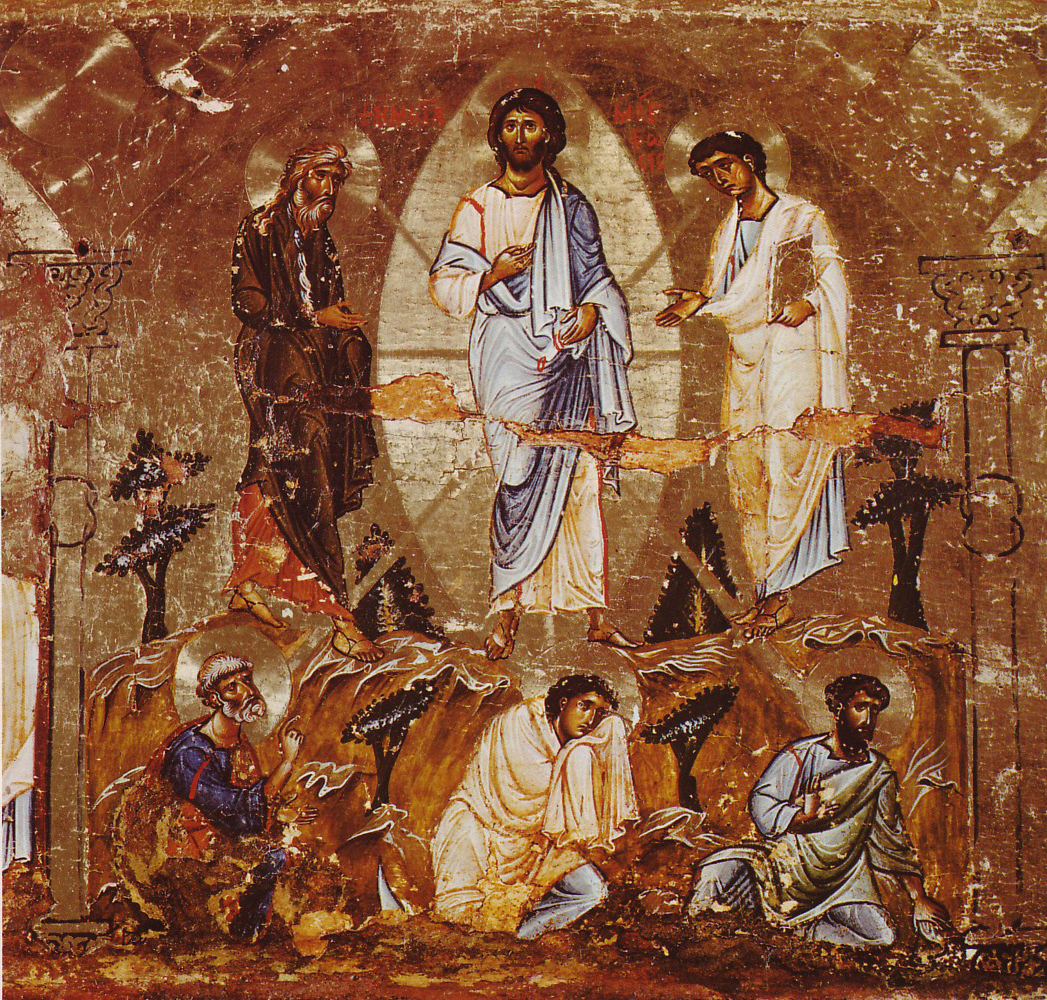
File:Transfiguration of Christ Icon Sinai 12th century.jpg

Icon of the Transfiguration

Mid-twelfth century Constantinople style
St catherine's monastery, Mount Sinai

Image:Wikipedia


There is an introduction to the theology of the Transfiguration here, and an acocount of how it is commemorated in different Christian traditions here.


Tuesday, 6 August 2013

Transfiguration


File:Transfiguration Christ Louvre ML145.jpg

Byzantine portable Icon of the Transfiguration circa 1200

The Louvre

Image; Wikimedia

From a sermon on the Transfiguration of the Lord by Bishop Anastasius of Sinai included in today's Office of Readings

It is good for us to be here
Upon Mount Tabor, Jesus revealed to his disciples a heavenly mystery. While living among them he had spoken of the kingdom and of his second coming in glory, but to banish from their hearts any possible doubt concerning the kingdom and to confirm their faith in what lay in the future by its prefiguration in the present, he gave them on Mount Tabor a wonderful vision of his glory, a foreshadowing of the kingdom of heaven. It was as if he said to them: “As time goes by you may be in danger of losing your faith. To save you from this I tell you now that some standing here listening to me will not taste death until they have seen the Son of Man coming in the glory of his Father.” Moreover, in order to assure us that Christ could command such power when he wished, the evangelist continues: Six days later, Jesus took with him Peter, James and John, and led them up a high mountain where they were alone. There, before their eyes, he was transfigured. His face shone like the sun, and his clothes became as white as light. Then the disciples saw Moses and Elijah appear, and they were talking to Jesus. 
  These are the divine wonders we celebrate today; this is the saving revelation given us upon the mountain; this is the festival of Christ that has drawn us here. Let us listen, then, to the sacred voice of God so compellingly calling us from on high, from the summit of the mountain, so that with the Lord’s chosen disciples we may penetrate the deep meaning of these holy mysteries, so far beyond our capacity to express. Jesus goes before us to show us the way, both up the mountain and into heaven, and – I speak boldly – it is for us now to follow him with all speed, yearning for the heavenly vision that will give us a share in his radiance, renew our spiritual nature and transform us into his own likeness, making us for ever sharers in his Godhead and raising us to heights as yet undreamed of.
  Let us run with confidence and joy to enter into the cloud like Moses and Elijah, or like James and John. Let us be caught up like Peter to behold the divine vision and to be transfigured by that glorious transfiguration. Let us retire from the world, stand aloof from the earth, rise above the body, detach ourselves from creatures and turn to the creator, to whom Peter in ecstasy exclaimed: Lord, it is good for us to be here.
  It is indeed good to be here, as you have said, Peter. It is good to be with Jesus and to remain here for ever. What greater happiness or higher honour could we have than to be with God, to be made like him and to live in his light?
  Therefore, since each of us possesses God in his heart and is being transformed into his divine image, we also should cry out with joy: It is good for us to be here – here where all things shine with divine radiance, where there is joy and gladness and exultation; where there is nothing in our hearts but peace, serenity and stillness; where God is seen. For here, in our hearts, Christ takes up his abode together with the Father, saying as he enters: Today salvation has come to this house. With Christ, our hearts receive all the wealth of his eternal blessings, and there where they are stored up for us in him, we see reflected as in a mirror both the first fruits and the whole of the world to come.

Source: Universalis


Monday, 6 August 2012

Celebrating the Transfiguration


In case you are wondering why we celebrate the Transfiguration today when it has already been commemorated by the liturgy in Lent as part of the lead up to the events of Easter (and I am sure you are) the answer lies in large part in the events of the mid-fifteenth century.

By then the Transfiguration was celebrated in various places, including Rome, on August 6th - presumably at a time of year when it was possible to reflect upon the theological truths of the feast rather than its place in the historical ascent of Our Lord to Jerusalem.

It was in 1456, on August 6th, that news reached Rome of the Hungarian defeat of the Ottomans at the battle of Belgrade on July 22nd. To understand the joy this produced requires a look back at the events of the previous sixty years.

In 1396 the last Western Crusade had ended in a disatrous defeat and in captivity or death for many of the combatants in the Nicoplois Crusade - there is an online article about it here.  In 1444 the Varna crusade led by the King of Hungary and Poland ended similarly in disaster - there are articles about it here and here. Finally in 1453 Constantinope fell to the Ottomans.

Thus in 1456 the news of the victory of the great John Hunyadi over the Ottomans at the battle of Belgrade, which is described here,  suggested that the tide was being held or turned.

Pope Callixtus III
, the other Borgia Pope, made August 6th a universal celebration od the Transfiguration in thanksgiving for the victory and ordered that church bells be rung at midday to commemorate the victory. This is still remembered in the popular mind in Hungary - where July 22nd has, since 2011, been a public holiday - but elsewhere has come to be thought of as the Angelus bell.


Pope Callixtus III 1455-58
Detail from a painting by Sano di Pietro

Image: Wikipedia

For central Europe the victory at Belgrade brought a respite, and under the rule of Hunyadi's son Matthias Corvinus as King from 1457-1490 Hungary witnessed a flowering of art and culture, but in August 1526 came the disaster of the battle of Mohács .

Hunyadi's victory at Belgrade, was to prove but a temporary reverse in the advance of the Ottomans, but it is still one we commemorate on August 6th by celebrating the Tranfiguration.

The Transfiguration


The Transfiguration of Our Lord, which we celebrate today, is a feast which seems rather to have defeated Western artists. There are certainly paintings which are filled with swirling drapery and figures, but their literalism seems to get in the way of the spiritual insight they are hoping to convey. In this case Eastern, Orthodox art, with its more static and staid, hieratic imagery seems to achieve the desired effect and convey the spirituasl truth of an event which was clearly beyond the experience and indeed largely, the comprehension of the Apostolic witnesses. The Eastern tradition was one which, perhaps earlier than in the West, that was well placed to meditate upon the truths revealed upon Mount Tabor.

File:Saint Catherine's Transfiguration.jpg

Mosaic of the Transfiguration
St Catherine's Monastery Sinai
Image: Wikipedia

In keeping with that thought, here, from the modern Divine Office, is part of a sermon by Abbot Athanasius of St Catherine's on Mount Sinai. He began his life as a monk under the rule of Abbot John of the Ladder. After John's death, he succeeded him as  abbot. Besides being a great ascetic, Anastasius was an eloquent author of the lives of the saints as well as instructional writings. He led a bitter struggle against the heretics, the so called Acephalites [Akefalita - Headless Ones], who denied the decisions of the Fourth Ecumenical Council at Chalcedon in 451. He died at an old age in the year 685.

Source: Western American Diocese website


Upon Mount Tabor, Jesus revealed to his disciples a heavenly mystery. While living among them he had spoken of the kingdom and of his second coming in glory, but to banish from their hearts any possible doubt concerning the kingdom and to confirm their faith in what lay in the future by its prefiguration in the present, he gave them on Mount Tabor a wonderful vision of his glory, a foreshadowing of the kingdom of heaven. It was as if he said to them: “As time goes by you may be in danger of losing your faith. To save you from this I tell you now that some standing here listening to me will not taste death until they have seen the Son of Man coming in the glory of his Father.” Moreover, in order to assure us that Christ could command such power when he wished, the evangelist continues: Six days later, Jesus took with him Peter, James and John, and led them up a high mountain where they were alone. There, before their eyes, he was transfigured. His face shone like the sun, and his clothes became as white as light. Then the disciples saw Moses and Elijah appear, and they were talking to Jesus.
  
These are the divine wonders we celebrate today; this is the saving revelation given us upon the mountain; this is the festival of Christ that has drawn us here. Let us listen, then, to the sacred voice of God so compellingly calling us from on high, from the summit of the mountain, so that with the Lord’s chosen disciples we may penetrate the deep meaning of these holy mysteries, so far beyond our capacity to express. Jesus goes before us to show us the way, both up the mountain and into heaven, and – I speak boldly – it is for us now to follow him with all speed, yearning for the heavenly vision that will give us a share in his radiance, renew our spiritual nature and transform us into his own likeness, making us for ever sharers in his Godhead and raising us to heights as yet undreamed of.
  
Let us run with confidence and joy to enter into the cloud like Moses and Elijah, or like James and John. Let us be caught up like Peter to behold the divine vision and to be transfigured by that glorious transfiguration. Let us retire from the world, stand aloof from the earth, rise above the body, detach ourselves from creatures and turn to the creator, to whom Peter in ecstasy exclaimed: Lord, it is good for us to be here.
  
It is indeed good to be here, as you have said, Peter. It is good to be with Jesus and to remain here for ever. What greater happiness or higher honour could we have than to be with God, to be made like him and to live in his light?
  
Therefore, since each of us possesses God in his heart and is being transformed into his divine image, we also should cry out with joy: It is good for us to be here – here where all things shine with divine radiance, where there is joy and gladness and exultation; where there is nothing in our hearts but peace, serenity and stillness; where God is seen. For here, in our hearts, Christ takes up his abode together with the Father, saying as he enters: Today salvation has come to this house. With Christ, our hearts receive all the wealth of his eternal blessings, and there where they are stored up for us in him, we see reflected as in a mirror both the first fruits and the whole of the world to come.
 Source : Universalis
File:Transfiguration of Christ Icon Sinai 12th century.jpg
Mid-twelfth century icon in Constantinople style
St Catherine's Monastery, Mount Sinai
Image: Wikipedia