Once I was a clever boy learning the arts of Oxford... is a quotation from the verses written by Bishop Richard Fleming (c.1385-1431) for his tomb in Lincoln Cathedral. Fleming, the founder of Lincoln College in Oxford, is the subject of my research for a D. Phil., and, like me, a son of the West Riding. I have remarked in the past that I have a deeply meaningful on-going relationship with a dead fifteenth century bishop... it was Fleming who, in effect, enabled me to come to Oxford and to learn its arts, and for that I am immensely grateful.


Showing posts with label St Chad's Cathedral Birmingham. Show all posts

Monday, 2 March 2015

St Chad's Day


Today is the feast of St Chad, who died in 672, and who is seen as the Apostle of Mercia, founder of the ancient see of Lichfield and patron of the Catholic archdiocese of Birmingham. His surviving relics are now housed above the High Altar in St Chad's Cathedral. The cathedral website has a piece about them and their survival at The Relics of St Chad.


The reliquary containing the bones of St Chad in front of the altar at the
Metropolitan Cathedral and Basilica of St Chad, Birmingham,
on the Solemnity of St Chad, March 2nd.
Image:clasmerdin.blogspot.com 


Many churches, both medieval and modern are under his patronage in the counties of the west midlands and Lancashire, the southern half of which was in the Lichfield diocese until 1541. I have posted about some of them previously in my post Churches of St Chad.

This year the church of St Chad at Uppermill in the moorland township of Saddleworth, historically in Yorkshire until the mangling of boundaries  in 1974, but looking more towards Lancashire in terms of its local economy, is celebrating its 800th anniversary, originating as a chapel established by Whalley Abbey. The parish website is at St Chad's (Uppermill) — Saddleworth Churches.

Saddleworth was the one piece of Yorkshire not in the medieval diocese of York, but in that of Lichfield and its successor dioceses of Chester and Manchester. 

Saddleworth Church (St Chad's)
 
Saddleworth Parish Church of St Chad
 
    Image: Geograph/© Copyright David Dixon and licensed for reuse under this Creative Commons Licence.


The church as it is today is a rebuilding of 1831-33, and typical of the style known as a "Waterloo Church." The smaller previous building, which looks to have been largely seventeenth and eighteenth century in date, the tower being rebuilt in 1746, can be seen below:


Rushcart Festival at Saddleworth Church, Yorkshire 

Painted circa 1826 by John Holland before the old church of St Chad was rebuilt from 1831 to 1833. This depicts the annual rushbearing ceremony, which has  recently been revived when rushcarts processed from the various villages and assembled outside the church. 

Image: Saddleworth Museum/BBC My Pictures website


There is more about the history and revival of the of the Saddleworth Rushcart here, and about the Rushcarts in general here.

It was at St Chad's that many of my ancestors must have worshipped before my branch of the family (and there are many branches of the Whiteheads in Saddleworth) became Wesleyan in the late eighteenth century, and eventually moved away to Manchester. The man who was the apparent founder of our family in Saddleworth, Henry Whitehead, sometime bailiff of the lands of Roche Abbey there, was recorded in the 1546 Chantry survey as one of the Churchwardens of St Chad's. I wonder how much his experience of parish life in those years mirrored that of The Voices of Morebath?

Tuesday, 20 May 2014

More photographs of Bishop Byrne's Episcopal Ordination


My friend Irim posted some links to other photographs of last week's episcopal consecration of Bishop Byrne in the comments section of my post about the day. In case other readers have not seen that the links are, firstly, to the cathedral website which has 216 photographs of the ceremonial, and can be viewed here


photo

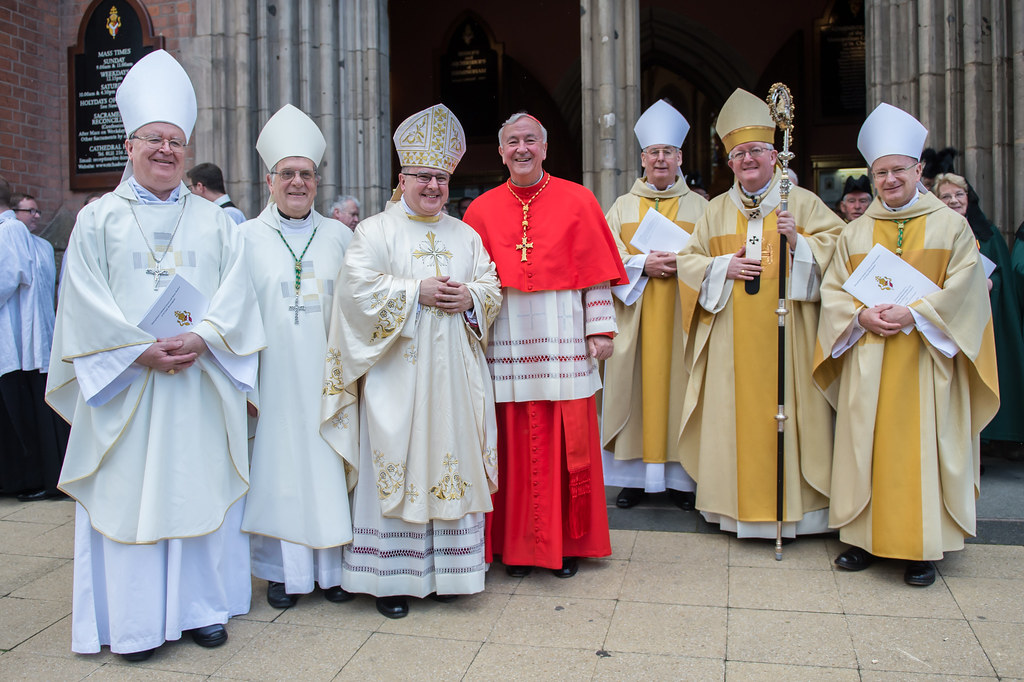
Episcopal line-up:
Left to right, Bishop William Kenney, Bishop David McGough, Bishop Byrne, Cardinal Nichols, Bishop Philip Pargeter, Archbishop Longley, Bishop Michael Barber

Image: mazur/catholicnews.org.uk.on Flickr

In addition she found some photographs of the reception at Oscott on the website of the Washington DC Oratorians which can be viewed here. She says she was particularly taken with one of the new Bishop checking his watch, which can be seen here, and one with his family - as was pointed out during the service in the cathedral it is quite unusual for a new bishop to have both his parents present at his consecration - and which can be seen here.

Wednesday, 14 May 2014

The Episcopal Ordination of Bishop Robert Byrne


Yesterday I went to the Episcopal Ordination of Bishop Robert Byrne, formerly Provost of the Oxford Oratory, in St Chad's Cathedral in Birmingham.

I have adapted this post from the excellent one by Charles Cole on the New Liturgical Movement site, adding my own comments where appropriate.


Bishop Byrne is the first Oratorian Bishop in England in 140 years, the last being Fr Edward Bagshawe who became Bishop of Nottingham in 1874. Fr Robert Byrne was one of the founders of the Oxford Oratory and he will serve as an auxiliary bishop in Birmingham, with responsibility for the city and for Worcestershire. He will be the titular Bishop of Cuncacestre (Chester-le-Street). The Ordination was attended by the Oratory Fathers from Birmingham, Oxford, Manchester, London and York, as well as from the Oratory in formation in Washington DC and by oratorians from Europe.

The evening before there was a Vigil Liturgy at the Birmingham Oratory at which His Grace Archbishop Longley of Birmingham presided. The Bishop-Elect made his Profession of Faith and Pontifical Benediction followed. During the sermon at the Vigil, Archbishop Longley said:

Blessed John Henry Newman's beatification by Pope Benedict in 2010 has brought so many blessings to our local Church... we must now count (Fr Robert Byrne's) episcopal ministry among us as one of the gifts we have received through the intercession of Blessed John Henry, Cardinal Newman. We see in tomorrow's ordination a deepening appreciation for the charism of the Oratory as members of its various English houses increasingly play their part in the life of the Church at diocesan and national levels.

During the sermon at the Ordination His Eminence Cardinal Nichols said:

After Bishop-elect Robert makes his promises, we turn in prayer to the saints of the Church. Uppermost in my mind will be St Philip Neri, so well known as the saint and prophet of joy, renowned for his relaxed and attractive method of education, living across the road from the Venerable English College in Rome, giving his blessing to the young students, especially as they set out for their mission here in England. We certainly ask for his blessing today on this man.

And Blessed John Henry Newman, of whom Father Robert is a true son. He too will bless us today and enkindle in us that same passion for the truth of faith which he followed at such cost and with such rigour. His journey was described, on his tombstone, as one of moving ‘Out of shadows and images into the truth.’ May that be our daily journey, too, coming each day more fully into the light of the glory of God shining in the face of Jesus.

The photographs below show the Vigil as well as the Episcopal Ordination and are taken from the Catholic Church of England & Wales Photostream.
© Mazur/catholicnews.org.uk
The Vigil service at the Birmingham Oratory, rebuilt as a memorial to Bl. John Henry Newman:


The blessing of Bishop Robert's pontificalia by the Archbishop:

The Archbishop's address to the congregation:

The Archbishop gives Benediction of the Blessed Sacrament:


The Archbishop, the Bishop-elect and Oratorians in the Newman Chapel at the Oratory:


There are more pictures on the Oxford Oratory website of the Vigil and the various ceremonies of oath taking and of the pontificalia at Vigil for Fr Robert at the Birmingham Oratory

On Tuesday two coaches brought members of the Oxford Oratory congregation, togetehr with the Oratorians and some Dominicans up to Birmingham. We arrived an hour earlier than the time of the liturgy, which gave time to pray for the Bishop-elect. I was sitting at the western end of the north aisle, which afforded a good view of the processions, but Mr Pugin's pulpit cut off much of the view of the ceremonies, but that is just the way things work out on these occasions. I did however have good view of the Cardinal when he delivered his homily.

The procession of Bishops preparing to enter the cathedral:


This, and the procession into the cathedral of the clergy, was an impressive reminder of the number of Catholic clergy who serve the faithful in this country.

The Papal Bull was read by Bishop David McGough as Provost of the Cathedral Chapter.

The Archbishop, flanked by the co-consecrators, Bishop Philip Pargeter, the retiring Auxiliary Bishop for Birmingham and Bishop Michael Barber of Oakland Ca., an old friend of the new Bishop, listen to Cardinal Nichols' homily. The Bishop-elect is seated at the foot of the steps :


The candidate prostrates himself before the altar and the consecrating bishops:

https://blogger.googleusercontent.com/img/b/R29vZ2xl/AVvXsEgbWiDcJSarZywG_RBnudPipTUCLkR_hGxVkyRZJuoQPrKQHO9H22gFdtSrjKeKNUn8kR6vJl7WKlncHj5UcCi7GSJv8IOBcUSZ0f0nt_ADJ4ZMSLSVQEOJxtaKpyjXPeCd7IRhQKrebKFv/s1600/14177609591_0e92147750_o.jpg


The chasuble worn by the new Bishop was that worn by Pope Benedict for the beatification of Bl.John Henry Newman at Birmingham in 2010 - the Papal arms are visible:

The anointing with Chrism:

The Gospel book is held over the candidate's head during the prayer of consecration:

The Archbishop lays on hands:

He was followed by the other Bishops present:


The delivery of the ring to the new Bishop. It is a handsome piece with a fime amethyst.


The mitre is placed on Bishop Robert's head:


Listening to this part of the liturgy and reading in the service book the formulae and understanding their significance it struck the historian in me (who is never far away) why eleventh and twelfth century Popes and reformers were so concerned by lay investiture with the ring and the staff. Whatever the legitimate concerns of Emperors and Kings as to territorial matters in regard of episcopal estates and military service, such a ceremony could indeed look as if it was the lay ruler, and not the Church, who was making a man a bishop, and all that implied.


The kiss of peace:

The new Bishop is seated in the place of honour:


The new Bishop processes around the cathedral giving his blessing as the Te Deum is sung - in Latin:


Following the Mass the Apostolic Nuncio, Archbishop Mennini, addressed the congregation and then Bishop Robert did expressing his gratitude and thanks, and speaking about his new mission as a bishop. He referred to his newly chosen episcopal motto - Soli Deo - as what he was called to proclaim to the Church and those outside it. He spoke of his appreciation of the prayerful support he had received over the weeks sinc ehis appointment was announced, and ot the vital need for prayer in the lives of the faithful. He also referred to his long experience as a prison chaplain as well as his work in ecumenical relations in recent years. To this he brought also his dry Lancashire humour - upon telephoning a priest friend to tell him of his appointment he received the comment "Well, they are desperate..."

So, after two and half hours of rich ceremonial and solemn significance, we had a new Bishop. 

From the catehdral we were transported by our coaches to Oscott College for a buffet lunch and a time to catch up with Bishop Robert - now looking very much the part in his habitus Piano, and with the chrism seeping through into his zucchetto - and with old friends. I will say more about Oscott as a building in the next post.

A wonderful day, and one on which I felt reinforced in my own Catholicism.


Tuesday, 7 May 2013

Pilgrimage to Birmingham


Yesterday I went on a pilgrimage to mark the Year of Faith organised for parishes from the North Oxford Deanery. The idea was to link together visits to places associated with, and indeed the relics, of St Chad, patron of the Archdiocese and cathedral, Bl. John Henry Newman,  and Bl.Dominic Barberi, and to see in them men who had lived by faith.

Our first stop was at the Birmingham Oratory. We joined member sof the congregation in saying the rosary before the  statue of Our Lady, splendidly coped and crowned for May, before Fr Richard Duffield C.O., the main organiser of the pilgrimage, gave a talk about the life of Bl. John Henry and the building of the church - the present structure was erected as a memorial to Newman in the early years of the twentieth century.

photo


The High Altar at the Birmingham Oratory
 
Image: Catholic Church (England and Wales) on Flickr


We then went through to the shrine chapel, the only part of Newman's church to survive, and redecorated in advance of his beatification in 2010. Here we had atime to pray, to view some relics of the Cardinal, including his mitre and crozier and the bull creating him a Cardinal, as well as seeing the modern chasse that contains such few fragments of bone as were found in his grave at Rednall, and which also incorporates the original handles from his coffin. There are mounted so that pilgrims may indeed touch them to establish a tangible, tactile contact with him.


The altar in the shrine chapel of Bl. John Henry Newman

Image:anglicanpatrimony.blogspot

There were too many of us to visit Newman's room, which has been preserved as it was at the time of his death. I have been fortunate enough to do so on three previous visits to the Oratory, and that is very remarkable exprience indeed - it is not areconstruction or redecoration, it is a genuine, undisturbed nineteenth century room, and that of one of the great voices of the age.

I think we could all have spent more time exploring the Oratory church and the other displays about Bl. John Henry, but the exigencies of timing sent us on to the cathedral in the centre of the city for the next stage of our pilgrimage.


photo

The Cathedral and Basilica of St Chad Birmingham

 Image: Simon_K on Flickr


If the Oratory is wonderfully Philippine in its baroque style and decoration, St Chad's cathedral is one of the great workks of A.W.N. Pugin, and built in 1839-41. In recent years a lot of work has been done to restore and reinstate aspects of Pugin's scheme, and the interior is striking and beautiful. like the oratory church, very much a place of prayer.

photo

Interior of St Chad's Cathedral


Aidan MCRae Thomson on Flickr

In the cathedral we had a votive Mass of St Chad, whose relics are preserved in the shrine above the High Altar. and time to look around before having our packed lunch and then back into the cathedral for a group photograph on the steps leading to the altar.

The cathedral has some splendid treasures amongst its furnishings, including late medieval items which were acquired from the Low Countries by Pugin. In the oils chapel is a reliquary with some hair of Bl.John Henry, one of his Cardinal's red zucchettos and his ring.

Either side of the steps leading to the altar are the Coenopium or Ombrellino and the tintinnabulum which indicate its status as a Minor Basilica, and honour granted to mark its centenary in June 1941, and about which there is more here.  

The last stage of our pilgrimage took us north of the city centre to the inner suburb of handsworth and to the Convent of the Sisters of Mercy, and built by Pugin for them in 1841 on land given bt his collaborators the Hardman family. A daughter of the family, Juliana, became the first Mother Superior of the house, and in those early months the foundress of the Sisters, Ven. Catherine McAuley stayed there, before returning to Dublin to die the same year.


http://www.birminghamheritage.org.uk/images/members/stmary.jpg

St Mary's Convent Handsworth

Image: birminghamheritage.org.uk

The convent is typical of Pugin, and was supported not only by the Hardman family but also by his great patron the 16th Earl of Shrewsbury. The church to the east which served as both the sister's church and as parish church was, alas, wrecked by a bomb in 1942, which also destroyed the House of Mercy which had provided shelter for vulnerable women. The descending cloister whuich linke dteh convent and church, atypically Puginesque feature, survives in part, and there are pictures of the lost church - rather like those he designed in Marlow and in Salisbury - on display in the extended house chapel, togetehr with examples of Hardman plate and furnishings.


http://www.english-heritage.org.uk/content/galleries/nuns-and-convent-building/design-by-awn-pugin-for-st-marys-convent-handsworth.jpg

Pugin's original design
Image: English Heritage

In the chapel is a chair and table which were used by Bl. Dominic Barberi when he visited the Sisters as their Extrordinary Confessor. It is also known that Bl. John Henry Newman used to visit the convent as a place of quiet.

Today the conevent continues to work with the local community, serves as a focus for Mercy Associates, and also is a heritage centre, open to visitors, which recounts the history of the Sisters in Handsworth and in the life of the Church and country.

The whole pilgrimage was very enjoyable, and we were blessed with beautiful weather, and the sight of the countryside finally bursting into leaf and flower as we travelled to and from Birmingham.


Saturday, 2 March 2013

Churches of St Chad


Today is the feast of St Chad, the seventh century bishop first of York and then, after the return of St Wilfrid to that see, he became the founding bishop of Lichfield. There is an account of his life here. Lichfield cathedral became the centre of his cult until the reformation. At that time some of his relics were rescued and in the nineteenth century re-enshrined in St Chad's Catholic cathedral in Birmingham. I have posted about those in previous years in St Chad and his relics and Relics of St Chad.

He is a popular patron of churches in the territory of the ancient diocese of Lichfield, including the chapel founded by the early thirteenth century (now a parish church and a nineteenth century rebuilding) of Saddleworth where my Whitehead forebears lived from the sixteenth century, and of the ancient parish church of the area in Rochdale.


http://ichef.bbci.co.uk/arts/yourpaintings/images/paintings/samg/large/gmi_samg_2001_73_1_large.jpg

The old church at Saddleworth circa 1826
A painting by John Holland of the Rushcarting ceremony, now in Saddleworth Museum.

Image: BBC

http://www.genuki.org.uk/big/eng/LAN/Rochdale/StChad.jpg

St Chad Rochdale

Image:Genuki

The handsome nineteenth century Catholic church of St Chad in Cheetham Hill in Manchester has become the new home of the Manchester Oratory.


St. Chad's Catholic Church on Cheetham Hill Road

Image:Manchesterhistory.net

St Chad's was built between 1846 and 1847 and was designed by the architectural practice of Weightman and Hadfield, who designed a number of  Catholic churches including Salford Cathedral.  


 Image:Manchesterhistory.net

St Chad's is associated with Sister Elizabeth Prout.  As a young woman Elizabeth attended a talk given by Bl. Dominic Barberi, who was a Passionists.  She was so inspired that she converted to Catholicism and then, on the advice of another Passionist, Father Gaudentius Rossi, she joined a Sisterhood in Northampton.  When Rossi was given a parish mission at St. Chad's he persuaded Sister Elizabeth to move there to teach in the parish church.  In the years that followed she worked among the poor of the community and founded a group that was known as the "Institute of the Holy Family" and she became known as Mother Mary Joseph of Jesus.  In 1864 at the age of 43 she died of tuberculosis at the Sutton Convent in Lancashire.  In more recent times she was put forward for canonisation, based on evidence of miraculous cures of people with cancer and severe brain damage.

In recent years the church was in the care of the Premonstratensian canons (Norbertines), but now has been assigned to the Oratorians who used to be at  the church of Holy Name in the city. The website of the new Oratory can be seen here.


Monday, 18 June 2012

Feast of Dedication of Birmingham Cathedral


Today is the feast of dedication of St Chad's Metropolitan Cathedral in Birmingham. Built in 1839-41 by A.W.N. Pugin, whose bicentenary is this year, it has served as the cathedral of the diocese since 1852 following the restoration of the hierarchy in 1850. Since 1941 it has had the status of a Minor Basilica - a dignity only held elsewhere in England now by Downside Abbey. There is an account of the cathedral here.

http://farm5.staticflickr.com/4124/5039189398_33392d5415_z.jpg

The interior of the cathedral

Image: farm5.staticflickr.com

http://media.vam.ac.uk/media/thira/collection_images/2006BF/2006BF3140.jpg

The interior as designed by Pugin, complete with the Rood Screen - now at Holy Trinity Reading

Image:media.vam.ac.uk

http://www.theanglocatholic.com/wp-content/uploads/2010/03/4429531895_820b29a0b6_b.jpg

The modern Archiepiscopal throne in the style of Pugin
Image: theanglo-catholic.com

Friday, 2 March 2012

Relics of St Chad


Today is the feast of St Chad, the apostle of Mercia, founder of the see of Lichfield and patron of the Archdiocese of Birmingham. The cathedral, designed and decorated by A.W.Pugin, is dedicated to him and his relics are enshrined above the High Altar.

There is a good account of his life and times here. The Oxford DNB biography by D.H.Farmer can be read here, and it includes some details as to the history of his relics.

Image 21

Statue of St Chad in his cathedral in Birmingham
He is holding a model of Lichfield cathedral


Image 17


The reliquary holding the relics of St Chad above the High Altar of the cathedral

I have adapted and developed the section about his relics from the article above as follows:

According to St. Bede, Chad was venerated as a saint immediately after his death, and his relics translated to a shrine. He remained the centre of an important cult, focussed on healing, throughout the Middle Ages. Indeed it was the presence of the relics that probably led in the twelfth century to the re-establishment of a co-cathedral at Lichfield following its removal to Coventry in the late eleventh century. Bythe later middle ages the cult had twin foci: his tomb, in the apse, directly behind the high altar of Lichfield cathedral, and, more particularly, his skull, kept in a special Head Chapel, above the south aisle, with a balcony from which the reliquary could be displayed.

The transmission of the relics after the Reformation was tortuous, and a testimony to the faith of recusant families in the centuries that followed. At the dismantling of the Shrine on the instructions of King Henry VIII in about 1538, Prebendary Arthur Dudley (d.1577) of Lichfield Cathedral removed and retained some relics. These eventually passed to his nieces, Bridget and Katherine Dudley, of Russells Hall, near the town of Dudley.

In 1651, they reappeared when a farmer, Henry Hodgetts of Sedgley, was on his death-bed and kept praying to St Chad. When the priest hearing his last confession, Fr Peter Turner SJ, asked him why he called upon Chad. Henry replied, "because his bones are in the head of my bed". He instructed his wife to give the relics to the priest, whence they found their way to the Seminary at St Omer, in France. After the penal times, in the early 19th century, they found their way into the hands of Sir Thomas Fitzherbert-Brockholes of Aston Hall, near Stone in Staffordshire. When his chapel was cleared after his death, his chaplain, Fr Benjamin Hulme, discovered the box containg the relics, which were examined and presented in 1837 to Bishop Thomas Walsh, the Vicar Apostolic of the Midland District, and were enshrined in the new St Chad's Birmingham, opened in 1841, in a new casket designed by Pugin. In 1850 the church became the cathedral of the new diocese.

The relics, which comprise some long bones, were examined by the Oxford Archeological Laboratory by carbon dating techniques in 1985, and all but one of the bones (which was a third femur, and therefore could not have come from Bishop Chad) were dated to the seventh century, and were authenticated as true relics by the Vatican.

In 1919, an Annual Mass and Solemn Outdoor Procession of the Relics was inaugurated at the cathedral in Birmingham. This observance which was at on epoint discontinued because of the redevelopment of the road system round the cathedral has been revived in recent years, on the Saturday nearest to his feast Day, 2 March. There are more pictures of last year's St Chad's Day on the website of St Chad's Cathedral Birmingham.

Wednesday, 2 March 2011

St Chad and his relics


Today is the feast of St Chad, bishop of York and then of Lichfield, who died in 672. He is the patron of the cathedral of the Archdiocese of Birmingham and a secondary patron of the diocese.

There is a good account of his life here. His episcopal centre at Lichfield became his shrine church, and the present thirteenth and fourteenth century cathedral housed his relics until the reformation.

File:LichCathedral4.jpg

Lichfield Cathedral
Image:Wikipedia

Today they are enshrined above the High Altar in St Chad's Cathedral in Birmingham, seat of the Catholic Archbishop of the see, and the cathedral's website has a section on the survival of the relics.

File:St Chads Cathedral  Birmingham.jpg

St Chad's Cathedral in Birmingham
Designed by AW Pugin in 1840
Image:Wikipedia


Monday, 6 December 2010

The Gospels of St Chad

Cutting-Edge Imaging Helps Scholar Reveal 8th-Century Manuscript 1

l


Image of St. Luke in the St. Chad Gospels
Courtesy of The Dean and Chapter of Lichfield Cathedral


The Medieval Religion discussion group has a link today to an article about work by two academics from the University of Kentucky on digitising and interpreting the eighth century St Chad Gospels at Lichfield Cathedral. You can read it here.

St Chad, about whom there is a good article here, died in 672. The Gospels date from c.730 and were associated with his shrine at Lichfield.

The relics of St Chad himself are now preserved in the Metropolitan Cathedral in Birmingham, which is dedicated to him.