Once I was a clever boy learning the arts of Oxford... is a quotation from the verses written by Bishop Richard Fleming (c.1385-1431) for his tomb in Lincoln Cathedral. Fleming, the founder of Lincoln College in Oxford, is the subject of my research for a D. Phil., and, like me, a son of the West Riding. I have remarked in the past that I have a deeply meaningful on-going relationship with a dead fifteenth century bishop... it was Fleming who, in effect, enabled me to come to Oxford and to learn its arts, and for that I am immensely grateful.


Showing posts with label Evelyn Waugh. Show all posts

Sunday, 10 April 2016

Evelyn Waugh


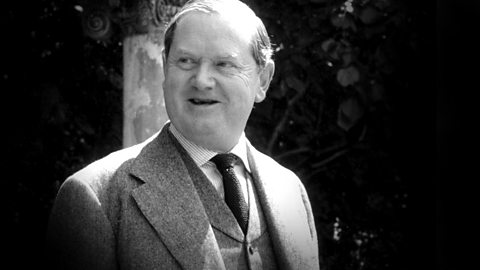
Today is the fiftieth anniversary of the death in 1966 of Evelyn Waugh.


Image. bbc.org.uk

A friend recently sent me the link to an article about Waugh in The Spectator by his son Septimus which seeks - and I think very reasonably so to do - to redress the image that has developed of Evelyn Waugh as a misanthropic cumudgeon. The article can be read at http://www.spectator.co.uk/2016/03/let-evelyn-waugh-back-into-combe-florey-churchyard/

The background to the dispute over acess to the grave can be read at  More News on Waugh Graves | The Evelyn Waugh Society

I am a great admirer of Evelyn Waugh and though not really one for visiting literary graves did make the point when on holiday in Somerset with a friend a quarter of a century or so ago to make a detour to visit the churchyard at Combe Florey and pay my respects. 


Image:findagrave.com 

Pray for the repose of his soul

Thursday, 22 August 2013

Second Spring


This week I have been working with an Oxford Summer School run by Second Spring, who are based here in the city, on the theme of Catholic Faith and Culture. The students were from the USA and Canada and based here at Blackfriars. Their course was wide-ranging and included visits to local places of Catholic and historic interestv as well as a series of talks from experts (so-called in my case...).

On Tuesday afternoon I gave a talk on four Oxford educated Catholic writers - Hilaire Belloc, Ronald Knox, Evelyn Waugh and Graham Greene. Although all of them were educated in Oxford, three of them at Balliol - Waugh was at Hertford - and three of them were converts - Belloc was a cradle Catholic, but had had a crisis of belief as a young man (but then in some senses he was a convert to being English, having a French father and being born in France himself) but the key point I stressed was their diversity of views on so many topics. They knew one another, but were not a group like the Inklings. What they did do was to bring a Catholic view or views into different aspects of writing and literature. By being well known and popular as writers and being known to be Catholics they thereby raised the profile of Catholicism in the perception of the wider reading public.

Today I gave the group a tour of Newman's Oxford. This was centred on visits to his undergraduate college at Trinity and Oriel where he was a Fellow. Along the way it was possible to visit St Mary's where he was Vicar and preached so many of his Anglican sermons.On such occasions one can indeed feel close to newman and that one is walking in his footsteps.

These were two very enjoyable sessions with agreeable people, and it was good to have a shared interest in the renewal and revival of an integrated Catholic visual and literary culture alongside the practise of the Faith.


Monday, 1 July 2013

Evelyn Waugh's Oxford


Yesterday afternoon I spent an enjoyable couple of hours giving a tour of Evelyn Waugh's Oxford to two US visitors. Blessed with fine weather I combined a general tour of some of the colleges with an emphasis on Waugh's years at the University. He was at Hertford College from 1922-24 and in the following years was often back in the city. Many enduring and significant friendships were made in those years, as well as bearing fruit in his novels, and one can still, of course, see many of the places Waugh and his friends would have known. It would be perhaps more difficult to provide the bibulous entertainments they enjoyed...
 
 
Evelyn Waugh, aged 21

Evelyn Waugh, aged 21, the year he finished at Hertford

Image: spectator.co.uk

I have enormous regard and affection for Waugh as a writer, and once hen on holiday in Somerset made a literary pilgrimage to his grave at Combe Florey. It is striking the way his reputation has grown in the years since his death, when he was becoming out of fashion. Today he is perceived as atruly great craftsman with the English language, and a writer of both comic genius, and also one who engaged with very serious and profound matters. He is interesting to compare with his near contemporary and friend John Betjeman - the similarities are striking, but so are the different reactions of the two to what their lives brought them.

I see that Selina Hastings 1994 biography of Waugh has recently been reissued. It is more substantial than Christopher Simon Syke's life, which is perhaps more a well-researched memoir, and which could perhaps not explore all of Waugh's relationships whilst some of his friends were still alive. I do, however, regret that Selina Hastings does not make more use of some of the stories Sykes recounts from Waugh's later years - her biography appears to me to lose interest a little in her subject after about 1950.


Monday, 14 January 2013

Serving Mass at Carshalton


Yesterday afternoon I travelled with my friend David Forster up to Carshalton to serve a Mass in the Extraordinary Form at the church of Holy Cross. We did a similar trip in November, and, as I posted recently, a monthly Mass in this Form has now been arranged at the church.

The attendance was larger than last time, and the congregation had in some cases travelled a fair distance to get there. The celebrant was Canon Peter Newby, of St Mary Moorfields in London, and formerly Catholic Chaplain to Oxford University.

David and I, together with a parishioner from Holy Cross, made up the serving team, with me doing my fairly usual performance as thurifer. We hope to hold a servers training session before the Mass on February 10th as there are men interested in assisting. 

Matthew Schellhorn, the local LMS representitive, brought his schola, Cantus Magnus, who provided an excellent polyphonic setting for the Mass by Orlando Lassus - the acoustic worked very well in the church. 

Afterwards there was an opportunity to meet up with friends and acquaintances and make plans for the future. Over tea and biscuits the intriguing idea was expressed that for many seminarians of the early 1980s the television production of Brideshead Revisited in 1981-82 was important in giving them a vision of Catholicism before the liturgical and presentational changes occurred, and making them more aware of traditional thought and practice . Given the generational shift and the advent of Pope John Paul II in 1978 I can see there may be something in the argument. If such is the case then I am sure Evelyn Waugh would be pleased.

After that we had time for a visit to a nearby pub with a friend before driving back for supper in Oxford. Quite a long session, especially for David with the driving, but well worthwhile.


Friday, 17 August 2012

Walking round Catholic Literary Oxford


Yesterday I gave a walking tour on the theme of Catholic Literary Oxford. I had been asked to do this by my friends who run Second Spring Oxford, which organises a summer school on Catholic culture each year. Having been told that the participants, from the US and from Chile, were particularly interested in J.R.R. Tolkien we started at the Eagle and Child (the "Bird and Baby") where Tolkien used to meet with the other Inklings, including C.S.Lewis and Charles Williams, in the 1930s and 40s to discuss their literary interests.

From there we looked in at St John's College, the alma mater of St Edmund Campion, before moving on to Balliol, the college of Cardinal Manning (no mean wordsmith himself), Gerard Manley Hopkins and that somewhat problematical Catholic Graham Greene. Balliol was also the undergraduate college of Ronald Knox, who went on to become the Anglican chaplain of Trinity, which is next door, on the eve of the Great War. It was in those years that he established himself as a leading Anglo-Catholic preacher and was a great influence in the spiritual life of Harold Macmillan. It was not far away in the Sheldonian Theatre that Knox gave his final public address, the Romanes Lecture, a few weeks before his death.

Trinity is, of course, the undergraduate college of Bl. John Henry Newman, and we took time to visit the chapel and to look at the outside of one of the rooms he occupied there and also the modern memorial bust of him as a Cardinal in the grounds.

Across Broad Street is Exeter, the college originally intended for Newman, and that of Tolkien from 1911-15. From there we walked round to Radcliffe Square to look at Hertford, Evelyn Waugh's college, and to talk about the sources for characters in Bridehead Revisited .

We managed to get into the building site that is currently the interior of the St Mary's University Church to try to see the pulpit from which Newman preached before crossing the High to Oriel, where Newman was a Fellow from 1822 until 1845. This being my own college I was able to take the party inside to show them where he had lived, before going round to Merton, which also has Newman links, but which was Tolkien's base as Professor of English from 1945 until 1959.

By walking into Christ Church Meadow we could view Lewis's Magdalen to the east before going to look at the outside of the Catholic Chapliancy, home to Mgr Knox in the 1920s and 30s, and pointing out Campion Hall - partly funded by Waugh's biography of St Edmund - and Pembroke College where Tolkien was Professor of Anglo-Saxon from 1925-45.

In a relatively short time we were able to cover a good selection of places of interest and a variety of authors. I hope my audience enjoyed their morning, and I certainly enjoyed meeting them.