Once I was a clever boy learning the arts of Oxford... is a quotation from the verses written by Bishop Richard Fleming (c.1385-1431) for his tomb in Lincoln Cathedral. Fleming, the founder of Lincoln College in Oxford, is the subject of my research for a D. Phil., and, like me, a son of the West Riding. I have remarked in the past that I have a deeply meaningful on-going relationship with a dead fifteenth century bishop... it was Fleming who, in effect, enabled me to come to Oxford and to learn its arts, and for that I am immensely grateful.


Showing posts with label Sainte Ampoulle. Show all posts

Wednesday, 14 January 2015

Le Roi est mort. Vive Le Roi. France in 1515


Five centuries ago France, in January 1515, witnessed the death of one king, and the accession of another.

The process began with the death on January 1st of King Louis XII. He had been ill since before Christmas, allegedly worn out by his recent marriage to Mary, sister of King Henry VIII.

King Louis XII

King Louis XII

Image: frenchmoments.eu

The King who was 52, the same age as King Henry VII had been, and formerly Duke of Orleans, had ruled France since 1498 when he succeeded his cousin King Charles VIII. From his predecessor he took over his wife Queen Anne so as to secure her inheritance of Brittany, and also the French campaign in Italy. From being a Prince of the Blood willing to challenge the monarch as he had done in the 1480s he now became King and pursued a pragmatic course, actively engaged in plans to conquer the Duchy of Milan and to partition Naples and Sicily with Spain, anxious to preserve the unity of his French realm  regarding Brittany, able to conciliate the nobility and yet retain secure finances. There is an online account of his life and reign here.

 King Louis XII

Image: Wikimedia

To retain Brittany and, hopefully, secure the succession, he married the widow of his predecessor, Queen Anne, of whom there is an illustrated online life here.

To do so required an annulment of his existing marriage to Jeanne of France, daughter of King Louis XI, who appears to have cynically married his disabled daughter to Louis as a means of ensuring that the Orleans line would die without heirs.  The Pope was willing to grant the appropriate dispensation and Queen Anne, uniquely, had her second turn at being Queen of France. Jeanne retired to a convent and was eventaually beatified in the twentieth century. The episode cannot have escaped the notice of King Henry VIII and his advisors a generation later.

As events turned out the new King and Queen hadsons who died at birth, and were left with two daughters,  the elder of whom, Claude, was married to the next male heir, Francis Duke of Angouleme, so as to maintain the Breton inheritance.

King Louis XII was buried alongside his late wife Queen Anne in the royal abbey of St Denis.


The tomb of King Louis XII and Queen Anne at St Denis

Image:wga.hu 

The baldachin was in arcades, and in the base of the sarcophagus was depicted the victories of Louis XII (Battle of Agnadello, the triumphal entry into Milan), and statues of the Twelve Apostles and the four cardinal virtues are the work of the Juste brothers, Italian sculptors who received the order in 1515. The transi(whose realism was so shocking that included an opening abdomen stitched after the extraction of the entrails before embalming) and orans Prie-dieu crowning the platform are attributed to Guillaume Regnault. The tomb was desecrated during the Revolution on 18 October 1793 and the bodies being thrown into a mass grave. Alexandre Lenoir saved much of the monument, which was preserved in the Museum of French Monuments in 1795, before being returned to the Royal Basilica under the second Bourbon Restoration.

Adapted from Wikipedia

The most important and original work of the Juste brothers is the tomb of Louis XII at St Denis, commissioned by his successor Francis I, probably in 1515, and finished in 1531. It bears the name of Jean (Giovanni) only, but is often said to be a work of both brothers working in collaboration. The arrangement with the kneeling figures above links the design with the tomb of Charles VIII, and the placing of the gisants in an arcaded enclosure below follows the usual disposition of the fifteenth century. In all other respects, however, the tomb marks an innovation in French practice. First of all, the enclosure of the gisants is now almost a small chapel open at the sides and the ends. This feature is combined with the allegorical figures of the Virtues at the corners and the apostles in front of the arcade.

In the sculpture several different hands can be distinguished. Two groups - the apostles and the Virtues - seem to be Florentine in derivation and apparently connected with the style of Andrea Sansovino. The apostles and the Virtues can almost certainly be attributed to members of the Juste family. The bas-reliefs round the base seem also Florentine in style and indicate an artist trained in the studio of Bertoldo. On the other hand, as suggested by Vitry and Pradel, the kneeling figures of the King and Queen on the top of the tomb are likely to be by a French artist of the circle of Colombe. The most remarkable group consists of the two gisants. It seems likely that these figures are by a French artist with some knowledge of Italian sculpture. The statues are among the most remarkable works of the period. The sensitiveness of their modelling and the liveliness of their conception are shown up by the contrast with the heavy proportions and coarse modelling of the statues round the base of the tomb. 

Web Gallery of Art

Image: Jean I Juste - Effigies of Louis XII (1462-1515) and Anne of Brittany (1477-1514) from their tomb

 Gisante sffigies of King Louis XII (1462-1515) and Queen Anne of Brittany (1477-1514) from their tomb at St Denis

Image:art-prints-on-demand.com

To English popular perception King Louis XII is presented as the elderly husband of Mary Tudor, who then married for love Charles Brandonm, and who, once reconciled to her brother King Henry VIII, became Duke and Duchess of Suffolk. By contrast King Francis I is one of the most easily recognised Kings of France, and recalled as a (usually)friendly rival and contemporary of King Henry VIII - the French king died only two months after him in 1547.  

There is an online biography of King Francis I here

The new king was 20 and there soon developed that rivalry over appearance and matters of style and presentation with King Henry VIII, who was three years older.
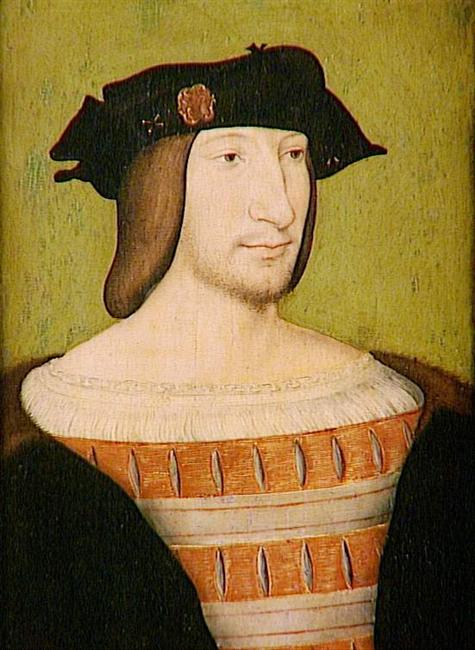
 File:François 1515.jpg

King Francis I

A portrait of 1515-20

Musée Condé Chantilly

Image: Wikipedia

King Francis I was crowned at Rheims on January 25th 1515. There is a useful online account of the history of the ceremony and its form at Coronation of the French monarch and there are some details of the regalia used in the liturgy at Crown of Charlemagne.

In the ritual of the Sacre the new King was anointed with oil from the Sainte Ampoulle - about which there is an online article here - and was vested and crowned as King of France.


The Sainte Ampoulle before it was smashed in 1793

Some fragments of the reliquary and of the oil survived and are still at Rheims

Image:Wikimedia

The Crown of Charlemagne - the Coronation Crown of France

Image: Wikipedia


Friday, 19 July 2013

Rheims


We travelled from Clairvaux northwards across the open landscape of Champagne - not that interesting to be honest as landscapes go.

Our first point of call around Rheims was to be the gite where we were to spend the night. this was in the village of Chamery, south west of Rheims, nestling against the foot of the scarp and reached along roads flanked by vineyards.

The gite is the property of an independent champagne producer, the house of Bonnet - Ponson. Upon arrival we were offered, and accepted, a glass of their product, and bottles were bought for consumption with dinner this evening or to take home. We enquired about a tour of the cellars, and this was given to us. The cellars seemed far more extensive than the property at ground level - I wonder if the whole village, which has several such producers, is standing on a  honeycomb of champagne caves. We gathered that there were 500,000 bottles in the cellars, and the method of fermentation and the creation of champagne was explained to us, both in its old methods, and the newer, slightly more technological way of doing these things. Our hostess urges us not to keep champagne for too long - it is designe dto be drunk. Well, I suppose she would say that wouldn't she - but the champagne and the tour were excellent.

On the way back towards Rheims we stopped to look at the exterior of the church at Villers aux Noeuds. This was by the roadside, and, unusually for much of the France we had seen, still a medieval building - albeit missing its nave aisles, but with some nice eleventh or twelfth century work on the tower - a bit reminiscent of the type of churches one finds on the Wolds and other areas of eastern England where the population has shrunk, and the church with it.

Fr Jerome navigated the road system of Rheims through the rush hour traffic of a hot Friday and we parked near the abbey of St Remi.
 
The abbey is far less well known than the cathedral, but very well worth visiting, and geared to visitors and pilgrims. As at the cathedral it had a good guide book section, rather as one would expect in England, but which is much less common in France, and again had a cared for quality that is not always the impression amongst French churches.

The shrine church of St Remi, who baptised King Clovis in 496, the abbey was the repository of the Sainte Ampoule until the reliquary was smashed in 1793. There is a modern statue outside the present church depicting that momentous baptism, and set in the remains of the earlier church.


The Baptism of Clovis

One of our party was concerned that St Remi was not wearing a maniple, until we pointed out that the a baptism is outside the specific liturgy of the Mass

Image:ca.wikipedia

The present church is a very fine, indeed noble building, which was consecrated by Pope Leo IX in 1049 during the meeting of the Council of Rheims, often seen as the effective beginning of the Papal reform movement. Since then the choir has been rebuilt in the late twelfth century and the vave extended westwards by two bays at a similar date. The building was heavily damage din the bombardment of 1918, and the middle largely blown away; restoration was not completed until 1958. Looking at the building this is not apparent, and the result is a tranquil and prayerful building that bears witness to centuries of continuing piety.  Behind the High Altar is the shrine of St Remi - the structure is mostly nineteenth century work of 1847 but with seventeenth century statues of the traditional Twelve Peers of France.  Here one could pray in front of the casket containing the relics of the saint.


The shrine of St Remi, looking west

Image: Wikipedia

There were several medieval or later sculptures in the abbey of the baptism of Clovis, and it was consciously paired and linked to that of Christ. There is more about the abbey in the online article with many links, here.

The exterior of the church is impressive - a rich array of flying buttresses at the eastern apse, and a fine Flamboyant south transept front, but the west end is a little disappointing, and the lack of a dominant tower or spire means the building is not the landmark its architectural and historical importance would justify.


The west front of St Remi

It was in similarly bright  conditions that we saw the abbey

Image;fr.wikipedia

We walked towards the cathedral along what was once one of the coronation processional routes. Today - well it is not The Mall or Whitehall, or Edinburgh's Royal Mile - if anything it seemed more like Oxford's Cowley Road.

The city centre seems rather drab - small businesses in rather run down properties, larger blocks in a Hausmann style and, near St Remi, modern buildings presumably replacing post-1918 rebuilding. Really rather disappointing for so historic a city. Nonetheless the cathedral was in sight, and then, then we rounded the corner to enter the square in front of it...

As with the visit to Cluny I had put forward the suggestion that we visit Rheims, which is another place I have wanted to see for fifty or more years. So now, at last, we were standing in the hot late afternoon sun in front of Notre Dame of Rheims, the coronation church of the King's of France, one of the great monuments of thirteenth century French gothic art and architecture...


The west front of Rheims cathedral

This photograph gives some idea of the impact of our first sight of the building in the late afternoon sun - but no photograph does the cathedral justice
Image:neatnik2009.wordpress.com

However well one knows the west front from photographs or other pictures, nothing prepares you for the impact of this great combination of architecture and sculpture into one soaring, delicate, diffuse yet unified Te Deum or Magnificat. It is truly awe-inspiring, going beyond other related facades I have seen such as  Laon, Chartres and Paris. This is undoubtedly, to my mind, one of the greatest artistic works of Man. As one of our group said you could spend all day looking at the sculpture and still at the end find something more to see and comment upon. I found myself reduced to such meaningless phrases as saying I had seen other great French west fronts but that this really is something else ...  
 
This is art and architecture calling you to worship and veneration. To stand as we did in front of the cathedral was for me at least a momentous experience.


The interior of the cathedral looking east

Image:neatnik2009.wordpress.com

The interior has a solemn grandeur befitting the importance of the see and cathedral, and is of one consistant design, giving it a sense of  unity. It combines grandeur with an elegant simplicity and has spaciousness that is largely uncluttered. Although busy with many visitors, they were not enough to detract from the atmosphere of prayer - there were many candle stands, aglow with votive lights, and the aisles had excellent wall banners outlining the history of the building, begin in 1211, and of the Sacre, last held there in 1825 for King Charles X. I noted with interest that the canopy of the archbishop's throne was hung in blue semee with gold fleur-de-lys. Is it a case of being prepared just in case?


Looking west down the nave

Image:rogersandall.com
Outside we looked at the sculpture of the portal of the north transept, which includes one dorrway from an earlier building programme, before boarding the bus, which Fr Jerome had very kindly gone back and driven up for us. Time did not permit us avisit to the Palace of Tau which adjoins the cathedral and has exhibitions about the history and treasures of this great building. There is more about the cathedral and its history in the online article here.

Then it was off to a supermarket on the edge of the city to buy food for a meal at the gite in Chamery and back there to cook and eat, and relax.
Before leaving the theme of the cathedral here is another photograph which gives a better idea than many of the play of light on the statues and the interplay of structure and space, as well as of the range of detail, but you really need to go and look at Rheims to appreciate it.
 
File:Reims cathedral.jpg

Rheims cathedral


Image: Wikimedia