Once I was a clever boy learning the arts of Oxford... is a quotation from the verses written by Bishop Richard Fleming (c.1385-1431) for his tomb in Lincoln Cathedral. Fleming, the founder of Lincoln College in Oxford, is the subject of my research for a D. Phil., and, like me, a son of the West Riding. I have remarked in the past that I have a deeply meaningful on-going relationship with a dead fifteenth century bishop... it was Fleming who, in effect, enabled me to come to Oxford and to learn its arts, and for that I am immensely grateful.


Showing posts with label French Coronation. Show all posts

Thursday, 29 May 2025

The Coronation of King Charles X in 1825


Today is Ascension Day, which is a cause for celebrationin itself.  This year it falls on May 29th, which is, of course, Oak Apple Day, the celebration of the Restoration of King Charles II to the thrones of the British Isles in 1660, and also a cause for celebration. It is also the two hundredth anniversary of the Coronation of another King with the same name, King Charles X of France, in 1825 at Rheims.

This was perhaps the ultimate celebration of France’s own Restoration. The last Royal Coronation had been fifty years earlier, that of the new King’s elder brother King Louis XVI. On that occasion Charles aged.18, was present in the cathedral as Count of Artois and a Peer of France. What would have been unimaginable that celebration where the events after 1789 and the fate of the Monarchy and several members of the Royal Family.
 The events of 1814-15 restored the Bourbons to the throne in the person of the other royal brother King Louis XVIII. Although often portrayed in the robes of state associated with the coronation ceremony due to his increasing disability the ponderous but politically cautious King Louis did not put himself through the physical ordeal of the Sacre at Rheims. On his death. In 1824 his successor King Charles, more overt in his fidelity to tradition and a still physically active and indeed debonair 68 year old m, decided on having a traditional coronation at Rheims, with some modest adaptations to the ritual. Unlike the late King he had a son who was Dauphin, married, childlessly, to the daughter of King Louis XVI and Queen Marie Antoinette, but with the widow of the new King’s other son, murdered by. Bonapartist, in 1820 and their son, the future King Henri V,  The future looked secure. 

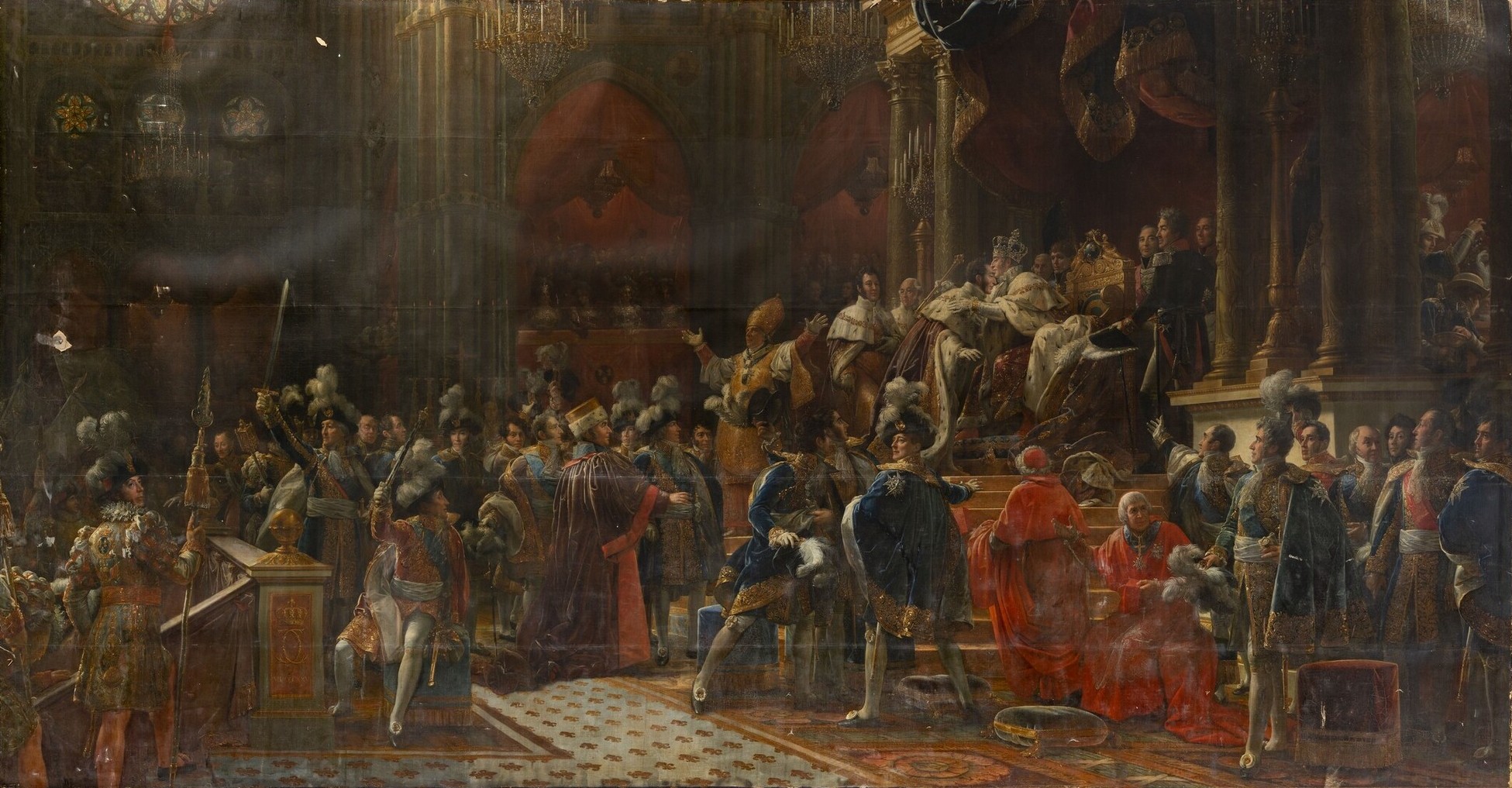
The early nineteenth century was an age of opulence for those in the social and political elites. When in 1804 Bonaparte proclaimed himself Emperor of the French he organised a lavish coronation for himself and Josephine, complete with a captive Pope Pius VII, in Notre Dame in Paris. The lavishness of that  occasion may well have influenced the splendour King George IV created for his own coronation in 1821 at Westminster with an extensive creation of new uniforms, and there had also been in 1818 the two coronations as King of Sweden and then as King of Norway of the former Marshal Bernadotte as King Carl XIV Johan and King Karl III Johan respectively. A splendid coronation at Rheims with the traditional pageantry would demonstrate that the Restoration was complete. So, on this day two centuries ago, King Charles X was anointed using what survived of the Sainte Ampoule and crowned with a new diamond fleur de lys  crown in the tradition mal place of the crowning of Kings of France. He was, I think, the only King to receive the homage of the Dauphin - a part of the ceremony immortalised in a painting - before leaving for the traditional banquet in the neighbouring Archiepiscopal Palace of Tau, the investiture the following day of new Knights of the Sainte Esprit and the custom of Touching for the King’s Evil. 

Wikipedia has an illustrated account of the celebrations at Coronation of Charles X of France 

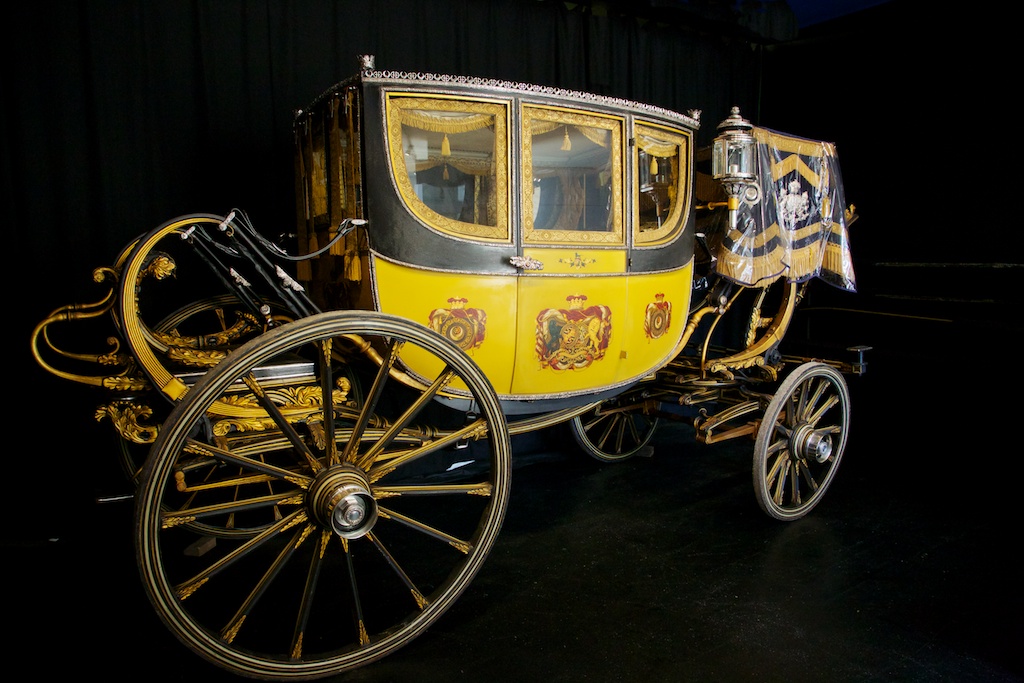
Alas events in 1830 and thereafter mean this was not a ceremony that has been repeated, but many of the items used in terms of mantles and uniforms do survive at the Palace of Tau or at st Denis and they are on display at a major exhibition in Paris this summer. The carriage made to take the King to and from Rheims was slightly repurposed by Napolean III with his heraldry for the baptism of the Prince Imperial and can usually be seen in the carriage museum, the Gallerie des Carosses, at Versailles. If you visit Alnwick Castle there you can see the coach especially made for the Duke of Northumberland to attend the ceremony as the official representative of King George IV.

The 1825 Coronation is one of those historic events which one really, really, wishes one could have been present at. 

The Palace of Tau as prepared for the Coronation has been digitally reconstructed at 

L'appartement du roi au Palais du Tau pour le sacre de Charles X - 28 mai 1825


The Coronation itself has been similarly recreated at Sacre de Charles X - 29 mai 1825 - cathédrale de Reims


The restoration of the coach can be seen at 

La restauration du carrosse du sacre de Charles X


Which just leaves me to shout Vive le Roi!


Friday, 29 May 2015

The Coronation of King Charles X - the Regalia


Following on from my previous post I have found a useful online site, which covers the history of both the regalia and th crown jewels, including their sale and dispersal in the 1880s, and which can be accessed here.  I have copied and slightly edited those parts about the surviving pieces of the French regalia which would have been used in 1825.

There are still in the Louvre French coronation ornaments of varying antiquity which were 'restored' for the coronations of Napoleon and King Charles X.

The most important item is the Sword of Charlemagne known as Joyeuse. The hilt and the ornamentation of the scabbard and hilt are in gold. The pommel is adorned with the intertwined figures of two fabulous birds resembling phoenixes. The guard terminates with two winged lions, the eyes being of lapis lazuli. The best authorities attribute the handle to between 1000 and 1100 AD although some consider that it has features which could date it back to the Carolingian period. The grip was remade in the 1800s but was restored for the coronation of King Charles X when the blue velvet covering was used. The goldsmith's work on the scabbard is enriched with sapphires, topazes, amethysts, a garnet and a rock crystal. The sword and scabbard in its original state can be seen in  Rigaud's portrait of King Louis XIV.


The Sword of Charlemagne ("Joyeuse")


Hyacinthe Rigaud's portrait of King Louis XIV. The sword 'Joyuese' is at his side.
 

The coronation spurs are made of gold and were restored in the 1800s when some garnets were added and the fastenings of gold and velvet were provided.


The Royal Sceptre, depicting Charlemagne seated on a throne.

The royal sceptre consists of the sceptre proper, a short rod with a lily resting on a ball, on the top of which rests a detailed statue of Charlemagne seated on a throne, with a closed crown on his head and a long scepter in his right hand and an orb in his left. On the step of the throne is the inscription Sanctus Karolus Magnus, Italia, Roma, Germania. On the base of the lily are three bas-reliefs of subjects taken from the Chronicle of Archbishop Turpin. The first subject is taken from the beginnings of the Chronicle in which the Apostle St. John ordered Charlemagne to deliver Spain and Galicia from the power of the Saracens. The second is taken from Chapter XIX of the Chronicle: "How the lances and axes of the Christian knights were found all flowing and rooted in the earth." The third subject is from Chapter XXXII of the Chronicle, and represents the death of Charlemagne. The sceptre was adapted for King Louis XIV into a long sceptre by the addition of a plain gold staff six feet high which could have been seperated into three pieces. The present staff (formerly that belonging to the Precentor of St. Denis) bears the following inscription in old French:

Of silver this baton was made
In the year MCC eighty [sic] [1280 AD?]
Fourteen, neither more nor less
(Of) those who will hold it in their hands
Will pray when life is ended
That his soul shall be transported to heaven
...Let it be kept
and he looked at great feasts
For to maintain loyalty
The Precentor should carry it in his hand.
 
Today the inscription is covered with purple velvet embroidered with fleurs-de-lis, added for the coronation of King Charles X.

The sceptre itself is thought to have been made for King Charles V (1364-1380) and that the lily was originally enamelled white [Clever Boy]


The Hand of Justice sceptre, now in the Louvre. 
The lower image  mirrored - it should be a reverse of what you see.


The clasp of the royal mantle, sometimes called the Clasp of St. Louis, is a large lozenge-shaped chased silver plate in the center of which is a large fleur-de-lis picked out with jewels. Several stones are now missing but 6 amethysts, 6 emeralds and 11 garnets remain while the framework is adorned with 26 garnets and 2 sapphires. Clasps of this sort had been worn by the Kings of France for several centuries and certainly earlier than St. Louis, but this one, despite its inscription in the inventories of St. Denis, is attributed to the 1300s and is similar to the one described in an inventory of the jewels of King Charles V taken in 1379.

The signet of St. Louis which was formerly kept at St. Denis has on the bezel a pale, table-cut aquamarine in which is engraved the figure of St. Louis standing crowned and carrying a scepter and the letters S.L., --- Sigillim Ludovici. The setting is of gold and on the hoop of the ring is a fleur-de-lis in niello. As the figure of St. Louis has a nimbus it must be of a later date than his canonization in 1297, twenty years after his death.


The crown of King Charles X, designed by the House of Bapst for King Louis XVIII. It followed the traditional pattern and the Regent Diamond was set in the great surmounting fleur-de-lis. It was not broken up until 1854, at which date the frame without the stones was kept in the cellars of the Ministry of Finance. The Crown Jewelers, Messrs Bapst, offered to purchase the crown, set it with facsimile stones and present it to the Louvre. Unfortunately, this led to authorities ordering it to be secretly broken up.


The Regent Diamond 140.50 carats
 
There is a history of this famous stone here

Images and text(adapted):famousdiamonds.tripod.com


The Coronation of King Charles X in 1825


190 years ago, on May 29th 1825, there took place the coronation of King Charles X in the cathedral at Rheims. Fify years earlier, and a world away, his elder brother King Louis XVI had been anointed and crowned at Rheims. Now in a true spirit of restoration once more a King of France approached his sacre. In style and splendour the Coronation was similar to that of King George IV at Westminster in 1821. They can both be seen as part of that awakening interest in medieval culture across western Europe at the time. For an introduction to the history of the ceremonial see the online article Coronation of the French monarch.


The Coronation of King Charles X
The homage of the Dauphin
François Gérard, 1827. Palace of Tau, Rheims

Image:Wikimedia

France, Dauphin's Crown, 1823Dauphin Crowns, Dauphin Louis, Royal Crowns, Diadem Crowns Tiaras, Louis Antoine, 1825, Crowns Jewels French, France, Royal Jewels

The Crown of the Dauiphin, Louis Antoine, Duke of Angouleme, and later the de jure King Louis XIXwhich he wore at his father's Coronation in 1825. The crown was apparently made in 1823.

Image:pinterest.com

There are pictures of some of  the liturgical vessels and robes and other insignia used at the Coronation, such as the Chancellor's mace which are now preserved in the Tau Palace adjoining the cathedral at the website Charles X, The Last Coronation. Tau Palace, Reims, [traveltoeat.com/charles-x-the-last-coronation-tau-palace-reims-france/} - but the link appears unstable.

For the Coronation a new state coach was made, and which today can be seen at Versailles..

The coronation coach of Charles X (otherwise know as Charles Philippe, the comte d'Artois)

  The Coronation Coach of King Charles X

Image:vivelareine.tumblr.com 
 
There is a video about it on the website at The Coronation Coach of Charles X - 1825, with some details about it and its subsequent history at Close-up on the Coronation Coach of Charles X - 1825. There are more pictures of the coach and other French royal coaches, including the very impressive funeral coach made for the body of King Louis XVIII in 1824, here.


The entry of Charles X into Paris after his coronation on June 6, 1825Louis François Lejene

The entry of King Charles X into Paris on June 6th 1825 following his coronation

Louis François Lejene


Image:vivelareine.tumblr.com 

A British link with the coronation can still be seen at Alnwick castle in Northumbertland:

The Percy family State Carriage - a luxurious state coach which once carried the 3rd Duke of Northumberland as George IV's personal representative to the coronation of Charles X in France in 1825.  It was repainted in 1902 for use at the coronation of King Edward VII, and was beautifully restored in 2011 for the wedding of the present Duke's eldest daughter, Katie.  Lady Katie's wedding dress is also on display in the coach house.  The coach was used again in June 2013 for the wedding of the Duke's youngest daughter, Lady Melissa, to Thomas van Straubenzee.

The Percy family State Carriage which carried the third Duke of Northumberland as KingGeorge IV’s personal representative at the coronation of King Charles X.

It was repainted in 1902 for use at the coronation of King Edward VII, and was beautifully restored in 2011 for the wedding of the present Duke’s eldest daughter, Katie. The coach was used again in June 2013 for the wedding of the Duke’s youngest daughter, Lady Melissa, to Thomas van Straubenzee.


Image: bikernz.wordpress.com

I am. of course, awaiting the next coronation of a King of France at Rheims.


Wednesday, 14 January 2015

Le Roi est mort. Vive Le Roi. France in 1515


Five centuries ago France, in January 1515, witnessed the death of one king, and the accession of another.

The process began with the death on January 1st of King Louis XII. He had been ill since before Christmas, allegedly worn out by his recent marriage to Mary, sister of King Henry VIII.

King Louis XII

King Louis XII

Image: frenchmoments.eu

The King who was 52, the same age as King Henry VII had been, and formerly Duke of Orleans, had ruled France since 1498 when he succeeded his cousin King Charles VIII. From his predecessor he took over his wife Queen Anne so as to secure her inheritance of Brittany, and also the French campaign in Italy. From being a Prince of the Blood willing to challenge the monarch as he had done in the 1480s he now became King and pursued a pragmatic course, actively engaged in plans to conquer the Duchy of Milan and to partition Naples and Sicily with Spain, anxious to preserve the unity of his French realm  regarding Brittany, able to conciliate the nobility and yet retain secure finances. There is an online account of his life and reign here.

 King Louis XII

Image: Wikimedia

To retain Brittany and, hopefully, secure the succession, he married the widow of his predecessor, Queen Anne, of whom there is an illustrated online life here.

To do so required an annulment of his existing marriage to Jeanne of France, daughter of King Louis XI, who appears to have cynically married his disabled daughter to Louis as a means of ensuring that the Orleans line would die without heirs.  The Pope was willing to grant the appropriate dispensation and Queen Anne, uniquely, had her second turn at being Queen of France. Jeanne retired to a convent and was eventaually beatified in the twentieth century. The episode cannot have escaped the notice of King Henry VIII and his advisors a generation later.

As events turned out the new King and Queen hadsons who died at birth, and were left with two daughters,  the elder of whom, Claude, was married to the next male heir, Francis Duke of Angouleme, so as to maintain the Breton inheritance.

King Louis XII was buried alongside his late wife Queen Anne in the royal abbey of St Denis.


The tomb of King Louis XII and Queen Anne at St Denis

Image:wga.hu 

The baldachin was in arcades, and in the base of the sarcophagus was depicted the victories of Louis XII (Battle of Agnadello, the triumphal entry into Milan), and statues of the Twelve Apostles and the four cardinal virtues are the work of the Juste brothers, Italian sculptors who received the order in 1515. The transi(whose realism was so shocking that included an opening abdomen stitched after the extraction of the entrails before embalming) and orans Prie-dieu crowning the platform are attributed to Guillaume Regnault. The tomb was desecrated during the Revolution on 18 October 1793 and the bodies being thrown into a mass grave. Alexandre Lenoir saved much of the monument, which was preserved in the Museum of French Monuments in 1795, before being returned to the Royal Basilica under the second Bourbon Restoration.

Adapted from Wikipedia

The most important and original work of the Juste brothers is the tomb of Louis XII at St Denis, commissioned by his successor Francis I, probably in 1515, and finished in 1531. It bears the name of Jean (Giovanni) only, but is often said to be a work of both brothers working in collaboration. The arrangement with the kneeling figures above links the design with the tomb of Charles VIII, and the placing of the gisants in an arcaded enclosure below follows the usual disposition of the fifteenth century. In all other respects, however, the tomb marks an innovation in French practice. First of all, the enclosure of the gisants is now almost a small chapel open at the sides and the ends. This feature is combined with the allegorical figures of the Virtues at the corners and the apostles in front of the arcade.

In the sculpture several different hands can be distinguished. Two groups - the apostles and the Virtues - seem to be Florentine in derivation and apparently connected with the style of Andrea Sansovino. The apostles and the Virtues can almost certainly be attributed to members of the Juste family. The bas-reliefs round the base seem also Florentine in style and indicate an artist trained in the studio of Bertoldo. On the other hand, as suggested by Vitry and Pradel, the kneeling figures of the King and Queen on the top of the tomb are likely to be by a French artist of the circle of Colombe. The most remarkable group consists of the two gisants. It seems likely that these figures are by a French artist with some knowledge of Italian sculpture. The statues are among the most remarkable works of the period. The sensitiveness of their modelling and the liveliness of their conception are shown up by the contrast with the heavy proportions and coarse modelling of the statues round the base of the tomb. 

Web Gallery of Art

Image: Jean I Juste - Effigies of Louis XII (1462-1515) and Anne of Brittany (1477-1514) from their tomb

 Gisante sffigies of King Louis XII (1462-1515) and Queen Anne of Brittany (1477-1514) from their tomb at St Denis

Image:art-prints-on-demand.com

To English popular perception King Louis XII is presented as the elderly husband of Mary Tudor, who then married for love Charles Brandonm, and who, once reconciled to her brother King Henry VIII, became Duke and Duchess of Suffolk. By contrast King Francis I is one of the most easily recognised Kings of France, and recalled as a (usually)friendly rival and contemporary of King Henry VIII - the French king died only two months after him in 1547.  

There is an online biography of King Francis I here

The new king was 20 and there soon developed that rivalry over appearance and matters of style and presentation with King Henry VIII, who was three years older.

 File:François 1515.jpg

King Francis I

A portrait of 1515-20

Musée Condé Chantilly

Image: Wikipedia

King Francis I was crowned at Rheims on January 25th 1515. There is a useful online account of the history of the ceremony and its form at Coronation of the French monarch and there are some details of the regalia used in the liturgy at Crown of Charlemagne.

In the ritual of the Sacre the new King was anointed with oil from the Sainte Ampoulle - about which there is an online article here - and was vested and crowned as King of France.


The Sainte Ampoulle before it was smashed in 1793

Some fragments of the reliquary and of the oil survived and are still at Rheims

Image:Wikimedia

The Crown of Charlemagne - the Coronation Crown of France

Image: Wikipedia