Once I was a clever boy learning the arts of Oxford... is a quotation from the verses written by Bishop Richard Fleming (c.1385-1431) for his tomb in Lincoln Cathedral. Fleming, the founder of Lincoln College in Oxford, is the subject of my research for a D. Phil., and, like me, a son of the West Riding. I have remarked in the past that I have a deeply meaningful on-going relationship with a dead fifteenth century bishop... it was Fleming who, in effect, enabled me to come to Oxford and to learn its arts, and for that I am immensely grateful.


Showing posts with label Coronation of King Charles X. Show all posts

Friday, 29 May 2015

The Coronation of King Charles X - the Regalia


Following on from my previous post I have found a useful online site, which covers the history of both the regalia and th crown jewels, including their sale and dispersal in the 1880s, and which can be accessed here.  I have copied and slightly edited those parts about the surviving pieces of the French regalia which would have been used in 1825.

There are still in the Louvre French coronation ornaments of varying antiquity which were 'restored' for the coronations of Napoleon and King Charles X.

The most important item is the Sword of Charlemagne known as Joyeuse. The hilt and the ornamentation of the scabbard and hilt are in gold. The pommel is adorned with the intertwined figures of two fabulous birds resembling phoenixes. The guard terminates with two winged lions, the eyes being of lapis lazuli. The best authorities attribute the handle to between 1000 and 1100 AD although some consider that it has features which could date it back to the Carolingian period. The grip was remade in the 1800s but was restored for the coronation of King Charles X when the blue velvet covering was used. The goldsmith's work on the scabbard is enriched with sapphires, topazes, amethysts, a garnet and a rock crystal. The sword and scabbard in its original state can be seen in  Rigaud's portrait of King Louis XIV.


The Sword of Charlemagne ("Joyeuse")


Hyacinthe Rigaud's portrait of King Louis XIV. The sword 'Joyuese' is at his side.
 

The coronation spurs are made of gold and were restored in the 1800s when some garnets were added and the fastenings of gold and velvet were provided.


The Royal Sceptre, depicting Charlemagne seated on a throne.

The royal sceptre consists of the sceptre proper, a short rod with a lily resting on a ball, on the top of which rests a detailed statue of Charlemagne seated on a throne, with a closed crown on his head and a long scepter in his right hand and an orb in his left. On the step of the throne is the inscription Sanctus Karolus Magnus, Italia, Roma, Germania. On the base of the lily are three bas-reliefs of subjects taken from the Chronicle of Archbishop Turpin. The first subject is taken from the beginnings of the Chronicle in which the Apostle St. John ordered Charlemagne to deliver Spain and Galicia from the power of the Saracens. The second is taken from Chapter XIX of the Chronicle: "How the lances and axes of the Christian knights were found all flowing and rooted in the earth." The third subject is from Chapter XXXII of the Chronicle, and represents the death of Charlemagne. The sceptre was adapted for King Louis XIV into a long sceptre by the addition of a plain gold staff six feet high which could have been seperated into three pieces. The present staff (formerly that belonging to the Precentor of St. Denis) bears the following inscription in old French:

Of silver this baton was made
In the year MCC eighty [sic] [1280 AD?]
Fourteen, neither more nor less
(Of) those who will hold it in their hands
Will pray when life is ended
That his soul shall be transported to heaven
...Let it be kept
and he looked at great feasts
For to maintain loyalty
The Precentor should carry it in his hand.
 
Today the inscription is covered with purple velvet embroidered with fleurs-de-lis, added for the coronation of King Charles X.

The sceptre itself is thought to have been made for King Charles V (1364-1380) and that the lily was originally enamelled white [Clever Boy]


The Hand of Justice sceptre, now in the Louvre. 
The lower image  mirrored - it should be a reverse of what you see.


The clasp of the royal mantle, sometimes called the Clasp of St. Louis, is a large lozenge-shaped chased silver plate in the center of which is a large fleur-de-lis picked out with jewels. Several stones are now missing but 6 amethysts, 6 emeralds and 11 garnets remain while the framework is adorned with 26 garnets and 2 sapphires. Clasps of this sort had been worn by the Kings of France for several centuries and certainly earlier than St. Louis, but this one, despite its inscription in the inventories of St. Denis, is attributed to the 1300s and is similar to the one described in an inventory of the jewels of King Charles V taken in 1379.

The signet of St. Louis which was formerly kept at St. Denis has on the bezel a pale, table-cut aquamarine in which is engraved the figure of St. Louis standing crowned and carrying a scepter and the letters S.L., --- Sigillim Ludovici. The setting is of gold and on the hoop of the ring is a fleur-de-lis in niello. As the figure of St. Louis has a nimbus it must be of a later date than his canonization in 1297, twenty years after his death.


The crown of King Charles X, designed by the House of Bapst for King Louis XVIII. It followed the traditional pattern and the Regent Diamond was set in the great surmounting fleur-de-lis. It was not broken up until 1854, at which date the frame without the stones was kept in the cellars of the Ministry of Finance. The Crown Jewelers, Messrs Bapst, offered to purchase the crown, set it with facsimile stones and present it to the Louvre. Unfortunately, this led to authorities ordering it to be secretly broken up.


The Regent Diamond 140.50 carats
 
There is a history of this famous stone here

Images and text(adapted):famousdiamonds.tripod.com


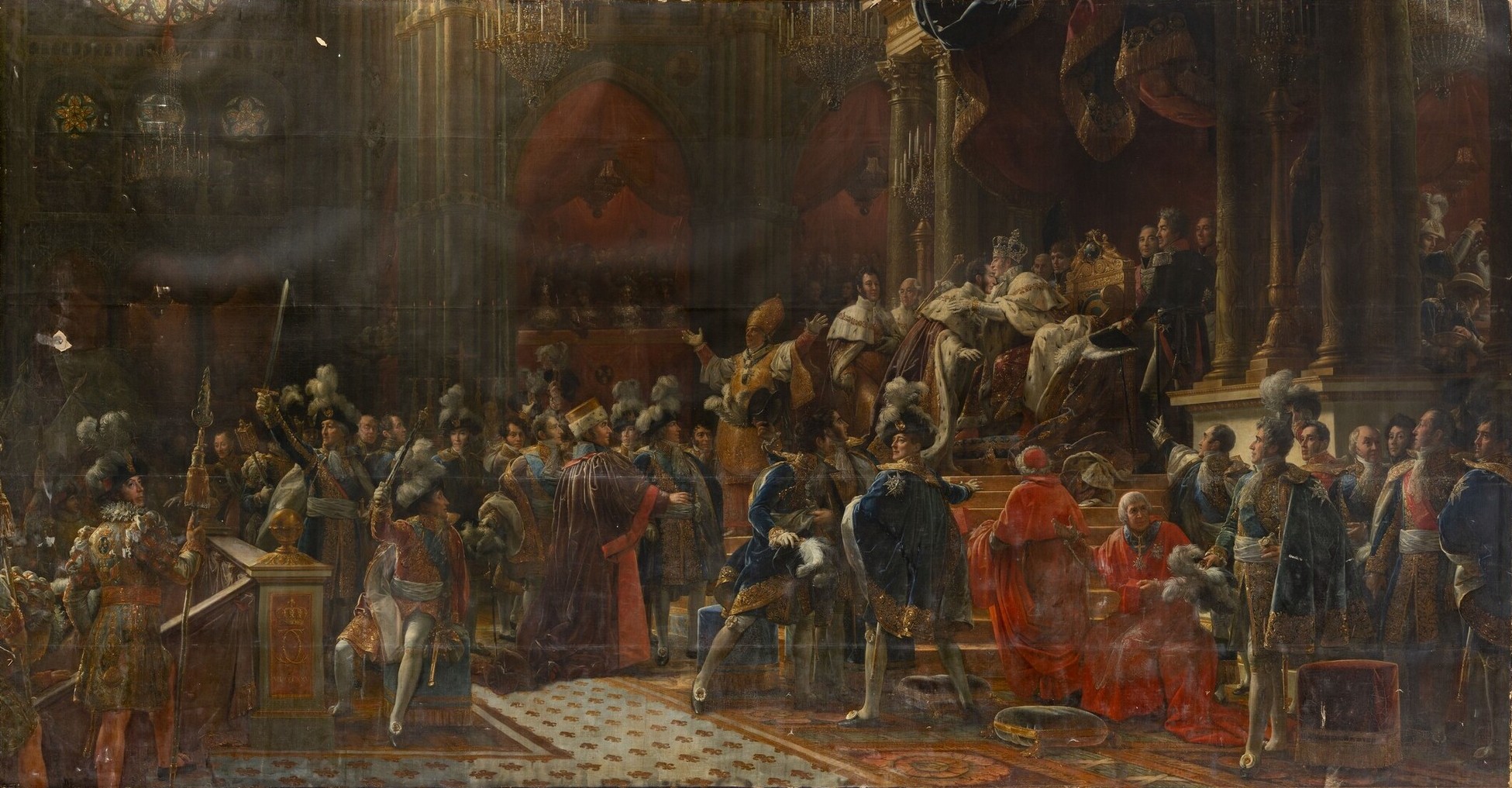
The Coronation of King Charles X in 1825


190 years ago, on May 29th 1825, there took place the coronation of King Charles X in the cathedral at Rheims. Fify years earlier, and a world away, his elder brother King Louis XVI had been anointed and crowned at Rheims. Now in a true spirit of restoration once more a King of France approached his sacre. In style and splendour the Coronation was similar to that of King George IV at Westminster in 1821. They can both be seen as part of that awakening interest in medieval culture across western Europe at the time. For an introduction to the history of the ceremonial see the online article Coronation of the French monarch.


The Coronation of King Charles X
The homage of the Dauphin
François Gérard, 1827. Palace of Tau, Rheims

Image:Wikimedia

France, Dauphin's Crown, 1823Dauphin Crowns, Dauphin Louis, Royal Crowns, Diadem Crowns Tiaras, Louis Antoine, 1825, Crowns Jewels French, France, Royal Jewels

The Crown of the Dauiphin, Louis Antoine, Duke of Angouleme, and later the de jure King Louis XIXwhich he wore at his father's Coronation in 1825. The crown was apparently made in 1823.

Image:pinterest.com

There are pictures of some of  the liturgical vessels and robes and other insignia used at the Coronation, such as the Chancellor's mace which are now preserved in the Tau Palace adjoining the cathedral at the website Charles X, The Last Coronation. Tau Palace, Reims, [traveltoeat.com/charles-x-the-last-coronation-tau-palace-reims-france/} - but the link appears unstable.

For the Coronation a new state coach was made, and which today can be seen at Versailles..

The coronation coach of Charles X (otherwise know as Charles Philippe, the comte d'Artois)

  The Coronation Coach of King Charles X

Image:vivelareine.tumblr.com 
 
There is a video about it on the website at The Coronation Coach of Charles X - 1825, with some details about it and its subsequent history at Close-up on the Coronation Coach of Charles X - 1825. There are more pictures of the coach and other French royal coaches, including the very impressive funeral coach made for the body of King Louis XVIII in 1824, here.


The entry of Charles X into Paris after his coronation on June 6, 1825Louis François Lejene

The entry of King Charles X into Paris on June 6th 1825 following his coronation

Louis François Lejene


Image:vivelareine.tumblr.com 

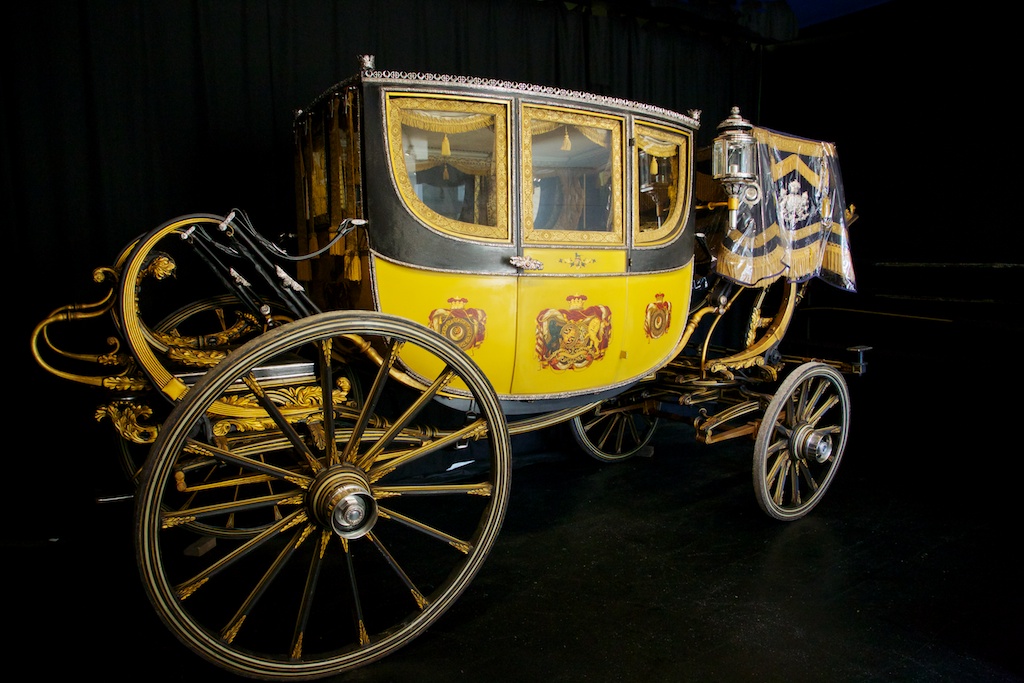
A British link with the coronation can still be seen at Alnwick castle in Northumbertland:

The Percy family State Carriage - a luxurious state coach which once carried the 3rd Duke of Northumberland as George IV's personal representative to the coronation of Charles X in France in 1825.  It was repainted in 1902 for use at the coronation of King Edward VII, and was beautifully restored in 2011 for the wedding of the present Duke's eldest daughter, Katie.  Lady Katie's wedding dress is also on display in the coach house.  The coach was used again in June 2013 for the wedding of the Duke's youngest daughter, Lady Melissa, to Thomas van Straubenzee.

The Percy family State Carriage which carried the third Duke of Northumberland as KingGeorge IV’s personal representative at the coronation of King Charles X.

It was repainted in 1902 for use at the coronation of King Edward VII, and was beautifully restored in 2011 for the wedding of the present Duke’s eldest daughter, Katie. The coach was used again in June 2013 for the wedding of the Duke’s youngest daughter, Lady Melissa, to Thomas van Straubenzee.


Image: bikernz.wordpress.com

I am. of course, awaiting the next coronation of a King of France at Rheims.


Sunday, 6 November 2011

King Charles X


Today is the 175th anniversary of the death in exile in 1836 of that oft-maligned monarch King Charles X of France.

http://upload.wikimedia.org/wikipedia/commons/8/8d/Charles_X_Roi_de_France_et_de_Navarre.jpg

King Charles X

Image:Wikipedia

There is an online life of the King here and an account of the revolution which led to his exile here. This was, in many ways, yet another Parisian 'Day of the Barricades'. His actions in July-August 1830 are reminiscent of those of King James II in 1688.


The homage of the Dauphin at the coronation of King Charles X
Rheims Cathedral May 29th 1825

François Gérard 1827
Musee des Beaux Artes, Chartres

Image:Lib-art.com

He is often remembered for his Coronation as King at Rheims in 1825, fifty years, a revolution and a world war away from the previous one in 1775 of his brother King Louis XVI. It can also be seen as a pendant to that of King George IV in 1821 at Westminster. This was the decade of lavish coronations, alas never repeated in France, and regrettably curtailed in Britain by King William IV, and gradually re-enhanced in the twentieth century, but still shorn of the Westminster Hall ceremonies and banquet.


http://www.terminartors.com/files/artworks/5/3/1/53133/Ingres_Jean-Auguste-Dominique-Charles_X_in_his_Coronation_Robes.jpg

King Charles X in his Coronation robes.
The similarity to clerical vestments in the robes is clear.
Jean-Auguste-Dominique Ingres 1829-30

Image:terminartors.com