Once I was a clever boy learning the arts of Oxford... is a quotation from the verses written by Bishop Richard Fleming (c.1385-1431) for his tomb in Lincoln Cathedral. Fleming, the founder of Lincoln College in Oxford, is the subject of my research for a D. Phil., and, like me, a son of the West Riding. I have remarked in the past that I have a deeply meaningful on-going relationship with a dead fifteenth century bishop... it was Fleming who, in effect, enabled me to come to Oxford and to learn its arts, and for that I am immensely grateful.


Showing posts with label King George IV. Show all posts

Sunday, 23 April 2017

Great George


Today is the feast of St George and a day in which in England teh order of the Garter come sto mind as a celebration of knightly virtues on the day of our national patron saint.

In recent months I have found these posts about insignia from the Order in the Royal Collection on Pinterest and thought they could be shared to mark the occasion.

The first is taken from the Royal Collection website and is about the Stuart insignia on display in Edinburgh Castle alongside the Honours of Scotland:

Great George, made by Robert Vyner for Charles II, 1661, thence by descent to Prince Henry Benedict Stuart, Cardinal York; acquired by George IV. Rev.

The back of the figure of St George and the Dragon

Image: Pinterest from Royal Collection Trust website

This magnificent Great George was supplied to Charles II in 1661 by the Royal goldsmith, Robert Vyner. It was described as ‘A v. large enamelled George set with 20 large diamonds and one hundred and odd lesser diamonds’. Charles II is depicted wearing it, together with the new coronation regalia, in John Michael Wright’s portrait of c.1670. The Great George was illustrated with Charles II’s other insignia in Ashmole’s History of the Garter, 1672. It has subsequently lost the flowing cloak worn by St George and the large diamond-set fleur-de-lis suspension loop with which it was attached to the collar. Some of the surviving stones are sixteenth century cuts and indicative of the reuse of stones following the Restoration. The oak leaves on the underside are, perhaps, an allusion to the Boscobel Oak in which Charles II hid to escape from Cromwell’s forces after the Battle of Worcester in 1651.

The Garter collar follows the style of collars produced after the Restoration. Its construction is significantly different from earlier seventeenth century collars and the finish of the reverse suggests hasty production. Collars made immediately after the Restoration included twenty-six roses and knots and weighed around 30 oz. This collar, with its twenty-one knots and weighing 33 oz 10 dwt, is therefore smaller in terms of knots and garters. The Jewel House began supplying heavier collars with twenty-one roses and knots in 1685 and it is therefore likely that this collar was made shortly after James II’s accession.

Both collar and George were taken by James II into exile in France in 1688. They appear as ‘A Collar of the order with a George to it of Diamonds’ valued at 6,000 livres in James II’s posthumous inventory drawn up at Saint-Germain on 20 July 1703. Prince James Edward Stuart is depicted wearing them in Francesco Trevisani’s portrait of c.1719-20.

The collar and George were not listed with other pieces bequeathed to the Prince of Wales by Henry Benedict, Cardinal York, in 1807. The Prince asked for their whereabouts to be investigated and in 1811 William Hill took up the task on the advice of General Mackenzie. Hill discovered that the collar and George, which were described as being ‘once in possession of Charles 2d’ had been given (by Cardinal York?) as security for debts. The whereabouts of the pieces was still unresolved at the time of the Congress of Vienna in 1814 and the topic was raised by the Prince Regent with Cardinal Consalvi when the two men met in July of that year. The Cardinal was able to inform the British Foreign Secretary, Lord Castlereagh, of the condition of the items when they met in Vienna in October 1815.

Although it is not known when the Prince received the collar and George they were certainly in his possession by 1825 when he wore the George at a Waterloo dinner at Carlton House: ‘He [George IV] ... acquainted his guests that the George which he reserved for his own wearing was the same which had been worn by Charles I, Charles II, and James II and was bequeathed by Henry IX, Cardinal of York to the present king’.

In 1830 the collar and George were deposited on loan by William IV in Edinburgh Castle where they remain on display with the Honours of Scotland.

Text adapted from Ancient and Modern Gems and Jewels in the Collection of Her Majesty The Queen, London, 2008


The Royal Collection website has a series of detailed expandable photographs of the items here

Jewel of the English Order of the Garter, Dresden, 1693-1694. Gold, enamel, 23 diamonds, a ruby. H 7,4 cm. Inventory number: VIII 263. Green Vault © Staatliche Kunstsammlungen Dresden 2016

This is a Lesser George  - worn on the riband of the Order - with diamonds and a ruby dated to 1693-4 and in the Green Vault in Dresden

Image: Pinterest

GREAT BRITAIN_From the Royal Collection - Lesser George of gold, jeweled all over, mainly with diamonds, probably made for George II before 1752; possibly remounted for George III, 1765; altered for Queen Victoria, 1858. 

A Lesser George probably made for King George II before 1752 and  possibly remounted for King George III in 1765. It was altered for Queen Victoria in 1858 when the eight large diamonds were replaced and used in the Coronation necklace, and replaced in the badge by clusters of smaller stones

Image: Pinterest from the Royal Collection Trust

George badge of the Order of the Garter, belonging to King George III. 1775-1800 Diamond, ruby, sapphire, amethyst, silver and gold Great

A Great George that belonged to King George III
Dated to 1775-1800

Image: Pinterest from the Royal Collection Trust

https://i.pinimg.com/236x/f3/7f/0c/f37f0c5ba9450f94dfcdc5a4ff8141e0.jpg

The reverse of the Great George 
 
Image: Pinterest from the Royal Collection Trust


One of the magnificent items bequeathed to the Queen Elizabeth from King George VI, was the
The Marlborough Great George
The Royal Collection
badge of the Marlborough Great George. This magnificent diamond and precious stone garter badge of St. George had been made for King George IV by an unknown jeweler, but has been altered by both Rundell, Bridge and Rundell as well as Garrard’s.

This badge was worn by King George VI in 1937 and was later worn by Queen Elizabeth II at her coronation in 1953. Her Majesty always wears it on Garter Day and at the State Opening of Parliament. The creation of the badge came about when King George IV noticed one worn by the Duke og Malborough and ordered a copy of the piece made for himself.

The badge was recently on display at Buckingham Palace as part of the 2010 “Queen’s Year” exhibition which gave citizens of Britain a chance to view objects in use by the Queen throughout her daily life in a year.

Adapted from stalkingthebelleepoque.blogspot.co.uk


Tuesday, 19 July 2016

Coronation of King George IV


Thursday July 19th 1821 witnessed the Coronation of King George IV at Westminster. This spectacular occasion 195 years ago outdid all previous such ceremonies, and was the last at which there were the ceremonies in Westminster Hall, the procession thence to the Abbey and the great banquet afterwards - those were all done away with by King William IV for his coronation in 1831.

https://upload.wikimedia.org/wikipedia/commons/e/ef/George_IV_1821_color.jpg

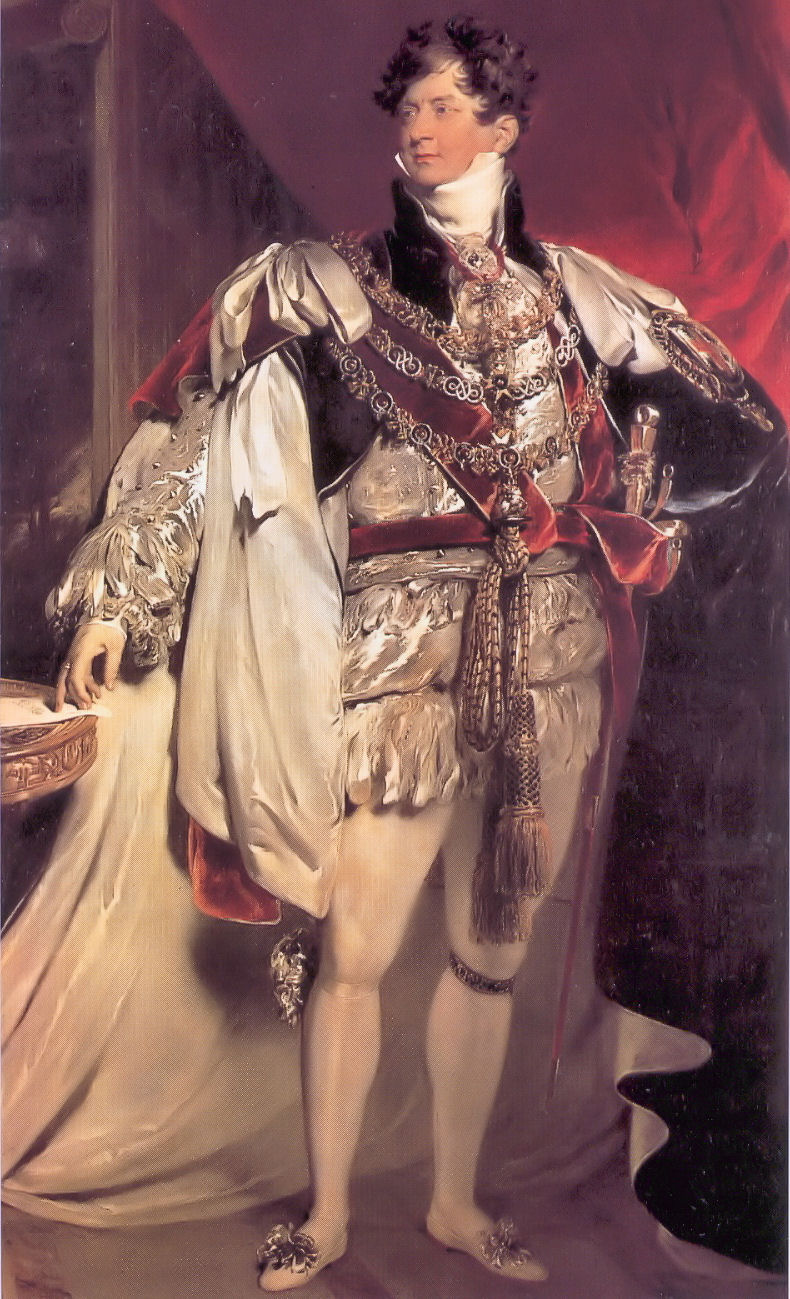
King George IV in his Coronation Robes
His new crown is at his side and he is wearing the collars of the Orders of the Golden Fleece, the Royal Guelphic Order, the Bath and the Garter

Portrait by Sir Thomas Lawrence

Image: Wikipedia/Royal Collection Trust


There are pictures and more information about the day at Coronation of George IV

Cast of George IV's crown

 A cast of the crown of King George IV
The frame of the crown can now be seen at the Tower of London
There is more about the crown at Coronation Crown of George IV
Image: Royal Collection Trust

Image result for George IV Coronation

The crown when set with diamonds

Image:jpnetuk.com


https://blogger.googleusercontent.com/img/b/R29vZ2xl/AVvXsEh61I6F1jxUPVH8zgZlvGsz5Bldrgz7h-9K5HnpRfscoglCVtzvMypE7fzooP5ULmaofVtNctzFB4ewy57sZXfy2jd8vJW8UdEFwXbOZ8TiNEcqS1eOcMM0H_ycqTS0npBFRCe2Cs_X_Txa/s1600/Coronation+Procession,+1821,+George+Scharf.jpg

 The Coronation Procession in 1821

Image:madamegilflurt.com

Amongst the spectators who witnessed the procession to and from the Abbey was the twenty year old John Henry Newman who left his impressions of the spectacle, and especially of the jewels in the regalia - you might, he thought, be able to counterfeit the coloured precious stones, but not the flash and sparkle of diamonds.

 http://assets3.parliament.uk/iv/main-large//ImageVault/Images/id_302/scope_0/ImageVaultHandler.aspx.jpg

 The Coronation Banquet in Westminster Hall
The King's Champion is entering the Hall on horseback to challenge any opponent of the King's title

Image: parliament.uk

Two of the chandeliers which were hanging in Westminster Hall that day are now here in Oxford, in a place Newman himself knew in those years, the Holywell Music Room.


http://conference-oxford.com/images/conference/venue/94/holywellmusicroom1of1__venue-room.jpg

The interior of the Holywell Music Room in Oxford

Image: conference-oxford.com 

Monday, 17 March 2014

Insignia of the Order of St Patrick


I have posted on several occasions about the Order of St Patrick in The Order of St Patrick in 2011, Banners of the Knights of St Patrick in 2012 and The Order of St Patrick in 2013. There is an online account of the Order, its history and insignia at Order of St. Patrick. A new online piece about the Order has appeared only today in The Order of St. Patrick.

I very much regret that it was allowed after 1922 to fall into abeyance, with only Royal Knights being appointed until 1936, and none since, the last one, the late Duke of Gloucester, dying in 1974. I think it should have been revived, and should be revived - why should this not be done with the forthcoming state visit of the President of the Irish Republic and make him an Extra Knight of the Order?

I am not alone in this opion as can be seen from a letter to The Times a decade ago at Time to revive Order of St Patrick , and more recently these Northern Irish blogpost Quis Separabit: Restore the Order of Saint Patrick  and Order of St Patrick as well as some discussion in the southern political scene at Should the Order of St. Patrick be revived? ( the comments suggest a lack of confidence in the ability of southern Irish politicians rather than doubt about the Order...) and there is the Facebook site Order of St Patrick - Revival.

A quick trawl on the internet produced a considerable number of pictures of the insignia of the Order. There is a wonderful collection of images of the insignia, as well as some of the Officers and Knights, here. Some of the others I found I have copied and pasted in this post.

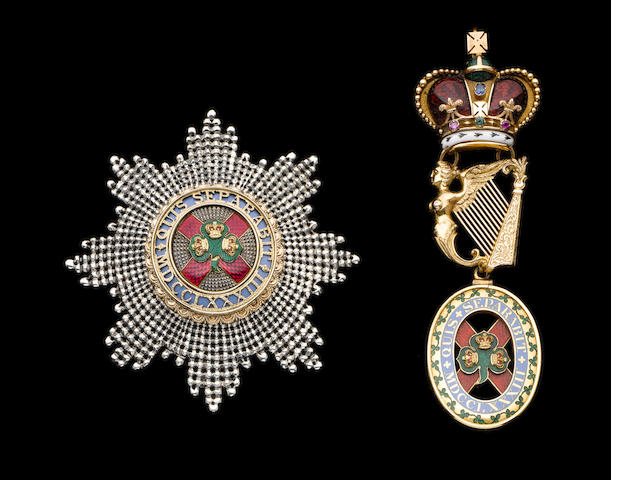
This example of a diamond star  from the Royal Collection appears to have been made in 1838 for Queen Victoria by Rundell and Bridge :


Star of the Order of St Patrick

 Star of the Order of St Patrick

Image:The Royal Collection © 2012,
Her Majesty Queen Elizabeth II
RCIN 441162


King George V's Diamond Star
Made around 1890, the  centre has a shamrock of emeralds, with the Saint's cross in rubies on a diamond background. 'George, Prince of Wales, April 1910' is engraved on the reverse.

Image:doyle.com.au

 Another jewelled badge of the Order

Image:doyle.com.au

The website these last three illustrations comes has an interesting section on the Order and on the theft of the Irish Crown Jewels - the insignia of the Lord Lieutenant as Grand Master of the Order - in 1907, which can be seen here.


Two stars of the Order were sold in the Harewood: The Attic sale at Christies South Kensington on  December 9th 2012:

Star of the Order of St. Patrick,
Silver, gold and enamel, 81mm. diam. 
Reverse engraved Storr & Mortimer, Jewellers to the Queen, mid 19th century, some enamel damage

Price realized £8,750 (Estimate £2,000 - £2,500)

The provenance was almost certainly Ulick John de Burgh, 1st Marquess of Clanricarde (1802 -1874), and by descent to his son,Herbert George de Burgh-Canning, 2nd Marquess of Clanricarde (1832- 1916), and bequeathed to his great-nephew, Henry Lascelles, 6th Earl of Harewood (1882-1947), and by descent at Harewood House, Yorkshire.

Image:Christies.com


Star of the Order of St. Patrick
Silver, gold and enamel, 68mm. diam, reverse engraved Storr & Mortimer. Early to mid 19th century, some enamel damage to shamrock  
Price realized £5,000 ( Estimate £1,500 - £2,000) 

Image:Christies.com

The Most Illustrious Order of St.Patrick, 

A star and badge of the Order
Made by West and Sons Dublin and hallmarked 1852
Offered but withdrawn at Bonhams 2012 

Image:Bonhams.com 

Badge 

The riband and  badge

Mantle and Collar

The mantle and collar  

Images:medal.org.uk 


Sunday, 12 August 2012

King George IV


Today is the 250th anniversary of the birth of King George IV in 1762.

File:George IV van het Verenigd Koninkrijk.jpg

King George IV in the robes of the Order of the Garter
Sir Thomas Lawrence
 
The King is also wearing the collars of the Spanish Order of the Golden Fleece, and those of his own Orders of St Michael and St George and of the Bath in addition to that of the Garter. As Prince Regent he revised and extended the Order of the Bath in 1815, and founded that of St Michael and St George in 1818.
 
The crown at his side was made for his coronation in 1821, replacing that used since 1661. Used again for King William IV in 1831 it was replaced in 1838 by the present Imperial State Crown. The frames of both the 1661 and 1821 crowns can now be seen in the Tower of London
 
Image: Wikipedia

There is an online biography of the King here which seesm to be even handed in its assessment and explores his life in the context of his times.

It is not difficult to see why many people found him difficult and dislikeable, and also to see that he did have genuine abilities and excellent qualities. His legacy to the Monarchy is not inconsiderable - not only the building of Buckingham Palace and the drastic but dramatic restoration and rebuilding of Windsor Castle, but the acquisition of significant parts of the Royal Collection, as well as the extraordinary Brighton Pavlion, which his neice sold off. More importantly still may have been his visits to Ireland in 1821 and Scotland in 1822 - the first by a reigning sovereign respectively since 1399 and 1651. Although King William IV and Queen Victoria reacted against King George's style and lavish expenditure - not to say indulgence - he had created both the setting and the revived concept of the royal visit that have become very significant parts of the modern British monarchy. A complex man, often selfish, but one who managed to leave a not inconsiderable legacy.


Tuesday, 17 April 2012

King's Cross


A friend who is regular reader of this blog has sent me the link, courtesy of The Georgian Group, to this picture of the monument which gave its name to King's Cross in London. Indeed I used, unthinkingly, to assume that the area took its name from one of the Eleanor Crosses erected by King Edward I after 1290. The facts are, in fact, otherwise, and resulted in changing the name of the area from Battle Bridge.


King's Cross
Image: twitpic.com/The Georgian Group

It was erected in 1830 as a a monument to King George IV and was built at the junction of Grays Inn Road,, Pentonville Road and New Road, which later became Euston Road.

The monument was sixty feet high and topped by an eleven-foot-high statue of the King, and was described in 1878 by the author Walter Thornbury as "a ridiculous octagonal structure crowned by an absurd statue". The upper storey was used as a camera obscura while the base in turn housed a police station and a public house. The unpopular building was demolished in 1845, though the area has kept the name of Kings Cross, and King's Cross Railway Station now stands by the junction where the cross stood.

Thornbury's description of the cross in his 1878 book Old and New London, vol ii, is as follows:

"In 1830 Battle Bridge assumed the name of King's Cross, from a ridiculous octagonal structure crowned by an absurd statue of George IV., which was erected at the centre of six roads which there united. The building, ornamented by eight Doric columns, was sixty feet high, and was crowned by a statue of the king eleven feet high. Pugin, in that bantering book, "The Contrasts," ridiculed this effort of art, and contrasted it with the beautiful Gothic market cross at Chichester. The Gothic revival was only just then beginning, and the dark age was still dark enough. The basement was first a police-station, then a public-house with a camera-obscura in the upper storey. The hideous monstrosity was removed in 1845. Battle Bridge, which had been a haunt of thieves and murderers, was first built upon by Mr. Bray and others, on the accession of George IV., when sixty-three houses were erected in Liverpool Street, Derby Street, &c. The locality being notorious, it was proposed to call it St. George's Cross, or Boadicea's Cross, but Mr. Bray at last decreed that King's Cross was to be the name."

http://www.british-history.ac.uk/image.aspx?compid=45097&filename=fig100.gif&pubid=340

The demolition of the King's Cross in 1845

Although a somewhat eccentric piece of architecture I suspect that had it survived KIng's Cross might well have become a fondly regarded piece of the London cityscape one can imagine Sir John Betjeman celebrating it.

Thornbury's history of the whole area can be read here.