Once I was a clever boy learning the arts of Oxford... is a quotation from the verses written by Bishop Richard Fleming (c.1385-1431) for his tomb in Lincoln Cathedral. Fleming, the founder of Lincoln College in Oxford, is the subject of my research for a D. Phil., and, like me, a son of the West Riding. I have remarked in the past that I have a deeply meaningful on-going relationship with a dead fifteenth century bishop... it was Fleming who, in effect, enabled me to come to Oxford and to learn its arts, and for that I am immensely grateful.


Showing posts with label Irish Crown Jewels. Show all posts

Monday, 17 March 2014

Insignia of the Order of St Patrick


I have posted on several occasions about the Order of St Patrick in The Order of St Patrick in 2011, Banners of the Knights of St Patrick in 2012 and The Order of St Patrick in 2013. There is an online account of the Order, its history and insignia at Order of St. Patrick. A new online piece about the Order has appeared only today in The Order of St. Patrick.

I very much regret that it was allowed after 1922 to fall into abeyance, with only Royal Knights being appointed until 1936, and none since, the last one, the late Duke of Gloucester, dying in 1974. I think it should have been revived, and should be revived - why should this not be done with the forthcoming state visit of the President of the Irish Republic and make him an Extra Knight of the Order?

I am not alone in this opion as can be seen from a letter to The Times a decade ago at Time to revive Order of St Patrick , and more recently these Northern Irish blogpost Quis Separabit: Restore the Order of Saint Patrick  and Order of St Patrick as well as some discussion in the southern political scene at Should the Order of St. Patrick be revived? ( the comments suggest a lack of confidence in the ability of southern Irish politicians rather than doubt about the Order...) and there is the Facebook site Order of St Patrick - Revival.

A quick trawl on the internet produced a considerable number of pictures of the insignia of the Order. There is a wonderful collection of images of the insignia, as well as some of the Officers and Knights, here. Some of the others I found I have copied and pasted in this post.

This example of a diamond star  from the Royal Collection appears to have been made in 1838 for Queen Victoria by Rundell and Bridge :


Star of the Order of St Patrick

 Star of the Order of St Patrick

Image:The Royal Collection © 2012,
Her Majesty Queen Elizabeth II
RCIN 441162


King George V's Diamond Star
Made around 1890, the  centre has a shamrock of emeralds, with the Saint's cross in rubies on a diamond background. 'George, Prince of Wales, April 1910' is engraved on the reverse.

Image:doyle.com.au

 Another jewelled badge of the Order

Image:doyle.com.au

The website these last three illustrations comes has an interesting section on the Order and on the theft of the Irish Crown Jewels - the insignia of the Lord Lieutenant as Grand Master of the Order - in 1907, which can be seen here.


Two stars of the Order were sold in the Harewood: The Attic sale at Christies South Kensington on  December 9th 2012:

Star of the Order of St. Patrick,
Silver, gold and enamel, 81mm. diam. 
Reverse engraved Storr & Mortimer, Jewellers to the Queen, mid 19th century, some enamel damage

Price realized £8,750 (Estimate £2,000 - £2,500)

The provenance was almost certainly Ulick John de Burgh, 1st Marquess of Clanricarde (1802 -1874), and by descent to his son,Herbert George de Burgh-Canning, 2nd Marquess of Clanricarde (1832- 1916), and bequeathed to his great-nephew, Henry Lascelles, 6th Earl of Harewood (1882-1947), and by descent at Harewood House, Yorkshire.

Image:Christies.com


Star of the Order of St. Patrick
Silver, gold and enamel, 68mm. diam, reverse engraved Storr & Mortimer. Early to mid 19th century, some enamel damage to shamrock  
Price realized £5,000 ( Estimate £1,500 - £2,000) 

Image:Christies.com

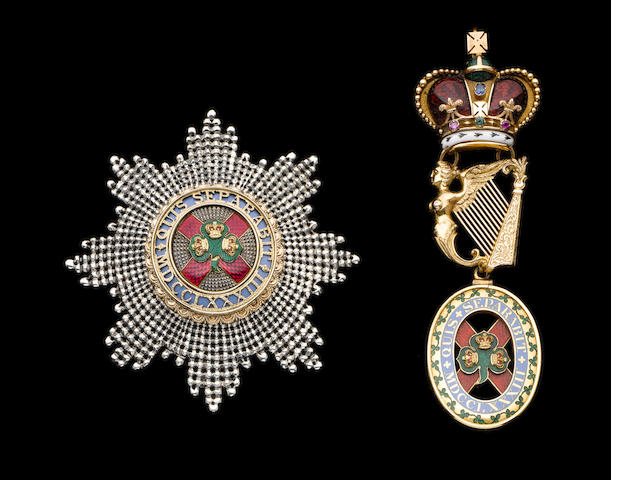
The Most Illustrious Order of St.Patrick, 

A star and badge of the Order
Made by West and Sons Dublin and hallmarked 1852
Offered but withdrawn at Bonhams 2012 

Image:Bonhams.com 

Badge 

The riband and  badge

Mantle and Collar

The mantle and collar  

Images:medal.org.uk 


Thursday, 17 March 2011

The Order of St Patrick


Today being St Patrick's Day it seems very appropriate to write something about the Most Illustrious Order of St Patrick which was inaugurated on this day in 1783 by King George III, and founded as the Irish equivalent of the Orders of the Garter and the Thistle.

It was clearly an early result of the era following the repeal of Poyning' s law and the political process associated with Grattan's parliament , that ended with the 1798 rebellion and the Union of 1801.

There is a very good article about the Order, its history and its insignia here and there is another article which deals with the origin of the colour of the riband - St Patrick's blue - here. The design of the collar and star were clearly inspired by those of the Order of the Garter


File:Insignia of Knight of St Patrick.jpg


The Collar and Star of the Order of St Patrick

Image: Wikipedia

Star

The star of the Order

Badge

The riband and badge

Mantle and Collar

The mantle and collar

Images: medal.org

After the 1921 treaty the only conferments were on members of the Royal Family - the Prince of Wales in 1922, the Duke of Gloucester in 1934 and the Duke of York in 1936. The last non-royal knight died in the 1950s and with the death of the Duke of Gloucester in 1974 no members apart from the Sovereign - who still lists the Order on the British Monarchy website. The star of the Order is still the badge of the Irish Guards.

As the Wikipedia article shows there has been periodically talk of reviving the Order, but it has not, so far, happened. I very much regret the dormancy of the Order and would very much want to see it revived.

I wonder if the Order might have continued to have appointments other than the three Princely ones had the Monarch been in sole exercise of the fount of honour at that time. Until the Attlee government appointments to the Orders of the Garter and Thistle (and by implication the Patrick) were on the nomination of the Prime Minister to the Sovereign. Attlee returned exclusive control to the King - the point is described in Sir John Wheeler-Bennett's biography of King George VI. Had it not been a political matter appointments might have continued both for Northern Ireland as part of the United Kingdom, and indeed for the southern part of Ireland which was still under the King's official authority until at least 1936-7, and in certain respects to 1949. Such was the curious position of the status of the southern part of Ireland after 1922 that the King's title within the United Kingdom was not changed until 1927 to reflect the change resulting from the 1921 treaty.

The forthcoming visit to Dublin by The Queen will highlight the numerous and unresolved constitutional ambiguities and ambivalences between the governments based in London and Dublin. I will write more about those points on another occasion.

The still unsolved theft of the Irish Crown jewels - actually the jewelled star and sash badge worn by the Sovereign or the Lord Lieutenant as Grand Master of the Order - in 1907 is discussed in the following articles which can be read here, here, here and here. That retains its fascination as a story because of its lack of a solution, or recovery of the jewels, the hints of political intrigue behind an official 'cover - up', and the period glamour of a detective story set in Edwardian high society.