Once I was a clever boy learning the arts of Oxford... is a quotation from the verses written by Bishop Richard Fleming (c.1385-1431) for his tomb in Lincoln Cathedral. Fleming, the founder of Lincoln College in Oxford, is the subject of my research for a D. Phil., and, like me, a son of the West Riding. I have remarked in the past that I have a deeply meaningful on-going relationship with a dead fifteenth century bishop... it was Fleming who, in effect, enabled me to come to Oxford and to learn its arts, and for that I am immensely grateful.


Showing posts with label Order of St Patrick. Show all posts

Friday, 17 March 2017

Badges of the Order of St Patrick


Today is the feast of St Patrick, and on previous years I have posted about the Most Illustrious Order of St Patrick, founded by King George III in 1783 as the equivalent for Ireland of the Orders of the Garter and the Thistle.

There is a useful and comprehensive online account of the Order at Order of St. Patrick

As that explains until the Disestablishment of the Church of Ireland in 1869-70 the Archbishop of Armagh was Prelate of the Order and the Archbishop of Dublin Chancellor. The Knights had stalls with their banners in St Patrick's Cathedral in Dublin.

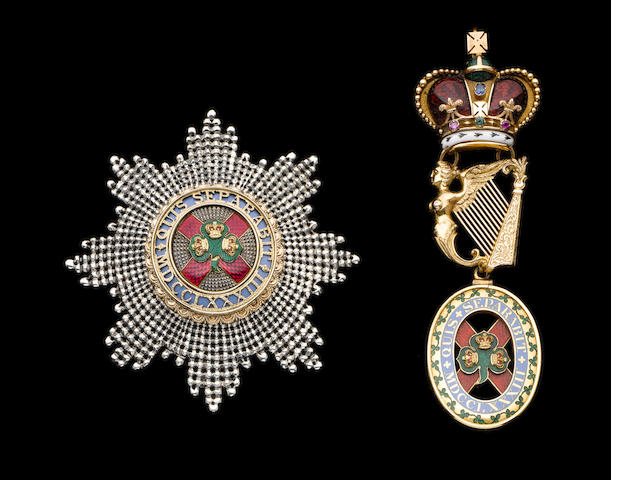
Image result for Order of St Patrick Prelates badge 

Badge of the Archbishop of Armagh as Prelate of the Order
Ulster Museum

Image: Pinterest 
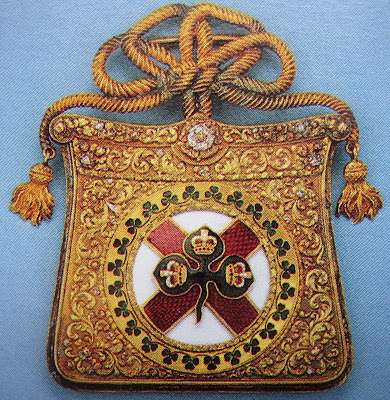
Image result for Order of St Patrick Prelates badge 

Badge of the Archbishop of Dublin as Chancellor of the Order
The small symbolic purse was worn suspended on a Patrick blue riband around the neck

Image: Lord Belmont in Northern Ireland 
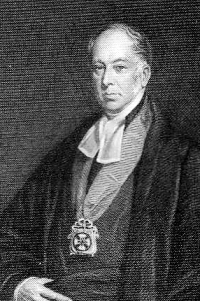
Image result for Archbishop Whately of Dublin

Archbishop Richard Whately wearing the Chancellor's Badge
An Oriel man he was Archbishop of Dublin 1831-63

Image: Wikipedia

There are online accounts of the Archbishop at Richard Whately and at Archbishop Richard Whately from Alfred Webb A Compendium of Irish Biography, 1878. The most detailed life online is by Richard Brent in the Oxford Dictionary of National Biography and it can be viewed here.

https://i.pinimg.com/236x/14/de/bf/14debf61f105099afc3cce9894e1f27a.jpg

Badge of the Usher of the Order

Image: Pinterest

My previous posts about the Order can be viewed at The Order of St Patrick (2011), Banners of the Knights of St Patrick (2012), The Order of St Patrick (2013), Insignia of the Order of St Patrick (2014), The Most Illustrious Order of St Patrick (2015), and Order of St Patrick (2016)

Just in case you feel like asking, yes, I am in favour of making new appointments to the Order and restoring it to its proper and historic place in the Honours system.


Thursday, 17 March 2016

Order of St Patrick


Today being St Patrick's Day, and this being this blog, regular readers will not be surprised to see again my virtually annual plea for the re-establishment of the Order of St Patrick.

The Order of St Patrick was founded in 1783, at the time of Grattan's Parliament, to reward those in high office in Ireland and Irish peers on whose support the government of the day depended. It therefore served as the national Order of Ireland as the Garter was for England and the Thistle for Scotland.

The Order in effect lapsed in 1974 with the death of the last surviving recipient, Prince Henry, Duke of Gloucester, leaving The Queen alone as a member as Sovereign of the Order. Originally, the number of Knights of St Patrick was 15, and this increased to 22 in 1833. The Knights wore mantles of sky-blue satin, and the star of the Order was embroidered in silver on the right breast. The Order's most famous insignia were the badge and star used by the Lords Lieutenant of Ireland as grand Master of the Order; these were made available for the serving Lord Lieutenant's use in 1830 by King William IV. The insignia were made from 394 stones taken in part from some of Queen Charlotte's jewellery and from one of the Order of the Bath Badges which had belonged to her husband George III. Known as the 'Irish Crown Jewels', the insignia were stolen from Dublin Castle in 1907 and never recovered.

The Order effectively went into abeyance with the establishment of the Irish Free State in 1922, and the last appointment to it was of the Duke of York as heir to the throne by his brother King Edward VIII in 1936.


King George IV's Sovereign's Sash Badge  made in 1812. In the centre is a green enamelled shamrock, each leaf with a diamond five-arched crown, set on a red enamelled cross of St Patrick. The Badge has a swivel suspension loop of eight diamonds, and the reverse has the same design in coloured enamel and gold.


King George V's Diamond Star. Made around 1890, the Star's centre has a shamrock of emeralds, with the Saint's cross in rubies on a diamond background. 'George, Prince of Wales, April 1910' is engraved on the reverse


The Order's motto was 'Quis Separabit MDCCLXXXIII' - 'Who will separate us 1783'.


The badge of the Usher of the Order

Images:doyle.com.au 


Allowing the Order to begin to lapse in the years after 1922 was a mistake - part of the old Kingdom of Ireland remained as part of the united Kingdom, and the King was head of state of the Irish Free State until the 1937 Constitution was introduced, if not indeed until 1949 and the repeal of the External Relations Act. the post Second World war governments of the United Kingdom who in the face of opposition to reappointing to the Order of Ulstermen and Irishmen who had fought for the Crown in the war from the Dublin government were craven so to do.

On the basis that the Garter and the Thistle since 1948 have been solely in the Monarch's gift, and not political honours, the same principle should be applied to the Order of St Patrick. It could be bestowed on a similar basis on the great and the good. On an analogy with the Scandinavian monarchs bestowal of their highest orders on Presidents of Finalnd it could be given to the Presidents of the Irish Republic as an Extra Knight.  The modern Irish state, which is unique in Europe in having no public system of honours can hardly object.

The Northern Irish 'Peace Process' and the commemorations of 1916 make much of shared recognitions of different traditions and their mutual acceptance. If that is so then restoring the Order cannot cause offence ( if it ever could have ) and it can be recognised as part of the historic traditions of all of Ireland.

The insignia of the Order survives as the emblem of the Irish Guards and gives them their blue bearskin flash. If the Duke of Cambridge as Colonel-in-Chief  of the Regiment could wear that on his uniform at his wedding and at Trooping the Colour it seems plain silly not to make him a Knight of the Order.


Star of the Order of St Patrick
Offered for sale at Spinks in 2005

Image:icollector.com


Tuesday, 17 March 2015

The Most Illustrious Order of St Patrick


Today being the feast of St Patrick it is once more time for my annual plea for the revival of The Most Illustrious Order of St Patrick.

Robes and insignia of the Order of St Patrick.
The Mantle and Collar of The Most Illustrious Order of St Patrick
 
Image: heritage-images.com/ Spectrum Colour Library


My previous posts on the Order can be seen at I have posted on several occasions about the Order of St Patrick in The Order of St Patrick in 2011, Banners of the Knights of St Patrick in 2012, The Order of St Patrick in 2013 and Insignia of the Order of St Patrick last year. That most recent one has a series of links to related websites.

Despite the reluctance of the Free State government after 1922 the Order should have been maintained for more than just conferments upon members of the Royal Family - the last being HRH The Duke of York as heir to the throne in 1936 - and until the Abdication Crisis the King was Sovereign of both parts of Ireland, as indicated by the Royal Title after 1928 - King of Great Britain, Ireland and the British Dominions... - and despite the southern Constitution of 1937 and the External Relations Act the issue was not definitively resolved until 1949 in respect of the southern twenty six counties. For the six counties of Northern Ireland, part of the United Kingdom, with its own hierarchy of government, the Order could have been bestowed, and it was suggested that this be done for Ulster-born military commanders after the Second World War, but opposition from the southern government was allowed to prevail.

Today it could be seen as a symbol of reconciliation and shared traditions and identity. Ireland as a whole appears to be getting much better at looking at its past dispassionately and celebrating its diversity of traditions. In such a climate the Order of St Patrick can surely be accommodated. It still provides the design of the Insignia of the Irish Guards - no-one has suggested changing that as far as I know. If HRH The Duke of Cambridge can wear that uniform at his wedding, as he did, why not make him, his father and uncles Knights of St Patrick?


 the most illustrious order of st. patrick, a fine quality breast star, unmarked, silver, with gold and enamel centre, 82 x 81 mm., gold pin for wearing, <i>extremely fine, circa 1870</i>


Star of the Order of St Patrick, unmarked, silver, with gold and enamel centre, 82 x 81 mm., gold pin for wearing, extremely fine, circa 1870

Attributed to Mervyn Edward Wingfield, K.P., the 7th Viscount Powerscourt, who was elected a Representative Peer for Ireland in 1865 and invested as a Knight of St. Patrick on 2nd August 1871.

Sold at Christies in 2000.

Image: christies.com


Monday, 17 March 2014

Insignia of the Order of St Patrick


I have posted on several occasions about the Order of St Patrick in The Order of St Patrick in 2011, Banners of the Knights of St Patrick in 2012 and The Order of St Patrick in 2013. There is an online account of the Order, its history and insignia at Order of St. Patrick. A new online piece about the Order has appeared only today in The Order of St. Patrick.

I very much regret that it was allowed after 1922 to fall into abeyance, with only Royal Knights being appointed until 1936, and none since, the last one, the late Duke of Gloucester, dying in 1974. I think it should have been revived, and should be revived - why should this not be done with the forthcoming state visit of the President of the Irish Republic and make him an Extra Knight of the Order?

I am not alone in this opion as can be seen from a letter to The Times a decade ago at Time to revive Order of St Patrick , and more recently these Northern Irish blogpost Quis Separabit: Restore the Order of Saint Patrick  and Order of St Patrick as well as some discussion in the southern political scene at Should the Order of St. Patrick be revived? ( the comments suggest a lack of confidence in the ability of southern Irish politicians rather than doubt about the Order...) and there is the Facebook site Order of St Patrick - Revival.

A quick trawl on the internet produced a considerable number of pictures of the insignia of the Order. There is a wonderful collection of images of the insignia, as well as some of the Officers and Knights, here. Some of the others I found I have copied and pasted in this post.

This example of a diamond star  from the Royal Collection appears to have been made in 1838 for Queen Victoria by Rundell and Bridge :


Star of the Order of St Patrick

 Star of the Order of St Patrick

Image:The Royal Collection © 2012,
Her Majesty Queen Elizabeth II
RCIN 441162


King George V's Diamond Star
Made around 1890, the  centre has a shamrock of emeralds, with the Saint's cross in rubies on a diamond background. 'George, Prince of Wales, April 1910' is engraved on the reverse.

Image:doyle.com.au

 Another jewelled badge of the Order

Image:doyle.com.au

The website these last three illustrations comes has an interesting section on the Order and on the theft of the Irish Crown Jewels - the insignia of the Lord Lieutenant as Grand Master of the Order - in 1907, which can be seen here.


Two stars of the Order were sold in the Harewood: The Attic sale at Christies South Kensington on  December 9th 2012:

Star of the Order of St. Patrick,
Silver, gold and enamel, 81mm. diam. 
Reverse engraved Storr & Mortimer, Jewellers to the Queen, mid 19th century, some enamel damage

Price realized £8,750 (Estimate £2,000 - £2,500)

The provenance was almost certainly Ulick John de Burgh, 1st Marquess of Clanricarde (1802 -1874), and by descent to his son,Herbert George de Burgh-Canning, 2nd Marquess of Clanricarde (1832- 1916), and bequeathed to his great-nephew, Henry Lascelles, 6th Earl of Harewood (1882-1947), and by descent at Harewood House, Yorkshire.

Image:Christies.com


Star of the Order of St. Patrick
Silver, gold and enamel, 68mm. diam, reverse engraved Storr & Mortimer. Early to mid 19th century, some enamel damage to shamrock  
Price realized £5,000 ( Estimate £1,500 - £2,000) 

Image:Christies.com

The Most Illustrious Order of St.Patrick, 

A star and badge of the Order
Made by West and Sons Dublin and hallmarked 1852
Offered but withdrawn at Bonhams 2012 

Image:Bonhams.com 

Badge 

The riband and  badge

Mantle and Collar

The mantle and collar  

Images:medal.org.uk 


Sunday, 17 March 2013

The Order of St Patrick


Today being St Patrick's Day, were it not also Passion Sunday, which takes liturgical preference, it seems appropriate to draw attention to the foundation 230 years ago in 1783 by King George III of the  Most Illustrious Order of St Patrick. This followed on from the summoning in 1782 of what became known as Grattan's Parliament, which gave effective self-government for the Kingdom of Ireland. One function of the Order was to be as a patronage resource for the governance of Ireland.

There is an illustrated online account of the Order here. The Queen's website still includes the Order, although there have been no conferments since 1922 other than to her uncles and, lastly, to her father as heir to the throne in 1936 - the relevant piece is here.
My previous posts on this subject from previous years can be read at  The Order of St Patrick and Banners of the Knights of St Patrick

The Most Illustrious Order of St. Patrick was the Irish equivalent of the English Order of the Garter and the Scottish Order of the Thistle. Knights were required to be "descended of three descents of nobleness" on both paternal and maternal sides. Its purpose was to give social advancement to senior peers and so further secure their loyalty. Admission to the Order was seen as evidence of the high social standing of the recipient and there was considerable competition for the limited places - originally there were fifteen Knights, but the number was later increased to twenty two. 

File:Order of St Patrick installation banquet.jpg

The installation banquet of the first Knights of the Order of St Patrick in St Patrick's Hall at Dublin Castle in 1783

A painting by John Keyse Sherwin of 1785

Image: Wikipedia

Star of the Order of St. Patrick

The Star of the Order of St Patrick


Image:Kotomicreations on Flickr
 
The then rebuilt Great Hall, or Ballroom, of Dublin Castle became known as St. Patrick's Hall when King George III instituted the Order of St. Patrick in 1783.

The impressive investiture ceremony of Knighthood took place in St. Patrick's Hall. As soldiers lined the route, the new knights in their mantles and habits, walked in ceremonial procession to an installation ceremony in St. Patrick's Cathedral. A celebratory banquet took place later in the Castle.

St. Patrick's Hall
St. Patrick's Hall in Dublin Castle
Image:dublincastle.ie

The central panel, of Valdre's ceiling paintings in St. Patrick's Hall, depicts the foundation of the Order with King George III seated on a dais, between the symbolic figures of Great Britain with the then British flag and Ireland with her harp, while Justice and Liberty are in attendance. The stall plates along the walls chronologically record the names and the banners bear the family arms of the Knights of St. Patrick invested after the end of the religious ceremonies in St Patrick's Cathedral consequent upon disestablishment of the Church of Ireland in 1869-71.  The star of the Order is reproduced above the eastern doorway of the Hall.


photo

From 1783 until 1871 the Cathedral of St Patrick in Dublin served as the Chapel of the Most Illustrious Order of Saint Patrick. With the disestablishment of the Church of Ireland in 1871 the installation ceremony moved to St. Patrick's Hall in Dublin Castle. The heraldic banners of those knights at the time of the move still hang over the choir stalls to this day.The stall plates of the Knights can also be seen as well as their helmets and swords.

Image: Hazboy on Flickr

photo

The banners on the north side of the choir

Image:timsackton on Flickr


Saturday, 17 March 2012

Banners of the Knights of St Patrick


As today is St Patrick's Day it seems appropriate to the context of this blog to post this picture of the choir of St Patrick's Cathedral in Dublin, complete with the banners of the Knights of the Order of St Patrick.

http://static.panoramio.com/photos/original/43131509.jpg

The banners of the Knights of St Patrick.
Facing the Sovereign's banner on the south side is, on the north, that of the Duke of Connaught and Strathearn who was appointed to the Order in 1869. That of the Prince of Wales appears to be behind that of the Sovereign.

Image: Panoramio

The cathedral dates from the early thirteenth century, and there is a history of it here. I have seen the suggestion that the then Archbishop of Dublin having attended the consecration of Salisbury cathedral modelled his new, second, cathedral on what he had seen in England. It is the largest, and in many ways the most impressive of Irish medieval cathedrals

I posted about the Order a year ago in The Order of St Patrick. From its foundation in 1783 until the Disestablishment of the Church of Ireland in 1871 the choir of the cathedral served as the chapel of the Order; after that date installations took place in St Patrick's Hall in Dublin Castle. One of last such installations was that of the Prince of Wales, the future King Edward VII, on the eve of Disestablishment. Modelled on the practice of the Order of the Garter at St George's Chapel in Windsor, the Knights' banners and helmet, crest and mantling were placed over the stall, and those which were there in 1871 remained at the request of Queen Victoria. There are also some stall plates for Knights, but not a complete series comparable to those at Windsor.

Prior to 1871 the Arcnbishop of Armagh was Prelate of the Order, an office which has been vacant since the death of the last holder of both posts in 1885, and the Archbishop of Dublin was Chancellor of the Order, that post falling to the Chief Secretary for Ireland in 1886.

There is more about the history, insignia and administration of the Order of St Patrick here.


Thursday, 17 March 2011

The Order of St Patrick


Today being St Patrick's Day it seems very appropriate to write something about the Most Illustrious Order of St Patrick which was inaugurated on this day in 1783 by King George III, and founded as the Irish equivalent of the Orders of the Garter and the Thistle.

It was clearly an early result of the era following the repeal of Poyning' s law and the political process associated with Grattan's parliament , that ended with the 1798 rebellion and the Union of 1801.

There is a very good article about the Order, its history and its insignia here and there is another article which deals with the origin of the colour of the riband - St Patrick's blue - here. The design of the collar and star were clearly inspired by those of the Order of the Garter


File:Insignia of Knight of St Patrick.jpg


The Collar and Star of the Order of St Patrick

Image: Wikipedia

Star

The star of the Order

Badge

The riband and badge

Mantle and Collar

The mantle and collar

Images: medal.org

After the 1921 treaty the only conferments were on members of the Royal Family - the Prince of Wales in 1922, the Duke of Gloucester in 1934 and the Duke of York in 1936. The last non-royal knight died in the 1950s and with the death of the Duke of Gloucester in 1974 no members apart from the Sovereign - who still lists the Order on the British Monarchy website. The star of the Order is still the badge of the Irish Guards.

As the Wikipedia article shows there has been periodically talk of reviving the Order, but it has not, so far, happened. I very much regret the dormancy of the Order and would very much want to see it revived.

I wonder if the Order might have continued to have appointments other than the three Princely ones had the Monarch been in sole exercise of the fount of honour at that time. Until the Attlee government appointments to the Orders of the Garter and Thistle (and by implication the Patrick) were on the nomination of the Prime Minister to the Sovereign. Attlee returned exclusive control to the King - the point is described in Sir John Wheeler-Bennett's biography of King George VI. Had it not been a political matter appointments might have continued both for Northern Ireland as part of the United Kingdom, and indeed for the southern part of Ireland which was still under the King's official authority until at least 1936-7, and in certain respects to 1949. Such was the curious position of the status of the southern part of Ireland after 1922 that the King's title within the United Kingdom was not changed until 1927 to reflect the change resulting from the 1921 treaty.

The forthcoming visit to Dublin by The Queen will highlight the numerous and unresolved constitutional ambiguities and ambivalences between the governments based in London and Dublin. I will write more about those points on another occasion.

The still unsolved theft of the Irish Crown jewels - actually the jewelled star and sash badge worn by the Sovereign or the Lord Lieutenant as Grand Master of the Order - in 1907 is discussed in the following articles which can be read here, here, here and here. That retains its fascination as a story because of its lack of a solution, or recovery of the jewels, the hints of political intrigue behind an official 'cover - up', and the period glamour of a detective story set in Edwardian high society.