Once I was a clever boy learning the arts of Oxford... is a quotation from the verses written by Bishop Richard Fleming (c.1385-1431) for his tomb in Lincoln Cathedral. Fleming, the founder of Lincoln College in Oxford, is the subject of my research for a D. Phil., and, like me, a son of the West Riding. I have remarked in the past that I have a deeply meaningful on-going relationship with a dead fifteenth century bishop... it was Fleming who, in effect, enabled me to come to Oxford and to learn its arts, and for that I am immensely grateful.


Showing posts with label King George V. Show all posts

Monday, 17 July 2017

The House of Windsor


Today is the centenary of the Proclamation by King George V in 1917 of the change of name of the British Royal family from Saxe-Coburg-Gotha to Windsor.

This was, of course, a consequence of the Great War and a decision to remove dynastic links with Germany.

There is an article about the change at The House of Windsor – A Proclamation 1917 


The background to this decision is set out in an article from the Daily Mail in July 2014

Why are the royals STILL hiding their German past?,which has some interesting tales about

 King George V at this period of his reign.


Another article about the name change from The Guardian can be 

read at at British royal family change their name to Windsor  

In addition this has a very interesting link at the side to a longer article about the 

adoption of the  Mountbatten-Windsor surname for non-titled descendants of The Queen in 1960 

shortly before the birth of Prince Andrew.


The reaction to this new name taken by his cousins of Kaiser Wilhelm II was his joke that he was looking forward to a production of "The Merry Wives of Saxe-Coburg-Gotha"

One contemporary - French I think - observed that the old Europe died when the British King changed his name because of a mere war. There is something in that.

Image result for House of Windsor badge


Badge of the House of Windsor as approved by King George VI in 1938

Image: Wikipedia


Wednesday, 20 January 2016

King George V


Today is the eightieth anniversary of the death in 1936 of King George V.

When he came to the throne in 1910 he began to emerge out of the shadow of his much more cosmopolitan father King Edward VII, and after the Great War became very much a national symbol held in genuine affection by his people - something which appears to have surprised him at the time of his Silver Jubilee in 1935. In the post-1918 world he was a reassuring figure embodying stability in a changed and changing world. He also discharged his responsibilities as King-Emperor with fidelity and conscientiousness. Whether his last words were "How is the Empire?" or were, at the suggestion he could recuperate at Bogor Regis, "Bugger Bognor" they appear both to be in character.

Some accounts stress his relative lack of early preparation as a younger son for the position he inherited, his naval officer formation, bluff and unintellectual manner and his stay-at-home approach summed up in his reported comment "Abroad's awful - I know I've been." that was very different from his father or even his grandmother.

However, as I argued in my post King George V and state ceremonial last June, in the years before the Great War he continued and expanded his father's enhancement of the public ceremonial of the monarchy, and that continued later in the reign with the revival by the King of the monarch being the central participant at the Royal Maundy service from 1931, as well as innovations such as the Christmas Broadcasts by the King to the nation. He was a more subtle exponent of the art of monarchy than some accounts would suggest.

Similarly although he is often presented as a stern and remote father to his children there is also good evidence of his real love and concern for them.

It was Kenneth Rose in his biography King George V who published the evidence that the King's death was hastened by a fatal injection by the royal physician Lord Dawson of Penn so that news of the monarch's decease would be in the morning rather than the evening newspapers.

It was also Rose who showed that despite what the King is said to have claimed afterwards, it was in fact his decision to withdraw the offer of exile at Balmoral to the Russian Imperial family in 1917-18. Perhaps in the light of this - and the subsequent fate of the Romanovs- the King sent a liaison officer to help safeguard the Emperor and Empress of Austria and their family in 1918-19.

It had been in 1917 that the King and his extended family in Britain renounced their German titles and took the name of Windsor. In the circumstances of the continuing First World War this was doubtless inevitable, but in many ways regrettable. This, and an attendant trimming of princely status, and a policy of allowing his children to marry members of the British aristocracy was part of a significant re-presentation of the royal family as being very much identified with Britain and her Empire. As a result maintaining something of a distance from not only German relatives but from continental relatives became more the norm than it had been for centuries, and that has continued over succeeding decades to a greater or lesser extent. Today that seems rather outdated and I think the monarchy should emphasise to a greater extent its common traditions with the other European royal houses.


Wednesday, 3 June 2015

King George V and state ceremonial


Today is the 150th anniversary of the birth of King George Vin 1865. The view of him as a rather unimaginative blunt naval officer may describe his personality in part but iyt misses, I think, one which has not had as much consideration as it perhaps deserves. This was something which came to my mind whilst giving acourse of tutorials last year to a visiting American student of the history of the Britiush Monarchy in the twentieth century.

The point at issue was the extent to which the King, far more than his father, the more flamboyant, socialising and widely travelled King Edward VII, was responsible for developing the outward ceremonial of the monarchy, and expecially in the first four years of his reign between 1910 and 1914.

This can be seen with the Coronation in June 1911. Unlike his father's somewhat shambolic coronation the ceremony was rehearsed and for the first time for several such ceremonies the King actually wore St Edward's Crown, though not for as long as his son and granddaughter were to do at their coronations.
Crown

 St Edward's Crown

Image:royal.gov.uk

Instead of hiring in precious stones for the occasion to decorate crown it was permanently set with precious and semi-precious stones and displayed with them ever since.

In the following month there was the Investiture of the Prince of Wales at Caernarvon on 13 July - the first such ceremony since that of Henry Prince of Wales in the reign of King James I. That Caernarvon was the constituency of the Chancellor of the Exchequer, David Lloyd George, may not be irrelevant. New insignia was made and a very public ceremony held, as can be seen in the pictures at The Investiture - 13th. July 1911
The Prince. © K. Morris

Edward Prince of Wales in 1911 following his Investiture

Image:carnarvontraders.com

This was followed by the Coronation Durbar in India on December 12th. Not only was this the first - indeed only time - the British Emptess or Emperor of India attended such a celebration, but it was carried out with enhanced ceremony. As a British crown count not be taken out of the realm under the Act of Settlement a new crown was made, taken to India for the occasion and returned to London. It was the King-Emperor who ruled that it was not, as had been suggested, to be broken up afterwards but to go on display at the Tower alongside the other Vcrown Jewels. It was made by Garrards between March and October 1911, together with a new tiara for the Queen-Empress -it is now worn, after long dissuitude by the Duchess of Cornwall. At the Durbar, and despite the intense heat, King George V and Queen Mary wore full Coronation robes at the ceremony, together with the new crown. The King later wrote in his diary "Rather tired after wearing the Crown for 3 1/2 hours, it hurt my head, as it is pretty heavy...".

Personal tour of the Crown Jewels - TopLots

The Imperial Crown of India

Image:toplots.co.uk


Notwithstanding the difficulties of wearing a crown upon his return and from 1913 until his death, the King, unlike his father, actually wore the Imperial State Crown at the annual State Opening of Parliament
The Imperial State Crown

The Imperial State Crown

Image:royal.gov.uk

As David  Starkey points out in his history of the monarchy this necessiated various adjustments over the years to the frame to try and make the crown more comfortable for the monarch to wear.

Similarly in these years the King presided at Garter processions at Windsor, although they did not take on a definitive annual form until the 600th anniversary of the Order in 1948. For the Order of the Bath with its chapel in King Henry VII's Chapel at Westminster ceremonial investitures were revived in 1913. The reign began with the building of the Thistle Chapel at St Giles in Edinburgh in 1910-11. Such a scheme had been talked of from the 1880s, beginning with a plan to restore the ruined nave at Holyrood. Now a new chapel was built, the first for the Order of the Thistle since 1688. King Edward VII had inaugurated the Chapel of the Order of St Michael and St George in St Paul's Cathedral a few years earlier, but this wasa more ambitious and much more public undertaking.

There appears to be a clear pattern in all this, and it must be one that was coming from the King himself and circle around him - carring further what his father had done - not quite what might expect from a King often thought to be rather diffident - certainly at this point in his reign with the major constitutional issues of the House of Lords and Irish Home Rule so prominent. They can be seen as balancing the regional tours the King and Queen carried out in those pre-war years.

Writing in exile in the early 1920s the king's cousin, Emperor Wilhelm II commented with reference to the ceremonial around the unveiling just before the Coronation in June 1911 by the two monarchs of the Queen Victoria Memorial that monarchies with less direct power were, the Kaiser thought, more inclined to the use of public spectacle and ceremony. That is an interesting insight from an insider - though few modern monarchs have been as keen on outward ceremony as Wilhelm, and he, presumably, was implying he had more direct power than his cousin George.

That this concern for historic ceremonial was not just a pre-War mood can be seen in the revival by King George V of the monarch's personal participation in the Royal Maundyservice in the early 1930s, at the suggestion of his cousin Princess Marie Louise.


Monday, 17 March 2014

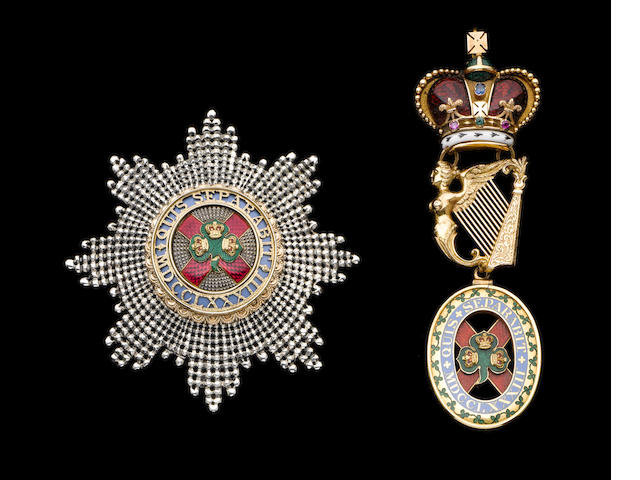
Insignia of the Order of St Patrick


I have posted on several occasions about the Order of St Patrick in The Order of St Patrick in 2011, Banners of the Knights of St Patrick in 2012 and The Order of St Patrick in 2013. There is an online account of the Order, its history and insignia at Order of St. Patrick. A new online piece about the Order has appeared only today in The Order of St. Patrick.

I very much regret that it was allowed after 1922 to fall into abeyance, with only Royal Knights being appointed until 1936, and none since, the last one, the late Duke of Gloucester, dying in 1974. I think it should have been revived, and should be revived - why should this not be done with the forthcoming state visit of the President of the Irish Republic and make him an Extra Knight of the Order?

I am not alone in this opion as can be seen from a letter to The Times a decade ago at Time to revive Order of St Patrick , and more recently these Northern Irish blogpost Quis Separabit: Restore the Order of Saint Patrick  and Order of St Patrick as well as some discussion in the southern political scene at Should the Order of St. Patrick be revived? ( the comments suggest a lack of confidence in the ability of southern Irish politicians rather than doubt about the Order...) and there is the Facebook site Order of St Patrick - Revival.

A quick trawl on the internet produced a considerable number of pictures of the insignia of the Order. There is a wonderful collection of images of the insignia, as well as some of the Officers and Knights, here. Some of the others I found I have copied and pasted in this post.

This example of a diamond star  from the Royal Collection appears to have been made in 1838 for Queen Victoria by Rundell and Bridge :


Star of the Order of St Patrick

 Star of the Order of St Patrick

Image:The Royal Collection © 2012,
Her Majesty Queen Elizabeth II
RCIN 441162


King George V's Diamond Star
Made around 1890, the  centre has a shamrock of emeralds, with the Saint's cross in rubies on a diamond background. 'George, Prince of Wales, April 1910' is engraved on the reverse.

Image:doyle.com.au

 Another jewelled badge of the Order

Image:doyle.com.au

The website these last three illustrations comes has an interesting section on the Order and on the theft of the Irish Crown Jewels - the insignia of the Lord Lieutenant as Grand Master of the Order - in 1907, which can be seen here.


Two stars of the Order were sold in the Harewood: The Attic sale at Christies South Kensington on  December 9th 2012:

Star of the Order of St. Patrick,
Silver, gold and enamel, 81mm. diam. 
Reverse engraved Storr & Mortimer, Jewellers to the Queen, mid 19th century, some enamel damage

Price realized £8,750 (Estimate £2,000 - £2,500)

The provenance was almost certainly Ulick John de Burgh, 1st Marquess of Clanricarde (1802 -1874), and by descent to his son,Herbert George de Burgh-Canning, 2nd Marquess of Clanricarde (1832- 1916), and bequeathed to his great-nephew, Henry Lascelles, 6th Earl of Harewood (1882-1947), and by descent at Harewood House, Yorkshire.

Image:Christies.com


Star of the Order of St. Patrick
Silver, gold and enamel, 68mm. diam, reverse engraved Storr & Mortimer. Early to mid 19th century, some enamel damage to shamrock  
Price realized £5,000 ( Estimate £1,500 - £2,000) 

Image:Christies.com

The Most Illustrious Order of St.Patrick, 

A star and badge of the Order
Made by West and Sons Dublin and hallmarked 1852
Offered but withdrawn at Bonhams 2012 

Image:Bonhams.com 

Badge 

The riband and  badge

Mantle and Collar

The mantle and collar  

Images:medal.org.uk 


Saturday, 16 June 2012

Promoting the Prince of Wales


A friend alerted me to this news story about the promotion of the Prince of Wales to the ranks of Admiral of the Fleet, Field Marshal, and Marshal of the Royal Air Force. 

Not only is it reassuring to see appointments being made to the most senior ranks in the armed services of the Crown - such rank is no longer granted automatically to serving chiefs of staff - but it is appropriate to the Prince's position. By such a set of appointments the Queen has quietly emphasised the Prince's position as her heir apparent.

I was interested to read recently that in 1910 Kaiser Wilhelm II, resplendent in uniform as a British Field Marshal, at the funeral of King Edward VII noted that his cousin King George V was only in the uniform of a Major General, that being the rank he had hitherto held.

Of related interest to the roles played by members of the Royal familythere was an interesting profile of the Earl and Countess of Wessex and their particular place within it in yesterday's Daily Telegraph and which can be read here.

Monday, 12 December 2011

The Imperial Crown of India


Today is the centenary of the Coronation Durbar in Delhi of the King-Emperor George V.

There is an online article about the Durbars of 1877, 1903 and 1911 here. I understand from a friend who works on the history of India that the ceremonial was carefully modelled on that of pre-1857 Mughal Imperial enthronements.

There is another about the title Emperor of India here, from which I was interested to learn that the title was used until June 22 1948, ten months after partition and independence, and two years before the present Indian state became a republic.

http://i273.photobucket.com/albums/jj238/georgewindsor/Family/banbury1.jpg

The King-Emperor receiving homage
Image: myspace.com

The two previous Durbars had been held by the Viceroy, but in 1911 the monarch himself was present.

This can be interpreted as part of what can misleadingly be termed the "invention of tradition" at that time. I would prefer to use a term like "recovery of tradition" to describe the process. It is interesting that King george V, by temperament arather retiring man shoul dbe so prominent in this process. Under him the Coronation service was restored to more of its traditional form, St Edward's Crown permanently set with precious stones, the Investiture of the Prince of Wales revived as a public ceremony and held at Caernarvon, the Durbar held by the King-Emperor, the wearing of the Imperial State Crown at the State Opening from 1913 and, later on, at the suggestion of his cousin Princess Marie- Louise, the Royal Maundy once more given by the Monarch in person. This policy has been continued by King George VI - as for example the revival of much of the Order of the Garter ceremonial in 1948 to mark its 600th anniversary - and by the present Queen.

http://prints.paphotos.com/image/british_royalty_coronations_emperor_and_empress_of_india_1911_1321525.jpg

The King-Emperor and Queen-Empress at the Durbar

Image: Press Association

The presence of the King-Emperor posed a ceremonial problem. As a Coronation Durbar it was fitting for him to wear a crown ansd robes of state. However the Act of Settlement of 1701 forbids the removal from the realm of the crown jewels. As a result a new crown had to be made - there are details about its composition and cost, together with a photograph, here. The government were sceptical about having new crwons across the Empire and it was suggested that after its return with the King to Britain it should be broken up. This was rejected by the King, who considered his Indian subjects would appreciate seeing it alongside the other regalia in the Tower of London.

Then the question arose as to when the King-Emperor should put the crown on. Entering the Durbar arena and putting it on himself would make it a non-religious ceremony, which was opposed by Archbishop Davidson of Canterbury, but a Christian coronation of the ruler of an overwhelmingly Hindu and Muslim empire deemed inappropriate. As a result the King-Emperor entered the Durbar robed and crowned, and the Queen-Empress wore robes and a tiara made for the occasion. This was inherited by the present Queen from Queen Mary, but not used until recent years when it has been worn by HRH The Duchess of Cornwall.

When the funeral of King George V was held in 1936 no place was found for the Indian crown - the second Orb, that of Queen Mary II, placed on Queen Victoria's coffin in 1901 is said to have symbolised her position as Empress of India. By contrast in Austria alongside the Imperial Crown was placed a replica of the Hungarian Crown to symbolise the dual monarchy - and India could be deemed to be analogous.


photo

The Imperial Crown of India

Image:Hylaride on Flickr


Following the independence of India and Pakistan and their becoming republics this spectacular crown has remained a museum piece rather than part of the living regalia of the monarchy. However as a crown that is not bound by statute to this realm it could take on the function of one to accompany the Monarch to his or her other realms, either to be worn or carried at State Openings of Parliament. Rather like the 'House-Crown' of the Holy Roman Emperor Rudolph II became the Imperial Crown of Austria after 1804-6 the Indian Crown could take on a new function.

Now that would be an invention or revival, or extension, of tradition - but it would, to my mind, make sense.


Wednesday, 22 June 2011

Coronation of King George V


Today is the centenary of the coronation of King George V and Queen Mary in 1911. There is an article with links about it here.

Amongsty other points of interest is the fact that this was the first British coronation ceremony, as opposed to the procession, to be recorded by photographs. This photograph shows the beginning of the ceremony in Westminster abbey.

The coronation of King George V, Westminster Abbey, 22 June 1911.

Copyright: Heritage Images


Image and video hosting by TinyPic

The King and Queen

Copyright: lamodeillustree.livejournal.com


It was King George who resumed the practice of being crowned with St Edward's Crown, rather than the lighter Imperial State Crown used by Queen Victoria and King Edward VII, although he quicly exchanged it for the Imperal crown. In 1937 and 1953 the monarch was to wear St Edward's Crown right up to the communion, only assuming the Imperial Stae Crown at the Recess for the procession out of the abbey and back to the palace. It was the King who ordered that St Edwar's Crown be permanently set with precious and semi-precious stones, rather than the previous practice of hiring gems for the Coronation and then replacing them with paste.


http://i29.photobucket.com/albums/c280/Royal-Britain/St-Edwards-Crown.jpg

St Edward's Crown

It was only fairly recently that I discovered that it was King George V who from the 1913 State Opening of Parliament actually wore the Imperial State Crown with his robes of state, and this has remained the practice. at Queen Victoria's few post 1861 State Openings and those of King Edward VII the crown was carried on its cushion, although the Sovereign wore the robes.

The 1911 Coronation was, I think, the only time that Queen Mary's crown was used with its arches. Like Queen Alexandra's 1902 crown, but unlike those of 1831 for Queen Adelaide and 1937 for Queen Elizabeth, it has eight half arches rather than the more traditional four. In design it is very like the Crown of India, which was also made by Garrards that year - but I will say more about that in December.

http://i30.photobucket.com/albums/c303/FredrikBergow/Kroner/England-dronningMaryskrone.jpg

Queen Mary's Crown

The crown contains some 2,200 diamonds and in 1911 it contained the Koh-i-Noor diamond as well as Cullinan III and Cullinan IV (the Cullinan diamond had been presented to King Edward VII and after cutting the largest piece was set in the sceptre and the second largest in the Imperial Stae Crown, displacing to the back of the circlet the Stuart Sapphire). In 1914 they were replaced by crystal models.

Unlike many earlier coronation crowns, it was specially constructed so that its arches could be removed, allowing it to be worn as a circlet, and it was in that way that Queen Mary wore it for State Openings and at the Coronation of King George VI in 1937. At her funeral in 1953 I understand that her crown did not rest on her coffin, unlike the practice at the funeral of Queen Elizabeth in 2002.

As the Queen Consort's crown has been seen as an ornament rather than regalia Queen Mary presented her crown to King George V for the use of future Queens consort. However a new crown, based on a circlet made for Queen Victoria, and incorporating the Koh-i-Noor was used to make the 1937 crown for Queen Elizabeth, allowing Queen Mary to wear her crown as a circlet at that Coronation.