Once I was a clever boy learning the arts of Oxford... is a quotation from the verses written by Bishop Richard Fleming (c.1385-1431) for his tomb in Lincoln Cathedral. Fleming, the founder of Lincoln College in Oxford, is the subject of my research for a D. Phil., and, like me, a son of the West Riding. I have remarked in the past that I have a deeply meaningful on-going relationship with a dead fifteenth century bishop... it was Fleming who, in effect, enabled me to come to Oxford and to learn its arts, and for that I am immensely grateful.


Showing posts with label Order of the Bath. Show all posts

Tuesday, 20 May 2025

The Order of the Bath 300


Last Friday the Most Honourable Order of the Bath held its quadrennial Service for the Installation of Knights Grand Cross in their designated chapel, that is the Lady Chapel of King Henry VII in Westminster Abbey. 

This year the service was of particular interest as it also witnessed the installation of the Prince of Wales as the new Great Master of the Order as successor to his father the King who had held the position from 1975 until his accession as Sovereign. 

Furthermore the Order is celebrating this month the tercentenary of its foundation as an Order of Chivalry in 1725. The origins of the Knights of the Bath are, of course, much earlier - probably in the twelfth century. They were a class or type of knight who had been initiated into the degree by the ritual bath, denoting purity, the admonition of older knights, a vigil and ritual dubbing. 

Some of the elements of the insignia used by the 1725 Order, notably the white knots in the collar, and the crimson mantles ( and possibly the white ones of the Officers of the Order ) derive from these early origins.

Knights of the Bath were usually created to mark coronations, royal weddings and similar royal celebrations. Under King James I it began to look a little more like an Order, with the introduction of the badge with three crowns and the motto Trio juncto in uno presumably as part of the Kings ambition to unify his realms into one polity. 

The complex history of the modern Order and its important statute revisions, notably in 1815 and 1847, changes to the insignia, the conscious inclusion of the medieval rituals and then their almost immediate abandonment, the creation of the various Officers of the Order, the revival of the installation ceremony in 1913, and much more can be found in the Wikipedia account at Order of the Bath


A much more detailed account, published in 1920, which includes a great deal about the ceremonies for the admission of later medieval and early modern knights, can be seen using the Archive website at Jocelyn Perkins The Most Honourable Order of the Bath


A friend who was in the congregation has shown me the Order of Service which has additional information about the Order and sets out the ceremonies in the Chapel. This can be seen online as part of the Westminster Abbey website about the Order and its tercentenary at The King and The Prince of Wales celebrate 300th anniversary of The Order of the Bath  | Westminster Abbey

The  one from 2022, where much is obviously the same, although not including the presence of the Sovereign and the installation of the Great Master, is available at order-of-service-order-of-the-bath-2022

One slight change is that the gold and silver coins offered at the altar that year were Victorian; this year, to mark the tercentenary they were from the reign of King George I.

There is more from the Westminster Abbey website about the Order and the service last Friday at Order of the Bath | Westminster Abbey

The processions at the Service last Friday can be seen on the Royal Family Channel. Unfortunately, this does not include the ceremonies in the Lady Chapel of King Henry.VII, and what there is would actually benefit from some judicious editing. That said it does give an idea of the occasion. The video can be seen at  Prince William Receives New Title Previously Held by King Charles


Thursday, 5 March 2015

The New Zealand Order of Merit


Following on from the previous post the Special Correspondent has sent a further despatch, pointing out the link on this page which shows the collar of the New Zealand Order of Merit:


As he says it is a particularly clever design being a Maori-influenced take on the traditional English - or perhaps we should say Lancastrian Collar of SS or the white knots on the collar of the Order of the Bath.

Monday, 12 May 2014

Ceremonial of the Order of the Bath


Last week the news that The Queen had delegated a part of the ceremonial at the service of the Order of the Bath - the Offering - to the Prince of Wales as Great Master of the Order led to more media coverage of the ceremony than might otherwise have happened. That Her Majesty at 88 might be advised to save herself a potentially awkward move down steep steps in evening dress and the robes of the Order from her stall to the altar and back is, in itself, no very great surprise.

There is in a sense more interest in both the interest this has caused as a news story, and in the fact that images of the ceremonies of the Order are readily available online.


Order of the Bath

The Queen arrives at Westminster Abbey for the service

Image BBC/Getty images


Last Saturday's Daily Telegraph has good coverage in Queen drops out of ceremonial role over concerns about steep steps and the BBC website, which can be seen here also features archive images.


photo

The Prince of Wales as Great Master of the Order presents the Offering during the service

Image: The British Monarchy on Flickr

There is an online history of the Order, its insignia and officers at Order of the Bath.


Sunday, 12 August 2012

King George IV


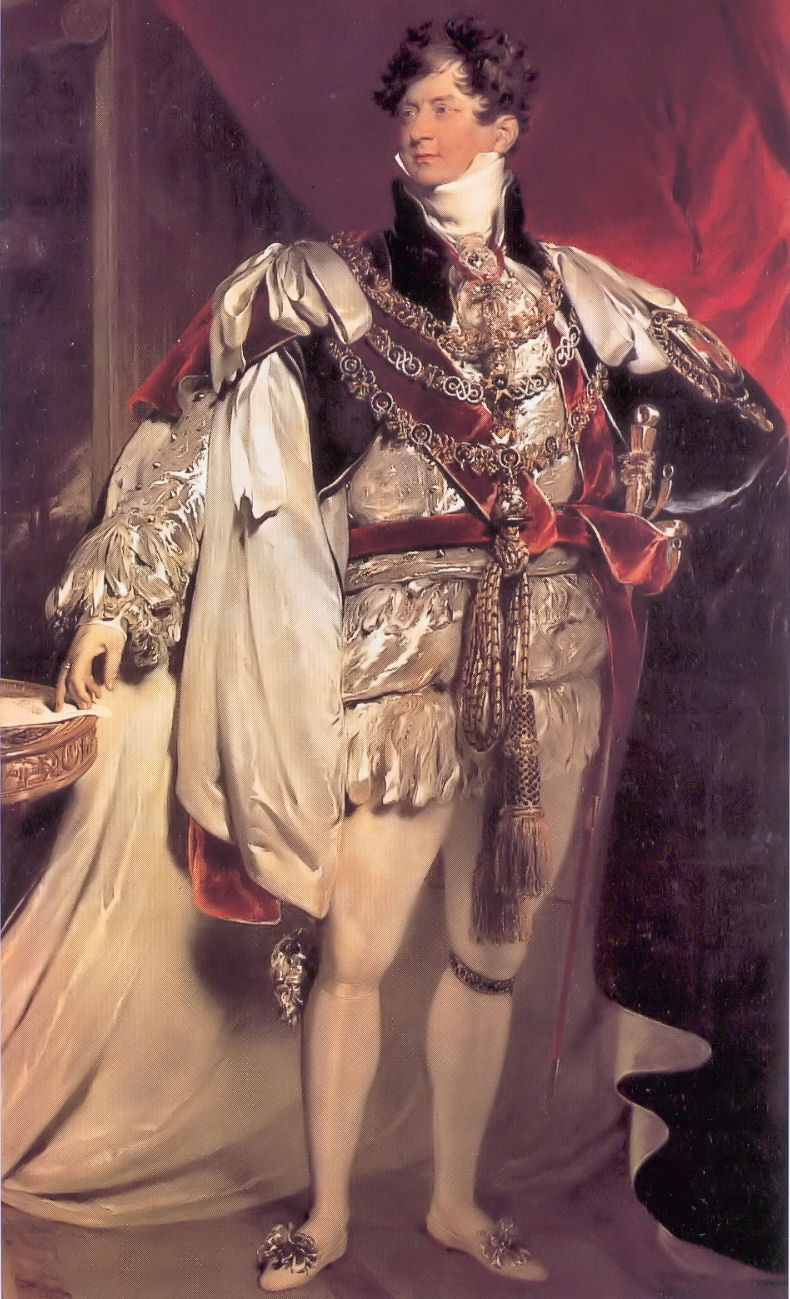
Today is the 250th anniversary of the birth of King George IV in 1762.

File:George IV van het Verenigd Koninkrijk.jpg

King George IV in the robes of the Order of the Garter
Sir Thomas Lawrence
 
The King is also wearing the collars of the Spanish Order of the Golden Fleece, and those of his own Orders of St Michael and St George and of the Bath in addition to that of the Garter. As Prince Regent he revised and extended the Order of the Bath in 1815, and founded that of St Michael and St George in 1818.
 
The crown at his side was made for his coronation in 1821, replacing that used since 1661. Used again for King William IV in 1831 it was replaced in 1838 by the present Imperial State Crown. The frames of both the 1661 and 1821 crowns can now be seen in the Tower of London
 
Image: Wikipedia

There is an online biography of the King here which seesm to be even handed in its assessment and explores his life in the context of his times.

It is not difficult to see why many people found him difficult and dislikeable, and also to see that he did have genuine abilities and excellent qualities. His legacy to the Monarchy is not inconsiderable - not only the building of Buckingham Palace and the drastic but dramatic restoration and rebuilding of Windsor Castle, but the acquisition of significant parts of the Royal Collection, as well as the extraordinary Brighton Pavlion, which his neice sold off. More importantly still may have been his visits to Ireland in 1821 and Scotland in 1822 - the first by a reigning sovereign respectively since 1399 and 1651. Although King William IV and Queen Victoria reacted against King George's style and lavish expenditure - not to say indulgence - he had created both the setting and the revived concept of the royal visit that have become very significant parts of the modern British monarchy. A complex man, often selfish, but one who managed to leave a not inconsiderable legacy.