Once I was a clever boy learning the arts of Oxford... is a quotation from the verses written by Bishop Richard Fleming (c.1385-1431) for his tomb in Lincoln Cathedral. Fleming, the founder of Lincoln College in Oxford, is the subject of my research for a D. Phil., and, like me, a son of the West Riding. I have remarked in the past that I have a deeply meaningful on-going relationship with a dead fifteenth century bishop... it was Fleming who, in effect, enabled me to come to Oxford and to learn its arts, and for that I am immensely grateful.


Showing posts with label Order of the Golden Fleece. Show all posts

Friday, 5 February 2016

The Prince of Liechtenstein at the Oxford Union


This evening I went to hear the Prince of Liechtenstein speak at the Oxford Union. H.S.H Prince Hans-Adam II was speaking about his view of how government worked in the Principality and how that might be employed elsewhere.

He began by making the point that if we look at the state model we need to look to the past to plan for the future. Globalisation and science offer ways for that future. For that there is a need to ensure peace, to have a system that serves all the people with maximum democracy and the rule of law

The State has therefore to be a service company, and emigration by those who feel disenfranchised or disengaged is not the answer. There are he considers groups in free countries who feel oppressed - in Northern Ireland, the Basques, the people of South Tyrol, the aborigines of Australia, the indigenous natives of North and South America.

For the Prince the splitting of the Swiss canton of Berne in 1974 to create a separate canton of Jura was an inspiring example of self determination at local level.

Under the Liechtenstein constitution all 11 units of locall administration have the right to secede if they wish. People have indeed questioned the case for the Principality to exist.

The risk of minorities resorting to violence has been seen in Yugoslavia, Russia, and in the break- up of Austria-Hungary. In any community, minorities may want to leave.

He proposes the service model - the state will not waste taxpayers money on defence.
What will remain to the state ould be law and order, foreign policy and education, and the rest is for the to decide at the local level.

The fear of anarchy leads to dictatorship, so maintaining law and order are the key to keeping a democratic system in place. Laws must be written in an understandable way and to inform subjects. Should not this be taught in schools and the text given to people?

Regulation can be a burden for business firms. If the tax laws are unclear it is the fault of the government that enacted them.

Direct democracyis not popular with politicians, and Switzerland and Liechtenstein are in contrast to  other countries. In 1990 the latter rejected a tax law. There remains the danger that the population may vote against minority rights.
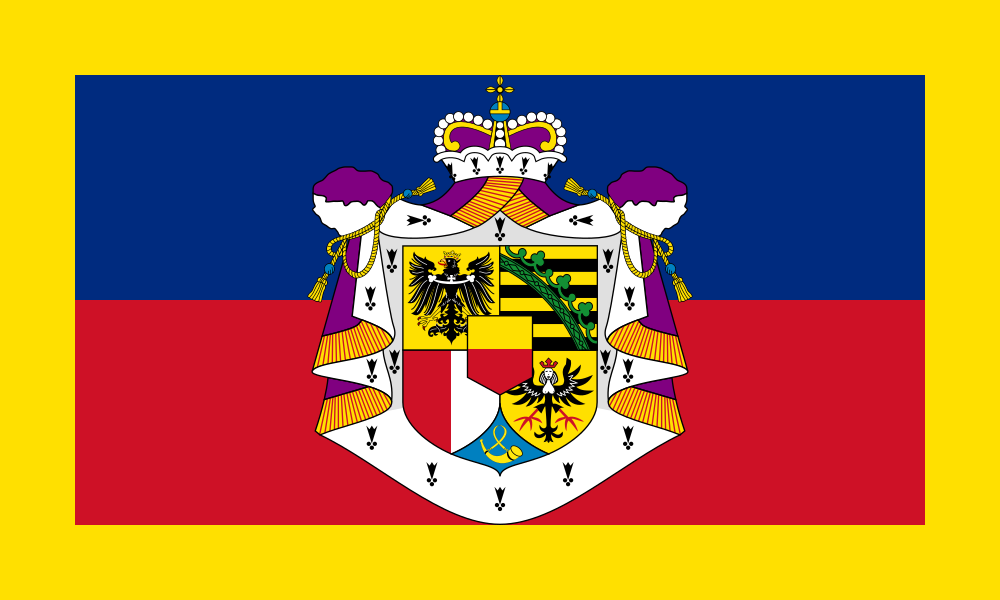

 Current personal standard of the Prince of Liechtenstein, adopted in 1982.

Personal standard of H.S.H. The Prince of Liechtenstein
Adopted in 1982

Image: Wikipedia 

Under the Liechtenstein constitution the Prince has a veto.
With representative democracy, voters cannot choose candidates in the way they might like, but rather vote for a programme, and have to wait until the next election to change the direction of policy.
Today education has levelled up the electorate, but all have to put up with bad decisions

Education is a state right, but should the state run schools or should they be privatised, run by local communities or by business? He favoured a voucher system, which gives the choice to parents and indeed children, and could be used to support home schooling. The Teachers unions are against such schemes, but people feel the state system not adequate.

Indirect taxation saves money for the State; the local community is funded by direct taxation. A social policy of differing rates does not help the poor. A minimalist state would require less cash. It should be possible to sell state property if it is not needed, and to sell off assets. this could help to pay off the national debt. Liechtenstein has done this although possessing few natural assets, but has paid off that debt. This raises the question as to whether taxpayers want to do so.

In answer to questions from the audiencewhen asked why as monarch did he have the idea of direct democracy he said that he considered that today there was need for more than religious validation for the monarchy. A clause in the Constitution allows the people to remove the Prince or abolish the monarchy by a simple majority.

Historically stStates rise and fall, but can we afford this in the third millennium? Can the ballot  replace the battlefield.

Asked further about the revised Constitution he has introduced in his Principality the Prince explained that legislative power remained with the Prince, and that populace were happy with that. The Parliament had parties. Draft laws were discussed with the Prince and Hereditary Prince ( who now exercises regency powers in routine matters ) and the chief minister, and then presented to Parliament.

The people, if they gather 1000 signatures, or 1500 to change constitution, can present to Parliament petitions for a popular vote, which will be signed off by the Prince. His father, Prince Franz-Josef  II,  did attract criticism once by exercising his veto, but Prince Hans-Adam says in advance of a vote if he intends so to do.

Sometimes such direct legislation is badly drafted, against the constitution or conflicts with international obligations. Democracy is the best system, keeping a check on the other side, and it keeps political life in touch with reality. He saw it as a listening to the market, indeed market research, building up from the local level.

Decolonisation outside Europe copied centralised models, when itwould have been better to build up from villages.

He said he had enjoyed business more than government which takes longer, and proved more tiresome

He thought the EU had failed as as United States, and that new model was needed, one that would bring government down to the local level. He also thought it needed a smaller parliament, more like the US Congress is size - he worked there in his youth.

Asked about the impending referendum he said he beinclined to vote to leave the EU, and welcome the UK to the EEA.

As to what happened if smaller units compete he thought it was for the UN to keep the peace - though this might be.Utopian. Liechtenstein had got rid of its army in the mid-19th century, it having been paid for from his own pocket by the Prince.

Parliaments have to be elected, and, in effect, politicians buy votes, and in managing the bureaucracy that ensues there was  political horsetrading - the monarch was there as referee.


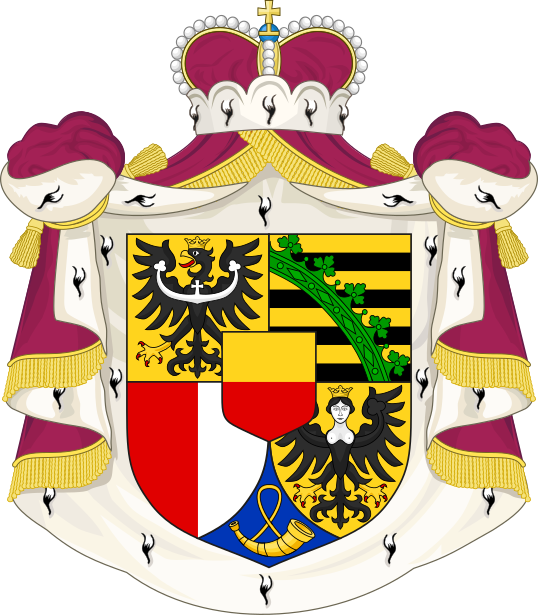
Ducal hat and insignia of the Liechtenstein primogeniture - a gouache of 1756
A replica of the Hat was presented to Prince Franz Josef II in 1976

Image: Wikipedia 

This was an interesting and wide ranging address. I am tempted to say taht what works in Liechtenstein might not be practical in larger units. In the Swiss Confederation it has along standing tradition, and a unique constitutional dispensation. As a model it does require an independent Monarch to reconcile and monitor, and that role is exercise wisely and well by the Prince's fellow European monarchs within their existing constitutional dispensations. How far larger realms could copy the Liechtenstein model is another matter.

There is more about the Principality and its history at the following links;

Liechtenstein

History of Liechtenstein

Monarchy of Liechtenstein

List of monarchs of Liechtenstein

Princely Family of Liechtenstein

Ducal hat of Liechtenstein

Hans-Adam II, Prince of Liechtenstein

Hereditary Prince Alois

HSH Prince Joseph Wenzel

File:Staatswappen-Liechtensteins.svg 

The Arms of the Principality of Liechtenstein

Image: Wikipedia

Friday, 20 June 2014

Spanish Monarchy - theories, symbols and ceremonies


I was already planning this post before I saw on Rorate Caeli the slightly waspish post from New Catholic A Message from the King to the People of Spain Mensaje del Rey al Pueblo de España.
By contrast the online version of the Catholic Herald has amorepositive assessment in Spain’s uncontroversial new king is good news for the Church, and the paper also reprints  an article from the US website First Things about evidence of a significant revival in Church life in Spain by Filip Mazurczak which can be read here.

 The absence of a formal religious element to the oath taking - a silver crucifix, from the collection of the Congress of Deputies was also on display alonside the regalia - or of a Mass of thanksgiving, as there was in 1975 - reflects , I imagine, the current constitution and is perhaps also an unfortunate legacy of the Zapatero government. That point is to some extent addressed in Mazurczak's article.

Spain's newly-crowned King Felipe VI and his wife Spain's Queen Letizia  (AP)

 King Felipe VI and  Queen Letizia 

Image: Catholic Herald/AP

The Spanish Royal family have shown continuing support for the practice of the Catholic faith, with their presence at Papal visits to the kingdom, with the pilgrimage to Santiago on July 25th, at the Mass for the victims of the rail disaster there the other year, with weddings theat are publically Catholic, and with a regular appearance outside the cathedral in Palma de Mallorca on Easter Day after Mass, very like the British Royal family at Sandringham at Christmas.

Despite its Catholic heritage and title the Spanish monarchy never had a Divine right tradition like Stuart England or France. For all its imagined absolutism - and most absolute monarchies turn out upon examination to have been very far from absolute - the Spanish crown represents a complex series of interrelated powers and limitations, exercised in varying ways over the centuries.

If Castile showed a more centralised monarchic tradition from the middle ages, the lands of the Crown of Aragon - in effect a federation - had a strong tradition of limited monarchy, expressed most famously in the coronation formula which stressed the near equality of King and nobles and its closing formula with its implicit, if not explicit, right of resistance of "if not, not", and where the Justiciar could veto royal enactments.

These traditions can be seen in the present constitution, including its devolved regional assemblies  - including swearing to the Viscayan privileges of the Basque region at Guernica - and expressed in the differing titles used by the new King as heir in different parts of the country not only Prince of Asturias, but distinct ones as heir to Aragon, and for its other territories of Catalonia, Valencia and Majorca, and for Navarre.

Even King Philip II was not as absolute as popular opinion might still think. He not only cut back on court ceremonial derived from his Burgundian ancestors in terms of outward display, but, as is pointed by a quotation in Henry Kamen's excellent Spain 1469-1714: A Divided Society, could be sued by his subjects in civil matters; on one occasion the King told a judge to be careful, as if the case came to court he would have to find against the King.

Unlike England and France, or central Europe, sacral kingship and the ceremonies of anointing and coronation never found much of a place in Iberia (The crown of Portugal obtained the privilege of anointing in the early fifteenth century, but abandoned the rite of coronation after 1640) and largely ceased in the later middle ages.

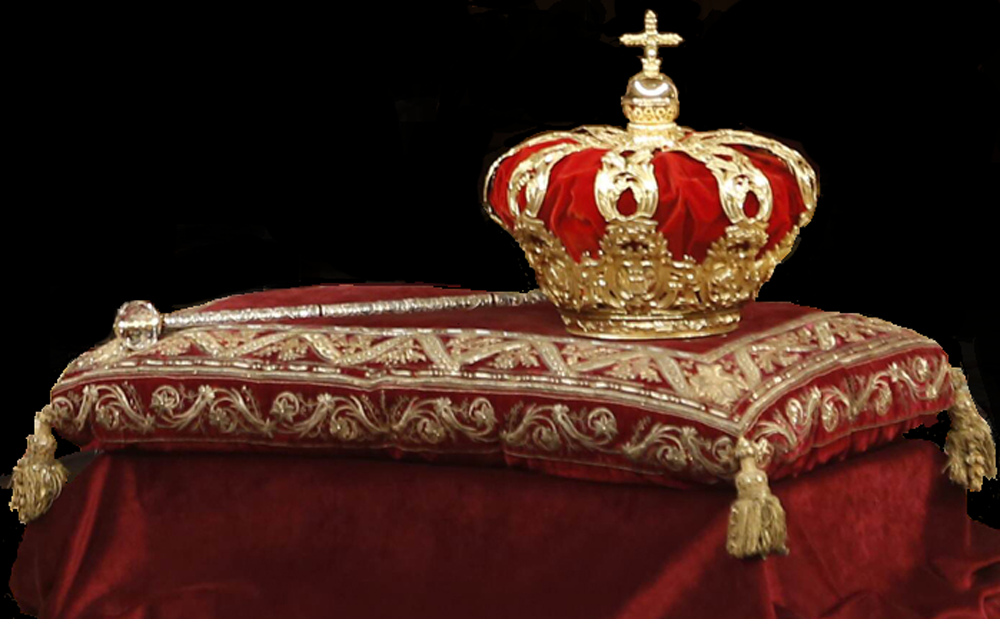
The last Spanish monarchs to be solemnly crowned were King John I of Castile in 1379, King Ferdinand I of Aragon  in 1414, and Queen Eleanor of Navarre in 1479). Queen Joan (Jeanne) III of Navarre was crowned as late as 1555, although she only ruled that part of Navarre beyond the Pyrenees. After them, all Spanish monarchs have assumed their role  by proclamation and acclamation before the Church and since the eighteenth century, before the Cortes Generales. The royal crown has been physically present in these ceremonies. When King Juan Carlos I was proclaimed King of Spain on November 22 1975 and when King Felipe VI was proclaimed this week the crown and sceptre were displayed in front of them in the Cortes. The last occasion on which the crown was seen at apublic ceremont was at the reburial of King Alfonso XIII in 1981 at El Escorial.

The crown itself , made of silver gilt and without gems, displays the emblems of the founding kingdoms of Castile and Leon, a castle and lion respectively. It was made by order of King Charles III (1759-88)in Madrid, following the loss of previous regalia in the fire which had destroyed the old Royal palace in the city.

The sceptre was a gift from Holy Roman Emperor Rudolf II to King Philip II and was made in Vienna.

File:Símbolos de la Monarquía Española.png

The crown and scepre of Spain

Image:Wikipedia

There are some very well illustrated articles about the heraldic arms of the Crown and of the Princes of Asturias on Wikipedia - which is always a good source of informationon such matters I find. They can be viewed at Coat of arms of Spain, at Coat of arms of the King of Spain and at Coat of arms of the Prince of Asturias and there is more heraldry and information about the premier chivalric Order of the monarchy at Order of the Golden Fleece.

A friend has sent me a link to an up-to-date online piece from Wikipedia about the Spanish Royal Standard. This was with a red background under the Hapsburgs and earlier Bourbons, changed to purple for Queen Isabella II and her succrssors - as in the example preserved on display in St James Spanish Place in London, and was blue for King Juan Carlos. With King Felipe it has reverted to red. My friend considers the red is best, though he adds he misses the Cross of Burgundy and yoke and arrows as used by the previous King. I would agree with him. The illustrated article can be viewed at Royal Standard of Spain.

I would slightly quibble  with the article when it states that a heraldic banner has not been used by the Kings since 1931; whilst it may not have been used in Spain, there is one over King Juan Carlos' Garter stall at St George's Windsor.

The history of the various titles used by or available to the Spanish King and Royal family are discussed in Titles and honours of the Spanish Crown, which has both a history of them and illustrations of their armorial bearings.


    Sunday, 12 August 2012

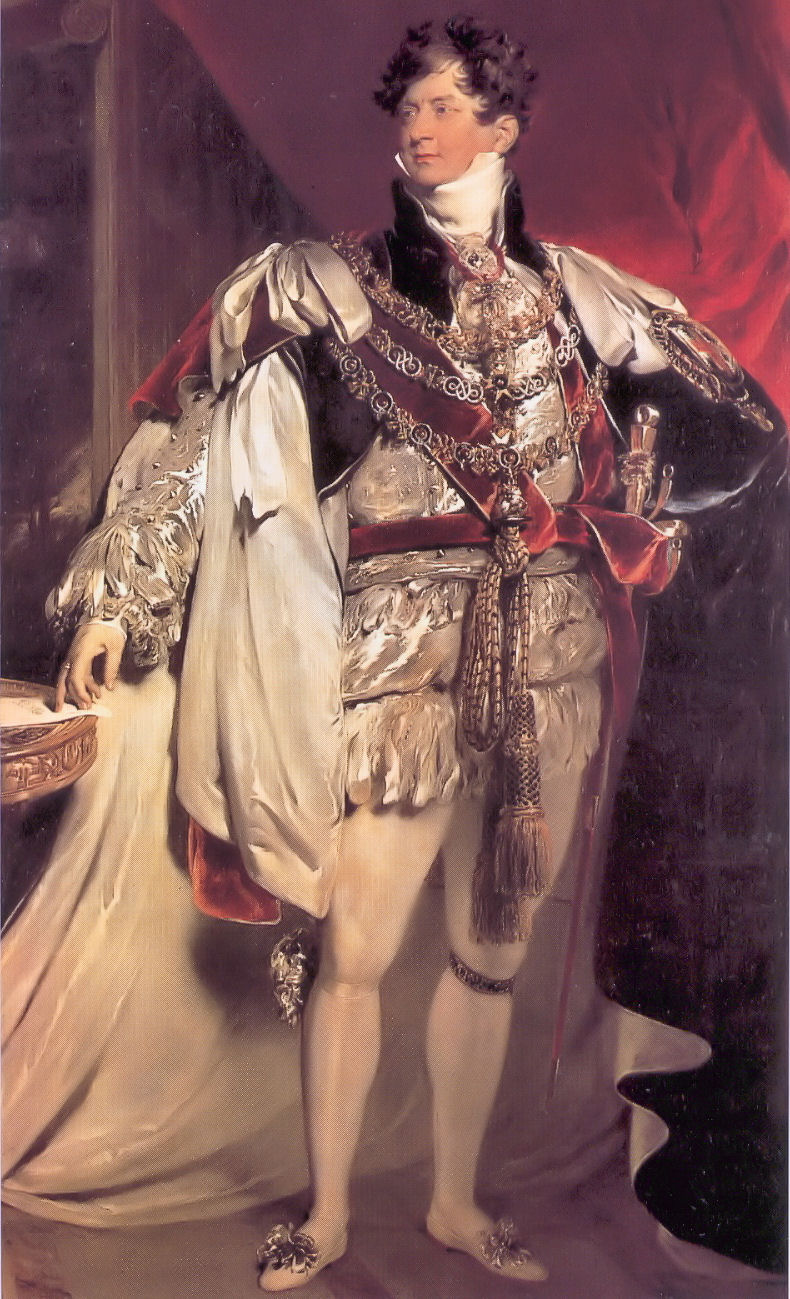
    King George IV


    Today is the 250th anniversary of the birth of King George IV in 1762.

    File:George IV van het Verenigd Koninkrijk.jpg

    King George IV in the robes of the Order of the Garter
    Sir Thomas Lawrence
     
    The King is also wearing the collars of the Spanish Order of the Golden Fleece, and those of his own Orders of St Michael and St George and of the Bath in addition to that of the Garter. As Prince Regent he revised and extended the Order of the Bath in 1815, and founded that of St Michael and St George in 1818.
     
    The crown at his side was made for his coronation in 1821, replacing that used since 1661. Used again for King William IV in 1831 it was replaced in 1838 by the present Imperial State Crown. The frames of both the 1661 and 1821 crowns can now be seen in the Tower of London
     
    Image: Wikipedia

    There is an online biography of the King here which seesm to be even handed in its assessment and explores his life in the context of his times.

    It is not difficult to see why many people found him difficult and dislikeable, and also to see that he did have genuine abilities and excellent qualities. His legacy to the Monarchy is not inconsiderable - not only the building of Buckingham Palace and the drastic but dramatic restoration and rebuilding of Windsor Castle, but the acquisition of significant parts of the Royal Collection, as well as the extraordinary Brighton Pavlion, which his neice sold off. More importantly still may have been his visits to Ireland in 1821 and Scotland in 1822 - the first by a reigning sovereign respectively since 1399 and 1651. Although King William IV and Queen Victoria reacted against King George's style and lavish expenditure - not to say indulgence - he had created both the setting and the revived concept of the royal visit that have become very significant parts of the modern British monarchy. A complex man, often selfish, but one who managed to leave a not inconsiderable legacy.


    Wednesday, 18 August 2010

    Emperor Francis Joseph I


    Today is the 180th anniversary of the birth of the Emperor Francis Joseph I, which seems as good an excuse as I can find to post this portrait of him as a young man - I think the portrait would be from about 1855. I had not seen this portrait before, and it is a reminder of the younger man before the venerable balding be-whiskered image became more or less definitive.


    photo


    He is wearing the Order of the Golden Fleece, the star of the Order of Maria Theresa and the Fourth Class of the Russian Order of St George, which he was awarded in 1849 by Emperor Nicholas I for bravery under fire in the fighting in Hungary in the months following Francis Joseph's accession.