Once I was a clever boy learning the arts of Oxford... is a quotation from the verses written by Bishop Richard Fleming (c.1385-1431) for his tomb in Lincoln Cathedral. Fleming, the founder of Lincoln College in Oxford, is the subject of my research for a D. Phil., and, like me, a son of the West Riding. I have remarked in the past that I have a deeply meaningful on-going relationship with a dead fifteenth century bishop... it was Fleming who, in effect, enabled me to come to Oxford and to learn its arts, and for that I am immensely grateful.


Showing posts with label Spanish Monarchy. Show all posts

Sunday, 13 September 2015

King Philip II


Today is the anniversary of the death at El Escorial in 1598 of King Philip II. I recently read the latest biography of the King, which is Geoffrey Parker's Imprudent King : A New Life of Philip II, and published by Yale U P.

http://ecx.images-amazon.com/images/I/41cBDwEfhWL._SX335_BO1,204,203,200_.jpg

Image: Amazon


The publishers - who, in my opinion, produce exceptionally handsome and reasonably priced books - say of the subject matter within: " Philip II is not only the most famous king in Spanish history, but also the most infamous king in English history: the man who launched the Spanish Armada was the same man who attempted the assassination of Elizabeth Tudor. This compelling biography of Europe's most powerful sixteenth-century monarch begins with his conception (1526) and ends with his ascent to heaven (1603), two occurrences surprisingly well-documented by contemporaries. Geoffrey Parker draws on decades of research and a recent, extraordinary archival discovery - a trove of 3,000 documents in the vaults of the Hispanic Society of America in New York City, unread since crossing Philip's own desk. Some of the documents confirm what is already known about the king. Others change the picture significantly. The book examines Philip's long apprenticeship; his three principal interests (work, play and religion); and the major political, military and personal challenges he faced during his long reign. Parker also reviews Philip's reputation in legend and history, offering fresh insights into the causes of Philip's leadership failures: was his empire simply too big to manage, or would a monarch with different talents and temperament have fared better? "

I think this is a remarkable book, which combines massive scholarship, and genuine academic and human insight, with an eminently readable style.

Few rulers of any age have left so complete an insight into their minds and ways of working as King Philip, with his endless annotation of official papers and his mixture of candour and obfuscation. Geoffrey Parker makes full use of all this to lead us into King Philip's world and mind.

What emerges is a portrait of a man, in many ways quite ordinary, but by reason of his birth, upbringing and inheritance quite extraordinary. Prosaic, self-disciplined, dedicated, devout, compulsive, pettifogging, struggling to keep his empire together, always seeking and striving to get the right answer to the problems he faced and to do the right thing ( a recurring idea in his comments), and despite his best efforts to get and respond to information often reacting too late, or offering too little.

In many ways King Philip shows typical Habsburg qualities of duty and dedication to the cares of governance, seeking to fulfil what he saw God was calling him to do. This sense of having a direct line to the Almighty sustained him, but may well have led him to what with hindsight one might see as unwise or disastrous political decisions. Prof. Parker also makes the point that on several crucial occasions the King came very close to achieving his grand aims.

In showing the limitations of  ruling a major power - indeed the European super-power of its day - this is a sobering book, and not just for historians. Its lessons should be taken on board by modern politicians.

Immensely readable and written with pace and breadth of vision I would warmly recommend it to anyone interested not only in the period but in the nature and exercise of political power.



Wednesday, 2 July 2014

The King and Queen of Spain visit the Pope


Following on from the point I made at the beginning of my post  Spanish Monarchy - theories, symbols and ceremonies that the Royal family have been continuing and concious supporters of the Catholic Church I now see in various newspapers reports of the visit paid by King Felipe and Queen Letizia to the Pope at the Vatican on Monday. This was their first visit abroad since the King's accession and it must have significance that it was to the Holy See, before visting the neighbouring countries of France, Portugal and Morocco in coming months.


Pope Francis looks up at Spain's King Felipe VI, as Queen Letizia looks on, at a meeting at the pontiff's library in the Apostolic Palace in the Vatican City

The King and Queen of Spain with the Pope

Image:Daily Mail

The Daily Mail report is, as usual for the paper, well illustrated and can be viewed at Pope Francis hints he will visit Spain soon after meeting King Felipe,and there are are pictures of the visit in King Felipe VI and Queen Letizia of Spain visit the Pope in first overseas engagement from the magazine Hello.
This may have been a formality as a visit, but that does not detract from what it expresses about the relationship of Spain and its monarchy to the Church, and of the Church to Spain and the crown.


Friday, 20 June 2014

Spanish Monarchy - theories, symbols and ceremonies


I was already planning this post before I saw on Rorate Caeli the slightly waspish post from New Catholic A Message from the King to the People of Spain Mensaje del Rey al Pueblo de España.
By contrast the online version of the Catholic Herald has amorepositive assessment in Spain’s uncontroversial new king is good news for the Church, and the paper also reprints  an article from the US website First Things about evidence of a significant revival in Church life in Spain by Filip Mazurczak which can be read here.

 The absence of a formal religious element to the oath taking - a silver crucifix, from the collection of the Congress of Deputies was also on display alonside the regalia - or of a Mass of thanksgiving, as there was in 1975 - reflects , I imagine, the current constitution and is perhaps also an unfortunate legacy of the Zapatero government. That point is to some extent addressed in Mazurczak's article.

Spain's newly-crowned King Felipe VI and his wife Spain's Queen Letizia  (AP)

 King Felipe VI and  Queen Letizia 

Image: Catholic Herald/AP

The Spanish Royal family have shown continuing support for the practice of the Catholic faith, with their presence at Papal visits to the kingdom, with the pilgrimage to Santiago on July 25th, at the Mass for the victims of the rail disaster there the other year, with weddings theat are publically Catholic, and with a regular appearance outside the cathedral in Palma de Mallorca on Easter Day after Mass, very like the British Royal family at Sandringham at Christmas.

Despite its Catholic heritage and title the Spanish monarchy never had a Divine right tradition like Stuart England or France. For all its imagined absolutism - and most absolute monarchies turn out upon examination to have been very far from absolute - the Spanish crown represents a complex series of interrelated powers and limitations, exercised in varying ways over the centuries.

If Castile showed a more centralised monarchic tradition from the middle ages, the lands of the Crown of Aragon - in effect a federation - had a strong tradition of limited monarchy, expressed most famously in the coronation formula which stressed the near equality of King and nobles and its closing formula with its implicit, if not explicit, right of resistance of "if not, not", and where the Justiciar could veto royal enactments.

These traditions can be seen in the present constitution, including its devolved regional assemblies  - including swearing to the Viscayan privileges of the Basque region at Guernica - and expressed in the differing titles used by the new King as heir in different parts of the country not only Prince of Asturias, but distinct ones as heir to Aragon, and for its other territories of Catalonia, Valencia and Majorca, and for Navarre.

Even King Philip II was not as absolute as popular opinion might still think. He not only cut back on court ceremonial derived from his Burgundian ancestors in terms of outward display, but, as is pointed by a quotation in Henry Kamen's excellent Spain 1469-1714: A Divided Society, could be sued by his subjects in civil matters; on one occasion the King told a judge to be careful, as if the case came to court he would have to find against the King.

Unlike England and France, or central Europe, sacral kingship and the ceremonies of anointing and coronation never found much of a place in Iberia (The crown of Portugal obtained the privilege of anointing in the early fifteenth century, but abandoned the rite of coronation after 1640) and largely ceased in the later middle ages.

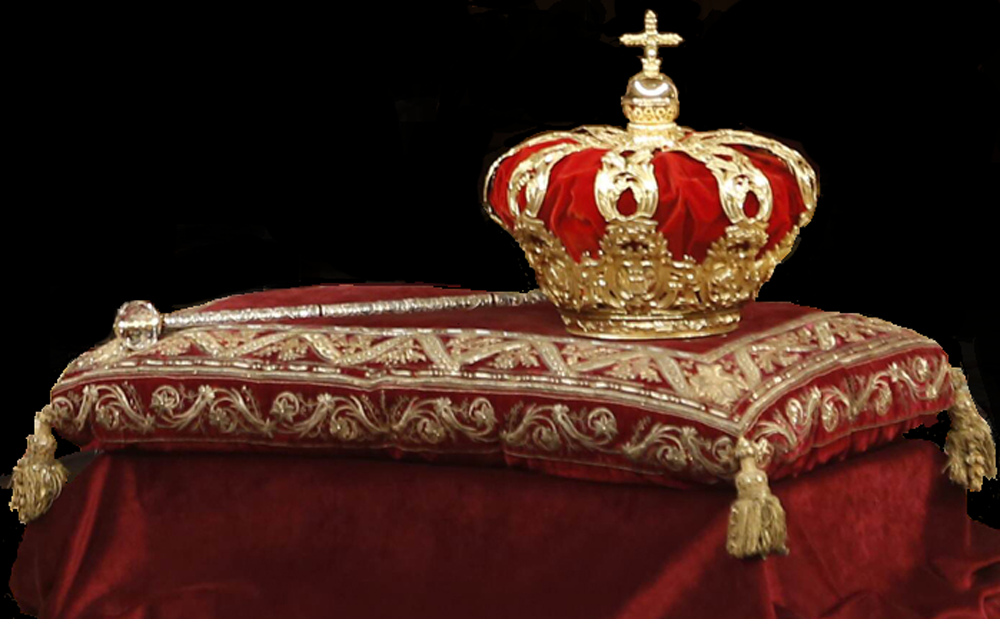
The last Spanish monarchs to be solemnly crowned were King John I of Castile in 1379, King Ferdinand I of Aragon  in 1414, and Queen Eleanor of Navarre in 1479). Queen Joan (Jeanne) III of Navarre was crowned as late as 1555, although she only ruled that part of Navarre beyond the Pyrenees. After them, all Spanish monarchs have assumed their role  by proclamation and acclamation before the Church and since the eighteenth century, before the Cortes Generales. The royal crown has been physically present in these ceremonies. When King Juan Carlos I was proclaimed King of Spain on November 22 1975 and when King Felipe VI was proclaimed this week the crown and sceptre were displayed in front of them in the Cortes. The last occasion on which the crown was seen at apublic ceremont was at the reburial of King Alfonso XIII in 1981 at El Escorial.

The crown itself , made of silver gilt and without gems, displays the emblems of the founding kingdoms of Castile and Leon, a castle and lion respectively. It was made by order of King Charles III (1759-88)in Madrid, following the loss of previous regalia in the fire which had destroyed the old Royal palace in the city.

The sceptre was a gift from Holy Roman Emperor Rudolf II to King Philip II and was made in Vienna.

File:Símbolos de la Monarquía Española.png

The crown and scepre of Spain

Image:Wikipedia

There are some very well illustrated articles about the heraldic arms of the Crown and of the Princes of Asturias on Wikipedia - which is always a good source of informationon such matters I find. They can be viewed at Coat of arms of Spain, at Coat of arms of the King of Spain and at Coat of arms of the Prince of Asturias and there is more heraldry and information about the premier chivalric Order of the monarchy at Order of the Golden Fleece.

A friend has sent me a link to an up-to-date online piece from Wikipedia about the Spanish Royal Standard. This was with a red background under the Hapsburgs and earlier Bourbons, changed to purple for Queen Isabella II and her succrssors - as in the example preserved on display in St James Spanish Place in London, and was blue for King Juan Carlos. With King Felipe it has reverted to red. My friend considers the red is best, though he adds he misses the Cross of Burgundy and yoke and arrows as used by the previous King. I would agree with him. The illustrated article can be viewed at Royal Standard of Spain.

I would slightly quibble  with the article when it states that a heraldic banner has not been used by the Kings since 1931; whilst it may not have been used in Spain, there is one over King Juan Carlos' Garter stall at St George's Windsor.

The history of the various titles used by or available to the Spanish King and Royal family are discussed in Titles and honours of the Spanish Crown, which has both a history of them and illustrations of their armorial bearings.


    Thursday, 19 June 2014

    New Reign in Spain


    Today has seen the formal enthronement ceremonies of King Felipe VI of Spain following the coming into force of his father's abdication at midnight.


    King Felipe VI, Queen Letizia , the Infanta Lleonor, Princess of Asturias and the Infanta Sofia with the Crown and sceptre in the foreground at the Accession ceremony

    Image:dw.de


    BBC News has an article with links to profiles of the King and of his father and a good selection of photographs of today's events in King Felipe calls for 'new Spain' 

    There is another online biography of the King, with appropriate links, here.

    There is what seems to be a well balanced article from the Guardian about the accession which can be read at Crown Prince Felipe on brink of becoming King Felipe VI and the same paper has a good account of the formal occasion at Spain's Felipe VI promises a 'renewed monarchy' as he is sworn in as king and also a good selection of photographs at Spain's King Felipe VI begins a new reign.

    Such essentially positive coverage by the Guardian,is, dare one suggest it, rather interesting in itself, and perhaps an happy augury.

    Coat of Arms of Spanish Monarch.svg

    The Spanish Royal Arms

    Image: Wikipedia 

    Viva El Rey Felipe!


    Monday, 9 June 2014

    A positive reaction to the Spanish abdication


    The Daily Telegraph has an article about an opinion poll which points to a fairly significant upsurge in popular support for the Spanish monarchy in the days following the King's announcement of his intention of abdicating in favour of the Prince of Asturias. The article , which has some other relevant links, including one with comments from the King that he did not wish his son to grow too old waiting to succeed to the throne, can be seen at Was King Juan Carlos right to abdicate?

    The suggestion may well be that in terms of serving the long term interests of the monarchy and the nation it has been the right, or appropriate, decision by King Juan Carlos. The King has shown himself a shrewd operator of the royal office since 1975, and this decision doubtless need to be understood in that light.

    That said, it is unfair to all that he has achieved as King that recent difficulties should be seen to lead to abdication. It is also unwise that monarchs become, or are perceived to be, dependent upon popular support as reflected in such ephemeral things as public opinion polls. I am sure there are far deeper levels of support for the institution as well as the personalities of the Spanish monarchy, and that those will stand the future King Felipe VI in good stead.

    Tuesday, 3 June 2014

    Spanish abdication


    The announcement by King Juan Carlos that he will abdicate as King of Spain appears to have come as something of a surprise, although there has been talk of the possibility of such a move on and off for the last couple of years. 

    Given his remarkable and enduring achievements since 1975, as all serious commentators have agreed, it is unfortunate that in recent years that has been clouded by public criticism over what should be seen as minor problems. The economic and social crisis affecting Spain has clearly not helped, and must have told upon the King as well as his age - he certainly looks older and more tired, and he has had several operations in recent years.

    I recall my own sense of excitement, indeed exhilaration, at the 1975 restoration, and the King's success,  and so ably supported by Queen Sofia, is both of historic significance for Spain, and an example other countries should follow.

    Given that background I would think that he and the Spanish royal family would be anxious to avoid anything that might tend towards a repeat of the 1931 disaster when the economic crisis combined with the political fall-out from the end of the Primo de Rivera military government of the 1920s and the decline in popularity of King Alfonso XIII effectively turned the local elections of that year into a referendum on the monarchy and led to the establishment of the appalling second republic.

    The King says that he decided to abdicate at this birthday in January, when he turned 76, but presumably has waited until after European elections to make his announcement, but before the Catalan independence referendum planned for the autumn.

    A point I have seen made in recent years is that whilst many in Spain have and do admire the King as a person and for what he has done for the realm, the support for the monarchy is for the person rather than for the institution in itself. It may well be that in abdicating now the King sees the opportunity to follow in the patterns of events last year with the abdications in the Netherlands, Belgium and the Papacy, as well as the relatively recent case of Luxembourg, and to give the Prince of Asturias the opportunity to reforge and reinforce the bonds that the monarchy is there to provide and has provided not only in recent decades but through the history of Spain and its constituent realms.

    This is then a way to manage the situation in the best interests of the nation and of its central institution, and potentially outflanking possible future problems. It seems clear that the Prince and Princess of Asturias have high public approval ratings and that the Prince has worked conscientiously as heir in a manner very similar to his cousins across Europe. He always appears serious minded man with genuine dedication to his future role.

    It is also worth pointing out that abdications are not that unusual in Spain - indeed almost commonplace. King Charles I(i.e. Emperor Charles V)abdicated in 1556, and in 1724 King Felipe V (one used to think of him in English as Philip, but maybe we shall get used to thinking of the various Spanish Kings of that name as Felipe) abdicated - possibly thinking he might succeed the temporarily sickly King Louis XV in France, only to find that the French King recovered, but that his own son and successor, King Luis I, died the same year and he was recalled to the throne. King Charles IV abdicated in favour of his sone King Ferdinand VII, and his daughter Queen Isabella II, following the 1868 revolution abdicated in favour of her son King Alfonso XII, who was resored toi the throne in 1875. Indeed she outlived him by nineteen years, only dying in France in 1904.  I believe I am right in saying that King Alfonso XIII, realising his condition was terminal, abdicated afew days before his death in 1941 in Rome, presumably to ensure the formal transfer of authority to his de jure successor, his son King Juan III. He in turn renounced his rights in 1977, two years after his son King Juan Carlos was proclaimedas monarch. So having a former monarch around is not that unusual. There has been no conventional succession of an adult son or daughter to a deceased monarch really since 1788 when King Charles III and was succeeded by King Charles IV.

    This evening a BBC report covered a military review at El Escorial attended by the King and the Prince of the Asturias, and as it pointed out the setting in front of the great palace monastery necropolis did stress continuity, which has been very much a theme of the reign of King Juan Carlos. Thus in burying his father as King Juan III and reinterring his grandparents King Alfonso XIII and Queen Victoria Eugenie at the Escorial the King symbolically indicated the continuity of his position with his ancestors, and that the monarchy was not a new creation of the Franco era.

    The BBC website has various linked articles about the abdication and reaction to it which can be accessed at Spain sets out abdication plan.

    As in this country in 1936 the monarch's abdication requires special legislation in the Cortes, so King Felipe VI will presumably take the oath and be acclaimed in June 18th.

    The Mad Monarchist blog has a very good piece which I would endorse and concur with at The Abdication of King Juan Carlos.

     Viva El Rey!

    Saturday, 19 May 2012

    The reign in Spain


    The most notable absentees from the Monarchs' lunch at Windsor were the King and Queen of Spain, whose government interdicted their visit because of the continuing dispute over the sovereigny of Gibralter - the issue which prevented their attending the wedding of the Prince and Princess of Wales in 1981.

    This year is proving something of an annus horribilis for the King and Queen, who did not publically celebrate their Golden wedding last Monday. The various rumours of scandal around members of the Royal family as are recorded, in a rather negative way, in this report in the supposedly conservative Daily Telegraph.

    In one sense this can be seen as a coming of age for the restored Spanish monarchy - like the other reigning dynasties of Europe they have become fair game for the bored and opinionated, for those with a fine nose for scandal and the grinding of particular axes. Too often, far too often it is the open season for sniping. Misjudgements there may have been, and mistakes made, but monarchs are human - that is one of the strengths of monarchy - it is not a machine.

    In the last generation or so we have seen the Swedish monarchy prounced terminally doomed from before the present King's accession in 1973, the hostility to the present Queen of the Netherlands' marriage in the 1960s, the allegations around her father in 1976, and doubts as to the future at the time of her accession in 1980.

    Here in the United Kingdom the problems of the mid 1990s were only too publically aired and discussed, and even in Denmark Prince Henrik has been the centre of various storms as indicated here.

    In Luxembourg and Lichtenstein the constitional position of the monarch has been under fire and in Belgium the very future of the country, and hence the monarchy, questioned.

    For the Spanish monarchy there is the problem of the hiatus between 1931-75, even if the monarchy was formally re-established in 1947. It has been argued that, despite the hitherto enormous popularity of the King, Spain itself is not a sufficently monarchist society. I do not know if that is true, but I can see that there might be some cause for concern for the future there. On the other hand this could be dismissed as the chattering classes at it again - and how they can chatter on such matters.

    So it is not easy, and for the moment it is the Spanish crown that is under the public scrutiny. The country has far more serious problems with which to concern itself, and should in no way belittle the extraordinary and fundamental achievements of the King and Queen and the Prince of Asturias in providing the stable constitutional framework that allows it as a nation to try to deal with the consequences of the eurocrisis, and which has guided it since 1975.

    Viva El Rey!


    Thursday, 5 January 2012

    Birthday of the King of Spain


    Today is the 74th birthday of the King of Spain, and an opportunity to express good wishes to a sovereign who has not only proved dutiful and capable but is also a shining example of what a monarchy can offer a nation.

    http://www.barcelonareporter.com/img_uploads/King_Juan_Carlos_and_Queen_Sofia_of_Spain.jpg

    The King and Queen of Spain

    Image:barcelonareporter.com

    His reign shows what could be done in other countries less fortunate than Spain and which have not restored their historic institutions of governance. The recent problems surrounding one of his sons-in-law are unfortunate and the Royal family are clearly showing their distance from allegations of financial scandal, but the King's achievements far outweigh what must be, I trust, a passing shadow.

    An insight into his approach to kingship in the modern age can be gleaned from this article from 2008 which is based around letters he wrote to the Prince of Asturias whilst the Infante was studying in the USA.

    Spain's King Juan Carlos and Queen Sofia with their son Crown Prince Felipe

    The King and Queen of Spain and the Prince of Asturias

    Image: Daily Telegraph

    Spain is very fortunate indeed in its King and Queen and their royal family, as is the cause of monarchy across Europe and the world.

    Sunday, 6 March 2011

    Royal libraries in late eighteenth century Spain


    Last Monday evening I attended a meeting of the Oxford Bibliographical Society, where we heard a lecture by Maria Luisa López-Vidriero is the director of the Royal Library in Madrid and co-director of the Institute for the History of the Book and Reading in Salamanca. Her talk, entitled "Masculine ou Feminine: Ways of Becoming Accomplished Heirs Apparent in Late Eighteenth-Century Spain" dealt with the contents of the private libraries of the Prince and Princess of Asturias, Carlos Antonio, the future King Charles IV, and Maria Luisa of Parma, and which are still preserved in Madrid.


    http://madameguillotine.files.wordpress.com/2009/12/maria_luisa_de_parma1.jpg?w=385&h=555

    Maria Luisa, Princess of Asturias

    Image: Madame Guillotine blog

    It was in part a reflection on gender differentiation as indicated by their libraries and related to the role of the royal family in Spain during the Enlightenment. I assume the libraries represent what King Charles III, who was influenced by contemporary reformist ideas, and his advisors thought was the ideal programme for the heir amd his wife.

    Amongst the points made by Dr López-Vidriero in her lecture were the following Charles and Maria Luisa, who were first cousins, both being grandchildren of King Philip V and his second wife, Elizabeth Farnese, were married in a lavish celebration in 1765. The architect of King Charles III's new Royal Palace was called upon to design the decorations and the theme was very much an Enlightenment view of monarchy. Thus Mars and Minerva and Perseus and Isis were paired as ideals for the young couple to follow. Following Rousseauesque ideas they wre expected to bring not merely humanity and piety to their dealings with their people but Maria Luisa was to bring tender affection to her new country. Happiness would spring from the natural background. What the royal couple approved or condemned would indeed be approved or condemned by the realm.

    Their libraries reinforce these themes. Charles owned 1,473 titles in 2,880 volumes, and Maria Luisa 524 titles. The books, 90% of which were magnificently bound by the bindery attached to the palace, and show the high level of the craft in the Spain of the perod. The designs reflect what was deemed appropraite to the owners. One of Maria Luisa's books has abinding that reproduces the design of a dinner service she owned, and other of her books have beautiful bindings. Charles' books had handsome but more masculine bindings. Binding was an industry the Crown wished to promote, and the styles reflect the changing fortunes of French and English influence - one binder was trained in England

    By comparison with her grandmother Queen Elizabeth Farnese, where French books predominate, with Maria Luisa it is Spanish which predominates as a language, Books on morality and prayer, together with novels, especially historical ones, predominate whereas the classics are poorly represented and there are only seven works by Cervantes included. Charles' library was more concerned with practical life, emphasising the ideas of the Enlightenment, his role asa model catholic and also as a collector. Whereas there were no incunables in Maria Luisa's collection 50% of his library was pre-eighteenth century.

    Many of Maria Luisa's books indicate her connections with Parma, which is followed by books published in Rome and Naples.

    Many of the books indicate the serious nature and purpose of the library. Facing problems and change they show an awareness of social problems 70% of Maria Luisa's books were official publications dealing with the progress of the Enlightenment in Spain. Charles was clearly expected to keep up to date with developments over awide range of subjects , including those in science

    As a library it appears to reflect an ideal programme for contemporary monarchs. It is not clear who chose the contents of the library. As King Charles III had been one of those European monarchs anxious to be rid of the Jesuits it appears as a collection illustrating that his dynasty could manage without Jesuit influence, and could do so with a new curriculum and new library books.

    There is no evidence of use of the books or any annotations by the Prince or Princess - which, of course, proves nothing more than that they did not write in their books, not whether they used them.

    Dr López-Vidriero ended her talk with two of Goya's devastating and unflattering portraits of the King and Queen in later years. The contents of their libraries and their images as monarchs suggest a disjunction somewhere along the way. The contents of their library and lives of the King and Queen may represent the triumph of experience over expectation.

    King Charles IV, Queen Maria Luisa and their family
    Goya 1798
    Museo del Prado, Madrid

    The French novelist Theòphile Gautier said of this painting: "It looks as if the corner baker and his wife after they have won the lottery."

    "Goya's true-to-life portrait probably shocked no one; even the Queen on occasion had made light of her ugliness, perhaps expecting to be contradicted. The royal couple expressed neither displeasure nor enthusiasm over the work. And although Goya never painted for the King and Queen again, it was apparently not because they were dissatisfied."

    Image:eeweems.com


    Monday, 28 February 2011

    King Alfonso XIII


    Today is the seventieth anniversary of the death in exile in Rome of King Alfonso XIII of Spain.

    http://www.royaltyguide.nl/images-families/bourbon/bbspain2/1886%20Alfonso-11.JPG


    King Alfonso is, I think, I am right in saying, one of only three European monarchs to have been actually born as King - the others are King John I of France, who lived for a few days in 1316 and King Ladislaus I of Hungary and Bohemia in the mid fifteenth century. The King officially came of age when he was 16 in 1902.

    His reign was one which saw the loss of Spain's remaining colonies in Cuba and the Caribbean  and the Philippines in 1898, and the partial recomspense of the creation of a holding in Morocco in the 1920s. It also saw the passing of the old politics of party rotation with the establishment of the dictatorship of Primo de Rivera 1923-30. This coincided with a temporary period of prosperity, but by supporting it the King can be seem  to have compromisd the position of the monarchy.  The economic crisis, resentment at the former dictatorship, together with nationalist and radical movements led to the King's exile. The municipal elections in 1931 led to the revolution which overthrew the monarchy on April 14. This seemed to many so sudden that someone remarked that Spain had gone to bed a monarchy and woke up a republic. 

    The dreadful years which followed led to increasing polarization and civil war. The Nationalists included many monarchists, but amongst these were Carlists, and those who were unfavourable to the King. In September 1936 Gen. Franco made it clear that they would not accept Alfonso back as King. Over a decade later the Caudillo formally restored the monarchy, but with avacant throne and himself as Regent. When urged to actually reinsate the monarchy he commented that he had found the crown in the dirt and was still burnishing it. Not until 1975 did King Alfonso's grandson become King on the death of Gen. Franco. 

    In some ways King Alfonso is reminiscent of our own King Charles II - it's not just the pencil moustache that makes for the resemblance. Alfonso produced several illegitimate children and portraits of him in the 1920s suggest a worldly-wise, dilettante quality not unlike the Merry Monarch.  The attempt of an anarchist to assassinate him and his Queen on their wedding day in 1906 may perhaps, even in that age of violent attacks, have given him a sense of the impermanence of the status quo. There was tendency to self-mockery: thus he made something of a farce of the annual maundy service of washing the feet of the poor and serving them a meal, or deliberately going to an exiled  Spanish republican hairdresser on his visits to London. He was certainly capable of affability and kindness. During the Great War he arranged for contact between prisoners of war and their families through his position as a neutral ruler, and in 1922 he chivalrously provided shelter for the Empress Zita and her family after the death of the Emperor Charles.
     
    His marriage to Queen Victoria Eugenie was overshadowed not only by his infidelity but also by the haemophilia inherited by two of their sons, which resulted in the deaths first of their youngest and then their eldest son, who had previously renounced his rights of succession whilst in exile so as to marry a commoner, as a result of otherwise minor car accidents in 1934 and 1938. Their second son became a deaf mute as a result of an operation as a boy, so he and the Queen were not spared family tragedies.

     On January  14 1941, with his health failing, he abdicated in favour of his third son, the Count of Barcelona, who became the de jure King Juan III, and who was the father of King Juan Carlos I. In January 1980 King Alfonso's remains were returned to Spain and reburied at El Escorial alongside his ancestors.

    Sunday, 30 January 2011

    The Prince of Asturias


    Today is the 43rd birthday of the Prince of Asturias, heir to the Spanish throne.


    In addition to wishing the Infante Don Felipe many happy returns I was interested to see that additional titles have been conferred upon him to reflect the historic roots of the monarchy, and to reflect the Spanish pattern of regional autonomy. Thus in addition to the traditional title of Prince of Asturias, a Castilian title, created in 1388 and modelled on that of the Prince of Wales, he now holds titles reflecting the various lands that comprised the Crown of Aragon and also the title of Prince of Viana as heir to the Kingdom of Navarre. This is analagous to the way in which the Prince of Wales is Duke of Rothesay in Scotland , and has other Scottish titles, and to Queen Victoria' bestowal of the title Earl of Dublin on the future King Edward VII, a title also borne by the future King George V and King Edward VIII as Prince of Wales.

    I have copied part of the Wikipedia article to illustrate the different coats of arms, including the distinctive crown, again comparable to those of the Prince of Wales or the Dauphin. The images can be expanded by clicking on the symbol at the lower righthand side.

    Titles and arms of the Prince of Asturias

    The coat of arms of the Prince of Asturias
    The coat of arms of the Prince of Girona
    The coat of arms of the Prince of Viana

    Since the proclamation of his father as King in 1975. In 1977, Felipe became Prince of Asturias, the title normally held by the heir to the Spanish throne.

    On 21 April 1990, Felipe became the first Bourbon to hold the Aragonese title of Prince of Girona. Formerly no other Bourbon had ever used or even held this title. He is also titled Prince of VianaDuke of MontblancCount of Cervera and Lord of Balaguer.

    On 30 January 1986, at the age of 18, Felipe swore allegiance to the Constitution and to the King in the Spanish Parliament, fully accepting his institutional role as successor to the Crown.

    By Royal Decree 284/2001 of 16 March, HRH the Prince of Asturias’s Guidon and Standard were created. The decree describes his coat of arms, his Guidon and his standard.

    He is also the 1,182nd Knight of the Order of the Golden Fleece in 1981 and Knight of the Order of Charles III in Spain.

    [edit]Titles and honours

    • His Royal Highness The Infante Felipe of Spain (1968–1977)
    • His Royal Highness The Prince of Asturias (1977–present)

    His official title is "His Royal Highness Prince Felipe, Prince of Asturias, Prince of Girona, Prince of Viana, Duke of Montblanc, Count of Cervera and Lord of Balaguer."

    Monday, 22 November 2010

    The King of Spain - thirty five years on


    Today is the 35th anniversary of the King of Spain assuming the crown when he took the constitutional oath in front of the Cortes and the Council of the Realm, thus definitively re-establishing and restoring the Spanish monarchy in 1975.

    http://www.voicesofthetransition.net/images/coronation.jpg

    The accession ceremony in 1975

    Now for me that was indeed a time when to be (relatively) young was very Heaven. Here one was witnessing the restoration of a great and historic institution. I remember reading at the time John Evelyn's account of the arrival of King Charles II in London in 1660 to put events in historical context.

    Back in 1975 clever people dismissed the King's chances of survival - he was going to be 'Juan Carlos the Brief'...

    Thirty five yeas on he and his people can look back over the process whereby the restored monarchy has enabled the various and varied groups which comprise Spanish society to reconcile differences and find means of living together as a society. In a time of constitutional, political and social change the Crown has provided a symbolic and actual centre of unity, and been an enabling force, as in 1981 when the King withstood the attempted coup.

    As I posted recently Portugal as a neighbour and as a country with a not dissimilar history is one that I think could profit from the Spanish experience, as could those countries which became free after 1989 - indeed Bulgaria did have the novel experiment of the legitimate King as Prime minister of a republic. The achievement of King Juan Carlos and Queen Sofia, and of their family is considerable, and worthy of emulation. Long may they reign!


    King Juan Carlos of Spain undergoes surgery

    The King of Spain

    Tuesday, 14 September 2010

    Royal Assent


    Tribunus on his excellent and always well-researched Roman Christendom blog has two valuable and related articles answering the argument that The Queen could have refused to sign into law the 1967 Abortion Act.The first is here, and the follow up one here.

    In the discussion there is reference to the situation in Belgium when the late King "abdicated" for the day, but that was under a written constitution. More recently we have seen a constitutional crisis and amendment to the powers of the Grand Duke in Luxembourg over the related issue of euthanasia legislation. The Spanish example is worth talking note of- when the King signed into law a liberalisation of the abortion legislation the Spanish bishops issued a statement clearly distinguishing between the King's position as Sovereign, bound by constitutional laws and norms, and his personal position as a Catholic.

    They clearly understood something not always understood by people in this country whom I have heard criticize The Queen for not intervening by refusing to sign or exercising a theoretical veto. Understanding the constitutional position is one of the many benefits of reading Ernst Kantorowicz's The King's Two Bodies - it really is a "must read" book.

    This post raises a further point - how common was it ever for monarch's to veto legislation? It last happened with a Scottish Militia Bill in 1707. I suspect apart from the occasional pesky bill sent up by Puritans in the time of Elizabeth I and the occasional spats of the Stuarts with recalcitrant Parliaments, it did not happen - and it did not happen because Parliament was managed by the Crown. That is why the Treasury bench is in the Commons. Good government is in part about managing Parliament, and has been since the thirteenth century. Legislation is killed off in Parliament, not by a veto. If you have to use the option of Le Roy or La Reine s'avisera something has gone wrong in managing Parliament. In 1967 the Abortion Act was tacitly backed by the government. Had The Queen sought spiritual advice on the matter she would have found that her Archbishop of Canterbury and many of the bishops had voted for the legislation - so no help there.