I was already planning this post before I saw on Rorate Caeli the slightly waspish post from New Catholic A Message from the King to the People of Spain Mensaje del Rey al Pueblo de España.
By contrast the online version of the Catholic Herald has amorepositive assessment in Spain’s uncontroversial new king is good news for the Church, and the paper also reprints an article from the US website First Things about evidence of a significant revival in Church life in Spain by Filip Mazurczak which can be read here.
The absence of a formal religious element to the oath taking - a silver crucifix, from the collection of the Congress of Deputies was also on display alonside the regalia - or of a Mass of thanksgiving, as there was in 1975 - reflects , I imagine, the current constitution and is perhaps also an unfortunate legacy of the Zapatero government. That point is to some extent addressed in Mazurczak's article.

The Spanish Royal family have shown continuing support for the practice of the Catholic faith, with their presence at Papal visits to the kingdom, with the pilgrimage to Santiago on July 25th, at the Mass for the victims of the rail disaster there the other year, with weddings theat are publically Catholic, and with a regular appearance outside the cathedral in Palma de Mallorca on Easter Day after Mass, very like the British Royal family at Sandringham at Christmas.
By contrast the online version of the Catholic Herald has amorepositive assessment in Spain’s uncontroversial new king is good news for the Church, and the paper also reprints an article from the US website First Things about evidence of a significant revival in Church life in Spain by Filip Mazurczak which can be read here.
The absence of a formal religious element to the oath taking - a silver crucifix, from the collection of the Congress of Deputies was also on display alonside the regalia - or of a Mass of thanksgiving, as there was in 1975 - reflects , I imagine, the current constitution and is perhaps also an unfortunate legacy of the Zapatero government. That point is to some extent addressed in Mazurczak's article.
King Felipe VI and Queen Letizia
Image: Catholic Herald/AP
Despite its Catholic heritage and title the Spanish monarchy never had a Divine right tradition like Stuart England or France. For all its imagined absolutism - and most absolute monarchies turn out upon examination to have been very far from absolute - the Spanish crown represents a complex series of interrelated powers and limitations, exercised in varying ways over the centuries.
If Castile showed a more centralised monarchic tradition from the middle ages, the lands of the Crown of Aragon - in effect a federation - had a strong tradition of limited monarchy, expressed most famously in the coronation formula which stressed the near equality of King and nobles and its closing formula with its implicit, if not explicit, right of resistance of "if not, not", and where the Justiciar could veto royal enactments.
These traditions can be seen in the present constitution, including its devolved regional assemblies - including swearing to the Viscayan privileges of the Basque region at Guernica - and expressed in the differing titles used by the new King as heir in different parts of the country not only Prince of Asturias, but distinct ones as heir to Aragon, and for its other territories of Catalonia, Valencia and Majorca, and for Navarre.
Even King Philip II was not as absolute as popular opinion might still think. He not only cut back on court ceremonial derived from his Burgundian ancestors in terms of outward display, but, as is pointed by a quotation in Henry Kamen's excellent Spain 1469-1714: A Divided Society, could be sued by his subjects in civil matters; on one occasion the King told a judge to be careful, as if the case came to court he would have to find against the King.
Unlike England and France, or central Europe, sacral kingship and the ceremonies of anointing and coronation never found much of a place in Iberia (The crown of Portugal obtained the privilege of anointing in the early fifteenth century, but abandoned the rite of coronation after 1640) and largely ceased in the later middle ages.
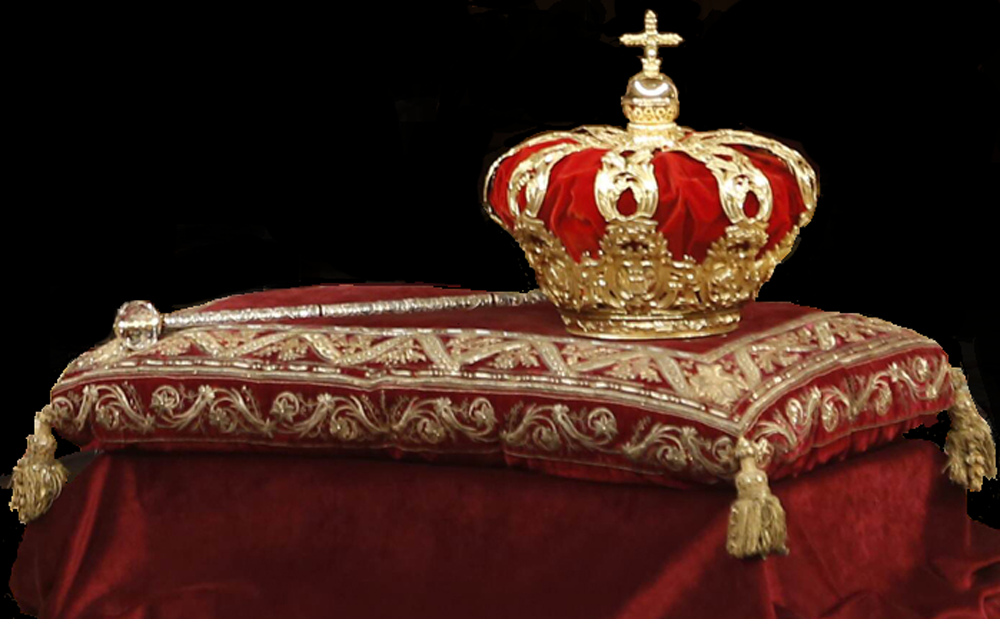
The last Spanish monarchs to be solemnly crowned were King John I of Castile in 1379, King Ferdinand I of Aragon in 1414, and Queen Eleanor of Navarre in 1479). Queen Joan (Jeanne) III of Navarre was crowned as late as 1555, although she only ruled that part of Navarre beyond the Pyrenees. After them, all Spanish monarchs have assumed their role by proclamation and acclamation before the Church and since the eighteenth century, before the Cortes Generales. The royal crown has been physically present in these ceremonies. When King Juan Carlos I was proclaimed King of Spain on November 22 1975 and when King Felipe VI was proclaimed this week the crown and sceptre were displayed in front of them in the Cortes. The last occasion on which the crown was seen at apublic ceremont was at the reburial of King Alfonso XIII in 1981 at El Escorial.
The crown itself , made of silver gilt and without gems, displays the emblems of the founding kingdoms of Castile and Leon, a castle and lion respectively. It was made by order of King Charles III (1759-88)in Madrid, following the loss of previous regalia in the fire which had destroyed the old Royal palace in the city.
The sceptre was a gift from Holy Roman Emperor Rudolf II to King Philip II and was made in Vienna.