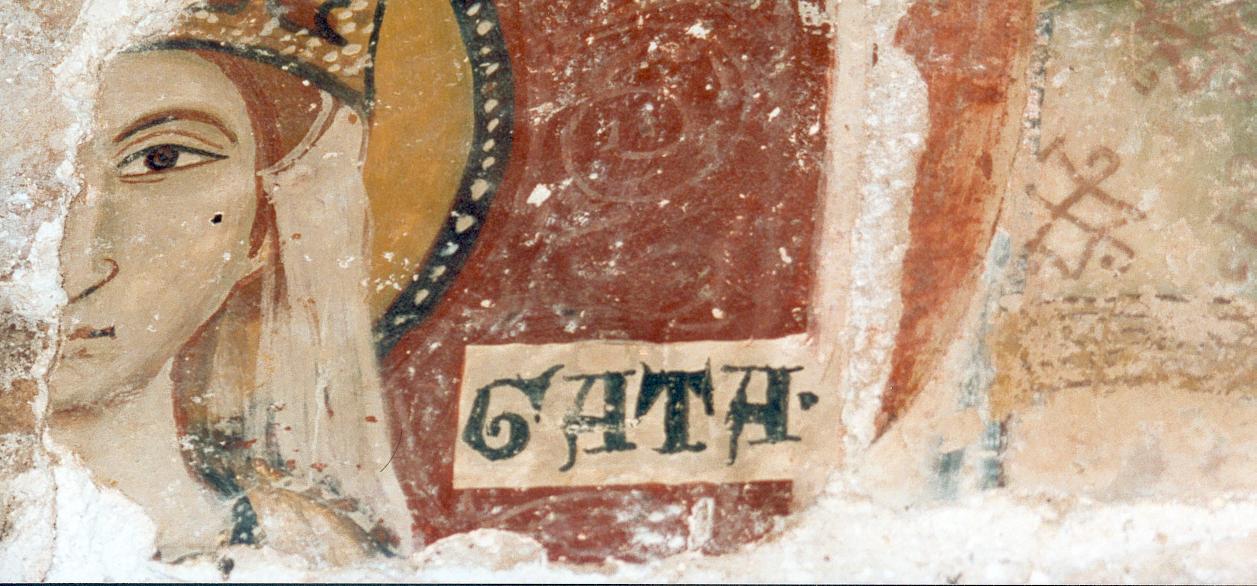
Today is the feast of St Agatha (d. 250 or 251, supposedly).
John Dillon posted the following piece about her cult on the Medieval Religion discussion group:
The virgin martyr Agatha, co-patron of this honourable list, is said legendarily to have perished at Catania at the age of fifteen in the Decian persecution. She has a rich hagiographic dossier that appears to begin early in the sixth century. Agatha's cult is attested in Rome from the later fifth century onward. Her basilica at Ravenna (Sant'Agata Maggiore) dates from the end of that century.
Some medieval images of Agatha:
a) Agatha as depicted in the earlier to mid-sixth-century mosaics of the presbytery arch (carefully restored, 1890-1900) in the Basilica Eufrasiana at Poreč:
Context on the arch (betw. the Agnus Dei and St. Agatha):
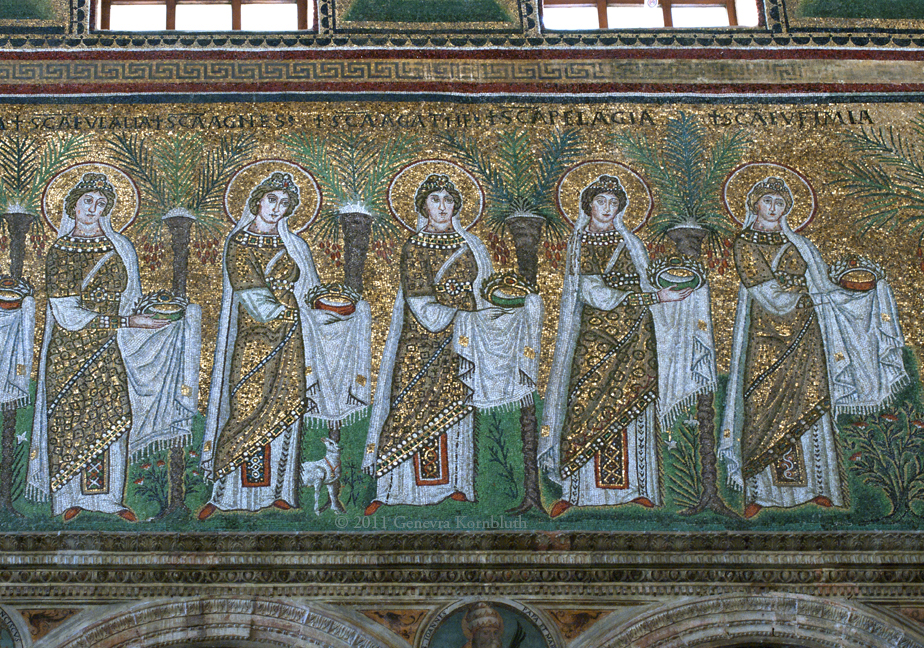
b) Agatha as depicted in the heavily restored, later sixth-century mosaics (ca. 560) in the nave of Ravenna's basilica di Sant'Apollinare Nuovo (photograph courtesy of Genevra Kornbluth):
c) Agatha as depicted in the late eighth-century sacramentary of Gellone (Paris, BnF, ms. Latin 12048, fol. 17v):
d) Agatha's torture and her death as depicted in the later tenth- or very early eleventh-century so-called Menologion of Basil II (Città del Vaticano, BAV, cod. Vat. gr. 1613, p. 373):
e) Agatha (upper register at right) as depicted in the earlier eleventh-century mosaics (restored between 1953 and 1962) in the katholikon of the monastery of Hosios Loukas near Distomo in Phokis:
A closer view:
f) Agatha as depicted in the late twelfth-century apse mosaics of the basilica cattedrale di Santa Maria Nuova in Monreale:
g) Agatha's torture as depicted in a late thirteenth-century copy of French origin of the _Legenda aurea_ (San Marino, CA, Huntington Library, ms. HM 3027, fol. 30r; image greatly expandable):
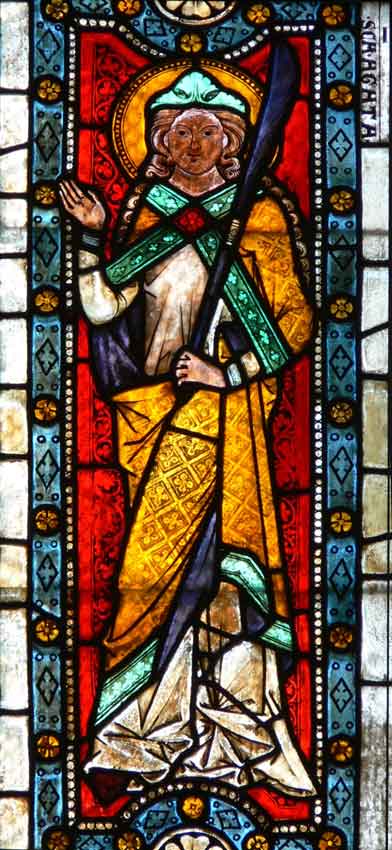
NB: We discussed gory representations of Agatha's torture last September (SUBJECT beginning "Photos of Sant'Angelo in Perugia"). Those wishing to see other examples will find some at the following sites:h) Agatha as depicted as depicted in a late thirteenth-century glass window (ca. 1295) in the Walburgiskirche in St. Michael in Obersteiermark (Land Steiermark):
http://www.burgenseite.com/glas/walb_agatha_glas_1.jpg
i) Agatha as depicted in a partly preserved later thirteenth- or fourteenth-century fresco portrait in the rupestrian church of Santa Lucia alle Malve (also dedicated to Agatha) in Matera (MT) in Basilicata:
http://tinyurl.com/amlyvyl
http://www.santaluciamatera.it/sagata.jpg
j) Agatha as depicted in the earlier fourteenth-century frescoes (betw. 1313 and 1318; conservation work in 1968) by Michael Astrapas and Eutychios in the church of St. George at Staro Nagoričane in the Former Yugoslav Republic of Macedonia:
http://tinyurl.com/kcedrck
Context in the church (in the narthex, among other saints of January and February; in this view, in the third register from top on the arch):
http://tinyurl.com/nah47cd
k) Agatha's martyrdom as depicted in an earlier fourteenth-century (second quarter) collection of French-language saint's lives (Paris, BnF, ms. Français 185, fol. 222r):
http://tinyurl.com/y8re7hv
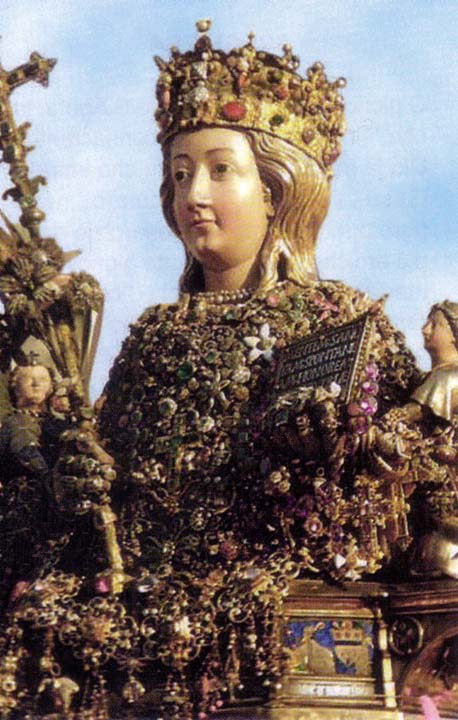
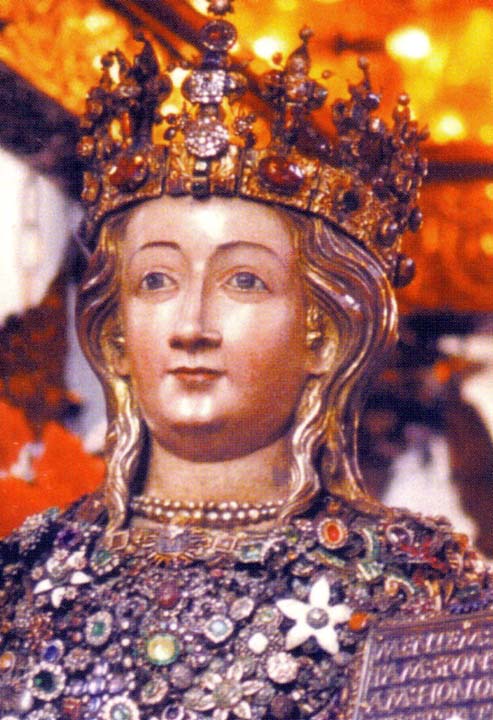
l) Agatha as portrayed in her later fourteenth-century reliquary bust by the Sienese master Giovanni di Bartolo (completed, 1376) kept in the basilica cattedrale Sant'Agata Vergine e Martire in Catania:
http://www.luigiminio.it/sites/default/files/busto.jpg
http://tinyurl.com/oxntpvz
The base is early modern and most of the jewelry with which the bust is bedecked is also post-medieval adornment. The metal plaque carried by Agatha in her left hand represents the inscribed marble one that in her Passio (both in Latin and in translation into Greek) was brought by an angel at her funeral and laid in her tomb by her head. The plaque's traditional Latin text reads MENTEM SANCTAM SPONTANEAM HONOREM DEO ET PATRIAE LIBERATIONEM ("A holy mind, a voluntary honor to God, and her home town's liberation"). Still according to the Passio, about a year later the citizens of Catania experienced the liberation part of this characterization of the saint when through the power of her veil taken from her tomb the city was protected from a lava flow emanating from nearby Mt. Etna. Whereupon they converted en masse to Christianity.
m) Agatha as portrayed in a sixteenth-century statue from her originally fourteenth-century church (demolished in the 1930s) in Piazza Armerina (EN) in Sicily and now in that town's Pinacoteca comunale:
http://tinyurl.com/py7ku6t
Here the inscription on Agatha's plaque is rendered, also traditionally, by the initial letters of each word (except for _et_, reproduced in full): MSS / HD / ET PL.
In addition the Rev. Gordon Plumb posted the following note and images:
Her early cult is attested by her inclusion in Jerome's Martyrology, the Roman Canon and the Calendar of Carthage of c.530. She is depicted in the mosaics of St Apolonaire Nuovo, Ravenna. Her Acts are late and fictitious and tell of her attempted seduction by the consul Quintinian, he invoking edicts against Christianity to do so. Then kept in a brothel, tortured by rods, rack and fire. Lastly her breasts were cut off - but she was apparently miraculously cured by a vision of St Peter. She died in prison. Invoked against fire and for diseases of the breast. She is also patron the patron saint of bell-founders.
Winchester Cathedral, north choir aisle, nX, A3, Agatha holding breast in tongs:
https://www.flickr.com/photos/22274117@N08/4438717456
Shrewsbury, St Mary, Shropshire, north aisle, glass from Trier:
https://www.flickr.com/photos/22274117@N08/3167207817
Mells, St Andrew, Somerset, nVI, A2, a figure labelled 'St Agatha' but holding a sword and a saw - surely some mistake:
https://www.flickr.com/photos/22274117@N08/3486637550