


Today is the feast of St Vincent, whose depiction in art I have featured before but this year Gordon Plumb and John Dillon have provided a most impressive series of pictures of the saint's story on the Medieval Religion discussion group. Many of these are very interesting as to what later medieval life and liturgy were like, and hence this rather lengthy post. Larger views of the pictures I have posted can be obtained by clicking on the appropriate link at the bottom right.
Gordon Plumb started the series of images as follows:
St Vincent of Saragossa:
The 22nd of January is the feast of St Vincent of Saragossa, who died in 304 and was a deacon and the first Spanish martyr. He was trained by Valerius, bishop of Saragossa. Of his martyrdom there is no doubt, though there is considerable uncertainty about exactly how it occurred. Prudentius is our first witness and Augustine attests that the cult was known all over the Roman Empire. According to the ancient Legend, he suffered under the edicts of Diocletian and Maximian. At first imprisoned and kept short of food, he refused to sacrifice and was then racked, roasted on a grid, imprisoned and put into the stocks. He died as a result of his sufferings. He is often shown as a deacon holding a palm, or else suffering on the grid.
Angers, Cathédrale Saint-Maurice, Bay 121, Martyrdom of St Vincent, c.1180:
https://www.flickr.com/photos/22274117@N08/16237364432
and detail of Vincent's body protected by crows:
https://www.flickr.com/photos/22274117@N08/16237383302
of Vincent being flogged:
https://www.flickr.com/photos/22274117@N08/15618333743
of Vincent being visited by angels in prison:
https://www.flickr.com/photos/22274117@N08/16052356717
Vincent on the grill:
https://www.flickr.com/photos/22274117@N08/16050686738
Death of Vincent:
https://www.flickr.com/photos/22274117@N08/16212308586
Vincent and Valerian before Decius:
https://www.flickr.com/photos/22274117@N08/15615773394
Oxford, St Peter in the East, North Chapel, North window, right-hand light, part of deacon holding palm (St Vincent of Saragossa): This glass was given by Vincent Wycking, Vicar in 1433.
https://www.flickr.com/photos/22274117@N08/2762050523
Heydour, St Michael, nV, 2a-3a:
https://www.flickr.com/photos/22274117@N08/3452347882
Harpley, St Lawrence, wI, D2, Vincent and Ledger:
https://www.flickr.com/photos/22274117@N08/3320378464
Panel in the Collections of the Victoria &Albert Museum showing Vincent burnt on the rack from Saint-Germain-des-Près, Paris of c.1240-45.
http://collections.vam.ac.uk/item/O8588/saint-vincent-burnt-on-the-window-unknown/
The church was originally dedicated to St Vincent, later being redecicated to St Vincent and St Germanus. On this window see Mary B Shepard in Gesta, Vol. 37, No, 2, 1998.
Further panels in the Metropolitan Museum, New York can be seen here:
http://www.metmuseum.org/collection/the-collection-online/search/466580
Bourges Cathedral, Bay 12, St Vincent of Saragossa window, with facility to see excellent images of each panel by clicking on the window outline. To get to Bay 12 click on the appropriate box in the
general plan of the Bourges windows:
http://www.medievalart.org.uk/Bourges/12_pages/Bourges_Bay_12_key.htm
John Dillon then posted his selection, again with an introduction to the cult:
A popular martyr of early Christian Iberia, Vincent (d. 304?) was a deacon at Zaragoza (a.k.a. Saragossa) who did a lot of preaching for his Bishop, Valerius. The latter (in some accounts) had a speech impediment. At the outbreak of the Diocletianic persecution they were both arrested and hauled off to Valencia, where they were imprisoned pending a hearing. When that hearing came, Vincent did most of the talking and spoke so ably that the presiding magistrate concluded that the really dangerous one was the deacon, not the bishop. Consequently, Valerius was exiled but Vincent remained in prison, where he underwent a series of tortures before being executed.
Early witnesses to Vincent's cult include St. Paulinus of Nola, Prudentius, and St. Augustine of Hippo. The last named eulogized Vincent annually on this day and we have from his pen no fewer than six sermons celebrating this saint. Vincent's Passio in its standard form (BHL 8631) was in existence by the middle of the sixth century. A briefer text (BHL 8638) may be close in content to a Passio that circulated in the fifth century. On Vincent's early medieval cult in general, with editions of major texts, see Victor Saxer, Saint Vincent diacre et martyr: Culte et légendes avant l'An Mil (Bruxelles: Société des Bollandistes, 2002; Subsidia Hagiographica, vol. 83).
Some period-pertinent images of Vincent of Zaragoza (or, if you prefer, of Saragossa; also V. of Huesca, V. of Valencia, and V. the Martyr) :
a) as depicted (third from left; after Sts. Demetrius and Polycarp) in the heavily restored, later sixth-century mosaics (c. 561) in the nave of Ravenna's basilica di Sant'Apollinare Nuovo:
http://tinyurl.com/2foe88u
b) as depicted in the late tenth- or very early eleventh-century so-called Menologion of Basil II (Città del Vaticano, BAV, cod. Vat. gr. 1613, p. 342):

c) as depicted (two scenes from his Passio) in the early eleventh-century frescoes of the central apse in the basilica di San Vincenzo in Galliano, a frazione of Cantù (CO) in Lombardy:
1) Undergoing torture by hot lead:
http://tinyurl.com/pgmpc2w
2) His corpse guarded by birds and being prepared for burial:
http://tinyurl.com/pt5qdy3
d) as depicted (in the soffit at right, second roundel from bottom) in the earlier twelfth-century mosaics (c. 1143) of the chiesa di Santa Maria dell'Ammiraglio (a.k.a. chiesa della Martorana) in Palermo:
http://tinyurl.com/7kxovph
e) as depicted (at right; at left, St. Germanus of Paris) in the frontispiece to a mid-twelfth-century collection of writings by Origen from the abbey of St.-Germain-des-Prés in Paris (Paris, BnF, ms. Latin 11615, fol. 2v):
http://tinyurl.com/phxpbpn
f) as depicted (centre register, second from left, between his fellow deacons Sts. Peter of Marcellinus-and-Peter and Lawrence of Rome) in a probably mid- or slightly later twelfth-century mosaic (restored, 1859) in the choir of the basilica cattedrale della Trasfigurazione in Cefalù :

This second view is greatly expandable:
g) as portrayed (martyrdom scenes) in a perhaps later twelfth-century relief (after c. 1160) in the Münster in Basel:

h) as depicted (at right; at left, St. Victor of Syria) in the later twelfth-century frescoes (1164) in the church of St. Panteleimon (Pantaleon) at Gorno Nerezi (Skopje municipality) in the former Yugoslav Republic of Macedonia:
http://tinyurl.com/h2jgbg4
In Byzantine-rite churches both Victor and Vincent are celebrated on 11. November (in the Synaxary of Constantinople Vincent also occurs by himself under 22. January). That is also the feast day of St. Men(n)as the Egyptian, whose church in Constantinople is reported from the twelfth century as possessing relics of Vincent and Victor.
i) as portrayed in high relief (scenes) on his late twelfth-century polychromed stone cenotaph in the Basilica de los Santos Hermanos Mártires, Vicente, Sabina y Cristeta in Ávila:
http://tinyurl.com/z6fnpka
http://tinyurl.com/h5g48nc
The Clever Boy would add that these are a wonderful series of pictures of late Romanesque sculpture which has retained its paintwork - a delight to peruse.
j) as depicted (martyrdom) in one of four panels of a full-page illumination in the late twelfth-century so-called Bible of Saint Bertin (c. 1190-1200; Den Haag, KB, ms. 76 F 5, fol. 28v, sc. 1B):
http://manuscripts.kb.nl/zoom/BYVANCKB%3Amimi_76f5%3A028v_min_b1
k) as portrayed in high relief (birds guarding his corpse at sea) on the left pillar of the left portal of the late twelfth or early thirteenth-century south porch (by 1210) of the basilique cathédrale Notre-Dame in Chartres:

l) as depicted (scenes of his life and martyrdom) in the early thirteenth-century St. Vincent window (bay 12; c. 1215) in the ambulatory of the cathédrale Saint-Étienne in Bourges:
http://www.medievalart.org.uk/bourges/12_pages/Bourges_Bay_12_key.htm
m) as depicted (scenes from his Passio) in panels from a mid-thirteenth-century glass window (1240s; from the abbey church of Saint-Germain-des-Prés in Paris) in the Walters art Gallery and Museum, Baltimore:
http://art.thewalters.org/detail/77393/stained-glass-window-with-scenes-from-the-life-of-saint-vincent/
Gordon Plumb's post has links to other panels from the same window in the Victoria and Albert Museum in London and the Metropolitan Museum of Art in New York.
n) as depicted (martyrdom) in a panel of a mid-thirteenth-century ambulatory window (Bay 201, panel A1; c. 1254) in the cathédrale Saint-Julien, Le Mans:
http://www.medievalart.org.uk/lemans/Clerestory/jpeg/Le_Mans_Bay_201_Panel_A1.jpg
o) as depicted (scenes of his life and martyrdom) on a later thirteenth-century altar frontal (parchment over wood; from the church of Santa María de Monte at Liesa [Huesca]) in the possession of the Diputación Provincial de Huesca (for better views click on the individual frames):

p) as depicted (sixth from left, after an archangel, St. Peter, the Christ child, the BVM, and St. Paul; the remaining two are St. Ambrose of Milan and St. Augustine's son Adeodatus, venerated in medieval Milan as a saint) in a later thirteenth-century fresco on the parapet of the Gospel ambo in the basilica di San Vincenzo in Galliano, a _frazione_ of Cantù (CO) in Lombardy:
http://tinyurl.com/mf7gqks
Detail view (Vincent):

q) as depicted (martyrdom) in a late thirteenth-century copy of French origin of the Legenda aurea (San Marino, CA, Huntington Library, ms. HM 3027, fol. 24v):
http://digitalassets.lib.berkeley.edu/ds/huntington/images//000967A.jpg
r) as depicted (martyrdom) in the late thirteenth-century Livre d'images de Madame Marie (ca. 1285-1290; Paris, BnF, ms. Nouvelle acquisition française 16251, fol. 78r):
http://tinyurl.com/yj8su7y
https://lafrancechretienne.files.wordpress.com/2014/12/martyr_de_saint_vincent.png
s) as depicted in the earlier fourteenth-century frescoes (between c.1312 and 1321/1322) in the monastery church of the Theotokos at Gračanica in, depending upon one's view of the matter, either Serbia's province of Kosovo and Metohija or the Republic of Kosovo:
https://kb.osu.edu/dspace/handle/1811/40826
t) as depicted (second from right, lower register, in the panel at lower left; martyrdom) in an earlier fourteenth-century pictorial menologion from Thessaloniki (between 1322 and 1340; Oxford, Bodleian Library, MS Gr. th. f. 1, fol. 16v):
http://image.ox.ac.uk/images/bodleian/msgrthf1/16v.jpg
u) as depicted (two scenes: preaching and undergoing martyrdom) in an earlier fourteenth-century copy of the Legenda aurea in its French-language version by Jean de Vignay (c. 1326-1350; Paris, BnF, ms. Français 185, fol. 101v):
http://tinyurl.com/yd8s4pf
Note that in these illuminations we seem to have evidence of that rare figure in church annals, the mitred deacon. In the first of these, the figure robed in blue is thought to depict Vincent's actual bishop, the confessor St. Valerius of Zaragoza.
v) as depicted in a panel of the mid-fourteenth-century great window (c. 1340-1350) in the choir of the Kirche St.-Vinzenz in Segringen (Lkr. Mittelfranken) in Bavaria:
http://id.corpusvitrearum.de/images/3419.html
w) as depicted (martyrdom) in an earlier fourteenth-century copy of the Legenda aurea, from the workshop of Richard and Jeanne de Montbaston, in its French-language version by Jean de Vignay (1348; Paris, BnF, ms. Français 241, fol. 46v):
http://tinyurl.com/y8snjlq
x) as depicted (portrait; scenes) by the Master of Estopiñán in a later fourteenth-century triptych (c. 1350-1370) in the Museo Nacional de Arte de Cataluña, Barcelona:

y) as depicted (the finding of his body) in a late fourteenth- or early fifteenth-century copy of the Legenda aurea in its French-language version by Jean de Vignay (Rennes, Bibliothèque de Rennes Métropole, ms. 266, fol. 48v):
http://tinyurl.com/jqau7dc
z) as depicted (his body about to be cast into the sea) in an early fifteenth-century copy of the Elsässische Legenda aurea (1419; Heidelberg, UB, Cod. Pal. germ. 144, fol. 295v):
http://digi.ub.uni-heidelberg.de/diglit/cpg144/0614
aa) as depicted (at left, martyrdom; at right, St. Vincent Ferrer) by Bernard (Bernat) Martorell in an earlier fifteenth-century panel painting in the State Hermitage Museum, St. Petersburg:

bb) as depicted (martyrdom) by the court workshop of Emperor Frederick III in a mid-fifteenth-century copy of the Legenda aurea (1446-1447; Vienna, Österreichische Nationalbibliothek, cod. 326, fol. 38v):
http://tarvos.imareal.oeaw.ac.at/server/images/7006832.JPG
cc) as depicted in grisaille by Jean le Tavernier in the mid-fifteenth-century Hours of Philip of Burgundy (c. 1451-1460; Den Haag, KB, ms. 76 F 2, fol. 257v):
http://manuscripts.kb.nl/zoom/BYVANCKB%3Amimi_76f2%3A257v_min
dd) as depicted (scenes) by Nuno Gonçalves on several later fifteenth-century panels (c. 1451-1475) in the Museu Nacional de Arte Antiga in Lisbon:
https://www.flickr.com/photos/andrepipa/5632595721/
A closer view of a copy:
http://upload.wikimedia.org/wikipedia/commons/c/c7/Lagos40_kopie.jpg
I posted about these great panels in
ee) as depicted by Jaume Huguet in five mid-fifteenth-century panels from a never-finished altarpiece (c. 1455-1460; for Barcelona's església de Sant Vicenç de Sarrià) in the Museo Nacional de Arte de Cataluña, Barcelona:
1) Ordained priest by St. Valerius of Zaragoza:

2) Brought before the proconsul Datianus / Dacianus:

3) Martyrdom - torture by fire:

4) Martyrdom - torture on a cross-shaped eculeus:

5) Seekers for cures at his tomb:

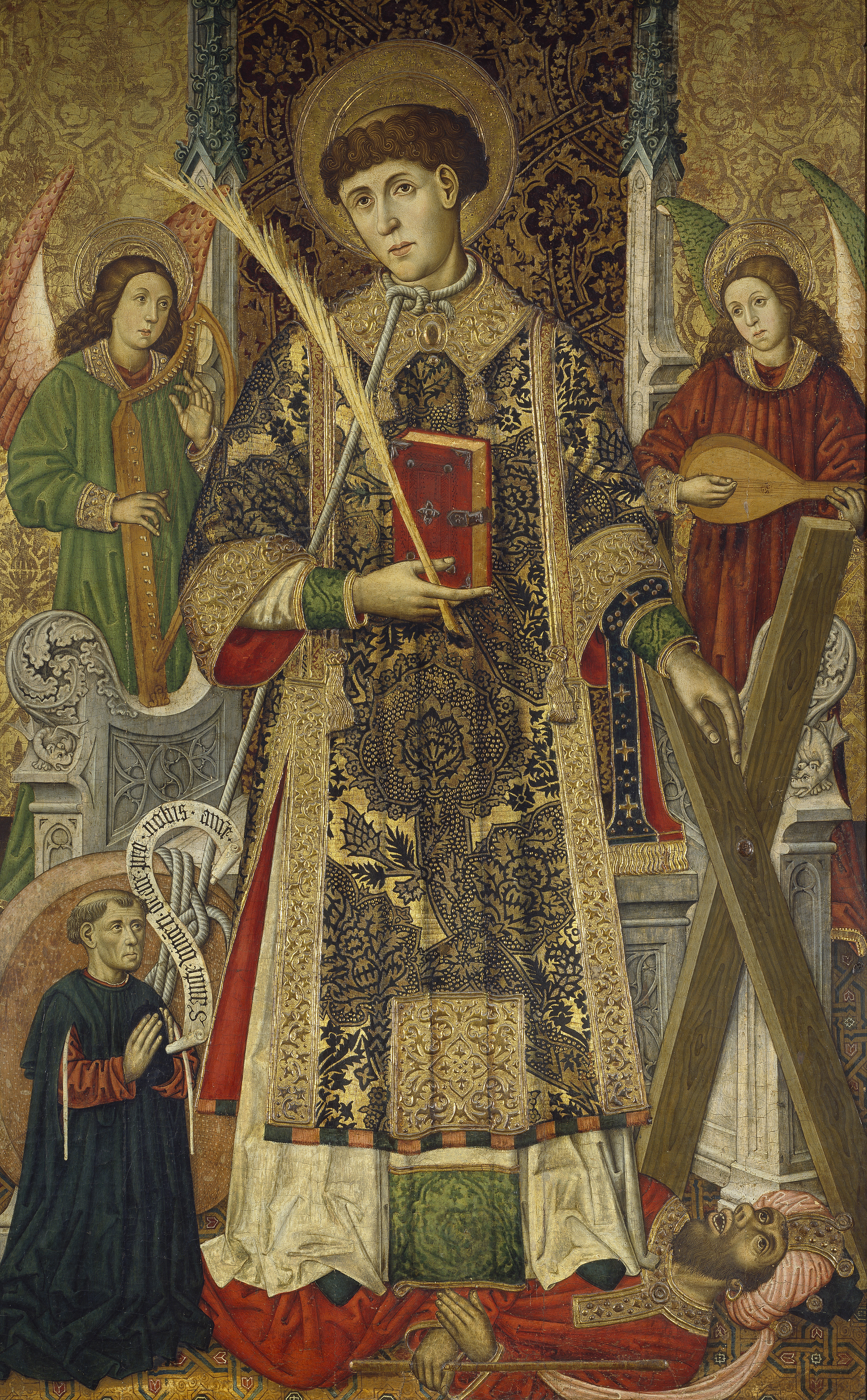
ff) as depicted by Tomás Giner in a later fifteenth-century panel painting (between 1462 and 1466) in the Museo del Prado, Madrid:
gg) as depicted (at left; at centre, St. James the Great; at right, St. Eustace) by Antonio and Piero del Pollaiolo in a later fifteenth-century panel painting (c. 1466-1468) in the Galleria degli Uffizi, Florence:
http://tinyurl.com/hu4or78

hh) as depicted (martyrdom) in a late fifteenth-century copy of the Legenda aurea in its French-language version by Jean de Vignay (c. 1480-1490; Paris, BnF, ms. Français 244, fol. 54v):
http://tinyurl.com/ydw94le
ii) as depicted (at centre, between St. Michael the Archangel and St. Lawrence of Rome) in the central panel of the late fifteenth-century retable in the iglesia de San Vicente Mártir at San Vicente de Labuerda in Labuerda (Huesca):

jj) as portrayed in relief (image at right) on a guldiner of 1493 from Bern:
http://tinyurl.com/lfxwdh4
kk) as depicted (martyrdom) in the earlier sixteenth-century portion (c. 1540) of a window in the église Saint-Ouen at Pont-Audemer (Eure):
http://tinyurl.com/l29vh9d
Later John posted some additional images of St. Vincent:
1) as depicted (two scenes) in an eleventh-century troper from Autun (Paris, BnF, ms. Arsenal, 1169):
a) Martyrdom on a cross-shaped eculeus (fol. 14v, bas-de-page):
http://gallica.bnf.fr/ark:/12148/btv1b52000516z/f34.item.r=Arsenal%201169.zoom
b) Martyrdom by fire (fol. 15r):
http://gallica.bnf.fr/ark:/12148/btv1b52000516z/f35.item.r=Arsenal%201169.zoom
2) as depicted (beaten with clubs) in an earlier fourteenth-century French-language legendary of Parisian origin with illuminations attributed to the Fauvel Master (c. 1327; Paris, BnF, ms. Français 183, fol. 215v):
http://tinyurl.com/hdruag4
3) as depicted (four scenes) in an earlier fourteenth-century copy of books 9-16 of Vincent of Beauvais' Speculum historiale in its French-language version by Jean de Vignay (c. 1335; Paris, BnF, ms. Arsenal 5080):
a) With St. Valerius of Zaragoza before Datianus / Dacianus (fol. 263r):
http://gallica.bnf.fr/ark:/12148/btv1b55000813g/f531.item.r=arsenal%205080.zoom
b) Martyrdom on a cross-shaped _eculeus_ (fol. 263v):
http://gallica.bnf.fr/ark:/12148/btv1b55000813g/f532.item.r=arsenal%205080.zoom
c) Martyrdom by fire (fol. 264r):
http://gallica.bnf.fr/ark:/12148/btv1b55000813g/f533.item.r=arsenal%205080.zoom
d) Datianus / Dacianus orders the disposal of V.'s body; ravens protect it from a wolf (fol. 264v):
http://gallica.bnf.fr/ark:/12148/btv1b55000813g/f534.item.r=arsenal%205080.zoom
4) as depicted in the very late fourteenth- or earlier fifteenth-century Breviary of Martin of Aragon (Paris, BnF, ms. Rothschild 2529, fol. 306v):
http://gallica.bnf.fr/ark:/12148/btv1b52000996s/f614.item.zoom

ee) as depicted by Jaume Huguet in five mid-fifteenth-century panels from a never-finished altarpiece (c. 1455-1460; for Barcelona's església de Sant Vicenç de Sarrià) in the Museo Nacional de Arte de Cataluña, Barcelona:
1) Ordained priest by St. Valerius of Zaragoza:
2) Brought before the proconsul Datianus / Dacianus:
3) Martyrdom - torture by fire:
4) Martyrdom - torture on a cross-shaped eculeus:
5) Seekers for cures at his tomb:
ff) as depicted by Tomás Giner in a later fifteenth-century panel painting (between 1462 and 1466) in the Museo del Prado, Madrid:
gg) as depicted (at left; at centre, St. James the Great; at right, St. Eustace) by Antonio and Piero del Pollaiolo in a later fifteenth-century panel painting (c. 1466-1468) in the Galleria degli Uffizi, Florence:
http://tinyurl.com/hu4or78
hh) as depicted (martyrdom) in a late fifteenth-century copy of the Legenda aurea in its French-language version by Jean de Vignay (c. 1480-1490; Paris, BnF, ms. Français 244, fol. 54v):
http://tinyurl.com/ydw94le
ii) as depicted (at centre, between St. Michael the Archangel and St. Lawrence of Rome) in the central panel of the late fifteenth-century retable in the iglesia de San Vicente Mártir at San Vicente de Labuerda in Labuerda (Huesca):
jj) as portrayed in relief (image at right) on a guldiner of 1493 from Bern:
http://tinyurl.com/lfxwdh4
kk) as depicted (martyrdom) in the earlier sixteenth-century portion (c. 1540) of a window in the église Saint-Ouen at Pont-Audemer (Eure):
http://tinyurl.com/l29vh9d
Later John posted some additional images of St. Vincent:
1) as depicted (two scenes) in an eleventh-century troper from Autun (Paris, BnF, ms. Arsenal, 1169):
a) Martyrdom on a cross-shaped eculeus (fol. 14v, bas-de-page):
http://gallica.bnf.fr/ark:/12148/btv1b52000516z/f34.item.r=Arsenal%201169.zoom
b) Martyrdom by fire (fol. 15r):
http://gallica.bnf.fr/ark:/12148/btv1b52000516z/f35.item.r=Arsenal%201169.zoom
2) as depicted (beaten with clubs) in an earlier fourteenth-century French-language legendary of Parisian origin with illuminations attributed to the Fauvel Master (c. 1327; Paris, BnF, ms. Français 183, fol. 215v):
http://tinyurl.com/hdruag4
3) as depicted (four scenes) in an earlier fourteenth-century copy of books 9-16 of Vincent of Beauvais' Speculum historiale in its French-language version by Jean de Vignay (c. 1335; Paris, BnF, ms. Arsenal 5080):
a) With St. Valerius of Zaragoza before Datianus / Dacianus (fol. 263r):
http://gallica.bnf.fr/ark:/12148/btv1b55000813g/f531.item.r=arsenal%205080.zoom
b) Martyrdom on a cross-shaped _eculeus_ (fol. 263v):
http://gallica.bnf.fr/ark:/12148/btv1b55000813g/f532.item.r=arsenal%205080.zoom
c) Martyrdom by fire (fol. 264r):
http://gallica.bnf.fr/ark:/12148/btv1b55000813g/f533.item.r=arsenal%205080.zoom
d) Datianus / Dacianus orders the disposal of V.'s body; ravens protect it from a wolf (fol. 264v):
http://gallica.bnf.fr/ark:/12148/btv1b55000813g/f534.item.r=arsenal%205080.zoom
4) as depicted in the very late fourteenth- or earlier fifteenth-century Breviary of Martin of Aragon (Paris, BnF, ms. Rothschild 2529, fol. 306v):
http://gallica.bnf.fr/ark:/12148/btv1b52000996s/f614.item.zoom
5) as depicted by the Portuguese artist Frei Carlos (attrib.) in an earlier sixteenth-century panel painting (c. 1520-1530) in the Metropolitan Museum of Art, New York. The Museum website can be seen here: http://www.metmuseum.org/collection/the-collection-online/search/435847


