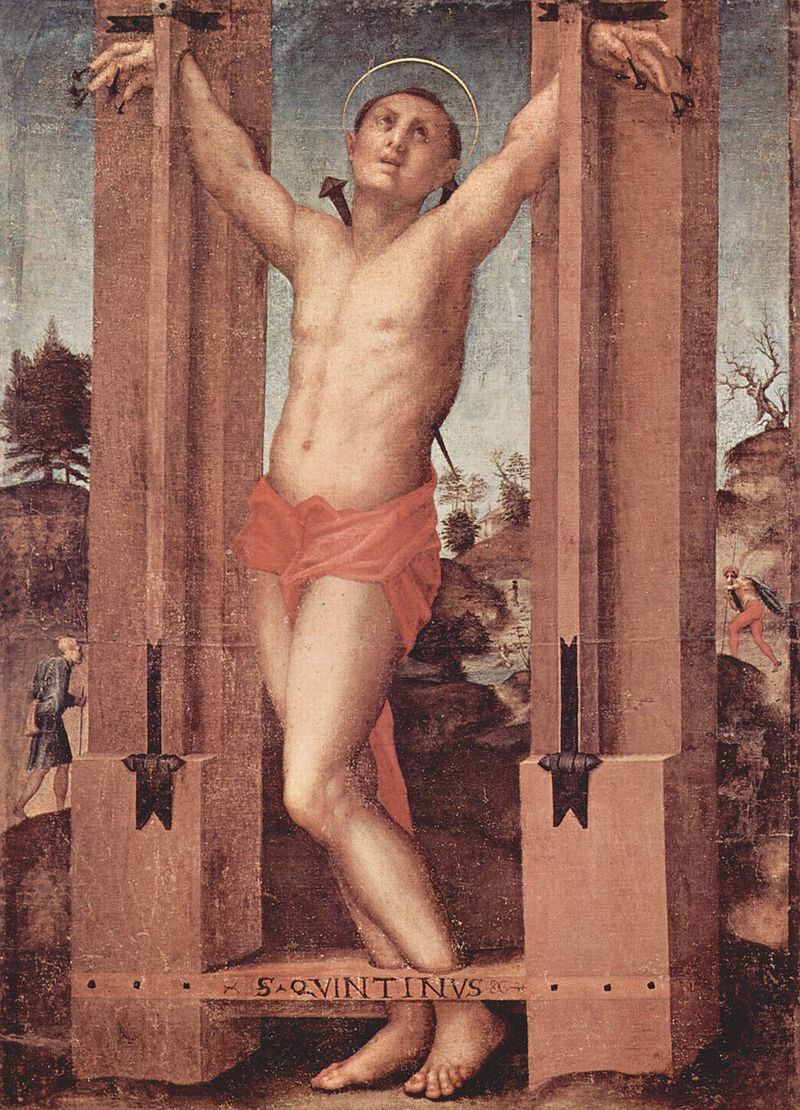
John Dillon posted as follows on the Medieval Religion discussion group; I have added occasional notes in [ ]
Quintinus of Vermand (Quintin, Quentin; d. late 3d cent., supposedly) is the martyr of today's Saint-Quentin (Aisne) in Picardy. His cult there is already recorded by St. Gregory of Tours in the sixth century.
The earliest of his many legendary Passiones (BHL 6999-7012) is commonly dated to the eighth century. According to this account, Quintinus, the son of a senator, was a Christian inhabitant of Rome who had traveled to northern Gaul as a missionary. During a persecution under Maximianus he was arrested on the orders of a Roman official named Rictiovarus or Rictius Varus (the villain of numerous Passiones from northern Francia) and was cruelly tortured in various ways: of these, the one most frequently depicted in the later Middle Ages was having iron nails and iron stakes driven into his body. Quintinus' sufferings ended when he was decapitated at Augusta Viromanduorum, a Roman-period predecessor of Saint-Quentin thought to underlie the modern city's outlying canton of Vermand. His body was then secretly deposited in the river Somme, where it remained incorrupt for about fifty-five years until its miraculous discovery by a Roman matron named Eusebia. Thus far BHL 6999.
Other accounts relate the translation of Quintinus' remains over a century later to a basilica where their location came in time to be forgotten and their subsequent rediscovery by St. Eligius in the seventh century. One may read about the latter finding in Jo Ann McNamara's English-language translation of Dado of Rouen's Life of St. Eligius (scroll down to II, 6):
http://www.fordham.edu/halsall/basis/eligius.html
Excursus: one thing that Dado does not tell us is how St. Eligius (Éloi) advised Dagobert I on matters pertaining to the king's wardrobe (or perhaps he did tell us but it's in one of the lacunae). For that, one has to go to the song "Le bon roi Dagobert":
http://en.wikipedia.org/wiki/Le_bon_roi_Dagobert_%28song%29
An illustrated, French-language summary of Quintinus' legend is here (better views of the illuminations are linked to in "images", below):
http://stqvillhist.free.fr/068Legende.htm
Some period-pertinent images of St. Quintinus of Vermand (the suffix differentiates him from St. Quintinus of Meaux):
a) as depicted in a late eleventh or early twelfth-century copy of a Vita et miracula s. Quintini (Saint-Quentin, Bibliothèque Guy de Maupassant; ms. Église Saint-Quentin 1):
1) leaving Rome with eleven companions (p. 9):
http://www.enluminures.culture.fr/Wave/savimage/enlumine/irht7/IRHT_106546-p.jpg
Detail view (Q. and companions):
http://www.enluminures.culture.fr/Wave/savimage/enlumine/irht7/IRHT_106548-p.jpg
2) preaching in Amiens (p. 20):

3) administering baptisms (p. 23):

4) undergoing arrest (p. 36):
http://www.enluminures.culture.fr/Wave/savimage/enlumine/irht7/IRHT_106580-p.jpg
5) taken in chains to Augusta Viromanduorum, where he is brought before Rictiovarus (p. 38):

http://www.enluminures.culture.fr/Wave/savimage/enlumine/irht7/IRHT_106582-p.jpg
6) undergoing torture; liberated by an angel (pp. 41-42??):

7) undergoing further torture (p. 43):


http://www.enluminures.culture.fr/Wave/savimage/enlumine/irht7/IRHT_106592-p.jpg
b) as depicted (martyrdom) in a late thirteenth-century copy of French origin of the Legenda aurea (San Marino, CA, Huntington Library, ms. HM 3027, fol. 149r; upper image):
http://digitalassets.lib.berkeley.edu/ds/huntington/images//000911A.jpg
c) as depicted (martyrdom) in the late thirteenth-century Livre d'images de Madame Marie (c. 1285-1290; Paris, BnF, ms. Nouvelle acquisition française 16251, fol. 82v):
http://tinyurl.com/yl3ex6n
d) as depicted (at left; at centre, St. Michael the Archangel; at right, St. Romanus of Rouen) in an earlier fourteenth-century glass window (w. 309; before 1325) in the cathédrale Saint-Pierre in Beauvais:

e) as depicted (martyrdom) in an earlier fourteenth-century copy of the Legenda aurea in its French-language version by Jean de Vignay (c. 1326-1350; Paris, BnF, ms. Français 185, fol. 266r):
http://tinyurl.com/ygf2dot
f) as depicted (three scenes) in an earlier fourteenth-century copy of books 9-16 of Vincent of Beauvais' Speculum historiale in its French-language version by Jean de Vignay (c. 1335; Paris, BnF, ms. Arsenal 5080):
1) leaving Rome with fellow missionaries (fol. 268v):
http://tinyurl.com/nqucqf5
2) martyrdom (fol. 269r):
http://tinyurl.com/qy4somw
3) his body discovered by Eusebia (fol. 269v):
http://tinyurl.com/ntgngbj
g) as depicted (martyrdom) in a late fourteenth- or early fifteenth-century copy of the Legenda aurea (Rennes, Bibliothèque de Rennes Métropole, ms. 266, fol. 300r):
http://tinyurl.com/nsobqxp
h) as depicted (left-hand column; martyrdom) in the early fifteenth-century Hours of René of Anjou (c. 1405-1410; London, BL, Egerton MS 1070, fol. 103v; image zoomable):
http://www.bl.uk/catalogues/illuminatedmanuscripts/ILLUMIN.ASP?Size=mid&IllID=48373
i) as depicted (martyrdom) in the earlier fifteenth-century Hours of Jacques Cauchon and Jeanne Bohais (c. 1440), one of the items in the Arcana Collection announced for sale at an auction at Christie's on 7. July 2010:

j) as depicted (at right, martyrdom; at left, St. Sebastian) by André Robin and workshop in a mid-fifteenth-century glass window (w. 115; 1450s) in the north transept of the cathédrale Saint-Maurice in Angers:

k) as depicted (at left, martyrdom; at right, his body discovered by Eusebia) in a later fifteenth-century copy from Bruges of the Legenda aurea in its French-language version by Jean de Vignay followed by the Festes nouvelles attributed to Jean Golein (c. 1460-1470; Mâcon, Médiathèque municipale, ms. 3, fol. 11v):

l) as depicted (martyrdom) in a later fifteenth-century copy of Vincent of Beauvais' Speculum historiale in its French-language version by Jean de Vignay (1463; Paris, BnF, ms. Français 51, fol. 87r):

m) as depicted on three painted panels of a late fifteenth-century winged altarpiece (ca. 1480-1500) in the kostol sv. Vavrinca in Revúca (Banská Bystrica Region), Slovakia:
1) appearing before Rictiovarus:

[ I suspect that originally St Quentin's armour was done insilver leaf whuich has flaked away, leaving the brown undercoat - Clever Boy]
2) being stripped and then flogged:


[Note the seed pearls decorating the mitres -Clever Boy ]
n) as depicted (martyrdom) in the Suffrages of a late fifteenth-century book of hours from the southern Netherlands (Mons?; ca. 1490-1500; Baltimore, The Walters Art Museum, Walters ms. W.431, fol. 111r):
http://tinyurl.com/pacqaz4
o) as depicted (martyrdom) in the Suffrages of an early sixteenth-century book of hours from the southern Netherlands (Cambrai?; c. 1500-1510; Den Haag, KB, ms. 76 F 20, fol. 176v):
http://manuscripts.kb.nl/zoom/BYVANCKB%3Amimi_76f20%3A176v
p) as depicted (martyrdom) in the Suffrages of another early sixteenth-century book of hours from the southern Netherlands (ca. 1500-1510; Den Haag, KB, ms. 133 E 14, fol. 60r):
http://manuscripts.kb.nl/zoom/BYVANCKB%3Amimi_133e14%3A060r
q) as depicted (martyrdom) by Jacopo Pontormo on an early sixteenth-century canvas processional banner (1517) in the Pinacoteca comunale of Sansepolcro (AR) in Tuscany: